Showing posts with label Islam. Show all posts

Tuesday, July 28, 2015

HORSES OF GOD (2012)

After the September 2001 terrorist attacks on the U.S. people were quick to argue that the attackers in no way represented the downtrodden, as if to preempt anyone thinking of saying they must have had some sincere personal grievance, grounded in poverty, in order to do what they did. Not quite two years later a wave of suicide bombings swept Casablanca, the legendary city in the Kingdom of Morocco. Adapting a novel based on those attacks, French director Nabil Ayouch tells us that these terrorists were the downtrodden, products of progressive impoverishment in the no-hope environment of a metastasizing shantytown. With every jump of time in his story he shows us dauntingly how the shantytown has grown. His protagonists are virtual dead end kids and his story is something like the original Dead End Kids of 1930s Hollywood getting recruited into the German-American Bund or the Ku Klux Klan with Pat O'Brien egging them on and no one to show them the error of their ways.


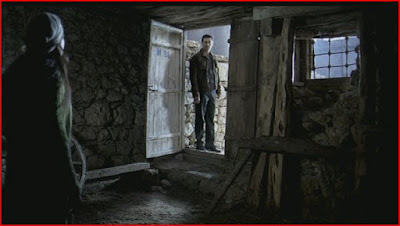
Our main focus is on a trio of shantytown kids who age from boys to men: Hamid, the bicycle-chain swinging leader of the band, his younger brother Tarek, nicknamed "Yachine" after a famous Soviet soccer goalie, and Tarek's weakling buddy Nabil. In ancient kid-gang fashion they and the rest of their team are chased back to their own neighborhood by the other team, the skins to their shirts, after a game falls apart. From the beginning Nabil and Tarek are accused of being gay for each other -- in a horrific scene a drunken Hamid actually rapes Nabil as Tarek and their other pals watch stupefied --  and a certain panic about masculinity amid a greater physical intimacy than men share in the west informs the decisions they make as young men. They work as mechanics for a boorish garage owner while Hamid, who'd become a drug dealer, stews in stir for throwing a rock through a cop's car window on a dare. Hamid returns from prison apparently reformed, but now he's too neat looking and there's something sinister about his new seeming serenity. It soon becomes apparent that he's been "radicalized," to use the current buzzword, but to Ayouch it looks more like plain old brainwashing by a cult.


The evolution (or devolution?) of Hamid (Abdelilah Rachid)


Still, while Hamid has grown a little aloof from his family -- including an alcoholic dad, a trashy mom and another brother who's a little crazy about his radio -- he and his new buddies come in handy when Tarek and Nabil need to cover up Tarek's killing of their boss for having out-of-nowhere started fondling Nabil. Tarek feels obliged to these devout dudes, who are also kind of cool for knowing karate, but he also finds their disciplined activity filling a void in his life. His promises to become a life of action rather than mere being, action becoming more important than life, even if he does still pine a little for Ghislaine, the pretty girl from the embroidery school. Suddenly he seems even more radicalized than Hamid, and Hamid notices this to his dismay. 


What elevates Horses of God above a simple expose on the making of terrorists is Hamid's wavering development. It's a surprising twist if you were expecting Tarek, the good brother and our point-of-view character, to observe and/or oppose Hamid's radicalization. As Hamid, Abdelilah Rachid undergoes multiple transformations, from thug to true believer to something more ambivalent. It's not so much that he comes to doubt jihad as that he can't stand to see Tarek traveling this path. It's as if some older-brother protectiveness overrides his radicalization. For all we know he could die readily himself, but eventually he can't bear even to think about Tarek martyring himself. At the brink of doom he tries to dissuade Tarek from carrying out a bombing of a niteclub, only to have Tarek at long last step out of older brother's shadow by shoving him to the ground. The dynamics of their whole sad family make Horses something more than a political film. Because the characters are convincingly human, the stakes seem more real for the audience, especially as we see harmless-seeming people denounced for sin and apostasy and targeted for death for no good strategic reason.


The film closes on a despairingly Bruegelian note as a consummating explosion is seen only from a tremendous distance -- from one of the soccer fields where Hamid and Tarek played as boys, where the next generation of shantytown boys watches with short-lived fascination, little suspecting what the filmmakers suspect is their own dark destiny. The subject matter alone makes Horses of God necessary viewing in our time, but fortunately there's more than necessity to justify seeing it.

Saturday, March 28, 2015

On the Big Screen: TIMBUKTU (2014)

Here is a film that might make you want to punch a Muslim, except that its subject is the oppression by Muslims of Muslims, and the director, Abderrahman Sissako, is Muslim himself. What we have instead is what Islamophobes have clamored for: a denunciation by a Muslim of the excesses of Islamism. Timbuktu might end up disappointing hard-core Islamophobes, however, since Sissako makes it fairly clear that those excesses are fueled by selective, self-serving readings of Islamic scripture rather than by something essential to Islam itself. Sissako is also wise enough to remember that Islamism is not an intrusion on otherwise peaceful, innocent communities, since one of the central conflicts in his story has nothing to do with religion or anyone's interpretation of it. Most importantly, he's enough of an artist as a director to make his story pictorially memorable, assuring it of a lasting impact.

Sissako is Mauritanian but his subject is Mali, where the title city is located. In Timbuktu the 21st century exists alongside timeless folkways. Satellite dishes crown the roofs of mud-brick buildings of perhaps incalculable age; nomads communicate with cellphones; a favorite cow is named GPS. To this place the jihadis came with all their absurd chickenshit laws, announced with megaphones in as many languages as the intruders know. Many of the occupiers don't know the local languages, making interpreters essential while highlighting a mutual incomprehension that a common faith can't overcome. In one case a commander requires an underling to inform him in English of what he sees at a crime scene. Yet these strangers claim a religious entitlement to tell the natives how to live. Women have to wear socks and gloves in the marketplace. The idea is so ridiculous and insulting to one of the female fishmongers ("We were brought up in honor and didn't have to wear gloves!") that she's willing to be arrested because she's sick and tired of the jihadi bullshit. Soccer and all sports are banned, even though some of the jihadis are football fans. One moment of comic relief comes when we overhear them talking about how many times somebody won or lost in the last few years. Almost certainly an unspoiled audience will assume they're talking about armies in war, but they're really debating the superiority of French and Spanish soccer teams. A fan of Spain accuses the French of bribing Brazil to throw the 1998 World Cup final; I wonder how he'd explain last year's semifinal. In any event, after a ball is confiscated, local sportsmen console themselves with a pantomime game, though when the hardcore jihadis ride by they revert to innocent calisthenics. Music is also forbidden by these totalitarian puritans, though one of them questions whether they should break in on someone singing praises to God. There's less hesitation when they find a mixed gathering with a woman singing secular lyrics while a man plays guitar. For this they're flogged, the woman defiantly singing the same song until the pain is too great. At least they didn't commit adultery. The penalty for that is stoning, and the jihadis ain't playing. No ducking or dodging for the guilty here; they're buried up to their necks and the rest is just target practice.

From a distance, from his tent, the herdsman Kidane (Ibrahim Ahmed dit Pinto) watches with concern as his nomad neighbors start to move away. He wants to stay, however, even though a jihadi commander is making suspicious visits to his wife and daughter when he's away. He's more concerned with Amadou, a cranky fisherman (who wears western clothes, for what that's worth) who begrudges Kidane's cattle drinking at the lake because he's afraid they'll foul his nets. His fears aren't unfounded, and when the beloved GPS wanders into his nets he kills the cow with a spear. Little does Amadou realize that he's brought a spear to a gunfight, though from all appearances the weapon Kidane brings to their confrontation goes off accidentally during their damp scuffle. Their conflict has had nothing to do with jihad until now, when the jihadis have to act as judges in the case. They set a blood money fine (in kind) that's more than Kidane is able or willing to pay. All that leaves to be decided is whether he'll see his family one more time....

Timbuktu is a photogenic location -- some of the architecture will remind movie buffs of Ousmane Sembene's classic Moolaade -- and Sissako films his story is a classically artful style. He makes brilliant use of the widescreen frame in a way that can only be appreciated on the big screen. Kidane has crossed a shallow lake to confront Amadou. After the gun goes off, he lays in the water awhile in shock, then springs back to life to assure himself that he is alive. Sissako cuts to a wide shot that encompasses both shores as Kidane staggers back to his side. We might almost miss Amadou stirring and lurching upright in the other direction. From this godlike distance we see Amadou struggle for the shore and fail as Kidane plows ahead without a look back. The moment has some of the same cold grandeur of the drowning scene in Under the Skin. At other points you wonder whether Sissako is quoting other filmmakers. The opening scene of jihadis in a jeep chasing a deer, opening with the deer, might remind you of Ran or Hatari!, while genre fans, at least, are tempted to see any shot of a ball bouncing ominously as an homage to Mario Bava's Kill Baby Kill. The director is enough his own man, however, that none of this looks fannish or blatant.

During that opening scene, one of the jihadi deer hunters tells the others not to shoot, but to tire the animal. If there's anything blatant about the scene, it's not any embedded homage but the thematic premonition. Apart from Kidane's storyline, Timbuktu is mainly about the wearing down of resistance through relentless petty regulation. That angry fishmonger ends up wearing gloves after all, and no one really scores a victory over the jihadis except the local madwoman, whose apparent immunity to the new dress code seems to confirm the old pulp chestnut about Muslims fearing to harm the insane.Then again, selectivity and hypocrisy characterize these jihadis. Practically the first order we hear is that smoking is forbidden, yet one of the leaders, the man paying suspicious attention to Kidane's wife, while needing an interpreter to talk to her, goes into the desert to sneak a few drags, only to be told by his driver that everyone knows of his habit, but no one apparently cares. The most damning case of selective rules involves an Anglophone jihadi (Nigerian, I presume?) courting a local girl. The girl's mother turns him down because she barely knows the man, despite his warning that he'll take the girl "in a bad way." The next day, we learn that he grabbed the girl and had his commander marry them. When a local qadi (for want of a more accurate term) protests, the commander first asks why anyone would complain about getting the guy for a son-in-law ("He's perfect!"), then quotes scripture commanding that righteous fighters like this guy should be given brides. One gets a feeling the qadi knows Islam better than the commander does, but the man with the power decides what religion requires. These jihadis claim to be all about religion, but Sissako seems to know better. People who wonder what's the matter with Islam probably should take his word for it. Timbuktu may not be the best of last year's Oscar nominees for Best Foreign Film -- it lost to Ida here while sweeping the year's French film awards -- but it would have deserved to win if a win meant more Americans would see it. If any 2014 film needs to be seen by more people, this may be it.

Saturday, October 25, 2014

DAY OF THE SIEGE (2012)

In the U.S. Renzo Martinelli's would-be epic has the title of a generic war film. That probably infuriated a director who opened the film with a quote from 20th century French historian (and victim of the Nazis) Marc Bloch: "Misunderstanding of the present grows fatally from ignorance of the past." In Martinelli's home country, Day of the Siege is known as 11 Settembre 1683. On that day, the siege of Vienna by the Ottoman Turks was broken by an attack by a Polish army led by King Jan Sobieski. Martinelli's Italo-Polish production credits this rescue of Christendom from the last great Islamic military assault to date to the Polish king (played by director Jerzy Skolimowski) and an Italian friar, Marco d'Aviano (F. Murray Abraham), who was the spiritual adviser to the Emperor of Austria. The Poles, presumably having less of an agenda, or more likely seeing an existential threat coming from a different direction, call this movie The Battle of Vienna. For Martinelli and his writers, however, the immediate agenda is Islamophobic, though their hackneyed commitment to the conventions of historical drama, and perhaps a degree of good taste, make the film less of a hatefest than it could have been.


In 1683 Islam was on the march again, the Turks' ultimate goal being to turn St. Peter's in Rome into a mosque. The Sultan entrusts his grand vizier Kara Mustafa (Enrico Lo Verso) to take the Hapsburg capital. Friar Marco, first seen in Venice almost reluctantly healing the blind, goes to Vienna to stiffen Austrian resolve and convince the haughty Hapsburgs to accept the aid of the Poles and their upstart King, whom the Austrians see as a social inferior. With the Poles finally on board Sobieski insures ultimate Christian victory by defying Kara Mustafa's expectation and dragging artillery up a steep mountain to a commanding position from which he can soften up the Turkish position before scattering it with the cavalry charge of his dreaded winged hussars.

 
Above: a Muslim's nightmare vision of a Christian army.
Below: the badass reality of the winged hussars


Martinelli -- last noticed here as the auteur of the boxing biopic Carnera: The Walking Mountain -- felt it necessary to add human interest to this epic subject. He does this in two ways. First, his writers invent a sort of relationship between Friar Marco and Kara Mustafa in order to justify a meeting between his two main characters. When they were young men, Kara Mustafa while visiting Venice saved Marco's life from a falling piece of ship's cargo. As the Ottoman army nears Vienna and the two men become aware of each other's role, each grows curious to meet the other, but their fictional showdown is necessarily anticlimactic since it can't change the course of history. Meanwhile, a subplot focuses on an interfaith couple in a village Marco visits. The husband is a Muslim, the wife a Christian mute. As news of the Turkish invasion spreads, the villagers want to lynch Abul (Greek actor Yorgo Voyagis), but Marco intervenes to save him. He is repaid by Abul's flight to the Turkish lines, where he advises Kara Mustafa about the holy man on the Christian side. Later, after the invaders sack the village, Abul's wife is taken prisoner. He ignores her squawking, grunting pleas for rescue and allows her to be herded into a stockade with other women, presumably to be used for sex or sold as slaves, but he returns at night to arrange for her release. Later still, he appears at the gate of Vienna to urge the Austrians to save their bodies and souls by surrendering, converting to Islam or paying the tax required of People of the Book. Abul's story ends when, with the Turkish army in retreat, he covers Kara Mustafa's escape by putting on the vizier's armor and charging the Polish cavalry single-handedly. His pregnant wife is left weeping over his bullet-riddled corpse. This little story ends tragically, it seems, solely because Abul is a Muslim and Muslims can't change their stripes. Martinelli seems to want it both ways, catering to liberals by having Marco save Abul from a lynching, yet pandering to Islamophobia by showing that Abul couldn't be trusted after all. That's a provocatively mixed message to send to audiences in Europe, where anxiety about Muslims in their midst is much greater than it is in the U.S.


For what it's worth, the screenwriters take the position that Muslims worship a different God than Christians. This would be news to Muslims, who believe themselves the most authentic acolytes of the God of Abraham; their idea is that Islam is the default religion of that God from which Jews, despite Moses, and Christians, despite Jesus, have deviated in dangerous if not damning ways. Many Christians believe, however, that if Islam can't imagine God having a son, or if it insufficiently emphasizes loving fatherhood as a defining divine attribute, then Allah may as well be a fictional character Muhammad invented. That point aside, the script tries to score more points against Islam by having Friar Marco argue that "the one true God" does not demand submission -- which literally defines Islam -- but wants men to be free. That in turn would be news to countless people who've lived in Christian countries under the dominance of various Christian churches, but to be fair that's another story for other films. For now it's enough to note that despite some sketchy efforts to humanize the important Muslim characters (Kara Mustafa is shown as a doting father, for instance), Day of the Siege is indisputably an Islamophobic film, though not grotesquely so. You can't argue that any film showing Christians fighting Muslims is Islamophobic because I'll throw Kingdom of Heaven at you to stop that argument. What makes Day Islamophobic is its constant implication that permanent peace with Islam is impossible. There's no other way to interpret the Marc Bloch epigraph, while Kara Mustafa in the story warns Friar Marco that defeating Islam before Vienna would only be "trimming the Prophet's beard," i.e. a temporary setback. Don't get me wrong; there's plenty to object to about Islam, and more still about Islamism, but Day of the Siege strays into "all Muslims are a threat" territory, where we shouldn't really want or need to go no matter what our beefs are with specific Muslim goons today.


The film's Islamophobia could be redeemed if it inspired some epic action, but Martinelli's reach exceeds the grasp of his international budget. He can compose some impressive images on a relatively intimate scale, but the battle scenes upon which the film presumably depends constantly betray limitations on budget, technology and imagination. Martinelli has to rely on CGI reinforcements to supplement his extras. Worse, he resorts to CGI explosions and musketry along with repetitive, too-familiar shots of stuntmen flinging themselves from explosions. It may be unfair to bring up Kingdom of Heaven again, but that underrated picture has perhaps the best portrayal of siege warfare ever, while the battle scenes in Day of the Siege are actually some of the dullest parts of the film. Bad acting also undermines the picture. It was reportedly shot in English, but that appears to have left everyone (who wasn't dubbed afterward, that is) except Abraham at a disadvantage. Predictably enough, he alone brings any passion or power to his role, and if anything he might have shot for over-the-top more often. Only he comes close to the intensity the whole show needed badly, and that Martinelli may have felt while shooting it but doesn't really show on screen. The Siege of Vienna should be the stuff of thrilling cinema, but for that to happen someone will have to attack the subject again another time. Marc Bloch's advice might come in handy then.

Sunday, September 11, 2011

SEPTEMBER 11 (11'9"01, 2002)

Has it been nine years already? Was it that long ago that Alain Brigand's portmanteau production premiered around the world. Maybe it doesn't seem that long ago to me, as an American, because it didn't premiere in my country until the summer of 2003. I remember that there was some concern that certain episodes might offend overly sensitive Americans, or that some were downright anti-American. I've had the DVD for awhile but haven't gotten around to watching it until this oppressively commemorative weekend. The anthology's reputation promised an antidote to the monotony of mood prevailing during the extended observance of what the vulgar call the "ten year anniversary" of the 2001 terrorist attacks on the United States. I dimly remembered what the various segments were about from the reviews I read, but I wasn't sure what attitude I might encounter. I ended up being surprised at the prevalence of irreverence over solemnity or stridency. Brigand promised his eleven directors "complete freedom of expression" as long as their segments wrapped up in eleven minutes, nine seconds and one frame of film. It wasn't nine minutes, eleven seconds and one frame because this was a European project and they put the day before the month, sensibly enough, and that gave the directors more time to work with. As for complete freedom of expression, judge for yourselves.
Brigand opens provocatively with a segment by an Iranian director, Samira Makhmalbaf, which sets the irreverent tone that keeps creeping into the proceedings. Her episode is a kind of thematic sequel to her movie Blackboards, since it focuses on a teacher desperate to impart knowledge to people mainly concerned with survival. It takes place in an Iranian refugee camp for Afghans where the children help make bricks in biblical fashion until a teacher lures them into a makeshift classroom. The day, of course, is September 11, 2001, and the teacher wants to tell her students that something of global importance has happened. But they know already: two people fell down a deep well, and one or both may be dead. She's clearly freaked out and expecting nuclear war ("You can't stop atom bombs with bricks," she tells the workers) but her explanation of what's happened in New York, and her insistence on a moment of silence only inspires a childish debate on whether God actually kills people and why he might be crazy enough to do so. Finally, to get them to at least visualize the enormity of the event, she takes them to the base of a tall brick-kiln smokestack and hopes they can imagine it falling. Whether they do remains uncertain.
How many heavyweight French directors turned Brigand down, do you imagine, before he finally recruited Claude Lelouch? He had his moment in the sun with A Man and a Woman back in the Sixties, but I doubt anyone would automatically think of him representing his country in this sort of project. Nor does he do his nation much credit with a gimmicky segment about the stormy romance of two French deaf-mutes living in New York and apparently breaking up on the dread day. In a gambit that makes his episode a bookend to another we'll see later, Lelouch films without sound to emphasize his characters' obliviousness to the awful events playing out on a nearby TV screen. He aims at empathy with the bereaved by teasing a lover's regret at wishing her beloved gone without realizing that he may well be very gone -- but the sooty reappearance of the beloved, who's apparently had a very eventful day, allows for a cheap, happyish ending. This may be the lamest segment of the film.
But it has competition from Egypt's Youssef Chahine, the only director narcissist enough to put himself in his segment. He's just returned from New York as the disaster happens, and is pressed by a female reporter to comment on it at a press conference. He begs off, needing time to think, and goes to Lebanon, where he meets the ghost of an American soldier killed in the 1983 Beirut barracks bombing. The ghost, who proves to have once been the fiance of the reporter, asks for empathy for his and other Americans' suffering, while the director is torn between his humanist instinct and his desire to reprimand an American for his insensitivity toward the victims of American violence. Still, he finally feels compelled to visit the soldier's grave at Arlington, where he meets the reporter again, as well as the soldier's father and the ghost of a suicide bomber who chides Chahine for showing sympathy to an enemy. Sometimes you try to do the right thing and you just can't win, and that pretty much describes Chahine's segment. But his heart was in the right place.
Bosnian director Denis Tanovic (of No Man's Land fame) contributes a trifle that takes the news from New York to a small town that holds a vigil on the 11th of each month to remember the Srebrenica massacre. It focuses on the friendship of a wheelchair-bound man and a young woman who lost loved ones in the massacre. It's one of several episodes that implicitly deny the centrality of the attacks on America by emphasizing the preoccupations, rational and irrational, of other peoples and nations. In this case, there's a call to cancel the monthly vigil because of the atrocities in America, but the protagonists insist on carrying on as usual to honor both their own losses and those of the Americans. The episode is well-meaning and unobjectionable but is also probably the least memorable of all the segments.
The goofiest segment by a wide margin comes from Burkina Faso and director Idrissa Ouedraogo. It has the naive absurdity of an Our Gang short, as a group of young protagonists become convinced that Osama bin Laden is hiding in their town and hope to collect the $25,000,000 bounty by capturing the terrorist leader. The kids seem to have some visual basis for their suspicion, but their target, whoever he may be, proves slippery, altering his itinerary whenever they plan an ambush. The boys rush about hoping to nab him with spears and machetes, only to see him disappear into an airport, where a guard insists firmly that bin Laden is not in the country. But as far as they're concerned, their chance at fame and fortune is flying away. Hope springs eternal, however, since President Bush may visit the country soon. Surely he'd be worth a large ransom, wouldn't he?... I'm not sure what point Ouedraogo wanted to make with that apparition of bin Laden, but I found this episode charmingly silly and admired its inclusion in the anthology.
A couple of the directors are ringers insofar as they don't actually represent their nation's reaction to or reflections on the terror attacks. One of these is the U.K.'s Ken Loach, who uses his time to commemorate the events of September 11, 1973 -- the day when a military coup overthrew the democratically elected Marxist government of Chile. Narrated by a Chilean exile in London, this is a mostly documentary segment with stark, dramatic footage of the Chilean upheaval, perpetrated with American encouragement, climaxing with black and white footage of a burning building, the presidential palace blasted by bombs from a seditious air force. This is the sort of segment Americans were probably expected to bristle at, but Loach's point is not to suggest that the U.S. deserved what it got because of its role in the Chilean coup. Instead, we should take its closing lines at face value; the Chileans will empathize with Americans every September 11, and hope that Americans will someday reciprocate.
If Claude Lelouch can get away with a silent segment, then Mexico's Alejandro Gonzalez Inarritu will try to top him with a mostly sightless segment. He confronts us with a black screen as he builds a tower of found sounds from September 11, from the noise of explosions and crashes to the angry words of call-in ranters. Every so often the screen will flicker to life with footage of people jumping from the twin towers, and it will roar to life with footage of the towers falling -- only then the screen goes silent. The screen finally lightens so Inarritu can close with the textual question, in Arabic and English, "Does the light of God guide or blind us?" His is probably the sort of segment most people would have expected from this film. It's the only one that confronts the attacks directly or tries to convey the horror of them without a mediating personal or national perspective. As such, apart from the technical gimmickry, it's one of the least imaginative segments, though it may well have the purest raw power.
Israeli director Amos Gitai takes a "welcome to our world" stance, showing us a car bombing in his own country that gets upstaged by the news from New York to the chagrin of a pushy TV reporter. In a hard-boiled segment shot in a single take, Gitai illustrates the terrible normality of violence in Israel by showing reporters, first responders, police and bystanders all jostling for space and attention in the absence of the awe Americans felt during their own admittedly much larger disaster. The overall effect is blackly comic, though I'm not sure if Gitai really meant it that way.
The other ringer in the picture is Mira Nair, who while officially representing India contributes what's really the first of two American episodes. Based on true events, it follows an Indian Muslim family's trauma as their son goes missing on September 11 and becomes a terror suspect. His family is questioned by the FBI and increasingly shunned by their New York neighbors until the truth is recovered from the Ground Zero wreckage. The son, a onetime police cadet, had volunteered on the spot to aid rescue efforts and had fallen with the towers, dying a hero. This is the one segment I can envision being expanded into a feature film and improved by the expansion. As it is, Nair's segment is no great exercise in style, but the story has a truthful simplicity that's impossible to botch.
The official American episode comes from Sean Penn, who directs arguably the most crassly audacious segment of all. It is likely to offend, not because it makes any provocative political statement of the sort you might expect from Penn, but because it commits a twofold atrocity. It uses the destruction of the towers as a sight gag, and it compels us to look at Ernest Borgnine, admittedly then still a spring chicken of 85 years, in his underwear.  The mighty Borgnine plays a slightly senile widower who talks to his dead wife regularly and seems to live mostly in his own little skyscraper-shadowed world where he can't get a potted plant to grow. In a daringly obscene bit of magical realism, the fall of the first tower allows a strong ray of sunlight to shine into Borgnine's bedroom (the historic pall of smoke notwithstanding) and not only wake him but bring his potted plant to fully blooming life. The old man is overjoyed at the miracle and tries to share his joy with his beloved wife, but in a moment of illumination, if you will, he tearfully acknowledges that she simply isn't there. You may not believe what you've seen -- that is, you may not believe that Penn actually conceived and directed such an outlandish anecdote, but the episode has a primitive power in its preposterous play for pathos like something out of classic silent film.
The elder statesman of the creative team was Japan's Shohei Imamura, and that earns him the chance to top the Penn segment. In his final cinematic work, the great man tops the project with a dollop of "WTF???" in the form of a period piece set at the end of World War II. His protagonist is a demobilized Japanese soldier who's Kafkaesque reaction to the horrors of war is to become a snake. That is, he crawls about on his belly, never uses his hands, swallows rats and tries to bite people. It's all very interesting in a demented way, but its relevance to the overall project is tenuous or tangential at best. The problem isn't that it doesn't refer to the 2001 attacks directly, but that Imamura imposes relevance simply by inserting a sentence in which an officer declares the Japanese aggression a "holy war" and closing his segment, and the film, with the bald statement (pay attention, Muslims!) that "there is no such thing as a holy war." Thanks for clearing that up, Imamura-san!

So did you expect something besides a mixed bag? Had every segment been as sensitive and appropriate as some may yet think correct, had the whole film been about heroism or resilience or whatever the official theme of the decade is, it would have been intolerable. Instead, it's as wild and erratic an anthology film as you'll probably ever see, and that, the faults of individual episodes notwithstanding, is a good thing. Does it do justice to the event? I'm not sure. Does it honor people's losses? That doesn't matter. September 11 succeeds as a cinematic event and a collective, kaleidoscopic portrait of a moment in history, and it should have been part of somebody's television schedule during the commemorative weekend. Of course, you can watch it whenever you want if you can find a copy, and its historical value alone makes it worth your effort.

Sunday, May 1, 2011

OF GODS AND MEN (Des Hommes et des Dieux, 2010)

In 1991 an "Arab spring" came to Algeria in the form of a free election apparently won by an Islamist party. It was snuffed out when the government voided the election, provoking a violent uprising and a reign of mutual terror, with the common people caught in the middle. Also caught in the middle were the French Trappist monks of the Tibhirine monastery in a village in the Taurus mountains, a vestige of France's colonial presence in the country. As portrayed in Xavier Beauvois' film, the monks are a welcome presence in their village. Brother Luc (Michael Lonsdale) runs a clinic for the poor, while the other monks earn their living by making jelly and other foodstuffs to sell on market day. At no time does the movie show them proselytizing to the Muslim natives. The villagers invite them to weddings and are entirely comfortable with the Christians' presence among them. Some even say that the monastery is the heart of the village. When the threat of terrorism closes in and some of the monks contemplate quitting the village, they describe themselves as birds on a branch, undecided about whether to leave or not. A village elder corrects them: they, the monks, are the branch, and the villagers the birds. The common people think the monastery offers them more protection than a government most despise. The monks themselves would rather not have the protection of a "corrupt" regime. Who'll protect them, then, when the terrorists come?...

Knowing little about Algeria except what I'd read about the civil war as it was happening, I don't know whether Beauvois painted too idealistic a picture of Christian-Islamic harmony in the mountain village, but it certainly is an appealing picture. I can imagine critics questioning the extent to which the village is portrayed depending upon the monks -- it could be called colonialist paternalism, I suppose -- but the monks themselves seem to live up to whatever vows of humility and service they took. They don't lord it over the villagers and clearly aren't out to convert anybody, based on what we see. Nor are the villagers uptight about their own religion; they're disgusted by the crimes of the Islamist terrorists, questioning whether the killers have read the same Qur'an they have. Some of them have, as we learn in a scene when Christian (Lambert Wilson), the monks' leader, persuades a guerilla leader to spare him with a quote from the Qur'an in French translation, which the militant finishes in the original. For the film's purposes, Islam is a religion of peace and tolerance, as Christianity is also at its best, until political fanatics distort its message.

Of Gods and Men makes a point of not just avoiding but repudiating the obvious parallel that might occur to viewers watching the monks stand their ground without government protection despite the increasing hopelessness of their situation. Unlike the terrorists, the monks don't intend to be martyrs. When they finally decide to stay, they don't do so to seek death. Christian makes clear that they should do everything possible to avoid death -- and one of the monks will survive the picture because he finds a place to hide at the right moment. But they also admit that their calling comes with a risk of death, and that, too, they should not avoid. Each feels called to serve God by serving the poor in a distant land, and they owe it to God and the poor to stay on despite the risk. The best argument against staying, at least without protection, may have been made by a government official who warns the monks that their deaths would only be exploited, presumably for propaganda purposes, by other parties. Some critics might say that Beauvois himself and his collaborators have exploited the story, but they may have intended it as a corrective to other, arguably more exploitative accounts -- those that portray the monks as religious martyrs, for instance.

There's no plot to the picture apart from the monks' dilemma and its resolution. It accumulates detail rather than build up narrative momentum, establishing the monks' place in the village and the routines of their private devotional lives. The early part of the picture has an almost documentary quality before the monks develop distinct personalities and individual issues like Luc's declining health and some slight resentment by the others of Christian's dominance. The story develops into a kind of spiritual Alamo, as each monk has to decide whether to stay or flee. The actors, led by Lonsdale and Wilson, are convincing as aging, intelligent men who've known each other for many years. As fate closes in on them, the film seems to grow in scale with sweeping helicopter shots of the village and hosts of soldiers swarming and scrambling nearby. It becomes a kind of epic without conventional action -- we get one shot of throat-slitting to establish the nature of the threat -- with the monks as nonviolent heroes facing inevitable doom as a matter of duty. The epic feeling is only enhanced by the final scenes in a snowy landscape that I, in my geographic ignorance, didn't expect to see in Algeria. But the epic retains an intimate scale in which the fates of nine men mean something, however relevant the episode may have been to the larger conflict.

Beauvois doesn't try to overdramatize this, with one awkward exception: a "last supper" scene in which the monks share wine and listen to a cassette of Swan Lake. This play for pathos seems superfluous and its focus on misty-eyed close-ups deprives the monks of their main strength as characters -- their intelligence. Worse, at least for some American viewers, the excerpt from the ballet we hear is the one long associated with the Universal Horror film cycle and now with the madness of Black Swan, so the effect for me was probably something different from what Beauvois intended. But this is an exceptional false note in an otherwise judicious portrait of men who became martyrs of a kind whether they wanted to or not.

Friday, January 21, 2011

SKIRT DAY (La Journee de la Jupe, 2009)

Isabelle Adjani has won a pile of awards for her work in Jean-Paul Lilienfeld's rabble-rousing schoolroom drama, her first film after a five-year absence from the screen. Her Cesar award gave her the record for the most such wins by a French actress. Thinking the film over, I have to attribute the praise to some sense that Adjani was making a comeback, or to some imperative to affirm the militantly secularist message of Lilienfeld's really rather familiar story.

The setting is the College Maxim Gorky, but we've seen the place before in American films from The Blackboard Jungle forward; Class of 1984 would make for a better analogy. Adjani is Sonia Bergerac, a theater teacher near the end of her tether. Her students are the dregs of the banlieue, mostly Muslims if in name only or as a matter of ethnic pride. The boys are thugs, except for Mme. Bergerac's pet, Mehmet; the girls are barely more civilized. They're as irreverent or apathetic as you'd expect, heckling anyone who takes the stage to perform the scenes they were supposed to have memorized from Moliere's Bourgeois Gentleman. "Skirt Day" means that, against the advice of her peers, Sonia is wearing a skirt (not to mention high-heeled boots) to class, which is asking for trouble from her Muslim charges. She clearly feels threatened by them but is determined not to appear intimidated, but her commands carry little authority, just as her subject carries little apparent relevance for the sweathogs' miserable lives.

Hearing the sounds of a scuffle in the back of the classroom, Sonia interrupts a fight over a duffel bag. In the tug of war a gun pops out of the bag. As luck has it, Sonia grabs the weapon before either of the boys, who try to talk her into giving it back. In her confusion she ends up winging the worst of the kids, Mouss, in the leg. A bunch of kids flee, but she locks a handful of stragglers in the room with her, now determined to teach them all a lesson in more than one sense.

Reached via cellphone by the police, Sonia convinces them that she's a hostage of Mouss. Meanwhile, she drills her charges into memorizing Moliere's real name. When Mouss proves recalcitrant despite his wound, Sonia head butts him, then goes into a victory dance chanting the name of Zinedine Zidan, the soccer star who earned infamy by head-butting an opponent in the 2006 World Cup final. She mocks the kids' trash culture by making them vote, reality TV style, to determine who'll be the first to, um, leave the room. She shows herself a militant advocate of French laicite, forcing one Muslim kid to take off his skullcap and reminding another that the laws against ethnic slurs cover anti-Semitism as well. On the other side, her unsympathetic fellow teachers (she seem to have only one friend on the faculty) are calling her a crazy racist after a spy camera finally reveals that she's the one with the gun and the power.

On Skirt Day we dance! Isabelle Adjani celebrates a small victory.

As Sonia bargains with a RAID negotiator -- one of her demands is a national Skirt Day in public schools -- power changes hands a few times inside the classroom. Mouss plays possum at one point so he can attack her, but the gun ends up in the hands of Nawel, an Algerian girl with an agenda of her own: to lambaste the stupid boys who think they know Islam and to expose some of them as participants in the gang rape of another student. Ultimately, Nawel gives the gun back to Nadia after her moment in the spotlight, but the twists keep on coming as we wonder whether everyone will walk out of the room alive....

Skirt Day is all about female empowerment; a gun for every girl!

La Journee de la Jupe isn't even 90 minutes long, but it grows tiresome well before the end. It becomes apparent in time that Sonia Bergerac is less a character than a platform for Lilienfeld's editorializing and Adjani's tirades. The actress's role is less a performance than a succession of turns and stunts. We learn that she has a troubled marriage, but it hardly seems relevant to her meltdown in the classroom. Lilienfeld's cavalier attitude toward character and motivation is best demonstrated by the big ironic revelation, late in the film, that Sonia is herself a Muslim, or at least of Muslim parentage (Adjani herself is half-Algerian). There's no point to this reveal except to make a debating point of some kind. Apparently Sonia practised what she now preaches, assimilating into and embracing French culture. Does that make her a heroine, or even a martyr? It's hard to answer since Lilienfeld leaves us wondering whether she was just plain crazy. Is there a point to that? Sonia's character is left so sketchy that it's hard to answer, and that's one reason why it's hard to like this film. Another reason is the pointless character development of the negotiator (Denis Podalydes) who's torn between his police work and maintaining his relationships at home, yet must strive to resolve the matter peacefully before a more militant officer takes over. Lilienfiled should note that having characters refer to the movie The Negotiator does not make his situations any less cliched. Little seems original or even real here. The kids are barely one-dimensional. The film doesn't have scenes; it has statements, though Adjani is encouraged to make a scene at every opportunity.

I accuse myself sometimes of having different standards for foreign and domestic films. I know that I tend to give the foreign stuff extra credit for exoticism, virtual-tourism or time-machine appeal, and so on. These things often enhance a foreign film's entertainment value aside from narrative merit. I bring this up now to warn you that if I say that a foreign film like Skirt Day is bad, it may well be really bad for other viewers.

Sunday, August 29, 2010

A STEP INTO THE DARKNESS (Buyuk Oyun, 2009)

The blurb on the box cover claims that Atil Inac's film "Plays like Hurt Locker from the opposite vantage point." However attractive that comment may have seemed to Vanguard Cinema, the distributor of the DVD, it misrepresents the film, which portrays a woman caught between the two fires of American occupation and jihadist terror. In war, contrary to what some may believe, there can be more than two sides.

Filmed on location in the Turkmen and Kurdish regions of Iraq and in Turkey, Buyuk Oyun is the story of Cennet (the name roughly rhymes with "Jeanette"), a young Turkmen woman who takes a lucky trip to an outhouse just as an American unit rolls into her village and shoots up her family. This is as much as we see of the Americans in the film, and they're shown as blunderers rather than villains. Nevertheless, Cennet bears a grudge. Her first priority, however, is to go to Kirkuk, where her one remaining brother works at a barter mart.

After the horrors Cennet (Suzan Genc) has seen, moving on isn't as easy as it looks.

In Kirkuk, Cennet learns that her brother was injured in a terrorist bombing and airlifted to Turkey for specialized medical care. Without a passport, she resolves to cross the border to find her brother. She entrusts herself to a group of smugglers ("bandits" from a more skeptical perspective) and gets raped for her trouble. Despairing and dishonored, she tries to kill herself by jumping off a cliff into a river, but she's fished out by good samaritans who finally get her into Turkey. She ends up in the tender care of a jihadist cell led by a goggle-eyed fanatic. He promises to inquire about her brother, who had been transferred to an Istanbul hospital, but blatantly lies to her, telling her without checking that the brother is dead. He quite consciously wants to mold her into a suicide bomber, cynically describing her and another woman as "lambs" who'll make quite a show by blowing themselves up simultaneously. This sets up the sort of suspense we've seen before. Will Cennet go through with the bombing? Will her suicide vest function or not? Will she manage to encounter her brother and learn the truth before she throws her life away? Without spoiling too much, I'll say I was favorably surprised by the lack of resolution at the end of the picture.

If sacrificing one's life is such a great thing, how come guys like this never do it themselves?

Atil Inac and co-writer Avni Ozgurel clearly oppose both the Americans and the jihadists. Their sympathies are with the simple people caught in the middle, whose lives are likely to be made no better no matter which side wins. While the jihadist leader is clearly the main villain of the piece (and his final scene raises questions about possible ties to the U.S.), Buyuk Oyun uses Cennet's odyssey to put a human face on a suicide terrorist. She is no Islamist. She isn't out to conquer the world in the name of a Caliphate. She doesn't hate anybody's freedom. But she's angry and vengeful and, most importantly, believing her brother dead, she has no family and thus, to her mind, nothing to live for. That detail may illustrate a significant cultural difference between Iraqis and Americans. We might expect an American so victimized and isolated to grit her teeth, start over and find her own place in the world. Cennet doesn't seem to believe that she has her own place as an individual; without her family, and without honor after the rape, she feels that her life means nothing and may as well be given up in some meaningful way. She thinks differently by the end, but her experiences have alienated her to the point where she seems to be more isolated, more alone than she really is.

Suzan Genc made her movie debut playing Cennet and makes a sympathetic impression. As a director, Inac has a strong eye for the landscapes of northern Iraq, but some montages seem padded to accommodate Sabri Tulug Tirpan's score. He opts for some narrative telescoping through montage that throws away some strong opportunities for drama, especially when we get to Cennet's indoctrination into jihadism. Inac may simply have been careful to avoid having Cennet espouse opinions that might lose her audience sympathy. As for the audience, Buyuk Oyun did the festival circuit before opening in Turkey earlier this year, and apparently hasn't played theatrically in the United States. One scene in which Cennet goes topless to apply dye to her breasts, out of fear that her explosion might expose naughty fragments to unwanted eyes, makes me suspect that Inac's primary audience is the global art-house crowd rather than the Turkish public. At the very least I'd bet that that scene isn't playing in Turkish or Iraqi theaters.

A Step Into the Darkness isn't the first suicide-bomber movie from a Muslim filmmaker and isn't necessarily the best one. But the setting and the story make me want to recommend this film as something like a moral imperative to those who still wonder why some folks in the Middle East have bad intentions toward Westerners. I consider myself fortunate that the Albany Public Library acquired the film. More libraries should do the same.

This English-subtitled trailer was uploaded to YouTube by tftyapim.

Saturday, May 15, 2010

MOOLAADE (2004)

It's been a long time since I saw an African film, and as I try to catch up with the late decade in order to compose a Top 25 for the Wonders in the Dark poll I thought I should check out the final movie by Sembene Ousmane, the Senegalese auteur generally hailed as the father of the African feature film. This valedictory effort got a lot of positive attention in the art house community when it reached America because Sembene was tackling the subject of female genital mutilation and taking the understandably progressive view that it's a bad thing. He was bound to be cheered for his message alone, but how was Moolaade as cinema?

Sembene's main character, Colle, is the middle wife of a middling villager. Like most women, she underwent the Purification as tradition dictates, but it didn't go well. The botched ritual operation by the Salimbana made pregnancies difficult for Colle, who lost two babies before a daughter was saved by caesarian section. That daughter, now a teenager, is a Bilakoro. Never having been cut, she's considered unfit to be a bride. Because Colle got away with sparing her daughter the ordeal, a group of four girls seek her protection when their cutting time comes. She grants them "Protection" by invoking the Moolaade tradition. Whoever crosses the sacred thread to seize the girls will be cursed. The great irony of the film is that Colle's traditionalist enemies are kept at bay by tradition, even while they try to stomp out other incursions of modernity.

They cut girls terribly young in Moolaade's African village, but not if Colle (Fatoumata Coulibaly) can help it.

The village has an ambivalent relationship to the modern world. Their main daily link is the local merchant, Mercenaire, who seems to make most of his money from batteries and day-old bread from the big city. The batteries run radios and the radios play modern music and commentaries that challenge local traditions. The elders will blame radios for subverting their authority and confiscate them from their wives, building a mound destined to become a bonfire of vanities. Mercenaire himself has seen the wider world; he was a UN peacekeeper who was busted for exposing corruption among his superiors, or so he says. We learn later that he's ripping off the villagers, overcharging them for the bread and probably for other stuff. On the other hand, he clearly disapproves of how the elders (including the female Salimbana) try to break Colle's will, and he's the one who finally steps up to defend her when her husband publicly whips her (albeit goaded himself by his cousin) in an attempt to force her to say the word that will revoke the Moolaade. He pays a dire price for interfering. But while Mercenaire is scapegoated as a representative of subversive modernity, the village is really very dependent on the chief's son Ibrahima, who brings home the big bucks by working in France. Among the things he brings home on his latest visit (when Colle's daughter hopes he'll marry her) is a TV set. Ibrahima is quite westernized, switching back and forth from native to European dress and recognizing Mercenaire's literary references. You expect him to become the hero of the picture, but Mercenaire beats him to the punch, and his own conflict with his father sometimes looks like that of a spoiled brat with a petty tyrant bickering (literally) over TV privileges. It's not until a critical mass of village women take Colle's side after another botched Purification that Ibrahima takes a decisive stand that seems to assure a happy ending.

Moolaade is mainly about female empowerment and it has a bit of an agitprop quality to it. I have to admit that the genital-mutilation question is pretty one-sided one for most American observers, but I can't help feeling that making that the battleground between tradition and modernity kind of stacks the deck in favor of the latter. I'm not saying that I'd be receptive to the case against modernity (what would that be anyway? Powaqqatsi?), but I think a deeper film would give that case more of a fair hearing than Sembene did this time out. I'd also concede that there are times and places when Sembene's approach is the appropriate, even necessary one.

Watching the film in cinematic-tourist mode, I was dazzled by Moolaade's artistry. Its village setting (in Burkina Faso) at first seems so abstract to the western eye, what with its eccentric mosque and Gaudi-like giant anthill, that it looks like a Tim Burton set. In time it takes on a lived-in quality and its strangeness doesn't stick out as much, but Sembene still exploits the architecture for starkly powerful effect. The defining shots of the film may be those that juxtapose three rival monuments: the mosque, the anthill (said to house the spirit of a defeated king) and the growing pile (later pyre) of radios -- some of which the elders don't even bother turning off. Sembene and cinematographer Dominique Gentil also have a strong shared eye for color in landcape and costume; this film is always great to look at. The actors are constrained by their good guy/bad guy assignments. Fatoumata Coulibaly is appropriately stalwart as Colle, but Dominique Zeida nearly steals the film, in my eyes, as Mercenaire, the most complex character.

I suspect my mild reservations about Moolaade's agitprop qualities won't trouble most people who give it a try. It's a strong crowd-pleasing story that should have any viewer on its side from the start and a good indicator of what African cinema can do. If someone wants to try a film from the continent, I'd have no problem recommending this one.

The English-language trailer was uploaded to YouTube by k364:

Saturday, March 27, 2010

BLISS (Mutluluk, 2007)

Here's a romantic drama from Turkey about rape and honor killing. Abdullah Oguz's film opens with shepherds discovering an unconscious girl on a beach. They wrap her in a rug and bring her to town, where it soon emerges, or it's assumed, that Meryem has been raped. That's a scandal that could hurt the prestige of the clan presided over by the Agha and local factory owner, Ali Riza. He summons Meryem's father and orders him to do the right thing for the extended family, which is to put Meryem to death to expunge the collective shame. But you can tell right off that Dad's a softy who won't have the heart to do it. Meryem's stepmom is probably a different story. She tosses Meryem a rope and suggests that the girl hang herself; God might be more forgiving that way. Meryem almost does it, but finally refuses, if only to spite the wicked stepmom. Fortunately for the Agha, there's a likely man for the job arriving in town: his own son Cemal, back from military service as a commando battling "terrorists," -- Kurds, presumably. Ali Riza tells his boy to take Meryem to Istanbul to do the deed away from local prying eyes. When Cemal balks briefly, the Agha reminds him that, as his dad, he's his commanding officer now. So it's off to the big city for a gravely mismatched couple.


When Meryem (Ozgu Namal) can't bump herself off, Cemal (Murat Han) is ordered to take her for a ride, but he sometimes isn't sure whom to bump off.

It'd be a short movie if Cemal could do the deed. When he can't goad her to jump to her death, he breaks down before he can pull the trigger on her. He clearly has issues of his own, at least with his dad (who we'll see has driven at least one other son away from him) if not with his wartime experiences. In any event, neither he nor Meryem can go back now, so they begin a picturesque picaresque adventure that takes them to a fishery and its adjoining shack, then to work as mate and cook on a college professor's sailboat. Cemal doesn't want Irfan the professor (Talat Bulut) to know their real identities and relationship, and he grows jealous as Irfan, who we see served with divorce papers in one scene, gives Meryem presents and tries to teach the backward girl about the wider world. Meanwhile, Ali Riza assumes the worst -- that Meryem hasn't been killed -- when Cemal doesn't come home, so he hits the trail to track them both down. Will Cemal's jealousy make the Agha's effort redundant?


Mutluluk is based on a novel, but cinematically it reminded me of some semi-waterborne tough-love stories like Sunrise and L'Atalante. It's distinguished by lovely land and seascape cinematography by Mirsad Herovic, who crafts pastoral images of almost archaic quality. The story may be a tough sell as a romance, in America at least, because of Cemal's occasional thuggishness. He's a man who, when provoked, will call Meryem a "whore" and sometimes slap her, but he's our hero, and as Irfan sees it, Cemal is only lashing out because he won't admit that he's in love with Meryem. Irfan is almost too good to be true in his disinterested benevolence, despite the director's attempt to incite suspicion with the divorce subplot. Nearly strangled by Cemal at one point, he drinks and has a heart-to-heart with him shortly afterward. I suppose it's part of the romantic tradition to have a benevolent eccentric around to steer the leads into each other's arms.

It's not until more than halfway through the film that we realize that there's a mystery to be solved. Meryem has constantly refused to name whoever raped her, and she sometimes insists that nothing actually happened. She may be keeping silent on purpose, but it seems more likely that she'd repressed the memory. In any event, the identity of the culprit seems irrelevant to the story for some time, since the rape dooms Meryem no matter whodunit. On the boat, however, Irfan throws her some rope, intending to teach her to tie a special knot, but it sparks a flashback to her near-hanging, and that leads to the first of several fragmentary scenes from her rape. Once we notice that the rapist's identity is being withheld, we know a big revelation is in store that is actually pretty predictable. And once that anticipation sinks in, you notice how a certain unconscious cultural prejudice may have kept you from anticipating it earlier, if you're a western viewer. Watching a film by and about a Muslim country, you may assume that honor killing is just what's done, especially in a backwater like Meryem's town. Scandalized by the concept, the issue of who raped Meryem may become irrelevant for you until Oguz gradually brings it back to the forefront. There may be a lesson in this film. When we see deplorable things in the Muslim world, we're tempted to blame them on Islam or Islamic culture in a way that makes the whole culture collectively guilty, but Bliss refutes that assumption by showing how religion or tradition can be exploited for pure self-interest. The best thing about the lesson is that Oguz doesn't make a lesson of it. It isn't a point that anyone has to make explicitly, but it's one that makes this sometimes-melodramatic story worthwhile.

Here's a trailer with English subtitles uploaded by the American DVD distributor, firstrunfeaturesnyc: