Showing posts with label 2016. Show all posts

Sunday, March 3, 2019

ESCAPE FROM PATAGONIA (Fuga de la Patagonia, 2016)

Javier Zevallos' screenplay, co-directed with Francisco D'Eufemia, has been described for American audiences as a "gaucho western," but it struck me more as an Argentine variation on The Naked Prey, only with less nakedness. It's based on a real-life exploit of Francisco Moreno, a 19th century explorer of Argentina's Patagonia region. Moreno (Pablo Ragoni, in the left foreground above) was captured by a hostile tribe but escaped just before he was scheduled to be put to death. In the film, as presumably in life, he has two helpers, a white man, and a civilized native, each more worldly than the scholarly Moreno in some respects. It seems for a while as if Zevallos means for these characters to articulate contrasting viewpoints relevant to the story (and to Argentine history) as a whole, but about halfway through the picture Moreno is separated from them when the trio come under fire from some hostile whites. Whether these men are outlaws or merely settlers is left unclear. In any event, Moreno is shot in the shoulder, falls into a river and is carried downstream. Now, concerned lest his wound grow infected under primitive conditions, he has to make his way back to his friends or to the nearest fort, whichever might come first. Starting over, he encounters an army deserter who may or may not have murdered a family of natives. The one constant, of which Moreno is unaware until the end, is a native pursuer, his own godson (Gustavo Rodriguez), who has come (after a history related in flashbacks) to realize that while Moreno himself may be a man of good intentions, his work mapping the region is too useful to the more dangerous whites from Buenos Aires for him to be allowed to continue.


It's really a simple survival story told with admirable brevity, coming in at only 80 minutes. Apart from Ragoni, the real star is the Patgonian landscape, often showcased in a way that reduces Moreno and his various friends and pursuers to tiny figures whose movements remain legible thanks to Lucio Bonelli's cinematography. The number of tracking and following shots suggest that Terrence Malick's The New World was a big influence on the directors, and that strikes me as a good choice of influence. More modest in its ambitions than the American film, Escape From Patagonia is an engaging window into an area of world history still largely unexplored by American moviegoers.

Wednesday, January 24, 2018

THE WORTHY (2016)

Americans, Europeans and Japanese share a wide range of post-apocalyptic fantasies, but it's unusual to see similar fantasies from other countries. Here's one from the United Arab Emirates, albeit shot in Romania, and to be honest there's nothing really unique about Ali F. Mostafa's film or VikramWeet's screenplay except the location. It's supposed to be somewhere in the Middle East, though it could be narrowed down further depending on how you interpret one character's reference to the "home of the religions of God." God hasn't smiled on the old home ground lately; civilization has collapsed and most water supplies are hopelessly contaminated. One small band of survivors have holed up in an abandoned airplane factory that they've made into a fortress with its own convenient plumbing system. You can't trust strangers, as patriarch Idrees (Samer al Masri) learns when he opens the gate to aid a fragile looking female, only to be faced with her master who uses her as a hostage to extort water our little band. Such negotiations as they are fall apart, but another stranger, also with a woman in tow, appears fortuitously to rescue Idrees, taking a friendly-fire bullet in the process. This is Mussa (Samer Ismail); his sidekick is Gulbin (Maisa Abd Elhadi), a Kurd whom only Mussa can understand.

Outside and inside one of civilization's last redoubts with the cast of The Worthy.


Mussa's heroism earns him a meal and some meatball surgery, but he's made to understand that if he and Gulbin intend to stay he has to abide by Idrees's rules. He quickly shows that he intends to recognize no master but himself, throwing the group into panicked disarray. Leaving Gulbin behind, he moves to assert control over the facility by cutting off the water supply. The film spirals out of control at this point, turning Mussa into the typical thriller supervillain, almost limitlessly versatile at setting traps on short notice. Worse, he has a point to make as he picks people off one and two at a time in an attempt to find one who might be "worthy" of joining forces with him and others who plan to rebuild society in their own Darwinian image.


More an international production than an authentic product of any particular culture, The Worthy is slickly generic, benefitting from nice production design and cinematography by Adrian Silisteanu. Mostafa's direction is reasonably suspenseful and from what I could tell from watching a subtitled version of the film he got good work from his actors. But like most post-apocalypse films since Mad Max, Worthy is too into the thrills of de-civilized existence to have anything real to say about social disintegration. That wouldn't be a problem if Mostafa had made a great action film, but by the climactic confrontation on a teetering airplane wing, with Idrees's daughter Maryam Rakeen Saad) chained and noosed at one end and Mussa at the other, threatening to jump off and let Maryam hang as her brother Eissa (Mahmoud al-Atrash) watches from the middle, the action had become cartoonish. A twist at the end leaves the story open-ended, raising the prospect of a sequel reversing the original situation as a vengeful survivor infiltrates the enemy's base, but I doubt whether Worthy will leave people wanting another chapter of the story.

Wednesday, September 13, 2017

OPERATION MEKONG (2016)

This "based on true events" Chinese action film has an oldschool energy to it befitting its relatively oldschool director, Dante Lam. He's been making movies since the 1990s, the heyday of Hong Kong action cinema, and Mekong is pretty much a Nineties action picture with a tech upgrade. The true event at the heart of the film is a 2011 massacre of two Chinese cargo ship crews by drug traffickers in the infamous "Golden Triangle" near the borders of Laos, Thailand and Myanmar. Public outcry in China led to the creation of an international task force and the deployment of Chinese investigators throughout the region. The film's ensemble of heroes are too many for all of them to have distinctive personalities, but this is the sort of film that doesn't depend on character development. We know them primarily by their nicknames -- they're named after Chinese gods in the original, while the English subtitles translate those to Olympian deities, including "Panoptes" (for Argus Panoptes) for the guy who operates the drone and "Aphrodite" for the team's only woman. That seems a bad fit because the film admirably refrains from sexualizing her in any way; "Athena" might have been a better fit. And there's a dog who gets perhaps the film's most startling or simply implausible moment. Used as a landmine detector, the animal dashes through a minefield and is simply too fast to be caught in the explosions he triggers. After that the poor creature gets shot -- the film makes sure to show us the mortal wound -- and its death proves one of Mekong's most sentimental scenes.  Like some Asian films, it has a sometimes uncomfortable mix of mawkishness and brutality that's probably genuinely foreign to many American viewers. The head drug lord has a cohort of child soldiers, high on his supply and already hopelessly vicious. We're introduced to them during a casual game of Russian roulette, and we see one of them lose. Later, one of them carries out a suicide bombing. Still another has to be shot in the back by one of our heroes to keep him from slaughtering people during one of the film's big action scenes. This element of the story will no doubt make some U.S. viewers squeamish, as violence against children in any context is still somewhat taboo here, but it's definitely effective in putting the film's villains over as amoral monsters. Despite those downer moments, Mekong is a giddy spree of mayhem, the controversial aspects of which -- the Thai government is touchy about the role of its nationals in the whole business -- won't matter to viewers outside Southeast Asia. The action scenes, if not outstanding, are at least energetic, especially one sequence that climaxes with a car chase inside a shopping mall. For those unlikely to shudder at its treatment of children, Mekong ought to be lightweight fun as well as an interesting exception to the CGI-driven action fantasies we usually get from China.

Tuesday, August 29, 2017

NERUDA (2016)

Pablo Larrain has picked up his pace lately. The Chilean director, who made his name globally with a trilogy of films set during the Pinochet era in his country, cranked out three features in 2015-16, including his Hollywood debut Jackie. For the home audience, the man who may already be Chile's greatest director took on arguably Chile's greatest writer, the 20th century poet Pablo Neruda. Neruda, however, is less the poet's life entire than an episode filmed with awareness of its own fictionalization. Neruda was a politician as well as a poet and, like many of his type in those days, a Communist, shown early proposing a toast to the Red Army for defeating fascism. As a Communist, Neruda (Luis Gnecco) was elected to the Chilean Senate, only to find himself outlawed during a crackdown on the left. The story of the film is his flight into French exile -- where he's idolized by the likes of Picasso -- involving various disguises and the help of a cross-section of Chilean culture. The added detail is his pursuit by an obsessed government agent (Gael Garcia Bernal), whose voiceover narration is no doubt instantly reminiscent of film noir even for non-American audiences.


Larrain apparently set himself a task for 2016 to rehabilitate the biopic. The genre has fallen into disdain, at least with American critics who decry the Academy's tendency to bestow Oscars on performances that seem mainly imitative over those that appear genuinely creative, e.g. Eddie Redmayne as Stephen Hawking in Theory of Everything over Michael Keaton in Birdman in 2014. Ironically, an arguably worthy biopic performance by Natalie Portman in Larrain's Jackie was ignored in the rush to honor La La Land at the last awards. Neruda shares with the American film an emphasis on its subject's less iconic, perhaps less admirable side, which creates the impression that the actor is interpreting rather than imitating. The Neruda of the film is as much a self-indulgent sensualist, for a fat guy, as he is The People's Poet, someone whose utopian vision is more hedonist than Stalinist, despite his shameful partisan praise for the Soviet despot. This side of the hero gives his trek an almost mock-epic quality that is only augmented by the detective's mock-noir pursuit. It ends up being hard to think of Neruda as a hero, but that's the uncanny think about art, and his clearly inspired lots of people.


The mock-epic turns tragic when the detective dies in the snow during the chase, and Neruda reveals its true concern with who'll have the last word on history. Its own stance on Pablo Neruda will be problematic for some observers already because of Larrain's apparent indifference to the poet's opinion of Stalin. By putting anti-communist commentary in the noirish narrative of the doomed detective, Larrain and screenwriter Guillermo Calderon suggest that the anti-communist narrative of Neruda's career is not only fatally flawed but also generic, like noir, in the particularly limited sense of that word. Worse for the antagonist, he dies with something between fear and faith that Neruda will have the last word on his life, that he'll be remembered, if at all, as a supporting character in the poet's story, if not as a subject for his art. In a way, the fatal pursuit into the mountains is a metaphor for efforts presumably ongoing, in Chile and elsewhere, to define Neruda as a villain, or at least a fool, for his communist leanings. Neruda projects a confidence that the poet's art, if not the whole of his complex personality, will outlast the hunt.

Friday, August 18, 2017

I, OLGA HEPNAROVA (2016)

From Nice to London to Charlottesville to Barcelona, the wonder is that it took so long for vehicular homicide to become a popular form of terrorism. On the Islamist side, I suppose you needed a generation not enthralled by Osama bin Laden's vision of spectacular attacks on a September 11 scale to come of age. Closer to home, the gun may still be the weapon of choice, but last weekend's atrocity in Virginia hints at the growing appeal of the car attack's lethal simplicity. All these tough guys follow in the footsteps of a 22 year old woman from the once-upon-a-time land of Czechoslovakia. Olga Hepnarova may not have been the first person to deliberately run down pedestrians en masse, but a Wikipedia list of mass vehicular homicides has her 1973 attack close to the beginning. Last year, filmmakers Tomáš Weinreb and Petr Kazda put her story on film, and you can stream it now on Netflix, where it is perhaps too exotic an item for its availability to be found insensitive.


Weinreb and Kazda show events leading up to Hepnarova's rampage in Prague, where she killed eight people and injured many more. Unlike today's auto-killers, Olga (Polish actress Michalina Olszanska) is a rebel pretty much without a cause, though she eventually portrays herself in court (and in a letter to the press mailed before the attack) as an anti-bullying avenger. We see some of this bullying early on, when Olga is beaten up in a shower by a gang of girls who we earlier saw making out two-by-two in their dormitory beds. Olga appears to be lesbian herself -- at one point she requests the Communist government to provider her a girlfriend -- but seems torn between her desire and a fundamental aloofness verging on the misanthropic. She makes little effort to get along with anyone, especially her long-suffering family, unless she's trying to seduce someone. At other times she's so reticent or phobic that she can hardly stand to claim her paycheck at her job because she'd have to say her name and talk to somebody.


Olga attempts suicide early in the picture, but the film leaves open whether she's really crazy until the end, after she's been sentenced to hang for her atrocity, when she develops (or affects) a separate personality who, unlike original Olga, considers herself innocent and doesn't want to die. A story like hers inevitably raises a three-way question: was she crazy, was she just doomed to be a miserable wretch, or does society bear some share of the blame for how she turned out? The filmmakers muddy the waters somewhat by having Olszanska portray Hepnarova as probably hotter than she actually was, in a glowering early Winona Ryder sort of way. The actress does what she can with body language and facial expressions to remind us of Olga's off-putting nature, but the fact that Olszanska is undeniably attractive, and the more questionable decision by the writer-directors to use her looks to titillating effect on occasion, might make you think that Olga could have had a happier life if she had a better attitude -- but I don't know if that's the auteurs' own conclusion. I'm not even sure they ever drew a conclusion. They keep a distance from the subject, both the woman and her crime, filming the actual attack in matter-of-fact fashion, from inside Olga's truck, as people go down like cardboard traffic obstacles. The black and white cinematography contributes to the distancing effect, though it also may be a shout-out to Czech New Wave cinema, which was a thing when Olga was growing up. The odd thing about that is that I was reminded less of Czech movies than of a particular French film. Combine the character's miserable existence, the actress's grim expressions, and the monochrome picture, I had the chilling feeling that Olga Hepnarova was Mouchette all grown up and taking an alternate path I'd imagined for her five years ago. You won't have to have seen Robert Bresson's classic to find I, Olga Hepnarova chilling, especially in our time, when it serves as stark evidence that nearly anyone -- never mind your profiles -- is capable of such a thing.

Sunday, August 13, 2017

THE FOUNDER (2016)

John Lee Hancock's biopic probably was doomed at the box office from the start. I'm sure most people, first hearing of the idea, assumed it would be some sort of infomercial for McDonald's. Even the actual screenplay, an ambiguous debunking of Ray Kroc's role as creator of the restaurant chain's global empire, probably struck very few people as compellingly cinematic. It was going to rise or fall on Michael Keaton's performance as Kroc, and once he was denied an Oscar nomination, the film was finished. He and the film were ripped off. Now streaming on Netflix, The Founder proves one of the best American films of 2016 and an unusually nuanced view of entrepreneurship that manages to educate by entertaining.

In 1954 Ray Kroc is an increasingly frustrated salesman for a milkshake-mixer manufacturer. Rallying himself daily with motivational recordings, Kroc pitches his machines at drive-in restaurants across the country, mostly in vain. Hancock and screenwriter Robert D. Siegel expertly establish Kroc as an impatient man, desperate to make sales and annoyed at the slow service from carhops at most drive-ins. He can hardly credit the news that one restaurant in San Bernadino CA has placed an order for six shake mixers. But if anything, the McDonald brothers, Dick (Nick Offerman) and Mac (John Carroll Lynch) probably could use more of them. Dick has invented the "Speedie System," an assembly line for hamburger and fry preparation, making their burger place a local sensation. Kroc is incredulous at both the speedy service -- he has his order within a minute of placing it -- and the quality of the food. He also likes the atmosphere of the place, or perhaps the absence of the casual "hangout" atmosphere of other restaurants. Even the McDonald's name appeals to him as typically American. With no place or reason for juvenile delinquents to lurk about, McDonald's is the ideal of a "family" restaurant. Kroc becomes convinced that every community in the country should have one.


The title of Hancock's film is deliberately ambiguous. Superficially, it's ironic, if not a lie, because Ray Kroc did not invent the Speedie System or build the first McDonald's restaurant. But he did invent the global McDonald's restaurant chain, against the resistance of the McDonald brothers, whose early experiment in franchising ended early when they could not maintain quality control. Kroc's determination to become a salesman for the Speedie System by spreading franchises clashes quickly with Dick McDonald's stubborn resistance to any compromise of his vision. It would have been too easy for the filmmakers to make Kroc a pure villain, a ruthless exploiter of the Siegel and Shuster of the restaurant business. But Hancock and Siegel are more subtle than that. From one perspective, Dick McDonald is an Ayn Rand hero, the entrepreneur as an artist entitled to absolute authority over his intellectual property, but the filmmakers make it just as easy for audiences to see him as an irrational control freak. And while Dick may think of Kroc as an increasingly-aggressive parasite, the film emphasizes how hard Ray works to make his vision for McDonald's a reality. In a crucial sequence, Kroc recognizes that some of his first franchises in the midwest are going the way the brothers feared from their own experience: deviating from the minimal burgers-and-fries menu, encouraging people to loiter, etc. Ray himself is so dedicated to getting his own place right that he personally sweeps the parking lot at night. He realizes his mistake in offering franchises to absentee investors, rentiers more than entrepreneurs, who are interested only in reaping profits. He turns instead to hustling salesmen like himself. A Jewish salesman hawking Catholic bibles is the type he wants -- and with relative understatement The Founder emphasizes (unless it fictionalizes) the inclusiveness of Kroc's vision. He recruits in synagogues and at mixed-race gatherings and doesn't appear to discriminate in his hiring. We can't tell the McDonald brothers' attitude on such matters, but we can guess that they weren't bigots from the fact that they're not portrayed as such. Suffice it to say that for Kroc, McDonald's is ideally American because of the opportunity it offers for upward mobility as well as its idealized family atmosphere. By comparison, Dick McDonald, abetted by his sickly brother, sees McDonald's entirely as his (or their) thing -- and it can only be what he says it is. The film sides with Ray against Dick so long as the main question is: why shouldn't the rest of the country have McDonald's?


Those who did go to The Founder might feel that the original McDonald's restaurants looked more like a Five Guys or some other 21st century deluxe burger joint than the too-familiar fast-food place that is most likely no one's standard of quality now. Inevitably Kroc has to start the company on the slippery slope, and the moment comes during a fateful stay in Minneapolis, where he meets Joan Smith (Linda Cardellini), a banker's wife for whom Ray will eventually dump his long-suffering first wife, Ethel (Laura Dern). Joan, a nightclub pianist, has a head for business herself, leading a cash-strapped Ray -- he has to give too much of his cut to the brothers -- to an opportunity to save money, ironically enough with a new way to make milkshakes. To Dick McDonald using powdered milk for shakes is an abomination, and the audience might share his revulsion at the cost-cutting compromise, but by now, on the other hand, they might see Dick as an unreasonable rentier with no sympathy for Ray and others in the trenches. The film is deliberately coy about the quality of the powdered shakes, but whether they were good or bad, they hasten the inevitable showdown between Kroc and the McDonalds. Thanks to the deus (or demonicus) ex machina intervention of an eavesdropping lawyer, Ray finds a way to checkmate the brothers, and only at this point does he fully become a villain, kicking them while they're down -- while also buying them out for millions -- as payback for their holding him back so long. By this point, also, audiences may have turned against Kroc for his treatment of Ethel, going all the way back to his mortgaging their home without consulting her. Even here there's an interesting irony in the Krocs' contrasting notions of upward mobility. Ethel is something of a social climber, seeking fulfillment in elitist club memberships among the kind of idling rich Ray comes to despise, while Ray comes to prefer the company to be found in lodge and bingo halls, people presumably of his own kind. Joan is attractive to him not only because she's attractive but because she proves herself the same sort of person -- an imaginative entrepreneur if not a take-no-prisoners corporate buccaneer. In the end, Ray Kroc's most unforgivable act is his failure to live up to a handshake agreement to pay the McDonald brothers millions in annual royalties, but while his refusal -- mentioned only in a text epilogue -- is despicable you can still ask what, exactly the brothers deserved from him. Any final summing up should conclude that Dick McDonald was the necessary but not the sufficient cause of today's McDonald's empire, and there probably would not have been millions in royalties to withhold from him had Dick had his own way from the start. His ultimate defeat may have been unfair, but there's also something of a comeuppance to it, at least in this viewer's eyes.

It's a measure of the seriousness of this film's ambitions, or its limited budget, that a picture set mostly during the 1950s is not infested with oldies on the soundtrack. Instead, Carter Burwell's score aspires to a less time-specific evocation of nostalgia, and while it's fairly generic music I welcomed its relative unobtrusiveness. Another point where I can't tell whether the producers were pinching pennies or showing restraint is a scene where Kroc goes to the movies to see On the Waterfornt. We neither see a clip or hear any of the soundtrack, and I prefer to see this as heroic resistance to the temptation of beating audiences over the head with Brando's contender speech and its obvious relevance to Ray's situation. The Founder makes the right choices most of the time, including hiring Michael Keaton, who since Birdman has surged into the Ben Kingsley zone of automatically watchable character stardom. Between losing his best chance yet at an Oscar to someone impersonating a handicapped person and not even getting a nomination this time, I start to wonder what the Academy has against him. Maybe the more diverse membership will show him some respect the next time they have a chance. He has a terrific tightrope act here, as at any moment Ray Kroc can be a compelling antihero or an outright monster, but Keaton makes barely a bobble. He and The Founder deserved more than they got at awards time -- tellingly, their only honors came from AARP -- but here's hoping that Netflix helps get them some overdue favorable attention. 

Wednesday, July 19, 2017

1898 (...Los ultimos de Filipinas, 2016)

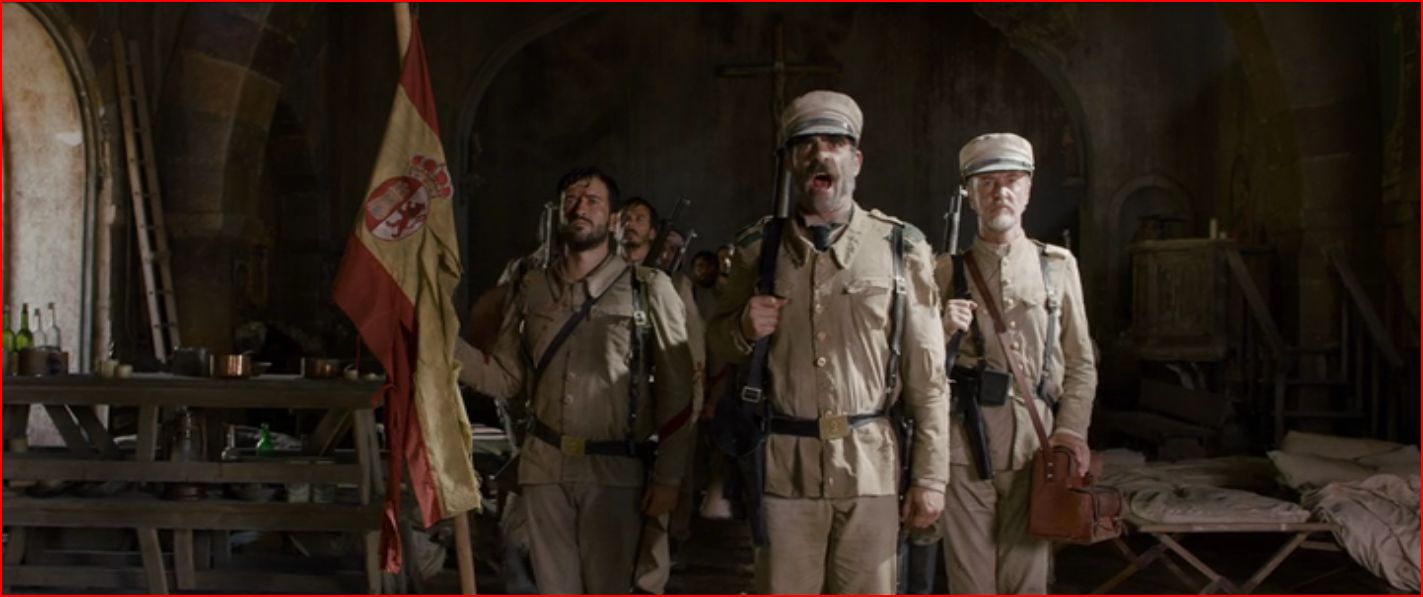
There's something about the Philippines, I guess, that makes foreign soldiers very reluctant to leave. The U.S. definitely overstayed its welcome there, but at least we didn't leave last-ditch fanatics behind when we decided to leave. When I was growing up, however, the world was fascinated by stories of Japanese soldiers holed up in the islands for up to thirty years after the end of World War II. There was precedent for this, on a more modest scale, after the 1898 war in which the U.S. "liberated" the Philippines from Spain. Despite that crushing defeat, a Spanish garrison held out at Baler, in eastern Luzon, for nearly a year, surrendering only in June 1899. The siege of Baler was the subject of a heroic war film in 1945, during the Franco dictatorship. Salvador Calvo's remake is far less celebratory.


The garrison is made up mostly of recent arrivals from Spain, few of whom have any real training. Our point-of-view character among these recruits is an aspiring artist who befriends the resident priest. While the soldiers can hold out for months with the ammo available, the important thing for the priest and his new protege is a plentiful supply of opium. One important thing the unit lacks is nutritious produce. Berberi breaks out, killing the original commander. The men continue to hold out, though at least one deserts.


Meanwhile, as the besieging Filipinos well know, Spain is negotiating a sale of the islands to the victorious U.S. to bring the war to a definitive close. Anticipating their next war with the Americans, the natives would like to end the siege with minimal fuss and hope to convince the Spaniards with up-to-date newspapers. The new commander dismisses all reports as fake news, contrived to trick them into surrendering. Eventually, our artist hero is sent out on a mission to get authentic news from Manila, the capital. He's promptly captured by a courteous Filipino commander who sends him on his way in the hope that the truth will set everyone free. The commander still won't believe and condemns the artist as a drug-addled traitor. Our hero will survive the siege, but his artistic ambitions end up one last casualty of a hopeless war.


The siege of Baler was something new to me, and that lent novelty to 1898. The siege was no Alamo and its conclusion -- the commander finally reads a piece of news he can't dismiss as fake -- is inescapably anticlimactic. The maiming of our artist hero serves as a symbolic catastrophe on top of the already pointless deaths during the siege. The film's real strength is its ensemble cast, led by Luis Tosar, Javier Gutierrez and Alvaro Cervantes as the artist. There's nothing really innovative here as far as battle films go, but for audiences outside the Spanish-speaking world 1898 provides a fresh look at the absurdity of imperialism and the folly of war.

Friday, June 30, 2017

DEVIL'S BRIDE (Tulen Morsian, 2016)

Saara Cantell's film turns a 17th century witch craze on a Swedish-ruled Finnish-speaking island into something of a Christian allegory. That's an interesting twist when most of the film feels like The Crucible with Abigail Williams -- the Winona Ryder character from the most recent movie version -- as the heroine. Anna (Tuulia Eloranta) lusts for a married man and tries to ruin his wife by accusing her of witchcraft. All she wants, though, is to drive the other woman from town, as Anna's own mentor, Valborg the midwife (Kaija Pakarinen) is banished early in the picture. It's not Anna's fault that the witch mania escalates to a lethal degree. The persecution is driven by hypocrisy and learned intolerance. The local pastor is the hypocrite, a serial rapist of young women whose main beef against Valborg seems to be that she performs abortions, presumably killing his children. The local judge (Magnus Krepper), for whose mother Anna works as a maid, is a pharisaical figure as intolerant of "superstition" as his like in future generations would be toward religion itself. He flaunts the latest thinking from academia, somehow more credulous toward rumors of witchcraft than the literature of his mother's time, which Anna, a bright girl, is able to read. As Valborg's banishment opens a flood of accusation, the patriarchs increasingly demand death for the accused, who in all too familiar fashion are tortured into confessing and denouncing others.


To her credit, Anna is horrified by this. She never really wanted her supposed rival, Rakel (Elen Petersdottir) to die, and the death sentence pronounced on the innocent wife crushes Anna's spirit. She begs forgiveness of the prisoner, promising to baptize Rakel's newborn daughter and eventually (and blasphemously?) doing it herself, but Rakel is understandably reluctant to forgive. Guided by the judge's mother, whose wits remain sharp despite a stroke, Anna challenges the entire premise of the witch trials, only to have the old literature scoffed away by the judge -- who nevertheless suspects that something is fishy about the anti-witch evidence pushed by the pastor. Finally, there's only one thing Anna can do to save Rakel. It won't be enough to admit her original lie. She has to accept guilt for all the fantastical sins others have attributed to the other woman, or that Rakel has been forced to admit -- in effect, to confess to witchcraft and effectively sentence herself to death.


Cantell may be best known in her own country for a popular series of films about the friendship between two young girls, so Tulen Morsian must have been a profound change of pace for her and those familiar with her work. She nails the terrifying escalation of the witch-craze, from the minor tragedy of Valborg's banishment to brutal mass executions. These are the makings of a horror movie, but  Devil's Bride proves to be a powerful emotional experience as Anna accepts martyrdom -- though the film teases us with a legend of her miraculous escape -- in order to expiate her own sins and those of the entire community. The awakening of her sexuality initially drives Anna wild and makes her a menace, but the awakening of her conscience -- her true coming of age -- redeems what might have been written off as a misogynist stereotype and makes a real heroine of her.  Taking the viewpoint of an accuser strikes me as a novel approach for a witch-trial film, and the gamble of inviting identification with an apparent villain pays off emphatically. In many ways Tulen Morsian is as horrifying and infuriating as any film in its grim genre, but in a modest way, with less of the barnstorming bombast of The Crucible (which is still tremendously entertaining in its own right), it's one of the most sincerely moving of witch-trial films.

Friday, June 23, 2017

ARES (2016)

There's something almost quaintly old-fashioned about the dystopia imagined by writer-director Jean-Patrick Benes in Ares. His dark future has nothing to do with French politics or demographics, haunted by neither a Muslim underclass nor the National Front. Instead, as was widely anticipated in the late 20th century, the corporations have taken over, with more widespread poverty and the further debasement of French culture as a result -- the latter signified by the death of Le Monde, France's answer to the New York Times. The rabble, as ever, are preoccupied by circuses if not also with bread. Cage fighting has become the leading spectator sport, made available for free on big screens hung from the country's cultural monuments. Fighters are openly sponsored by pharmaceutical companies whose stock value depends on their success in the cage. The competitors are injected with each corporation's proprietary serums in the open before each bout and sometimes between rounds.


Reda Kowalski (Ola Rapace) is about a decade past his prime, ranked #266 in France as the story begins. He fights under the ring name "Ares" when he isn't working as a private-security goon pounding on street protesters, who include his own relatives. His sister is some sort of investigative reporter or hacker who ends up getting arrested in an obvious frame-up. To raise bail money for her, Reda agrees to test a dangerous new super-fighter serum in the cage. It turns out that he's one of the lucky few who can take the drug without dying almost instantly, and there's no guarantee that he'll survive the comedown from his initial high. The stuff works well enough for Ares to score a major upset in the first round of the latest European tournament, and once Reda wakes up after fainting with no ill effects, stock in the company skyrockets. Having bet the farm on himself by proxy, Reda can now spring his sister, but learns that she was killed in prison. C'est la vie.


Reda smells a set-up and soon learns the terrible truth. He knows that he is "patient zero" for the new drug, the first test subject to survive, but thanks to some hackers who were friends with his sister he discovers that the corporation had killed 30,000 people with the stuff before they found him. He takes his revenge by twisting one of the ancient tropes of the fight-game genre and throwing his next fight in the tournament, causing the corporate stock to tank. He's too valuable for them to let him walk away, so their goons take his sister's kids hostage to bring him back in line. Suspecting that he'd refused to take the drug before the last fight, they want to continue experimenting with him, but they've underestimated the cunning of Reda's new friends and how far Reda himself will go to deny them what they want....


For a dystopian film Ares ends rather optimistically with its hero the hero of a presumably successful mass uprising against the corporate regime. It's nice that Benes and his co-writers believe that the masses would be aroused by Reda's story, but it also demonstrates the limits of their dystopian imagination. That aside, Ares is a modestly entertaining cyberpunk variation on oldtime boxing movies. It's clearly limited by a budget that doesn't allow the cage fights to play out before masses of extras in an arena. I'm not sure if the sport would catch on as the filmmakers claim it did without the enthusiasm of a live crowd for TV audiences to respond to, but I suppose you could call it a live version of any fighting-tournament video game, none of which need audiences to get over. The fighting itself is nothing special, but I suppose it doesn't need to be, since Ares is more film noir than martial arts movie in the final analysis. The plot is more compelling than the action, but not compelling enough to hide the datedness of its dystopia. The same film could have been made a quarter-century ago, and while I certainly don't mean to disparage anyone's fear of corporations taking over the world, I do doubt whether that's the subject for any really ambitious dystopian film in our own, already somewhat dystopian time.

Friday, June 16, 2017

THREE (2016)

The Chinese director Johnnie To is one of today's best crafters of crime thrillers, but his latest genre exercise sacrifices his talent to technology. Three starts strong enough but goes badly off the rails in an overindulgent final act. The title presumably refers to the lowest score possible on the Glasgow Coma Scale, indicating deep if not irreversible unconsciousness, as explained by the neurosurgeons in whose hospital ward most of the action takes place. Like an old all-star-cast medical melodrama, Three introduces us to several patients in the ward, including a childish old man who serves as comedy relief and a patient who angrily discovers that he's partially paralyzed after emergency surgery. His anger is aimed at Tong Qian (Zhao Wei), who has several crises of confidence and conscience as the film goes on. Her newest patient is Shun (Wallace Chung), a gangster who was shot in the head by a cop during an interrogation. Detectives led by Ken (Louis Koo) hover over him at all times, waiting to whisk him to jail once he recovers from surgery. But there's the rub. Shun has suffered a lucky hit that leaves him fully conscious and alert even though the bullet remains lodged dangerously in his brain. Erudite and philosophical in classic movie-villain fashion, he refuses surgery, against Tong's advice, on the assumption that so long as he remains a patient in critical condition, he can't be taken to jail. He's gambling that his gang can work up a plan to break him out of the hospital, while Ken, taking such a plan for granted, prepares his defense. For Tong, their chess match is a frustrating if not terrifying experience, understanding as she does the risk Shun is taking and the dread consequences of any medical error.


So far, so okay, even if Wallace Chung lays the taunting-genius-villain act on a bit thick. Working with admirable economy -- the film is under 90 minutes long -- To deftly sets us the inevitable showdown only to botch it completely. My opinion may just be a matter of taste, however. I happen to think that a good aesthetic principle for thrillers is "less is more." Pacing, achieved through editing, matters more here than in any other genre. But for Three's climax To decides to do without editing entirely. For some inscrutable reason he chooses to shoot most of the attack by Shun's gang on the neurological ward in a single CGI-enhanced take, dialing the speed of the action up and down and making the scene look more like a Zack Snyder ripoff or a scene with that speedy kid from one of the recent X-Men movies, or a video game, than anything dramatic or suspenseful. Of course, it's all set to some sappy pop tune.


Once To finally tears himself away from this spectacle, things don't really get any better. As Shun and Ken dangle unconvincingly from a hospital window, chaos spills into the hospital as a whole while the angry paralyzed guy wheels himself toward a grand stairway in an apparent suicide bid. So out of touch has Johnnie To suddenly become with the basics of thriller filmmaking that he wastes a perfectly good "Odessa steps" situation in a way that should make Brian De Palma want to smack him. More in keeping with medical-melodrama tradition, this poor idiot goes tumbling wheels over head all the way down the stairs only to pick himself up and announce that he is cured and can walk again. Will someone please tell me that Three was a tongue-in-cheek exercise in camp? Whether it was meant that way or not, tongue-in-cheek may be the only way to appreciate this trainwreck of a thriller.

Wednesday, May 24, 2017

A YELLOW BIRD (2016)

 Singapore has a reputation as a nation that combines free market capitalism and an authoritarian social order of the sort that gets you fined for spitting your gum out in the street and caned for many other offenses. Above all it has a reputation as an orderly place, but K. Rajagopal's film appears to belie that reputation. A Yellow Bird examines the seamy underbelly of Singapore and finds it just as vile as the slums and underworlds of other nations. It opens on a note of absurdity as people in colorful costumes prepare to march in some sort of parade. They're led by two guys wearing giant cartoon heads. It's no doubt less of a shock for the home audience than it is for the rest of us when it turns out that these are all professional mourners taking part in a funeral procession. Two of the mourners are our protagoinsts. Siva (Sivakumar Palakrishnan) is an ex-con who belongs to Singapore's Indian minority. He desperately wants to reunite with his wife and daughter but his probation officer is reluctant to tell him where they live. For all I know they have an order of protection against him, and the way he flies off the handle sometimes that would be very believable. Chen Chen (Huang Lu) is a sometime prostitute  desperate to earn money to support her daughter, who's being raised elsewhere. Sick of being underpaid or ripped off by the boss mourner, Chen decides to resume the world's oldest profession. Seeing a sympathetic face in the imposing Siva, she persuades him to act as her bodyguard and collector with the one word of English she knows: "Money." She still has to go to work for a pimp who maintains two tents in the woods, and he's uncomfortable with the "black ghost" around. It's all pretty squalid and things never really get better. Just when you think the film might be shipping Siva and Chen she accuses him of stealing her savings, and just as he tries to make things right she gets arrested and exits the picture. Finally, though, with help from a somewhat sympathetic probation bureaucrat, Siva tracks down his wife and kid, finds the latter in a terrible state and promptly makes it worse. It's something of a shock that the first Singaporean film I've seen (it's trilingual, by the way) is in the grimy naturalist tradition of global cinema and not something more expressive of the Asian modernity Singapore supposedly represents. I actually appreciate A Yellow Bird more for that reason, because it refuses to flinch from the miserable lives of the underclass or to romanticize their struggles. If anything it may overstate Singaporean squalor with its portrayal of poor people living in apartment complexes that seem modeled on prisons, down to the bars in the doorways. The characters' wretchedness may be too much for some moviegoers, but there's something about the cinema of poverty that works to its advantage as cinema. When done right, it seems more real, if that's what you're looking for, than any other genre of film.

Tuesday, April 25, 2017

ALI AND NINO (2016)

April 24 was Armenian Martyrs Day in the U.S., and with that thought presumably in mind the movie The Promise, a romantic drama set in those dark days, was released last weekend. The producers gravely overestimated the moviegoing public's interest in that still-controversial episode of 20th century history. So if no one really wants to see Armenians victimized on film, how about a movie in which an Armenian is a villain? Set roughly at the same time as The Promise, Asif Kapadia's film adapts a 1930s novel credited to "Kurban Said," whose true identity remains a mystery today. Kapadia is a British director best known for his documentaries about the doomed race car driver Ayrton Senna and the doomed singer Amy Winehouse. Fittingly, his subject here is a doomed (or should we say star-crossed) romance between Ali, a Muslim Azeri prince (Adam Bakri) and Nino, a Christian Georgian princess (Maria Valverde) at the brink of World War I.


At that time, Georgia and Azerbaijan are territories of the Russian empire, and when war breaks out Ali's brothers join the Russian army, only to face discrimination due to their religion and nationality despite their largely westernized upper-class credentials. Back in Baku, the Azeri metropolis, Malik, an Armenian (Riccardo Scarmacio), tries to impose himself on Nino, but is killed by Ali in an oil field. Ali must flee to the sticks while Nino, shamed by the scandal in the eyes of Georgian society, faces the prospect of exile to Moscow. Instead, she persuades Ali's spiritual adviser Mustafa (Numan Acar) -- he wears traditional dress so that's what I'm guessing -- to take her to where her beloved is holed up. Here they consummate their romance, with Mustafa conveniently at hand with the credentials to make everything legal. In this apparently easygoing environment Nino is not required to renounce her faith.


For a time the happy couple live in idyllic rural poverty, but the collapse of the Russian empire creates an opportunity for Azeri patriots. A democratic republic of Azerbaijan is proclaimed but soon finds itself menaced by the new Bolshevik regime in Russia, which covets Azeri oil. Nino is sent to Iran for safekeeping but can't stand it in that more traditional Muslim country, complete with a harem and a well-meaning eunuch whom Nino can't help but find repulsive. It takes a while for her to forgive Ali for leaving her there, but they're hardly reconciled before he has to join the troops once more in a heroic last-ditch defense of a railroad bridge against the Commie invaders.


Ali and Nino is one part Romeo and Juliet, one part For Whom the Bell Tolls, though to be fair the original novel appeared before the Hemingway story. Movie buffs might be reminded more of Doctor Zhivago, only with less snow. Kapadia's film is unlikely to inspire comparisons with future films, however, because it's only superficially epic. It features picturesque landscapes and cityscapes and picturesque young lovers, but Christopher Hampton's screenplay and its interpretation by the leads are almost perfectly vapid. It's a lovely picture to look at thanks to Gökhan Tiryaki's cinematography and the slam-dunk locations he gets to shoot, but for all the tragic elements the film sometimes feels like something shot as a musical with the songs left on the cutting room floor. I'm still satisfied with it because it introduced an unfamiliar bit of world history to me and it really does look good, but Ali and Nino also left me thinking that that same history could be the makings of a real movie someday.