S
Shaw Bros. saddled Chu Yuan's (or Yuen Chor's) remarkable film with a title reminiscent of Victorian erotica, perhaps hoping to sell it as erotica in English-language markets. The film definitely does have its erotic moments, but when it counts, sensuality takes second place to savagery in this revenge epic and, if anything, makes the savagery more savage.
Chinese audiences know the film by the name of its heroine, which is first mentioned at a murder scene. A man is dead in his own home, partly covered in snow falling through a hole in the roof. His butler explains that the victim had just recently entertained Ai Nu, a noted courtesan. An extended flashback follows, forming the first act of the film. Ai Nu (Lily Ho) is one of a number of young women recruited forcibly from the countryside to become courtesans at the elegant brothel of Madame Chun Yi (Betty Pei Ti). Chun wants her girls flawless and virginal. Finding that one of her minions had deflowered one of the girls en route, the madame kills him with her bare hands. She can literally put her fist through your body. She enjoys it, too, especially the taste of blood afterward.
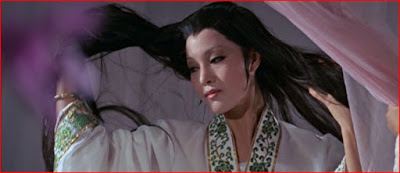


Betty Pei-Ti as Madame Chun
Another thing Chun enjoys is the company of women. This ultimate exploiter of women happens to be a lesbian, apparently keeping some of the girls as her personal concubines, unless all of them take turns at the task. She's a Chinese amazon, stunningly beautiful and masterfully violent. She takes a special interest in the spunkiest and most defiant of the new recruits, poor little Ai Nu. It's not clear how soon her interest becomes sexual, because she doesn't scruple at selling her virginity to the highest bidder among four wealthy old men, regulars at the brothel. The winner submits a blank check; he can get away with it because his son's the provincial governor. All four men get their turn at Ai Nu, tying her up, whipping her, forcing themselves upon her, the brutality of it accentuated by freeze frames and harsh sound effects just before the act is done each time.

Madame Chun with bed-warmers (Ai Nu not included)
Afterward, Ai Nu tries to hang herself in her cell; the suicide attempt is scored with Leonard Bernstein's music from
On the Waterfront. She's rescued by a mute male housekeeper who had tried to show her kindness earlier, after Chun had ordered her flogged. Now he reveals that he can speak, but had taken a vow of silence in atonement for errors that had cost him the love of his life. The hero of the film seems to have revealed himself as he promises to help Ai Nu escape the brothel. But he can't get her past Chun and her private army. The hero has a few skills himself, but he's no match for the madame nor her major-domo Bao Hu (Lin Tung), the master who trained her. Our would-be hero is promptly expiring on the snowy ground, urging Ai Nu not to kill herself or otherwise throw her life away, because then who'd be around to avenge him? As she sobs over his corpse, Chun gives her a simple choice: die now, or live on Chun's terms. Ai Nu chooses life.

Lily Ho (left) gives Betty Pei-Ti a fateful elbow nudge during a training exercise
Chun sets about remaking Ai Nu in her own image, teaching her kung fu and swordsmanship and taking her to bed. Once we learn this, the scene at the murdered man's house repeats itself and we return to the present, following Constable Ji (Hua Yueh) as he investigates Ai Nu's link to the victim. He discovers an imperious, arrogant beauty, far removed from the terrified country girl we first saw. When he demands that she prove that the victim was alive when she left him, she challenges him to prove that he wasn't. Now, we suppose, the hero has arrived, but we'll learn soon enough that this film doesn't have a hero.

As Ji finds his investigation impeded by the social standing of the victim's circle, Ai Nu carries out a spree of revenge on the four men who first violated her. She varies the m.o. to keep people guessing, tying one up and setting him on fire to avenge his tying her up, but allowing another to love himself to death with three insatiable women and an overdose of aphrodisiacs. Finally, Ji finds her practically red-handed with the fourth victim, whom she'd whipped to death in a room locked from the inside as the constables desperately try to break in. Denying nothing, she only dares him to follow her to the real criminals. She leads the constables to the latest shipment of fresh females for the brothel, which she attacks. Leaving Ji to mop up, she races back to the brothel, where Bao Hu has been warning Chun about Ai Nu's dangerous intentions. Chun won't believe a word of it. She and Ai Nu are like one and the same person! Why not? Chun has created a peer for herself; that may have been the only way she'd ever find someone she could truly love. So when the constables arrive to storm the brothel, and Bao Hu with all his men insists that Ai Nu has betrayed them all, Chun can only stand by her woman at all costs.

There's a moment when the women warriors stand back to back, gravely outnumbered, and one gives the other an affectionate elbow in the side, and the other returns the gesture. It's like William Holden saying, "Let's go," and Warren Oates answering, "Why not?" It's a
Wild Bunch moment, or a
Sword of Doom moment if you want to keep the context Asiatic. It's the moment before Armageddon as the two women psyche themselves up for an
amoklauf.

And before long it's down to Bao Hu against the women, a hopeless situation. But he doesn't go down without an epic bloodbath and a crippling blow, slicing off Chun's arm just as she's run it through his body up to her elbow. A bit of a setback, that, but Chun takes it like a trouper, worried only that Ai Nu might stop loving her now that she's a little handicapped. Of course not, Ai Nu coos. She won't stop loving Chun -- because she never did love her. It was --
duh!!! -- all a ruse to set up her revenge against
all her oppressors, with the worst one saved for last. It was a nice plan, but for all that revenge is something you kinda have to boast about, this isn't exactly something you should admit so bluntly to someone who still has one good arm....
Ai Nu has an emotional ferocity and a raw romanticism that I've rarely seen in Hong Kong action films. The fantastic martial-arts context takes the transgression of lesbianism and elevates it (or degrades it, depending on your political sensibilities) to the level of a supernatural attribute. Chun and Ai Nu are the most beautiful women and the mightiest warriors in the picture, as if their sexuality (however insincere it may be on Ai Nu's part) gives them extra power, particularly in a setting where no man seems to have a conventional domestic relationship. The men are either patrons of prostitutes like the four old men, or they're emotionally damaged characters like Bao Hu and the erstwhile mute, or else sexlessly ineffectual like the constable. Given the men around them, lesbianism looks less like mere deviance (though its deviance gives the film an extra charge) than the natural recourse of naturally superior women.
The brilliant thing about Kang Chien Chu's screenplay is the way he turns Chun from an outright villainess into a tragically clueless, noirishly romantic antiheroine. The madame -- what a sap! --has clearly fallen deeply and sincerely in love with her deceiving Galataea, and after the women slaughter all around them, you can't help but feel that Ai Nu isn't righteous but just a little
mean to hit Chun with the truth at a vulnerable moment. Another moment will come, however, to make us wonder how sincere Ai Nu was about her insincerity -- and there'll be consequences for that, as well. It all works, maybe just because this is my king but also, as I hope any viewing would prove, because Betty Pei Ti and Lily Ho have real chemistry and throw themselves passionately into their roles. Chu Yuan does all he can to make them majestic and malignant all at once while maintaining a suspenseful balance between pastel sensuality and livid brutality.
Intimate Confessions is arguably part of Quentin Tarantino's universe, with the business of lopping off arms possibly having a direct influence on
Kill Bill. I think I saw something else here that I saw there as well; the way Ai Nu completes Chun's sentence for her at a crucial moment reminded me of the eerie exchange between The Bride and O-ren Ishii in which one finishes the other's sentence ("Silly rabbit...Trix are for kids") in a way that suggests that the cereal slogan was a shared catchphrase. That moment always leaves me thinking that there was a subtext of
something between the two assassins in Tarantino's film, and it may be that
Ai Nu is the something, or a key to it. But this is all just stuff for speculation unless Tarantino has actually identified
Ai Nu as an influence. Whether it influenced him or not doesn't change the fact that
Intimate Confessions influenced me. It's now one of my favorite Hong Kong martial arts films.
The following DVD trailer barely scratches the surface, but it'll do until you see the movie. Triphibian uploaded this copy to YouTube.


 Like the U.S., Germany had a "pre-Code" period of film production. They call it the Weimar Republic, and the repression that followed was considerably more sweeping than what befell America. During Weimar Germany was part of the global vanguard of cinema, and plenty of envelopes were pushed. One of the last milestones of the Weimar era was history's reputed first-ever "lesbian" film, Leontine Sagan and Carl Froelich's Mädchen in Uniform. For screenwriter Christa Winsloe, this was just the latest of many titles for her play, which started life as "Yesterday and Today" and morphed into "Sickness of Love" before acquiring its more familiar fetishistic label. The 1931 film survived Nazi suppression and its name endured enough in memories that there was probably no alternative to using the same title when Geza von Radvanyi remade the story in 1958. The uniforms are school uniforms, of course, but on first hearing the title you might expect something more military, and that impression wouldn't be entirely accidental. We first see the students of the film's girls' school marching in formation, and the faculty emphasizes repeatedly that the girls are being trained to be the wives and mothers of soldiers. That doesn't exactly make them Spartan women but it does impose a perhaps-unnatural discipline on the girls. Whether or not the definitive title implies that the militaristic discipline, not to mention the all-female environment, has something to do with Manuela von Meinhardis's dangerous attraction to her teacher Fraulein von Bernburg is open to question, but the story definitely looks like a critique of Prussian culture in general.


 Always a weaker rival to Turner Classic Movies, the Fox Movie Channel more or less gave up on the competition earlier this year when it began showing contemporary movies with commercials in prime time. From early morning to mid-afternoon, however, FMC still shows the old stuff commercial-free, and if anything they've delved deeper into their library than before to broadcast obscure oddities. For example, here's a Filipino-directed crime melodrama shot in India and starring one of the subcontinent's biggest stars, the late Dev Anand, alongside future blaxploitation actor and S.W.A.T. star Rod Perry, who sings the picture's title song. Directed by Lamberto V. Avellana, The Evil Within's first reel promises more craziness than the picture ultimately delivers. We follow a stocky fellow known only as "The Fat Man" on a series of fatal rounds. Without preliminaries, we open with him stabbing someone. In short order he leaves a trail of bloody bodies in his wake. He may be an implausible fighter but he's a charismatic attacker, often screaming before he strikes. If he's the antagonist we may be on to something -- but eight minutes into the picture, he's shot in the back and killed in perfunctory manner by the minions of Hakim, a more ordinary figure who now settles into the primary villain role. The Fat Man was a Syndicate enforcer and his death signals a power play for control of the opium racket. That brings in Anand (playing "Dev") and Perry (playing "Rob"), the latter having survived a rare non-fatal encounter with the Fat Man during that brief, glorious rampage. One powerful clan runs the drug trade, buying the opium from the mountain tribes and shipping it out to the wider world. The clan is riven by family feuds, and for a while it looks like our heroes will play the Red Harvest game of playing criminals against each other. The crooks need little prodding in this direction, their rivalries ultimately complicated by a lesbian love triangle that leaves Dev himself in a shotgun-toting rage by the end of the show.
  About a third of the way through Dennis Gansel's film -- at the point when novice vampire Lena is urged to put aside her qualms about blood-drinking and "just let go," my friend Wendigo turned to me and said, "This is Near Dark." A few minutes later, when the four vampire women went on a shopping spree, I suggested, "This is Near Dark meets Sex in the City," and Wendigo agreed. Moments after that, as the ladies raced their stolen luxury cars through a tunnel, we decided it might really be Lost Boys meets Sex in the City. It got more Near Dark-y again when one of the characters got trapped outside her car and caught on fire. But let's backtrack a little.
 Wendigo liked that the film didn't go for either of the obvious directions. Louise and Lena do not become lovers, nor do they become mortal enemies in a revenge feud until the very end of the picture. Not that he has any objection to lesbian vampires, but he liked that being vampirized didn't automatically turn Lena (or Nora, who has a crush on a mortal bellboy) into a lesbian -- which makes things difficult for Louise. This is a glamorous but not romantic vampire film in which vampirized people can't shake lose the baggage of their lives. This is most poignantly shown in Charlotte's subplot, which has her visiting a hospital where her now-elderly daughter lies dying, and deciding afterward to take a walk in the sun. Unlike in some stories, vampirism here doesn't mean losing your soul. Lena is, unusually, a "noble vampire" from the get-go, constantly struggling against the impulse to kill for blood. As Wendigo notes, in fiction a noble vampire doesn't usually start out noble, -- not even Edward Cullen did -- but has an early career of murder prior to a moral transformation. Lena is very much like the heroes of Near Dark and Lost Boys in her scruples, but in the two American films the hero is presumed not to have fully transformed, while Lena has as far as we can tell. She never drinks straight from a vein, except possibly at the very end of the film. Through her, We Are the Night has it both ways, showing the vampire lifestyle as superficially cool while the heroine rejects that coolness.
 Sometimes you can't trust your cable guide. Mine told me that Turner Classic Movies was going to be running Luis Bunuel's Oscar-nominated version of Robinson Crusoe starring Dan O'Herlihy. Apparently I'll have to watch that here if I really want to see it, because what TCM ended up showing the other day was something that might well have appealed to the arch-surrealist of cinema: a gender-bending adaptation of Defoe raging with sexual subtext.
  It's been more than a decade since I last showed my friend Wendigo Harry Kumel's Euro-vampire film, which I'd just bought on VHS in a letterboxed director's cut. Wendigo remembers being disappointed with the film. He'd expected more sex scenes with more overt lesbianism and a greater resemblance between Delphine Seyrig's "Countess Elizabeth Bathory" and the legendary Blood Countess whose name she bears. I'm to blame, in part, because I'd talked it up pretty big based on what I'd read about the film in the fan press. Now, however, Wendigo wanted to appraise it as a vampire film, not a cult sex film. While some of its flaws are still pretty obvious, he finds that he appreciates the movie more on a second viewing.


 Lisa Cholodenko's film has been nominated for four Academy Awards. It's one of ten nominees for Best Picture, and Cholodenko is up for co-writing the screenplay, but not for direction. It strikes me as a movie that probably wouldn't have made it into the traditional five-film field, though that says less about the film than about the Academy's biases. My own biases would probably argue against a Best Picture nomination. The subject doesn't seem dramatic or momentous enough to suit my sense of cinema as spectacle. On the other hand, other people apply a single standard of compassionate humanism to all media, and a lot of such people are likely to be moved enough by The Kids Are All Right to make a case for it. Our common ground, I'd suggest, is acting. The stars make it a spectacle, though not of glamor. Annette Bening and Julianne Moore have drastically de-glammed themselves to play a middle-aged lesbian couple here, though Mark Ruffalo is arguably glammed up as the laid-back sexy sperm donor who complicates the heroines' family life. Bening and Ruffalo have been nominated for Oscars, while Moore's omission suprises me. If anything, she gives the most showy performance, and gets to make a big speech of a sort, but maybe she came on too strong for some viewers.


 Wendigo doesn't remember when exactly he first saw Roy Ward Baker's Hammer production. The earliest viewing he can remember was an unusual broadcast on our local PBS station on a Saturday night -- unusual for showing the film, if not uncut, than without the nudity cut out. He's unashamed to admit that the nudity, which he had heard of from his monster mags, was a major draw. He was also intrigued by the idea of a whole series of Hammer films he hadn't yet seen, dealing with the evil Karnstein clan. He knew the Karnstein name from the two unofficial tie-ins Hammer made, Vampire Circus and Captain Kronos, Vampire Hunter. The actual trilogy -- Vampire Lovers was followed by Lust for a Vampire and Twins of Evil -- was hard to find back in the Eighties. By the time Wendigo saw the first film, he had read its inspiration, Sheridan LeFanu's Carmilla. The movie proved surprisingly faithful, especially compared to adaptations both of us have seen subsequently. The nudity was no shock for him, since the underaged Wendigo had seen Old Dracula at least a decade earlier at one of the last local grindhouse theaters -- he hadn't expected that to be a nudie film, nor did the grandmother who brought him there, but he took it in stride.
 What was new, to him, in The Vampire Lovers was the blatant lesbian angle. As he puts it, that element slapped him in the face in a way he'd never experienced before, having seen Dracula's Daughter long before he could infer anything salacious from the title character's conduct toward her female victim. He'd seen it in print, of course, and knew from history how the Elizabeth Bathory legend had influenced Le Fanu. So lesbianism doesn't strike him as an alien implant in vampire cinema. As an "unnatural" act, as it was perceived by the genre pioneers, it was probably a natural fit. Homosexuality in general as a "sterile" relationship defined exclusively in sensuous terms seemed analogous to the victim's romance with the vampire, and the lesbian angle plays on male fears of both the seductive succubus and the romantic friendships of 19th century women. Wendigo suggests that the lesbian seductress archetype has over time transformed the image of the male vampire from rapist to sensual seducer in his own right. On the other side of the equation, feminine weakness seemed to make a female victimized by another female a natural horror subject. There's a misogynist aspect to the archetype, a presumption of omnivorous female sexuality, that's probably still there even when guys consider lesbianism cool. But there's also a fantasy of female empowerment involved, though whether that's a guy's or gal's fantasy is unclear.


 While The Vampire Lovers is probably the best-known film version of Carmilla, it wasn't the first. Hammer came late to the subject, preceded by Carl-Theodor Dreyer's very loosely-inspired Vampyr, by Roger Vadim's nearly-as-loose and much worse Blood and Roses, and the Italian Crypt of the Vampire, which admirably builds plot complications around a fairly faithful core to make a mystery out of the story. Wendigo was recently quite impressed by the stylishness and creativity of Crypt of the Vampire, which he finds visually more impressive, even in black and white, than the mostly set-bound Lovers. Hammer has the advantage, however, in casting, with Peter Cushing as the vengeful General as well as Pitt (while Crypt has Christopher Lee in a mortal role), in scale of sets, extras and costumes, and in more overt sexuality than the merely suggestive Crypt. If gore counts, Lovers's two decapitations are another advantage over the merely creepy Crypt. Some corny crossings (a dagger hilt? really?) are mild demerits, however.