Showing posts with label Fairbanks. Show all posts

Saturday, March 11, 2017

THE MYSTERY OF THE LEAPING FISH (1916)

I don't know enough early films to say whether The Mystery of the Leaping Fish is the first American drug comedy film, so let's make a more modest claim: John Emerson's two-reeler, conceived by that beloved humorist of the cinema, Tod Browning, is the Birth of a Nation of drug comedies. I suppose we could be more modest still and call it the Inherent Vice of 100 years ago. It's almost certainly the weirdest performance ever given by Douglas Fairbanks Sr., who plays the "scientific detective" Coke Ennyday. While the name is a loose play on Arthur B. Reeve's then-popular scientific detective Craig Kennedy, the character's awesome drug habit is taken from Sherlock Holmes, and expanded upon immensely. The great detective sits at his desk, injecting himself with something every couple of minutes to restore his spirits -- he chuckles after each injection -- while a huge jar labeled COCAINE is within easy reach. A closet holds the detective's many disguises, clearly labeled as such, while a clock divides Ennyday's routine into four phases: drinks, eats, sleep and dope. This film was made two years after the federal government first cracked down on the distribution of cocaine and other narcotics, so Leaping Fish flies in the face of a national anti-drug hysteria in the admirably irreverent fashion of that era's films. A police chief, I.M. Keen, rings Ennyday's doorbell, and the slightly paranoid scientific detective pulls out his "scientific periscope," a proto-TV apparatus to verify the man's identity. After his servant, dressed like a giant bellboy, opens three layers of doors, Ennyday hears the lawman's appeal. There's a man in Short Beach rolling in wealth despite lacking apparent means of support. Certainly something requires investigation there!

In Short Beach we are introduced to the mysterious leaping fish, which are inflatable floating devices for coastal frolicking. We are also introduced to the film's heroine, Inane the Fish Blower (Bessie Love). That's what they call the girl who inflates the inflatables with an air pump. The lurking Coke Ennyday discovers her in distress, having fallen off a pier into shallow water. Skipping into action with the celerity of a Keystone Kop, Coke flings himself off the pier and plants himself head-first in the mud. Inane has to rescue him from this predicament, but he'll return the favor later. The man Ennyday was assigned to trail, earlier shown literally rolling in money in his bed, is, in fact, a drug smuggler; he sends two Japanese minions out to sea with Leaping Fish, and they return with contraband. Poor Inane knows nothing about this, but is threatened just the same by the amorous attentions of Fishy Joe. Another member of the criminal ring is the Chinese launderer Sum Hop. For you youngsters, that was more drug humor. Despite his perpetual daze some instinct drives Coke Ennyday to discover a cache of opium, which he commences to eat like cake batter out of the bowl. In the double climax Coke must battle the yellow perils and their white master, while Inane must defend her virtue against Fishy Joe. She defends it with all the vim and violence you'd expect of Douglas Fairbanks himself, wiping the floor with Joe, while Ennyday, quivering as if he'd OD'd on Acme Earthquake Pills, uses his trusty hypodermics to inject his foes into various states of stupefaction. One virtually floats through the ceiling, while another throws himself out a window. Finally comes the showdown with the mastermind, which conveniently goes down in darkness, with Coke conveniently victorious when the lights go on again. Once more Coke Ennyday has conquered crime, and this time he gets the girl, too -- only that's not the end of the story. Before we really got started with the story we were shown a quick shot of Fairbanks out of makeup, laughing at something he'd just read. The film closes with the real Fairbanks trying to sell the very story we've just seen to the scenario department at the Triangle Studio. The department head tells him to stick to acting, and Fairbanks exits with a pout. He actually did a lot of his own writing under the Elton Thomas pseudonym, but here he gives one of the great good-sport performances ever in what some have seen as a send up of his own already-formed frantic screen persona. It's an all-out fearless physical performance that shows the young star unafraid to look like a complete idiot, flaunting the fakeness of Ennyday's moustache, rocking his ridiculous outfits, and pretty much pogo-ing through most of the story as if he, the actor, really were on something. He helps mightily to make The Mystery of the Leaping Fish one of the damnedest things you'll ever seen. And you can see it right here, as uploaded to YouTube by one Ivan Smirnov. Check it out, man...

Wednesday, September 2, 2015

Pre-Code Parade: THE NARROW CORNER (1933)

One of the things insisted on most vehemently in the period of Code Enforcement, from 1934 through the mid-1960s, was that movie characters couldn't get away with crimes, especially killing. Something like The Narrow Corner, despite its literary credentials as a W. Somerset Maugham novel, probably couldn't be made as a movie a year or two after Alfred E. Green's film came out. The hero (Douglas Fairbanks Jr.) is clearly a fugitive as the film begins, though we don't find out why he's on the run until later in the picture. An American (or English) fugitive in exotic exile was a popular motif at this time; the idea combines the appealing prospect of starting over with the persistence of threat if not outright guilt for whatever you've done. This time there's the added terror of repeating your original mistake. Fred Blake, it turns out, killed a man back home. Green illustrates this awkwardly, in a manner presumably inspired by the Rouben Mamoulian Dr. Jekyll & Mr. Hyde, using a split screen to show both Fred telling the story and the story itself in flashback. Showing Fred talking really adds nothing to the sequence, which is highlighted by the faceless shot of a woman's hand putting a gun in Fred's hand as he grapples for life with her husband. This matters because Fred is falling in love again with another man's woman. The man is Ralph Bellamy in something like his eventual archetypal role as the loser boyfriend, the guy who gets dumped in favor of the more charismatic star. But this was still a time when Bellamy could win the girl in some of his pictures, and even when he doesn't you're in for a fight if you try to take his woman. In Narrow Corner he sort of wins but definitely loses, choking out Fairbanks in a fit of jealous rage but horrified immediately by what he's done. "I killed him," he moans in exactly the tone of voice you associate with those guilt-stricken, stupid predators who think they've done in Bugs Bunny, but before Junior can pop up and kiss him the inconsolable lug goes and kills himself. Bellamy dies, dead, as Old Ygor might explain it, Junior dies, live! The way is now clear for Fred Blake to get the girl, and as long as he can steer a boat through some treacherous reefs he and she can start over, presumably without worries over the man he did kill or the man for whose death he bears at least a little responsibility. Not that I object morally, mind you, but a lot of people in 1933 did seem to object to such seemingly triumphant immorality. For me it was just in keeping with the admirable seediness of the whole project, and it's preferable to some stories I've seen where the big twist is that the hero (or heroine) didn't actually kill anyone back home. Fairbanks, Bellamy and female lead Patricia Ellis are surrounded by a strong cast of grotesques, from alcoholic sea captains and opium-addicted doctors to cantankerous old codgers boasting of their ancient conquests in the islands. The show is purely studio and soundstage bound but the special effects for the story's dangerous sea voyages are, if modest, at least dramatically effective also. Narrow Corner is another entertaining Pre-Code star vehicle for Fairbanks Jr., for whom the period meant freedom, above all, from having to be his father's son on film. He showed a range in these few years at Warner Bros. that, his other virtues notwithstanding, he would never show again.

Tuesday, August 18, 2015

DVR Diary: THE EXILE (1947)

It's hard not to believe that Douglas Fairbanks Jr. and Max Ophuls didn't appreciate where they were, which was Universal Studios, where Ophuls, freshly fired by Howard Hughes and still hoping to make his American directorial debut, would film Fairbanks's screenplay -- he received sole credit for a collaboration with Ophuls and Clemence Dane, among others -- as Junior's first film as an independent producer. The Exile is often described as Junior's homage to his swashbuckling father, but it could as easily be seen as the two auteurs' tribute to Universal itself, as if Ophuls + Fairbanks = James Whale. Why, there's a climactic fight in a windmill a la Frankenstein and IMDB confirms my fleeting glimpse of Michael Mark, Little Maria's poor father, in a bit part. Like Ophuls, Whale liked to move the camera around, though his were halting steps compared to the later master. Perhaps most reminiscent of Whale are the obvious backdrop skies of this setbound yet expressionist picture, which is, to be fair, only superficially an homage to Whale or Universal. The auteurs are greater romantics than Whale or any of the Universal crew ever were and put their personal stamp -- presumably Fairbanks's as much as Ophuls's -- on what looks very much like a Universal film, down to the participation of Maria (Cobra Woman) Montez, Nigel (Dr. Watson) Bruce and Henry (Prof. Moriarty) Daniell in key roles. Moreover, it has more heart, or at least a different kind of heart, than any of Fairbanks Senior's pictures did.

You may know The Exile by its alias, Bonnie Prince Charlie, a title that eliminates any uncertainty over who the film is about. Fairbanks and company adapted a novel about the eventual Charles II by Cosmo Hamilton, portraying the prince in Dutch exile late in the Protectorate and wearying of the grim responsibility his remaining loyalists impose upon him. He doesn't want to risk their lives in another attempt to reclaim England by force and appears content to live a simpler life as an assistant innkeeper, having fallen for the innkeeper's daughter (Pauline Crosset aka Rita Corday). The first half of the picture is doubly comic as the regime in England trembles at the thought of Charles' plots while he romps with his new love Katie, and Charles has to help entertain a preposterous imposter (Robert Coote) calling himself Charles Stuart only so he can mooch meals off the fools who trust his letters of credit. Katie herself doesn't know the truth, despite the appearance of the flamboyant Countess Arabella (Montez), who lavishes attentions on humble Charlie.

Things turn deadly serious once the English government's agent, Col. Ingram (Daniell) arrives at the inn. Daniell, one of the great villain actors, is such a baleful presence that Ophuls's gliding camera seems frozen in his presence as Ingram has a guarded, loaded talk with the inn's English employee. The film hits a peak of suspense as Charlie is about to walk away with Ingram none the wiser on his true identity, and the impostor strolls in and affects a royal tantrum at the sight of a Roundhead. For a moment Charlie seems willing to let this idiot get his comeuppance, but once it becomes apparent that Ingram is credulous enough to kill the fool our hero must stop hiding in plain sight. Now the film becomes the sort of swashbuckler Fairbanks Senior would have recognized, with Ophuls sharing credit with "action scene designer" David Sharpe for some bravura sequences climaxing in the windmill fight. Credit is also due to cinematographer Fritz Planer (and two undredited collaborators) for adding an extra expressionist, almost noir aspect to these night battles. While his collaborators arguably are looking backward, Planer shoots as if he wanted this, rather than Anthony Mann's Black Book, to be the first historical costume noir film. It's not at all inappropriate, of course, in a film that in many ways looks like the last Universal film in the studio's classical manner.

Still, neither Fairbanks nor Ophuls really had noir in his heart. The heart of their picture is the romance of the exiled king and the inkeeper's daughter, Charlie realizing that he really could live out his life happily there, only to face unavoidable responsibility once the once-hoped-for summons comes from England. This sort of bittersweetness is Ophuls's meat, and for all that this is Fairbanks's film as producer and writer, it's also clearly an Ophuls film in its sentiments as well as its mobility. The two worked so well together that it's a shame that their film's flop at the box office kept them from teaming up again. Ophuls went on to greater victories, of course, but Fairbanks, whose career grows more interesting the more I see of it, probably was never as good after this. It's a bigger shame that he's remembered more for Sinbad the Sailor, where he more blatantly apes his father, than for The Exile, perhaps his most personal work of art.

Tuesday, November 18, 2014

DVR Diary: CATHERINE THE GREAT (1934)

Every few years the studio system displays an embarrassing redundancy by giving the public two films on the same subject in the same year. Just this year, for instance, Hollywood gave us two Hercules movies. That might not be the best example, since fiftysomething years ago Hercules movies were practically a dime a dozen, but readers can think of other cases. Tombstone and Wyatt Earp didn't fall in the same calendar year, but they came so close together that I saw a trailer for the latter the night I saw the former -- at the time I thought the trailer gave the feature a tough act to follow, but the first Earp actually set a standard that doomed the second. Eighty years ago we had two Catherine the Great movies, but to be fair this was a transatlantic rather than inter-Hollywood competition. There were Hollywood talent and money in both pictures however. Paramount deemed Catherine a proper subject for the latest collaboration between director Josef von Sternberg and star Marlene Dietrich. Their picture, The Scarlet Empress, is by far the better known of the Catherine movies. The British contender, sometimes known as The Rise of Catherine the Great, beat the Hollywood film into theaters by several months. Producer Alexander Korda, fresh from the global success of The Private Life of Henry VIII, had the backing of United Artists and the particular patronage of one of UA's founders, Douglas Fairbanks. The old swashbuckler would star for Korda in a career-killing bomb, The Private Life of Don Juan. For Catherine Fairbanks contributed his son, fresh from a stint in the Warner Bros. contingent in the Pre-Code Parade. Junior's Atlantic crossing began a middle period in his movie career. At Warners he'd proven himself a fairly charismatic young actor in a variety of roles, none of which marked him as his father's son. Later, he would become just that in the roles for which he's best remembered, in films like Gunga Din and Sinbad the Sailor. I haven't read Junior's autobiography, so I'm left wondering what sort of anxiety of influence he felt when Hollywood reporters described him and his father as a package deal for Korda. I do know this: his two best-known roles from his middle period are villains -- his Tsar Peter in Catherine and his Rupert of Hentzau in David O. Selznick's Prisoner of Zenda -- and the defining trait of his Peter is his hysterical resentment of a virtual parent.

Fairbanks's performance as Peter III -- from here on I'll stop calling him Junior -- pales for many viewers in comparison with Sam Jaffe's performance of the same role in Scarlet Empress. Jaffe gives a grotesque performance worthy of Sternberg's more expressionistic movie. Paul Czinner's film for Korda has suffered overall in comparison with Sternberg and Dietrich's iconic extravagance, but I rather like the modesty of scale in the Korda Catherine that makes Fairbanks's Peter a more menacing figure. The Tsar-to-be has lived for years under the thumb of his aunt, the Tsarina Elizabeth (Flora Robson), for whom men in general are to be dominated sexually and politically and Peter in particular is to be treated like a child. He angrily resists her attempts to marry him off, but is momentarily smitten by Catherine (Elizabeth Bergner), the princess of Anhalt-Zerbst, having caught her unawares and finding her charmingly guileless. Hoping to marry the heir to the throne, she has never seen him and doesn't know him when she meets him by accident. He likes that her behavior isn't conditioned by knowledge of his rank, but before his wedding day is done he starts second-guessing himself and her, jumping to the conclusion that she knew him all along and had tricked him into marrying her. In this comparably subtle way Peter's erratic intellect and paranoia are established while this Peter remains a sort of tragic figure. Who doesn't want to be liked or loved for who rather than what you are, after all? Unfortunately, Peter is such a damaged person, presumably thanks largely to Elizabeth, that who he is makes him a hopeless fit for what he must become. Even as he plans a purge after taking the throne, Peter leaves hints of a more promising sensibility, baffling his generals by asking for an opinion on military strategy of "Ivan Ivanovich," his idea of the average Russian and a man he can never find. His impulse dies as he interviews a literal-minded guard whose only answer to all questions is that his name isn't Ivan Ivanovich. The moment is comic if not tragicomic, depending on how generous you feel toward Peter.

How you feel toward Peter in this picture may depend on how you feel toward its Catherine. Bergner begins the picture as a simpering ninny but is slowly shaped into a future ruler by Elizabeth, who has no confidence in Peter's prospects. The actress never quite matures into the role history and the film demand of her; Bergner lacks Dietrich's iconic authority and the flattering framing a Sternberg could provide. Bergner never fully transforms into the voracious Catherine of legend, and her movie pointedly highlights the princess's first pathetic attempt to play that role. Advised by Elizabeth to make Peter jealous, she adopts a regiment and boasts of having seventeen lovers in the unit, but her count is as much bluster as the military uniform she adopts. In each case she comes across as a child playing an adult game. Her tragedy in this picture is that she really wants to save Peter from his madness as much as she wants to save Russia from his madness. What redeems her in our eyes is her reluctance to destroy Peter, however necessary doing so must be, and how outraged she is when he is inevitably destroyed. Bergner was highly regarded in her time and would come to Hollywood to do Shakespeare soon after this, but she isn't as impressive here as Fairbanks. She lacks his intensity but, to be fair, she isn't playing a madman. But the picture works in its modest way because Fairbanks plays a very human madman, while Peter's relationship with Catherine is emotionally realistic enough to make you wish a better outcome had been possible. Perhaps the best comparison of the two Catherines isn't with the sort of rival pictures I've mentioned, but with the two complementary pictures on similar subjects from 1964: Dr. Strangelove and Fail-Safe. One is indisputably greater than the other, but the lesser film doesn't wither in comparison but shows powerful qualities of its own. Likewise, if you concede the artistic superiority of The Scarlet Empress, that should still leave room to recognize the virtues of its nearly-forgotten double.

Saturday, December 19, 2009

THE THIEF OF BAGDAD (1924)

I'm making a list and checking it twice. I'm going to find out...what are my favorite movies from the silent film era. That's because the Wonders In The Dark blog is holding a poll to determine the favorite films, short or long, made between 1895 and 1929 to coincide with resident movie-omnivore Allan Fish's own Top 100 list. Have I even seen 100 silent films? Counting short subjects, I think so, and there are more to see online and at the local library. Just now, for instance, I've finished watching Raoul Walsh's Arabian Nights-inspired fantasy epic -- co-written, produced by and starring Douglas Fairbanks the elder. It's as good a point as any to address the challenges involved in appraising silent film.

Some silents have aged better than others, though it does depend on the eyes of the beholder. The major American (or Anglo-American) comedians -- Chaplin, Keaton, Harold Lloyd, Laurel & Hardy, Harry Langdon -- are still funny to many people, and Keaton in particular is arguably the father or grandfather of the modern action movie. There are other directors whose standings have improved over time after having been ahead of their own time. Then there are those films or filmmakers that seem hopelessly alien to modern sensibilities or modern narrative expectations, which approach the stereotype of silent film that some people hold in their heads. Talking pictures rendered a certain style of silent performance and storytelling obsolete, because that style wasn't appropriate to sound film. But we'd be wrong to define silent film as a whole by standards set by talkies; that'd make silents look inadequate by default. The silents lasted long enough to be judged as a genre or medium on their own terms, and that's how we have to deal with Douglas Fairbanks.

The Thief of Bagdad enjoys life. Above, he responds to the smell of food. Below, he drinks from a water fountain.
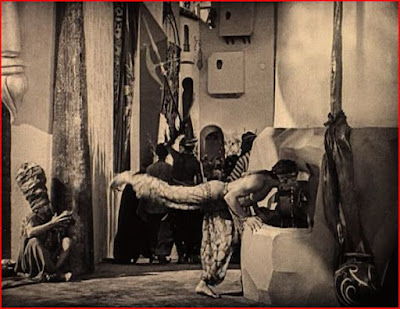
Fairbanks had a stage background, but in silent cinema he practised pantomime. It's not the same as "mime" which nowadays has to do with the manipulation of non-existent objects. Pantomime is the business of expressing oneself without words, and its how many silent actors described their work. Gesture has a lot to do with it, and Fairbanks does a lot of gesturing. So do most of his cast. The Thief of Bagdad has a lot of arm raising in it. Today it looks stagy and fake, but beside its practical purpose of making emotions plain from a distance it's a matter of style. Thief is a very stylized film, and it's more Fairbanks's style than Walsh's. His own style is very balletic, or else it's the style of a man who, like Chaplin, has been told that he had balletic grace and agility. He's flamboyant to the point of camp in his movements and his costumes in a way that's probably more alarming now than it was 80 years ago. Fairbanks himself probably saw no contradiction between his prancing and posing and his role as a manly man. Pantomime doesn't usually aspire to naturalism, and if you insist on naturalism you may as well try a different movie. In any event, an Arabian Nights fantasy probably shouldn't be held to naturalist standards of anything.

After all, what's this all about? Thief is the story of a shirtless barefoot brigand who eventually calls himself Ahmed. He pads the polished pavement of Bagdad in a one-man crime wave, eventually pilfering a magic rope that'll let him climb the highest walls. There's only one thing to do with such a gimmick: rob the Caliph's palace. Inside, however, he falls in love at first sight with the Caliph's daughter. This puts the whole kingdom in play, because the old Caliph has decided that whoever wins his daughter's hand will be his heir, the girl herself being obviously incapable of rulership. A geopolitical showdown results as the Prince of Persia, the Mongol Khan and the Prince of the Indies all seek her hand. So does Prince Achmed, the Prince of the Isles and Seas and of the Seven Castles, i.e. our hero in stolen finery. He happens to land butt first in a rosebush in a way that fulfills the prediction of the Princess's fortune-telling slavegirl, and given the unlikely looks of the competition that's a fortunate thing. But eventually Achmed is exposed as a fraud and cast out, while the Khan plots to infiltrate an army into Bagdad (with the help of traitorous slavegirl Anna May Wong) and win the kingdom as well as the girl.

A guilt-stricken Achmed, once contemptuous toward Islam, seeks consolation from the wise local mullah, who tells him to learn humility and earn true happiness through an arduous quest. It so happens that, the Princess's first choice having been disqualified, the three remaining Princes have been sent out treasure hunting. The one who comes back with the most unique treasure will win the Princess. The Prince of Persia buys a flying carpet. The Prince of the Indies recovers a crystal ball from the eye of an idol, at the cost of a minion's life. The Khan acquires a golden apple that can resurrect the dead. After rendezvousing at a caravansary, they combine their powers to fly back to Bagdad to cure the Princess of a mortal malady (secretly sicced on her by Wong). They argue over who should get the most credit, but our heroine points out that any one treasure was useless without the other two. The Caliph needs time to ponder this, but during that time the Khan makes his power play.

The suitors: (l-r) Persian, Indian, Mongol.

Meanwhile, after braving caves of fire, slaying a dragon, talking to a tree man, fending off a giant bat and resisting the temptations of mermaids, Achmed hustles back with his prize: a container of instant stuff. Instant horse! Instant princely clothes! Instant loaf of bread! Instant army of 100,000 men to liberate the captured city! And having earned happiness, he flies off on the carpet for his honeymoon.


This film has nothing more profound to say about the human condition than "Happiness Must Be Earned." It is pure high-spirited fantasy with onetime state-of-the-art special effects. Some of them, especially the crane-guided carpet sent swooping over William Cameron Menzies's massive sets, are still impressive. But it seems like the sets themselves were meant to be the most special effects. Many are so huge that Fairbanks has to make his gestures as big as he can just to be noticed. Walsh's camera is mostly immobile on the assumption that all you need to do is look at those sets and feel awe. When he fills those sets with hundreds or thousands of extras, it is awesome. It's certainly more awe-inspiring than programmers filling a digital screen with so many avatars or whatever you call them nowadays. It must be admitted that the presentation is little advanced in principle from the time of Georges Melies. On the other hand, the tableau isn't an automatically obsolete way of filming things, and there's something to be said for the way Walsh's images fill the screen. It may be the most appropriate way to tell the type of story Fairbanks wants, which is more a fairy tale than an action movie.

There's something sort of poignant now about the way Fairbanks romanticizes the Muslim world. It's fashionable now to deplore people like him, not being Arabs, for playing Arabs, but for all that Thief plays on stereotypes of Arab or Muslim culture, doesn't it speak to some admirable universalizing impulse in Fairbanks that he presents himself as an Arab hero who takes unquestioned moral advice from a Muslim teacher. He had a very different image of Arab culture than many people do today, and while it may be no more accurate than the present stereotype it's certainly a more congenial one than today's murderous puritan. Admittedly it's a vision of a fantastical past, but it's also a very American fantasy of maximum upward mobility (Thief to Caliph) that does look like a shortcut to success despite the star-written moralizing at the beginning and end of the film.

Don't go in expecting a fast-paced action film -- in fact, prepare to be patient for a relatively slow-paced 2.5 hours -- but if you appreciate impressive art direction and old-time heroic fantasy you may well be entertained by The Thief of Bagdad. It's tempting to dismiss films like this one as an aesthetic dead end, but that's just history playing tricks on us. As a historian I'm intrigued by the dead ends, and I found Thief fascinating. But I think people who understand the craftsmanship involved in this sort of project and understand exactly what they're going to see can still appreciate Fairbanks's work on its own terms.