Showing posts with label police. Show all posts

Sunday, December 24, 2017

BRIGHT (2017)

Urban fantasy is a genre of popular fiction in which mythological creatures coexist with humans in modern cities. There are two broad categories of urban fantasy, one in which the fantasy creatures hail from the horror genre: vampires especially, but also werewolves and all the rest. In the other category, you have the creatures of Tolkienesque high fantasy: elves, dwarves, orcs and so on. David Ayer's Bright, now streaming on Netflix, is one of the first large-scale attempts to put that second type of urban fantasy on screen. Like many an urban fantasy book, it uses the cop or crime format, giving us as mismatched LAPD partners Daryl Ward (Will Smith) and Nick Jakoby (Joel Edgerton), the latter being the city's first orc cop. Orcs are hated for their looks -- Nick is a "pig" even before he becomes a cop because orcs normally have tusks, though he's filed his down to fit in better -- and for their apparently treacherous role a long-ago war between the Alliance of the Nine Races and the forces of the Dark Lord. While this event explains centuries of human hate for orcs, it doesn't seem to have had any other major impact on the evolution of human society. Bright's LA is pretty much our LA, except that wealthy, beautiful elves live in their own exclusive enclave and some store signs are in non-human languages. Daryl Ward lives a normal suburban life (though his neighborhood is going gangsta and he wants to move out) apart from the occasional nuisance of a fairy buzzing around and being a pest.


Slices of life in Bright's America


There's a certain lack of imagination at work, but the point of the genre is the juxtaposition of the fantastic with the here-and-now, so there'd be no point in altering the here-and-now beyond recognition. More practically speaking, elves and orcs (or vampires) play the role in urban fantasy that Chinatown used to fill in pulp fiction: a community nearby and yet a world away, where people live by different rules from ours and often can get away with stuff we can't. Inevitably the world of urban fantasy invites comparison with the increasingly uncomfortably multiculturalism of here and now, and Bright directly invites comparisons when Daryl jokes, "Fairy lives don't matter today" when he swats a winged mini-humanoid pest with a broom. Nick Jakoby could be the oppressed minority or the distrusted refugee depending on your perspective. Despised by most fellow cops and society at large, he's also looked on as an "unblooded" sellout by the orc underclass. Daryl has even more reason not to trust Nick after getting shot by an orc gangster while Jakoby was preoccupied with buying his partner a burrito, and still more reason when evidence suggests that Nick let a suspect get away. It's sure to be a long, difficult day when Daryl returns to active duty, but neither he nor Nick could guess how difficult it gets.
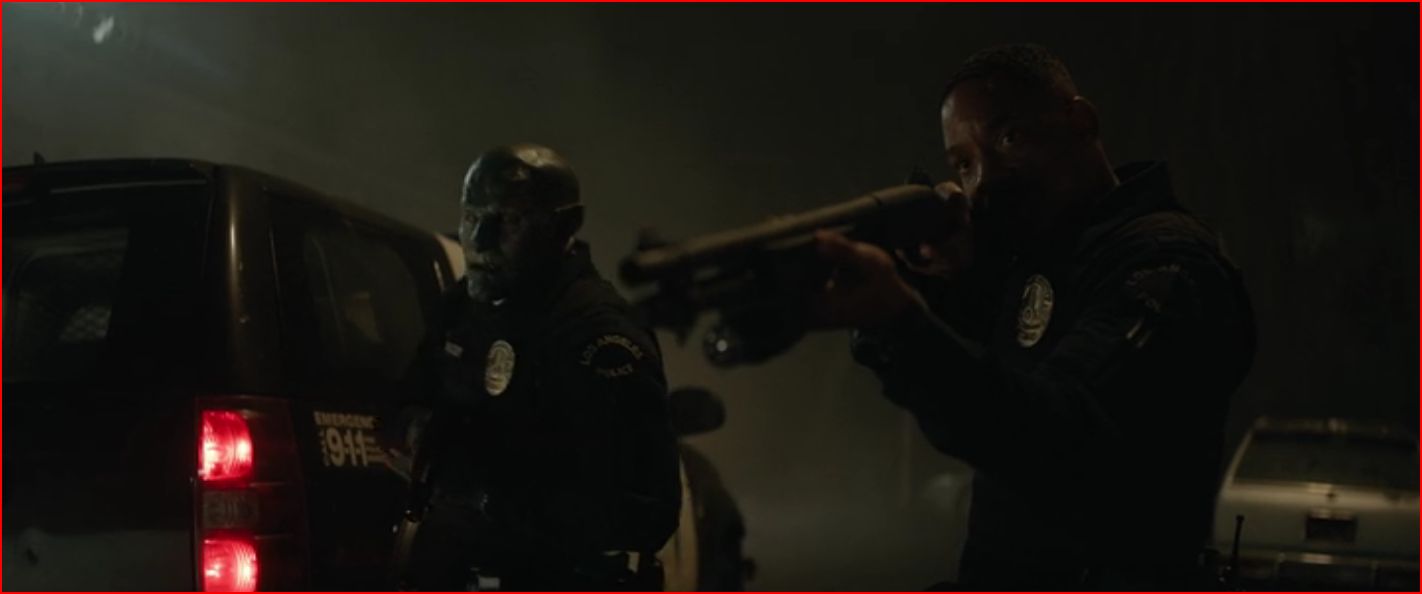

David Ayer may have formed an alliance with Will Smith after the dubious triumph of Suicide Squad, but the main reason he's here is his history of cop movies, beginning with his authorship of Training Day. His job is to maintain a veneer of verisimilitude as the proceedings grow increasingly fantastic. To a great extent, that's simply a matter of keeping the dialogue salty, or just the way Will Smith likes it. It's also a matter of restraint, and to the relief of anyone who saw Suicide Squad Ayer resists many opportunities to go over the top with special effects. Max Landis's story heads dangerously close to Suicide Squad territory as Daryl and Nick become embroiled in the hunt for a rare magic wand -- only a "Bright" of any race can use one without dying explosively -- that an evil elf (Noomi Rapace) wants to use to bring back the Dark Lord. A good elf (Lucy Fry, giving a strong Fifth Element vibe without the sex appeal) has the wand, but not only her evil sister but corrupt cops and both orc and human gangsters want it, hoping for everything from limitless wealth to a cure for the injuries that have left one crime boss in a wheelchair. Daryl has to kill four cops to stop them from taking the wand and whacking Nick, and from there the episodic chase is on, taking the three protagonists through a half-orcish, half-Hispanic underworld while the federal Bureau of Magic (led by an elfin Edgar Ramirez) scrambles to keep tabs on things.


You may have read some brutal reviews identifying Bright as one of the year's worst films. I've only seen the headlines in an effort to avoid spoilers, so I can only guess whether the reviewers have their knives out for Smith and/or Ayer, expressing reflexive hostility to the very premises of urban fantasy, or flinching from the implicit comparisons to real-world race relations. In all fairness, Bright is no instant classic and suffers from moments of gratuitous violence and story-sustaining stupidity -- e.g., why didn't the corrupt cops just blow Daryl and Nick away when they had a golden opportunity, or why does a sniper let the three protagonists run to shelter just after taking a deputy down with one shot? --  but it's easily better than Suicide Squad, to set the bar admittedly low, and not half-bad on its own terms. Smith and Edgerton develop a decent chemistry and Ayer maintains a better balance of fantasy and grittiness than he did in his previous effort. He passes one crucial test late in the picture by never having the portal or whatever the evil elf was working on open, and never showing us the Dark Lord. For the type of story he's telling this time, he didn't really need that extra spectacle. The climax, with an inevitable but still implausible revelation of another Bright, may induce groans, but by then the film should have earned just enough good will from indulgent audiences to be forgiven that ploy. 


This shot features some nice widescreen composition, some admirably grungy set design, 
and Lucy Fry's peculiar curiosity about restroom hand-driers.

Bright has a better overall production design than Suicide Squad, with Ayer's frequent cinematographer Roman Vasyanov also improving on his last collaboration. The real difference, I suspect, was that there was no nervous mega-corporation looking over the talents' shoulders throughout this production, which leaves Bright looser and sharper than the Warner Bros.-DC extravaganza. At the end of the day it's still an overblown B picture, and maybe too reminiscent of Alien Nation for its own good, but I found it a diverting experiment in translating pop fiction into a new movie genre.

Wednesday, September 6, 2017

DVR Diary: POLICE PYTHON 357 (1976)

A quarter-century before Alain Corneau's cop thriller came out, Yves Montand and Simone Signoret may have been the hottest couple in entertainment, at least in Europe. The Robbins and Sarandon of their day in their advocacy of left-wing causes, Montand was a pop singer turned actor who gained global cachet in The Wages of Fear, while Signoret was a major movie star on the strength of a string of art-house hits culminating in Diabolique. By the end of the 1950s both were doing high-profile work in English -- Signoret actually had started doing so at the start of the decade in Frank Tuttle's Euro-noir Gunman in the Streets -- she winning an Oscar for Room at the Top, he as an on-and-offscreen consort for Marilyn Monroe in Let's Make Love. They worked together occasionally, intriguingly in a French-language version of The Crucible and for the last time in Police Python 357. The years had not been kind to Signoret, nor had the cinematic double-standard that permitted Montand, looking by now almost like a gallic Walter Matthau, to be the onscreen lover of a woman 25 years his junior, while she, long since grown chunky, was reduced to playing his bedridden confidante. I'm probably reading real life into the movie, but I assumed that their characters -- he's a police detective, she's his superior's wife -- had had a romantic relationship in the past. In any event, he can talk freely with her about his current affair with the same woman (Stefania Sandrelli) his boss (Francois Perier) is sleeping with. This triangle grows unsustainable as the Montand character pressures her (with a slap) to commit to him, while she tries to goad the other man into pressing his claim more manfully.  Goaded too far, he finally presses his claim with a heavy ashtray, at which point Police Python becomes a cop-film version of The Big Clock, with Montand assigned to an investigation likely to incriminate himself.

Montand makes it through, despite a breakdown that sees him disfigure himself in an effort to throw off witnesses, but his victory seems quite pyrrhic. Corneau and cowriter Daniel Boulanger leave the impression that their protagonist can only destroy everything he touches, as lover, boss and confidante all end up dead. Montand's flic seems at heart to be a fighter, not a lover. Corneau sets the tone with a contrapuntal montage that plays over Georges Delerue's ominous theme, intercutting the making of breakfast with the making of bullets. Montand's proficiency on the firing range is pointedly contrasted with his deteriorating personal life. After all those disasters, Corneau closes the film with a climactic action scene in which Montand gets to play hero in reckless fashion, rescuing some cop buddies pinned down in an airport standoff by ramming his car into the bad guys.  He takes a bullet in the process but seems likely to survive, while one of the buddies tending to him discovers a clue that could implicate him all over again. The final implication, however, is that the grateful buddy is going to cover up for him. He's too good a cop to waste, but one can't help wondering what damage he may cause civilians once he's back on his feet.

Wednesday, April 12, 2017

OPERAÇÕES ESPECIAIS (2015)

The modern standard for Brazilian cop films was set by Jose Padilha's 2007 film Tropa de Elite, known in the Anglophone world as Elite Squad. Tomas Portella's film returns us to that violent milieu from the novel perspective of a female cop. Francis (Cleo Pires) is a bank employee who decides to try out for the police after rescuing a child during a robbery. To her disgust, she finds a bank security guard cowering in the same rest room where she'd taken the child. She proves a solid marksman, but learns quickly that shooting at targets is no substitute for the real thing.


While Francis turns out fairly badass, the film is realistic about her physical limitations. During one raid, she's bowled over effortlessly while guarding a stairwell when a suspect charges her. Portella and his co-writers also show her all too plausible terror during her baptism of fire, a combined car chase and fire fight. It's an impressively staged action scene, as are all the film's set pieces -- and it's made better by the director's emphasis on Francis's fear and discomfort as tight turns slam her from side to side of the car or bounce her off her partners. At one point, having struggled to pick her gun off the floor, she's crouched down in the back seat  after gunfire has blown out the rear window. One of her colleagues blasts away at the gangsters with his automatic next to her, and the empty cartridges rain down on Francis's neck while she frantically brushes them away.

That's Cleo Pires as Francis in the lower right in both shots.
Above, you can see a gangster jumping down from the upper left while another 
(in the little box just right of center) gets ready to open fire.


Francis careens from terror to recklessness in another major urban battle scene. The cops are trading fire with gangsters in a terraced apartment complex across the street, the gangsters hopping like mountain goats from terrace to terrace while gunmen try to cover their getaway. On the cops' side, a man is down and helpless with a leg wound, crying for help as Francis clings to cover. Finally she puts her own life in jeopardy, forcing her buddies to cover for her, as she drags the wounded man to shelter. She gets reprimanded for this, but it marks a turning point for her as she begins to overcome her rookie terror and win acceptance from her macho colleagues.

 The life of a cop is not all glamorous violence, but all over the world, that's what people pay to see.
 

Our heroes are federal police sent to a crime ridden town where an ex-cop is one of the leading gangsters and organized crime has much of the municipal infrastructure and public opinion on its side. At one point, the cops have to break out the candles and manual typewriters in order to take statements and file reports after their station loses power or, more likely, has it taken from them. I guess it's a good thing that they never throw anything out. The tide seems to turn after Francis loses a partner to a drive-by, but the politicians snatch defeat from the jaws of victory and reassign Francis and her team elsewhere. Despite that nod to the apparent facts of corruption in Brazil, Portella ends his film on an optimistic or at least a defiant note with the team arriving in a new town, ready for a new fight. Whether that means a sequel can be expected remains to be seen, but  Portella's skill as an urban action director and Cleo Pires' empathetic performance as Francis would make a reunion a welcome event.

Wednesday, April 13, 2016

DVR Diary: STRAY DOG (1949)

It doesn't surprise me that when Akira Kurosawa made a cop movie, he was influenced less by American film noirs than by Jules Dassin's shot-on-location procedural The Naked City. Kurosawa was more a naturalist than an expressionist, more elemental than chiaroscuro, so the whole shadows-and-light thing probably didn't impress him as much as it did others. As it is, there are faint parallels with an American procedural noir made the same year, Alfred Werker and Anthony Mann's He Walked By Night, though these shouldn't be overstressed. It comes down to an increasingly desperate manhunt for a seeming supercriminal, but for Kurosawa the criminal matters less than his pursuer, while in He Walked By Night the criminal is the most fully (or nearly) developed character. What Kurosawa mainly seems interested in is personal responsibility, as shown by his protagonist, a rookie police detective whose stolen gun is used in the criminal's crimes. As the rookie, Toshiro Mifune is driven by an already-awful sense of guilt that grows worse as robberies and a murder are traced back to the stolen gun. When the criminal nearly kills his new mentor (Takashi Shimura, inevitably), the rookie's guilt nearly breaks him, despite every well-meaning effort of his more seasoned colleagues to put all the blame for the crimes on the criminal. Once he starts using it it's his gun, not yours, they tell him, but you can't blame the rookie for feeling as bad as he does, especially once you understand that it's exactly that acute sense of responsibility that sets him apart from his antagonist (Isao Kimura). Both men are war veterans who were robbed on their way home. One man lashes out at society for that offense, among others, by becoming a criminal, while our hero becomes a cop. It's not that he blames himself for getting his stuff stolen, but it's his refusal to surrender to cynicism or rage, or to hold the whole world responsible, that makes him a hero.

Mifune is still young here, though Rashomon isn't far away, but it's still impressive that someone we recognize as one of cinema's mightiest badasses can so convincingly play someone so green and, in some ways, naive. Just the same, the film is nearly stolen from him by Keiko Awaji, playing the criminal's showgirl sweetheart, whose tough exterior is under siege by the rookie and her own mother. She gets one of the film's most memorable and gratuitous scenes as one of an dance team hoofing away at some seedy theater. Their routine over, the showgirls stagger back to their dressing room and collapse en masse in an almost orgiastic sprawl of exhaustion. Kurosawa lingers, half-leering, half-sympathetic, as the dancers catch their breath. As one might expect, he has a number of nice set pieces distributed throughout the picture, from Mifune's Droopy Dog-like stalking of a possible lead on the sale of his gun to the stakeout of a baseball stadium and the use of the PA system to lure the criminal into a trap. I said Kurosawa was an elemental director, and there's plenty of rain here to prove it, and an even more effective evocation of oppressive summer heat. Stray Dog is a slickly-made film and I suppose some will take it as further proof that Kurosawa spent too much time aping western genres and archetypes, but the emotional element of the film and Mifune's intensely emotive lead performance set this Japanese cop movie apart from its more world-weary or hard-boiled American models and mark it as an unmistakably personal film.

Tuesday, June 30, 2015

DVR Diary: THE SUPER COPS (1974)

Gordon Parks's cop movie -- the pioneer black photojournalist turned director's follow up to Shaft and Shaft's Big Score -- is a kind of missing link between Batman and Batman. Consider: the screenplay, based on a book glorifying the exploits of two New York City cops supposedly nicknamed "Batman and Robin," was written by Lorenzo Semple Jr., one of the key creators of the 1966 Batman TV series and the screenwriter of the follow-up feature film. And as if pointing toward the future, Pat Hingle, Tim Burton's Commissioner Gordon in the 1989 Batman film, joins the show late as a hardcase Internal Affairs inspector. Did Hingle's performance here as an buttheaded bureaucrat going after the wrong targets influence Burton's casting of him a generation later? Hard to know, unless Burton has spoken on the subject, but it'd be interesting to make a short subject using his scenes in Super Cops in a Gotham-style prequel to Burton's Batman. Super Cops itself is a curious hybrid of two seemingly contradictory Seventies genres: the tough-cop picture and the vigilante film. Dave "Batman" Greenberg (Ron Leibman) and Robert "Robin" Hantz (David Selby) were vigilante cops. While the TV ads I remember from childhood gave me the impression that they were "Batman and Robin" because of their acrobatic stunts, they probably earned the epithets at least in part because they did much of their crimefighting on their own time, after uniform hours, because they were impatient with the minutiae of police training and the tedium of rookie assignments. New to their neighborhood, the run-down 21st Precinct, Greenberg and Hantz went undercover at night to make citizens' arrests of drug pushers, working their way toward the local kingpins, the Hayes brothers. In their naive enthusiasm they don't realize how their activities make them look like shakedown artists, drawing the attention of Internal Affairs while earning the hostility of most of their co-workers who don't like to be made to look bad by their aggressive arrest record. All of this proves less provocative than many other cop or vigilante movies, largely because the film foregrounds the police bureaucracy, not the local criminals, as our heroes' primary antagonists. Super Cops has no political or cultural axe to grind. In fact -- and one would like to credit Parks with this, but why not Semple if he deserves it? -- the protagonists feel pity rather than hate for the ghetto underworld they patrol. An early sequence establishes the impoverished squalor of the precinct as our rookies see it for the first time. Their conclusion: if people can't make it out of places like this, why wouldn't they turn to crime? That one modest observation may have put audiences on their side even where we might have expected hostility to two Jewish hero cops.

The Super Cops story was too good to be true to some extent. Neither "Batman" nor "Robin" proved as incorruptible in later life as they were shown here. Wikipedia reports that Greenberg, after leaving the force for politics, did time twice for fraud, while Hantz quit the force after getting busted for pot possession in the Bahamas. All of this was in the future when the film came out, however, and Super Cops can be accepted as unapologetic entertainment. Leibman earnest aggression dominates the film, leaving Selby (the erstwhile werewolf of Dark Shadows) even more of a second banana than Burt Ward was to Adam West. Greenberg reveals himself a comic hero from the beginning, when he raises himself on tiptoe to justify his place in the front row of a graduation ceremony after the tallest men -- "Batman" is shorter than his "Robin" here -- to the front. His confrontations with the Hayes brothers and other foes are more comical in their banter than menacing. Parks directs the action with admirable clarity and with almost swashbuckling gusto during the climactic chase through a building that's falling apart all around them under the wrecking ball. And in a way the film itself acknowledges that its story may be too good to be true by showing us that the initial official story of "Batman and Robin" was too good to be true. Parks opens the picture with documentary footage of the real Greenberg and Hantz being honored for their conquests. He closes with a recreation of that scene with his cast of actors, having shown us in the meantime how the police establishment had to be brought kicking and screaming to acknowledge the officers' achievements. There may well have been further layers to peel away, but Super Cops is content to stop here. Audiences were presumably content to be entertained by an ideal of crimefighting too rarely lived up to in the real world of the time, or since.

Tuesday, March 24, 2015

MARDAANI (2014): "This is India!"

Female empowerment, Indian style. Here's a 2014 release that has a Seventiesish vibe in its pulp action and righteous indignation. Rani Mukerji stars as a Mumbai supercop for whom the war against human trafficking gets personal when a street urchin she'd befriended gets swept into the vile trade. Officer Shivani plows through official inertia to wage war on "Walt" (Tahir Raj Bhasin), the trafficking kingpin. With Shivani Indian heroines catch up to their western counterparts. She can outrun a motorcycle, though admittedly it's going slow on a sidewalk. She can get out of seemingly unbreakable bonds. Her adventures remind me of American pulp fiction or "golden age" comics. Some of the plot devices are so old that even within the film characters comment on how unlikely it is in the 21st century for a street criminal to have all his clothes hand-tailored, so that Shivani can track him by checking the tag on his shirt. There's even a climactic fight scene in which she throws her gun away so she can prove a point to Walt's erstwhile captives by beating the crap out of him with her bare hands. It's all quite corny and the plight of Shivani's involuntarily tarted up little protege (Priyanka Sharma) is milked for all its melodramatic pathos, but director Pradeep Sarkar plows ahead with such guileless enthusiasm that much can be forgiven. You can't help enjoying an early scene in which Shivani bitch-slaps some jerk whom I take to be a Hindu nationalist for vandalizing a shop that dared hold a Valentine's Day sale. He's India's answer to the Klan or the Daesh, though only a vandal, and he deserves what he gets from our heroine.


While bigots get beaten down for comedy relief, Mardaani taps something darker in Indian society at its climax. Shivani has defeated Walt and in the process has exposed a powerful politician whose kink is raping prostitutes. She has challenged Walt to hand-to-hand combat, as mentioned above, and humiliated him. But he doesn't care and isn't worried. "This is India," he reminds her, and that means his political and business connections will see to it that he serves little if any time. Her answer? Yes, this is India, but that means she doesn't necessarily have to arrest him to get him off the streets. Is she going to murder him, then? No, but they are: the girls he's tortured and exploited. Technically it won't be murder. Since this is India, the law there says it isn't murder is someone is killed in a demonstration involving a certain number of people or more. There just happens to be a quorum present, so as Shivani discreetly walks away the film's upbeat girl-power theme song plays over a lynching, the death of a thousand kicks from high-heeled shoes.


Mardaani's over-the-top final act alone makes the film worth seeing for fans of global pop cinema. Mukerji brings badass authority to her lead performance, and that's all the film really needs. I haven't watched as much Indian cinema as I probably should have by now, so I don't know how extraordinary or transgressive such a female role would be there. But it certainly can't hurt anywhere for people to see women kicking ass on the big screen. Just maybe it might make some men think twice before acting out their fantasies.

Tuesday, September 2, 2014

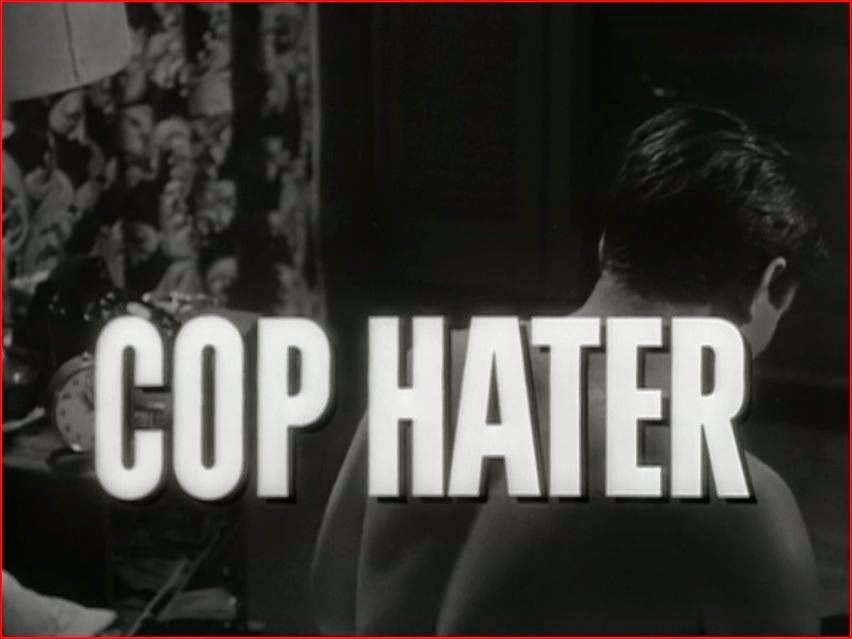
COP HATER (1958)

William Berke produced and directed the first two feature-length adaptations of Ed McBain's 87th Precinct novels before dying in February 1958. Cop Hater and The Mugger were released posthumously. McBain (aka Evan "Blackboard Jungle" Hunter) is credited with popularizing if not perfecting the police procedural genre in American literature. Movies had beaten him to the punch, a procedural genre being well defined by the release of He Walked By Night in 1949, seven years before McBain published Cop Hater. McBain's accomplishment was to sustain readers' interest in a precinct of police and their adventures over half a century, publishing new 87th Precinct novels until his death in 2005. I've read those first two books; they're page turners with the flavor of their era. The Cop Hater novel has more energy than Berke's movie, which was scripted by another popular crime novelist, Henry Kane. There are the usual arbitrary tweaks of adaptation: Steve Carella, the primus inter pares of McBain's ensemble, is renamed Carelli in the film; Carella's friend Hank Bush, one of the cop killer's victims, becomes Mike Maguire in the movie. Who knows why? The plot remains more or less intact, and on film comes across more like a noir than a procedural.


As you might have guessed, someone hates cops and is killing them. Three die in the course of the picture, including a token black officer. The 87th is challenged to find clues or figure out a pattern linking the murders. Meanwhile, Carelli (Robert Loggia) and Maguire (Gerald O'Laughlin) are on opposite personal trajectories. Maguire, something of a slob, seems to be losing his grip on his beautiful but bored wife Alice (Shirley Ballard) while Carelli is engaged to the magazine writer Teddy Franklin (Ellen Parker). Teddy seems like a sexist's dream woman: beautiful and intelligent in a way that doesn't impose upon you, since she happens to be deaf and mute -- a "dummy," as they said back then. We have to take the intelligence for granted since we don't see her at work and she communicates with her boyfriend not with American Sign Language but with pantomime signals the actress acquired, so the publicity tells us, through study with the deaf. See for yourself:


I can't help seeing a faint authoritarian streak in McBain ever since I read that he started a cop series because he decided private eyes shouldn't deal with murder cases. You might see that streak in the book and film's negative portrait of an irresponsible journalist who endangers Teddy by publicizing her relationship with Carelli after plying him with drinks to get a story about the murders. Cop Hater suffers as a procedural from this plot device, which resolves the mystery literally by bringing the killer to Carelli's, or rather Teddy's door. The procedural elements are most prominent in a scene where a forensics expert explains how one of the cop victims was able to get crucial clues about the killer simply by scratching him before dying. The final twist to the plot isn't exactly alien to the procedural, since the genre depends on a random assemblage of scattered puzzle pieces rather than a domino theory of ingenious deduction, but it also reinforces the noir feeling of the movie, which Berke conveys not in spite of but to some extent because of a certain poverty of style that effectively expresses a certain poverty of existence for low-income cops and frustrated wives in those primitive times before air conditioning was common. There's something authentically abject about the sight of O'Laughlin lounging in his underwear and swilling beer on a hot summer night. There's also an adequate amount of location work to establish the 87th's seedy milieu.


Along with the young Loggia, who makes a plausible Carell(i) and really deserved another crack at the role, you'll see a relatively young Vince Gardenia as a stoolie and a very young Jerry Orbach in his first credited role as a spokesman for the local youth gang. Ballard and Parker are attractive in their respectively forbidding and innocent fashions. But the film as a whole doesn't quite do McBain justice, and it's understandable that this first attempt at a film series didn't outlive William Berke, while the novels kept on coming, inspiring Akira Kurosawa (High and Low) and others to give them different degrees of cinematic life.

Monday, August 18, 2014

THE RAID: REDEMPTION (Serbuan Maut, 2011)

The decade's new standard for martial arts movies was set by a police thriller combining Indonesian performers and a Welsh director. Gareth Evans's Raid is the sort of action movie that may compel some American viewers to suspend disbelief as it segues from conventional cop action to martial arts mayhem. Where did the guns go? There's plenty of shooting early, but as the raiding cops, having no hope of backup and actually set up, fight their way up a tenement tower, practically a panopticon of peril, to the lair of crime lord Tama, we go from guns to machetes and finally to feet and bare hands. The transition is nearly seamless if you know what you're getting into, but Evans, who writes as well as directs, overplays his hand just a little when he has Mad Dog, one of Tama's sub-bosses, make a speech about how much more he enjoys beating people to death with his hands than he enjoys shooting or stabbing them. All pretense of urban realism falls away in that moment and The Raid stands revealed as pure pulp fiction. Anyway, Indonesia probably isn't as much of a gun culture as the U.S. or some other places. As The Act of Killing ably illustrates, people of the peninsula are often quite inventive about dispatching their enemies.


The Raid remains very much a cop film after it shows its true genre colors. Its behind-the-scenes subject is the treacherous politics of policing. The raid's commanding officer, Wahyu, doesn't tell his men until they're already in too deep that they can't expect backup because his is an unauthorized mission, his rogue action to kill or capture Tama. Wahyu's agenda is so close to his vest that he's ready to betray his men to the ultimate extent. Yet he proves a dupe, or so Tama claims when he tells the officer that he'd been tipped off about the raid and invited to kill a troublesome cop, the rest being a bonus. One gets the sense that the Jakarta police are authoritarian, ruthless and corrupt, except for an honest handful, many of whom end up sacrificed to the ambitions or rivalries of higher-ups. I could see an American film on the same subject, except it'd be guns all the way to the top floor.


I'm not complaining about The Raid, because the martial arts lived up to the film's already-lofty reputation. The highlight and instant entry in the best-fight-scene-ever sweepstakes is the two-on-one climax pitting the aforementioned Mad Dog (fight co-choreographer Yayan Ruhian) against a surviving cop and another sub-boss who happens to be the cop's brother. Again, Mad Dog takes the story into preposterous pulp territory; he has his erstwhile partner chained and is pummeling him like a heavy bag when the cop shows up. There's a pause while Mad Dog frees his captive, who proves hardly worse for wear, so our villain can test his might against two antagonists. Fastidious Mad Dog even raises the chain back up the ceiling so it won't impede the action or be used unfairly. If that sounds silly in the description, especially when I mention how the brothers wait patiently for him to finish, it's also a brilliant way for Evans to build anticipation for a battle that justifies the wait. For all the all-out mayhem he directs, Evans also proves himself quite good at suspense. He's happy to bring things to a halt after a gangster has plunged his machete repeatedly through a flimsy wall like a magician running his swords through the magic trunk with the girl in it. Our cop hero is behind the wall with a wounded partner and has just had his cheek sliced by that machete when something distracts the criminal. He has to stand there with that blade literally in his face, and he has to make sure somehow that there's no blood to tip off his pursuer when the blade is finally withdrawn. Nicely done.


Remarkably, Evans has not yet been assigned a Hollywood tentpole -- the Godzilla people went with a different Gareth -- though he did contribute to last year's portmanteau film V/H/S2. Instead he released The Raid 2 earlier this year and has announced a Raid 3, while an American Raid is reportedly in the works with little if any input from the original director. Evans may simply prefer to work in his adopted homeland, and it's not as if he hasn't made a name for himself worldwide from that base. Watch this space for a review of Raid 2 before the year is out; that should give some idea of whether Evans bears further watching.

Friday, June 13, 2014

MEET HIM AND DIE (Pronto ad uccidere, 1976)

There were two men named Franco Prosperi directing movies in Italy during the 1960s and 1970s. The better known of the two is Franco E. Prosperi, the collaborator with Gualtiero Jacopetti on the Mondo Cane movies, Goodbye Uncle Tom, etc. The other Franco Prosperi was not distinguished with a middle initial, and since the Mondo co-director often isn't in references, he's sometimes credited, or blamed, for the other guy's work. The other guy directed and co-wrote Pronto ad uccidere (literally, "Ready to Kill") a somewhat old fashioned movie in Italy's polizziotteschi genre. The same story might have been filmed in the U.S. twenty or forty years earlier. In short, it's about a cop (Ray Lovelock) who pretends to be a criminal to the point of getting caught attempting a robbery and going a prison, the better to infiltrate a drug gang led by Giulanelli (Martin Balsam). For our hero, the mission is also an opportunity for revenge; members of this gang shot and paralyzed his mother during an earlier robbery. As usual in such stories, our undercover man must earn the boss's trust without blowing his cover. Along the way he falls for a moll (Elke Sommer) who has an agenda of her own. This recent Raro DVD release is noteworthy only for its action scenes. The highlight is an extended sequence in which Lovelock, driving truck full of drugs hidden inside eggs, is hijacked after stopping for what looks like an injured female motorcyclist. Against four-to-one odds, Lovelock, after taking a beating, first commandeers the fully functioning motocycle, then chases down the truck, and then chases it down again after the hijackers drive him off the road. There's terrific stuntwork here highlighted by Lovelock's double doing a Yakima Canutt style trick, anticipating Indiana Jones by doing it with a truck rather than a stagecoach. There's also a nice ending that isn't really an ending as the story stops at a moment of truth for our hero, his vengeance denied and another enemy revealed. It's more of a Seventies moment than the rest of the picture as some of his assumptions are knocked out from under him, but otherwise it has less of the crusading zeitgiest of other Italian police pictures. There's little personality either in front of or behind the camera, though Balsam is always fun to watch and Sommer's still easy on the eye at this point. None of this is necessarily enough to recommend Meet Him and Die to posterity, but this film isn't really the bottom of the poliziotteschi barrel, either. Not a keeper, but maybe worth a look.

Sunday, May 4, 2014

CONVOY BUSTERS (Un poliziotto scomodo, 1978)

On the verge of making his first movie, Maurizio Merli was arrested for a crime he didn't commit. Ruggero Deodato was the director, and as he tells the story, young Merli had gotten his first significant TV gig shortly before, and when an old woman saw the program, she thought she'd recognized the actor as a man who had attacked her. According to Deodato, Merli was ultimately proven innocent, but not until he had spent a year in jail. Believe it or not. The story has an obvious irony if you know Maurizio Merli as Italy's answer to Dirty Harry, that country's iconic rules-be-damned tough cop of the 1970s. If true, the story would make you wonder how Merli felt playing a character -- the name changed but the personality was consistent -- so self-righteously indifferent to the rights of the accused and so forth. It may not have troubled him at all. Merli's contemporaries agree that success went to his head, for one thing. Also, the master premise of the police genre in Italy was that we all know who the really guilty people are -- we all know who the mafiosi are in our midst and what should be done with them. The villains in Merli's films are in a different category than the unlucky Merli of Deodato's anecdote, and the target audience would have rejected any analogy with mistakenly railroaded wretches like young Maurizio.


Un poliziotto scomodo ("An uncomfortable cop") is relatively late in Merli's starring run, which was short lived due to the actor's poor health and other factors. You could believe that Stelvio Massi's picture was meant as a pilot for a Merli TV show, since it breaks into unrelated halves. This time the star plays Commisario Olmi of the Rome homicide division, investigating the murder of a young woman. Given a car's license plate by an eyewitness, Olmi soon learns that the car has been torched and its driver killed. He goes after the son of a powerful criminal in his usual no-holds-barred fashion -- his partners conceded that he really does go too far sometimes while Olmi slaps the snot out of the guy. The inspector is no respecter of gender, either. Questioning a young woman, he slaps her in the face despite her warning that her lawyer's on the way. He won't get here for an hour, Olmi explains, and in that time Olmi will have beaten the crap out of her. She talks. How you feel about scenes like this depends on your feeling about crime. In Seventies Italy, you obviously had a lot of people who took a by-any-means-necessary attitude toward crime fighting, what with not only the Mafia but its regional rivals and terrorist gangs like the Red Brigades running amok. Merli's aren't mystery movies; you know who's guilty (the way many know O.J. is guilty no matter what a jury says) and you know they have to be stopped, or made to confess, at all costs. Their guilt is so self-evident that they have no rights a virtuous cop should respect. Merli's Italy is a noir-free, nuance-free zone. But these films' great concession to realism is their recognition that the Merli cop can't accomplish much in any one spot for long. The bad people have too many connections, too much influence.


One Olmi realizes that he won't be able to take down his main target, he basically gives up. He asks to be transferred to a quiet locale, and ends up in a coastal tourist town, where he falls in love with a schoolteacher (Olga Karlatos). At his new desk he actually unloads his revolver, marking a peaceful turn in in his life. But he learns, as if he couldn't guess, that crime is everywhere. His new town is the headquarters of a smuggling racket; ships receive contraband at sea and send them by truck throughout Italy. The trucks, by the way, explain the title change for the film's American release during the C.B. radio craze sparked by the song "Convoy." These smugglers have a gimmick to avoid detection that's the stuff of comic books or pulp fiction. They control the local TV station, which broadcasts a soft-core dance show at the time of the off-shore deliveries. If they get tipped off that the cops are watching, they have the program interrupted and replaced with a movie. The locals assume that some old killjoy has called in to complain, but Olmi figures out the trick the first time he sees it and turns the tables on the smugglers. His men force the station to broadcast the dance show at an odd hour, and the smugglers assume that there must be an off-schedule delivery.


The ensuing mayhem climaxes when gang members run into town and take the local school, along with Olmi's girlfriend and several students, hostage. The gang leaders has trouble keeping his men in line when one gets rapey thoughts about the teacher, while Olmi arranges to be inconspicuously raised to just the right window by a stealthy construction crane. The film ends on an abrupt and oddly downbeat note as Olmi rescues the teacher and her kids, only for the teacher to see Olmi's true, violent nature. Massi leaves the impression that something dies there after all as Olmi walks away alone.


Massi's muscular direction is nearly all you could ask for for this kind of picture, though it's not up to the standard set by Umberto Lenzi's Violent Naples. Merli is Merli, though his character is arguably more introspective here than usual. The real problem is the plot. It's bound to disappoint if you expect the two halves of the film to tie together at some point, e.g. if Olmi learned that his Roman antagonist was the ultimate boss of the coastal smugglers. But that never happens, and it leaves the feeling that the writers had either too much or not enough material for a single feature film. Un poliziotto scomodo seems to be saying something about the Merli archetype, whether something as simple as he'll always have crime to fight or something darker about his essential violence. But in the absence of dramatic unity some of the point, and definitely much of the force, is lost. It should not be anyone's introduction to Maurizio Merli, though the NoShame DVD has a lot of interesting supplemental material about the actor, including the Dedoato interview. That material should have been attached to a more definitive Merli film.

Sunday, March 24, 2013

CONFESSIONS OF A POLICE CAPTAIN (Confessione di un commissario di polizia al procuratore della repubblica, 1971)

In his imperfect English, Franco Nero describes this film from the late director Damiano Damiani as the "most sold" movie in the history of Italian cinema. What he means is that Confessions of a Police Captain played in more countries around the world than any previous Italian film. This fact must gall him, since he reports that the producers never paid him for his work. That may explain why he didn't do his own dubbing for the English-language edition. The effect is mixed, since Nero is one of the few Italian actors whose own voice was readily recognized by American audiences. But doing without Nero's voice preempts any confusion over why his character alone has an accent while his co-star Martin Balsam, doing his own dubbing, clearly doesn't. Nero encouraged Damiani to cast Balsam after both star and producer had rejected Anthony Quinn and Ben Gazzara -- the latter had already committed to the film -- because both actors insisted on changes in the story and its location. Nero had seen Balsam in Catch-22 and other films and thought he looked Sicilian. It was a good break for Balsam, who could depend on work in Europe for years afterward, and he's a surprisingly authoritative figure in the title role. The picture itself is a potent urban tragedy, a portrayal of a government so rotten with corruption that two essentially honest (or at least good) men are unable to trust one another in the fight against crime.


Balsam is Captain (more correctly, Commisario) Bonavia, first seen paying a visit to a lockup for the criminally insane, where he orders the release of an atypically fastidious prisoner. Only days later, the ex-prisoner shoots up an office building, dying soon afterward of wounds inflicted by the guards. Bonavia seems to have expected this to happen, but he's surprised to learn that one person in particular wasn't killed and wasn't even there. He has to assume that the apparent target, one D'Amrbosio, was tipped off to the impending attack. Meanwhile, newly arrived assistant prosecutor Traini (Nero) finds the situation fishy as he learns more about the circumstances of the con's release. He can guess that Bonavia is up to something, but the reason remains a mystery. Meanwhile, Bonavia regards anyone else on the case as an impediment or a threat.


Bonavia and Traini circle one anoter warily and with increasing hostility as Traini sets up a meeting with the otherwise-elusive D'Ambrosio to learn why the ex-con or someone higher up would want to kill him. Finally Bonavia has to put his cards on the table, explaining to Traini his grudge against D'Ambrosio. It has to do with his failure to convict D'Ambrosio for the murder of a union agitator ten years ago, mainly because an eyewitness to the killing, a shepherd boy, had "accidentally" fallen off a cliff. D'Ambrosio controls the workforce on corrupt construction projects and is tight with local businessmen and politicians. That makes him virtually untouchable for Bonavia; hence his recourse to assassination, relying on a man whose family had a grudge against D'Ambrosio and whose sister (Marilu Tolo) has information on D'Amrbosio's more lethal activities. When Bonavia takes her into his personal custody, it only makes him look worse in Traini's eyes, since the prosecutor still suspects more venal motives on the Commisario's part. The gears of justice only seem to tighten the noose around Bonavia's neck, thanks in part to Traini's naivete, until the police captain feels compelled to take even more drastic steps to secure justice ...


Confessions may be the most pessimistic -- or cynical, depending on how you see it -- of Damiani's crime films, though it leaves open an actually strong possibility that Traini may finally do the right thing. It leaves you questioning what he could accomplish, however, given the systematic, self-reinforcing and demoralizing corruption in Sicily. The movie is clear kin to Italy's tough-cop movies from the same decade but is clearly more ambivalent about the apparent necessity of cops bending or breaking rules than the average Maurizio Merli or Tomas Milian vehicle. Balsam does a lot to sustain the ambivalence, avoiding the self-righteous hysteria we might expect from his role. When he blows his stack, it's in frustration with the system, while his vendetta against D'Ambrosio is a more cold-blooded affair, explained in matter-of-fact fashion. There's a growing resignation in his character, again best expressed by the actor's restraint when he realizes that Traini has unwittingly doomed another character. You remain convinced throughout of his authentic moral indignation, but it's Balsam's underplaying, his refusal to let you think his character is crazy, that keeps the Commisario a sympathetic and ultimately tragic figure. I can only judge Nero fairly by his physical presence in the English edition but Damiani again exploits a certain earnest shallowness he can make the actor project, as he did in a similar role in Day of the Owl. It's to Nero's credit that he liked working with Damiani even when the roles weren't flattering. I'd like to see The Case is Closed, the prison movie they made together between this and How to Kill a Judge, but I don't know if it's available in any English language form. I do have How to Kill a Judge at hand, so look forward to a review of that title in the near future.

Sunday, September 2, 2012

ONCE UPON A TIME IN ANATOLIA (Bir zamanlar anadolu'da, 2011)

The English-language title of Nuri Bilge Ceylan's latest film is a literal translation from the Turkish, so there's no denying that the director works in the shadow of Sergio Leone -- except that's not quite accurate. The image isn't quite right. Think of Leone as the sun, rather, while Ceylan works in the shadow of Quentin Tarantino. That may not sound right to you, either, given how little violence or action this film has. But Tarantino helps explain the influence of Once Upon a Time in the West in particular among Leone's movies. You could reference a different film in acknowledging Leone's influence, as the Korean film The Good the Bad the Weird did. Why invoke Once Upon a Time..., apart from a belief that the fairy-tale prefix is cool? Tarantino does it in Inglourious Basterds with a title setting the picture "Once Upon a Time in Occupied France." This sets up the scene in which Christoph Waltz's Jew-hunter makes menacing small talk with a French farmer. The small talk makes it Leonean, makes it Once Upon a Time. More specifically, the time killing does. What set Once Upon a Time in the West apart from Leone's previous westerns, and reportedly turned Clint Eastwood off of appearing in it, was the lavishly protracted credits sequence in which Jack Elam, Al Mulock and Woody Strode occupy a train station and wait for Charles Bronson arrive. They're not much for small talk but Leone is fascinated by the ways they kill time, from Elam trapping a fly in the barrel of his gun to Strode accumulating water from a leaky ceiling in the brim of his hat until he can take a drink. Tarantino is Leone plus George V. Higgins (an author about whom I've written before and will have cause to cite again later this year). His characters kill the time with conversation, sometimes brilliantly but sometimes excessively (Death-Proof). Once Upon a Time in Anatolia applies the Leone/Tarantino method to a police procedural.


Following a prologue that seems to set up some action, only to cut away, the film proper follows a group of police investigators in three cars through the Anatolian countryside over the course of a night and morning, with two of the men we met in the prologue in custody. The cops, including a sensitive doctor who emerges as our POV character, want the suspects to show them where they buried a man they presumably murdered. The perps' memories aren't very good. One was drunk at the time and the other's kind of simple. They stop and start over again several times, the tougher cops getting increasingly frustrated. There's a lot of time for small talk, discussions of the virtues of buffalo yogurt, seeming tall tales of past cases. They stop in a village where courtesy requires them to settle down for a feast at the mayor's house, until the power goes out. They finally find the body, hogtied, the next morning. The cops' moods go across the board. Some of them are appalled over the killers' apparent barbarity -- turns out they hogtied the guy because that was the only way to fit him into the trunk of a car, and fitting him into one of the cop vehicles becomes a blackly comic problem later. But the prosecutor accompanying the cops cracks himself up by noting that the mustachioed victim resembles Clark Gable, only to be told by one of the cops that he looks a little like Gable himself. The onetime "King" apparently looms larger among Turks today than he does among his own people -- or else that's the Tarantino influence coming through again.


You get the feeling that the doctor doesn't really know how to deal with the whole experience, which proves a sort of domestic tragedy, the man having died because he started a fight after hearing that one of the eventual killers was his son's real father. Before he learns this he tends to be more kindly toward Kenan, the lead suspect, while the  more hardened cops warn him that Kenan is out to manipulate him. Yet we see Kenan blubber like a baby when the mayor's daughter offers him some honey, and overall he looks more like a sad-sack than a badass -- especially when he appears (unintentionally?) haloed by the headlights of the car behind him while sitting among his prosecutors. Through the doctor's eyes we see Kenan take a rock to the face from a kid in an angry crowd outside the police station -- the kid is apparently Kenan's natural child. While the other investigators find ways to objectify the victim -- the Clark Gable jokes, for instance -- that do little to restore the humanity Kenan had taken from him, the doctor opts at the end of the picture for an act of reticence -- he suppresses autopsy evidence indicating that Kenan had buried his victim alive -- motivated by compassion for perpetrator and survivors alike. Revealing that extra sordid detail would only cause more pain for everyone. It's probably also telling that while the victim is dug up and displayed in broad daylight, in full view of the camera, Ceylan always keeps his camera above the grisly work of the autopsy the doctor supervises. The Tarantino influence is more a matter of form than a matter of content.


Ceylan has established his own identity as an international arthouse mainstay over the past decade, and he has enough of a distinct directorial personality that the Tarantino influence might go unnoticed. Pictorially Ceylan is his own man. While taking full advantage of a wide screen, his effects are often more like those of a miniaturist in his attention to fine detail -- though I may see that only because I watched the film (in HD) on a tablet rather than a full-sized monitor. As was the case in his previous picture (and the only other one I've seen), Three Monkeys, his frames sometimes seem too carefully composed, too self-consciously painterly. His aesthetic sense remains underdisciplined, so that the brilliant compositions threaten to distract attention from story or theme. There's almost a show-off quality in the cinematography of Gökhan Tiryaki: look what I can do with lighting at night! The balance of style and substance remains uncertain in Ceylan's work, but any excess only enhances its attraction as a visual spectacle. His actors, however, are unimpeachable; it's hard to judge in a foreign language, but nothing rang false here. The writing, shared with his wife and another scripter, grounds the flights of style so that substance arguably triumphs in the end. That accomplishment may mark Ceylan as a director who shares influences with Tarantino rather than being influenced directly by the American. While Tarantino likes to wear his influences on his sleeve, Ceylan may yet transcend them and become an influence in his own right.