Showing posts with label Japan. Show all posts

Wednesday, June 5, 2019

DANGER PAYS (1962)

In recent years American audiences were made acquainted with "Nikkatsu noir," the Japanese studio's sometimes gritty, sometimes stylish crime films of the 1950s and 1960s. Nikkatsu made other kinds of crime film as well, including this Ko Nakahira film that might best be described as Runyonesque in the manner, if without the music, of Guys and Dolls. It showcases a colorful crowd of cartoonish crooks, led by Nikkatsu noir standout Jo Shishido as Glass-Heart Joe, a petty purple peacock of a hood who putters around town in his tiny two-seater looking for the main chance. When gangsters on a larger scale hijack a truck carrying paper used to print currency, Joe figures out that there's counterfeiting to be done. The thing to do in such circumstances is to nab the top counterfeiter, an old man known as The Expert (Bokuzen Hidari), and ask a high price of the hijackers for his services. Unsurprisingly, Joe isn't the only guy to get that idea. He has to deal with two semi-friendly rivals: Slide Rule (Hiroyuki Nagato), so named because of his Mad Thinker-like habit of calculating the probabilities in any situation, and Dump Truck Ken (Kojiro Kusanagi), so named because that's what he drives. They have Joe's number because they know his weakness. Rub two pieces of glass together and the squeaky sound drives Joe bananas and renders him helpless.


These three cancel each other out initially, letting the hijack gang get away with The Expert, who proves a bit of a prima donna. He demands ideal work conditions, i.e., working in the basement of the Cabaret Acapulco  with a glass ceiling giving him a private angle on the showgirls performing on stage. His new employers prove quite accommodating, being desperate for a big payday when they exchange their counterfeit yen for authentic U.S. dollars from unsuspecting Hong Kong crooks.


The rest of the film follows the three small-timers' attempts to snatch The Expert until they're forced to join forces for their own protection. Along the way, Joe picks up a feisty sidekick when his machinations get Tomoko, an innocent secretary (Ruriko Asaoka) fired from her office job. She proves to be a judo and akido expert who gets to throw Joe across a room in one scene and gets into an extended brawl with a randy trucker in another. Pound for pound she's probably the toughest of our protagonists, as long as firearms aren't involved. She otherwise makes a helpful accomplice when Joe's trying to convince the hijackers, for his life's sake, that he's wearing a wire and the cops are listening in.


Since everyone's hoping for a big payday, the danger has to match the prize. However goofy the main characters seen, this is still a take-no-prisoners crime film. It opens with the original truck drivers getting murdered, and reaches its climax when our fighting foursome, after escaping a gassy deathtrap, somehow shoot their way out of an elevator shaft, slaughtering the entire hijack gang. The joke here is that two-fisted Tomoko gets ill at the sight of blood. The irony is that those gangsters gave their lives for nothing. On a whim, the Expert had tricked them, putting a subtle flaw in the engraving that renders the fake bills even more worthless -- but our heroes hope to put one over on the Hong Kong crew before those fools have a chance to figure things out....


It's a fun change of pace to see Jo Shishido in something like Rat Pack mode, and the probability that he'll bungle everything keeps him sympathetic throughout. The comedy is broad though not embarrassingly so, and the vivid cinematography of Shinsaku Himeda, a frequent collaborator with Shohei Imamura, makes the whole thing lovely to look at. International audiences don't get comedies like these as often as they get any country's more violent and cool genre pictures, but something like Danger Pays probably brings us closer to popular taste in Japan than the more arty or outrageous films. We need more comedies like this to round out our picture of one of the most prolific film industries of the golden age of international cinema.

Thursday, April 25, 2019

On the Big Screen: BLIND WOMAN'S CURSE (1970)

Teruo Ishii might be called the Tod Browning of Japanese cinema. He shared with his American precursor an interest in crime and an instinct for the grotesque. These converge in Blind Woman's Curse, an early starring role for 70s death-goddess Meiko Kaji that I got to see at the Proctor's GE Theater thanks to the It Came From Schenectady cult film society. If some of the film's virtually supernatural elements seem incongruous in a yakuza film, bear in mind that its setting is implicitly a fantasy film, one in which a yakuza boss can be described as pure in heart. That boss is our star, playing Akemi Tachibana, who inherited the mantle and the unquestioned loyalty of her henchmen from her father. She's a fighting boss, as demonstrated in a formal showdown with another gang during the opening credits, and almost unconsciously charismatic, as demonstrated when, serving time for her role in the fight, she converts some skeptical fellow convicts in a women's prison into future soldiers. Her clan controls a public market but is regularly challenged by her clownish rivals, the Aozora clan. These challenges aren't to be taken too seriously, since the primary attribute of the Aozora boss (Ryohei Uchida) is the long-unwashed loincloth that adorns his prominently displayed buttocks. But when a retaliatory raid on his gang goes terribly wrong, Akemi comes under increasing pressure to escalate the feud.

As we quickly learn, events are being manipulated by a third gang, led by the ambitious Dobashi (Toru Abe) and abetted by a traitor in Akemi's midst. The provocations grow more extreme as Akemi's followers are stripped of the dragon tattoos that adorn their backs and a dubious feline is seen licking at the flayed remnants. There are, in fact, still more players in the game. One is a soft-spoken swordswoman (Hoki Tokuda -- at the time Mrs. Henry Miller!) who happens to be blind. She happens to have been blinded by Akemi in that opening-credits fight, during which her brother was killed. She actually looks really good for someone who apparently had her eyes slashed, and of course, this being Japan, her handicap confers a compensatory advantage in fighting skill. A cat licking her wounds immediately after the injury probably helped as well. Anyway, you get the idea; she's out for vengeance against Akemi. Meiko Kaji is the object of vengeance for once, that is, but this was still early in her career before she was set in her ways.

What the story is with the blind woman's sidekick, who can say? Ushimatsu is hunchbacked performance artist, played by Tatsumi Hijikata, credited as a creator of the modern dance form of butoh.  We're treated to one of his strange performances, enhanced (if that's the word) by Ishii's (and Osamu Inoue's) frantic editing. We're also treated (if that's the word) to his hobby, which is maintaining a carny house of horrors featuring fake (???) severed heads, limbs, etc. Ushimatsu appears to go above and beyond whatever mandate the blind swordswoman or Dobashi gave him, and his exploits are pretty much the essence of this picture. At one point, after the more conventional thugs have bumped off Akemi's wise old uncle, the rare yakuza who has gone straight, the hunchback shows up to lick and fondle the corpse. Later, the apparently living corpse shows up to spook some people, but when the head promptly rolls off we see that Ushimatsu is just having fun with his new meat puppet. As far as movie hunchbacks go, this guy makes Paul Naschy in Hunchback of the Morgue look like Quasi from the Disney cartoon.

Things can't go on like this forever -- can they? -- so finally Akemi's had all she can stand, til she can't stands no more. Once the traitor in her midst is exposed, she leads the climactic assault on Dobashi's headquarters, except that it's only a warmup for the inevitable showdown between our jingi-licious heroine and the blind swordswoman. Again, in Japan you always bet on the handicapped person in these encounters, even if it's Meiko Kaji on the other side. Only this time, you wouldn't collect, because nobody wins. After the damned cat tries to interfere and gets gutted for its trouble, it looks like Akemi is down for the count. She's waiting for the coup de grace, but it never comes, for the blind swordswoman can tell -- she usually can smell such things -- that our yakuza boss lady is genuinely repentant about killing her brother and the other stuff. She accepts this as an apology, takes her dying cat and goes home. But let's face it: anything after what we've already seen in this picture is going to be an anticlimax, and maybe that's for the best. Otherwise people are bound to leave the theater in a disoriented state dangerous to themselves and others. As it is, the downbeat-yet-upbeat finish gives viewers time to reflect on the fact that, for all its excesses and confusions Blind Woman's Curse is goofy fun, as long as you're in the right -- or fright -- frame of mind.

Saturday, November 17, 2018

LEGENDS OF THE POISONOUS SEDUCTRESS: FEMALE DEMON OHYAKU (1968)

Female Demon Ohyaku is like a film noir where the hero and the femme fatale are one and the same. The heroine is the moll of a thief whose gang is planning a big gold heist thanks to inside information from a government bureaucrat. The heist goes off as planned, and then the betrayal goes off as planned -- except for one thing. The bureaucrat, probably to no Japanese audience's surprise, plans to eliminate the thieves and claim all the gold for himself, presumably writing it off to the government as a loss. The gang is wiped out except for Ohyaku (Junko Miyazono) and her boyfriend Shin (Kunio Murai), who's stashed the loot in secret. Shin is put to the torture, his head placed beneath the blade of a guillotine, and when that doesn't work Ohyaku is tortured in front of him. To spare her he gives the gold away, and for his trouble his head's lopped off as Ohyaku watches. She's sent to an island prison where slave labor mines more gold.


To this point, everyone has underestimated the heroine. She survived a near-drowning in infancy when her mother jumped off a bridge, but bears a scar as a constant reminder of this primal injustice. She grows up to be a high-wire artist but has grown sick of all the wolf whistles by the time the story proper starts. Shin's scheme looks like the easy path to a new and better life, but after the great betrayal the only path left to her is the path of revenge.


On the island, Ohyaku becomes the plaything of a privileged convict and his wife, a tattoo artist (Yuriko Mishima) who grows obsessed with the heroine's smooth skin. She aches to tattoo and otherwise make Ohyaku her own. Ohyaku appears to give in, and rather likes the idea of a big nasty demon tattoo on her back, but for her the non-poisonous seductress is just one of many people she manipulates and leaves in the dust on the way back to the mainland. There, her ultimate revenge will be twofold. With some gangster friends she'll rob not merely a gold shipment, but the mint itself -- and then she'll kill the bureaucratic bastard who ruined her life the same way he had Shin killed.


Female Demon Ohyaku has an oldschool attitude toward revenge from which modern American pop culture has grown alienated. We've long understood that revenge can make a monster of you, the end justifying all means and all manner of mistreatment of not just the guilty but the innocent. Nowadays, we like to catch someone on the brink of taking revenge and tell them, "This is not you" or "You're better than this." I don't know if Japanese attitudes have changed in a similar way over the last 50 years, but in this picture, set sometime during the 19th century, when Ohyaku tells her friends what she's going to do to her past tormentors, their response basically is, "You go, girl!" Some modern viewers may expect her to stop short, to decide that the bad guy isn't worth what Ohyaku presumably is doing to her own soul or karma, but let me assure you that she does not stop short. There's something both awful and awesome about that that may be lost on those whose moral hedonism is so absolute that they can't even imagine anyone actually deserving to be killed. Movies like Ohyaku allow a vicarious release from the passivity such absolutism may encourage, without necessarily convincing anyone to turn killer. Ohyaku's revenge may seem self-indulgent to some viewers, but it also lends the film a kind of gravitas lacking in today's more common appeals to "hope," regardless of whether you think the heroine right or wrong. One can assume that identifying her as a "demon" makes Yoshihiro Ishikawa's film something other than an unambiguous endorsement of Ohyaku's revenge, but the fact that she is a heroine probably tells you as much about the world she lives in, or the world as Ishikawa saw it, as it tells you about Ohyaku herself.


Sunday, September 2, 2018

KAIZOKU BAHANSEN ("The Pirates," 1960)

The director Tadashi Sawashima, who died last January at age 91, specialized in samurai and yakuza films. I suppose a pirate film would occupy a middle ground between those two categories, depending on whom the English title refers to. Depending on what you read -- I recommend an essay by the scholar Bernard Scheid in the anthology The Sea and the Sacred in Japan -- "Kaizoku Bahansen" is something of a redundancy, since both words have been translated as "pirate." Kaizoku seems to be the more unambiguous word, while bahansen, in the film's historical context, has more to do with illicit trade. During the mid 16th century CE, Japan's Sengoku or civil war period, China forbade maritime trade, but Chinese traders maintained clandestine relations with their Japanese counterparts. The argument of Sawashima's film is that the bahansen in general were peaceful traders, but acquired a bad name because a few bad apples raided and plundered coastal China, Korea, and other places. Thus, in the film, Kamon (Hashizo Okawa) is initially outraged to discover that, though raised a merchant's son, he's actually the son of a renowned bahansen. He discovers this when his natural father's old cronies press him, for all intents and purposes, into the service, though a younger leader (Eiji Okada) wants nothing to do with the landlubber. Kamon begins to change his mind when he's told that his father and mother were murdered by outright pirate Uemondayu, who's been ravaging the seas under the bahansen banner. Having some pretty girls with the fleet also helps win him over to the cause. Fortunately, he proves a natural with some innate cunning, winning a mast-climbing contest by distracting his competitor with the sight of one of those women. With his sea cred thus established it's on to high adventure on the high seas.


Toei spent some money on this film, which deploys several full-scale ships on open water, though they resort to more predictable model work on occasion and many night scenes on board are understandably shot on soundstage interiors. All in all, there's less of a ship-in-a-bottle feel here than in contemporary pirate programmers from the U.S. Sawashima directs energetically, cross cutting and moving his camera closer and closer to the principals to build up momentum for the film's sea battles and keeping his climactic shipboard fight moving at an urgent clip. If anything, his direction is most frantic and over the top in the scenes where the good bahansens return to and depart from their home port. The home folks go nuts for their seafaring heroes, their enthusiasm illustrated by insistently repetitive shots of celebration, from sailors throwing themselves into the water to meet welcoming rowboats to shots of cheering females. The director's galloping camera gives these festive scenes more of an epic feel than anything else in the picture.


In the end it's a simple story of good and evil, but its goodness of purpose is marred by a trip to a primitive island previously ravaged by Uemondayu, populated by badly blackfaced Japanese extras who give the good guys exactly the treatment you might expect from the most racist American movie, short of throwing our heroes into the proverbial stewpot. If you took offense at the Faro Island scenes from King Kong vs. Godzilla, you'd better steer clear of this picture.  But if you think you can stomach some unenlightened moments, you'll find Kaizoku Bahansen a pleasant enough adventure film that gets more entertaining as it goes along.

Sunday, May 13, 2018

FUNERAL PARADE OF ROSES (1969)

It was interesting of TCM to run Toshio Matsumoto's film in the "Underground" time slot instead of during the customary foreign-film slot, as if the programmers thought Funeral Parade of Roses might be too radical for their regular foreign-film audience. Radical it certainly is, flaunting its Godard influence and featuring a "gay boy" as its hero. It's of a piece with contemporary Japanese New Wave cinema in its attention to political protest in the country, but its suggestion of an affinity between political and sexual radicals proves problematic given its sometimes satiric presentation of cross-dressing homosexual youth. Given the way it speeds-up catfights between transvestites or between them and a girl gang and presents them like scenes from silent slapstick, you have to wonder whether the film is pro-gay at all. You could believe that Matsumoto finds gayness as another form of rebellion as an end unto itself. He doesn't exactly hint at greater depths when he stages interviews with protagonist Eddie ("Peter," a performer best known as the Fool in Kurosawa's Ran) and other "gay boys" that show them unable to articulate intelligible reasons for their behavior, though one arguably gives the right answer, by today's standards at least, by stating that he was simply born that way. There doesn't seem to be much more depth to the political radicals we encounter, who seem as much preoccupied with making experimental films, getting high and having orgies as with staging demonstrations that seem little more than performance art. They're such losers at times that they drop eye drops on their tongues in a desperate effort to get high. One suspects that most of them couldn't articulate their motives any more eloquently than the gay boys do. Meanwhile, critics make a big deal of the Oedipus angle of Eddie's story, in which he becomes the madam (after fighting his predecessor) for a pimp/gangster who turns out to be his father, whose wife died by frequently-flashbacked violence. Once all becomes clear -- Eddie has kept photos of his family with the father's face burned out -- the dad kills himself and Eddie decides that the only thing to do is put his eyes out in classic style. Whatever effect he aims for is undercut when he makes his way downstairs to a street, where a crowd has gathered, but instead of reacting with appropriate horror they mostly shrug and go their way. They've probably grown accustomed to such performances, while the sheer archetypal nature of Eddie's situation simply underscores the extent to which he, like others, is playing a role rather than living a life, just like those people whose protests are nothing more than performance.  It didn't surprise me to learn that Matsumoto, who died last year, didn't make many feature films in his career, since Funeral Parade, howevermuch it revels in its radical techniques, expresses an inescapable pessimism about cinema's ability to change the world. It may change the way we see it, but whether anything can change how we behave and treat each other seems open to doubt after this film.

Saturday, February 10, 2018

RED PEONY GAMBLER 3: THE FLOWER CARD GAME (1969)

For all their exotic coolness to the gaijin eye, the Red Peony Gambler series starring Junko Fuji as the heroic yakuza woman Oryu are often as corny as American B-movies. The third film in the series, directed by Tai Kato, reminds us that Oryu is a good guy in the most blatant fashion, by having her rescue a blind child from getting run over by a train, earning the tearful gratitude of the child's mother. Oryu, continuing her dual quest to become a master gambler and restore her father's clan, arrives in Nagoya, and is promptly accused of cheating people. Fortunately, she has a letter of introduction from her comedy-relief mentor (the recurring Tomasaburo Wakiyama) that persuades the local boss, Sugiyama, to trust her. In any event, once one of the accusers fails to recognize Oryu it's obvious to everyone, as it was obvious to the audience, that an impostor was at work. Melodramatically enough, the fake Oryu is the same woman whose daughter the real Oryu rescued from the train. This poor woman works as a crooked gambler, speaking of melodrama, to raise money for the surgery that will restore her child's sight. She and Oryu become embroiled in a local power play complicated by a star-crossed romance. An ambitious boss, Jinbara, hopes to push Sugiyama aside and take charge of the big charity casino night that will benefit a local Buddhist temple. To further advance himself, Jinbara wants to marry his daughter off to a local aristocrat, but the daughter's true love is Jiro, Sugiyama's son. Jiro is willing to gamble for his love's hand and wager his life, but Jinbara uses the pseudo-Oryu to win the hand and gain leverage over Sugiyama. She later redeems herself, and sacrifices herself, helping the lovers elope, while Oryu herself helps them out of town, thanks in part to the benign neglect of the inevitably benevolent interloper, this time played by guest star Ken Takakura.


Needless to say, the elopement puts further pressure on Sugiyama as Jinbara escalates his effort to take over the casino night. Oryu becomes Sugiyama's surrogate in a one-hand-settles-all contest against Jinbara's surrogate, a disfigured man Oryu recognizes as the late pseudo-Oryu's husband. Meanwhile, the Takakura character, Shogo Hanaoka, takes such an interest in the blind girl that I assumed that the film was implying that he was her real father. Good guy Shogo may be, but as a guest and vassal of Jinbara he's ordered to assassinate Sugiyama to get the old man out of the way once and for all. He goes about his mission as I suppose a good guy would, formally challenging Sugiyama to a duel. The old man accepts the challenge like the man of honor he is, telling his astonished retainers that Shogo is only fulfilling an obligation and criticizing Shogo only for not necessarily striking a mortal blow. As might be expected, the younger man and more prominent star gets the better of the contest, but doesn't kill Sugiyama outright. This allows the mortally wounded oyabun to surprise Jinbara by showing up for the ceremonial opening of the casino night, though he doesn't make it long past that. His clan is hamstrung by his dying order not to take revenge until after the casino night is officially over. Taking advantage of the fact that the casino night isn't officially over until the proceeds are delivered to the temple, Jinbara has his men steal the proceeds. While Sugiyama's men can't do much about that, there are people who are not technically his men -- Oryu, Shogo and fake-Oryu's husband, for instance, who can....


While the Red Peony series' romanticization of yakuza is always going to look lame to a Kinji Fukasaku fan, on their own terms they're dynamic, colorful B pictures of the sort the Toei studio cranked out effortlessly in the Sixties and Seventies. Junko Fuji is by no means the ultimate Japanese action heroine, but her relatively understated ass-kicking with sword and gun has a charm of its own. These films aren't great, but they are fun, and I expect to have more fun with the rest of the series.

Saturday, December 30, 2017

YOSO (1963)

Teinosuke Kinugasa is known outside Japan for two of his films. His Gate of Hell, an early color film from Japan, won the honorary Academy Award equivalent to the modern Best Foreign Film Oscar in 1954. He's probably best known now for a film made much earlier: the silent psychological horror film A Page of Madness from 1926 that Kinugasa himself rediscovered and restored in the 1970s. It could fairly be called the Japanese Cabinet of Dr. Caligari, not for aping German Expressionism in its set design or camerawork but for its escalating anxiety about the sanity of its point-of-view character. Kinugasa's much less widely known Yoso starts out as if it's going to be a horror film, but ends up a tragic romance apparently premised on the question: What if Rasputin was a good guy in medieval Japan?

  
Yoso's Rasputin is Dokyo (Raizo Ichikawa), a monk who after years of solitude and repeated transcription of Buddhist treatises has acquired supernatural powers. His first experiments appear malevolent: with a twist of his string of prayer beads he causes a mouse's skeleton (or is the effect supposed to represent its soul?) to leave its body, and then makes a snake curl up and wither. He's now ready to rejoin the world of men and quickly makes an impression by healing a thief apparently killed by guards. A man with his powers might be just the thing for an ailing Empress (Yukiko Fuji), and indeed, just as Rasputin supposedly could relieve the Tsarevich's hemophilia, so Dokyo can ease the frail ruler's oppressive chest pains. The monks of the palace think they should get some of the credit because of their constant prayers, and that the state should continue its ambitious temple building program.


Dokyo quickly realizes that the Empress is surrounded by a bunch of grafters both spiritual and secular who are bankrupting the state treasury with their building programs and subsidized prayers, not to mention their proposed public celebrations of the Empress's recovery. When he uses his new influence with the monarch to challenge their policies and demand reforms, the regime (led by Prime Minister Tomasaburo Wakayama) decides to eliminate him, but running him through with a sword has no effect thanks to his spiritual power. His rise to power appears inexorable as the Empress entrusts him with implementing a "New Deal" -- or so the translator calls it -- aimed at alleviating poverty. Only the Empress's own diplomatic sense of restraint keeps him from taking more radical action against the political hacks at court.


With Dokyo -- or Dokjo, as the Empress affectionately renames him -- invincible if not immortal, there's nothing the politicians can do to stop him. Luckily for them, Dokjo authors his own undoing. As his carnal attraction to the Empress and his temporal political ambitions grow stronger, his spiritual power dwindles until he is no longer able to ease the ruler's chest pains. Ironically, she's more a model of serenity at this point than he is. As he grows desperate to save her, she urges him to let her go, explaining that she can die happy after he gave her happiness. It's not in the cards for Dokjo to die happy, however, as his enemies, sensing weakness, close in for the genuine kill....


Yoso isn't particularly flashy, but it's effectively moody thanks to Kinugasa and his chief collaborators, cinematographer Hiroshi Imai and composer Akira Ifukube, who adds thunderously ominous piano notes to an unmistakably characteristic score. As Dokyo, Raizo Ichikawa makes a great, almost Gothic antihero, so grimly righteous, until he gives in to temptation, that you can hardly blame people, whatever their reasons, for thinking him a villain.  What makes Yoso work as a tragedy is that it isn't until you finally feel pretty certain that Dokyo is a good guy without ulterior motives that his plans start to fall apart. I suppose it may be a particularly Buddhist sort of tragedy that dooms the hero for wanting so badly to help the nation and its ruler, but whatever the spiritual or philosophical rationale, it's one of the most successful cinematic tragedies I've seen in some time.

Wednesday, November 29, 2017

RED PEONY GAMBLER: GAMBLER'S OBLIGATION (1968)

Junko Fuji starred as Oryu, the Red Peony, in a series of eight films from the Toei Studio from 1967 to 1971. These are romanticized yakuza films of the sort that might have made Kinji Fukasaku vomit in his mouth. At the least, they make a distinction between good yakuza, the sort who run honest gambling parlors, and the less savory sort who, as in this second installment, prey on ordinary people through loan sharking and running sweatshops. The setting is the "Middle Meiji period," approximately the turn of the 20th century, so that characters use pistols, telephones and other nearly modern devices and a contrast can be drawn between people who go too modern, like this film's big-bad who goes back and forth between Japanese and western dress, and characters like Oryu who, despite her pistol, embody traditional values in their dress and demeanor.Oryu is a yakuza and, in theory at least, the oyabun of a clan inherited from her father, but unlike some women of the milieu, she doesn't flaunt her outlaw identity but dresses and behaves modestly, until forced into violent action. She can shoot, stab, slash and do judo throws like a champion, but while she travels around learning the gambler's trade and the ways of honorable yakuza, she remains somewhat ashamed of her vocation. She doesn't show off her yakuza tattoos, and only displays them to a female friend in this picture in order to warn her, in effect, "Don't end up like me." Badass Oryu may be, but like many wandering heroes of Japanese cinema, her life often seems like a curse, or at least an unhappy destiny.


Gambler's Obligation is helmed by cult director Norifumi Suzuki, who gives the proceedings plenty of widescreen panache. Oryu's having a good time as the film starts, working for the benign oyabun Togazaki and merrily banging a festival drum as the opening credits roll. A skilled gambler, she's able to shut down the winning streak of Oren (Mari Shiraki), a tattoo-flaunting women who recurs through the picture as a road-not-taken version of Oryu herself. Togazaki sends Oryu away for her own good when he decides to deal with his wicked rival Kasamatsu, which allows this sequel to reintroduce the comedy-relief yakuza clan from the first film, headed by Tomisaburo Wakayama. When Togazaki the elder is killed in the battle, Oryu returns to help the old man's son and daughter-in-law hold on to their businesses as Kasamatsu, backed by the quietly menacing Shiraishi (Bunta Sugawara), muscles in. Acquiring her own little band of followers along the way, Oryu travels to Tokyo to plead the Togazaki cause with a yakuza conclave, but the tide seems to be flowing inexorably against them.


This film does a good job establishing Kasamatsu as a real scumbag villain. He invites Oryu to decide the Togazakis' future in a dice game, with Oren as his proxy, whom he forces to cheat. Naturally, Oryu catches her at it, and Kasamatsu has the hapless woman beaten viciously for it. Then he does some additional cheating, convincing Togazaki's wife that her husband, whose liberation from prison has already been arranged by Oryu, can only be freed by her signing away the family carriage business -- and submitting to rape. She ends up disgraced, and poor Togazaki ends up getting killed after everything everyone's done for him. That only means it's time for Oryu to settle accounts with all the bad guys.


While the Japanese clearly liked badass fighting heroines before they really became a thing in the U.S., Gambler's Obligation doesn't quite go as far as fans might expect or hope. Everything seemed to point toward a battle between Oryu and the Bunta Sugawara character, but the way things actually play out makes you suspect that someone at Toei didn't think audiences would buy Junko Fuji beating Bunta in a fight. Instead, they bring in Koji Tsuruta in a glorified cameo as a good-guy interloper with his own reasons for fighting Kasamtasu. He gets to kill Bunta, while he and Fuji share in finishing off Kasamatsu before a random enemy blows him away, since Oryu does need to be the last person standing when the smoke clears. Despite this disappointment, Fuji certainly more than holds up her end of the action while lending her character the swan-necked dignity and superficial stoicism Oryu requires.


This first sequel ends on a sad note as Oryu returns to the site of the opening-credits festival. Many of her fellow celebrants are dead now, and it's a lonely climb to the tower where she beat the drum so happily before. Now she beats it again in mourning for all the friends she's lost, if not also for the hope for a normal life that seems just a little more lost now. Earlier, the Tsuruta character had explained to her the history of her rival Oren and her lover. They seem to lead a miserable life, but Tsuruta observes, almost with a note of envy, that they'll never leave each other. If in some ways Oren seems like an Oryu gone wrong, the film suggests that, despite all Oren suffers, she has something Oryu doesn't and may never have. There are many films to go in this series, but I doubt that this will change.

Monday, October 16, 2017

DVR Diary: GHOST OF YOTSUYA (1959)

Starting in the late 1950s the horror genre exploded into a bold new world of color. Japan's answer to Fisher, Bava and Corman was Nobuo Nakagawa, who brought an oft-filmed 1825 kabuki play to livid life at the end of the decade. It's a simple story of greed and its supernatural comeuppance that wouldn't be entirely out of place in an American EC comic of the time. An ambitious ronin, Iemon (Shigeru Amachi) wants to marry Oiwa (Katsuko Wakasugi) won't take no for an answer when her dad. apparently a good judge of character, turns him down. Encouraged by his mephistophelean minion Naosuke (Shuntaro Emi), Iemon kills the old man, and a few others, covering his trail so Oiwa is none the wiser. Married life proves less comfortable than Iemon hoped for, as he's quickly reduced to walking the streets as the Japanese equivalent of those guys who wore sandwich boards in old American movies, advertising that wonder remedy, "Dutch medicine." When an opportunity arises to marry into more wealth, Iemon decides that it's time to move on and leave no loose ends behind. Resourceful Naosuke provides him with some European poison to mix into Oiwa's face cream to ensure a painful, disfiguring demise, but Iemon's taking no chances. He recruits the hapless Takuetsu (Jun Otomo) to seduce Oiwa so the aggrieved hubby can rush in, in a cruel variant on the old badger game, and exercise his conjugal prerogative by killing his adulterous wife. Takuetsu quickly loses his enthusiasm for the project when Oiwa applies the face cream and is, as planned, painfully disfigured. Deranged by pain, she tries to kill Takuetsu but ends up impaling herself on a knife. Not to worry: Iemon promptly arrives to make sure Takuetsu doesn't tell the truth. We learn that Iemon's prerogative extends to nailing the "adulterers" to shingles and cutting them in half, but he's content to dump their bodies in a swamp.

The problem for quickly-remarried Iemon is that Oiwa died cursing him, and in Tokugawa Japan you can't write that stuff off as mere delirium. She and Takuetsu have a bad habit of turning up on intimate occasions, while Iemon has the worse habit of trying to kill ghosts with a sword. Worse still, his aim is pretty accurate, but there usually are living people -- temporarily living people, that is -- standing where he sees the ghosts.  In short, Iemon goes Sword of Doom on his new family. Meanwhile, his old family isn't done with him. Oiwa's brother, whom he and Naosuke had thrown down a waterfall earlier in the picture, reappears as a living, angry avenger. He teams up with both a live sister and, indirectly, a dead sister to mete out samurai justice to the villain. In many respects Yotsuya is basically a samurai film or the cynical, debunking variety with supernatural trappings, but some of the spooky stuff is quite effective, particularly the surprise reveal of Oiwa's ghost crawling on Iemon's ceiling. The best scene from the horror standpoint is Iemon's out-of-control rampage, which has you fearing helplessly for innocent people once you realize that whenever he starts waving his sword at a ghost, somebody real is going to die. Tadashi Nishimoto's cinematography strikes a stylish balance between natural locations and expressionistic set lighting, but overall Nakagawa's work in color here is a dry run for his real calling-card effort in Jigoku the following year.Yotsuya is still a nicely done film in its own right that did much, in retrospect, to put Japan on the global horror film map.

Tuesday, August 8, 2017

TAG (2015)

TAG may or may not have been a nostalgic exercise for Sion Sono, but watching it was a nostalgic exercise for me. Back when I bought my first DVD player, I rushed about trying to see as many exotic movies as were now available to me, picking from the tremendous inventories to be found in places like Borders in those long-gone days. One early purchase was Sono's Suicide Club (also known as Suicide Circle). That film memorably opens with a bunch of schoolgirls marching into a subway station and leaping arm in arm in front of an oncoming train. Waves of blood splashed back onto the platform. Since then, Sono has been a very prolific and eclectic filmmaker. I'd be tempted to call Tag his Sucker Punch if not that there are probably a lot of Sucker Punches in his filmography. In any event, the opening scene will bring back memories for anyone who's seen Suicide Club/Circle. This time the schoolgirls are taking a bus to a field trip. A pillow fight breaks out while Mitsuko (Reina Treindl), apparently an aspiring writer, scribbles in her notebook. Dropping her pen, she ducks down to pick it up off the floor of the bus. That fortuitous move saves her life as a freakish wind shear, which had already torn apart the bus in front, takes the top halves off Mistuko's bus and all her fellow passengers. The driver is seated lower down and only loses her head. The bus slowly comes to a stop as our dazed heroine-by-default stands amid the blood-spurting trunks of her school chums. All righty then....


It occurs to Mitsuko to get off the bus and seek cover. She manages to duck a second wind shear (others aren't so lucky) and makes her way to a pond in the woods, where she finds more bisected corpses. Finding at least one clean set of clothes, she switches into them and makes her way to a school. It's not her school, but everyone there seems to recognize her. She quickly falls in with new friends who decide to play hooky in another part of the woods -- or is it the same location with the bodies gone? Finally they head back to class, but Mitsuko's new teachers prove to be strict disciplinarians, opening fire on their students with machine guns. Again, Mitsuko ends up the final girl, but this is not the final chapter for her.


She finds herself being prepared for a wedding, except now everyone calls her Keiko, and she has actually become a different person (Mariko Shinoda). There are familiar faces among the bridesmaids, however, who advise her that she's going to have to fight her way out of her wedding. By now, when all the wedding guests are girls, audiences may have noticed that we haven't seen a man in the film yet. The girls' congratulations turn to taunts as many strip to their underwear and drag Mitsuko/Keiko to the altar, where the boar-headed groom awaits inside an upright coffin. An ally comes to our heroine's rescue, and as they fight free our protagonist finds herself again transformed (into Erina Mano) and in the homestretch of a distance race, though her teammates are again familiar. Her enemies are following her from one reality to another now as the boar-man and two of the killer teachers join the race. But where in hell is she going?


The truth of the matter isn't too surprising. Crossing over into a male-dominated if not male-only world, she sees herself on a poster advertising "Tag," a virtual-reality game incorporating the scenarios our heroine has survived. The decrepit inventor -- possibly a directorial self-satire? -- explains that all the characters are clones of his long-ago contemporaries: living beings who die real deaths in the game where Mitsuko is the protagonist and final girl. The other girls are slaughtered repeatedly simply to signify her peril. But all through her odyssey, the motif of falling feathers has prompted Mitsuko to question the fatedness of existence, and now she realizes that she can change the course of the game to end the cycle of destruction....

Sono is adapting another author's novel, but Tag can't help but look like a commentary on the excesses of his own work, though in that case it'd also be a case of eating your cake and having it too, indulging his violent imagination while implicitly critiquing it. For all I know, it's just another job of work for a busy filmmaker, but there's enough auteurial personality in every Sono film I've seen -- though those are relatively few -- to make me doubt that. It may still be just another movie in the sense that it marks no special milestone or turning point, but I'll need to see more of his movies before I can judge. It seems easier to see them now than it might have been fifteen or so years ago. The teachers-murdering-students bit might have made Tag taboo in the U.S. once upon a time, but in 2017 you can stream the thing on Netflix. Do so only if you have a strong stomach; the exercise in style may justify your effort.

Tuesday, March 28, 2017

DVR Diary: A STORY FROM CHIKAMATSU (aka The Crucified Lovers, 1954)

I get the impression that Kenji Mizoguchi's adaptation of a classic 18th century puppet play is not considered one of his home-run pictures like its contemporaries Ugetsu and Sansho the Bailiff. It doesn't merit its own Criterion Collection DVD release, for instance, and its appearance on TCM last weekend was my first chance to see it. Perhaps the subject matter is too much like a 19th century European novel -- or something by Theodore Dreiser, if your tastes run American -- its actual pedigree notwithstanding, for world cinema fans seeking something more echt Japanese. Yet it's exactly that quality, its clash of intense romanticism, bourgeois repression and brutal traditional values, that impressed me the most. Of course, I can't say whether Mizoguchi and his screenwriters added those layers to Chikamatsu Monzaemon's original, but given Chikamatsu's reputation as Japan's greatest dramatist I suspect all that stuff was there all along. Basically everything revolves around a successful entrepreneur, Ishun (Eitaro Shindo) who as the official Scroll Master has an exclusive franchise to publish calendars. He's so wealthy that the nobility borrow money from him, and despite their manners they clearly resent their dependence on this arriviste. The opportunity to destroy him comes when his neglected wife Osan (Kyoko Kagawa) falls in love with one of his top salesmen, Mohei (Kazuo Hasegawa). Initially, embezzlement brings them together, as Mohei dabbles in forgery to help Osan's brother pay off a loan. This first transgression escalates into adultery after some farcical contrivances, but the affair is no laughing matter, since the Tokugawa Shogunate punishes adultery with death. It's also potentially a huge embarrassment for Ishun. It could even ruin his career if the authorities determine that he knew of his wife's infidelity without reporting it. Come to think of it, the fact that I found Ishun's predicament more fascinating than the lovers' romance may expose a problem with a film presumably sold (especially under the more exploitative English language title) as a tale of blazing passion. The romantic leads are fine, but passionate doomed lovers are almost a dime a dozen in cinema. What intrigued me to the end was they way everything shaped up against poor selfish, mean-spirited Ishun. At first he thinks he'll avoid embarrassment or ruin by cancelling some nobles' debts in return for their covering up the scandal. That plan falls apart when Mohei and Osun turn themselves in to the authorities, preferring death by crucifixion to life on the run or under Ishun's thumb. Once they've done that, the nobles pounce on Ishun, terminating his franchise, confiscating his wealth and exiling him. On one hand you can say the bum had it coming, but at the same time this is clearly an unfair, unjust system at work for the exclusive benefit of the upper class, and that makes Ishun's comeuppance nothing to celebrate. By comparison, and unlike a condemned couple we see paraded through the streets earlier in the picture, Mohei and Osun seem almost beatific at the end, their parade to the crosses almost like a triumph. Mizoguchi, I think, is canny and objective enough to let us question that even as bystanders comment on the lovers' apparent bliss. It may not have the spectacular camerawork or spooky grandeur of Mizoguchi's more canonical movies, but I found plenty to chew on in Chikamatsu Monogatari, and I'd recommend it to those with similar cinematic tastes.

Saturday, January 14, 2017

On the Big Screen: SILENCE (2016)

Martin Scorsese has made films about Jesus Christ and the Dalai Lama. Silence, adapted from a novel by the Japanese Catholic Shusaku Endo, sometimes seems like an attempt to reconcile or synthesize Christianity and Buddhism in the historical context of the persecution of Christians by Buddhists in Tokugawa Japan. Two young Jesuit priests, Rodrigues (Andrew Garfield) and Garupe (Adam Driver) sneak into Japan to investigate reports that one of the last remaining priests, Fr. Ferrera (Liam Neeson) has apostasized, renouncing the faith. They minister to underground congregations who revere "Deus" and cherish any material artifact of faith, from crude tiny crucifixes to rosary beads. These people face terrible torture and certain death if their faith is discovered and they refuse to recant by trampling icons. The priests are in constant danger from betrayal, especially from the man who ferried them to Japan, Kichijiro (Yosuke Kobozuka), an abject character whose family was slaughtered despite his apostasy. Kichijiro in many ways is the worst sort of Christian, one who wallows in his weakness just so he can confess it, yet we will see that his faith is in some sense the strongest of all. Ultimately it is Rodrigues whose faith faces the sternest test after Kichijiro betrays him into the hands of Inoue (Issey Ogata), ironically designated an "Inquisitor." Inoue sees Christianity as the foot in the door for unwanted European influence in his country, and claims that it may be "true" elsewhere but not in Japan. He respects the power of symbolism, telling Christians that they don't have to sincerely recant so long as they go through the motions he hopes will demoralize others by undermining respect for the clergy and their sacred symbols. One can also see an ideological threat to the shogunate, at least as seen by a Japanese believer and a Catholic filmmaker, in the Christian insistence on the value of every human life, while Japan's feudal culture -- as shown in many a Japanese film -- holds much life worthless. You can understand the preference for a Buddhism that aspires to the nullification of self and implicitly acquiesces in feudal tyranny, as well as the significance of the apparent conversion of Fr. Ferrera to Buddhism. He claims to be convinced that real Christianity can get nowhere in the "swamp" of Japan, and tries to convince Rodrigues that keeping the faith is worse than futile. He employs moral blackmail, holding Rodrigues responsible for the torture that the audience more likely will blame on Japan's vicious rulers. But if unassailable power holds innocent lives hostage against the priest's apostasy, Ferrera claims they'll be sacrificed to Rodrigues's pride. Through his ordeal, Rodriguez aches for divine guidance, but the film's title tells you what he gets until the climax.

Apart from a couple of pretentious shots early on, this is a relatively austere film for Scorsese, and that may explain why some reviewers find its length oppressive. It's also unavoidably an intellectual if not theological film, for all the gruesome poignancy of the tortures inflicted on Japanese Christians, and for that reason Silence has probably lost some reviewers' attention. One particularly philistine pan asks why everyone makes a big deal about trampling icons, but this issue really is -- pun intended, I guess -- the crux of the film. Ultimately Scorsese and co-writer Jay Cocks, if not Endo before them, are critiquing a materialist element of Christianity that arguably can be done without. Investing these symbols with such crucial significance leaves the faith vulnerable to the sort of hostile iconoclasm Inoue practices. Rodrigues's initial dismay at the Japanese Christians' devotion to symbols proves the right instinct, and while we see that Christians ultimately can't do entirely without such symbols, it looks like the key to the survival of Christian people is their readiness to sacrifice symbols, on the understanding that the symbols aren't the faith itself. The less Christianity takes the form of idolatry, the less vulnerable it is to Inoue's sort of propaganda. It's an oddly Protestant note to sound as an important theme of a Catholic story, but there it is.

If Silence convinces people of anything, it's that Andrew Garfield still has a future in movies after the Amazing Spider-Man debacle, though Hacksaw Ridge may already have convinced some people. The film ends up on his shoulders and he bears it well. I was even more impressed by the Japanese performing in English. Kobozuka goes all out as Kichijiro, giving the story's Judas a pathetic grandiosity that might remind you of Akira Kurosawa in his more Dostoevskian moods. Issey Ogata gives an eccentrically gnomic performance as the Japanese inquisitor (credit is also due to Tadanobu Asano, more fluent than ever, as his slick interpreter) both verbally and physically creepy. There's a moment where Rodrigues seems to have the upper hand in a debate when Inoue seems to deflate in stages before our eyes; the only missing effect is the steam coming out of his ears. He makes a great villain, though Neeson, in a smaller role than his billing suggests, is arguably more effective the sort of devil's advocate the story really needs. It looks like the film will prove a flop at the box-office, and that makes me wonder why Paramount didn't promote Silence more to the apparently growing audience for religious pictures. It certainly would strike a chord with those Christians who for whatever reason feel persecuted today, but perhaps the film is too specifically Catholic for the faith-based audience here, and maybe some still hold the allegedly sacrilegious Last Temptation of Christ against Scorsese. That'd be unfortunate, since Silence is really a more effective Christian film than that earlier effort. It's still far from Scorsese's best, but it's one of the better pictures of 2016.

Saturday, October 15, 2016

On the Big Screen: SHIN GODZILLA (Shin Gojira, 2016)

In an alternate universe, Hollywood's second film in its latest attempt at a Godzilla franchise is due in 2018. In the real world, Toho studios returned to the game it invented this past summer with a picture modestly entitled "New Godzilla." It's as new as a New Godzilla can get, since if I'm not mistaken this is the first film since the 1954 not in continuity with that film. That is, Shin Godzilla shows the ever-popular kaiju attacking Tokyo for the first time in the year 2016. That's a big part of its novelty as envisioned by screenwriter and co-director Hideaki Anno. He and co-director Shinji Highuchi are fascinated by the idea of 21st century Japanese society, and especially its government bureaucracy, confronting a "giant unidentified creature" without any precedent. It allows them to reconstruct many of the old monster-movie tropes from scratch, with what strikes me as a new touch of satire. The first half of the film in particular may make American audiences impatient with all the bureaucratic conferences and talking heads, no matter how the directors try to keep things lively with whipcrack editing. Shin is a kind of apocalyptic procedural, and a quick Google search just now shows that I wasn't the only person who felt a resemblance to another movie that would fit that description: Sidney Lumet's Fail Safe (1964). I don't know whether either of the filmmakers have acknowledged any debt to Lumet, but little details like intercom conversations between heads of governments, with translators standing by, and a brief mention of a theoretical nuclear strike on New York City make me wonder. Ultimately it's a trivial question, since Anno and Higuchi do an admirable job giving their Godzilla film its own identity.

Theirs is a new Godzilla in this sense, too: when you first see it, you won't be sure what the hell you're looking at. It seems that this sea creature has been chowing down on nuclear waste in the vicinity of good old Ohdo Island for the last 60 years before deciding to explore Japan, and it takes him a while to get his land legs. He crawls ashore, creating waves of boats, cars and trucks in his wake as he putters along, looking very little like his traditional self in this almost larval state. He finally hauls himself to his feet on the side of a tall building, only to immediately flop again. The poor creature seems to have a puppet face grafted onto a CGI body, but he soon outgrows this. He proves capable of auto-mutation and quickly becomes more or less bipedal, plus tail. He's still pretty wobbly, though, and you can believe that the Self-Defense Force could have taken him out if not for two stragglers, one on the other's back, getting in the way when they should have been evacuated. The Prime Minister, terrified of collateral damage, scratches what proves the last best chance to nip the creature in the bud.

In effect, Godzilla -- so the Americans have called him, having learned of a creature living near Ohdo Island years earlier, though the Japanese quickly correct this -- can program himself to grow. After slinking back into the ocean, he returns in much larger, more familiar form. He's still rather ropey looking, with perhaps his tiniest hands ever and quite the snaggletoothed and largely immobile face, but you'd definitely call him Godzilla, or Gojira if you insist. Now the full might of the SDF is unleashed on him, but from bullets to bombs they have no effect. It takes an American bunker-buster to get to the monster, and that only makes him mad. In the film's most outlandishly original moment -- one that drew applause from the monster-loving crowd at my local theater -- Godzilla unloads with not only laser breath but tail lasers and dorsal fin lasers, shredding large parts of the capital and nearly wiping out the government. Fortunately, even though the creature is a living nuclear reactor, he can't quite go all night and now needs to rest.

The last phase of the picture is a race against time as a team of malcontents and renegades led by fast-rising bureaucrat Yaguchi (Hiroki Hasegawa) rushes to perfect their wild plan to freeze the monster from the inside out before the UN, pressed by the US, Russia and China, greenlights a preemptive thermonuclear strike on Tokyo. This isn't as dire as threat as it could have been since Godzilla's dormancy gives the Japanese a fortnight-window to evacuate the city and a conscientious world pledges massive contributions to reconstruction, but the Japanese understandably resent the idea of taking yet another atomic hit. For that matter, so does our hero's American liaison, a Japanese-American U.S. Senator's daughter (Satomi Ishihara) whose grandmother survived the Hiroshima bomb. She has ambitions of becoming the first Asian-American President, but Americans viewers can't avoid noticing that the actress doesn't sound like a native English speaker. No matter. While there's plenty of (again) understandable bristling at American domination throughout Shin Godzilla, the filmmakers don't try to demonize all Americans and shows the military willing to help out crucially in the alternate plan. The big finish is epic stuff in which the city of Tokyo is virtually weaponized, the very buildings claiming payback against their tormentor. Maybe I'm a mark for "destruction porn," but I found it one of the best action sequences I've seen in a while. It was fun to root against Godzilla for once, other audience members notwithstanding, and it was exhilarating to see Yaguchi's plan come together against the odds after Godzilla had come to seem, well, godlike in his invincibility. Despite many dry moments -- I imagine an actual American edition, as opposed to the subtitled original playing limited engagements this week, would cut out a lot of the bureaucratic satire -- and despite some initial difficulty trying to follow two layers of subtitles, one for the dialogue, another for all the Japanese on-screen subtitles identifying characters, weaponry, etc., Shin Godzilla is a fun film for monster-movie fans, happily unencumbered by the mundane character arcs that burdened the most recent American Godzilla, despite its virtues. It's a textbook reboot, proving that something like the original narrative could be made fresh again after all these years.

Friday, July 29, 2016

DVR Diary: THE SILENT STRANGER (1968-75)

If spaghetti westerns owed their global popularity to Sergio Leone imitating Akira Kurosawa, it probably was inevitable that the archetypal circle would close with a spaghetti cowboy visiting the land of samurai. This was accomplished by Tony Anthony, an American who started more obscurely than Clint Eastwood and scored a hit with A Stranger in Town, a film he co-produced with M-G-M money. "The Stranger" became Anthony's spaghetti persona, with the exception of his title character in Blindman, where he was upstaged by Ringo Starr. The Silent Stranger was the third Stranger movie made, but despite the character's apparent popularity it sat shelved for seven years, not appearing until near the tail end of the spaghetti era, and after other east-meets-westerns (Red Sun, The Fighting Fists of Shanghai Joe, etc.) had come and gone. Silent Stranger remained a novelty as a west-meets-eastern, and it's really more interesting as a samurai movie than as a transplanted spaghetti.

Why the film is called The Silent Stranger is beyond me, since Anthony offers a sporadic voice-over commentary on the action. The story opens in the Klondike, where The Stranger rescues a Japanese man from some ruthless northwestern types. The rescue comes just a little too late, since the Japanese man dies, but he's rescued enough to give Stranger a scroll, with instructions to deliver it to Osaka in return for $20,000. Crossing the Pacific, Stranger becomes the typical Ugly American visitor, expecting to be understood when he speaks pidgin English and drops names. Gradually a Red Harvest type situation emerges as two factions of samurai fight for control of a territory and Stranger, possessing the scroll everyone covets, ends up in the middle. Since this is a spaghetti samurai film, a machine gun factors in the conflict. The scenes showing the oppression of the common people are the best in the picture, particularly a sequence in which tax collectors compel peasants to come out of their houses one family at a time to pay up and rough up those who won't or can't pay, with one man nervously waiting for his turn while Stranger holds him captive. These moments of frantic cruelty feel authentically Japanese, at least in a generic sense, making me wonder whether there was an uncredited native second-unit man during the location shoot. Another highlight is a fight highlighting clashing national styles, as an unarmed Stranger tries to bludgeon a samurai with a hunk of bamboo, only to have the swordsman gradually whittle his weapon down to a nub. At its best, Silent Stranger benefits from an engaging grotesquerie that encompasses the smugly oafish Anthony himself and extends to a villain's dwarf sidekick. At its worst, it takes for granted what it should not, that Tony Anthony is a funny guy, or that anything can be made funny by playing a flute. Inevitably the film is an ego trip for Anthony, and that trips it up, since by a certain point The Stranger is the least interesting thing about the film. It's still an interesting and often entertaining picture, but I recommend it in spite of its star.

Monday, July 11, 2016

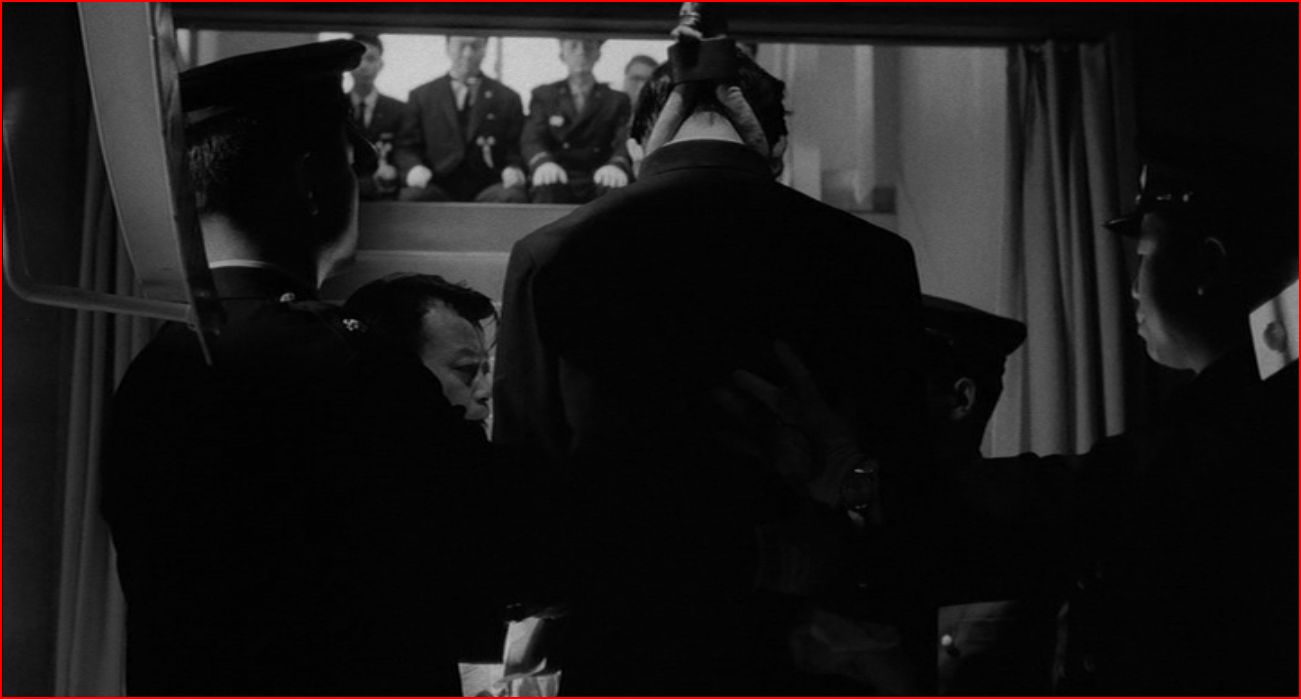
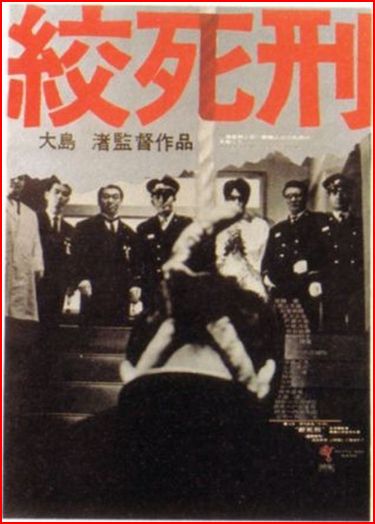
DEATH BY HANGING (1968)

Death by hanging in Japan means death by strangulation, or else Nagisa Oshima's admittedly magical-realist satire wouldn't even get started. Death By Hanging would be a very different movie if everyone in the audience assumed that the condemned man's neck should have been broken. Instead, the trouble starts when the man's heart keeps beating beyond all expectation. The officials aren't sure if "R" (Do-yun Yu) should be hung a second time, given their assumption that they're actually dealing with some sort of revenant. R, a rapist and murderer, recognizes some of the officials when he wakes up but claims to have no recollection of his crimes. His Christian chaplain speculates that R's soul has left his body, which means this soul-less but sentient husk should not be hanged again. The other officials, all involved with law enforcement, agree that R has to regain his memories and recognize his guilt before he can be hung a second time. The main action of Oshima's black comedy is the blundering effort to reawaken R's identity, from his wretched background as a Korean immigrant to his carnal lust for his victim. This mock-epic attempt at recovering memories takes the cast from the newspapered walls of an imagined Korean hovel to the rooftops of Tokyo as a reenacted seems to turn all too real.


The director's not-so-subtle message is (in part) that R's original identity was shaped in the first place by the same sort of national prejudices that make the officials look like bigoted idiots, not to mention the very circumstance of being a Korean in Japan. From the way they act when restaging R's family life, Koreans are the n-words of Japan, viewed through a prism of minstrelsy as a rabble of slobbovian morons who piss on each other during family arguments. Having the Japanese act out their stereotypes of Koreans may be the best way to subvert those stereotypes, and it's definitely one of the funniest parts of an often-hilarious movie. As a black comedy it's like Dr. Strangelove in microcosm, with the stakes reduced to one life but with the cartoonish cast behaving just as ludicrously, or even more so in proportion to the situation.

Sacrilege: a drunken Christian priest loses his inhibitions and lunges for a singing partygoer's strap-on.

Death By Hanging is a kind of companion piece to Oshima's previous film, the one with the unfortunate English title Sing a Song of Sex. Despite the bawdy title, that film is an ominous, brilliant portrait of Japan on a precipice of revolt and reaction in the form of rape. In turn, despite its ominous English title, Death By Hanging revels in its absurdity and even throws in a Japanese bawdy song of the sort that superficially formed part of Sing a Song's subject matter. In both movies Oshima seems to be indicting a bawdy streak in Japanese culture that seems inherently reactionary and oppressive (not to mention complacent) insofar as it helps shape R's carnal lust and makes women eligible for the sort of rape the officials so casually or sometimes enthusiastically reenact.  


Death also renews an interest in Christianity that Oshima had expressed in his 1962 historical epic The Christian Revolt.It's apropos given the popularity of Christianity among Koreans, which makes it almost natural for Oshima to imagine R, who is based on a real-life convict who wrote a famous book of prison letters before his execution, as a Christ figure who has to die a second time, or as often as possible, for the imagined sins of Koreans as a race. Jesus's saying that he who imagines himself committing sin is just as guilty as if he had committed the actual act is pointedly invoked, with an Oshima twist that indicts those who imagine others committing sins like rape, as if R was fulfilling a Japanese expectation of carnal violence from Koreans. Any supposed Korean proclivity for rape or other crimes thus becomes a projection of Japanese culture's own yen for such atrocities. In effect, Oshima suggests, condemned Koreans, if not all condemned men, die a second death as the nation reassures itself that the dead deserved what they got, while their victims did not. That seems to be the point of the apparition (Akiko Koyama) who calls herself R's sister and tempts him to see his crime as a revolt against Japanese oppression. That the Japanese on some level buy into that interpretation seems apparent from the way the officials one by one start to see the sister when most of them hadn't at first. Eventually, there's an even more urgent need to "liquidate" this accusing ghost than there is to reawaken R's guilt. R's turn finally comes after the chief prosecutor, the one official who's retained some dignity throughout, dares him to leave the prison if he thinks himself innocent. R can't do it because he realizes he can't be innocent in Japan, even as he claims that he isn't guilty in the way the Japanese portray his guilt. In the end he accepts the noose again and the trapdoor opens beneath him, to reveal an empty noose below like the empty sepulcher of Christian myth. Perhaps this second death has exorcised whatever of R had haunted his executioners, but you can easily imagine an eternal recurrence of these scenes despite R's hope to die for the sake of all the other Rs. Death By Hanging can be heavyhanded at times but Oshima mostly succeeds at his Brechtian work of thought-provoking absurdity. The more I see of his films from the Sixties, the more it seems like one of the great bodies of work in the wild world of cinema.