Showing posts with label bad movies. Show all posts

Saturday, March 16, 2019

DVR Diary: ANOTHER SON OF SAM (1977)

Aspiring North Carolina auteur Dave A. Adams reportedly wrote and directed his first film, originally called "Hostages," in 1975. It took two years for him to find an exploitation angle, but in late 1977 Adams anointed his film's killer Another Son of Sam. All it took was to preface the picture with a lineage of killers starting with Jack the Ripper and concluding with the then still active Hillside Strangler. It might not inspire confidence to see Adams attribute fourteen victims to the Ripper, but a friend tells me that many Ripperologists at least tentatively credit Jack with more than the canonical five killings. Whether Adams knew this is unclear, bur you'd be right anyway not to have confidence in him. For what it's worth, his original concept arguably owes more to another killer in Adams' list, Richard Speck, since Adams' killer spends much of his time in a girls' dormitory. This killer, Harvey, escapes from the hospital after a round of electroshock therapy and heavy sedation, despite being put in a straitjacket. He strangles one guard with a telephone cord, then impales another with a coat rack. Through all of this, we haven't seen the man's face, but we get repeated close-ups of his actually quite inexpressive eyes. No madness seethes there, nor does depravity glisten in them. Nevertheless, these repeated shots of his eyes are this film's equivalent of Bela Lugosi spreading his cape in Plan 9 From Outer Space.

Despite his murderous ways, Harvey is satisfied merely to knock his doctor unconscious. We're told that she's in a coma, but suffering more from shock than anything else. That's enough to enrage the doctor's husband, a plainclothes detective, though rage seems to be beyond the actor's emotional range. He's given a backstory that consumes the first reel of the picture and consists of speedboating and the patronage of a nightclub where Johnny Charro, a stereotypical hairy-chested real-life local lounge singer, performs. Charro's awful ballad, "I Never Said Goodbye," is a local hit, receiving radio airplay in at least one scene, and counts as the Love Theme from Another Son of Sam. As for the police detective, the most that can be said for our hero is that he's probably the most competent member of the Belmont police force. Once you see the picture, however, you'll realize that I'm not giving him much credit.

After he evades some cops in an urban park, Harvey follows two college students to their dorm. The girls' chatter introduces the major subplot of the picture, which is that one of them has stolen some money to finance an abortion. That this is implicitly obvious without abortion being mentioned is the one bit of cleverness in Adams' script. Harvey wanders through the building and for all I know is under the bed where the two girls have another chat, in order to justify more cut-ins of those evil eyes. We get a fake scare when one of the girls opens a closet door to fetch her pet mouse's cage, but instead of Harvey a large plush dog falls on her. Harvey will get his chance later.

The theft-abortion subplot provides an excuse for cops to be in the dorm when Harvey takes his first victim. A desultory siege ensues in which Harvey displays ninja skills relative to his inept police pursuers. At last a SWAT team is called in as Harvey menaces two of the girls we've already seen. He takes his time menacing them while the SWAT officer gingerly rappels into position, with orders to simply nose his rifle through an open window, part the curtain, and fire. One of the girls impatiently charges Harvey with one of those fraternity/sorority paddles, and at first it's unclear whether the madman has killed or merely kayoed her when she hits the mattress with blood trickling from her mouth. Meanwhile, the other girl makes her way to the window and tentatively parts the curtain. BANG! Score one for the cops. Then, another cop charges into the room, and for all his specialized training is immediately mowed down by Harvey. By this time the unconscious girl has come to, and she takes the carnage playing out around her with remarkable, almost inhuman calm.

Finally, Harvey's mother is brought to the dorm to talk him into surrendering. She tells a sob story, blaming herself for his going bad, and promises him on the cops' behalf that he won't be harmed if he turns himself in. Harvey, represented by the camera, steps into the hallway and stands in front of her, apparently staring at her handbag. The cops immediately open fire and it's as if the old lady has disappeared as Harvey, his face finally shown in mortal agony, is riddled with bullets. By way of an epilogue, the final girl from the dorm room gets the bad news from a doctor that her friend never regained consciousness, and she takes it with a great pout. We're left with no real insight into the homicidal mind, few quotably bad lines (though our hero's response to a false report of Harvey's capture, "There's a college girl here who would disagree with you -- if she could talk," is probably the 'best.') and nagging questions about the director's habit of freeze-framing the action while the dialogue continues. You might even ask whether this film every played in theaters, but as this was the Seventies, I'm sure that some drive-in or grindhouse did take it. Another Son of Sam isn't one of the laughably crazy bad films that provide genuine entertainment on some level, but if you'll settle for laughably inept it might still entertain you a little.

Sunday, January 7, 2018

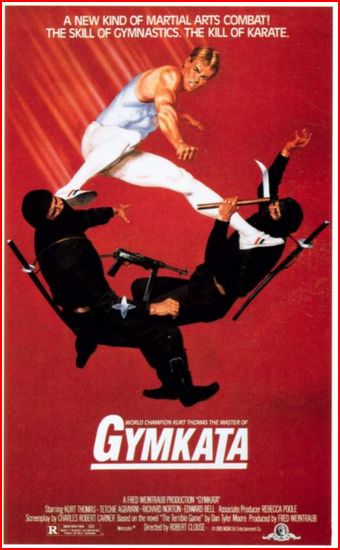
DVR Diary: GYMKATA (1985)

In a better world Kurt Thomas would be known as an American Olympic hero. He broke through generations of Eastern European and Japanese dominance to win the Men's All-Around title in the 1979 world gymnastics championship and was a favorite to take gold in the 1980 Moscow Olympics until the U.S. pulled its team out of the games to protest the Soviet invasion of Afghanistan. Thomas did not stick around to be part of the 1984 Olympic team, which won a team gold in a games tainted by a tit-for-tat Warsaw Pact boycott. In this context, Gymkata looks like a desperate bid for the fame Thomas may have felt he deserved from athletics, but my suspicion is that Robert Clouse's film, or something like it, probably would have happened even had Thomas gone to Moscow and won the gold. Exactly because he would have been an American hero, someone in Hollywood would want to exploit his fame. The same thinking immortalized Bruce Jenner's masculinity on film in the unlikely musical vehicle Can't Stop the Music. Gymkata at least gave Thomas an opportunity to put his face on screen. By comparison, some of his comrades who persevered and won gold in 1984 also made movies, but they were usually stuntmen wearing Ninja Turtle costumes. Thomas, the star of that generation of gymnasts, would be showcased as a leading man and exposed as an actor of inflexible woodenness, and his film would live in infamy.

Someone had the idea, less obvious in hindsight, that someone with Thomas's acrobatic prowess would make an excellent martial-arts hero. That insight delivered him into the hands of Clouse, who could always be identified, at a minimum, as the director of Enter the Dragon to give subsequent films the illusion of expertise. More recently, Clouse had bungled Jackie Chan's American starring debut, The Big Brawl, apparently because he had come to believe his own hype and thought he could direct fight scenes better than Chan. While Chan might have disputed the claim, Thomas would bring no such pretense to Gymkata. The remarkable thing about Clouse is that after Gymkata he was called on again to put over a martial-arts prospect, directing Cynthia Rothrock in two China O'Brien movies in the late Eighties.

Gymkata portrays the invention of a new martial art as part of an American intelligence project. The government believes that Jonathan Cabot's gymastics prowess will give him an advantage in securing the use of the nation of Parmistan for the U.S. "Star Wars" missile-defense program. For the traditionalist Parmistanis and their monarch (Buck Kartalian) to even consider granting rights to the Americans, our representative must prevail in an ancient competition known to us simply as "The Game." Foreigners in Parmistan are entertained by being compelled to run a nationwide gauntlet, with all citizens eligible, within the rules, to kill them. Cabot's father has already tried the Game and has gone missing for his trouble. Jonathan thus has the filial duty to find his father, or avenge him, to enhance his patriotic motivation to take part in the Game.

"Gymkata" -- never named as such in the story, if I recall right, is invented on the fly as a variety of martial artists help Jonathan adapt his gymnastic disciplines into combat techniques. His training ranges from getting beat up a lot to walking up flights of stairs on his hands -- Clouse visually emphasizes Thomas's hand strength but there's no real payoff to this in the form of extra striking power, as would seem obvious to any Chinese director -- while his cultural advisor, a half-Parmistani, half-Indonesian princess (Techie Agbayani) engages him in knife fights to remind him not to trust anyone. The Princess's own position is insecure, as the King's top advisor and game master (Richard Norton) covets not only her hand but her father's throne. Jonathan will find himself not only running and fighting for his life, and not only hunting for his father, but rescuing Parmistan from a coup d'etat that will throw its strategic location and resources to "the other side" of the Cold War.

Whatever its other consequences, the U.S. alliance with the Afghan mujaheddin against the Soviets revived the idea of heroic barbarians in the modern world, or just plain barbarians, in the pop/pulp imagination. Gymkata's Parmistan is a preposterous place ruled over by a community theater's idea of a comic-opera sultan, where the sort of savage customs a penny-a-word might imagine to make rent money -- the film is, in fact, based on a 1957 novel -- still prevail. For all that Gymkata looks like a throwback to Saturday matinee serials, it makes sure to include masked warriors who could be taken for ninjas by undiscriminating up-to-date audiences. At select moments, when props permit, Thomas uses all his gymkata skills to fight off a nation of hunters. In an early scene, a bar built between buildings in an alley enables our hero to take out enemies with a succession of giant swings, his antagonists dutifully walking into range to take their medicine before Cabot accidentally wallops a civilian in his berserker rage. In the film's most infamous scene, Cabot discovers a pommel horse -- I presume it's meant to be a hitching post -- in the middle of Parmistan's notorious "village of the damned," where all the nation's homicidal maniacs are confined. That discovery enables Thomas to do his signature gymnastics move, the Thomas Flair, to fend off the crazies with flying feet in all directions while they, being crazy, never think to throw something at him to stop his legs. The entire village sequence is a lugubrious side trip into attempted horror or the trippy absurdity of Circle of Iron. It kills what momentum the film had dead, though some bad-movie connoisseurs may find this part its most entertaining. At least no one talks in that part, so one is spared Thomas's acting. Typical of his line reading is this dramatic response to the news that the villain has kidnapped the princess: "Not for long, 'cause .........I'll kill him." The truly awful thing about Gymkata is that Thomas isn't even its worst actor. That honor probably goes to Buck Kartalian, whose vaudevillian capers as the Khan kill anyone's attempted immersion in the film's fantasy world, though Eric Lawson in his brief appearance as Thomas's father is, if anything, even more wooden, being an older tree, than his onscreen offspring. For all that Clouse and his writers want Gymkata to be some weird experience, it has none of the artistic insanity that redeems many another bad movie with indulgent audiences. It is all empty exploitation, a stinker by committee, soullessly stupid, something to be laughed at, not with, with no skewed view of society of humanity for audiences to even try sharing. Yet people still find plenty to laugh at in it, it seems, so Gymkata and Kurt Thomas will live on in movie memory.

Saturday, December 9, 2017

On the Big Screen: THE DISASTER ARTIST (2017)

In American pop culture, the label "worst film ever made" is almost an honorific. It's an acknowledgment of, or a backhanded tribute to, unintentional entertainment value unlikely to be found in whatever the worst film really is, if the worst can be defined objectively. If it can, it would most likely be the least entertaining of movies -- and most likely an unfunny comedy -- yet defining the worst by a failure to entertain is problematic when entertainment can be seen as unintentional and recognized as the result of an arguably objective failure of technical competence or artistic verisimilitude. Is the bad film we laugh at better or worse than the bad film we don't laugh at? It depends on whether you're laughing at or with the film and its filmmakers. People may say that certain cult films, like Tommy Wiseau's The Room, are "so bad they're good," but once such a film acquires a cult following people definitely are laughing with it. The Room is an unusual candidate for Worst Film for people of my generation, who are used to the worst being films whose auteurs' reach exceeds their grasp: fantasies like Plan 9 or Robot Monster, without resources or conventional screenwriting. Wiseau's film is a domestic drama, theoretically in the manner of Tennessee Williams, though the auteur, trimming his sails, now describes his screenplay as a parody of some sort. Its entertainment value is based entirely on Wiseau's audacious incompetence as actor, writer and director. In some ways Wiseau is the antithesis of Ed Wood; he seems to have had a limited imagination but limitless financial resources. They're two of a kind, however, in their struggles to convey basic human thoughts and emotions through scripted dialogue. Their appeal may lay in the way they inspire in audiences a recognition of how difficult that task actually is -- or how artificial conventional screenwriting is compared to the raw, idiosyncratic authenticity of those bad movies that earn cult followings as moments of personal expression rather than as imitations of life. Parody as a genre has had the same appeal for just about as long as movie comedies have been made. The truly worst films, those that fail to entertain in any way, may be those that don't stray far enough from convention and don't fail spectacularly enough. If anything is worse than "the worst," it's mediocrity.

Wiseau and Wood, neither a mediocrity by any measure, now occupy the same spot in movie history as the objects of biopics, though James Franco's Disaster Artist is less a biopic -- since Wiseau remains something of a mystery man to this day --  than one of that emerging subgenre, the "making of" movie (e.g. Hitchcock, Saving Mr. Banks, etc.) As a result, there's something inescapably formulaic about the picture, which was written by Michael H. Webster and Scott Neustadter. The eccentric, difficult artist (Franco) realizes his dream against all odds and after numerous conflicts with collaborators. Unlike in Tim Burton's Ed Wood, we can't really face Wiseau directly, so the writers give us a point-of-view character in the convenient form of Wiseau's roomate and star Greg Sestero (Dave Franco), whose memoir of his experience gives this film its title. Disaster Artist thus becomes a buddy film or bromance, with Wiseau going through a betrayal experience -- Sestero moves out of his apartment to live with a girlfriend -- echoing the narrative of The Room -- yet reconciling with his onetime protege when Greg explains to him that audiences laughing at (or with) Wiseau's picture are actually showing their appreciation of a unique cinematic achievement. If Disaster Artist is to be more than a cult film about a cult film -- about half the people in the theater where I saw it had seen The Room, laughed at the mere sight of its characters entering beloved sets, and often recited dialogue ahead of the actors -- it's up to James Franco, whom some may see as a Tommy Wiseau who had better luck in the genetic lottery, to entertain the uninitiated as an actor.  He does so in championship fashion, managing to disappear into the Wiseau role -- the subject's signature mop of hair helps a lot here -- while giving one of the funniest performances I've seen in a long time. He'll probably win most people over in his very first scene, set in an acting class when, in response to the teacher's (Melanie Griffith) demand for emotion, turns the "Stella" scene from A Streetcar Named Desire into a sprawling, wall-climbing, furniture-tossing conniption fit that anticipates his Room performance. It sets the tone for a character for whom acting is synonymous with acting out, who justifies his neglect of convention (or common sense) with appeals to "real life," and whose self-pitying screenplay is ultimately a protest, as one bemused collaborator suspects, against his betrayal by the universe.

Wiseau, who sees himself as an all-American hero type, is betrayed by his own embodiment, partly voluntary, in a form reminiscent of a "vampire rapist" and a voice no one accepts, despite his insistence, as a product of New Orleans. Someone like him should never dare aspire to movie stardom when the odds are against even the geniuses, but the fact that he does dare, damning the consequences with a paradoxical contempt for the masses he aspires to entertain, makes him a kind of typically American hero, even when he behaves like a bully or a clueless ass, and earns The Room a measure of respect, the kind arguably reserved for the "worst films," as an act of pure will. Part of the appeal of the worst movies, I've long suspected, is their potential to inspire the rest of us to imagine ourselves making movies, bad or otherwise, and an all-round auteur -- or, if you prefer, a pretentious pretty boy -- like James Franco probably can't help empathizing with that feeling. His Wiseau is both a freak and an everyman in his innocence of craft who allows you to laugh with or at him with equal enjoyment. Once he wins you over, everything else is a bonus. The Disaster Artist may be the best of the "making of" movies so far, simply because the making of such an astoundingly bad film is easily more compelling than the making of a presumed masterpiece against whatever odds. It looks especially good in comparison with something like The Man Who Invented Christmas, which I only know from its trailer but looks, from that nauseating evidence, like something Tommy Wiseau could only improve upon.

Saturday, October 29, 2016

DVR Diary: BILLY THE KID VS. DRACULA (1966)

You get the feeling watching William Beaudine's horror-western that the real creative work had been done when someone thought up the titles for the notorious double-feature of this film and Jesse James Meets Frankenstein's Daughter. Put those titles on a poster, someone must have thought, and you'll get people into the theaters. At that point, it doesn't matter what they see. It has to have been like that -- doesn't it? -- to explain what we still see. Beaudine was near the end of a very long career that stretched from Mary Pickford A pictures in the 1920s to Bowery Boys Bs and Bela Lugosi Meets a Brooklyn Gorilla in the 1950s. Apart from the color, BvD is no real advance on the horror films Beaudine had made with Lugosi twenty years earlier for Monogram. For John Carradine, returning to the role of Dracula (though no one calls him that in the film) after twenty years, it was the opposite of an advance. He is a sadly shabby vampire despite the desperate attempt to tart him up with poofy cuffs and a huge red tie. His hypnotic gaze looks more like the drunken leer it probably was. His special-effects surrogates are some of the worst bat effects you'll ever see, and the transitions are truly primitive. A fake bat glides behind some object -- a rock or a stagecoach, for instance -- and Carradine scuttles out from behind.  He's probably the least graceful Dracula, though that's more the producers' fault for casting so physically limited an actor in the role. And with all these handicaps, Carradine is almost still the best actor in the cast. His only real rival is Olive Carey as a folksy old female doctor who becomes the nearest thing this film has to a Van Helsing.

But who needs Van Helsing when you have Billy the Kid (Chuck Courtney)? The legendary gunman has gone straight and hopes to live in obscurity as just plain old William Bonney the ranch foreman, even though everyone in town seems to know about his past. He's sweet on Betty Bentley (Melinda Plowman), the gal who's inherited the ranch he works on, and he has a rival so we can have a fistfight every few reels. Betty is expecting an uncle to arrive and act as her guardian, but she's never seen the man before -- no photo, no painting, no lithograph. Unfortunately, the uncle and his wife divulge this fact to their fellow stagecoach passenger in black and red, who boards not long after draining but not killing the blonde daughter of an immigrant couple. At the next stop, the vampire bites an Indian girl, inciting the nearby tribe to massacre the stagecoach while he flaps to town to introduce himself as the uncle arriving early. The immigrants reach the same town and recognize "Mr. Underhill" as the vampire. If you're a vampire trying to maintain an imposture, what do you do at this point?

A. Kill the entire immigrant family.
B. Kill the daughter while leaving the mother, sleeping beside her, alone, and allowing the immigrant elders to live even after Betty has hired them as your household servants who constantly interfere with your plans, from spouting vampire lore to lining Betty's window with wolfsbane.


Underhill apparently prefers to rant at the hapless foreigners and occasionally shove them, because that way he gets more lines. That's the only motivation that makes sense. But the vampire's lack of self-preservation instincts is partly understandable: the poor man's in love. From the first time he saw Betty's face in a black and white miniature, he had decided that she would be his immortal mate. Underhill has set up a challenge for himself: seduce a woman while passing himself off as her uncle. But never underestimate an old man's stare and the seductive power of Raoul Kraushaar's generic spooky music. All that's left is to consummate the unholy marriage in an abandoned silver mine -- who knows how he got the big bed in there? But it's Billy to the rescue, having overcome everyone's skepticism about "bats and vampires" (both being equally mythical, I guess) and armed himself with Doc's book-learning -- admittedly incomplete since her German isn't so hot -- and the metal spike necessary to kill a vampire. Of course, Billy being Billy, he leads with his revolver, but bullets can't hurt the undead! Bullets can't, but the gun itself can as Underhill takes a vicious blow to the face that sets him up for the deathblow. Apparently a vampire can not only transform into a bat, but can also project a bat from his body, as one takes flight as Underhill squirms in Billy's grip. The bat flops to earth as the vampire dissolves into nothingness. But we don't see the bat dissolve, so is this truly the end??? Gott in Himmel, let's hope so.

Saturday, June 18, 2016

DVR Diary: HILLBILLYS IN A HAUNTED HOUSE (1967)

From the director of The Devil Bat and The Abbott & Costello Show comes a film that lives in infamy as the humiliating final film of Basil Rathbone, even though he made one more film in Mexico. This sequel to Las Vegas Hillbillys -- I believe the producers had to use the illiterate plural to avoid confusion with The Beverly Hillbillies -- better fits a narrative of tragic decline, especially when you see how far down in the billing Rathbone is, below not only the title characters but fellow horror men Lon Chaney Jr. and John Carradine, who presumably were more accustomed to such work by this point in their careers. It's not merely the badness of this Woolner Bros. production but the mere idea of these beloved actors stooging for second-rate hillbilly actors -- and that's being too generous -- that offends fans of the horror genre and classic cinema in general. Seeing it offered in one of Turner Classic Movies' eccentric moods, I expected something dreadful, and got it. A trio of protagonists returns from Las Vegas Hillbillys, the entertainers Woody (Ferlin Husky) and Jeepers (Don Bowman) and "girl singer" Boots Malone, originally played by Mamie Van Doren but now incarnated by Joi Lansing. They're on their way to Nashville but interrupt their trek to allow the allegedly agitated Jeepers some r & r. Told that there are no hotels or boardinghouses in the small town where they stop for gas, they decide to squat in a mansion recommended to them. This is our haunted house, but it's actually infested by spies for Red China who intend to steal an important formula from a nearby military base. The spies seem to be divided into two factions. Gregor (Rathbone) and Himmel (Carradine) are straightlaced, almost effete characters, compared to their handler Madame Wong (Linda Ho), her henchman Maximillian (Chaney) and his sidekick, Anatole the gorilla. Tension flares up constantly between Himmel and Anatole, escalating from insults to banana stealing and, finally, murder. Into this volatile setting blunder the hillbillys, who stand their ground despite the spies' best efforts to scare them away, and in spite of the fact that hillbillys scare very easily. There's a twist to come, however, that upends everyone's plans....

Hillbillys may be the worst haunted-house comedy I've ever seen. The reason has nothing to do with the performances or misuse of the horror stars, and everything to do with Lansing, Husky and especially Bowman being without doubt the worst scaredy-cat comedians I've ever seen. The singers have no comic timing at all, and while Lansing at least can scream when required, the men seem incapable of emoting in any way, and Duke Yelton's script leaves them helpless like fish on a haunted beach. Here's his idea of something either funny or scary. Jeepers tries to soothe his alleged nerves by watching some television. Luckily for him, some station is showing a performance by Merle Haggard. The spies are able to interfere with the broadcast, so that Haggard's singing is intercut with random shots of Rathbone, Chaney, Carradine and Ho staring at the camera or making faces, while Bowman tries to indicate in his stunted way that he's frightened. Maybe a laugh track would have helped.

Of the horror men, Carradine probably does the best with what he's given. He gets to have mood swings from his mounting rage at Chaney and the gorilla to his friendly, familiar banter with Rathbone. One of the few interesting things about the picture is the way Rathbone and Carradine seem to be competing over who can underplay better in their scenes together. Carradine in particular is unusually relaxed and casual in those moments, and the veteran actors succeed, at this if at nothing else, in convincing you that Gregor and Himmel are longtime partners and friends for whom this preposterous mission is just another day on the job. By comparison, Chaney is on autopilot at best, and at worst has a pathetic scene when Maximillian, in all the actor's sodden, grizzled splendor, infiltrates the military base and must convince a talkative janitor that he's a scientist with high security clearance. It's hard to tell whether his obvious unfitness for the task was meant to be a joke in a comedy picture or not, but Chaney's actually a sadder sight than Rathbone for most of the picture.

While most viewers will resent the lack of comedy or terror in Hillbillys, the producers seemed most concerned that audiences would think there wasn't enough music. Thus, after the spies are defeated, we get a square-up reel that finds the Hillbillys finally in "Nashville" hosting a variety show with guest performances by Haggard and other possibly-popular singers of the moment, as well as a comedy song by "the Great Jeepers," all before a stock-footage audience, apart from occasional insets of about a dozen people. Because it's a performance setting, the echo-chamber effect you get in all the film's musical numbers -- including Lansing's pathetic "Beautiful Dresses," in which she's supposed to be an 18th century aristocrat in a bouffant hairdo --  isn't as glaring, but this musical epilogue is strictly for country-western fans of the old school. For the rest of us, it simply keeps a terrible film going for another twelve minutes or so.

Friday, March 6, 2015

VIKTOR (2014): 'All because of that fat app!'

It's easy to say Gerard Depardieu is trying to horn in on Liam Neeson's action, but this thing right now with old guys who kick ass with a vengeance really dates back to Steven Soderbergh's The Limey (1999), a film that Depardieu's Franco-Russian vehicle resembles arguably more closely than any of Neeson's recent action films. In both The Limey and Viktor, an ex-con with a will and skills that are underrated due to his age goes to a strange country to find out who's responsible for the death of his child. In Soderbergh's film Terrence Stamp traveled from the UK to the USA. In Viktor Depardieu goes to Russia, where the actor conveniently happens to live now as an act of tax protest. The comparisons end there, however, because one you recall that The Limey is a good movie comparisons are no longer fair to Viktor.


Every generation, it seems, has its great actor who goes to pot in the belly for reasons perhaps unfathomable. Depardieu, once globally plausible as a leading man, has become the Marlon Brando of our time, but now hopes to be accepted as an unstoppable force of destruction, and as someone who can still attract the likes of Elizabeth Hurley to his bed. Hurley is this international production's token English speaker, though everyone in the picture speaks English, with varying degrees of incompetence. Honestly, some of the Russian performers make Depardieu himself sound Shakespearean, but all too often the great man himself mumbles mechanically through his lines. Still, nothing that comes from his mouth sounds as awful or hilarious as the rage of a Russian mobster who blames his current troubles on "that fat APP!"


Viktor, our protagonist, is an art thief whose boy got involved in drugs, got a girl pregnant, and died somewhere in Chechnya. Viktor goes to Russia with a lot of questions and some friends to help him get answers. The Russian police are aware of him and give him some warnings but given their inability to deter the country's reputed authoritarianism doesn't look like much to worry about. Viktor's method is to have his friends capture someone (sometimes with Viktor's own help) whom he can torture to learn the next step in his quest. Since Depardieu obviously can't do much real action, Viktor becomes a mild case of torture porn -- more so if we think of the audience as masochists. I hate to say it, but the best scene in the film, or at least Depardieu's most enthusiastic acting, comes when Viktor is enjoying a meal. He loves to cook, he tells a shackled victim, and he apparently loves to eat before he tortures someone. Food gets him in the mood to thrust cooking utensils into sensitive areas.


Philippe Martinez, who had previously directed Jean-Claude Van Damme in Wake of Death and Val Kilmer in something called The Steam Experiment, wrote and directed Viktor. He puts more energy into his direction of a Chechen folk dance performance over the end credits than he invests in the by-the-numbers plot. Everyone involved really seemed to think that any sixtysomething actor of repute can make a hit of this sort of story. And maybe there was a market for Viktor in quarters where Depardieu may be a reactionary hero for his tax resistance. But unless he exemplifies some patriarchal national manliness for you Viktor will look like little more than a fat man's vanity project, and a sad one at that given the star's storied career. But if no one weeps over the latest Taken movie because Neeson once made Schindler's List I suppose you can't hold Viktor against Depardieu's legacy.

Thursday, July 3, 2014

DVR Diary: BRAVE WARRIOR (1952)

Many westerns with historical figures as characters play fast and loose with history, but this Sam Katzman B western for Columbia Pictures, directed by serial specialist Spencer G. Bennett, is like a Bizarro history lesson. The utterly generic title refers, I presume, to Tecumseh (Jay Silverheels), the great Shawnee chief. In this picture, Tecumseh feuds with his violent brother, the self-styled Prophet (Michael Ansara), because the Prophet wants to wage war on the white men in the Ohio Valley, while Tecumseh only wants peace. Tecumseh is passionately devoted to the idea that white and red man can live together. For him, the ultimate proof of racial harmony will be his marriage to Laura (Christine Larson), a white woman and his dear friend since childhood. Toward this end, he wants to build an American-style town for the Shawnee. Called New Tippecanoe, it will prove that Native Americans are as capable of bourgeois civlization as the whites. But the Prophet will have none of it; nor will the British, for whom the Prophet is a pawn in their plan to wage war on the former colonies. The town is built with the encouragement of Gov. William Henry Harrison and Harrison's man on the scene, another of Tecumseh's boyhood white friends, Steve Rudell (Jon Hall), who also loves Laura -- none of the young people knowing that her father is in league with the Brits to arm the Prophet and make mischief. At the climax, the Prophet's braves attack the Americans, but are repulsed. In a fit of vindictive rage, he and his remaining braves burn New Tippecanoe to the ground. Tecumseh survives to see his dream reduced to ruin. In his despair, he doesn't even press his claim to Laura against Steve's obvious advances. Instead, he bids them farewell and heads north to face his lonely destiny.

I'm not going to bother giving you a history lesson, but NO!!! Suffice it to say that many today regard Tecumseh as a hero because of his resistance to American expansion, that when people called William Henry Harrison "Old Tippecanoe" it was not to compliment his peaceful ways toward the Indians, and that the town that was burnt was called "Prophetstown," and it was burnt by whites. Brave Warrior is flabbergasting in its indifference to facts. To an extent I can understand moviemakers taking liberties with the lives of the famous outlaws and gunfighters for dramatic or "print the legend" reasons. But Brave Warrior seems determined to make a new legend of Tecumseh from whole cloth, and it seems like there should be a reason for this, but for the life of me I can't figure it out. I get that the film whitewashes the Americans, blaming the violence in the Ohio Valley on the Prophet and the British, but why -- so to speak -- whitewash Tecumseh? Why make him the friend of the U.S. when he wasn't? The only good reason I can see is to give Jay Silverheels a virtual leading man part, even though top billing goes to the dull Hall. It's always cool to hear "Tonto" use that great voice in complete sentences, but that's just about the only cool thing in this ahistorical misfire. Ansara is wasted in what should have been a great role, the script doing very little to play up the Prophet's mystical pretensions. Here he's basically a thug with bad war paint and an eyepatch. While Ansara was establishing himself as one of Hollywood's all-purpose ethnics, he hardly looks like Jay Silverheels's brother. When the brothers take their shirts off to fight for leadership, Ansara almost looks like Bolo Yeung compared to the authentically wiry Silverheels. Worse still, we never get the final showdown between the brothers everything seems to be pointing toward. Tecumseh should be hell-bent for revenge on the Prophet for burning New Tippecanoe, but instead he mopes into the horizon, an appropriate symbol of this idiosyncratic yet uninspired project.

It says something about the studio system that Columbia still made an effort to promote this plodding programmer. The studio sent leading lady Larson -- purportedly a paramour of Ronald Reagan -- on the road with a troupe of Indian extras to plug the picture. Here are some relics of their trip to Pittsburgh.


Somehow it didn't surprise me to learn that Larson's career didn't last long.

Monday, June 9, 2014

DVR Diary: THE WIZARD OF OZ (1925)

Try to keep the title in mind as I describe Larry Semon's film to you. An elderly toymaker in an Expressionist toyshop reads to a little girl from L. Frank Baum's famous novel. He relates how the land of Oz is ruled by Prime Minister Kruel following the disappearance years earlier of the baby princess who was to become queen at age eighteen. The rabble are restless so Kruel turns to his minion, the Wizard, to keep them terrified by summoning the Phantom of the Basket. At this point the little girl interrupts the narrative to say, in effect, what the hell? She wants to hear about Dorothy and her friends. Fortunately, the toymaker is nothing if not obliging.

Dorothy (Dorothy Dwan) is a teenager, though her mental age seems somewhat younger, frolicking on her Aunt Em's farm. Uncle Henry (Frank Alexander) is a distant, obese figure, less lovable than Em, but to be fair, Auntie doesn't have to deal with the farmhands. Two of them, played by the auteur and his frequent stooge Oliver N. Hardy, are rivals for Dorothy's affections. Another, called Snowball, is played by an actor billed as G. Howe Black. There's a lot of slapstick action here that aspires to comedy. But you lose much the point of Oliver Hardy if you have an actor playing Uncle Henry who is far fatter than Ollie. And there seems to be no point to G. Howe Black (whose real name was Spencer Bell) except that, well, black folks are funny. For instance, Snowball is described in a title card as a "meloncholic." Because black folks do like to eat that watermelon. Isn't that funny?

All this bores the toymaker as much as the palace intrigue bored the little girl, so we return to the palace. The rabble remains restless, impatient for the rightful queen to claim the throne. To prevent this, Kruell dispatches his faithful lackey, Wikked, by biplane to the land of Kansas, where he must take possession of certain papers that might otherwise bring down the government. At this point the little girl interrupts once more to say, really -- honestly -- what the hell? It was clever of Larry Semon to embed the obvious criticisms of his project in the film itself -- not that it helps reconcile anyone to its free-to-the-point of anarchic adaptation of the Baum book, for which one L. Frank Baum jr. must share the blame.

Wikked and his helpers touch down on the vast Gale farm and seek to take possession of the damning documents. Ollie turns traitor when Wikked tells him that the papers would prevent him from marrying Dorothy, but Larry manages to steal them at the last moment, before a great storm strikes. Semon is star, director and co-writer of The Wizard of Oz, so there's no way Larry is staying behind when the big wind picks up the barn. In fact, Ollie, Uncle Henry and Snowball all accompany Larry and Dorothy on their tempestuous journey. Snowball had actually been hiding in a rain barrel and missed the takeoff, but a persistent bolt of lightning propels him all the way to the roof and through the chimney. Because if black people are funny, black people getting hit in the ass with cartoon lightning bolts is hilarious.

So our farmers land in the land of Oz and face an armed guard at the gates of the capital. Kruell impatiently implores the Wizard to transform the farmhands into monkeys or other harmless things, but the Wizard's powerlessness leaves Larry and Ollie, now back on Dorothy's side, to their own devices. Larry has it easy; he simply steals a scarecrow's clothes and assumes the role, thought I can't say where he got the makeup for his face. Ollie reveals hidden talents; diving into a scrap heap, he emerges as a tin woodsman, complete with axe and hat. Snowball does not transform. That's because a black man already looks funny.

Our heroes somehow get Dorothy into the palace and have her proclaimed queen, though Kruell insists that he retains certain prerogatives as Dictator of Oz. The farmhands must be put into temporary custody in a dungeon, but Ollie avoids this fate by turning on Larry again, while Uncle Henry is made Prince of Whales. Because fat people are funny, and since Uncle Henry is much fatter than Ollie he gets a funny name as well. Larry and Snowball are sent below, doomed to torture in molten mud until the Wizard reappears to give Snowball a lion suit. This suffices to frighten away the dungeon guards but creates confusion when Snowball and Larry find themselves trapped in a cage with real lions. Snowball dives through a window and G. Howe Black's stuntman takes an epic tumble down a hillside while Larry escapes to assist in the belated overthrow of Kruell by the good Prince Kynd. Yes, all the names in Oz are like that. There's a vamp character named Vishus in Kruell's entourage, but most of her role seems to have ended up on the cutting room floor.

There's a pretense of pathos when Dorothy ends up favoring Kynd over Larry, but Ollie is still on the loose and gives chase to our hero. Larry climbs a high tower -- some of this film's sets look terribly cheap but some of the props are huge -- just as Snowball, whom we've all underestimated drastically, has hired a plane for the trip back to Kansas. Larry leaps for the rope ladder dangling from Snowball's plane, catches it -- but the ladder breaks! And down he goes! But by this point the little girl in the toyshop has fallen asleep and the toymaker simply gives up. Since he is also Larry Semon, I expected a payoff revealing that he had once been Larry the farmhand, but that would have made sense in a way Semon's Wizard never does. So a title card tells us that The Wizard of Oz ends with Dorothy marrying her prince and ruling happily ever after.

Semon had just about broken into the top tier of silent comics with a series of expensive shorts dominated by stunts and special effects when he jumped the shark -- had he heard the term he would probably have tried to do it literally -- with his Wizard, a project that reportedly bankrupted the independent studio that released it, though it was still turning up in theaters through the end of the silent era, after Semon himself was dead. The film lives down to its dire reputation as grimly described in Walter Kerr's The Silent Clowns. I don't know how Semon thought he could get away with his loose-to-the-point-of-liquid adaptation of Baum, since the Oz mythos was already quite well known thanks to stage versions and a film series produced by Baum himself a decade before Semon. I suppose he assumed that talent would justify the liberties he took, as it justified the liberties taken by Metro-Goldwyn-Mayer a generation later. Then, talent prevailed to the point that the 1939 musical is the definitive version of the Dorothy story for subsequent generations. And that leaves Semon no excuses. If his Wizard failed, it was because he failed. Out of his usual comedy costume, Semon looks nondescript, and he doesn't do much with the scarecrow gimmick. He wastes time with self-indulgent effects-driven gags that stop the story dead. In the worst case, when the storm hits Kansas, Larry stalls, taking a step or two, getting hit by cartoon lightning, waiting, and tentatively taking a few more steps before lightning hits him again. Later, pursued by Hardy in the dungeon, Larry takes on a Bugs Bunny aspect, hiding under one wooden box only to appear miraculously under another, and at one point seeming to split in two and run in opposite directions. It's one thing for an actual cartoon character to do this sort of magic, but in live action it looks like cheating.  In the end Semon only cheated himself by revealing his own limitations as a clown and a director. A feature as bad as this one reminds us of how far ahead of the pack the top three or four comics were. It's a shame that Semon had to destroy his career to prove this point, but the gesture seems typical of the man's work.

Sunday, December 22, 2013

DVR Diary: MASSACRE MAFIA STYLE (1974)

Consider the source: Duke Mitchell was a Sinatra wannabe marketed as a Dean Martin clone and paired with a Jerry Lewis clone, Sammy Petrillo, at the height of the original pair's popularity as a team. Early on, Mitchell staked a claim to cult-movie history by co-starring with Petrillo in Bela Lugosi Meets a Brooklyn Gorilla, one of the most sublimely self-explanatory titles ever. After Jerry Lewis litigated Petrillo into oblivion, Mitchell stuck to live performance, declaring himself "King of Palm Beach." By the 1970s, the man born Dominic Micelli was a Johnny Fontane who wanted to be Sonny Corleone. He had caught something of the zeitgeist of the time, both prideful and defensive about his Sicilian heritage. Massacre Mafia Style seems intended as an answer to The Godfather, a film criticized by Mitchell's character, who bears the actor's real family name. Mimi Micelli feels that the character of Don Vito Corleone is based on his own father, "the Padrone," who's been insulted by Brando's clownish portrayal of the don in retirement. Mimi rails against the stereotype of the Sicilian as a gangster, complaining that none of the other ethnic types with whom Sicilians interact in the underworld are so stigmatized. At the same time, he condemns himself and his peers for giving enough reality to the stereotype to disgrace their innocent, long-suffering mothers. This self-criticism comes in the middle of a mad-dog spree during which Mimi tries to muscle his way into control of the numbers and prostitution rackets in Los Angeles, escalating his tactics from kidnapping to indiscriminate slaughter. Part of his campaign is the murder on live television of the spokesman for a Sicilian anti-defamation league modeled on Joe Colombo's quixotic real-life movement in New York and Colombo's near-assassination at a public rally. As a filmmaker, Micelli/Mitchell protests the stereotyping of Sicilians as gangsters by making as nearly stereotypical a Sicilian gangster film as possible. His is a conflicted message, though less generous observers might call it incoherent.

But the funny thing about Massacre Mafia Style is how much the neophyte Mitchell's work resembles that of not just Coppola but Scorsese. The resemblance to the latter, whose most recent film was Mean Streets while Mitchell shot his picture, is stronger yet almost certainly coincidental. Mitchell opens his film in what we'd now recognize as Scorsesean fashion, with a shock sequence that actually takes place in the middle of the story, scored to ironically chosen pop music, from which he flashes back to the beginning of Mimi's American adventure as narrated by the protagonist. The opening is a brazen if not bravura sequence in which Mimi and his partner Jolly (Vic Caesar) walk into a high-rise office to kill a businessman. They set him up to be electrocuted by the flush of a urinal, then decide that they leave no witnesses in the entire office suite. The film earns its true title -- it was also known as Like Father Like Son and, most popularly on videotape, The Executioner -- right here. Whatever budgetary limitations Mitchell labored under, he was never short of squibs and blood packs. This film is almost absurdly bloody, but Mitchell stages other creative kills, from the crucifixion of a pimp (scored to the Hallelujah Chorus and staged near the Hollywood Bowl) to the impalement of an enemy through the back of the head with a meathook that comes out through his eye ("He's hanging around in there," Mimi quips bondishly). Mitchell was clearly trying to have it both ways, as if the exploitation-level violence would cover the tirades against Sicilian stereotypes, or vice versa -- or else he never really figured out what he was trying to do or say. But Mitchell clearly has something to say, and that's something that distinguishes the truly great bad movies. I'm not ready after one viewing to say this is one of that group, but Massacre definitely touches a lot of the bases.

Mitchell's own unintimidating personage -- balding on top but hair all he way down his neck, enhanced later in the story (thus already present in the opening) by a moustache that made him resemble late-stage Rock Hudson slightly -- maintains a constant of absurdity through the whole picture, especially when Mimi scores with babes who go nude for him. Memorable moments abound; another is a rival's attempt to intimidate Mimi and Jolly with a karate-expert bodyguard who chops through a coffee table, only to be riddled immediately with bullets by the unimpressed pair. The script is baldly racist, at least in the words it puts into Mimi's mouth, and in a manner not necessarily alien to the style of Mitchell's Italo-American peers, and Mitchell dependably carries the bigotry to an absurd extreme by having Mimi rant about the proliferation of blaxploitation films with "Super" characters. Some of this is genuinely ugly, like the crucifixion of the black pimp with the commentary, "He said Jesus was black; maybe he can get a resurrection," and Mitchell isn't good enough a writer to make clear whether this represents his own deplorable attitude or an attitude he deplores in Mimi. One way or the other, it's still a kind of truth-telling that makes Massacre a perhaps-unconscious self-revelation and enhances its cult-film credentials.

Films like this are often mocked for their low-budgets, though in this case Mitchell often manages to maximize his production value with decent location work, but the true cult-film fan is more impressed by the ability of marginal figures like Mitchell to get feature films made at all. On that level, Massacre Mafia Style is a kind of epic achievement, and its rise-and-fall narrative (including Mimi's attempt to go straight by becoming a shot-on-yacht porn producer) has an appropriate sub-Scorsesean sweep. For every Scorsese or Coppola there may have been a million Mitchells monkeying around on typewriters trying to do the same thing. You'd have to figure some of them would come close to something, and seeing how close Mitchell came in many ways was a fascinating experience.

Wednesday, October 9, 2013

In Brief: WORLD WAR Z (2013)

Did you ever see one of the old time movie serials? The story builds to a climax every fifteen minutes or so and after an implausible escape the story moves on. Now, have you ever seen one of those feature films made by compressing a serial into 90 minutes or less? Usually they have all the cliffhangers while jettisoning much of the exposition and most of what little character development there was in the original. That's what World War Z is like. To be fair, Brad Pitt and Marc Foster have closer to two hours to work with and manage to fit more exposition in. But there's the same sort of perfunctory sensationalism to their production, notoriously troubled but eventually modestly triumphant at the box office. Action scenes -- for this is an action rather than a horror film -- arrive with a telegraphed inevitability that smothers any suspense the filmmakers hoped to generate. Much like the film's "zekes," the film itself is energetically lifeless, taking for granted that our empathy for "family" or our adoration of Pitt will keep us emotionally involved without director, writers or actors really doing anything to engage us. The irony of the project is that the zombie at its heart is Brad Pitt. Repeatedly, Pitt has proven his versatility and charisma as an actor, from the subtle villainy of his Jesse James to his sublime idiocy in Burn After Reading, but his ambition as an actor seems inversely proportional to his ambition, as a producer, to make money. He seems to think that, to be a hero, or at least an action hero, he doesn't have to develop an interesting personality. His protagonist is an automaton, though he looks like a professional wrestler (it's the hair, mainly) bereft of the gift of gab, barely personalized by the era's prevalent reluctant-hero cliches -- yet perversely, this character, if it can be called that, dominates the story in a way that no one, or so I understand, dominates Max Brooks's source novel. As Pitt trots the globe, abortive characters threaten to form around him, only to be abandoned, with the exception of a female Israeli soldier whose infected hand he helpfully amputates during the great bug-out from Jerusalem. You get none of the abrasive interaction of personalities in distress that defines the zombie movie as much as the zombies do. Everyone involved with the project seemed more interested in the novel ways they make the zekes move, but it is all too often rendered from too great a distance and too much in the manner of video games to seem as strange as it's supposed to, let alone frightening. Foster proves incapable of generating real thrills, and his commitment to a PG-13 rating denies viewers even the simplest pleasures (gore, that is) of zombie films. Sure, the fate of the world's at stake, but when isn't it in movies? The real question is, when have you cared less?

Monday, June 3, 2013

DVR Diary: THE JACKALS (1967)

A dead man wrote The Jackals, and it shows. Robert D. Webb's film is the story of a gang of bandits who flee across a stretch of desert to escape a posse after a bank holdup. Barely making it through the parched landscape, they end up in a ghost town, where they encounter a tough young woman who lives alone with her grizzled grandfather. The gunmen guess that the only reason the pair stays on is gold. Everyone else thought the vein had been played out -- hence the ghost town -- but grandpa knows better. The gang wants the gold, but the gang leader grows a conscience. Finally, the gang divides against itself as the repentant leader faces off against his dandyish rival with lives and a fortune at stake.

Perhaps this rings a bell. Imagine a black and white desert and Gregory Peck and Richard Widmark leading the gang across. Imagine Anne Baxter as the tomboy decking Peck with a punch but later falling in love with him. That's William Wellman's Yellow Sky (1948), one of that decade's best westerns. Lamar Trotti adapted a story by gangster specialist W. R. Burnett to grim, gritty effect. Trotti died in 1952, but Twentieth Century-Fox resurrected him when the opportunity arose to remake Yellow Sky. The dead man shared script credit with Harold Medford, whose job it was to translate place names and monetary units into terms fit for the story's new setting, the wastes of South Africa. Medford and Webb did a similar translation of Samuel Fuller's Pickup on South Street the same year, calling it The Cape Town Affair. I haven't seen that, and now I better not, given how godforsaken The Jackals is. The direction is uninspired. The music almost invariably finds the wrong tone. The actors, with one exception, may as well be an amateur production of Yellow Sky. Jackals replaces Gregory Peck with Robert Gunner, best known (if known at all) as one of the other astronauts in the original Planet of the Apes. It replaces Richard Widmark with Bob Courtney, a British actor with a grand total of 12 screen credits, which is more than Gunner has. It replaces Anne Baxter with Diana Ivarson, best known (if known at all) for appearing in two episodes of the Batman TV show. They stink. Billed above them all is the actor playing our grizzled grandpa, a role played in Yellow Sky by veteran character actor James Barton. This part they needed a star for, and they brought in Vincent Price. He stinks. Whatever his virtues, grizzled is a type Price could not do. He camps it up like he thinks himself the comedy relief. Not one line he speaks rings true. I hope whatever painting he bought with his paycheck was a fake.

Robert D. Webb directed at least one halfway-decent movie in his career, the 1956 Robert Ryan western The Proud Ones. Others more familiar with his work may cite other films worth remembering. The Jackals was his last feature film, not counting a 1968 documentary, and it's clear that he was played out by the time he ended up in South Africa. He brings nothing to this picture; he either copies Wellman's shots or comes up with far less effective shots of his own, and he has no control over Price. His direction is as uninspired as the idea of remaking Yellow Sky in another country. Maybe my high regard for the original handicaps Jackals in my eyes, but I'd like to think that someone who's never seen or heard of the Wellman film would also recognize the Webb for the inert crap it is. It's hard to see any historical interest or curiosity value that would justify anyone else wasting their time with it, however, so take my word on this one.

Tuesday, January 15, 2013

DJANGO'S CUT PRICE CORPSES (Anche per Django le carogne hanno un prezzo, 1971)

Quentin Tarantino's Django Unchained is just the latest picture to invoke the global success of Sergio Corbucci's original Django movie. Almost innumerable Djangosploitation westerns followed that 1965 release, taking advantage of the fact that the name "Django" was not or could not be copyrighted to tell tales of countless cowboys who all happened to share the magical gypsy name. Inevitably, the appearance of Tarantino's Django movie has drawn some of the past Djangos to American video stores, though not as many as might have been expected had Unchained come out just a few years earlier. Taking the lead in home-video Djangosploitation is Timeless Media Group, a company that's carved a niche for itself putting TV westerns on video while releasing a decent spaghetti western collection back in 2011. Timeless has put out two double-feature DVDs which could be had dirt cheap at some chains last month. The film reviewed here, directed by Luigi Batzella under the alias of Paolo Solvay, is enjoying its official American DVD debut thanks to Timeless and Tarantino. It's a good example of how low Djangosploitation could go by the time spaghetti westerns as a whole had become increasingly silly and childish.


Filmed in incongruously grassy and fertile locations for a story set on the U.S.-Mexico border, Django's Cut Price Corpses seems most influenced by the comic Trinity films. Hence the prominence given John Desmont (in his only known movie role) playing Pickwick, a big, burly, Bud Spencer-like brawler introduced punching and tossing people about in a cantina as the film's Django (Jeff Cameron, who also did two Sartana movies) arrives. Clad in a shaggy vest that looks more Euro than American, Pickwick has an inane catch phrase ("By the great bull of Bashan!") and just about nothing else going for him. His nonlethal antics instantly reduce the show to the slapstick level, whether he's brawling interminably in the cantina or else holding a gang of gunmen on horseback at bay by shoving his saddle into their horses's flanks. He has a grudge against the Cortez brothers, who cheated him at cards, and so is willing to join Django in his pursuit of their band. To establish his badass credentials, Django orders four coffins from the town's dwarf undertaker. But bank agent Fulton (Gengher Gatti) doesn't want Django to kill the Cortezes right away; he's hoping that the bandits will somehow show him where the loot from their last big bank job is hidden so he can reclaim it... if Fulton himself is what he claims.


Batzella/Solvay, on this evidence, lacks any of the pictorial flair that so often redeems an otherwise uninspired spaghetti western. He seems incapable of establishing or maintaining any kind of dramatic momentum, as he proves immediately with Pickwick's endless cantina fight. The most that can be said for Cut Price Corpses visually is that the locations certainly look different. Perhaps the most different element of the story is the fact that the Cortez Brothers actually include a Cortez Sister. Pilar (Esmeralda Barros) wears a bandana under her sombrero and is mistaken for a boy by everyone until someone shakes her hair loose late, but the dubbed English voice, not to mention Barros's face, makes her gender pretty obvious. You don't usually get female outlaws in spaghetti westerns; usually women handle weapons only when they're revolutionaries in the "zapata" subgenre of Mexico-set stories. Pilar isn't a progressive figure, however. She isn't much of a gunfighter, and during the climactic battle Django is too chivalrous to shoot her. She ends up getting shot down by one of her own gang by mistake.


Django's chivalry typifies this picture's ultimate betrayal of the spaghetti ethos. It closes with a number of plot reversals designed to leave the heroes looking as goody-good as possible. So Fulton isn't a potentially ambiguous bank agent but a lawman who happens to have the bounty money for the Cortez brood to hand to Django. And Django isn't a bounty hunter at all, but only pursued the Cortezes, and tried to call their attention to him with his purchase of the coffins, because they had kidnapped his fiancee. He gives the bounty money to Pickwick, at which point you might well see the whole film as a great bull. That's Djangosploitation, folks: use the magic name and people would watch just about anything. Count me as one of the suckers if you must, but I write it off as a learning experience, and anyway the disc was on sale.

Tuesday, November 6, 2012

Weird Noir: THE NAKED ROAD (1959)

According to gossip columnist Dorothy Kilgallen, William Martin's independent feature, now included in Something Weird Video's Weird-Noir collection, was inspired by an Edward R. Murrow radio report on prostitution rings operating near the advertising industry district on Madison Ave in New York City. Writing in July 1959, Kilgallen predicted that The Naked Road would "cause quite a stir" in the metropolis later that summer. This was probably the best publicity the film ever got. If it caused a stir anywhere it played, it was probably nothing a square-up reel couldn't fix. An exhibitor would have been wise to have one on hand, as Naked Road is a textbook case of delivering much, much less than a movie might promise.

The ad-industry angle consists of an agency man taking the heroine, Gay Andrews (Jeanne Rainer), out on a date, only to learn that she won't put out. Taking her home, our Mad Man is pulled over for speeding and conducted to the home of a local justice of the peace, who levies a stiff fine. Mr. Big Businessman doesn't have the ready cash, but the judge lets him go get the money, as long as Gay stays in his custody until the driver returns.

 
The Majesty of the Law

Hours later, another sympathetic speeder sees that Gay's been abandoned, confined to the judge's couch. Taking pity on the girl, he pays the ad guy's fine as well as his own so the girl can be let go. This Wayne Jackson (Ronald Long) takes Gay to a fancy restaurant (see below), but it soon becomes apparent that his motives are even more ulterior than those of the ad guy. Wayne intends to recruit Gay into his "public relations" racket, enticing her with a promise of $1,000 a week and threatening her with "the Treatment." Gay has a pain in her arm when she wakes up in Wayne's apartment. That pain was the first prick of the needle, the first round of the Treatment. But if she agrees to become a whore voluntarily, Wayne will spare her the horror of drug addiction.

 
Wayne takes his victims to the finest places.

A waiting game now begins that rivals Beckett for existential futility. Wayne and his stooge impatiently await Gay's surrender, going so far as denying her food -- though cigarettes are still okay, since they'll help her think. The threat of the Treatment always looms, and Gay finally surrenders. At this point Wayne sets up an impromptu training session, ordering Gay to show his stooge a good time. As the jazz music builds on the soundtrack, Wayne steps into the other room, and we watch him wait until Gay screams. Back in the bedroom, she's smacked the stooge in the face, and Wayne sends him away. Angrily, Wayne reminds Gay of the Treatment, but then informs her that the initial shot had only been penicillin. The waiting game resumes, and might go on forever were Wayne's stooge not caught by an eyewitness, one of Wayne's own hookers, dumping a dead girl's body out a window to simulate suicide.  Wayne rightly chides his flunky for letting someone see him, and warns him that the consequences will be dire if the girl talks -- but the thought of silencing the girl never takes root in either mind. Finally, it's only a matter of waiting for the cops to come....

 
After an hour or so of Naked Road,
you'll probably be ready to chuck it.
 

The weird thing about this would-be noir is how absolutely ineffectual its villains are. Their recruitment process for prostitutes stops short only at saying "pretty please with sugar on top" to poor Gay, whose torture by tedium can only inspire empathy from audiences who watch it, so long as they stay awake. Martin may have convinced Dorothy Kilgallen, without showing her the film, of its relevance, but Naked Road is more nearly a film about nothing.  It appears to have been filmed in people's houses, various rooms passing for offices and restaurants, apart from the closing coup de cinema, for which Martin arranged for the denouement, settling the fate of Wayne's official co-conspirators, to scroll across a New York TV station's electronic sign. If Something Weird deems it "Weird-Noir," that's in spite of Martin's effort to purge the tale of any weird vitality. I suppose there is something weird about Wayne's desultory attempts to dominate Gay, but it's dumb-weird, not weird-weird, if you appreciate the distinction. Naked Road is a truly bad movie, a celluloid void that friends and intoxicants are unlikely to redeem -- though that probably won't stop people from trying.

Monday, July 23, 2012

THE SHADOW in BEHIND THE MASK (1946)

 
Back in the golden age of pulp fiction and superhero comics, this was the treatment most people felt superheroes deserved. By 1946, The Shadow had been an immensely popular hero of pulps and radio for nearly a generation. Walter Gibson's mysterious crimefighter had already been rendered on film three times, including a Columbia serial, before Poverty Row mainstay Monogram Pictures launched a fresh series in 1945 with The Shadow Returns. Phil Karlson's Behind the Mask is the second of the three Monogram Shadows, and it opens with a promise of better things to come from Karlson. A man makes his rounds at night in moody scenes that reveal him to be a newspaper reporter who uses his information to blackmail shady characters like the proprietors of illegal gambling operations. He's raising his price and people don't like it. This is straight and to the point and nearly noir, until the reporter is killed. It seems that The Shadow did it, and that'd be understandable since the reporter's a rat -- except The Shadow didn't do it. Lamont Cranston (Kane Richmond) was at a pre-wedding party that night; he's finally planning to make it legal with Margo Lane and she's putting the pressure on him to quit his nocturnal crimefighting. But getting framed for murder is a poor note to quit on, so Cranston and his loyal driver Shrevvy set about finding the real killer, despite the best efforts (that's irony, son) of Inspector Cardona, while Margo and her loyal galpal Jennie set about complicating matters even further.

The Shadow has hardly been done justice on film. His first two outings, in which Rod La Rocque plays him, miss the mark in different ways. I want to emphasize here, however, that La Rocque's second effort, International Crime, is a genuinely funny film in its brazen abandonment of the pulp/radio gimmick in favor of a lightly hard-boiled portrayal of Lamont Cranston as a wiseass radio crime reporter who uses The Shadow to rib ineffective cops and get himself in trouble. International Crime is a more complete travesty of the original concept than Behind the Mask, yet Karlson's picture, inherited from old "One Shot" Beaudine, is infinitely more stupid. Story writer Arthur Hoerl did a lot of hero pictures, including the original Superman serial, while scripter George Callahan did a lot of Monogram's Charlie Chan pictures, noteworthy for their emphasis on comic relief. I would not have been surprised had either of them had written Bowery Boys movies, though that seems not to have been the case. The comedy is on that level. Margo is written as a complete shrew and idiot, and you have the mirror effect of two obnoxious women -- Jennie is Shrevvy's girlfriend -- harassing their men and getting their comeuppance. The picture ends with the men spanking the women on a fire escape. It takes 67 minutes getting there and that's a hard hour and change to sit through. I didn't keep exact score, but Margo may actually wear the Shadow costume more than Lamont does, having appropriated it to snoop around a crime scene on the assumption that solving the crime would speed her wedding day. Slapstick ensues, all of it scored to the most intelligence-insulting mickey-mousing soundtrack imaginable. The film's big action scene is a romp in an impoverished gym with the Shadow running up and down flights of stairs, swinging from a rope, bouncing off mattresses, etc. He can neither shoot people as his pulp precursor would nor cloud men's minds as his radio self could. His one power is the ability to elicit radio-esque organ music when he finally appears in costume.

It all leaves you wondering who wouldn't see this film and feel cheated, and why a studio would so blithely cheat its presumed audience. I can't help but feel that it boils down to contempt. The Shadow and his ilk were disposable garbage then, which is why their original publications are so valuable now. The idea of fidelity to the source material would probably have struck screenwriters, even at Monogram, as insulting. You see this whimsical contempt in so many of the earliest superhero adaptations that by comparison the infamous Sam Katzman Batman serials are nearly Nolanesque in their respect for the character. At least Katzman didn't change Batman's name and origin like Republic did with Captain America.  But I digress. My main point is that even a travesty can work, as International Crime did for me, if it can at least work on its own terms. Behind the Mask doesn't even do that. There are different degrees of contempt for material, after all. You may be so contemptuous of the source material that you assume you can do better. Or you may be so contemptuous that you won't bother doing any good. Common to either form of contempt is an assumption that the stupid audience won't really care. Contempt in, contempt out, I say. Behind the Mask is one of the most contemptible movies I've seen in a while.

Believe it or not, a trailer survives. Captbijou uploaded it to YouTube.

Wednesday, May 30, 2012

THE THREE MUSKETEERS (2011)

In the year that gave us Red Riding Hood and Immortals, Paul W.S. Anderson's travesty on themes by Alexandre Dumas doesn't come close to being the worst film. In any other year, who can say? Before we go further, let's make clear that I have no problem with the "steampunk" gimmickry that adds a climax of dueling airships over Paris to the story of the Queen's necklace. The imagery in the advertisements hinted at a certain lunatic grandeur, and the finished product, unlike its competition in the worst-film category, is often pictorially ravishing. In fact, I was ready to be won over when Anderson opened the film with toy soldiers on a map of Europe. That was so charmingly unexpected that I briefly believed that the director did have the insane spark that might have made this thing work. But Anderson is anything but a madman, alas, and his writers are worse still. Their script is a thing of jaw-dropping banality. Never mind the anachronistic superweapons; you simply can't believe the words the characters are saying. If the intro raised my hopes, those hopes were dashed the moment Milla Jovovich replies to a snarky compliment with, "I bet you say that to all the girls." The words she said and the way she said them were fatal. I haven't seen any Resident Evil movies, but I can't believe that they've caused her to regress so badly as an actress, or Anderson to regress so badly as a director of actors. He can't extract a decent performance out of anyone here, even the phoning-it-in Christoph Waltz, and it's as if Anderson has forgotten (if he ever knew) how to film dialogue for emphasis or even clarity. It's debatable whether Anderson has really ever been a good director, but for all their flaws films like Event Horizon and Soldier seemed to respect actors more than this film does.

The actors hold our interest only so we can keep track of whose career is closest to total ruin. For Orlando Bloom, The Hobbit can't come soon enough, and it probably won't be enough to restore him to where he was about eight years ago. His Buckingham gets arguably the most cliches, having to utter such gems as "The game's afoot," and "Sending a boy to do a man's work." Listening to him strut and simper, you begin to wonder whether the movie was intended all along as a party game where you have to drink every time you hear an old wheeze like that. But if Bloom is bad, Logan Lerman as D'Artagnan is hopeless, smug rather than earnest or arrogant and a pretty face more than anything else. His exchanges with Gabriella Wilde's Constance are treated as if the actors were glamorous wits, but the actors seem not to have a brain between them. They embody the film's unforgivable vapidity. The writers are the sort who think they're clever for quoting from A Fistful of Dollars at one end of the picture and Star Trek II: The Wrath of Khan at the other, but what does it all prove apart from their film-geekery? Beyond such showboating, their worst sin is lying to the audience or, more specifically, having their characters lie to the audience --not to another character, but to the people watching the movie. I kid you not. They show us the musketeers plotting their strategy for attacking the Tower of London, with Athos explaining that the bad guys will expect a certain approach, so they'll try another, with the musketeers as decoys for D'Artagnan. Then, after Buckingham captures D'Artagnan, our hero tells his British enemy, "They're not the decoys; I am!" The earlier scene exists only to deceive us, not the bad guys, and that's kind of insulting -- not in the way the whole film's an insult to your intelligence, but almost a personal insult. Yet despite it all, the visuals nearly redeem the movie at times, even if they raise more questions than they answer about physics, logic, etc. If the production designers had been at the service of a more inspired or just more reckless director or writer, this same story might have attained the level of guilty pleasure at least -- something like a 17th century Hudson Hawk. As it is, Anderson's Musketeers might be compared to Hudson Hawk (there is a convergence on the point of Leonardo da Vinci) as an expensive and misconceived failure, but such comparisons are unfair to Hudson Hawk. If you want to make comparisons, think of 2011 and remember that there were worse films than The Three Musketeers. Chilling, isn't it?

Monday, April 16, 2012

NEW FACES OF 1937: Of producers and reproducers

Leigh Jason's RKO musical comedy is a footnote to the history of American comedy twice over. Comedian Harry Einstein, billed as his radio character "Parkyakarkus" (get it?) met actress Thelma Leeds on the set. They eventually married, and from their union came the comics we know now as Albert Brooks and "Super Dave" Osbourne. But that's just one footnote. Here's the other:

Based on a 1933 Saturday Evening Post story, "Shoestring," by George Bradshaw, New Faces of 1937 deals with the troubled production of a Broadway musical comedy. Despite the good intentions of the play's author and a sincere if simpleminded investor, the producer seems determined to sabotage the show by casting incompetents, most notably a deranged-seeming, apparently talentless idiot named Seymore Seymore. Why should the producer do this? Because, after a string of well-meaning flops, he has figured out a system to bilk the public and make a mint for himself. The system is to convince multiple backers and angels to "own" each play. For the current production, for instance, Robert Hunt sold 85% of the production to three different people who don't know each other. But if the play flops and closes after opening night, as Hunt's recent shows usually do, the producer doesn't have to pay anyone back and he pockets all the money that didn't go into the show.
You can see where this is going. I don't know if Mel Brooks has ever acknowledged either the Bradshaw story or the RKO musical, but what we have here, of course, is the core of Brooks's Oscar-winning original screenplay for his directorial debut, 1968's The Producers. Brooks was 11 when New Faces appeared, an age when he was presumably still more interested in horror movies. But that wouldn't stop him from seeing the film later, maybe on television. That's reason enough for New Faces to be better known -- not to prove Mel Brooks a plagiarizer, but to demonstrate what a genius can do with a plot device -- for that's really all that Brooks reproduced in his film -- compared to how New Faces turned out.

New Faces of 1937 is a train wreck of a picture that like many train wrecks remains oddly if not morbidly fascinating. Its purpose, as you may have guessed, was to put over young talent in the singing, dancing and comedy categories. The show within the show takes care of the singing and dancing, and some of the numbers and performers are charmingly bizarre. The title song showcases the girl singers in rocking cradles, each with side-table telephones, from which they emerge to sing like an army of Baby Snookses. I leave it to the specialists and the old-timers to be troubled by that images. More bizarre yet is "Peckin'," which appears to describe the viral spread of a new dance craze which consists of people bobbing their heads like chickens, from the original inspiration of three colored waiters obsessing in an unseemly manner over live poultry through a Cotton Club-like establishment with a vague Hell motif to a lady patron's employment as a maid to a white bride contaminating her wedding party. For those keeping track of The Producers' origins, this is one of the numbers that is meant to be good. The unsettling aspect of New Faces is that it's often difficult to tell which parts comprise the corrupt producer's sabotage and which represent the best efforts of creators and artists. This is something Brooks improved upon tremendously by making it clear that Springtime for Hitler in its original, sincere form is hopeless garbage. New Faces, however, wages a good guys vs. bad guys struggle for the soul of its play, which we are to understand would (or could) be good if the producer didn't sabotage it by cutting the best numbers (restored after he absconds) and casting losers like Seymore Seymore. Then it undercuts the good guys' commitment to the play by having the loser redeem it. Now we're in Producers territory, with Seymore Seymore a likely model for Dick Shawn's Lorenzo DuBois, the hippie moron who turns the planned atrocity of Springtime for Hitler into a comedy sensation. For the film to work, as opposed to the play within either film, the loser has to be funny. This is where New Faces proves an evolutionary dead end.

Seymore Seymore is played by Joe Penner. As Jack Benny used to say, there will now be a pause while the audience asks, "Who?" Penner himself is a sort of footnote to the history of American comedy, having provided the vocal model for "Egghead," the Merrie Melodies cartoon character who evolved into Elmer Fudd. Penner was a pop-culture meteor, emerging suddenly as a radio star, breaking into movies and scoring a Broadway hit in The Boys From Syracuse before dying from heart failure at age 35. He was a comic made for radio, no more than a voice really and that pitched somewhere between Larry Fine and Pee Wee Herman. He got by on catchphrases like "Wanna buy a duck?" "You naaasty man!" and the one he uses a few times in New Faces, "I'll smash you!" Penner is what they call a "nut comic." That means nothing he did really had to make any sense. He just went out and acted out and hoped people would laugh. People during the Depression, it seems, were ready to laugh at anything -- what else explains the Ritz Brothers? That's all that explains Penner from a modern perspective. In person, he is less than nondescript. If he looked like Egghead I might understand better, but he really has no memorable features, and that, more than his limited material, may have doomed him in movies. Yet New Faces of 1937 would have us think that this profoundly unfunny man could save its play twice over. Since the good guys are determined not to let him ruin the play, when Seymore shows up backstage they start chasing him around and end up onstage, or else silhouetted against sheer backdrops, making him an accidental sensation like Charlie Chaplin in The Circus. Then he manages to get in front of the curtain and compels the orchestra to play one of his specialty songs, something about something making his heart go bump-bump-bump, echoed by an uncooperative drummer. Despite his clear failure to be so bad that he's good, we are to understand that the audience likes him, though it remains unclear whether his act in particular put over the play. To this viewer it seemed like Robert Hunt should be laughing all the way to the bank, but this was the era of Code Enforcement and Crime Could Not Pay. Only under such circumstances, it seems, could Joe Penner be a success in movies.

While Penner is fatal, the supporting comics don't help much. Harry Einstein's Parkyakarkus character -- his accent is supposed to be Greek, I guess -- comes across here as a surlier, stockier, more thuggish version of Chico Marx, right down to the malaprops. If anything, "Parky" is more stupid than Chico. This film's idea of a joke is to have him, as Hunt's right-hand man, ask Hunt why he makes flops. After Hunt explains in detail George Bradshaw's golden premise, Parky says there's one thing he still doesn't understand -- why does Hunt make flops? Gene Wilder he ain't. And then there's 28 year old Milton Berle in the role that arguably set his career in the visual media back by a decade. Berle is one of the good-guy characters, the naive investor I mentioned a while back. He shines best in a lengthy digression I presume to have been taken from a vaudeville sketch Berle did (the sketch, "A Day at the Broker's," gets a separate credit from "Shoestring"), in which he happily abandons any pretense of playing a character and just does Berle, or an early version of Berle. Berle's talents, such as they were, weren't particularly suited to the narrative arts. He was a sort of nut comic himself, and it may be only because he only succeeded in middle age that he doesn't seem fully formed here. Outside the bubble of the broker sketch, a timely satire of the irrational swings of the stock market, Berle is virtually a straight man for the likes of Penner and Parkyakarkus, and it's a measure of how little impression he actually made that he actually works in that role.

New Faces of 1937 proves that you can have a plot idea of incredible potential and botch it with almost inversely proportionate perfection. Once can imagine Mel Brooks as a young comic analyzing all the ways this film went wrong and solving all the problems it made for itself. The smartest thing he did, I can see now, was to make the perpetrators of the production swindle the sympathetic heroes rather than the skulking villains of the piece. It helps to have them discover their criminal idea almost by accident, rather than opening with them as practiced operators of the con. As I wrote earlier, it helps above all to make clear that the play itself is hopeless until the producers overplay their hand and tip it into so-bad-it's-good territory. It may be that the so-bad-it's-good concept, with its nod to camp, may not have occurred to 1930s writers, though we should reserve judgment until someone reads "Shoestring" and tells us how it ends. The Producers itself illustrates the principle. By making its play as bad as possible and casting it as badly as possible, Brooks achieved a comic triumph. By not being bad enough, New Faces of 1937 is simply bad. It may simply be bad in the wrong places, but that makes all the difference.