 Jack Cardiff was the cinematographer for The Archers -- Michael Powell and Emeric Pressburger -- for three of their greatest films: A Matter of Life and Death, Black Narcissus and The Red Shoes. Cardiff won an Oscar for Narcissus and should have had another for Shoes. He went to Hollywood and continued to do impressive work. Just this weekend I saw his photography of The Master of Ballantrae for director William Keighley and it was spectacular. But I guess what he really wanted to do is direct. It's a common affectation of cinematographers once they get credited for the look of their directors' work. Of the many who took the step up in responsibility and prestige, arguably only Mario Bava and Nicolas Roeg transcended their cinematography as directors. But Cardiff got off to a good start and got an Oscar nomination for directing Sons and Lovers. Still, nothing he directed was on Michael Powell's level and at last, with this Anglo-French adaptation of an acclaimed French novel, it became clear that Cardiff wanted to be Powell. Here was the vehicle, for which he gets an adaptation credit, in which he would prove himself as much a visionary as his erstwhile mentor. He sure wasn't going to do that with his previous film, the badass mercenary drama Dark of the Sun, which was released the same year -- even though Dark is easily the better film of the two, and Girl is really a bit of a disaster.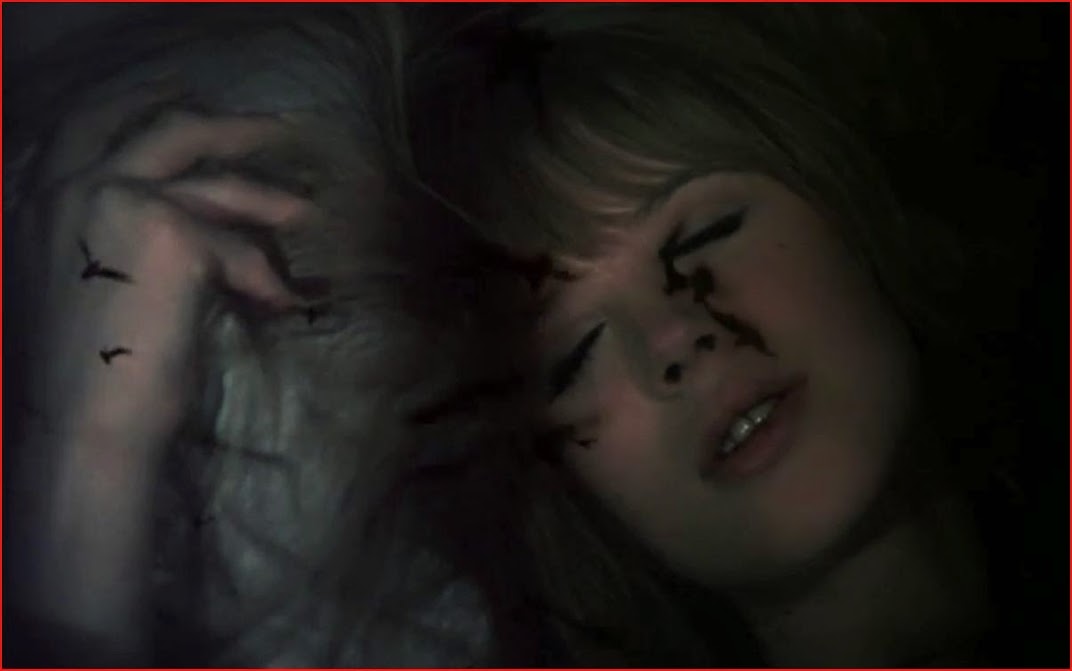
Boasting direction and photography by the legendary Jack Cardiff, Girl opens with a horrid effects shot of birds hovering over a house that's only slightly redeemed once identified as part of the title character's dream. Rebecca (Marianne Faithful) is having a restless night: she also dreams of doing a bareback act in her motorcycle costume in a circus, with Alain Delon as the ringmaster. He patiently whips her suit to shreds. Later, looking contemptuously professorial -- it turns out he is a professor -- Delon laughs at Rebecca in an abstract background. And there's solarization. Very visionary, Cardiff.

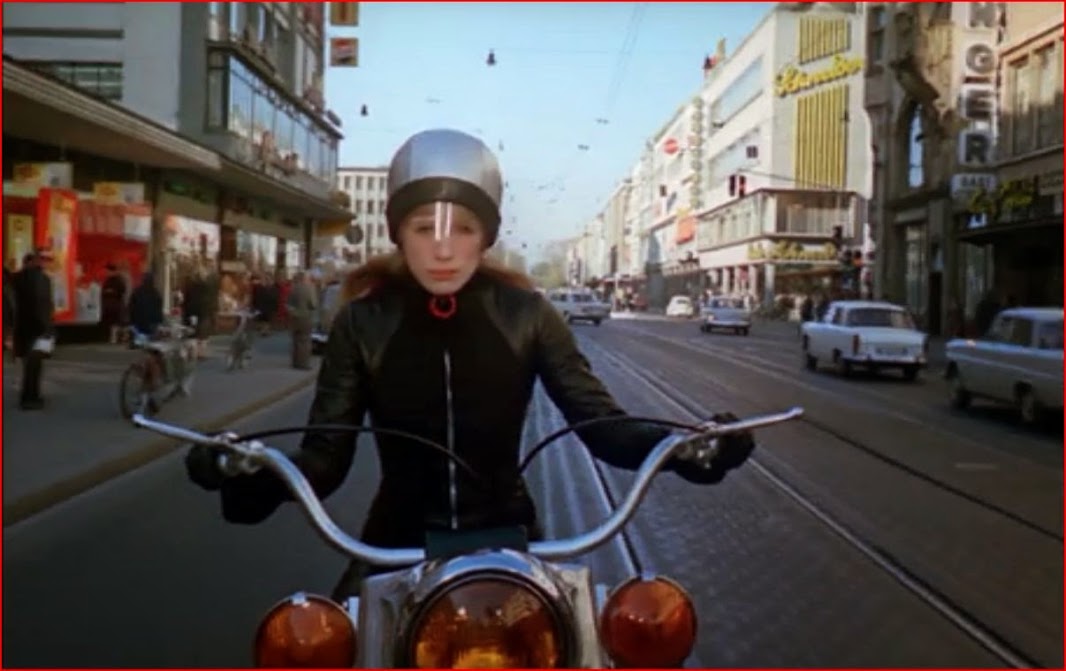
Fortunately, our auteur is on surer ground when he goes on location with the girl and the motorcycle. Rebecca is unhappily married because she pines for Delon. Compared to the sadly-named actor Roger Mutton, who plays her hapless schoolteacher of a husband, who wouldn't pine for Delon. While Mutton can't control a classroom of small boys, Delon commandingly lectures college students on the Playboy Philosophy or something along those lines. Sporting a professorial pipe, he could be teaching them Slack for all I know. The intellectuality of it all no doubt appeals to Rebecca the bookseller's daughter -- and it may be no accident that Archers icon Marius Goring plays the bookseller. Delon is extravagant, giving Rebecca the motorcycle as a wedding present. Where she got her moto-catsuit I don't know, but it looks like the cartoonist Darwyn Cooke got at least some of his ideas for his 21st-century redesign of Catwoman from Rebecca's costume. Wearing the costume, with boots and helmet and nothing else (hence the alternate title Naked Under Leather), Rebecca rides from France to Germany to reunite with Delon while indulging in voiceover monologues and flashbacks that make Cardiff's work seem a little like a caveman version of Terrence Malick. Cardiff indugles in the illusion that Rebecca is riding a motorcycle. To me it looks suspiciously like she's being towed in some shots, though that may be only to make it easier for Cardiff to show off by doing a 360 degree spin around Rebecca's head while she's riding. In other scenes, those where she and Delon must share a bike and talk to each other, or close-ups in dangerous conditions, Cardiff resorts to process shots, though he strives, with mixed success, to make them more convincing than normal. And in some long shots, the stunt rider is clearly wearing a bulkier costume than Rebecca's. You can't help noticing these things because this is a pretentiously visionary film by a legendary cinematographer. The inconsistencies can't help but distract the mind -- but from what?


The most dated thing about The Girl on a Motorcycle is that Rebecca's plight is considered a subject for a feature film. Nearly fifty years ago I suppose her adventures did seem daring, but it's hard to imagine anyone caring even then. So she's adulterous and worries about being a nymphomaniac. What of it? What of it, indeed, given this film's dull thud of an ending, which seems to reduce Rebecca's drama to a cruel joke. In short, she's ecstatically closing the kilometers between herself and Delon, bouncing on her seat and otherwise stimulating her libido, when she's killed in a traffic accident, in slapstick fashion. Bam! Her bike hits the side of a vehicle and she goes flying. Cardiff cuts to a flying shot and a brief close-up of Rebecca's shot. Then she goes head-first through a windshield, presumably killed instantly. A VW swerves to avoid this wreck, flips and explodes. In many of the shots Rebecca's dead legs are still visible sticking out of that windshield, our heroine reduced to no more an object than the cars on the road. I suppose it put Cardiff ahead of his time, since I was reminded partly of the gruesome finish of Daughters of Darkness and partly of the comedy accident scene in Jacques Tati's Trafic -- both films from a few years later. The really funny part is imagining that Cardiff thought this numb spectacle was akin to Moira Shearer's death scene in Red Shoes. But maybe there's a moral, too? Has transgression been punished? Or, more objectively, has liberation been proved transient at best? Or should Rebecca have been wearing her helmet, no matter how white and ugly it was?

Some people may give Cardiff a pass on style-over-substance grounds, but the film's tackiness makes that difficult. Sure, many shots are as brilliant as you'd demand from Cardiff, but some show horrendous bad taste. One scene I've snipped, with Delon's privates obscured by a flower vase, looks like something Benny Hill would have come up with. For every truly gorgeous moment there's a ghastly one, at least. And throughout, we have Marianne Faithful and the unresolved question of whether Rebecca is insane or simply an idiot. Faithful will leave you guessing, if not wondering about her real self. As for Delon, his quest for English-language stardom had taken him to strange places already (Texas Across the River, anyone?), and at least he seems to enjoy himself here. That's more than I can say for the audience.

Cardiff wouldn't work in movies again for another five years, and would direct only two more films before reverting to full-time cinematography. To this day cinematographers crash and burn when they turn into directors; Wally Pfister is the most recent victim. It's a shame that they don't get enough recognition -- or compensation? -- for their true talents. Fortunately, the very best like Cardiff are remembered for their real triumphs, while failures like Girl on a Motorcycle fade in time.


 B
B


