David Lowery's film steers a middle course between the temptations of terror and romanticism and ends up being one of the saddest films I've seen in awhile. This is the film with the gimmick that its ghost (Casey Affleck) goes through the picture, after the character's death, wearing the iconic white sheet with eyeholes that western culture has identified with ghosts for who knows how long. The gimmick requires Affleck, an Oscar-winning performer, to rely on the most constrained pantomime to express anything, but it confers a degree of universality on his character's experience, and the reduction of his individuality probably has a point as well. The dead man is an aspiring musician who'd just agreed with his wife (Rooney Mara), after considerable stalling, to move out of their home. Killed in a car wreck outside the house, he "wakes up" in the hospital moments after his wife has viewed his body. Mute and invisible, he travels on foot to the house, and from that point he seems bound to the property. He watches his wife grieve by gorging herself to sickness on pie and has a brief poltergeist episode after seeing her drunkenly flirt with another man. It's clear, however, that she misses him greatly, for all the good that does either of them. Communication beyond moving objects seems impossible; our ghost is capable only of telepathic communication (rendered with subtitles) with another ghost who "lives" across the way. This other ghost's plight portends a bad fate for ours; it's waiting for someone to return, but can't remember who exactly.
Finally the widow moves out, but feels moved first to leave a note in a crack in a freshly-painted wall. Painting it over, she drives away behind the moving van and it's clear that our poor ghost will never see her again. There's no following her and witnessing the rest of her life; instead, he remains in the house as it changes hands a few times, mostly torpid but sometimes hauntingly angry, until it is finally demolished. Whether Lowery intended it or not, the wife's departure is an ingenious role reversal. Since we'll never see her again or hear of what became of her, the ghost may as well be the widowed and bereaved one, permanently cut off from the beloved as far as we can tell. There is something beyond, as we saw when a sort of doorway into "the light" opened for him in the hospital, but for any number of reasons he turned it down. Now, however, he wants to get at that note, not knowing whether it was addressed to him, the house, the future or whatever. And in a brilliant bit of timing, the moment he manages to scratch his way to it a wrecking ball hits the building and soon the house is gone.
The film grows more expansively fantastic from here. Our ghost remains on the property as it becomes the site of an office building while a great city encroaches on the once-rural community. The neighbor ghost finally gave up the ghost, so to speak, shortly after the demolition, but ours holds on for what must be decades more, wandering through the corridors until it ends up on the roof. The cityscape he sees is our signal of a great passage of time. In response, he jumps, and to be honest I'm not sure what he's trying to accomplish. Is he trying to destroy himself, or simply trying to escape his prison? In any event, he doesn't hit the sidewalk but plunges through history, landing nearly two centuries in the past as a pioneer family makes camp on the property. The daughter hums a tune resembling something the ghost wrote in life; did she inspire him from a distance, or is he possibly her reincarnation? In any event, she and her family are killed by Indians and from there history proceeds rapidly until the ghost sees himself and his wife moving into the house. We now see that he had haunted himself, having made the noises we'd heard wake the living man early in the picture. He reviews the post-mortem events, now a ghost of a ghost watching his sheeted self watch his wife until she once again departs. He knows now to get after that note promptly and finding it, he finds the closure that can end his earthly existence once and for all.
On the DVD, Lowery claims that he never knew what was in the note, having told Rooney Mara to write whatever she pleased, presumably in character. This suggests that the fact of the note rather than the content is what allows the ghost finally to let go of the property and break the time loop he seemed trapped in. Knowing this, each viewer can imagine the wife's message to your own satisfaction. It could be an ultimate disappointment like the feeling that led the other ghost to quit this sphere; it could be the ultimate farewell that he didn't get at the hospital; or it could simply have been an ultimate reaffirmation of his identity as something separate from the property that can freely depart from it. That's a good kind of ambiguity and appropriate to a movie addressing the mysteries of life's end. A Ghost Story's less-is-more approach proves very effective and helps it succeed on an empathetic level that transcends genre formulae. Some may find the sight of Affleck in a sheet hopelessly absurd or may be frustrated by the near-complete refusal of obvious acting -- Lowery actually could have kept a deleted scene of Affleck making coffee, as it establishes the stillness that characterizes the ghost -- but more, I hope, will see the film as testimony to the storytelling potential of the simplest image.
A randomly comprehensive survey of extraordinary movie experiences from the art house to the grindhouse, featuring the good, the bad, the ugly, but not the boring or the banal.
Showing posts with label 2017. Show all posts
Sunday, February 10, 2019
Sunday, October 21, 2018
ERREMENTARI (2017)
The Spanish affinity for traditional gothic horror extends to the Basque country, which gives us Paul Urkijo Alijo's grim fairy tale of a film. Based on a European legend that also influenced the "Howling Man" episode of The Twilight Zone, Errementari is set at the time of the First Carlist War in 19th century Spain. A deserter from that war is Patxi the blacksmith (Kandido Uranga), who made a pact with the minor demon Sartael (Eneko Sagardoy) in order to be reunited with his wife, only to find that she, presuming him dead, had shacked up with another man and had a daughter, Usue (Uma Bracaglia). The tragedy results in the other man killed, the wife a suicide, Usue a despised outcast raised by foster parents taunted with tales of her mother suffering in Hell, and Patxi the keeper of a terrible secret. The arrival of a government official with stories of a hidden stash of gold at Patxi's forge hastens the revelation of the secret, but it's Usue, hoping that the smith can repair her headless doll, who makes the discovery. Believing the smith a fresh murderer (in fact, a trespasser has died by accident), Usue discovers evidence that Patxi is keeping a child in a cage. Naturally, not having watched The Twilight Zone, Usue frees the pathetic victim, who promptly reveals himself as Sartael in all his folkloric if not cartoonish splendor: red skin, horns, presumably cloven hooves, etc. The demon tries to avenge himself on Patxi, but the blacksmith could not have held a demon captive in the first place without being knowledgeable and resourceful. In folklore, demons are very vulnerable. Far from invulnerable to physical attack, they're also hypersensitive to the ringing of bells and, like some vampires, they're compelled to count chickpeas cast on the ground. Worse, mess with the pile and the poor creatures have to start counting over again. It soon becomes clear that for all his frightful appearance and taunting, Sartael's actually a pretty pathetic excuse for a demon, a laughingstock among his peers, and especially his superiors, for getting himself trapped and detained so easily by a mortal. When another hellish emissary arrives, planning not only to claim Patxi's soul at last but also to demote Sartael to a fate worse than death in the infernal hierarchy, old enemies will join forces, each seeking redemption of a sort through kindness to Usue and the memory of her much-wronged mother. Boasting lavish art-direction, lurid cinematography and a satiric attitude toward Carlist conservatism (their side supported absolute monarchy) that echoes in Europe and elsewhere today, Errementari feels like a crossbreed merging Spanish historical gothic and a more Burtonesque sensibility in its sympathy for a devil who never entirely becomes a good guy. Available for streaming on Netflix in its native language and an English dub, it may be the most charming new horror film you'll see this Halloween season.
Thursday, October 11, 2018
THE DEVIL AND FATHER AMORTH (2017)
The first thing that's hard to believe about William Friedkin's documentary is that more than forty years passed before the director of The Exorcist was invited to witness an actual exorcism. Once the opportunity arose, Friedkin made it the occasion for a meditation, at times searching and at times utterly credulous, on the potential real-world benefits of exorcism. He was invited to Italy to witness the pre-eminent exorcist of the age, the nonagenarian Fr. Gabriele Amorth, in his ninth session with a woman named Cristina. It looks nothing like Friedkin's visualizations of William Peter Blatty's novel. Cristina is surrounded by an extended family as Amorth, who died before the film was released, does his thing. Blatty is constrained by Amorth's forbidding of a film crew of cinematic lighting, but his digital video long-take approach seems appropriate to the material, though his cinema-verite presentation of the exorcism is marred by his obvious resort to enhanced sound effects whenever Cristina starts ranting. Of course, she's incapable of the contortions or levitations of pop legend, but it is unsettling to see her thrashing about and playing the devil at random moments during the session. She says nothing outrageous -- or nothing outrageous was translated -- unless you're still outraged by people claiming to be the devil, or "legion," or whatever. For all that, it seemed, especially with the family around, more like an exotic therapy session than a struggle with the forces of darkness.
Digressing, Friedkin interviews a number of reputed experts in various related fields, from the author of a scholarly history of the devil to medical specialists who debate whether Amorth's work can have a genuine therapeutic effect. The film is at its best here, steering away from sensationalism to suggest that there may be some worth to exorcism, perhaps on a placebo level, apart from its spiritual pretensions, though it was Amorth's own policy not to exorcise anyone who could be diagnosed with psychological issues. There are reasons, detailed in his Wikipedia listing, to question whether Amorth was the best judge of his own work, though Friedkin tends to take his claims on, well, faith. His film has ultimately limited value as a documentary, compared to an essay film, because it fails to appraise either Amorth or Cristina objectively. I especially missed the lack of background to Cristina or her family that might suggest more mundane reasons for her odd, attention-seeking behavior. Instead, Friedkin goes in an even more sensationalist direction, telling a yarn about an unfilmed encounter with Cristina and her boyfriend in a creepy church in which she went apeshit and the boyfriend threatened the director with physical violence. It's hard not to call bullshit on that bit of business, but Friedkin is probably betting that no one will care enough to try to corroborate the Cristina story. There's an "evil wins" implication here, underscored by the facts of Amorth's final illness, but The Devil and Father Amorth is really too slapdash to make any strong impression. Nevertheless, I found it entertaining on a barnstorming level, a bit of exploitation hucksterism that seems more like something from The Exorcist's own time than the work of the director's old age.
Sunday, September 23, 2018
ORBITER 9 (Órbita 9, 2017)
For an Anglophone moviegoer it's a novelty to see space exploration carried out in Spanish. This isn't some implausible chauvinism on the part of writer-director Hatem Khraiche, as he tells us eventually that Spain is just one of four countries involved in the preparation of pioneer voyages to the planet Celeste, a goldilocks world that offers the only hope of survival for the people of an increasingly polluted Earth. A young Spanish woman, Helena (Clara Lago) is the sole crewmember of one of the family-sized colony ships. Stalled by an oxygen malfunction, she has waited for a repair ship for three years since her parents apparently sacrificed themselves to extend her oxygen supply. At last, Alex the engineer (Alex Gonzalez) arrives to fix the problem. He has only 50 hours of "autonomy" to do the job; after that, Helena will have another 20 years on her own before she reaches her destination. Alex is the first human being other than her parents that she's ever seen. Five minutes in you can guess the direction the picture will take, but your movie brain should tell you that that's probably too soon to jump to conclusions. It may not surprise you to learn that Alex has some alarming secrets, and that his interaction with Helena will put both people in danger as they edge toward revolt against a manipulative government's plans. Órbita 9 is ultimately more of a thriller than an all-out sci-fi film, but the sort of dystopia that forms its backdrop does tend to lend itself to thriller plots. I've probably now made it sound like a rather conventional movie, and I suppose it is that, superficially speaking. But the lead actors put it over with convincing displays of moral indignation, with Gonzalez adding a level of guilty torment over his role in a past failed experiment. The romance angle is a little much, taking the ending almost to a fairy-tale level, but then again, this is, for all its trendy pessimism, a fantasy film that ends on an odd note of reconciliation, given the seemingly unforgivable ruthlessness the head scientist showed earlier in the picture. At 95 minutes it seems scrupulous about not overstaying its welcome, even if it strikes you a Twilight Zone episode opened out and padded to feature length. Thanks to Netflix I didn't have to go out of my way to see this, so I don't feel that I can hold much against it.
Saturday, March 31, 2018
On the Big Screen: THE DEATH OF STALIN (2017)
Russia banned Armando Iannucci's burlesque of Soviet history shortly before its scheduled release in the former U.S.S.R. The country's culture ministry describes it as an incitement to ethnic hatred and an insult to those who lived through the Soviet Union and apparently liked it. The Russians protest that Ianucci and his co-writers, adapting a French graphic novel, sought to brainwash moviegoers so that "the thought of the 1950s Soviet Union [would make] people feel only terror and disgust." A westerner's inevitable rejoinder might be, "what else was there to feel?" but we should never underestimate the persistence and virulence of "my country right or wrong" thinking anywhere, or the legitimate pride Soviet citizens may have felt or still feel about the nation's technological achievements, particularly in space exploration. Also, to the extent that Russia was a different culture before Stalinism arguably warped it further, patriotic Russians today, from the president on down, may simply disagree with the admittedly reflexive western assessment that Stalinist terror -- the killing of actual and (mostly) suspected political enemies -- disqualifies Josef Stalin's every other achievement, from the decisive battles against Nazi Germany to ... well, whatever Russians think he achieved. The irony of Russian outrage, no doubt exacerbated by their resentment of the persistent vilification of their country since the ascent of Vladimir Putin, is that The Death of Stalin may well offend people who have the polar opposite view of Stalin and his collaborators. Iannucci's burlesque treatment of the power struggle following the tyrant's demise will no doubt appear to trivialize the cruelty of Stalin's despotism by making it an occasion for black comedy.
Imagine the Coen brothers (or Martin Scorsese in comic mood) directing the Three Stooges in one of those wartime propaganda pictures in which Moe Howard played Hitler and you'll get close to the flavor of this film. Stalin's inner circle are portrayed as thuggish clowns -- which probably is unfair, to the extent to which they were committed ideologues with an ideal of the common good that just happened to be incompatible with liberal democracy, but isn't exactly inconsistent with the way Stalin himself treated them during his long late-night bull sessions. Their sophomoric antics on such an evening are juxtaposed with both a final wave of arrests and the farcical doings at a Radio Moscow studio when the dictator requests a transcript of that evening's concert, forcing the idiot managers to restage it since they'd forgotten to record the performance. The unvarnished brutality of the roundup is intercut with comedy on the level of, "You'd better do as I say, or off with your head!" It reminds you that despotism has always been the stuff of slapstick comedy, tapping into shared destructive fantasies. A thread runs from this scene through the rest of the picture as the featured pianist (Olga Kuryenko in the nearest thing to a sympathetic role), who holds out for a huge bribe before reprising her performance, sends a nasty message to Stalin that becomes part of the later power struggle.
Inevitably the story gets going as Stalin (Adrian McLoughlin) suffers a cerebral hemorrhage and spends a fatal night on his office floor marinating in his own pee, because the guards outside are too scared to investigate the loud thump they heard. Finally his henchmen are summoned to the scene, setting up the funniest scene in the picture as they compete to express grief and collaborate to move the still-living leader despite their great disgust at his urine-soaked clothes. It becomes clear that while the dim-witted Gyorgy Malenkov (Jeffrey Tambor, way too old yet ideally expressing the character's lumbering incompetence) is Stalin's heir-apparent, real power will be seized either by longtime security chief Lavrenti Beria (Simon Russell Beale) or the Moscow party boss Nikita Khrushchev (Steve Buscemi). Beria would seem to have all the advantages, including a vicious streak that has him, on film at least, still personally torturing suspects, but everyone else's fear or hatred of Beria ultimately works to Khrushchev's advantage. The film leaves the impression that the result made little difference, since each man was committed to a degree of liberalization, if only to gain popularity. The film is even more insistent, however, about each man being out only for himself, while their Politburo colleagues are too dumb -- or too damaged in the case of longtime foreign minister Vyacheslav Molotov (Michael Palin) -- to show any initiative.
From one perspective this approach indisputably trivializes history, but Iannucci's perspective and purpose are bluntly iconoclastic. He was disturbed to see Stalin portraits shamelessly on display in Moscow hotels, finding that equivalent to Germans displaying portraits of Hitler. While Russians might answer that Hitler helps explain why they see Stalin as a good guy, Iannucci presumably sees both men as tyrants and gangsters equally deserving of repudiation from their people. His film suffers from his conflicting desires to lampoon and condemn as it swings from the pitch-black comedy of the title event to the more dramatically brutal resolution of the Khrushchev-Beria feud. There's little funny about Beria's end, apart from Jason Isaacs's over-the-top portrayal of Marshal Zhukov as a two-fisted Russian cowboy -- as Khrushchev has his rival shot in the head and burnt in a courtyard -- in a compression of events that played out over several months -- and in fairness to Iannucci's intentions little is meant to be. To reinforce his point that all Stalin's men were gangsters -- hence, presumably, the casting of Buscemi in the first place -- he ends the movie like a gangster picture, apart from an epilogue that uses title cards to skim through future Khrushchev power struggles that might have made for a full-scale sequel. Ultimately The Death of Stalin is grimly entertaining despite some tonal incoherence, and with Russophobia at a new fever pitch in the west, the nebulous attitude of the President of the United States notwithstanding, the picture probably has found an ideal moment to open wide in the U.S. Since Iannucci has next to nothing to say about communism as an economic or political system, Russians today are probably right to guess that his film's ultimate message will be that Russians have always been thugs and always will be. Since they take a tit-for-tat attitude about such slights, perhaps we'll soon see something in Russian about British or American scandals or atrocities, maybe something that makes Churchill or Reagan look like an idiot -- and if we did see such a picture here I suppose that would prove a point.
Imagine the Coen brothers (or Martin Scorsese in comic mood) directing the Three Stooges in one of those wartime propaganda pictures in which Moe Howard played Hitler and you'll get close to the flavor of this film. Stalin's inner circle are portrayed as thuggish clowns -- which probably is unfair, to the extent to which they were committed ideologues with an ideal of the common good that just happened to be incompatible with liberal democracy, but isn't exactly inconsistent with the way Stalin himself treated them during his long late-night bull sessions. Their sophomoric antics on such an evening are juxtaposed with both a final wave of arrests and the farcical doings at a Radio Moscow studio when the dictator requests a transcript of that evening's concert, forcing the idiot managers to restage it since they'd forgotten to record the performance. The unvarnished brutality of the roundup is intercut with comedy on the level of, "You'd better do as I say, or off with your head!" It reminds you that despotism has always been the stuff of slapstick comedy, tapping into shared destructive fantasies. A thread runs from this scene through the rest of the picture as the featured pianist (Olga Kuryenko in the nearest thing to a sympathetic role), who holds out for a huge bribe before reprising her performance, sends a nasty message to Stalin that becomes part of the later power struggle.
Inevitably the story gets going as Stalin (Adrian McLoughlin) suffers a cerebral hemorrhage and spends a fatal night on his office floor marinating in his own pee, because the guards outside are too scared to investigate the loud thump they heard. Finally his henchmen are summoned to the scene, setting up the funniest scene in the picture as they compete to express grief and collaborate to move the still-living leader despite their great disgust at his urine-soaked clothes. It becomes clear that while the dim-witted Gyorgy Malenkov (Jeffrey Tambor, way too old yet ideally expressing the character's lumbering incompetence) is Stalin's heir-apparent, real power will be seized either by longtime security chief Lavrenti Beria (Simon Russell Beale) or the Moscow party boss Nikita Khrushchev (Steve Buscemi). Beria would seem to have all the advantages, including a vicious streak that has him, on film at least, still personally torturing suspects, but everyone else's fear or hatred of Beria ultimately works to Khrushchev's advantage. The film leaves the impression that the result made little difference, since each man was committed to a degree of liberalization, if only to gain popularity. The film is even more insistent, however, about each man being out only for himself, while their Politburo colleagues are too dumb -- or too damaged in the case of longtime foreign minister Vyacheslav Molotov (Michael Palin) -- to show any initiative.
From one perspective this approach indisputably trivializes history, but Iannucci's perspective and purpose are bluntly iconoclastic. He was disturbed to see Stalin portraits shamelessly on display in Moscow hotels, finding that equivalent to Germans displaying portraits of Hitler. While Russians might answer that Hitler helps explain why they see Stalin as a good guy, Iannucci presumably sees both men as tyrants and gangsters equally deserving of repudiation from their people. His film suffers from his conflicting desires to lampoon and condemn as it swings from the pitch-black comedy of the title event to the more dramatically brutal resolution of the Khrushchev-Beria feud. There's little funny about Beria's end, apart from Jason Isaacs's over-the-top portrayal of Marshal Zhukov as a two-fisted Russian cowboy -- as Khrushchev has his rival shot in the head and burnt in a courtyard -- in a compression of events that played out over several months -- and in fairness to Iannucci's intentions little is meant to be. To reinforce his point that all Stalin's men were gangsters -- hence, presumably, the casting of Buscemi in the first place -- he ends the movie like a gangster picture, apart from an epilogue that uses title cards to skim through future Khrushchev power struggles that might have made for a full-scale sequel. Ultimately The Death of Stalin is grimly entertaining despite some tonal incoherence, and with Russophobia at a new fever pitch in the west, the nebulous attitude of the President of the United States notwithstanding, the picture probably has found an ideal moment to open wide in the U.S. Since Iannucci has next to nothing to say about communism as an economic or political system, Russians today are probably right to guess that his film's ultimate message will be that Russians have always been thugs and always will be. Since they take a tit-for-tat attitude about such slights, perhaps we'll soon see something in Russian about British or American scandals or atrocities, maybe something that makes Churchill or Reagan look like an idiot -- and if we did see such a picture here I suppose that would prove a point.
Saturday, February 24, 2018
UNCERTAIN GLORY (Incerta gloria, 2017)
Twentieth century Spain, from the civil war through the Franco dictatorship, is the new capital of gothic cinema. There's something morbidly picturesque about the ruined architecture and the passionate politics that has inspired not only Guillermo del Toro but other filmmakers as well. There's nothing supernatural about Agusti Villaronga's film or the Joan Sales novel, one of the classics on the civil war, that inspired it, but the mood is inescapable. Ruins, crypts, corpses abound, and these details make gothic what could almost as easily, from a different aesthetic vantage, have been film noir. From the country that gave us Paul Naschy and The Spirit of the Beehive, gothic seems right somehow.
The story focuses on a quadrilateral of characters: the Republican soldier Lluis (Marcel Borras), his wife Trini (Bruna Cusi), his buddy Soleras (Oriol Pla) and the local aristocrat, the Carlana (Nuria Prims). We meet the Carlana first as she barely escapes with her life when an anarchist army overruns the Carlan's estate and executes him. She convinces the soldiers that she was just a sexually-exploited maid, and now she continues to occupy the property. Looking to her children's future, she wants them recognized as legitimate heirs to the land. As no witnesses to her marriage to the Carlan to survive, she looks to Lluis to help persuade some local peasants to perjure themselves by swearing under oath that they witnessed the wedding. She's made it clear to lonely Lluis, far from home and wife, that helping her with this is his best chance at getting to ride more than the Carlan's horse.
The Carlana is a black widow, a noirish femme fatale willing to kill her deadbeat dad when he shows up to extort money from her, yet you can't help empathizing if not sympathizing with her survival instincts given the savagery of the anarchists and the brutality (we learn of it later) of most men she's known. Amid the collapse of civil society it's every woman for herself as everyone struggles to keep their heads above water. While Lluis's loyalty to Trini wavers, Soleras, struggling with his own desire for Trini, changes sides altogether, going over to the Falangists in a sort of protest against Lluis's imminent infidelity. Chickening out of a suicide attempt, he vents his spleen at the Carlana, invading her sanctum and forcing her at gunpoint to strip and reveal the scars of past tortures.
Lluis and Trini try to reconcile but their child's illness brings a new crisis. Medicine for diphtheria is in short supply on both sides of the war, as Soleras unhappily admits, but someone of the Carlana's standing can deliver the goods -- for a price. The price she extracts from Lluis for his son's life is Soleras's death. Fortunately, Soleras is more willing to pay that price than Lluis did, but what good does any of this do anyone while the war grinds on. A closing air raid blends into newsreel refugee footage, with some of our actors added, to suggest that any victory in such an environment is only temporary.That's the moral of this vividly shot picture -- cinematographer Josep M. Civit runs the gamut from the funereal darkness of the crypt to the blazing light on the landscapes. It's more a sensational, psychological piece than a historical or political drama: the foreign viewer won't learn much about the civil war from Uncertain Glory, apart perhaps from how it was experienced on an unideological individual level. You don't really need to know what any side stood for to appreciate the film's human drama and its dramatically picturesque presentation. At a time when societies everywhere seem to be coming apart, it might seem less like a period piece and more like a premonition in its gothic timelessness.
The story focuses on a quadrilateral of characters: the Republican soldier Lluis (Marcel Borras), his wife Trini (Bruna Cusi), his buddy Soleras (Oriol Pla) and the local aristocrat, the Carlana (Nuria Prims). We meet the Carlana first as she barely escapes with her life when an anarchist army overruns the Carlan's estate and executes him. She convinces the soldiers that she was just a sexually-exploited maid, and now she continues to occupy the property. Looking to her children's future, she wants them recognized as legitimate heirs to the land. As no witnesses to her marriage to the Carlan to survive, she looks to Lluis to help persuade some local peasants to perjure themselves by swearing under oath that they witnessed the wedding. She's made it clear to lonely Lluis, far from home and wife, that helping her with this is his best chance at getting to ride more than the Carlan's horse.
Lluis and Trini try to reconcile but their child's illness brings a new crisis. Medicine for diphtheria is in short supply on both sides of the war, as Soleras unhappily admits, but someone of the Carlana's standing can deliver the goods -- for a price. The price she extracts from Lluis for his son's life is Soleras's death. Fortunately, Soleras is more willing to pay that price than Lluis did, but what good does any of this do anyone while the war grinds on. A closing air raid blends into newsreel refugee footage, with some of our actors added, to suggest that any victory in such an environment is only temporary.That's the moral of this vividly shot picture -- cinematographer Josep M. Civit runs the gamut from the funereal darkness of the crypt to the blazing light on the landscapes. It's more a sensational, psychological piece than a historical or political drama: the foreign viewer won't learn much about the civil war from Uncertain Glory, apart perhaps from how it was experienced on an unideological individual level. You don't really need to know what any side stood for to appreciate the film's human drama and its dramatically picturesque presentation. At a time when societies everywhere seem to be coming apart, it might seem less like a period piece and more like a premonition in its gothic timelessness.
Saturday, January 27, 2018
On the Big Screen: HOSTILES (2017)
Scott Cooper's western has come touted in some quarters as "the best western since Unforgiven," as has every promising film in the genre since Unforgiven. Baby steps first: is Hostiles the best western of the 21st century? Better than Meek's Cutoff, or The Assassination of Jesse James by the Coward Robert Ford, or The Hateful Eight? No, no and no, but I can understand why some might think differently. Hostiles has more of a mainstream sensibility than any of the actual best westerns since Unforgiven, and it has a very strong performance by Christian Bale up front. His, at least, comes closest to living up to the film's formidable epigraph, the famous quote by D.H. Lawrence about the American archetype being "isolate, stoic and a killer." Done up right, Bale looks and carries himself more like a 19th century person than many 21st century actors, though to be fair his moustache helps him greatly. He plays Captain Joe Blocker, tasked at the brink of retirement, and with his pension at stake, with escorting an old enemy, the moribund Chief Yellow Hawk (Wes Studi), from New Mexico to his ancestral lands in Montana. Blocker, goaded by a snarky Harper's Weekly reporter, refuses until threatened by his superiors to have anything to do with the mission, showing an irrational vehemence that marks him as a hardcore Indian hater. But it becomes apparent once the journey is under way that Blocker would simply rather not be reminded in any way of the buddies he lost during the Indian wars. The journey to Montana promises to be a catharsis one way or another.
The party, including Yellow Hawk's family and the usual collection of cavalry types, discovers the remains of a farm that we saw destroyed by renegade Comanches. Inside the farmhouse is Rosalie Quaid (Rosamund Pike) sole survivor of a massacre that took her husband and three children from her. She freaks out at the sight of more Indians, but as with Blocker, something about the journey softens her feelings toward them, and one can safely predict from a still-early point that the youngest of Yellow Hawk's group will end up her own surrogate child.
Adapting an unfinished treatment by the late Academy Award winner Donald E. Stewart, Cooper as writer-director seems to be saying something about what happens to people taking a journey together. As long as everyone's on the move, everyone finds it easier to get along than anyone might have expected. It helps to have common foes to force them together: first those Comanches, whom Yellow Hand's people also regard as enemies; then a rapey band of fur trappers; then a convicted murderer and former comrade of Blocker's (Ben Foster) who's dumped in the captain's last for a latter leg of the trek. It also helps, in a more contrived way, that despite whatever atrocities Yellow Hawk may have perpetrated in the past -- we're meant to remember that Wes Studi was the bad Indian of modern cinema -- the old chief and his family are nothing but wise and compassionate throughout the trip. You hear not a word of bitterness from them, nor any thought of just desserts when the whites are wounded or killed. Their final obstacle at the end of the trail, after Yellow Hawk becomes one with the Force, is an obnoxious group of whites who refuse to let the old man be buried on land they claim as their own. Not even the presidential safe-conduct pass Blocker carries impresses these yahoos, who clearly give a damn about nothing and no one but their property rights. "Republicans," some in the audience will surely think. But the main idea seems to be that once people put down stakes they have something to fight over, and so just when it seemed that the film had reached its conclusion on a note of reconciliation, it has one more bloodbath left.
Cooper has an odd attitude toward violence. The opening massacre scene pulls no punches in showing Rosalie's daughters getting shot down and focusing on Rosalie herself cuddling a bloodstained bundle that was her baby. From there, Hostiles becomes inconsistently reticent. We see a running battle between the travelers and the Comanches, but when Yellow Hawk and his son are let loose to track them down and kill them, we only see the aftermath. Later, when the troopers and Cheyennes rescue their women from the trappers, we only hear their slaughter of the bad guys inside a house; like Rosalie, we only see gun-flashes, the sounds of stabbing and the screams of victims. Later still, after the convict has escaped and killed a trooper, Blocker's oldest buddy (Rory Cochrane), who'd been about to desert, rides off to chase down the killer. As with the Comanches, we find the convict dead the next morning, while Blocker's buddy has killed himself. Finally, the showdown in Montana climaxes with Blocker stalking the patriarch who had started the trouble, after everyone but Rosalie Little Bear have been killed. Blocker is clearly determined to finish the troublemaker off. While Rosalie watches in horror, trying to shield Little Bear's eyes, we see Blocker do something awful to the man -- most likely cut his throat -- from behind. This reticence is noteworthy in a R-rated film, and maybe praiseworthy when so many westerns are still spaghetti-inspired bloodbaths. But what Cooper might be saying about violence isn't really clear. The way the final fight ends, you might think that Blocker's killing of the man might be a deal-breaker for whatever relationship he and Rosalie might have, that by taking this extra step -- who can say if it's really necessary? -- Blocker is showing something of his true nature that would repel her. Yet the film has a theoretically happy ending with Blocker deciding to join Rosalie and Little Bear on a train to civilization -- or at least to Chicago, in a result to which Rosalie presumably would not object. I suppose a commitment to a new journey is just what Blocker needs to avoid further dwelling on his violent past, but at once there's something too neat and too muddled about the way Hostiles addresses issues of violence and hatred, as if Cooper were satisfied that to address these issues is to settle them. In the end, I suspect that he's gone too far in superimposing our modern ideas of post-traumatic strain on an Old West that's ultimately too abstract -- practically the only activities we see are transportation and killing -- to be convincing. The West of Hostiles is a place where post-traumatic stress seems to be the normal state of being, which is not quite what D. H. Lawrence was saying about America. Of course, he was a kinky English novelist, so what does he know, but if you take your epigraph from him, and then you make Hostiles, there's some contradiction going on. Either he's right, or Scott Cooper is -- or, more likely, both of them are wrong.
The party, including Yellow Hawk's family and the usual collection of cavalry types, discovers the remains of a farm that we saw destroyed by renegade Comanches. Inside the farmhouse is Rosalie Quaid (Rosamund Pike) sole survivor of a massacre that took her husband and three children from her. She freaks out at the sight of more Indians, but as with Blocker, something about the journey softens her feelings toward them, and one can safely predict from a still-early point that the youngest of Yellow Hawk's group will end up her own surrogate child.
Adapting an unfinished treatment by the late Academy Award winner Donald E. Stewart, Cooper as writer-director seems to be saying something about what happens to people taking a journey together. As long as everyone's on the move, everyone finds it easier to get along than anyone might have expected. It helps to have common foes to force them together: first those Comanches, whom Yellow Hand's people also regard as enemies; then a rapey band of fur trappers; then a convicted murderer and former comrade of Blocker's (Ben Foster) who's dumped in the captain's last for a latter leg of the trek. It also helps, in a more contrived way, that despite whatever atrocities Yellow Hawk may have perpetrated in the past -- we're meant to remember that Wes Studi was the bad Indian of modern cinema -- the old chief and his family are nothing but wise and compassionate throughout the trip. You hear not a word of bitterness from them, nor any thought of just desserts when the whites are wounded or killed. Their final obstacle at the end of the trail, after Yellow Hawk becomes one with the Force, is an obnoxious group of whites who refuse to let the old man be buried on land they claim as their own. Not even the presidential safe-conduct pass Blocker carries impresses these yahoos, who clearly give a damn about nothing and no one but their property rights. "Republicans," some in the audience will surely think. But the main idea seems to be that once people put down stakes they have something to fight over, and so just when it seemed that the film had reached its conclusion on a note of reconciliation, it has one more bloodbath left.
Cooper has an odd attitude toward violence. The opening massacre scene pulls no punches in showing Rosalie's daughters getting shot down and focusing on Rosalie herself cuddling a bloodstained bundle that was her baby. From there, Hostiles becomes inconsistently reticent. We see a running battle between the travelers and the Comanches, but when Yellow Hawk and his son are let loose to track them down and kill them, we only see the aftermath. Later, when the troopers and Cheyennes rescue their women from the trappers, we only hear their slaughter of the bad guys inside a house; like Rosalie, we only see gun-flashes, the sounds of stabbing and the screams of victims. Later still, after the convict has escaped and killed a trooper, Blocker's oldest buddy (Rory Cochrane), who'd been about to desert, rides off to chase down the killer. As with the Comanches, we find the convict dead the next morning, while Blocker's buddy has killed himself. Finally, the showdown in Montana climaxes with Blocker stalking the patriarch who had started the trouble, after everyone but Rosalie Little Bear have been killed. Blocker is clearly determined to finish the troublemaker off. While Rosalie watches in horror, trying to shield Little Bear's eyes, we see Blocker do something awful to the man -- most likely cut his throat -- from behind. This reticence is noteworthy in a R-rated film, and maybe praiseworthy when so many westerns are still spaghetti-inspired bloodbaths. But what Cooper might be saying about violence isn't really clear. The way the final fight ends, you might think that Blocker's killing of the man might be a deal-breaker for whatever relationship he and Rosalie might have, that by taking this extra step -- who can say if it's really necessary? -- Blocker is showing something of his true nature that would repel her. Yet the film has a theoretically happy ending with Blocker deciding to join Rosalie and Little Bear on a train to civilization -- or at least to Chicago, in a result to which Rosalie presumably would not object. I suppose a commitment to a new journey is just what Blocker needs to avoid further dwelling on his violent past, but at once there's something too neat and too muddled about the way Hostiles addresses issues of violence and hatred, as if Cooper were satisfied that to address these issues is to settle them. In the end, I suspect that he's gone too far in superimposing our modern ideas of post-traumatic strain on an Old West that's ultimately too abstract -- practically the only activities we see are transportation and killing -- to be convincing. The West of Hostiles is a place where post-traumatic stress seems to be the normal state of being, which is not quite what D. H. Lawrence was saying about America. Of course, he was a kinky English novelist, so what does he know, but if you take your epigraph from him, and then you make Hostiles, there's some contradiction going on. Either he's right, or Scott Cooper is -- or, more likely, both of them are wrong.
Saturday, January 13, 2018
On the Big Screen: THE SHAPE OF WATER (2017)
Basically, Guillermo del Toro made a Tim Burton film, down to the kitschy nostalgia and the alienated misfits sticking it to bourgeois society. Only here's the difference. Burton empathizes with alienation from within bourgeois society. To put it more plainly, he deals with alienated whites. Del Toro gives us a cast of outsiders for whom alienation isn't simply a lifestyle choice: a mute, a gay man, a black woman and a gill-man. I suppose you can throw in the sympathetic Russia spy, too, since he's shown to be a better, more compassionate man than his KGB masters. Compassion apparently missing among the powerful puts all these characters on the same side. Del Toro and co-writer Vanessa Taylor can sometimes get heavy-handed about this. The gay man (Richard Jenkins), a commercial artist, is initially unwilling to help his mute neighbor (Sally Hawkins, this generation's Shelley Duvall) in her mad scheme to free the gill-man (Doug Jones) from government captivity. But after getting harshly rejected by the pie-shop clerk he'd been crushing on, and seeing him throw a black couple out of the place, the artist is all in. There's a solidarity of otherness here somewhat different from whatever solidarity of alienation exists in Burton's worlds, and perhaps a more eager embrace of the happy ending than Burton often could countenance. But let's say that if Burton were going to remake Splash, but del Toro inherited the project, The Shape of Water is quite close to what you'd probably get.
The film's true origin, we've been told, is the strange pang of romance little Guillermo felt when he saw the Creature from the Black Lagoon stalking Julia Adams underwater. The object of Shape of Water is to milk whatever romantic potential exists between a relatively homely, socially handicapped female and an amphibian man who is said to be "beautiful," though he's a typical del Toro critter, and has conveniently godlike powers of healing. It helps that Elisa, the mute, has an aquatic fetish -- she masturbates in her bathtub and later recklessly floods her bathroom so she and the gill-man can get it on outside the tub's cramped confines -- that may date back to when she was found, Moses-like, in the water as a babe. Compassion forms the core of their romance; she, merely a cleaning lady at the Occam research facility ("The Simplest Explanation is the Best!"), seems to be the only person in the building really interested in communicating with the captive creature, offering it hard-boiled eggs while teaching it the sign for "egg." She shares her music collection with the creature -- this Sixties-set film admirably eschews the usual oldies in favor of the Forties music of the artist's beloved Fox musicals and the stuff Elisa presumably grew up on -- and gains self-esteem as she teaches another non-verbal being to communicate. However intelligent the gill-man might be, he will not see Elisa as "incomplete" because she can't talk. Like with plague-muted little Luna in War for the Planet of the Apes, there's an implication that doing without speech allows for more pure, guileless, communication.
The other side of that coin is the preference for silence during sex expressed by the creature's chief captor, Col. Strickland (Michael Shannon), who puts his maimed, bleeding hand over his wife's mouth to shut her up during intercourse. Strickland in some ways is more like a Burton protagonist in that he feels increasing alienation from his family's bland bourgeois existence ("Bonanza is much too violent!") He tries to buck the consumer fad for the color green -- the artist is ordered to recolor the Jell-O in his spec painting, for instance -- resisting the sales pitch for a green Cadillac until the salesman assures him that the color is actually teal. For whatever reason, his alienation takes oppressive, domineering form, with his cattle prod a surrogate phallus, perhaps because, as a general tells him, the military is the cruel face his society shows the outside world, while denying violence in its own midst; see also the artist's reluctance to watch news footage of the Birmingham police dogs attacking civil-rights protesters. Strickland's most obviously a control freak, refusing to accept the loss of two fingers at the gill-man's hands until the regrafted digits begin to rot and stink on him. But there's also a self-destructive streak that leads him to see himself as a Samson willing to destroy himself in order to take all his enemies down with him. Inevitably, when other characters are good guys simply by virtue of their otherness (see also Elisa's workplace protector, played by Octavia Spencer), Strickland ends up the most intriguing character, if also a tailor-made Michael Shannon villain.
The Shape of Water is an even weirder film than the ads and trailers let on, perhaps because even a snippet of Elisa's Rogers-Astaire fantasy dance with the gill-man might have been a too-Burtonesque deal-breaker for some prospective viewers. It's really more fairy-tale than horror film, or at least more of a fairy tale, in the "happily ever after" sense, than any previous del Toro film. It's a lovely looking film with well-dressed locations and sets shot by Dan Laustsen. The soundtrack is an intriguing mix of Forties tunes and an Alexander Desplat score that veers between Danny Elfman and Bernard Herrmann with some gallic touches of the composer's own. The film's on shakiest ground in imagining the interior life of the gill-man. He sometimes seems like a too-good-to-be-true innocent, but then del Toro has it kill and eat one of the artist's housecats. But if that was to remind us that the gill-man is a monster, the film promptly reverses that impression by having the creature apologize to the artist, after his fashion, and in the process heal both the scratches he inflicted on the artist's arm and his pattern baldness. If a last-supper scene where the gill-man's signing skills don't seem to have progressed past "egg" suggests that there's an inherent limit to his communication skills, he later manages to sign his desire that Elisa return to the sea with him. A stricken Strickland concludes that the gill-man really is a god -- he was worshiped as such in the land where the colonel found him -- but whether we're really meant to see him that way, or simply as a fairy-tale creature, is ultimately unclear. Each viewer can draw his or her own conclusion, but I think Shape of Water will succeed in getting most audiences to buy into Elisa's fantasy and del Toro's, if not necessarily his view of a time when America, as far as most people were concerned, was still great.
The film's true origin, we've been told, is the strange pang of romance little Guillermo felt when he saw the Creature from the Black Lagoon stalking Julia Adams underwater. The object of Shape of Water is to milk whatever romantic potential exists between a relatively homely, socially handicapped female and an amphibian man who is said to be "beautiful," though he's a typical del Toro critter, and has conveniently godlike powers of healing. It helps that Elisa, the mute, has an aquatic fetish -- she masturbates in her bathtub and later recklessly floods her bathroom so she and the gill-man can get it on outside the tub's cramped confines -- that may date back to when she was found, Moses-like, in the water as a babe. Compassion forms the core of their romance; she, merely a cleaning lady at the Occam research facility ("The Simplest Explanation is the Best!"), seems to be the only person in the building really interested in communicating with the captive creature, offering it hard-boiled eggs while teaching it the sign for "egg." She shares her music collection with the creature -- this Sixties-set film admirably eschews the usual oldies in favor of the Forties music of the artist's beloved Fox musicals and the stuff Elisa presumably grew up on -- and gains self-esteem as she teaches another non-verbal being to communicate. However intelligent the gill-man might be, he will not see Elisa as "incomplete" because she can't talk. Like with plague-muted little Luna in War for the Planet of the Apes, there's an implication that doing without speech allows for more pure, guileless, communication.
The other side of that coin is the preference for silence during sex expressed by the creature's chief captor, Col. Strickland (Michael Shannon), who puts his maimed, bleeding hand over his wife's mouth to shut her up during intercourse. Strickland in some ways is more like a Burton protagonist in that he feels increasing alienation from his family's bland bourgeois existence ("Bonanza is much too violent!") He tries to buck the consumer fad for the color green -- the artist is ordered to recolor the Jell-O in his spec painting, for instance -- resisting the sales pitch for a green Cadillac until the salesman assures him that the color is actually teal. For whatever reason, his alienation takes oppressive, domineering form, with his cattle prod a surrogate phallus, perhaps because, as a general tells him, the military is the cruel face his society shows the outside world, while denying violence in its own midst; see also the artist's reluctance to watch news footage of the Birmingham police dogs attacking civil-rights protesters. Strickland's most obviously a control freak, refusing to accept the loss of two fingers at the gill-man's hands until the regrafted digits begin to rot and stink on him. But there's also a self-destructive streak that leads him to see himself as a Samson willing to destroy himself in order to take all his enemies down with him. Inevitably, when other characters are good guys simply by virtue of their otherness (see also Elisa's workplace protector, played by Octavia Spencer), Strickland ends up the most intriguing character, if also a tailor-made Michael Shannon villain.
The Shape of Water is an even weirder film than the ads and trailers let on, perhaps because even a snippet of Elisa's Rogers-Astaire fantasy dance with the gill-man might have been a too-Burtonesque deal-breaker for some prospective viewers. It's really more fairy-tale than horror film, or at least more of a fairy tale, in the "happily ever after" sense, than any previous del Toro film. It's a lovely looking film with well-dressed locations and sets shot by Dan Laustsen. The soundtrack is an intriguing mix of Forties tunes and an Alexander Desplat score that veers between Danny Elfman and Bernard Herrmann with some gallic touches of the composer's own. The film's on shakiest ground in imagining the interior life of the gill-man. He sometimes seems like a too-good-to-be-true innocent, but then del Toro has it kill and eat one of the artist's housecats. But if that was to remind us that the gill-man is a monster, the film promptly reverses that impression by having the creature apologize to the artist, after his fashion, and in the process heal both the scratches he inflicted on the artist's arm and his pattern baldness. If a last-supper scene where the gill-man's signing skills don't seem to have progressed past "egg" suggests that there's an inherent limit to his communication skills, he later manages to sign his desire that Elisa return to the sea with him. A stricken Strickland concludes that the gill-man really is a god -- he was worshiped as such in the land where the colonel found him -- but whether we're really meant to see him that way, or simply as a fairy-tale creature, is ultimately unclear. Each viewer can draw his or her own conclusion, but I think Shape of Water will succeed in getting most audiences to buy into Elisa's fantasy and del Toro's, if not necessarily his view of a time when America, as far as most people were concerned, was still great.
Sunday, December 24, 2017
BRIGHT (2017)
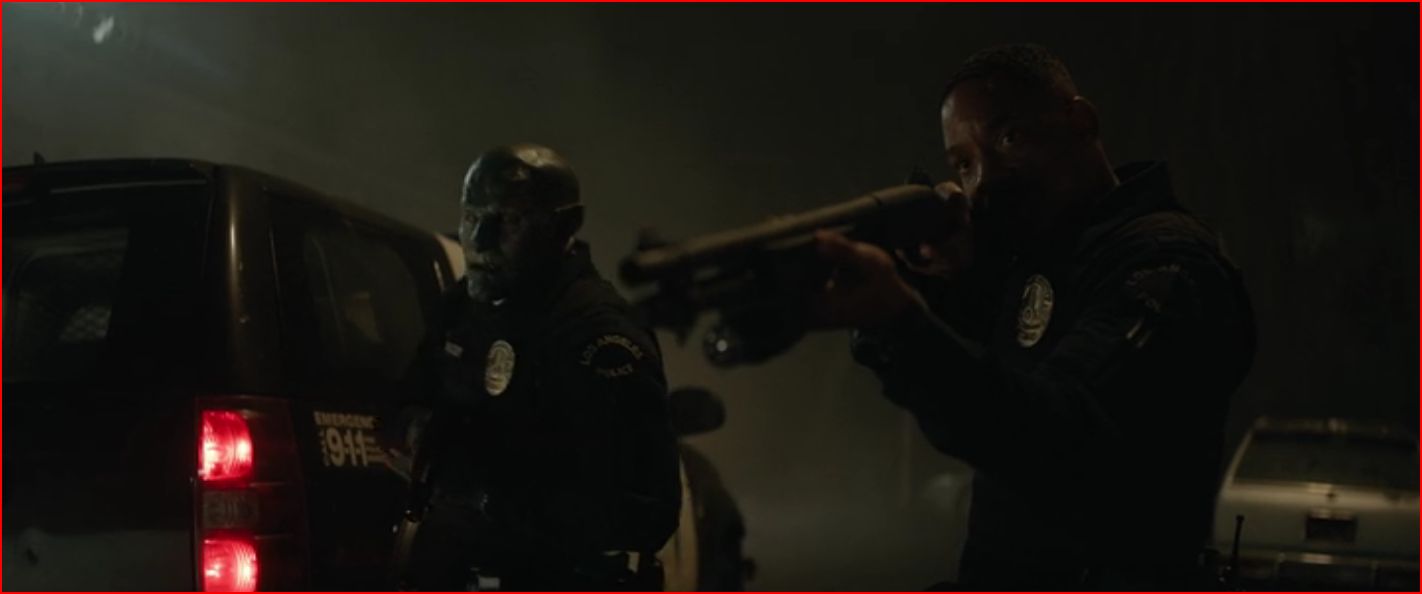
Urban fantasy is a genre of popular fiction in which mythological creatures coexist with humans in modern cities. There are two broad categories of urban fantasy, one in which the fantasy creatures hail from the horror genre: vampires especially, but also werewolves and all the rest. In the other category, you have the creatures of Tolkienesque high fantasy: elves, dwarves, orcs and so on. David Ayer's Bright, now streaming on Netflix, is one of the first large-scale attempts to put that second type of urban fantasy on screen. Like many an urban fantasy book, it uses the cop or crime format, giving us as mismatched LAPD partners Daryl Ward (Will Smith) and Nick Jakoby (Joel Edgerton), the latter being the city's first orc cop. Orcs are hated for their looks -- Nick is a "pig" even before he becomes a cop because orcs normally have tusks, though he's filed his down to fit in better -- and for their apparently treacherous role a long-ago war between the Alliance of the Nine Races and the forces of the Dark Lord. While this event explains centuries of human hate for orcs, it doesn't seem to have had any other major impact on the evolution of human society. Bright's LA is pretty much our LA, except that wealthy, beautiful elves live in their own exclusive enclave and some store signs are in non-human languages. Daryl Ward lives a normal suburban life (though his neighborhood is going gangsta and he wants to move out) apart from the occasional nuisance of a fairy buzzing around and being a pest.
There's a certain lack of imagination at work, but the point of the genre is the juxtaposition of the fantastic with the here-and-now, so there'd be no point in altering the here-and-now beyond recognition. More practically speaking, elves and orcs (or vampires) play the role in urban fantasy that Chinatown used to fill in pulp fiction: a community nearby and yet a world away, where people live by different rules from ours and often can get away with stuff we can't. Inevitably the world of urban fantasy invites comparison with the increasingly uncomfortably multiculturalism of here and now, and Bright directly invites comparisons when Daryl jokes, "Fairy lives don't matter today" when he swats a winged mini-humanoid pest with a broom. Nick Jakoby could be the oppressed minority or the distrusted refugee depending on your perspective. Despised by most fellow cops and society at large, he's also looked on as an "unblooded" sellout by the orc underclass. Daryl has even more reason not to trust Nick after getting shot by an orc gangster while Jakoby was preoccupied with buying his partner a burrito, and still more reason when evidence suggests that Nick let a suspect get away. It's sure to be a long, difficult day when Daryl returns to active duty, but neither he nor Nick could guess how difficult it gets.
David Ayer may have formed an alliance with Will Smith after the dubious triumph of Suicide Squad, but the main reason he's here is his history of cop movies, beginning with his authorship of Training Day. His job is to maintain a veneer of verisimilitude as the proceedings grow increasingly fantastic. To a great extent, that's simply a matter of keeping the dialogue salty, or just the way Will Smith likes it. It's also a matter of restraint, and to the relief of anyone who saw Suicide Squad Ayer resists many opportunities to go over the top with special effects. Max Landis's story heads dangerously close to Suicide Squad territory as Daryl and Nick become embroiled in the hunt for a rare magic wand -- only a "Bright" of any race can use one without dying explosively -- that an evil elf (Noomi Rapace) wants to use to bring back the Dark Lord. A good elf (Lucy Fry, giving a strong Fifth Element vibe without the sex appeal) has the wand, but not only her evil sister but corrupt cops and both orc and human gangsters want it, hoping for everything from limitless wealth to a cure for the injuries that have left one crime boss in a wheelchair. Daryl has to kill four cops to stop them from taking the wand and whacking Nick, and from there the episodic chase is on, taking the three protagonists through a half-orcish, half-Hispanic underworld while the federal Bureau of Magic (led by an elfin Edgar Ramirez) scrambles to keep tabs on things.
You may have read some brutal reviews identifying Bright as one of the year's worst films. I've only seen the headlines in an effort to avoid spoilers, so I can only guess whether the reviewers have their knives out for Smith and/or Ayer, expressing reflexive hostility to the very premises of urban fantasy, or flinching from the implicit comparisons to real-world race relations. In all fairness, Bright is no instant classic and suffers from moments of gratuitous violence and story-sustaining stupidity -- e.g., why didn't the corrupt cops just blow Daryl and Nick away when they had a golden opportunity, or why does a sniper let the three protagonists run to shelter just after taking a deputy down with one shot? -- but it's easily better than Suicide Squad, to set the bar admittedly low, and not half-bad on its own terms. Smith and Edgerton develop a decent chemistry and Ayer maintains a better balance of fantasy and grittiness than he did in his previous effort. He passes one crucial test late in the picture by never having the portal or whatever the evil elf was working on open, and never showing us the Dark Lord. For the type of story he's telling this time, he didn't really need that extra spectacle. The climax, with an inevitable but still implausible revelation of another Bright, may induce groans, but by then the film should have earned just enough good will from indulgent audiences to be forgiven that ploy.
Bright has a better overall production design than Suicide Squad, with Ayer's frequent cinematographer Roman Vasyanov also improving on his last collaboration. The real difference, I suspect, was that there was no nervous mega-corporation looking over the talents' shoulders throughout this production, which leaves Bright looser and sharper than the Warner Bros.-DC extravaganza. At the end of the day it's still an overblown B picture, and maybe too reminiscent of Alien Nation for its own good, but I found it a diverting experiment in translating pop fiction into a new movie genre.
Slices of life in Bright's America
There's a certain lack of imagination at work, but the point of the genre is the juxtaposition of the fantastic with the here-and-now, so there'd be no point in altering the here-and-now beyond recognition. More practically speaking, elves and orcs (or vampires) play the role in urban fantasy that Chinatown used to fill in pulp fiction: a community nearby and yet a world away, where people live by different rules from ours and often can get away with stuff we can't. Inevitably the world of urban fantasy invites comparison with the increasingly uncomfortably multiculturalism of here and now, and Bright directly invites comparisons when Daryl jokes, "Fairy lives don't matter today" when he swats a winged mini-humanoid pest with a broom. Nick Jakoby could be the oppressed minority or the distrusted refugee depending on your perspective. Despised by most fellow cops and society at large, he's also looked on as an "unblooded" sellout by the orc underclass. Daryl has even more reason not to trust Nick after getting shot by an orc gangster while Jakoby was preoccupied with buying his partner a burrito, and still more reason when evidence suggests that Nick let a suspect get away. It's sure to be a long, difficult day when Daryl returns to active duty, but neither he nor Nick could guess how difficult it gets.
David Ayer may have formed an alliance with Will Smith after the dubious triumph of Suicide Squad, but the main reason he's here is his history of cop movies, beginning with his authorship of Training Day. His job is to maintain a veneer of verisimilitude as the proceedings grow increasingly fantastic. To a great extent, that's simply a matter of keeping the dialogue salty, or just the way Will Smith likes it. It's also a matter of restraint, and to the relief of anyone who saw Suicide Squad Ayer resists many opportunities to go over the top with special effects. Max Landis's story heads dangerously close to Suicide Squad territory as Daryl and Nick become embroiled in the hunt for a rare magic wand -- only a "Bright" of any race can use one without dying explosively -- that an evil elf (Noomi Rapace) wants to use to bring back the Dark Lord. A good elf (Lucy Fry, giving a strong Fifth Element vibe without the sex appeal) has the wand, but not only her evil sister but corrupt cops and both orc and human gangsters want it, hoping for everything from limitless wealth to a cure for the injuries that have left one crime boss in a wheelchair. Daryl has to kill four cops to stop them from taking the wand and whacking Nick, and from there the episodic chase is on, taking the three protagonists through a half-orcish, half-Hispanic underworld while the federal Bureau of Magic (led by an elfin Edgar Ramirez) scrambles to keep tabs on things.
You may have read some brutal reviews identifying Bright as one of the year's worst films. I've only seen the headlines in an effort to avoid spoilers, so I can only guess whether the reviewers have their knives out for Smith and/or Ayer, expressing reflexive hostility to the very premises of urban fantasy, or flinching from the implicit comparisons to real-world race relations. In all fairness, Bright is no instant classic and suffers from moments of gratuitous violence and story-sustaining stupidity -- e.g., why didn't the corrupt cops just blow Daryl and Nick away when they had a golden opportunity, or why does a sniper let the three protagonists run to shelter just after taking a deputy down with one shot? -- but it's easily better than Suicide Squad, to set the bar admittedly low, and not half-bad on its own terms. Smith and Edgerton develop a decent chemistry and Ayer maintains a better balance of fantasy and grittiness than he did in his previous effort. He passes one crucial test late in the picture by never having the portal or whatever the evil elf was working on open, and never showing us the Dark Lord. For the type of story he's telling this time, he didn't really need that extra spectacle. The climax, with an inevitable but still implausible revelation of another Bright, may induce groans, but by then the film should have earned just enough good will from indulgent audiences to be forgiven that ploy.
This shot features some nice widescreen composition, some admirably grungy set design,
and Lucy Fry's peculiar curiosity about restroom hand-driers.
Bright has a better overall production design than Suicide Squad, with Ayer's frequent cinematographer Roman Vasyanov also improving on his last collaboration. The real difference, I suspect, was that there was no nervous mega-corporation looking over the talents' shoulders throughout this production, which leaves Bright looser and sharper than the Warner Bros.-DC extravaganza. At the end of the day it's still an overblown B picture, and maybe too reminiscent of Alien Nation for its own good, but I found it a diverting experiment in translating pop fiction into a new movie genre.
Saturday, December 9, 2017
On the Big Screen: THE DISASTER ARTIST (2017)
In American pop culture, the label "worst film ever made" is almost an honorific. It's an acknowledgment of, or a backhanded tribute to, unintentional entertainment value unlikely to be found in whatever the worst film really is, if the worst can be defined objectively. If it can, it would most likely be the least entertaining of movies -- and most likely an unfunny comedy -- yet defining the worst by a failure to entertain is problematic when entertainment can be seen as unintentional and recognized as the result of an arguably objective failure of technical competence or artistic verisimilitude. Is the bad film we laugh at better or worse than the bad film we don't laugh at? It depends on whether you're laughing at or with the film and its filmmakers. People may say that certain cult films, like Tommy Wiseau's The Room, are "so bad they're good," but once such a film acquires a cult following people definitely are laughing with it. The Room is an unusual candidate for Worst Film for people of my generation, who are used to the worst being films whose auteurs' reach exceeds their grasp: fantasies like Plan 9 or Robot Monster, without resources or conventional screenwriting. Wiseau's film is a domestic drama, theoretically in the manner of Tennessee Williams, though the auteur, trimming his sails, now describes his screenplay as a parody of some sort. Its entertainment value is based entirely on Wiseau's audacious incompetence as actor, writer and director. In some ways Wiseau is the antithesis of Ed Wood; he seems to have had a limited imagination but limitless financial resources. They're two of a kind, however, in their struggles to convey basic human thoughts and emotions through scripted dialogue. Their appeal may lay in the way they inspire in audiences a recognition of how difficult that task actually is -- or how artificial conventional screenwriting is compared to the raw, idiosyncratic authenticity of those bad movies that earn cult followings as moments of personal expression rather than as imitations of life. Parody as a genre has had the same appeal for just about as long as movie comedies have been made. The truly worst films, those that fail to entertain in any way, may be those that don't stray far enough from convention and don't fail spectacularly enough. If anything is worse than "the worst," it's mediocrity.
Wiseau and Wood, neither a mediocrity by any measure, now occupy the same spot in movie history as the objects of biopics, though James Franco's Disaster Artist is less a biopic -- since Wiseau remains something of a mystery man to this day -- than one of that emerging subgenre, the "making of" movie (e.g. Hitchcock, Saving Mr. Banks, etc.) As a result, there's something inescapably formulaic about the picture, which was written by Michael H. Webster and Scott Neustadter. The eccentric, difficult artist (Franco) realizes his dream against all odds and after numerous conflicts with collaborators. Unlike in Tim Burton's Ed Wood, we can't really face Wiseau directly, so the writers give us a point-of-view character in the convenient form of Wiseau's roomate and star Greg Sestero (Dave Franco), whose memoir of his experience gives this film its title. Disaster Artist thus becomes a buddy film or bromance, with Wiseau going through a betrayal experience -- Sestero moves out of his apartment to live with a girlfriend -- echoing the narrative of The Room -- yet reconciling with his onetime protege when Greg explains to him that audiences laughing at (or with) Wiseau's picture are actually showing their appreciation of a unique cinematic achievement. If Disaster Artist is to be more than a cult film about a cult film -- about half the people in the theater where I saw it had seen The Room, laughed at the mere sight of its characters entering beloved sets, and often recited dialogue ahead of the actors -- it's up to James Franco, whom some may see as a Tommy Wiseau who had better luck in the genetic lottery, to entertain the uninitiated as an actor. He does so in championship fashion, managing to disappear into the Wiseau role -- the subject's signature mop of hair helps a lot here -- while giving one of the funniest performances I've seen in a long time. He'll probably win most people over in his very first scene, set in an acting class when, in response to the teacher's (Melanie Griffith) demand for emotion, turns the "Stella" scene from A Streetcar Named Desire into a sprawling, wall-climbing, furniture-tossing conniption fit that anticipates his Room performance. It sets the tone for a character for whom acting is synonymous with acting out, who justifies his neglect of convention (or common sense) with appeals to "real life," and whose self-pitying screenplay is ultimately a protest, as one bemused collaborator suspects, against his betrayal by the universe.
Wiseau, who sees himself as an all-American hero type, is betrayed by his own embodiment, partly voluntary, in a form reminiscent of a "vampire rapist" and a voice no one accepts, despite his insistence, as a product of New Orleans. Someone like him should never dare aspire to movie stardom when the odds are against even the geniuses, but the fact that he does dare, damning the consequences with a paradoxical contempt for the masses he aspires to entertain, makes him a kind of typically American hero, even when he behaves like a bully or a clueless ass, and earns The Room a measure of respect, the kind arguably reserved for the "worst films," as an act of pure will. Part of the appeal of the worst movies, I've long suspected, is their potential to inspire the rest of us to imagine ourselves making movies, bad or otherwise, and an all-round auteur -- or, if you prefer, a pretentious pretty boy -- like James Franco probably can't help empathizing with that feeling. His Wiseau is both a freak and an everyman in his innocence of craft who allows you to laugh with or at him with equal enjoyment. Once he wins you over, everything else is a bonus. The Disaster Artist may be the best of the "making of" movies so far, simply because the making of such an astoundingly bad film is easily more compelling than the making of a presumed masterpiece against whatever odds. It looks especially good in comparison with something like The Man Who Invented Christmas, which I only know from its trailer but looks, from that nauseating evidence, like something Tommy Wiseau could only improve upon.
Wiseau and Wood, neither a mediocrity by any measure, now occupy the same spot in movie history as the objects of biopics, though James Franco's Disaster Artist is less a biopic -- since Wiseau remains something of a mystery man to this day -- than one of that emerging subgenre, the "making of" movie (e.g. Hitchcock, Saving Mr. Banks, etc.) As a result, there's something inescapably formulaic about the picture, which was written by Michael H. Webster and Scott Neustadter. The eccentric, difficult artist (Franco) realizes his dream against all odds and after numerous conflicts with collaborators. Unlike in Tim Burton's Ed Wood, we can't really face Wiseau directly, so the writers give us a point-of-view character in the convenient form of Wiseau's roomate and star Greg Sestero (Dave Franco), whose memoir of his experience gives this film its title. Disaster Artist thus becomes a buddy film or bromance, with Wiseau going through a betrayal experience -- Sestero moves out of his apartment to live with a girlfriend -- echoing the narrative of The Room -- yet reconciling with his onetime protege when Greg explains to him that audiences laughing at (or with) Wiseau's picture are actually showing their appreciation of a unique cinematic achievement. If Disaster Artist is to be more than a cult film about a cult film -- about half the people in the theater where I saw it had seen The Room, laughed at the mere sight of its characters entering beloved sets, and often recited dialogue ahead of the actors -- it's up to James Franco, whom some may see as a Tommy Wiseau who had better luck in the genetic lottery, to entertain the uninitiated as an actor. He does so in championship fashion, managing to disappear into the Wiseau role -- the subject's signature mop of hair helps a lot here -- while giving one of the funniest performances I've seen in a long time. He'll probably win most people over in his very first scene, set in an acting class when, in response to the teacher's (Melanie Griffith) demand for emotion, turns the "Stella" scene from A Streetcar Named Desire into a sprawling, wall-climbing, furniture-tossing conniption fit that anticipates his Room performance. It sets the tone for a character for whom acting is synonymous with acting out, who justifies his neglect of convention (or common sense) with appeals to "real life," and whose self-pitying screenplay is ultimately a protest, as one bemused collaborator suspects, against his betrayal by the universe.
Wiseau, who sees himself as an all-American hero type, is betrayed by his own embodiment, partly voluntary, in a form reminiscent of a "vampire rapist" and a voice no one accepts, despite his insistence, as a product of New Orleans. Someone like him should never dare aspire to movie stardom when the odds are against even the geniuses, but the fact that he does dare, damning the consequences with a paradoxical contempt for the masses he aspires to entertain, makes him a kind of typically American hero, even when he behaves like a bully or a clueless ass, and earns The Room a measure of respect, the kind arguably reserved for the "worst films," as an act of pure will. Part of the appeal of the worst movies, I've long suspected, is their potential to inspire the rest of us to imagine ourselves making movies, bad or otherwise, and an all-round auteur -- or, if you prefer, a pretentious pretty boy -- like James Franco probably can't help empathizing with that feeling. His Wiseau is both a freak and an everyman in his innocence of craft who allows you to laugh with or at him with equal enjoyment. Once he wins you over, everything else is a bonus. The Disaster Artist may be the best of the "making of" movies so far, simply because the making of such an astoundingly bad film is easily more compelling than the making of a presumed masterpiece against whatever odds. It looks especially good in comparison with something like The Man Who Invented Christmas, which I only know from its trailer but looks, from that nauseating evidence, like something Tommy Wiseau could only improve upon.
Saturday, November 18, 2017
JUSTICE LEAGUE (2017) in SPOILERVISION
It's not that bad as a whole, but to be honest, the first half-hour of Zack Snyder's new film, with credited co-writing and uncredited reshoots by Joss Whedon, is awful: a jumble of scenes attempting to establish an important trait of parademons (the bug-winged creatures Batman [Ben Affleck] saw in his Dawn of Justice nightmare); remind us urgently that Wonder Woman (Gal Gadot) exists; and remind us more clumsily that the world is worse for the death of Superman (Henry Cavill) in the aforementioned Snyder production. Nothing really flows together and you might believe that several films, not just the Snyder and Whedon footage, had been awkwardly spliced into something crudely approximating a feature film. Nor are things helped much by the introduction of the film's villain. Steppenwolf, here embarking on his second stab at world conquest after millennia of dormancy, is a relatively minor character in Jack Kirby's "Fourth World" mythos, which few at DC Comics have really known what to do with since the King laid down his pencil. His presence here looks like a hedging of bets, as if Snyder, co-writer Chris Terrio and DC producer Geoff Johns didn't want to waste Kirby's actual big bad, the oft-misused Darkseid, on this particular movie and chose Steppenwolf as his proxy. No effort was made to give this substitute villain any personality beyond his generic lust for conquest, but I suppose you could argue that the villain of this piece was never meant to be anything more than a Macguffin, since the real story of Justice League is the formation of DC's in-print precursor and cinematic answer to Marvel's Avengers. Picking up the hints dropped like anchors in the last film, Batman and Wonder Woman set out to recruit the three supposed superbeings discovered by Lex Luthor's researchers: Arthur "The Aquaman" Curry (Jason Momoa), the bastard child of Atlantean royalty and quite the strongman on land; Barry "Flash" Allen (Ezra Miller), the young Central City speedster; and Victor "Cyborg" Stone (Ray Fisher), a man now more than half machine desperately trying to keep up with his evolving alien technology. The real purpose of this movie is to get you interested enough in these three to seek out their solo films as they appear, beginning with next year's Aquaman.
The results are mixed. All three actors succeeded in making their characters interesting, and they establish decent chemistry with each other and the established heroes. But I still question whether any of them can carry a feature film by today's standard of what such films should be. The future of the DC movie franchise now rests on the shoulders of Jason Momoa, and I'm glad to report that, liberated from his grim typecasting, the actor gives easily the best performance I've ever seen from him. But I still doubt whether whatever good will he's earned will make people interested in exploring DC's Atlantis, all too little of which was shown here apart from introducing Aquaman's eventual love interest Mera (Amber Heard). As Cyborg, Ray Fisher does probably as good as anyone could do with Marv Wolfman's character, making him sardonically bitter rather than self-pitying and adding a certain coldness that inclines the character to agree with Batman much of the time. But Cyborg has always been a hard sell as the black face of the DC Comics universe since Geoff Johns gave him that role by putting the character in his "New 52" era Justice League. Popular though he may be as one of Wolfman and George Perez's Teen Titans, Cyborg never seems to have clicked as a solo character despite Johns and other writers' stubborn efforts, and he has so little personal mythos that I find myself wondering what on earth a Cyborg movie would be about. Meanwhile, the development of a Flash movie is an ongoing nightmare for Warner Bros. Laboring in the shadow of the popular CW TV series, which automatically begs that question of what a feature film can do differently other than spend more money, the project can't hold on to a director as everyone struggles to fine-tune the property. The one thing different about Miller's Flash so far is his relative youth and his jittery Spider-Manic personality that makes him Justice League's comedy relief character. I thought Miller was likable enough to get away with it here, but I don't know if he can carry his own movie doing the same stuff. I'd be happy to see all of these guys again in another Justice League film, but despite this film's post-credit scene there are no immediate plans for another that I know of, and the drubbing the film is getting from Snyderphobic reviewers is unlikely to speed the day of their return.
I probably should talk about the story some more. The plot is right out of a serial: an artifact hunt. If Steppenwolf gets all the artifacts he can activate "the Unity," which won't be a good thing for anybody. Despite their being salted away on Atlantis, Themyscira and ... somewhere Cyborg knows about, he gets them. Fortunately, the good guys had just used that last one to resurrect their old pal Superman who, acting true to comic-book form, starts fighting them until Lois Lane (Amy Adams) shows up and tells him that the sun's getting real low, or something along those lines. Honestly, though, even in comics if Superman is messed up and not behaving right, mind-controlled, amnesiac or whatever, Lois is your best antidote. There was this one comic where to snap Superman out of Poison Ivy's mind-control, Batman has Catwoman throw Lois off a building, or at least that's how I remember it. But I digress. Anyway, Supes still needs some work in the shop so Lois takes him back for (ahem) debriefing in Smallville while the rest of the gang goes to some Sokovia-like place where Steppenwolf, his Unity and his army of parademons make life miserable for one humble family -- to, you know, make the situation more real for us, I guess. Determined that this shall not stand, the as-yet-unnamed Justice League -- I think the only person who actually describes them as a "league" is Lex Luthor (our old friend Jesse Eisenberg) in a post-credits secene -- go about delaying the bad guy until Superman is cleared for action, after which point there's really no contest.
Sounds stupid, right? Well, it kind of is, but while this is regrettably one of those films where the whole is less than the sum of its parts, a lot of those parts are quite entertaining. While Fisher, Miller and Momoa held up their end of the deal, Affleck, Cavill and Gadot were once more their reliable selves, though our Batman is much more mild-mannered than in his last appearance, to a degree that's left some again questioning his commitment to the franchise. I actually liked the change of pace and the way some things (like Bruce Wayne's whiskey-swilling) remained the same. So the acting was fine, apart from the helpless Ciaran Hinds, tasked with voicing Steppenwolf. As one might expect from Zack Snyder, some of the action is spectacular. The highlights include an extended battle on Themyscira as the Amazons run a desperate relay race to keep their artifact from Steppenwolf; a flashback establishing Steppenwolf's backstory featuring a super-epic battle pitting Amazons, Atlanteans, Olympian gods, Green Lanterns, etc. against old-timey parademons; and the guilty pleasure of the JL's brawl with the reawakened Superman, who seems capable of matching the Flash's speed (Miller sells this wonderfully) and trading head-butts with Wonder Woman all day. For all its many flaws, the film ultimately entertains. I'd reverse the conventional reviewer consensus and contend that Justice League is marginally worse than Dawn of Justice, and almost the weakest of this year's good crop of superhero movies -- after a second viewing of Guardians of the Galaxy Vol. 2, I'm inclined to leave that at the bottom. Snyder and Whedon have done Warner Bros. no great favors as far as Friday morning reviewers are concerned, but I close with the observation that at my half-full multiplex screening the audience applauded the film.
The results are mixed. All three actors succeeded in making their characters interesting, and they establish decent chemistry with each other and the established heroes. But I still question whether any of them can carry a feature film by today's standard of what such films should be. The future of the DC movie franchise now rests on the shoulders of Jason Momoa, and I'm glad to report that, liberated from his grim typecasting, the actor gives easily the best performance I've ever seen from him. But I still doubt whether whatever good will he's earned will make people interested in exploring DC's Atlantis, all too little of which was shown here apart from introducing Aquaman's eventual love interest Mera (Amber Heard). As Cyborg, Ray Fisher does probably as good as anyone could do with Marv Wolfman's character, making him sardonically bitter rather than self-pitying and adding a certain coldness that inclines the character to agree with Batman much of the time. But Cyborg has always been a hard sell as the black face of the DC Comics universe since Geoff Johns gave him that role by putting the character in his "New 52" era Justice League. Popular though he may be as one of Wolfman and George Perez's Teen Titans, Cyborg never seems to have clicked as a solo character despite Johns and other writers' stubborn efforts, and he has so little personal mythos that I find myself wondering what on earth a Cyborg movie would be about. Meanwhile, the development of a Flash movie is an ongoing nightmare for Warner Bros. Laboring in the shadow of the popular CW TV series, which automatically begs that question of what a feature film can do differently other than spend more money, the project can't hold on to a director as everyone struggles to fine-tune the property. The one thing different about Miller's Flash so far is his relative youth and his jittery Spider-Manic personality that makes him Justice League's comedy relief character. I thought Miller was likable enough to get away with it here, but I don't know if he can carry his own movie doing the same stuff. I'd be happy to see all of these guys again in another Justice League film, but despite this film's post-credit scene there are no immediate plans for another that I know of, and the drubbing the film is getting from Snyderphobic reviewers is unlikely to speed the day of their return.
I probably should talk about the story some more. The plot is right out of a serial: an artifact hunt. If Steppenwolf gets all the artifacts he can activate "the Unity," which won't be a good thing for anybody. Despite their being salted away on Atlantis, Themyscira and ... somewhere Cyborg knows about, he gets them. Fortunately, the good guys had just used that last one to resurrect their old pal Superman who, acting true to comic-book form, starts fighting them until Lois Lane (Amy Adams) shows up and tells him that the sun's getting real low, or something along those lines. Honestly, though, even in comics if Superman is messed up and not behaving right, mind-controlled, amnesiac or whatever, Lois is your best antidote. There was this one comic where to snap Superman out of Poison Ivy's mind-control, Batman has Catwoman throw Lois off a building, or at least that's how I remember it. But I digress. Anyway, Supes still needs some work in the shop so Lois takes him back for (ahem) debriefing in Smallville while the rest of the gang goes to some Sokovia-like place where Steppenwolf, his Unity and his army of parademons make life miserable for one humble family -- to, you know, make the situation more real for us, I guess. Determined that this shall not stand, the as-yet-unnamed Justice League -- I think the only person who actually describes them as a "league" is Lex Luthor (our old friend Jesse Eisenberg) in a post-credits secene -- go about delaying the bad guy until Superman is cleared for action, after which point there's really no contest.
Sounds stupid, right? Well, it kind of is, but while this is regrettably one of those films where the whole is less than the sum of its parts, a lot of those parts are quite entertaining. While Fisher, Miller and Momoa held up their end of the deal, Affleck, Cavill and Gadot were once more their reliable selves, though our Batman is much more mild-mannered than in his last appearance, to a degree that's left some again questioning his commitment to the franchise. I actually liked the change of pace and the way some things (like Bruce Wayne's whiskey-swilling) remained the same. So the acting was fine, apart from the helpless Ciaran Hinds, tasked with voicing Steppenwolf. As one might expect from Zack Snyder, some of the action is spectacular. The highlights include an extended battle on Themyscira as the Amazons run a desperate relay race to keep their artifact from Steppenwolf; a flashback establishing Steppenwolf's backstory featuring a super-epic battle pitting Amazons, Atlanteans, Olympian gods, Green Lanterns, etc. against old-timey parademons; and the guilty pleasure of the JL's brawl with the reawakened Superman, who seems capable of matching the Flash's speed (Miller sells this wonderfully) and trading head-butts with Wonder Woman all day. For all its many flaws, the film ultimately entertains. I'd reverse the conventional reviewer consensus and contend that Justice League is marginally worse than Dawn of Justice, and almost the weakest of this year's good crop of superhero movies -- after a second viewing of Guardians of the Galaxy Vol. 2, I'm inclined to leave that at the bottom. Snyder and Whedon have done Warner Bros. no great favors as far as Friday morning reviewers are concerned, but I close with the observation that at my half-full multiplex screening the audience applauded the film.
Saturday, November 11, 2017
On the Big Screen: MURDER ON THE ORIENT EXPRESS (2017)
After an unlikely period as a director of high-profile tentpole pictures -- Thor, Jack Ryan, Cinderella -- Kenneth Branagh returns to more personal filmmaking with this new adaptation of Agatha Christie's beloved novel, previously filmed to great effect by Sidney Lumet in 1974. It's a more personal picture this time because, unlike those recent efforts, this one stars Kenneth Branagh, following in the prominent footsteps of Albert Finney and Peter Ustinov, and the deeper tracks of David Suchet, by taking on the role of Christie's fussy Belgian, Hercule Poirot. For that you need an accent and a moustache. Branagh's Poirot accent -- I don't know whether it can be described accurately as a Belgian accent -- is at least superior to his attempts at an American accent; he's one of the few British actors who can't really do that well. It's with the moustache that Branagh really tries to differentiate himself from past Poirots. Certainly the preemptive favorite for the Best Moustache Oscar, should that category suddenly come into being, it's big, brown and bristly where the typical Poirot look is small, black and oily. As the years tell on the former boy-wonder actor-director, you wonder sometimes whether this is a Poirot mystery or The Sam Elliott Story. Ultimately, however, there's no mistaking the familiar story of a murder with a seemingly ever-expanding number of likely suspects, and if you've seen the Lumet movie (I have) or read the Christie original (I haven't) the only suspense the new film offers is whether Branagh's writer, Michael Green -- who was very busy this year with Wolverine, Alien and Blade Runner sequels -- would dare change Christie's ending. Spoiler alert: he doesn't.
That leaves it up to Branagh and his cast of actors to make the story fresh in other ways. There are some stabs at progressive casting that let Penelope Cruz and Leslie Odom Jr. into the picture, but only Willem Dafoe as the Pinkerton man (with an extra level of imposture) is arguably an improvement over his 1974 predecessor. The other actors aren't bad, though Michelle Pfeiffer goes maybe too far over the top, but as a director of actors Branagh, for all his Shakespearean experience, is no Sidney Lumet. He proves that further by indulging in overblown camera movements in an effort to give what should be an economically staged story -- apart from the Orient Express's necessarily luxurious furnishings -- a quasi-epic feel. If two characters are chatting in a boxcar, he'll have the camera hovering at some distance, and then he'll have it rise from below, or descend from above. Toward the end he rolls out a long shot following Poirot through a number of train cars, but it only reminds you that he'd done a much more impressive tracking shot in his debut film, Henry V, nearly thirty years ago. He even gives Poirot a Bond-style prologue as a mystery-solving peacemaker in the Old City of Jerusalem, and for all we know, given the nod toward Death on the Nile at the very end, he may have a franchise in mind, if audiences demand it. The theater where I saw the film is a neighborhood arthouse where the audience skews older, and there was a healthy crowd for a second matinee on a cold November afternoon, but I doubt the houses will look the same at the multiplexes. If he wants and gets another chance at Poirot I'd recommend that Branagh not go for the pre-sold titles but look for stories that have not been filmed as theatrical features. His Murder is not a bad film by any means, but in the end it did nothing to make me forget the Lumet film or what I knew to expect from the Christie mystery. But as someone who remembers a 43 year old movie fondly, perhaps I wasn't this film's target audience. Maybe those who know nothing of Agatha Christie or Sidney Lumet are the ones who'll rightly decide this film or this franchise's fate.
Saturday, November 4, 2017
THOR: RAGNAROK in SPOILERVISION
Taika Waititi is a cinematic miracle worker. His What We Do in the Shadows is not only the funniest vampire comedy ever made, which isn't much of an achievement in itself, but one of the funniest movies I've seen recently. His portrayal of vampires as almost childishly narcissistic apparently persuaded Kevin Feige and the folks at Marvel Studios that Waititi could be entrusted with the next chapter of their absurd Asgardian soap opera after the disaster of Thor: The Dark World. That Waititi could work wonders on a limited budget didn't hurt either, though now, by comparison, he would have money thrown at him. Working from a screenplay by three other people, he's made the most imaginative and funniest Marvel movie since Guardians of the Galaxy (2014) while demonstrating an aptitude for epic action on a colossal scale -- though as always with Marvel movies, one must wonder exactly how much of the set-piece action was planned out and rendered on computers before Waititi first called "Action!"
For all the spectacle, Ragnarok is character-centered, reiterating more strongly the premise implicit since the beginning that Thor (Chris Helmsworth) and his half-brother Loki (Tom Hiddleston) are a couple of spoiled brats of frighteningly immense power. This is re-established early as Thor, after thwarting the demon Surtur's scheme to initiate Ragnarok, the foredoomed fall of Asgard, quickly clears up the one dangling plot thread from Dark World, exposing Loki's impersonation of All-father Odin (Anthony Hopkins finally has some fun imitating Hiddleston) and overthrowing the self-indulgent trickster, who had placed the old man in a since-demolished retirement facility in New York City. Their arrival in Manhattan to claim Odin sets up the encounter with Doctor Strange (Benedict Cumberbatch) previewed in the epilogue to Strange's own origin film. The Strange scene shows Waititi's hand most plainly in the disorienting way the Master of the Mystic Arts teleports Thor all over his sanctum in a succession of jump cuts. The good doctor sends them off to some cliff where Odin has been waiting, before dying, to tell his boys that their elder sister Hela, goddess of death (Cate Blanchett), will be released from her prison upon his imminent demise. In other words, the grown-ups are taking over, as Hela, who grows an antler-like crest in combat mode, breaks Thor's favorite toy, his Uru hammer, and boots both him and Loki off Bifrost bridge en route to Asgard, where she promptly slaughters the Warriors Three (Tadanobu Asano, Ray Stevenson and the other guy) on her way to the throne, while the boys tumble to parts unknown. I'm sure this perfunctory dispatching of three favorite supporting characters from the comics will annoy some people, but it really was a waste of time having Asano and Stevenson keep showing up for how little the films have used them. As for the other supporting players, Sif is AWOL (the actress has a regular gig elsewhere) while Heimdall (Idris Elba) conveniently went underground when "Odin" started acting weird, forcing the king to appoint the mediocrity Skurge (Karl Urban) as guardian of Bifrost. Skurge survives Hela's initial onslaught to give the villainess someone to whom she can tell the secret history of Asgard and offer the job she held under her father as Executioner of the ruler's will and enemies.
A film within the film now begins as Thor crash-lands on Sakaar, better known to comics fans as "Planet Hulk" but ruled here by the self-styled Grandmaster (Jeff Goldblum) on bread-and-circus principles, with emphasis on circus. Big G relies on slave hunters like Scrapper 142 (Tessa Thompson) to recruit talent for his gladiatorial games. He agrees with her assessment that Thor, rendered tractable by a classic sci-fi pain device, will make a good contender for his "incredible champion," whose identity was revealed in trailers long ago. Loki has ended up here as well, but is content to make money betting on Thor to lose. For his part, Thor has recognized Scrapper 142 as a Valkyrie -- for all intents and purposes, the Valkyrie or just plain "Valkyrie" -- one of a long-gone cohort of Asgardian women warriors, and apparently the sole survivor of an attack by Hela during her uprising against Odin. There's no hope of Thor pulling rank, however, since Scrapper/Valkyrie has grown cynical and alcoholic in her attempt to forget the loss of many close comrades-in-arms. But the situation isn't as hopeless as it looks, since Thor's powers over thunder and lightning prove innate rather than hammer-based, though it takes the Hulk (Mark Ruffalo) nearly beating him to death to realize his potential. Ol' Greenskin has been on Sakaar since we last saw him in Avengers: Age of Ultron and has come both to like it here and to express his liking. Waititi and the writers give us a classically stupid Hulk (he had one of his increasingly common intelligent periods in the original Planet Hulk comics) with an almost-Trumpian insistence on taunting and "winning" regardless of appearances. Fans of the character will regret the wasting of one of Hulk's best-regarded storylines as a subplot to a Thor movie, but as Ruffalo himself has conceded that we'll probably never see another Hulk solo movie this is probably as good as it'll get for Marvel's Hulkamaniacs.
Thor's challenge now is to rally his three most likely collaborators into teaming with him on a breakout and reconquest of Asgard. Valkyrie would rather drink and forget, Loki is still out for himself and Hulk actually likes it on a planet where he's beloved by fight fans and hasn't had to turn back to Bruce Banner for ages. Those of you who found the buildup of a Hulk-Black Widow ship in Age of Ultron icky will be annoyed to learn that that's still a thing and key to Banner finally reappearing after Thor's own efforts to use Natasha's calming spiel fail miserably. The other pieces soon fall into place and we're finally on our way to a spectacular showdown in Asgard, assisted by Heimdall and, eventually, Skurge, whose machine-gun fetish allows him to recreate the comics character's classic last stand in Walt Simonson's 1980s comics, which are acknowledged in the end credits and regarded by fans as the best Thor stories since Stan Lee and Jack Kirby's time. A lot of undead minions are wasted, Hulk fights a big dog, and Thor hits Hela with "the biggest bolt of lightning in the history of lightning," but the film still hasn't hit 11 yet....
While most of Ragnarok is generic Marvel spectacle on paper, on screen it benefits from Waititi putting a fresh set of eyes on it. As the Doctor Strange sequence shows, the style he developed collaborating on What We Do in the Shadows was not entirely homogenized into the Marvel machine, and that helps make the new Thor feel fresher than, say, Guardians of the Galaxy Vol. 2. Both films may share a retro sensibility in their soundtracks -- as do most recent Marvel movies, it seems -- but Ragnarok creatively enhances that retro feel with original music with hints of video-game soundtracks from Mark Mothersbaugh and a pictorial sensibility, assisted by cinematographer Javie Aguirresarobe, reminiscent of vintage van murals or Heavy Metal magazine covers come to life. The acting is a mixed bag, and a lot of it may disappoint people who expect something more like, as Tony Stark would say, Shakespeare in the Park from a Thor movie. Helmsworth and Hiddleston are fine, but as Hela Cate Blanchett arguably doesn't chew the scenery enough, or as much as one might expect from a barnstormer like her. You might have expected Galadriel with the Ring on, but she sometimes sinks to the overall glib level of the dialogue, referring to Odin as "Daddy," for instance. By now, of course, we should be reconciled to not getting authentic Stan Lee-style rodomontade from Marvel movie villains, but if you were going to get away with it in any Marvel movie, this was probably it. These are action movies anyway, and Hela's actions (both Blanchett's and uber-stuntwoman Zoe Bell's) speak louder than her words. As for the other villain, Jeff Goldblum gives, to no legitimate surprise, a Jeff Goldblum performance as the Grandmaster that makes that Elder of the Universe more capricious than truly threatening, but his participation in the interlude doesn't require him to be truly evil or scary. For all Waititi's efforts to maximize the comedy in the story, Ragnarok was only ever going to be an action spectacle, and the fact that he succeeds on that level gives us more cause to look forward to whatever he does next, for Marvel or on his own.
For all the spectacle, Ragnarok is character-centered, reiterating more strongly the premise implicit since the beginning that Thor (Chris Helmsworth) and his half-brother Loki (Tom Hiddleston) are a couple of spoiled brats of frighteningly immense power. This is re-established early as Thor, after thwarting the demon Surtur's scheme to initiate Ragnarok, the foredoomed fall of Asgard, quickly clears up the one dangling plot thread from Dark World, exposing Loki's impersonation of All-father Odin (Anthony Hopkins finally has some fun imitating Hiddleston) and overthrowing the self-indulgent trickster, who had placed the old man in a since-demolished retirement facility in New York City. Their arrival in Manhattan to claim Odin sets up the encounter with Doctor Strange (Benedict Cumberbatch) previewed in the epilogue to Strange's own origin film. The Strange scene shows Waititi's hand most plainly in the disorienting way the Master of the Mystic Arts teleports Thor all over his sanctum in a succession of jump cuts. The good doctor sends them off to some cliff where Odin has been waiting, before dying, to tell his boys that their elder sister Hela, goddess of death (Cate Blanchett), will be released from her prison upon his imminent demise. In other words, the grown-ups are taking over, as Hela, who grows an antler-like crest in combat mode, breaks Thor's favorite toy, his Uru hammer, and boots both him and Loki off Bifrost bridge en route to Asgard, where she promptly slaughters the Warriors Three (Tadanobu Asano, Ray Stevenson and the other guy) on her way to the throne, while the boys tumble to parts unknown. I'm sure this perfunctory dispatching of three favorite supporting characters from the comics will annoy some people, but it really was a waste of time having Asano and Stevenson keep showing up for how little the films have used them. As for the other supporting players, Sif is AWOL (the actress has a regular gig elsewhere) while Heimdall (Idris Elba) conveniently went underground when "Odin" started acting weird, forcing the king to appoint the mediocrity Skurge (Karl Urban) as guardian of Bifrost. Skurge survives Hela's initial onslaught to give the villainess someone to whom she can tell the secret history of Asgard and offer the job she held under her father as Executioner of the ruler's will and enemies.
A film within the film now begins as Thor crash-lands on Sakaar, better known to comics fans as "Planet Hulk" but ruled here by the self-styled Grandmaster (Jeff Goldblum) on bread-and-circus principles, with emphasis on circus. Big G relies on slave hunters like Scrapper 142 (Tessa Thompson) to recruit talent for his gladiatorial games. He agrees with her assessment that Thor, rendered tractable by a classic sci-fi pain device, will make a good contender for his "incredible champion," whose identity was revealed in trailers long ago. Loki has ended up here as well, but is content to make money betting on Thor to lose. For his part, Thor has recognized Scrapper 142 as a Valkyrie -- for all intents and purposes, the Valkyrie or just plain "Valkyrie" -- one of a long-gone cohort of Asgardian women warriors, and apparently the sole survivor of an attack by Hela during her uprising against Odin. There's no hope of Thor pulling rank, however, since Scrapper/Valkyrie has grown cynical and alcoholic in her attempt to forget the loss of many close comrades-in-arms. But the situation isn't as hopeless as it looks, since Thor's powers over thunder and lightning prove innate rather than hammer-based, though it takes the Hulk (Mark Ruffalo) nearly beating him to death to realize his potential. Ol' Greenskin has been on Sakaar since we last saw him in Avengers: Age of Ultron and has come both to like it here and to express his liking. Waititi and the writers give us a classically stupid Hulk (he had one of his increasingly common intelligent periods in the original Planet Hulk comics) with an almost-Trumpian insistence on taunting and "winning" regardless of appearances. Fans of the character will regret the wasting of one of Hulk's best-regarded storylines as a subplot to a Thor movie, but as Ruffalo himself has conceded that we'll probably never see another Hulk solo movie this is probably as good as it'll get for Marvel's Hulkamaniacs.
Thor's challenge now is to rally his three most likely collaborators into teaming with him on a breakout and reconquest of Asgard. Valkyrie would rather drink and forget, Loki is still out for himself and Hulk actually likes it on a planet where he's beloved by fight fans and hasn't had to turn back to Bruce Banner for ages. Those of you who found the buildup of a Hulk-Black Widow ship in Age of Ultron icky will be annoyed to learn that that's still a thing and key to Banner finally reappearing after Thor's own efforts to use Natasha's calming spiel fail miserably. The other pieces soon fall into place and we're finally on our way to a spectacular showdown in Asgard, assisted by Heimdall and, eventually, Skurge, whose machine-gun fetish allows him to recreate the comics character's classic last stand in Walt Simonson's 1980s comics, which are acknowledged in the end credits and regarded by fans as the best Thor stories since Stan Lee and Jack Kirby's time. A lot of undead minions are wasted, Hulk fights a big dog, and Thor hits Hela with "the biggest bolt of lightning in the history of lightning," but the film still hasn't hit 11 yet....
While most of Ragnarok is generic Marvel spectacle on paper, on screen it benefits from Waititi putting a fresh set of eyes on it. As the Doctor Strange sequence shows, the style he developed collaborating on What We Do in the Shadows was not entirely homogenized into the Marvel machine, and that helps make the new Thor feel fresher than, say, Guardians of the Galaxy Vol. 2. Both films may share a retro sensibility in their soundtracks -- as do most recent Marvel movies, it seems -- but Ragnarok creatively enhances that retro feel with original music with hints of video-game soundtracks from Mark Mothersbaugh and a pictorial sensibility, assisted by cinematographer Javie Aguirresarobe, reminiscent of vintage van murals or Heavy Metal magazine covers come to life. The acting is a mixed bag, and a lot of it may disappoint people who expect something more like, as Tony Stark would say, Shakespeare in the Park from a Thor movie. Helmsworth and Hiddleston are fine, but as Hela Cate Blanchett arguably doesn't chew the scenery enough, or as much as one might expect from a barnstormer like her. You might have expected Galadriel with the Ring on, but she sometimes sinks to the overall glib level of the dialogue, referring to Odin as "Daddy," for instance. By now, of course, we should be reconciled to not getting authentic Stan Lee-style rodomontade from Marvel movie villains, but if you were going to get away with it in any Marvel movie, this was probably it. These are action movies anyway, and Hela's actions (both Blanchett's and uber-stuntwoman Zoe Bell's) speak louder than her words. As for the other villain, Jeff Goldblum gives, to no legitimate surprise, a Jeff Goldblum performance as the Grandmaster that makes that Elder of the Universe more capricious than truly threatening, but his participation in the interlude doesn't require him to be truly evil or scary. For all Waititi's efforts to maximize the comedy in the story, Ragnarok was only ever going to be an action spectacle, and the fact that he succeeds on that level gives us more cause to look forward to whatever he does next, for Marvel or on his own.
Labels:
2017,
comic book,
Marvel,
sequels,
superheroes,
U.S.
Saturday, October 21, 2017
On the Big Screen: PROFESSOR MARSTON AND THE WONDER WOMEN (2017)
When Wonder Woman made her big-screen debut last year in Batman v. Superman: Dawn of Justice, comics fans wondered why it took Hollywood so long to put the medium's most famous female character in the cinematic spotlight. Ironically, hard on the heels of a blockbuster Wonder Woman solo film comes the first-ever big-screen biopic about a comic-book creator, featuring Princess Diana's inventor, William Moulton Marston, aka Charles Moulton. It's not as if no one else's story had cinematic potential. The riches-to-rags saga of Jerry Siegel and Joe Shuster, the creators of Superman, would make a great cautionary tale, for instance. Once Stan Lee passes from the scene, his turbulent collaborations with Steve Ditko (Spider-Man, Dr. Strange) and Jack Kirby (just about everything else) might make epics of pop-culture history. But there's a more obvious hook to the Marston story, the same one that made Jill Lepore's Secret History of Wonder Woman a best-seller a couple of years ago. Depending on your perspective, Marston was a sexual progressive, a sexual predator, a pervert or simply a creep whose preoccupations made the early issues of the Wonder Woman comic some of the most peculiar reading of the medium's Golden Age. Long story short: Marston, a proponent not merely of gender equality but female supremacy, was a bondage fetishist who lived in a menage-a-trois in which the two women were the breadwinners most of the time while Marston himself, a disgraced academic who failed to profit from his development of a lie-detector, struggled to write something that would sell. I imagine anyone who's read Lepore's book will share the author's ambivalent view of a man whose theories of erotic submission as the key to world peace could well be interpreted as mere rationalizations for his fetishistic fantasies. Angela Robinson's version of the Marston story is somewhat less ambivalent.
Writer-director Robinson follows a standard biopic formula, using a late-career crisis as an opportunity to tell Marston's story as a lengthy flashback. As in real life, Marston faces criticism from National Comics' (aka DC) educational consultants over Wonder Woman's kinkier content, as well as scrutiny, perhaps more so than in real life, over his personal background. Robinson elects to start the story proper at Radcliffe College in 1928, at the time when Marston (Luke Evans, who's played Greek gods in the past) was already long-married to his intellectual partner Elizabeth Holloway (Rebecca Hall, in a performance that strongly resembles an Emma Thompson impersonation), but just meeting junior muse Olive Byrne (Bella Heathcoate, wearing what strikes me as anachronistic non-bobbed hair), a student turned teaching assistant. In fact, this happens in the wrong year and the wrong college, but there's no point to calling out all Professor Marston's errors and anachronisms. By now, once you see "Based on True Events," you should know what to expect. Dramatic license dictates that the Marstons are still struggling to develop their lie-detector, so the proof of its success can also be an early emotional climax of the story. In any event, Marston hires Olive because he has the hots for her, while Elizabeth allows it as part of her film-long effort to appear more progressive than she often feels. Another expression of this, and practically a character trait in its own right, is her habit of saying "Fuck" in approximately every other sentence. She has a lot to curse about, since Harvard Law is unwilling to award her a doctorate and her husband's a bit of a dick. But -- and here the film has raised controversy and riled descendants of the Marstons -- it develops that Elizabeth shares William's attraction to Olive, who possesses a certain progressive glamour as the niece of birth-control pioneer Margaret Sanger. After Elizabeth catches Olive in a lie and discovers, in classic biopic fashion, the key to the lie-detector, the Marstons test their device on their protege, who makes a negative confession of her desire for both husband and wife.
This leads to a three-way that is at once ingeniously prophetic and intrusively anachronistic. The trio invades the costume department of the school's theater-arts building for some role-play. Olive puts on a Fay Wray like fairytale princess costume, while William throws on a uniform that makes him a precursor of Steve Trevor and Elizabeth wears a leopard-skin coat evocative of Wonder Woman's arch-enemy, the Cheetah. The year is still 1928 or 1929, but the scene is scored to Nina Simone's "Feeling Good" from the Swingin' Sixties. That's just another hint that the filmmakers would rather not have dealt with the Twenties at all. They've already moved events forward in time so that the characters aren't too old when Wonder Woman hits big -- the trio hardly seems to age over approximately twenty years -- and the music heard in a speakeasy early on didn't sound authentic, either. Was there no erotic music back then? That can't be true, but I guess whoever compiled the soundtrack gave up too quickly.
Olive's doubly-cuckolded fiance denounces the menage and gets the Marstons fired from Radcliffe. Elizabeth is forced to become a secretary while William pounds the typewriter at home -- in fact, he spent time in Hollywood experimenting with monitoring audiences' emotional responses to movies -- and Olive does ...? In bad times Elizabeth takes her frustrations out on Olive, but their estrangements never last long. Meanwhile, William's discovery of a fetish store in Greenwich Village leads inexorably to his invention of "Suprema, the Wonder Woman" after he discovers how the proverbial French postcards illustrate his DISC principle more effectively than all his treatises. National Comics impresario M.C. Gaines (Oliver Platt) finds Martson pretentious but bites on the idea, suggesting only that they do without the "Suprema" part. Apparently the kinky bits that caused such trouble later -- Marston's scripts were very detailed about knots, for instance -- troubled Gaines not at all initially. But before long proto-suburbanites are holding merry book-burnings and the Marston kids are getting into fights at school after a neighbor wanders through an unlocked front door (these really were more innocent times) and finds our trio in a compromising position. Once more, Elizabeth folds almost instantly and Olive is driven into exile, but in another biopic tradition, William's tense meeting with the consulting board coincides with a health crisis -- somehow he doesn't cough up blood -- that brings everybody back together for good. The Marston makes a speech somewhere, for some reason, and the movie ends.
I'm probably not the ideal audience for Professor Marston because I've read Lepore's book, but I tried to be indulgent toward dramatic license, except that superficial things like the Nina Simone song annoyed the hell out of me. I can't help feeling that the film would have been better off starting before Olive and doing more to establish the progressive milieu from which the Marstons emerged. In the final analysis I don't think Robinson or Luke Evans ever really figured out what to make of Marston. Was he a martyr for sexual freedom -- despite the factual cancer diagnosis film logic implies that persecution hastened his demise -- or a pretentious jackass, as he is sometimes shown to be? Perhaps we should accept that he was a little bit of both, just as you can decide that Elizabeth and Olive were to some extent his partners, and to a lesser extent his victims. The greatest act of creative license in the picture is its imagining of a sexual relationship between the two women, which their descendants deny. At the end of the movie its they who live happily ever after, after Marston's death, but to this day it's still subject to debate whether we can assume that two women who raised a family together were lovers, or whether such an assumption is stereotypical. Making the main relationship a true threesome arguably makes Marston look less bad, though I doubt that was the intention so much as to make Elizabeth and Olive more like "wonder women" as sexual progressives by modern standards. In all likelihood the jury is still out on William Marston, and his story remains fascinating enough that, like many a comic book character, it could stand to be "rebooted" sometime by better filmmakers.
Writer-director Robinson follows a standard biopic formula, using a late-career crisis as an opportunity to tell Marston's story as a lengthy flashback. As in real life, Marston faces criticism from National Comics' (aka DC) educational consultants over Wonder Woman's kinkier content, as well as scrutiny, perhaps more so than in real life, over his personal background. Robinson elects to start the story proper at Radcliffe College in 1928, at the time when Marston (Luke Evans, who's played Greek gods in the past) was already long-married to his intellectual partner Elizabeth Holloway (Rebecca Hall, in a performance that strongly resembles an Emma Thompson impersonation), but just meeting junior muse Olive Byrne (Bella Heathcoate, wearing what strikes me as anachronistic non-bobbed hair), a student turned teaching assistant. In fact, this happens in the wrong year and the wrong college, but there's no point to calling out all Professor Marston's errors and anachronisms. By now, once you see "Based on True Events," you should know what to expect. Dramatic license dictates that the Marstons are still struggling to develop their lie-detector, so the proof of its success can also be an early emotional climax of the story. In any event, Marston hires Olive because he has the hots for her, while Elizabeth allows it as part of her film-long effort to appear more progressive than she often feels. Another expression of this, and practically a character trait in its own right, is her habit of saying "Fuck" in approximately every other sentence. She has a lot to curse about, since Harvard Law is unwilling to award her a doctorate and her husband's a bit of a dick. But -- and here the film has raised controversy and riled descendants of the Marstons -- it develops that Elizabeth shares William's attraction to Olive, who possesses a certain progressive glamour as the niece of birth-control pioneer Margaret Sanger. After Elizabeth catches Olive in a lie and discovers, in classic biopic fashion, the key to the lie-detector, the Marstons test their device on their protege, who makes a negative confession of her desire for both husband and wife.
This leads to a three-way that is at once ingeniously prophetic and intrusively anachronistic. The trio invades the costume department of the school's theater-arts building for some role-play. Olive puts on a Fay Wray like fairytale princess costume, while William throws on a uniform that makes him a precursor of Steve Trevor and Elizabeth wears a leopard-skin coat evocative of Wonder Woman's arch-enemy, the Cheetah. The year is still 1928 or 1929, but the scene is scored to Nina Simone's "Feeling Good" from the Swingin' Sixties. That's just another hint that the filmmakers would rather not have dealt with the Twenties at all. They've already moved events forward in time so that the characters aren't too old when Wonder Woman hits big -- the trio hardly seems to age over approximately twenty years -- and the music heard in a speakeasy early on didn't sound authentic, either. Was there no erotic music back then? That can't be true, but I guess whoever compiled the soundtrack gave up too quickly.
Olive's doubly-cuckolded fiance denounces the menage and gets the Marstons fired from Radcliffe. Elizabeth is forced to become a secretary while William pounds the typewriter at home -- in fact, he spent time in Hollywood experimenting with monitoring audiences' emotional responses to movies -- and Olive does ...? In bad times Elizabeth takes her frustrations out on Olive, but their estrangements never last long. Meanwhile, William's discovery of a fetish store in Greenwich Village leads inexorably to his invention of "Suprema, the Wonder Woman" after he discovers how the proverbial French postcards illustrate his DISC principle more effectively than all his treatises. National Comics impresario M.C. Gaines (Oliver Platt) finds Martson pretentious but bites on the idea, suggesting only that they do without the "Suprema" part. Apparently the kinky bits that caused such trouble later -- Marston's scripts were very detailed about knots, for instance -- troubled Gaines not at all initially. But before long proto-suburbanites are holding merry book-burnings and the Marston kids are getting into fights at school after a neighbor wanders through an unlocked front door (these really were more innocent times) and finds our trio in a compromising position. Once more, Elizabeth folds almost instantly and Olive is driven into exile, but in another biopic tradition, William's tense meeting with the consulting board coincides with a health crisis -- somehow he doesn't cough up blood -- that brings everybody back together for good. The Marston makes a speech somewhere, for some reason, and the movie ends.
I'm probably not the ideal audience for Professor Marston because I've read Lepore's book, but I tried to be indulgent toward dramatic license, except that superficial things like the Nina Simone song annoyed the hell out of me. I can't help feeling that the film would have been better off starting before Olive and doing more to establish the progressive milieu from which the Marstons emerged. In the final analysis I don't think Robinson or Luke Evans ever really figured out what to make of Marston. Was he a martyr for sexual freedom -- despite the factual cancer diagnosis film logic implies that persecution hastened his demise -- or a pretentious jackass, as he is sometimes shown to be? Perhaps we should accept that he was a little bit of both, just as you can decide that Elizabeth and Olive were to some extent his partners, and to a lesser extent his victims. The greatest act of creative license in the picture is its imagining of a sexual relationship between the two women, which their descendants deny. At the end of the movie its they who live happily ever after, after Marston's death, but to this day it's still subject to debate whether we can assume that two women who raised a family together were lovers, or whether such an assumption is stereotypical. Making the main relationship a true threesome arguably makes Marston look less bad, though I doubt that was the intention so much as to make Elizabeth and Olive more like "wonder women" as sexual progressives by modern standards. In all likelihood the jury is still out on William Marston, and his story remains fascinating enough that, like many a comic book character, it could stand to be "rebooted" sometime by better filmmakers.
Subscribe to:
Posts (Atom)