A randomly comprehensive survey of extraordinary movie experiences from the art house to the grindhouse, featuring the good, the bad, the ugly, but not the boring or the banal.
Pawel Pawlikowski's follow-up to Ida, though mostly praised by critics, didn't have the same impact in the U.S. as the earlier, Oscar-winning film. The lack of a Holocaust angle in the new film may be the simplest explanation for this, but Cold War itself may have been a little too foreign -- which is to say too nationalist -- for American art-house tastes. It marks a territory of tragic Polish exceptionalism that has no true home in either the Russian-dominated east or the American-dominated west, though the film has little or nothing to say about the U.S.A. or actual Americans. Instead, it asserts a nebulous Polish authenticity apparently incapable of true expression in the film's Cold War setting. The nebulous element finds form in the film's heroine, the aspiring singer Zula (Joanna Kulig), who pretends to be a peasant in order to join a folk-singing troupe organized in the late 1940s by musicologists Irena (Agata Kuleza) and Wiktor (Tomasz Kot). Wiktor falls in love with Zula, and the romance keeps him with the troupe after Irena quits in futile protest against the Communist government transforming it into a Stalinist propaganda vehicle. Its propaganda function allows the singers to tour the eastern bloc, including East Berlin, where Wiktor, as artistically frustrated as Irena, hopes to defect with Zula to the west. Alas, Zula never makes the rendezvous, so Wiktor defects alone.
Later in the 1950s, the troupe travels the wider world, and in Paris Zula encounters Wiktor again. Our hero will find a variety of work in the west, from composing film scores to playing in a niteclub jazz band. He still hopes to bring Zula to the other side, but his efforts to transform her into a jazz singer, including arranging a cool-jazz version of the folk tune that serves effectively as her theme song, only estrange them further. The issue isn't that she dislikes modern music -- she's seen dancing to "Rock Around the Clock" almost as a form of protest -- but that Wiktor is trying to make her into something she isn't for no good reason. Wiktor seems to realize this, too, and you could argue that for him she embodies the true Poland, to such a degree that he risks certain imprisonment in order to return home to be near her. In a melodramatic scenario mercifully underplayed by all involved, Wiktor can only be freed from prison by Zula marrying the party hack (Boris Szyc) who corrupted the folk troupe in the first place. In true melodramatic fashion, she becomes a lush until Wiktor finally emerges from prison, his artistic career apparently mangled (with his hand) beyond repair. With it already established that the west offers no real escape for them, the only remaining option is romantic suicide -- again carried out with respectable understatement. A point is made nevertheless, presumably one that found an appreciative audience in a newly-nationalist Poland. Cold War isn't exactly saying "a plague on both your houses," but it does say quite clearly that the freedom promised by the west wasn't really freedom, at least for some people -- or else that the west's freedom wasn't enough for some people. Wiktor seals his fate, against the advice of a harshly realistic Polish diplomat, with the explanation, "I'm Polish." What being Polish entails, if not what it actually means, is Cold War's ultimate subject, and it should be no surprise that, good as the film is -- strongly acted, sharply shot, admirably succinct -- it doesn't travel as well as Pawlikowski's previous effort. It should do no harm to his reputation, however, and whatever he does next is sure to be, most likely deservedly, an art-house event.
Imagine a cross between an AIP beach movie and All That Jazz and you come close to Agnieszka Smoczyńska's perhaps unwitting contribution to the urban fantasy genre. From a different perspective, perhaps it belongs in the same category as Ana Lily Amirpour's A Girl Walks Home Alone at Night, a near contemporary film and another quirky woman's take on familiar horror tropes. It's a vividly grungy fantasy with the tragic quality of many an authentic fairy tale, and it clearly has something to earn almost instant canonization in the Criterion Collection, if only Janus Film's involvement in its U.S. distribution last year.
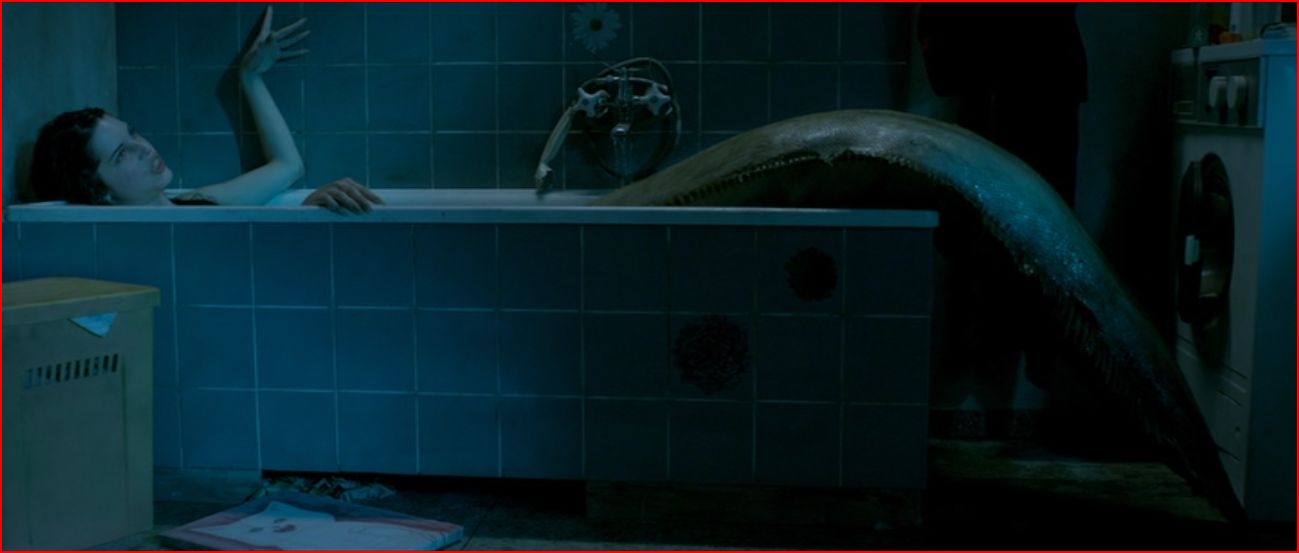
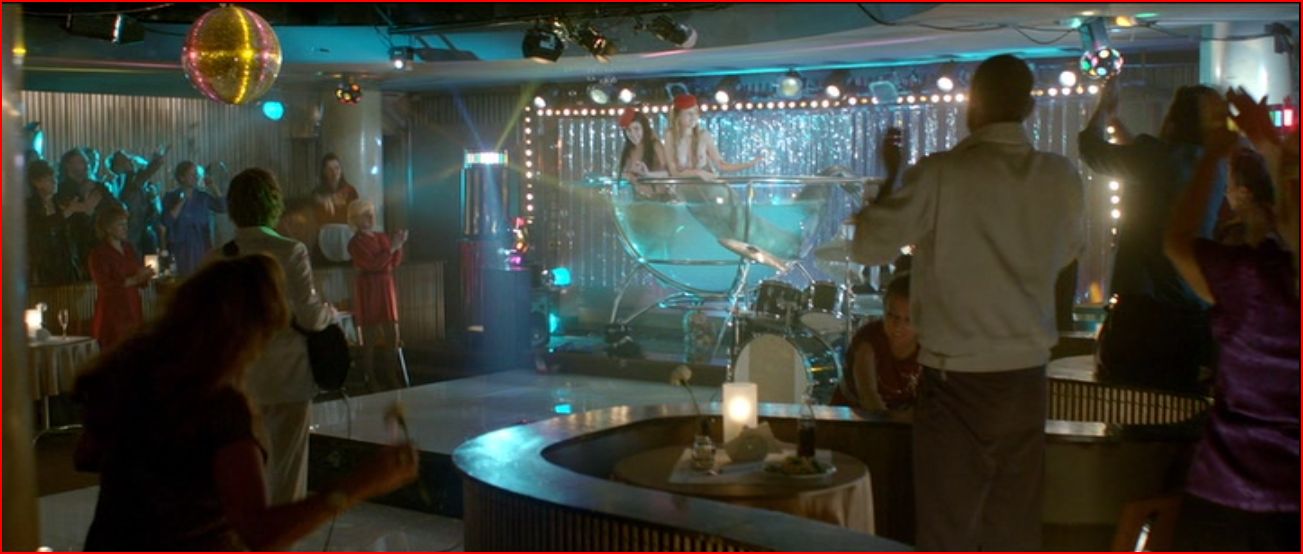
Set in a time approximately contemporary with Splash!, The Lure tells what might happen if that film's protagonist, a mermaid, made a wrong turn on her way to America and ended up in a decadent Communist bloc country. This film is twice as good, however, because there are two mermaids! In fact, Silver (Marta Mazurek) and Golden (Michalina Olszanska) are on their way to the U.S.A. when they're drawn to some Polish shore by a trashy rock trio jamming on the beach. These three could be father, mother and son, though they probably aren't. They perform regularly at the sort of trashy nightclub you might not have expected to exist in a Warsaw Pact nation, and recognizing the significance of their catch, they propose adding the finny girls, naturally topless to their act. The mermaids can transform their tails into simulacra of human legs, but lack sex organs in that state, though they do not lack sexual desire. They could be a global cultural phenomenon but appear content to be, so to speak, big fish in a small pond.
Above, the mermaids show their true faces. Below, for a 1980s nightclub act they look a lot like a
Commander Lexa tribute band.
While Golden (the one who isn't blond) still sees people, with apparently one exception, as food, Silver (the blond) falls for Mietek (Jakud Gierszal) the boy in the band. He tells her he can only think of her as an animal, but she can take steps, so to speak, to correct that. Silver is your classic Hans Christian Andersen/Walt Disney mermaid, willing to sacrifice her identity and risk her existence to win a landlubber's love. She opts for a preposterous lower-body transplant. Even more preposterously, it works, though Mietek gets grossed out by her all over again when they try sex before she's fully healed. A singer in another band lures her away, putting Silver in mortal peril. By the rules of her kind, if you love a man but he marries another, you turn to sea foam -- unless you eat him, as Golden urges her to do.
In an interview, Smoczyńska says that the mermaid story was the hook that enabled her to make a movie about the seedy show-business milieu she grew up in. The result is inevitably more fantastic than whatever she originally intended, but I suppose there was something fantastical about that milieu of people struggling to live their dreams or embody other people's dreams. Perhaps liberated by the fantasy element, she makes her film a full-blown musical by staging a classical-style set piece with people bursting into song into a surprisingly well-stocked (for 1980s Poland, I presume) department store as the mermaids take their first-ever shopping trip. That exuberant excess makes The Lure more tragicomic than tragic, but also more opera than musical comedy. Inevitably more prickly than quirky than any American approach to the subject you can imagine, it still feels like a genuine 21st century fairy tale. Playing here in 2017, it makes an interesting companion piece to The Shape of Water and makes that film look like pure Hollywood pap by comparison. That's not to say that The Lure is the better film by any standard, but it's definitely the more grim fairy tale of the two, if that's what you're looking for in your sea-creature romances.
Andrzej Wajda's epic of the Warsaw uprising -- the gentile one, as opposed to the Warsaw Ghetto uprising -- immediately struck me as one of the great World War II films, but it's a strange one considering the time and place. For Poles, I'd assume, the 1944 uprising against the Nazi occupiers must be something like the Alamo for Americans, a noble to-the-last-man defeat on the way to ultimate liberation. For us, the Alamo is a tale of heroic sacrifice with strategic value. For Wajda, arguably Poland's greatest filmmaker and still active as of three years ago, the Warsaw uprising is a defeat of crushing completeness, a mental as well as physical defeat. The way he saw it seemed to be okay with the Communist government of Poland at the time, who might have been expected to expect a more patriotic, more Alamo-like affair. I wonder if the attitude of director and government alike -- Wajda would flee the country in the early Eighties during the crackdown on the Solidarity movement and return after the fall of Communism -- has something to do with the subject being a non-Communist uprising, one during which Soviet forces were supposedly in a position to lend aid but purportedly stood by to let likely future opponents of Russian dominance get slaughtered. Maybe Poles in 1956 saw the uprising leaders, or were ordered to see them, as presumably noble and definitely tragic but also a historic dead end that had to pass from the scene before a postwar revolution could take place. I can only guess because I see no obvious ideological context in Kanal and I don't recall the Russians being mentioned. Yet the film literally follows uprising fighters into numerous dead ends, both physical and mental, as if to say there was never any hope for this revolt. Maybe Wajda was just making an anti-war film, since there's little inspiring or worthy of emulation here. Outside of Japanese cinema I've hardly seen military defeat portrayed so definitively.
Kanal opens on an epic scale, showing itself a technical tour-de-force of tracking shots and composition in depth as we meet the unit we'll follow to the bitter end as they hustle carefully from one position to another. Wajda's directorial proficiency compares favorably with Stanley Kubrick's Paths of Glory, but Wajda gets to top Kurbick, at least on the technical level, with dangerous looking scenes of urban destruction as our heroes bug out under fire. The plan ultimately is to race through the sewers (hence the Polish title) and break out and disperse in a safer part of the city. Our group is broken up into smaller units, each with its own storyline. Each story features some sort of physical or mental breakdown or breakdown of solidarity. A musician (Vladek Sheybal, who went on to an extensive English-language career) wants to contribute and also seeks creative inspiration; he gets the latter at the apparent cost of his sanity. An officer has been having an affair with a young female messenger; in a moment of stress he drives her to suicide by panicking and begging to live for his wife's sake. A commander is one of the very few to make it out, with one loyal soldier, after one more has cleared their way by being blown up; when his last follower reveals that there are no others left, and that he'd hidden that fact to keep up the officer's morale, the officer shoots him and jumps back into the sewer. Another man appears to make it, but finds the surface surrounded by Germans and prisoners in a scene shot with the brutal narrative clarity of a cartoon. The most heroic and competent character is a civilian female, Daisy, an almost too-good-to-be-true sewer-rat amazon (Teresa Izewska, who to my surprise, according to IMDB made only ten films before dying at 49), who just about literally carries a feverish, delirious man through the muck, only to run up against possibly the cruelest reality. She's found a way to the Vistula river, the most likely way to safety, yet the exit is barred by a metal grate. It's too big to be kicked away, and Wajda makes it sadly clear that Daisy can't squeeze her head through the bars. If Kanal is one part Alamo, it's also inescapably one part Third Man, and the so-close-and-yet-so-far hopelessness that comes with that comes through most eloquently when Daisy reaches the end of her trail. Was all of this worth it? Maybe if you're a Pole that's a question you just don't ask, and if the alternative is submission to the Nazis I suppose any question is moot. But once you watch Kanal you can't help wondering for the characters' sake. That might not make it an anti-war film, but it's certainly one of the most intimately humane war films I've ever seen.
Ida premiered last year in Poland but will most likely be a front-runner for this year's Academy Award for Best Foreign Film. It hit the art houses highly touted and has the Holocaust factor in its favor, but Pawel Pawlikowski's picture is more about 20th century Poland as a whole than it is specifically about the slaughter of Polish Jews. Deracination in a broader sense is the film's major subject as it addresses not just genocide but the incursions on Polish national consciousness by Communism and western culture. The title character (her name's pronounced "Ee-da," not "Eye-da") is Poland in microcosm. She's a novie nun in the 1960s who's advised to meet her one surviving relative before taking her vows. She meets a disreputable seeming character -- the lady and a gentleman caller are dressing after sex when Ida (Agata Trzebuchowska) arrives. After a brusque introduction, Aunt Wanda (Agata Kulesza) rushes to work, and it's a surprise to learn that she's a judge. She has a bigger surprise for Ida: the devout Catholic girl is really Jewish, rescued in infancy from her parents' fate and raised in the majority faith. This revelation sets up a road movie as Ida and Wanda roll through the countryside to find where their relatives are buried, For Wanda the trip revives a remembered traumatic past and accelerates her personal decline. For Ida it puts her whole sense of self in question, but making Wanda a model for modern secular womanhood proves unsatisfactory in some vague way.
Wanda confronts Ida with her Jewishness but that isn't Wanda's primary identity, either. Her judgeship represents a career on the skids; a decade earlier she was a state prosecutor, presumably conducting political purge trials, and she's still willing to use her office as a threat to uncooperative people. Ida, however, presumably sees Wanda as not so much Jewish or Communist as modern and secular. The climactic scenes come when Ida resolves literally to walk in Wanda's shoes and consummate an attraction to a progressive jazz musician. Ida's unburdened by Wanda's issues (guilt, alcoholism, etc.), but like Wanda, if less dramatically, she seems to opt out of modern life.
Ida chronicles a futile quest for authenticity. A reactionary reading of it might see her reversion to habit -- clothing, that is -- as a decision in favor of the Church as her true home, but the ambiguity of her Catholic identity is the starting point of the entire picture. If you accept that there's something essentially false about her faith -- so long as she didn't have a choice to embrace first her Jewish heritage and then Christianity -- you face the bleak conclusion that there is no "authentic" Polish identity anymore, or anymore than any nation could claim to have by the mid-20th century. In that context it makes more sense to see more ambiguity in the ending. Dressed in her habit again after her tryst, Ida walks briskly foward as the camera retreats. You might assume you know where she's going because of what she's wearing, but I think it's important that we don't see her destination, that the film leaves her still moving.
Pawlikowski, who has worked primarily in English, evokes the film's period with a rigorous monochrome style many viewers find reminiscent of Ingmar Bergman. He works with a pre-widescreen squarish frame in which Ida is often a small figure at the bottom or in a corner. He also employs a kind of retro-modernism in the jazzier scenes amid midcentury decor. In short, the director makes it as obvious as possible that his is an arthouse film, but he and his cinematographers make their pretentiousness often quite impressive. He gets the desired guilelessness from his amateur lead actress, while Agata Kulesza easily dominates the picture whenever Wanda's on screen. Ida is the sort of picture that will be more admired than enjoyed, but in its ambition and execution it does deserve some admiration.
In the U.S. Renzo Martinelli's would-be epic has the title of a generic war film. That probably infuriated a director who opened the film with a quote from 20th century French historian (and victim of the Nazis) Marc Bloch: "Misunderstanding of the present grows fatally from ignorance of the past." In Martinelli's home country, Day of the Siege is known as 11 Settembre 1683. On that day, the siege of Vienna by the Ottoman Turks was broken by an attack by a Polish army led by King Jan Sobieski. Martinelli's Italo-Polish production credits this rescue of Christendom from the last great Islamic military assault to date to the Polish king (played by director Jerzy Skolimowski) and an Italian friar, Marco d'Aviano (F. Murray Abraham), who was the spiritual adviser to the Emperor of Austria. The Poles, presumably having less of an agenda, or more likely seeing an existential threat coming from a different direction, call this movie The Battle of Vienna. For Martinelli and his writers, however, the immediate agenda is Islamophobic, though their hackneyed commitment to the conventions of historical drama, and perhaps a degree of good taste, make the film less of a hatefest than it could have been.
In 1683 Islam was on the march again, the Turks' ultimate goal being to turn St. Peter's in Rome into a mosque. The Sultan entrusts his grand vizier Kara Mustafa (Enrico Lo Verso) to take the Hapsburg capital. Friar Marco, first seen in Venice almost reluctantly healing the blind, goes to Vienna to stiffen Austrian resolve and convince the haughty Hapsburgs to accept the aid of the Poles and their upstart King, whom the Austrians see as a social inferior. With the Poles finally on board Sobieski insures ultimate Christian victory by defying Kara Mustafa's expectation and dragging artillery up a steep mountain to a commanding position from which he can soften up the Turkish position before scattering it with the cavalry charge of his dreaded winged hussars.
Above: a Muslim's nightmare vision of a Christian army.
Below: the badass reality of the winged hussars
Martinelli -- last noticed here as the auteur of the boxing biopic Carnera: The Walking Mountain -- felt it necessary to add human interest to this epic subject. He does this in two ways. First, his writers invent a sort of relationship between Friar Marco and Kara Mustafa in order to justify a meeting between his two main characters. When they were young men, Kara Mustafa while visiting Venice saved Marco's life from a falling piece of ship's cargo. As the Ottoman army nears Vienna and the two men become aware of each other's role, each grows curious to meet the other, but their fictional showdown is necessarily anticlimactic since it can't change the course of history. Meanwhile, a subplot focuses on an interfaith couple in a village Marco visits. The husband is a Muslim, the wife a Christian mute. As news of the Turkish invasion spreads, the villagers want to lynch Abul (Greek actor Yorgo Voyagis), but Marco intervenes to save him. He is repaid by Abul's flight to the Turkish lines, where he advises Kara Mustafa about the holy man on the Christian side. Later, after the invaders sack the village, Abul's wife is taken prisoner. He ignores her squawking, grunting pleas for rescue and allows her to be herded into a stockade with other women, presumably to be used for sex or sold as slaves, but he returns at night to arrange for her release. Later still, he appears at the gate of Vienna to urge the Austrians to save their bodies and souls by surrendering, converting to Islam or paying the tax required of People of the Book. Abul's story ends when, with the Turkish army in retreat, he covers Kara Mustafa's escape by putting on the vizier's armor and charging the Polish cavalry single-handedly. His pregnant wife is left weeping over his bullet-riddled corpse. This little story ends tragically, it seems, solely because Abul is a Muslim and Muslims can't change their stripes. Martinelli seems to want it both ways, catering to liberals by having Marco save Abul from a lynching, yet pandering to Islamophobia by showing that Abul couldn't be trusted after all. That's a provocatively mixed message to send to audiences in Europe, where anxiety about Muslims in their midst is much greater than it is in the U.S.
For what it's worth, the screenwriters take the position that Muslims worship a different God than Christians. This would be news to Muslims, who believe themselves the most authentic acolytes of the God of Abraham; their idea is that Islam is the default religion of that God from which Jews, despite Moses, and Christians, despite Jesus, have deviated in dangerous if not damning ways. Many Christians believe, however, that if Islam can't imagine God having a son, or if it insufficiently emphasizes loving fatherhood as a defining divine attribute, then Allah may as well be a fictional character Muhammad invented. That point aside, the script tries to score more points against Islam by having Friar Marco argue that "the one true God" does not demand submission -- which literally defines Islam -- but wants men to be free. That in turn would be news to countless people who've lived in Christian countries under the dominance of various Christian churches, but to be fair that's another story for other films. For now it's enough to note that despite some sketchy efforts to humanize the important Muslim characters (Kara Mustafa is shown as a doting father, for instance), Day of the Siege is indisputably an Islamophobic film, though not grotesquely so. You can't argue that any film showing Christians fighting Muslims is Islamophobic because I'll throw Kingdom of Heaven at you to stop that argument. What makes Day Islamophobic is its constant implication that permanent peace with Islam is impossible. There's no other way to interpret the Marc Bloch epigraph, while Kara Mustafa in the story warns Friar Marco that defeating Islam before Vienna would only be "trimming the Prophet's beard," i.e. a temporary setback. Don't get me wrong; there's plenty to object to about Islam, and more still about Islamism, but Day of the Siege strays into "all Muslims are a threat" territory, where we shouldn't really want or need to go no matter what our beefs are with specific Muslim goons today.
The film's Islamophobia could be redeemed if it inspired some epic action, but Martinelli's reach exceeds the grasp of his international budget. He can compose some impressive images on a relatively intimate scale, but the battle scenes upon which the film presumably depends constantly betray limitations on budget, technology and imagination. Martinelli has to rely on CGI reinforcements to supplement his extras. Worse, he resorts to CGI explosions and musketry along with repetitive, too-familiar shots of stuntmen flinging themselves from explosions. It may be unfair to bring up Kingdom of Heaven again, but that underrated picture has perhaps the best portrayal of siege warfare ever, while the battle scenes in Day of the Siege are actually some of the dullest parts of the film. Bad acting also undermines the picture. It was reportedly shot in English, but that appears to have left everyone (who wasn't dubbed afterward, that is) except Abraham at a disadvantage. Predictably enough, he alone brings any passion or power to his role, and if anything he might have shot for over-the-top more often. Only he comes close to the intensity the whole show needed badly, and that Martinelli may have felt while shooting it but doesn't really show on screen. The Siege of Vienna should be the stuff of thrilling cinema, but for that to happen someone will have to attack the subject again another time. Marc Bloch's advice might come in handy then.
In two films director Andrzej Wajda runs the cinematic gamut from arthouse classicism to guerilla filmmaking in a race with accelerating history. Together, the films form a two-generation saga of disillusionment and resistance in Communist Poland. They're parallel stories of a father and son and two chroniclers. In Man of Marble (Czlowiek z Marmuru) we follow student documentarian Agnieszka (Krystyna Janda) in the footsteps of Citizen Kane as she watches old newsreels and interviews survivors to learn whatever happened to a once-famous hero of Polish labor. Her subject is Mateusz Birkut (Jerzy Radziwilowicz), once idolized for setting a record for bricklaying during the construction of the city of Nowa Huta. Birkut is the title character, supposedly immortalized in stone but soon to become an unperson, denounced as a foreign agent and saboteur. As Agnieszka penetrates the veil between film and reality, Wajda shows us some scenes twice. We first see Birkut's bricklaying feat as it was shown on in black and white in theaters: an exemplary story of heroic labor to build the new Poland. The reality, as remembered by living witnesses, is almost Fellini-esque in its absurdity as an audience gathers, a band plays constantly, and an announcer keeps score during the spectacle of bricklaying. The director's also careful to show us Birkut's moments of barely-suppressed annoyance as the newsreel camera gets in his face. Still, Birkut starts as an idealist truly committed to spreading a more efficient method of bricklaying, but everything goes downhill after an odd incident when his hands are burned by a superheated brick during one of his personal appearances. At the lowest point, he shows up during a show trial, in raw footage never shown until Agnieszka screens it, to implicate himself in the incident. Even the authorities find that too ridiculous to believe.
Man of Marble chronicles the sordid demise of whatever socialist idealism actually existed in Poland. The country never seems to have become the totalitarian dystopia of the typical American imagination -- the film, though partly censored, was actually released there -- but something has clearly gone terribly wrong, and may have been wrong from the beginning. If there was an idealism during Birkut's salad days, it was based on some belief that through propaganda people could be made to believe in a Communist future. By Agnieszka's time, you get the impression that nobody really bothers trying to convince anybody. By the time of Man of Iron (Czelowiek z Zelaza), which eventually picks up where Marble left off, it's as if Johnny Friendly's union from On the Waterfront runs the country. It's government by bullying control over jobs and favors rather than the totalitarian brainwashing of Orwellian nightmares. When the authorities decide that Agnieszka can't finish her Birkut documentary, she's reminded that the state paid her way through film school and provided for her in every way, and told that she owes the state loyalty in return, or else they'll make sure she never makes another movie. That's the logic that makes dependence a dirty word in political discourse: if you owe someone something, you can't question them. It shouldn't be so, but people in power tend to think differently. Agnieszka is ruined and eventually jailed.
Before Wajda re-introduces us to Agnieszka he opens Man of Iron with the misadventures of Winkel (Marian Opania). Winkel is pretty much Agneiszka's opposite: sloppy, alcoholic, cowardly. He is tasked by his superiors with researching the background of Maciej Tomczak (Radziwilowicz again), a Solidarity leader in Gdansk, for a hatchet-job TV documentary. Winkel is one of cinema's wretches, so abject in his alcoholism (Gdansk has gone dry during the 1980 shipyard strike) that he soaks paper towels with the booze from a broken bottle and squeezes the liquor into a glass to drink. He has no integrity but seems too cowardly to actually betray the independent union. As he conducts his interviews, we're reminded, since we first met Tomczak late in Man of Marble, that the agitator is Birkut's son. We now learn of Birkut's tragic last years. Still recognized as a workers' leader in the shipyard, he refused to lead the workers out in support of student protesters, including his son, during the global tumult of 1968. Two years later it was the workers' turn and Birkut died during a street melee. The government allows his family to bury the body, only to exhume and vanish it later. In protest, Tomczak erects a cross and lights a candle on the site near a bridge where his father fell.
Later, Winkel is snuck into prison to interview Agnieszka, who relates what happened to her since Man of Marble. She'd fallen in love with Tomczak and married him, with no less a personage than Lech Walesa the Solidarity leader (playing himself) as a witness. There's something exhilirating yet almost unseemly about the way Wajda embeds himself and his film in history as it happens. Man of Iron is one part Medium Cool, another part one of those old Mack Sennett one-reelers where he'd set Fatty, Mabel et al loose at some public event. The climax of all this comes when Tomczak is reunited with a liberated Agnieszka at the moment when the government recognizes Solidarity as a legitimate workers' representative. The reunion of the lovers seems to be shot as the historic speech is actually happening. Wajda's apparent freedom of movement is amazing, even considering that 1981 was another moment of dramatic liberalization in Poland until the martial-law declaration of December put Walesa in prison and drove Wajda into exile in western Europe (where he made Danton and other films). Wajda was careful enough not to close Man of Iron on that Capra-esque note of triumph. While the film does end with the lovers walking off together, we first see that Winkel, despite his best intentions, is not redeemed, or at least not forgiven by the victorious union. We also see a bullying party hack warn him, prophetically enough, that the agreement wouldn't stand, that the government had been under duress, etc. Winkel's last scenes strike discordant notes that serve the film well retroactively, but you do wonder why Wajda seems so unforgiving toward his creation. It may have simply been that Opania is so entertainingly wretched that you wouldn't want to change him.
Man of Marble and Man of Iron are historic films from near the front line of dissent inside the Cold War Communist bloc. While Wajda doesn't have a Wellsian pictorial imagination to match the Wellsian ambitions of the first film, both films make the most of dramatic figures in the drably epic landscapes of Gdansk and Nowa Huta. An optimistic romanticism surges to the surface by the climax of Man of Iron that almost requires the last Winkel scenes as a corrective. The contrast between Winkel and Agnieszka itself belies much of the rhetoric against totalitarian power; neither is purely a creature of state-controlled upbringing, since otherwise they'd be more alike. Character matters, in life and in art, and Wajda's commitment to character over ideology makes his diptych more richly realistic and more morally meaningful. These are anti-Communist films (capital C, please) that aren't simply arguments for free-market capitalism -- the heroes of the sequel, after all, are labor leaders. They transcend ideology in a way their audiences should emulate.
Krystyna Janda and Lech Walesa in Man of Iron;
it may have been a brush with greatness for both people.
Now that Andrzej Wajda's standing as a master of gore has been established (see post below), let's look at the film of which that astounding clip is part. Intriguingly, for a film from a communist country, Ziemia Obiecana, an adaptation of an 1899 novel, has three capitalists for its heroes -- or antiheroes. They're charismatic young men on the make, first introduced to us counting out paces in the woods as if preparing for a duel. It turns out that they're measuring out the tract of land on which they plan to build a textile mill in Russian-ruled Lodz. They're appealing from the start because they represent an admirable ethnic mix. Karol Borowiecki is a Pole, Moryc Welt a Jew, Max Baum a German. While they often have issues with each other, they stick together against all attempts to drive them apart by appeals to ethnic loyalty or individual greed. They have the confidence of youth on their side, along with opportunistic instincts.
The old guard ranges from Buchholtz, Borowiecki's employer and a Dickensian monster of meanness, to a clique of Jewish investors who'd give Mel Gibson the creeps on sight. By comparison, our trio seem progressive despite a certain indifference to the welfare of workers or the ethics of private correspondence. When an industrial accident leaves a worker without an arm and yards of cloth covered with blood, Borowiecki's only concern is to get everyone back to work as soon as possible. When his flirtation with the wife of another factory owner gets him access to a coded tip-off on revised tariff rates, he and his buddies take advantage of the inside information to make a killing in the cotton market. Despite all this, we're still tempted to root for the threesome because they seem different and better than their elders. When someone arranges for their new factory to be burnt down just after its festive opening, you expect them to persevere and rebuild. In an epilogue, however, Wajda tears down whatever illusions we may have had about his protagonists. "Years later," Lodz is in the grip of a strike as the working class finally takes an active role in the story. However repugnant Borowiecki, Welt and Baum find their elders, in the end they stand on the same side as their peers, the exploiters, and order their security force to fire on the workers.
The version of Promised Land that I saw is billed as a director's cut, whittled down by Wajda himself in 2000 from almost three hours (according to IMDB; a TV version is even longer) to 138 on DVD. Of course, I have no idea what I've missed, but Wajda would presumably have me believe that I've missed nothing. This article explains what he changed and why. The least I can say is, not knowing the extent to which Wajda had cut it, nothing seemed missing. But the longer original length reinforces my feeling that the film was intended as Poland's answer to the socially-conscious historical epics coming out of Italy, reminiscent of Luchino Visconti's The Leopard while anticipating Bernardo Bertolucci's 1900. Wajda clearly aspired to similar sweep and grandeur -- it shows in every aspect of the impressive production design, -- and to a certain decadence that's arguably more like Federico Fellini. The best sequence in Wajda's film is a night at an opera house during which our three protagonists are more fascinated by the dramas playing out in the balconies as word of some financial disaster spreads than by the excerpts from Swan Lake or an interminable comedy song featuring a fat woman on a swing. Brilliantly edited, but not without self-indulgent swing-cam shots of the audience, the sequence veers from Viscontian opulence to Fellinian grotesque, as does another perhaps more De Millean display of decadence, a masked ball featuring bare breasted courtesans and caged tigers. Mixed in with these luxuriantly satirical episodes, the moments of horrific mutilation I've mentioned may be meant to assert a kind of reality principle, as did scenes of brutality and gore in many other films in the "history of cruelty" genre I've retroactively recognized in the 1960s and 1970s.
It would be a long day at the movies, but Promised Land would make a good double-feature with 1900. They complement each other, Wajda focusing on urban capitalists while Bertolucci deals with rural landowners and peasantry and goes deeper into the 20th century than Wajda does. Both films are presumably Marxist, but that leaves us wondering why Wajda made a film that invites us to identify on some level with three ambitious factory builders rather than with the workers who appear mostly at the periphery. There's no class struggle in the picture until the very end, and even then we see it from the capitalists' point of view. One IMDB reviewer suggests that Wajda was making a subtly subversive point, so long as we see Borowiecki and his buddies as revolutionaries who eventually become reactionaries and in doing so see them as symbols, not of capital, but of the revolutionary Communist regime that had fired on its own people on multiple occasions. This seems right insofar as the three protagonists are ultimately revealed as false revolutionaries who despite their clear desire to shake things up are ultimately assimilated into the old order. But I think this point could be made in a Polish or East Bloc film without it being an implicit critique of Communist regimes. You could also see Borowiecki, Welt and Baum, as I was tempted to, as Polish counterparts of Kane, Bernstein and Leland, another ambitious trio out to shake up the system only to be absorbed by it. Given that many people seem to regard Ziemia Obiecana as the greatest of all Polish films, this analogy with Citizen Kane may be the most appropriate. I've seen all too few Polish films to say whether its admirers are right, but it certainly wouldn't be to Poland's shame if they were.
Here's a fascinating promotional clip featuring Wajda's three stars -- Daniel Obrychski, Wojciech Pszoniak and Andrzej Seweryn -- in modern dress (c. 1975) lip-synching in the middle of modern Lodz over clips from the film. It was uploaded to YouTube by atomek2.
Made in 1974 under a Communist regime, Ziemia Obiecana (Promised Land) is a sweeping portrait of capitalism on the rise in late-19th century Poland directed by Andrzej Wajda, arguably that nation's greatest director. In some ways it looks like Wajda's attempt to imitate the opulent yet socially conscious work of the Italian director Luchino Visconti, or a companion piece to another Italian epic, Bernardo Bertolucci's 1900. I'll have more to say about the film as a whole this weekend, but for now I have to report the shock I experienced, and wish to share with you, when I discovered, in the midst of this highbrow project, one of the most horrific exhibitions of cinematic gore I've ever seen. You won't have to wait long if you watch the clip below, which was uploaded to YouTube by polskietodobore; the worst is over in less than a minute. To set things up, a factory executive is attacking an employee whom he suspects is out to blackmail him. But the whos and whys won't matter for long once the two men tumble into that wheelwell. Just remember to remind yourself: "It's only socialist realism....It's only socialist realism...."
That's the sort of moment that might mark another movie, or at least one from the capitalist world, as a genre product not to be taken seriously. And some may well feel that Promised Land can't be taken very seriously after such a display, while some of those more intrigued by this sample might find themselves disappointed, despite another factory mutilation scene and a nice man-on-fire bit later, in a film that's much like a densely packed 19th century novel. Does such a scene discredit the artistic aspirations of its director, or can there be a point to it that wouldn't compromise Wajda's artistic integrity. Since one might presume that there'd be no such thing as exploitation cinema in a communist country, we probably should assume the latter, but I'll save my own judgement for later. For now, to reiterate: damn......
What do all those women do behind those convent walls? That's the question behind the nunsploitation subgenre, a global phenomenon that found expression inside the old Communist Bloc with this film by Jerzy Kawalerowicz. Some accounts of this movie claim that it's loosely based on the same historical incidents that inspired Ken Russell's ultimate nunsploitation epic, The Devils. If so, then it's more of a loose thematic sequel to that core story, with the charismatic priest played by Oliver Reed in the Russell film already dead by the time Kawalerowicz's film begins. Adapting a Polish novella, Kawalerowicz gives the story a different emphasis that makes Mother Joan more than an alternate version of The Devils while still touching many of the mandatory nunsploitation bases.
The story focuses on Father Joseph Suryn, newly arrived in a village dominated by a convent swept by demonic possession. The young priest has been sent to aid in a long-term exorcism project; the entire convent, led by the title nun, seems to be possessed. Suryn is unworldly and aloof, while in the village the possessions and exorcisms are the stuff of gossip as well as superstition. What gives Mother Joan its distinctive quality is the way both the possessions and the exorcisms are treated as an almost-normalized public spectacle. The villagers gather to watch the nuns march into church, the next-to-last in line spinning around compulsively, and subject themselves to attempted exorcism. The efforts of the priests only inspire the nuns to frenzy, with Mother Joan herself the most flamboyant performer. In some way the spectacle resembles a show trial, except that justice, or the will of God, never seems to prevail, while the suspects freely confess their guilt yet refuse to repent. One character suggests that Christians embrace the concept of demonic possession because it somehow confirms the existence of God, and that seems to be a key to understanding this film.
Lucyna Winnicka is possessed by the turbulent spirit of Mother Joan of the Angels.
Along the way, Suryn gets a major crush on Mother Joan. He tries to deal with it by flogging himself, but to no avail. Trying to get to the bottom of the possession question, he consults a Jewish rabbi who harangues him about the angels who mated humans and spawned a race of giants and finally tells Suryn that the two of them are the same. Given that they're played by the same actor, Mieczyslaw Volt, the rabbi has a point, though that fact also raises the question of whether the meeting was real or only in Suryn's head. In any event, Suryn finally decides that the only thing he can do to save Joan, and in some way save himself, is to invite the devils inside her to take him over. In fact, this licenses him to let the demons already inside him rise to the surface, with dire consequences for some of the other villagers....
Mother Joan is not one of the "history of cruelty" films I've seen from all over Europe from the 1960s. Kawalerowicz doesn't make a fetish of the ordeals to which Joan is subjected, and we never see anyone burnt at the prominently displayed stake. His attitude toward the people of 17th century Poland is generally compassionate. The common folk are folksy and bawdy and musical and superstitious, unafraid to peep through a window to watch Suryn and Joan in bed together. This movie isn't really about the overwhelming oppressive power of the state or the church, focusing instead on one man's breakdown and its several causes. Volt makes the breakdown convincing, while Lucyna Winnicka in the title role catches the unstable ambiguity of a character self-consciously committed to her role in the exorcism drama. She tells Suryn that she enjoys being possessed; is she acting possessed when she says that, or is she embracing the liberating power of performance? Whatever the answer, it's all too much for poor Suryn, and the two characters arguably illustrate a dangerous distinction between internalized private and dramatized public religion, the one corrupting the other.
On the nunsploitation spectrum Mother Joan falls closer to the high-end, high-toned stuff like Black Narcissus than to the wild, salacious fare that gives the subgenre its name. Nudity is at a minimum here and there's no hint of lesbianism. That may disappoint hardcore nunsploitation fans, but if you just like to see women in habits acting nutty, this film as plenty of that to offer. In the bargain, you'll also get a persuasive period piece with strong performances that are marred somewhat by the awful English subtitles on the Polstar DVD. Spelling and grammar errors abound, and some lines simply don't make sense as translated. Fortunately, the story still makes sense and you can still appreciate the overall effort. This is another film of surprisingly subversive potential from a Communist country, and an interesting one by any country's standard.
Poland has been partitioned between Germans and Russians four times in its history, thrice in the 18th century, finally resulting in the extinction of the country, and once in 1939, after the Molotov-Ribbentrop Pact freed Hitler to invade from the west. Days later, Stalin invaded from the east. Andrzej Wajda's film opens on a bridge as refugees from the German assault head east, only to be warned by people on the other side that the Russians are coming. Among those who cross anyway are Anna and her daughter Nika. Anna's husband Andrzej is a Polish officer recently captured by the Russians. Security is still pretty lax, so Anna can walk her bike over to where the captured officers are being kept and invite Andrzej to escape. He refuses. His oath to Poland outweighs his oath to remain with Anna 'til death do them part.
Bolsheviks and Nazis share the spoils of Poland in the early scens of Katyn.
The first act of Katyn traces the ruin of Andrzej's family between the millstones of Hitler and Stalin. His father is a college professor whose university in the German occupation zone is closed down by the Nazis for holding unauthorized classes. The professors are packed onto trucks and taken to Sachsenhausen concentration camp. Some months later, Andrzej's mother receives a package in the mail along with a polite message of regret from the German authorities. The professor died of heart disease, and his captors have done the courtesy of mailing his ashes home. It's a chilling moment and typical of Katyn's approach to the terror of World War II. We're used to images of industrialized mass killing as perfected on Jewish prisoners: mass gassings, mass shootings. The Poles don't suffer that way in this film. They're eliminated one at a time, albeit with just as much remorseless efficiency, and the horror of it is that it makes every killing seem more personal, more vicious.
For a while, Andrzej continues to write heavily-censored letters from his Soviet-run prison camp, where his fellow officers maintain discipline and are treated relatively well. By the spring of 1940 the letters stop coming, and eventually the Russians start rounding up the officers' wives and children. One Russian officer is being quartered in Anna's home. He has a crush on her and wants her to marry him. He urges this on her as much for her own sake as for his; he speaks cryptically about being unable to save loved ones of his own at home, and wants to atone for that here. When Anna reminds him that she's married to Andrzej, he blurts out that he and the other officers are "no more," but Anna doesn't follow up on that hint and refuses the officer's offer. Nevertheless, when the soldiers come for her he hides her and Nika and bullies his own men away. He then advises her to escape into the German sector.
Maja Ostaszewska as Anna
Cut to 1943, in German-occupied Krakow. Loudspeakers recite a litany of names, and it settles in gradually that these are the names of Polish officers whose bodies have been exhumed by the Germans from mass graves in the Katyn Forest. The list is also published in newspapers, and we find Anna scanning one eagerly for news of Andrzej. Improbably, his name is not there. He may still be alive, Anna believes, and Andrzej's mother feels certain that she couldn't lose both her husband and her son to the war. Meanwhile, the Germans want the widow of Andrzej's commanding general to record a denunciation of the Soviets, whom the Germans blame for the massacre. She's unwilling to collaborate with the occupier, despite the bullying of a Nazi officer, until she's taken into a private room and shown newsreel footage of the exhumation. She can barely stand afterward, though it isn't clear whether this persuaded her to make the propaganda recording.
Danuta Stenka as the General's widow studies a tape recorder suspiciously.
Notice that Wajda has jumped in time past the actual deaths of the officers. His focus is on the survivors reaction to the news of the massacre and the changing narratives that different occupiers impose on events. He also creates something of a mystery, though that effect may be felt more by non-Polish viewers. For us, Wajda's avoidance (so far) of showing the massacre leaves open the question of who killed the officers. The Germans say the Russians did it, but they are Nazis, after all. They could be lying -- and this is exactly what the Russians say when they "liberate" Krakow and occupy Poland. They show the same exhumation footage the Germans used, but what the Nazis called the typical Bolshevik execution method -- a bullet in the back of the head -- the Russians call the typical Gestapo method. They also claim that forensics prove that the officers were killed in the summer of 1941, when the Germans would have overrun the camp during their invasion of Russia.
Once we get to the postwar period, the focus moves away from Andrzej's family for a while as we follow characters who refuse to accept the new party line on Katyn. Agnieszka, the sister of an air force pilot who died there, is determined to erect a headstone in her local church in his memory. The stone gives his date of death as Spring 1940. The authorities, including a complacent Catholic Church, refuse permission. The 1940 date is a provocation and a slander on Poland's Soviet allies and protectors. She erects the headstone in a cemetery instead; it is almost immediately smashed by the occupiers, and Agnieszka is brought in for questioning. She refuses to play ball, preferring, as she tells her collaborationist sister, to take the side of the murdered against the murderers. For her trouble, she's taken into a basement and never seen again. For Wajda Agnieszka is a modern Antigone, and he makes the archetype obvious to everyone when she gets her hair cut to donate it as a wig for a performance of the Greek play starring a concentration-camp survivor.
Above, Magdalena Cielecka as Agnieszka. Below, the broken headstone.
Meanwhile, Andrzej's old friend Jerzy, a fellow imprisoned officer, returns to Krakow as part of the Soviet occupying force. People are surprised to see him because his name was on the original Katyn list. But as he explains to Anna, that's because he had a name tag attached to a sweater that we saw him lend to Andrzej. It's almost certain, then, that Andrzej died in Jerzy's place, while Jerzy managed never to be transported to the execution ground. He knows quite well what happened to Andrzej, but his job is to uphold the party line for the good of fraternal Polish-Soviet relations. He can't take it. After making arrangements to have Andrzej's remaining personal effects delivered to Anna, he gets roaring drunk, staggers out onto the street, and blows his brains out.
Finally, Anna receives the material Jerzy requested for her. The most important possession is Andrzej's diary, which records his movements up to his final transport to Katyn. Obviously he can't tell what happened there, but Wajda can. He has saved the crucial event for the end, and the effect is more terrible than anyone could anticipate. One by one, starting with the General, the officers are taken from their prison trucks and taken into a nondescript building where Soviet officers standing in front of a red flag and a portrait of Stalin matter-of-factly sentence each one to death by checking off their names. It takes place with primitive efficiency. A man whose face we never see gets up from a stool and shoots each Pole in the back of the head. As the body is dumped through a chute out a window and into a dump truck, and the pooling blood is washed away with pails of water, the executioner hands his pistol to a second for reloading and receives a loaded weapon for the next job.
Other officers, including Andrzej, are taken to an outdoor killing ground where each has his hands tied behind him before the bullet in the head. The scene is repeated oppressively, and Wajda goes a little overboard with sentimentality as each officer recites a snippet of the Lord's Prayer before going down, the next man picking up where the last was cut off before all are dumped into mass graves and covered with bulldozed earth. This is not a "Eureka" in which a character in the story has discovered the truth and can tell the world about it. All Anna has to work with is a battered journal that conveys the horror of what happened through its numerous empty pages, and once we see the earth cover the victims, the film is over.
Wajda has covered some of this territory before in disguised form in his French Revolution movie, Danton. Katyn reminds me very much of the French film in its first act, which concentrates on people anticipating certain destruction at the hands of merciless power, and that makes me wonder whether Wajda already had the Katyn story in mind and was using Danton as an indirect dry run at it. But Danton won't prepare anyone for the relentless atrocity that closes Katyn. The one-at-a-time slaughter makes this film look less like a war movie or Holocaust film (comparisons may be inevitable) and more like a horror film. Wajda doesn't go overboard with gore effects, but the final scenes of this movie will still be hard for sensitive people to watch.
Critics around the world have been tempted to read a political message into Katyn. The Koch Lorber DVD invites such a reading by describing the subject as "The Crime Stalin Couldn't Hide." Wajda's been accused of making an anti-Communist or anti-Russian movie, and in the latter capacity the film has been labelled propaganda for Poland's current right-wing anti-Russian government. I honestly didn't see it. There's nothing Communist or communistic about the Soviets' treatment of their Polish prisoners or their attempts to suppress the truth about Katyn. It's simply what any tyrannical occupying power (and arguably any occupying power, leaving adjectives out of it) would do. It so happens that the Nazis stumbled upon the truth, but you get the impression that they would have just as happily lied and blamed a massacre of their own on the Russians. The scene with the General's widow shows that the Germans were interested less in the objective historic truth than in the propaganda advantage they could get from it. The German-Russian collaboration at the start of the film suffices to establish Wajda's point that Nazis and Soviets were two of a kind. The Poles are interested in the truth because their loved ones are involved, but they can't necessarily handle it. Anna lingers in denial long after Jerzy sets her straight, still assuming that the next knock on her door will be Andrzej finally making it home. Other Poles like Agnieszka's sister are willing to forget history in order to get on with the present and build the future, and who's to say that if the truth is just a reason to hold grudges, some truths should be forgotten for the future's sake? In Poland's case, however, insisting on the truth was a form of resistance to occupation. Poland's present-day sovereignty consists in part in being able to tell their version of the Katyn story without worrying what the Russians think, and doing so is about as political as Wajda's Katyn gets.
It's a film of undeniable power, underscored with Krzysztof Penderecki's ominous music and introduced amid swirling clouds during the opening credits that suggest the mists of history parting at Wajda's command. There's a self-conscious epic quality to it that's probably appropriate for a subject that must rank among Poland's greatest tragedies. Structurally it digresses a bit in the middle by introducing new characters to take the struggle for truth in directions Anna won't follow. Anna's story is tangentially related to Agnieszka's because the former works in a photo studio that provides the image that the latter wants to use on her brother's headstone, but the two women don't interact beyond that. There's another even briefer subplot involving an unruly student who ends up getting run down by a truck that makes the movie feel more erratically episodic than it should. But once we come back to Anna and she receives Andrzej's journal Wajda closes the movie with scenes of unforgettable power that make most objections to his story structure trivial. Katyn is one of those films that fits Woodrow Wilson's description of Birth of A Nation as "history written with lightning." It's one of the best European films of the decade.
Here's a trailer with English subtitles, uploaded to YouTube by Kiedra666
The Polish director Andrzej Wajda is probably on quite a few shortlists of Greatest Living Directors, especially after the rave reviews earned by his latest film, Katyn. He first came to my attention about 25 years ago when his highly-touted film about the French Revolution was getting a strong art-house release in the U.S. I first saw it on video several years later, but didn't take much away from it. Now Danton is part of the Criterion Collection and a new arrival at the Albany Public Library, so I decided to give it another shot.
Here, in France and in Poland, Danton was taken to say something about the Cold War and current events in Wajda's home country. It seemed easy to equate the French Reign of Terror with the martial law regime in Poland, while Danton as a dissident could be seen as an analogue of Lech Walesa, the Solidarity union leader. But in an interview for Criterion, Wajda clarifies that Danton was in the works long before the 1981 crackdown, and that Jean-Claude Carriere's screenplay is based on a Polish play written in the 1930s. The symbolism was not so obvious that the film couldn't be released in Poland -- even though the government did its best to bury it by emphasizing every little nitpick from European reviewers.
In any event any analogy between Danton and Walesa fails because Walesa, at that point, had never been part of his country's ruling clique. Danton had been. As Wajda's film points out, Danton had helped design the system that would condemn him to death. In one telling prison scene, the recent arrival Danton is denounced by a veteran prisoner who's happy to see one of the persecutors get his.
In Orphans of the Storm D.W. Griffith calls Danton "the Abraham Lincoln of France," on what basis I couldn't tell you. For the record, Griffith called Robespierre "the original pussy footer." Make of that what you will. To the extent that I know anything about the French Revolution, Danton struck me more as the Leon Trotsky of France, a thug himself who became sympathetic once outclassed by worse thugs. On the Criterion disc a critic calls Wajda out for whitewashing some aspects of Danton's career, but the director doesn't exactly portray his hero as an innocent, or even necessarily as a hero. But he seems to stand for something, and it's no accident that he's incarnated by Gerard Depardieu. For one thing, Wajda needed Depardieu to get French financing for his project. Second, he wanted a big, hulking, shambling Danton to contrast with his delicate Robespierre, a Polish actor whose performance, like many of the cast, was dubbed into French. Danton's sensuality is opposed to Robespierre's asceticism, though Depardieu's vices seem restricted to gluttony in this film. For story purposes, Danton claims to know what ordinary people want, contrary to Robespierre's dangerous idealism. But the moral of the film isn't really that simple.
Danton begins in 1794, with the Terror already underway and Danton himself already on the outs with Robespierre and the Committee of Public Safety. Members of the committee want Danton's head, but Robespierre proves more pragmatic at first. He understands (and we have to take his word for it) that persecuting Danton would alienate the bourgeoisie and the bankers and likely lead to an uprising against the Committee, if not the Revolution itself. He would rather defeat Danton politically without making a martyr of him. He would rather yet reconcile with his onetime colleague, but it has to be on Robespierre's terms. Danton has to give an unconditional endorsement to the Committee, but he won't. Danton is also capable of offering pragmatic advice to his fellow dissidents, often encouraging them to find ways to save themselves. He also thinks that pushing the Terror to far will endanger the whole Revolution, but his unwillingness to compromise with Robespierre after a tense meeting over a mostly uneaten dinner puts the two leaders on an irreversible collision course. Robespierre becomes convinced that Danton will move against him unless he acts preemptively in the matter he had only recently warned against. The survival of the Revolution as he understands it depends on crushing Danton.
France under the Terror was never as "totalitarian" as the Warsaw Pact bloc during the Cold War. There are always dissidents to heckle or challenge Robespierre whenever he speaks. But Wajda shows Robespierre taking on totalitarian traits under pressure, progressively more willing to throw aside the rule of law in order to eliminate Danton. Like later totalitarians, he can't just have Danton whacked, but must put him through a kind of show trial that serves to force the nation to affirm the government's interpretation of events. Elsewhere, we see him instructing the painter David to erase a disgraced revolutionary from a historical painting -- typical Stalinist tactics.
According to Danton, the Revolution is devouring its young. A 1980s audience would assume that Wajda means this diagnosis to apply to Communist regimes, but it's probably true for any revolution that goes beyond merely shucking off an old regime toward establishing a new order. Revolutionaries tend to equate dissent with counter-revolution. That was even true in the early U.S., though no one was executed for thoughtcrime here. Revolutionaries also tend to think of themselves as indispensable persons. Robespierre seemed to think that the Revolution depended on his leadership, and Danton clearly thought it needed his own more modest guidance. But a revolution that's become that personal has probably already jumped the shark. The point of Wajda's Danton seems to be that the personal incompatibility of Danton and Robespierre, as much as any conflicts over principle or policy, doomed the French Revolution to a deeper descent into terror.
But Danton can be enjoyed as a kind of political thriller without going to interpretive extremes. The drama derives from both protagonists' efforts to prevent a showdown that neither man fully desires, and from Depardieu's fire-breathing histrionics in the trial scenes. He's as much of a sell-out now as his American peers of a certain age, but he had his game on for this show. You can believe that Robespierre would come to consider Danton's mere existence a threat, because Depardieu looks like he could break the man in half. Wajda is no avant-garde director and presents his material in a straightforward and seamless narrative style. He handles the crowd scenes in the Convention and during Danton's trial quite smoothly, knowing that all he needs to do much of the time is let Depardieu rip. He also sells the guillotine as a huge scary thing, first seen covered in tarp at the start of the film, then being scrubbed lovingly in preparation for Danton's execution. Finally, he indulges in a little gore at the end. We see blood soak the straw under the guillotine, and a bloody stump of a neck after the blade has fallen. Danton asks that his own head be shown to the people ("It's worth it.") but Wajda doesn't spring for a fake Depardieu head. We only see the bloody trophy from behind. Some sinister soundtrack music from Jean Prodromides heightens the mood of foreboding throughout the picture.
This is basically a solid big-time art house film. You'll like it if you like Depardieu or you're interested in the French Revolution or political history generally. It definitely made me more eager to see Katyn if it hits the local art house.




 I
I


 I
I


 I
I


 Before Wajda re-introduces us to Agnieszka he opens Man of Iron with the misadventures of Winkel (Marian Opania). Winkel is pretty much Agneiszka's opposite: sloppy, alcoholic, cowardly. He is tasked by his superiors with researching the background of Maciej Tomczak (Radziwilowicz again), a Solidarity leader in Gdansk, for a hatchet-job TV documentary. Winkel is one of cinema's wretches, so abject in his alcoholism (Gdansk has gone dry during the 1980 shipyard strike) that he soaks paper towels with the booze from a broken bottle and squeezes the liquor into a glass to drink. He has no integrity but seems too cowardly to actually betray the independent union. As he conducts his interviews, we're reminded, since we first met Tomczak late in Man of Marble, that the agitator is Birkut's son. We now learn of Birkut's tragic last years. Still recognized as a workers' leader in the shipyard, he refused to lead the workers out in support of student protesters, including his son, during the global tumult of 1968. Two years later it was the workers' turn and Birkut died during a street melee. The government allows his family to bury the body, only to exhume and vanish it later. In protest, Tomczak erects a cross and lights a candle on the site near a bridge where his father fell.


