Showing posts with label Universal. Show all posts

Thursday, October 11, 2012

The Last of the High Priests of Karnak

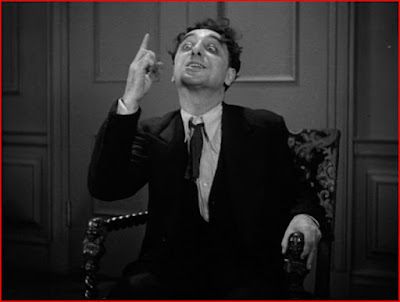
Turhan Bey, who died on September 30, had been one of the very last surviving actors from the classic Universal horror cycle, appearing most prominently as the villain who inherits the priesthood of Karnak and custody of Kharis from George Zucco in The Mummy's Tomb. The Austria-born Bey also figured in the studio's cycle of Technicolor adventure films, later acclaimed as the height of camp, appearing in Arabian Nights and Ali Baba and the Forty Thieves. He cut an exotically boyish figure in wartime Hollywood and endured to work sporadically into the 1990s, when he appeared as an alien emperor on the Babylon 5 show. With his passing, his time and his cinematic world are more past than ever.

 
1922-2012

Friday, October 21, 2011

Wendigo cumpla DRACULA (1931)


"Dracula hasn't had servants in 400 years and then a man comes to his ancestral home, and he must convince him that he... that he is like the man. He has to feed him, when he himself hasn't eaten food in centuries. Can he even remember how to buy bread? How to select cheese and wine? ...The loneliest part of the book comes... when the man accidentally sees Dracula setting his table."

Steven Katz, Shadow of the Vampire (2001)

 
Like many horror-film fans, my friend Wendigo and I were excited twenty or so years ago when we learned of the rediscovery of a long-lost Universal horror film from the studio's classic era: George Melford's Spanish-language version of Dracula. Before its release on videotape the "Spanish Dracula," now probably the best-known instance of the short-lived studio practice of filming alternative foreign-language versions of certain films rather than dubbing or subtitling the originals, was hyped to the skies as a cinematic revelation. At least we were told it would seem like that when compared to Tod Browning's stodgy old Dracula. The camera moves more! The women look hotter! There's half an hour more of the story! We'd heard the legend, and Wendigo had read it long ago in Famous Monsters of Filmland: Melford shot his version at night on the same sets Browning used and, knowing what Browning had done, he and his crew tried every night to top the English-language version. There were wild rumors, too. Could the great F. W. Murnau, the director of Nosferatu, have been coaching Melford behind the scenes? Could it be true that Melford managed the shoot without knowing Spanish? Could any old film live up to that kind of fan hype? Wendigo's memory of his first viewing is dominated by the camera movement and the sexier vampire brides and victims -- he dug their longer hair compared to the American actresses Browning used. Beyond that, the story seemed to have been performed differently in nearly every way by nearly every actor -- and the differences seemed to make Melford's the superior Dracula in every respect but the obvious one. Bela Lugosi remained unassailable, and we'd also say that Edward Van Sloan's Van Helsing remained unchallenged, but technically and artistically Melford appeared Browning's master.

Our viewing of Melford's Dracula this week was Wendigo's third. He's seen the Browning many more times in between viewings of Melford, and over time he's gained a fresh appreciation of Browning's strengths, some of which became still more clear after a fresh comparison with Melford. Wendigo now readily concedes that Browning is the better director, with a far superior eye for framing iconic images. He seems to have had an extraordinary rapport with both Bela Lugosi and Dwight Frye and directs both actors for maximum creepiness, while Melford often seems to have no control over his Renfield -- about whom more later. Browning's 75 minutes now seem more efficient and effective than Melford's sometimes meandering 104 minutes. Browning seems to have had a superior instinct for pruning the core script from which both directors worked, while little of what Melford keeps (most of which deals with Renfield) really enhances his version. Some parts of Melford are just plain repetitive, especially the shots we once so much enjoyed of his Dracula rising from his smoke-spewing coffin. Do it once and the point is made, but Melford must have wanted to use every foot of footage of his vampire puttering around. Some other parts are just bad, like the terrible continuity mismatch of Dracula's hand first emerging from a coffin, followed by the vampire rising from an obvious crate, or the borrowing of a stock shot of Browning's brides before we first see Melford's much different vamps. And, as Wendigo must emphasize, Melford's bat effects are crap. When Dracula flies into Lucia Weston's room, the bat first swings in and swings right out again, then crashes into the windowframe and bounces off until it finally swoops drunkenly over Lucia and out of frame for the last time. Was it too late for a retake?

Wendigo is still impressed by Melford's greater mobility, and by his exploration of areas of the classic sets that Browning never examined in any detail. Melford's fluidity, especially during dialogue scenes, sometimes makes up for his lack of dramatic framing. The greater length allows for nuances that are interesting if not significant, particularly during the interviews with Renfield that reveal his academic background. On the other hand, the big confrontation between Dracula and Van Helsing is protracted and slackened, awkwardly intercut with a scene of Eva Seward and Juan Harker, and finally belittling to both characters. The business of Dracula hiding his face and asking if Van Helsing has obeyed him by putting his cross away makes the vampire look just plain stupid, while the vampire hunter had looked utterly weak until he revealed his ruse. To sum up, the longer script comes with pluses and minuses, and we can mostly take or leave it. And overall the Melford Dracula remains a good, entertaining film in the Universal horror tradition. We wrapped this latest viewing with a better appreciation of some aspects of the film, especially that aspect most often criticized: the star.

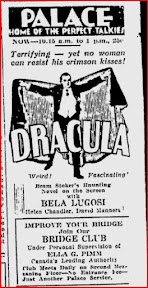
We don't think anyone has ever claimed that Carlos Villarias (not Vallarias as in the ad art above) was better than Bela Lugosi, and we're not going to say that, either. But while the consensus has been that Villarias was only doing a failed Bela impersonation -- he alone of the actors, supposedly, was shown the Browning rushes -- we saw something far different this time. If the studio's thought was that he would simply ape Lugosi, Villarias clearly had a different idea. Critics find his performance awkward, with its grimaces, idiot grins and overall leering and mugging, but we'd like to suggest that a good deal of that awkwardness is deliberate. Watching him this time, we were reminded of what Willem Dafoe's Count Orlok says about the literary Dracula in the movie Shadow of the Vampire, as we quote above. Villarias's awkwardness, his tendency to switch from a simpering smile to an impatient frown or a petulant pout, is his way of expressing Dracula's alien, inhuman nature -- the same quality Lugosi expresses with his uncanny stillness, his carefully choreographed hand movements, and his accent. Since we don't understand Spanish, we can't tell whether Villarias is playing the vampire with a "foreign" accent, whether Spanish speaking audiences would hear him as a Lugosi or as a Christopher Lee. Given our uncertainty about his vocal performance, we focus on Villarias's physicality.


Above, Villarias's Dracula impatiently observes Renfield's dinner.


Is Dracula more disturbed by the sight of blood (above) or a cross (below)?

His Dracula is a predator barely capable of pretending to be a human being, who often goes overboard with his goofy smiles while pretending, and his concentration fails easily. While Lugosi is almost always masterful, except when blocked by a cross or thwarted by Van Helsing, Villarias is barely master of himself, and hardly seems in Lugosi's league as a mesmerist. His hand gestures are all wrong; he seems to be threatening to pat people on the head. It's an interesting and even intelligent performance -- Villarias seems to have calculated his every expression carefully -- but the qualities that make him a distinctive Dracula disqualify him as a scary one. If anything, as Wendigo emphasizes, his awkwardness while pretending to be human ends up making his vampire all too human. In the end, it's a performance we can respect without ranking it highly among vampire actors.

Villarias's eccentric performance leaves the film for Pedro Alvarez Rubio's Renfield to steal in a way Dwight Frye could never have dreamed of. Alvarez can match Frye madness for madness, but there are different methods to each. Wendigo hears in Alvarez the laughter of a completely shattered mind, and sees in his performance a more completely fractured, mercurial personality. Alvarez can turn from calm or arrogant to batshit shrieking crazy on a dime, while Frye is in a constant simmer of insanity that occasionally boils over. Alvarez gives a more theatrical performance, while Frye plays more conscientiously to the camera. You remember Frye's face and his thin, simpering laugh above all, while Alvarez is all shouting and arm-waving, effectively often enough but too often playing to the balcony rather than with Frye's creepy intimacy.


Renfield is a test of directorial control, and the final exam is his scene with the fainting nurse. Browning films it with Frye creeping straight ahead in one of his best shots, while Melford has Alvarez come in from the side and turn in her direction in an inferior composition, holding the shot until Alvarez turns the scene into a joke by snatching at a fly in the air. In this tag-team comparison, Wendigo and I agree that Browning and Frye win hands down.

Probably the greatest acting disparity between the Browning and Melford versions comes in the form of Van Helsing. Edward Van Sloan's iron-willed performance remains definitive for many and second only to Peter Cushing for the rest. By comparison, Eduardo Arazomena impressed Wendigo as some bum who got hired while sleeping on the set. He brings no sense of authority or power to a role that demands those qualities. The most he offers is sympathy, and that's not nothing. Wendigo noticed how often Arazomena wears a horrified or baffled expression compared to the imperturbable Van Sloan. That may make Arazomena's a more humane or warm performance, but the language barrier leaves him looking weak to us based on his soft, doughy presence.

In Bram Stoker's novel, Van Helsing describes Dracula's "baby brain." The "Have you obeyed me?" moment from Melford's movie (below) appears to prove the doctor's point.

Wendigo also suggests that Melford may have needed a relatively wishy-washy Van Helsing given the limitations of his Dracula. You can imagine Villarias immolating under Van Sloan's gaze, while Villarias vs. Arazomena is more like a battle of equals -- or as Wendigo proposes, a battle of clowns hitting each other with flour.

On the other hand, if one actor from the Spanish cast surpasses his English-language counterpart, it'd probably be Barry Norton as Juan Harker. He is the superior of David Manners as long as you understand that Harker is meant to be dull and dense, for Norton achieves the miracle of coming off as a duller, denser twit than Manners, Universal's sublimely named embodiment of stalwart dullness. Those plus-fours he wears help make the right impression, though he does get one unexpectedly noirish badass moment when he stands outside the cemetery in a heavy coat, head down, his face shielded by his hat, after he and Van Helsing have dispatched the "Lady in White."

At age 101, Lupita Tovar may be the last survivor, apart from child actors, of Universal's classic horror era. Seeing her in this film, you can believe that she has a life force that keeps her with us today. Perhaps because Melford's Spanish collaborators were less constrained by lingering Victorian sensibilities, the director is able to get a far more vivacious, voluptuous performance from Tovar as Eva Seward than Browning got from Helen Chandler -- especially after she's been halfway vamped.  It's not hard to dominate a Harker actor, but Tovar practically devours Norton in a seduction scene that's far more aggressive than Browning's and topped with laughter that nearly gives Alvarez a run for his money. Both versions of Dracula are pre-Code films of course, but it's Melford's version that really looks and feels like it. Here, too, Wendigo claims, Melford's casting tops Browning's.
Ever since Melford's Dracula returned to circulation, horror fans have wished for the best of both worlds. Some suppose that Lugosi directed by Melford would have made the ultimate vampire film. Wendigo wouldn't mind seeing that theoretical film, which should also import Van Sloan and Frye from the Browning version while employing Melford's art directors, who give the Spanish version more visual variety than Browning offers. Wendigo could have fun fine-tuning the casting, down to the actor in Browning who tells Renfield, "Nooooo...." when he learns of the solicitor's Borgo Pass itinerary and the two crypto-lesbian tourists in Melford. There may never be a definitive cinematic Dracula, but there is a cumulative version out there, made up of bits and pieces of all the famous and infamous versions, and the novel, that's always in production. Once nearly forgotten, Melford's contributions to the Dracula script of our collective imagination should now be permanent.

Tuesday, August 31, 2010

Wendigo Meets DRACULA (1931)

Let's get back to basics. My friend Wendigo and I have been looking at sexy vampires, mindless monster vampires, surreal Euro vampires and unfunny clown vampires, and it's left us wondering what the point has been. Wendigo was in a mood to go back to the beginning --not all the way to Nosferatu, but back to the film that really starts vampire cinema as we know it. But Tod Browning's film did more than that; it reclaimed the word vampire for the world of supernatural horror.

Browning's Dracula is regarded as the first Hollywood film to feature an actual supernatural menace, one that isn't proven a fraud at the end of the picture. I'm not sure that that's true; there has to have been some movies with real ghosts during the silent era. But I can see why it seemed that way in 1931, when debunking movies like The Cat and the Canary and Browning's own pseudo-vampire story London After Midnight were fresh in memories. Because he'd made London (in which Lon Chaney is a detective who dresses as a vampire to catch a human villain), Browning seemed determined in Dracula to leave no doubt in viewers' minds. He shows us Dracula and his brides rolling out of their coffins to anticipate Renfield's arrival at the castle, which made me ask Wendigo why Browning wasted the opportunity to create suspense by making us figure things out as Renfield does. The point, Wendigo said, was to do without suspense, to put it in your face that Dracula is an undead, unnatural being, and that there were new rules in the horror genre.

Dracula is a vampire -- a nosferatu, as some peasants and academics say. What of it? What is a vampire, exactly? Most American moviegoers, given the rarity of Murnau's Nosferatu, had never seen a "real" vampire. What, then, do they learn from Browning and Bela Lugosi?


Which of these three doesn't belong?

Posterity tells us that a vampire is a suave dude in an opera cape with a medallion and a goofy accent. The first impression, however, is of a compelling, seductive creature capable of raping you, sort of, at night until he drains your life force and makes you one of his kind. They have an intense blood hunger that gives them a predatory look when they find a victim. The blood is a kind of life for them, and a kind of bond. One bite is enough to give the master vampire a mental power over a victim, making him a servant; more bites may make one a bride -- as long as the victim dies at night rather than by day. On some in-between level the vampire will just kill you, as Dracula deals with the crew of the Vesta. The vampire has animal magnetism -- a mesmeric power -- and can become an animal, a bat or a wolf.

Bela Lugosi played this character, a repulsive monster, on Broadway and became a sex symbol. How did that happen? Part of it had to do with his famous accent, which made him a counterpart of the "Latin Lovers" who were popular during the Twenties -- though in silent movies you couldn't hear the accents. There was a bit of the "demon lover" in the Latin Lover, something savage and dominant -- think of Valentino as The Sheik. Think of Valentino as Dracula, for that matter, had he lived. Plausible? If so, that may clarify the connection between the vampire and the Latin Lover. For female audiences, both offered a rape fantasy of sorts that was made safe by being fictional, even if the vampire's rape threatened a fate literally worse than death.

Sex appeal makes Lugosi's Dracula something very different from the ugly horrors of Nosferatu and London After Midnight, but Wendigo reminds me that in folklore the word nosferatu means an incubus who sexually ravishes women until they die of exhaustion or become pregnant by the creature. So sex has always been there, Wendigo suggests, but women weren't going to imagine welcoming Max Schreck into their beds. Lugosi adds sex appeal to the sex. He dresses well and displays a Romantic if Gothic sensibility ("To be truly dead...that would be glorious"). At the same time, Wendigo emphasizes the way that Lugosi conveys with his slowness, his labored English ("to-morrow...eve...nink.") and his glacial, deliberate movements, that he is a dead thing. We've seen other Lugosi films from 1931 where he moves more energetically and speaks English much more easily than in Dracula, so we can conclude that his manner of speaking the lines he's known for years is a deliberate choice. Slowness also symbolizes sleep, hypnosis and somnambulism, and his victims (most notably his brides) become as slow as Dracula. Under his influence, Mina thirsts for Jonathan Harker's blood, but doesn't pounce with fangs bared as in a modern vampire film. Instead, she closes in oh so slowly as the camera closes in in another instance of Browning's (and Karl Freund's) underrated facility with the camera. The slowness identifies her and Dracula as not of this world.

Helen Chandler as Mina, with a lean and hungry look. David Manners
may as well have his back to us throughout the picture.

Lugosi's undead sexiness is, most significantly, a synthesis of the folkloric vampire and the pop-culture vampire, two very different things that had been competing for attention for decades before the Hamilton Deane-John R. Balderston play and the Universal adaptation began to merge them. In the very year when Bram Stoker published the novel Dracula, Rudyard Kipling published "The Vampire," which was inspired by Philip Burne-Jones's painting of the same name. Poem and painting described a man drained of life force by a predatory female who was not a bloodsucker but a kind of moral succubus.

The poem's opening words, "A fool there was," became the title of Porter Emerson Browne's play and nove that, as a 1914 movie, made Theda Bara one of Hollywood's first true stars. Bara's star persona was the "vampire." The subsequent diminutive, "vamp," which survives today, doesn't convey the malignancy imagined by Kipling and subsequent writers.

If someone used the word "vampire" in the media from 1897 until 1931, they were less likely to have meant someone like Dracula than someone like Theda Bara. Bram Stoker's legacy was lapped by Kipling's almost as soon as both were out of the starting gate. Wendigo observes, however, that the pop-culture vampire archetype I've described reminds him a lot of Sheridan LeFanu's Carmilla, while Bara's habit of striking batlike poses at least evoked a supernatural lineage for her mundane menaces. What Balderston, Deane, Browning and Lugosi did with Dracula was integrate the seductive aspect of the pop vamp with the traditional supernatural monster -- with a lingering pop fascination with mesmerism (Svengali reached the screen the same year as Dracula) thrown in. After the movie, when people spoke of vampires they were once more more likely to mean the undead than gold-digging maneaters. That's a little cultural revolution right there.

The bat effects in Dracula aren't really bad for a first try.

It all sounds good on paper, but it was up to Browning, the recognized master of cinematic grotesques, to sell it. His direction of Dracula has a bad reputation, mainly because he mostly stuck with the play's centralization of action at the Seward house. Critics give him credit for an atmospheric first half hour, while Renfield travels to Castle Dracula, but act as if the camera simply froze once the vampire reached London. Browning has suffered even more since George Melford's Spanish-language version returned to mass circulation, but Wendigo and I agree that the English-language version gets a bad rap. Looking at the main action with reviewers' eyes, we noticed how frequently Browning moves the camera in the dreaded drawing room, how often he dollies in and out for emphasis, and how often he stages the action to let actors walk toward the camera or retreat from the camera for maximum dramatic effect. Also, Browning doesn't need as many fancy directoral tricks to hold your attention as Melford does, because Browning has Lugosi. Any sensible director of Dracula would film Lugosi the way Fred Astaire preferred to be filmed, because Bela acts with his whole body and needs to be seen occupying the same space as his fellow actors in order for his timing to work. Browning doesn't need to impose an auteurial signature here; the story itself is enough to mark this as a typical Browning film for his fans.

Art direction by Charles D. Hall


Browning enjoys a definitive cast of supporting players.

Dwight Frye is Renfield. He's a more important character than in the novel, based on the writers' need to tie the madman more closely to the main plot. He takes Harker's place on the trip to Transylvania (which reduces David Manners's Harker to a near nonentity) and is stuck in a situation where the audience knows more than he does. He holds our sympathy with his determined politeness, but once under Dracula's sway he blossoms into one of movies' great madmen, as well as a faithful-enough embodiment of Stoker's "sane man fighting for his soul." Nearly everyone admires Frye's mad scenes and his incredible laugh, but Wendigo feels that he deserves more credit for a more fully nuanced performance that encompasses compassion and moral terror as well as insane arrogance and craven servility. Frye's Renfield may persist as an archetype for actors even longer than Lugosi's Dracula.

Sorry, Hammer fans, but Edward Van Sloan is Van Helsing. Peter Cushing does a great version of the character, but Van Sloan embodies pure willpower in a manner Cushing never matched. Here a character's slowness (compared with Cushing's dynamic performances) expresses indomitable authority. The scene where Van Helsing stares down Dracula despite the vampire's full exertion of his dominance is an awesome moment. Van Sloan portrays a man who takes no shit from anyone, dead or alive. Dracula has heard of this guy, Bela tells us, but still underestimates him. Van Helsing's virtues are willpower and knowledge, a point sometimes missed by Cushing and entirely lost by (ugh!) Hugh Jackman in a recent travesty of the mythos.

Dwight Frye sets the tone for generations of viewers dissatisfied with Charles Gerrard as Martin.

Van Helsing tells us that he will turn the superstitions of the past into the scientific truths of today by revealing a vampire's existence. This assertion helps us understand why some other characters in the movie annoy people so much. Probably the most hated person in the picture is Martin, the sanitarium keeper and "loony" catcher. Martin's only response to any outburst from Renfield, no matter how revealing it might be, is to reiterate that he's a loony. He grows convinced by the end of the film that everyone but himself is loony. In simplest terms Martin is comedy relief on the Shakespearean model of an ignorant smart-aleck, but for Dracula's purposes he represents the far extreme of unwillingness to believe the increasingly obvious. Wendigo adds that comedy-relief characters and scenes serve a necessary release-valve function, breaking up the tension of the plot so that the next shock will be a fresh jolt. Next most obtuse is poor Jonathan Harker, who scoffs and sneers at Van Helsing's notions until Mina's teeth are practically in his throat. David Manners' very name may have destined him to play bland heroes, but he can't be blamed for a thankless role that reduces the hero of the novel to a clueless observer of events. We want him to figure it out, but we might just take him for a stubborn skeptic if we didn't have Martin around to show us that Harker's viewpoint is just plain stupid.

Wendigo suggests, however, that Harker's ignorance may be a necessary component of his innocence. He notes that, even after Harker realizes the truth, he never becomes such a vampire hunter that he has blood on his hands. Wendigo's impressed by the final symbolism of Harker escorting Mina up the great staircase out of the Carfax crypt, as if he were guiding her out of the underworld into which the fallen angel (Dracula) had driven her. Harker has to retain a sort of innocence in order to fulfill this function, but viewers might be excused for finding him a little too innocent to be respectable.

The Browning Dracula remains one of Wendigo's top ten vampire films. It holds up well after eighty years, and Wendigo sees fresh details and nuances every time he watches it. Because it's a consciously trailblazing film, it retains a certain transgressive quality no matter how tame the action may seem compared to so many later vampire films. Wendigo has never read the play, so he can't be certain how much Browning really contributed, but the director was probably the right man for the moment. When I asked him what Dracula has that so many later films lack, he told me that it might be the simplistic answer, but "Bela Lugosi" is the correct one. He has "it," as might have been said of a contemporary "vamp," and it sticks with us today. No matter how many have followed him in the role, Dracula still speaks to the collective consciousness in Lugosi's voice. Wendigo will not say that this is the best vampire film ever, but it'll always be in the running. For my part, when asked by Wendigo, I won't claim it's the best either, but I will say it still sets a standard for the genre. The others are all variations on Dracula's theme.

Here's the familiar Realart re-release trailer, uploaded to YouTube by RoboJapan.

Thursday, February 18, 2010

Talbot vs. Dracula, Part II

When Larry Talbot responded to a woman's distress call in Dr. Edelmann's house, he had no idea until after the fact that he was about to have a close encounter with Count Dracula. It's unclear from the evidence of House of Dracula whether Larry even knew that "Baron Latos" was a fellow patient of the great scientist. Yet the next time we see Talbot, he is a sworn enemy of the Count and all his evil works (whether Dracula knows this or not), tracking him across the Atlantic to thwart his latest scheme. Asked why he must battle Dracula almost on his own, and definitely without police aid, Larry tells a new friend that going to the cops would require him to explain "why I know what I know." But what's to explain? Why can't Larry simply say that he was being treated at the late Dr. Edelmann's clinic in Visaria when he encountered the vampire? Leave aside whether American cops would believe the vampire part; unless Talbot has a compulsion to tell the whole truth he shouldn't have to say that he was a werewolf, or believed himself to be, at the time....that is, unless Larry was talking about something else that explains why he knows what he knows about Dracula.

There's an obvious temptation to try to draw a line of continuity from House of Dracula to Bud Abbott [and] Lou Costello Meet Frankenstein (1948), to give the film its full title, but is it necessary to try? My friend Wendigo says he used to wonder how Larry's cure from the previous film failed. For amusement purposes only, he speculates now that Dr. Edelmann's surgery simply lacked lasting effect. The pressure on Larry's brain may have reasserted itself, or his curse may have. While there is no compelling reason to identify Charles Barton's comedy as a sequel to Erle C. Kenton's monster rally, Wendigo, like many people, can't help thinking of it as one. When Larry talks of what he knows, then, he could just be referring to the events of House (which Dr. Edelmann would have to have filled him in on in the doctor's declining moments of sanity) or he could be dropping a hint of a to-date untold story that may link Talbot's pursuit of Dracula to the resurgence of his curse.

My own view is that A&CMF is as much of a cartoon, if not obviously more so, than House of Dracula was in their common disregard for continuity. While HofD barely acknowledges its predecessor, House of Frankenstein, A&CMF acknowledges HofD not at all. Dracula never calls himself Baron Latos (it's "Dr. Lejos" instead) and no attempt is made to explain his latest escape from exposure to sunlight. Since it's unclear whether Latos even knew that Edelmann was keeping the Frankenstein Monster in a separate lab, HofD can tell us nothing about how the master vampire hooked up with the creature. There's definitely a tale to be told here if you feel a need to explain how everyone got from House to Florida, but we can just as easily take House out of the equation altogether and consider A&CMF a kind of default Universal Horror film with the classic monsters in what might be assumed was their typical state. And because Larry Talbot was essentially a good and righteous man when he wasn't the Wolf Man, he's naturally going to be Dracula's enemy.

Pitting Talbot against Dracula and the Monster is actually a stroke of genius on the part of Abbott & Costello's writers -- all veterans of Bud & Lou rather than the horror cycle. Compared to the House movies, A&CMF is a masterpiece of plotting with all the monsters integrated thoroughly into a single story. Larry's alliance with Wilbur Gray and Chick Young also integrates the comedians into a fairly straight horror-fantasy story beyond Dracula's plot to implant Wilbur's brain in the Monster's body. It makes Bud & Lou more than hapless scaredy-cats constantly on the run. Instead, they're part of a team that can take the battle to the enemy, even to the point of Bud Abbott, normally a monster of selfishness in his own right, rallying a guilt-stricken Talbot to invade Dracula's lair to save Lou from doom.

Lou Costello stoically faces Bela Lugosi's silent command (above) and Glenn Strange's silent scream (below).

The writers actually magnify this team effect by adding not one, but two femmes fatales to the mix, one on each team. Dracula's ally is Dr. Sandra Mornay, who's seduced Wilbur to lure him into their trap. She's both a femme fatale and a mad scientist over whom Dracula has (at first) some blackmail power because she's wanted in Europe for some questionable experiments. With Sandra, Universal was thisclose to an awesome trifecta of villainy: femme fatale, mad scientist and Nazi. Against her, the good guys have Joan Raymond, an intrepid insurance investigator dedicated to tracking down the "museum exhibits" Wilbur and Chick allegedly stole from the obnoxious wax-museum owner Mr. McDougal. She's a femme fatale because her method is also to seduce Wilbur, in the hope of finding out where he's stashed the "exhibits." The women are strong enough characters to have an important scene to themselves as they try to spy on one another's activities.

Dr. Mornay (Lenore Aubert) spies while Joan Raymond (Jane Randolph) scans The Secrets of Life and Death at a costume party. Below, Mornay likes to dress up as an evil crypto-fascist nurse for professional occasions.

It's another great feature of this film that McDougal remains a wildcard factor throughout, making mischief for the good guys while remaining clueless about the true nature of his stolen goods. This movie is full of great characters, with the glaring though minor exception of the dull scientist Dr. Stevens, Mornay's unwitting assistant, who ends up with Joan by default.

For many monster fans, the highlight of A&CMF is Bela Lugosi's return to the role that made his name, whose name he made. Wendigo thinks it's always great to see him back, especially since he looks in much better shape than he did in the (still good) Return of the Vampire. Compared to that film of five years earlier, it looks like at least five years have fallen away from him. But have the years changed his approach to Dracula? One change that occurred to me was that the character now has to deal with the legend of Dracula (by concealing his identity) in a way that Tod Browning's Dracula didn't. For his part, Wendigo sees some subtle differences in the two performances. There's a hint of doomed melancholy to the 1931 Bela, and a sense that Dracula is an unnatural force of nature. In 1948 Dracula is more evil, more of a schemer, more inclined to revel in villainy. But there are more differences between Lugosi and his imitators (Latos, Alucard) than between the '48 and '31 models. For starters, those so-called Draculas are hapless creatures with few survival instincts. More signifcant is Dracula's dominance of a briefly-defiant Mornay compared to Alucard's virtual victimization by the femme fatale of Son of Dracula. Bela makes it plain: "I am accustomed to obedience from women," and he gets it. Another difference: the pseudo (or crypto?) Draculas from the Forties get by with mesmerism, a learned skill almost, while Lugosi's Dracula dominates people by overwhelming force of pure will. He can command from a distance in ways his emulators can't dream of. However you may feel about the way the monsters are used here, Bela's Dracula is the real deal.

Lou mugs like mad, and brilliantly, in the "young blood and brains" scene, but he has to to keep Bela from stealing the scene just by wearing that smoking jacket.

It wouldn't surprise us if fans don't feel the same way about Lon Chaney Jr.'s Wolf Man. As Larry, Lon is impeccable, as impressive and heroic as he's ever been despite his bouts of despair and guilt. But the Wolf Man is still under the constraints necessary for the film to treat Larry as a good guy. That means he has to be an ineffectual monster in two scenes in which he proves incapable of even pouncing on Wilbur, instead tripping and tangling himself in every possible impediment. It's fair to ask what's worse: the fact that the Wolf Man can't escape from a locked hotel room or the fact that Lou Costello bops him on the nose, mistaking him for a masked Abbott, and survives? It's also fair to remind ourselves that the film is meant as a comedy, and that, as Wendigo reminds, me, Chaney was a very good sport about taking his monster's pratfalls. None of this compromises Larry Talbot's role as a hero, if not the hero of the movie. Wendigo adds: if he can't consider The Munsters a travesty of the Universal monsters, he can't complain about this film.

"Grrrrrr!" Even Bud makes fun of the Wolf Man, but his playacting gets him in trouble later in the picture.

In any event, the Wolf Man redeems himself a bit by taking down Dracula after a rather absurd battle that sees the desperate vampire throw everything he can lay hands on at the persistent lycanthrope. Bela even resorts to hitting him with a chair, rasslin'-style. You can ask whether the Wolf Man attacks Dracula because he knows the vampire is the enemy, or just because Dracula is there? On the other hand, the vampire's enmity toward the werewolf seems to be a matter of panicky disgust, as if Dracula had seen a large rat. In any event, Larry gets the job done even if it means a dip in the rocky drink. Do they both die? Well, Dracula is clearly out of action because the plunge breaks his power over Joan Raymond, but on the evidence of Talbot's suicide attempt in HofD it's definitely debatable whether the drop would kill the Wolf Man. It may be best for us to wish Larry Talbot godspeed on his long, long journey home -- or back to Europe, or wherever.

A&CMF, of course, is the top-billed team's big comeback film, restoring a declining pair to audience good will by riding their lingering good will toward the Universal Monsters. The comedy is knowing rather than contemptuous (unless you disapprove of the Wolf Man's clumsiness) and is arguably the first filmic expression of the fandom that would blossom with the spread of television in the next decade. As for Bud and Lou, once upon a time you could see a movie of theirs at least once a week on cable TV. Now this film is one of the few Abbott & Costello movies that turns up occasionally on stations like TCM. It's been a long time since we've seen any other besides their awful public-domain films. A&CMF shows the team in top form after a series of non-team experiments. Lou gives as good as he takes here in an incredible performance, talking back to everyone, going nuts with pantomiming the monster's movements, reveling in the attentions of two beautiful women and coping with the creatures with childlike credulity. Costello often strikes me as a progenitor of the obnoxious infantile men of modern movie comedy, but Lou brings something extra to the show: a self-consciousness that cracks the fourth wall and invites you to share his enjoyment of the ride. His character may be a sap, but he's a sap and he knows it, and in a redeeming way he seems to know more than he thinks he knows. You can't leave this film feeling contempt for Lou Costello, and the more you watch the more little details you catch, including his titanic scene-stealing battles with Lugosi. His interplay with Abbott (and Chaney, for that matter) is note perfect.

"Back...back... He thinks I'm Dracula."

Abbott & Costello are Wendigo's favorite comedy team, and he has many fond memories of Sunday morning double-features on WPIX. I didn't like them as much as he did back then, but every time I see A&CMF I get an urge to see more of their films. Some time ago I put this film on my list of ten favorite comedies, and I'd say that Lou Costello gives one of my favorite comedy performances ever in it. With Bud and Lou in top form and the return of the monsters, I'm inspired to ask: does any other Hollywood studio have a film in its library that is as definitive an expression of its creative identity as this film is for Universal? Abbott and Costello Meet Frankenstein is Universal's monument.

And here's the Realart trailer, uploaded to YouTube by horrormovieshows

Tuesday, February 16, 2010

Larry Talbot vs. Dracula: Part 1

The way he walked was thorny, though no fault of his own.... This past weekend, moviegoers saw Lawrence Talbot begin a new journey along a fairly familiar path. My friend Wendigo is invalid enough that he can't watch a film he craves to see until it hits DVD, so this weekend he and I entertained ourselves by examining the end of Talbot's original journey -- the two ends, actually: the formal end of his storyline and a satirical epilogue.

So we start at the end: Erle C. Kenton's House of Dracula (1945), a film that some take as proof that the Universal Monster genre had gone creatively bankrupt. Its cavalier attitude toward series continuity, its late attempt to almost undo Universal's place in history as the pioneers of true supernatural content in horror films by reducing curses to medical ailments, and its upstaging of all the classic monsters by a mad scientist, make it look like the end of the series (for it's very consciously the end) had come just in time, if not a little too late. But Wendigo, I suspect, isn't the only person who considers it at the very least an improvement on 1944's House of Frankenstein, and speaking for myself, I think that mad doctor deserves some credit as Universal's last great creation of its classic, pre-Creature From the Black Lagoon era.

Continuity is out the window once Baron Latos, the man who claims to be (and as far as Universal is concerned, is) Count Dracula bats his way through an open window to ogle Miliza, a live-in nurse and research assistant in the employ of the eminent Dr. Edelmann (Onslow Stevens). After satisfying his voyeuristic urges, though not his vampiric ones, Latos (John Carradine) strolls into Edelmann's quarters shortly before dawn. Excusing the hour and the intrusion, Latos banters his way into a confession of his Count-dom and declares his readiness to be rid of the curse that compels him to drink blood. We last saw Latos as a pile of bones bleaching in the open air once he fell off the wagon in House of Frankenstein. So what's the rule, now? Did someone just have to drag the skeleton indoors to bring him back? Admittedly, we could ask what Dracula's staked skeleton was doing somewhere in Pre-Occupied Europe at the start of HofF when we saw alleged Dracula Count Alucard skeletonized somewhere in Louisiana at the end of Son of Dracula? Universal was no longer asking questions, probably presuming that audiences no longer regarded its monsters as anything but cartoon characters who could turn up at any time or place as a script demanded, but that doesn't mean we can't ask.


Carradine's glare at Martha O'Driscoll may have something to do with her being billed ahead of him in a film called House of Dracula!


Wendigo likes to speculate that Latos and Alucard are imposters, either vampires actually turned by the original Dracula (you know who) or interlopers exploiting the real one's absence to advance themselves in the realm of the supernatural. He offers this as a take-it-or-leave-it proposition, since he concedes that Universal had no interest in vampire continuity as of Son of Dracula. As Latos, Carradine has more to do in HofD than in his perfunctory previous outing, and he gives a better performance: more refined, colder, less southern gentleman-like. As the title says, he's the center of the film, though once again he drops out of the picture well before the end.

When he first saw HofD, Wendigo believed that Latos sincerely desired a cure but succumbed to his unnatural lust for Miliza. It's clear to him now that Latos had an urge for the nurse from a previous encounter, meant to vamp her and made himself Edelman's patient in order to get close to her -- but why doesn't he just bite her when he can freely fly through her window??? Wendigo suggests that Latos was toying with Edelmann and his staff, but he admits it's not a very convincing explanation. You could also argue that he initially sought a cure to win her as a human, since he submits to Edelmann's initial treatments. But he quits the treatments and sets about mesmerizing the nurse and making his usual spiel about the strange twilight world where the people are dead, yet alive, that peculiar emotionless realm where there are, on Latos's word, no material needs, yet he needs to drink the blood of the living. I wonder sometimes whether the mythical realm of Visaria where the House films take place isn't itself the strange twilight world where World War II isn't happening and Larry Talbot seems to be falling backwards through time from his 1941 starting point.

Could Latos have been cured? The film hints that Dr. Edelmann is on to something, and there'd be no reason for Latos to stop the treatments if they weren't going to work. Edelmann's success with Larry makes one wonder whether he could have worked similar wonders with a more compliant Latos, but his failure to complete the treatment leaves open whether the curse of vampirism is something beyond science. Of course, we had been led to believe that Larry's curse was beyond the ken of science, and look what happens to him.

What a coincidence. One day after Latos shows up at Edelmann's office, Larry Talbot turns up begging for help, only to run off impatiently when the doctor doesn't come running. We last saw Talbot dead at the end of House of Frankenstein with a silver bullet through the heart, shot there by a gypsy girl fulfilling the rule that one who truly loves a wolfman and is willing to die for him can kill him. Only he isn't killed. There's a lot of stuff that can kill a wolf man, we've learned over time, but nothing does it permanently. Larry gets himself arrested and locked in the local jail by the ever-authoritative Lionel Atwill, and the result leaves us asking why Talbot never thought of this before. Before the eyes of a hastily-summoned Edelmann, Larry transforms into the Wolf Man, tugs at the iron bars a few times, sinks to the floor in despair and rolls into a catatonic fetal position for the rest of the night. How the mighty are fallen! Admittedly, Wendigo realizes in retrospect that, in order to have a happy ending in 1945 under the Production Code, Talbot could have no blood on his hands. But this spectacle in jail, followed by his failure to kill Dr. Edelmann in a cliffside cave (the old man holds out until sunrise) make it a kind of relief that we never see the Wolf Man again.

Guess who they find in that cave? It's the Frankenstein Monster, who oozed his way here through the quicksand he sank in at the end of House of Frankenstein. Are we supposed to believe that? Yes! For there beside him are the bones of Dr. Niemann, the only explicit reference to the previous movie, and a mint-condition manuscript of Dr. Frankenstein's Secrets of Life and Death. So there is continuity of a sort, and we're all justified in asking every question you want about how Latos and Talbot got out of their predicaments. I suppose they could have handled the Monster the same way as the other monsters. I can see him banging on Edelman's door and announcing himself: "Me...sick...fix?...friend?"

Edelmann and Talbot drag the thing to the former's lab, where Larry warns the good doctor against experimenting with the Monster. His argument from experience, on top of a stern moral argument from Nina, his other nurse, convince Edelmann to leave it alone. Nina longs for Edelmann to cure her hunchback and pines for him as a person, though I wonder at her reasoning. As things stand she's the world's prettiest hunchback. Afterwards, she'd only be another pretty nurse. As it is, she has a prettier face than Miliza, but those insensitive boors Talbot and Latos can't look past the hump, apparently. They only have eyes for Miliza, and one wonders whether there's a missing scene in which Latos's jealousy over Talbot making a move on the blonde nurse provokes him into rejecting his treatments and asserting his dominance. You have to wonder. You have to wonder why poor Nina has to die in such a brutal way later on when she's a more sympathetic character than Miliza. Wendigo's sad conclusion is that Miliza was simply too blonde to die.

The lovely Jane Adams as Nurse Nina, with that distracting hump away from the camera

Anyway, Latos pulls a fast one on Edelmann, rejecting an emergency transfusion and instead infusing the poor doctor with his own accursed blood. He heads for Miliza's room to take her once and for all, but Edelmann recovers quickly, follows Latos into the room, and pulls a cross on him. As Larry enters through another door, Latos cowers and runs for his coffin. This is the only encounter of Chaney and Carradine in the entire film, but Wendigo points out that this could be sufficient to establish Talbot's lasting enmity toward Dracula, since the vampiric bastard was going after his woman! We learn quickly that Latos has planned things poorly. All this time he's existed at Edelmann's suffrance, since the doc could expose Latos's encoffined corpse to the sunlight through a basement window anytime he pleased. After this episode, Edelmann damn well pleases.

Larry never actually sees Baron Latos face to face, so the fact that Count Dracula looks quite different in their next encounter wouldn't have fazed him at all.


Exit Latos, but he's done his evil work. His blood flows through Edelmann's veins, but instead of developing a thirst for blood, the accursed doctor develops a lust to kill. It's ironically Wolf Man-like, but Wendigo says it's Universal's way of finally doing a Jekyll-Hide character. Edelmann doesn't seem to have become a vampire, but he transforms when night falls into a depraved killer. Up to this point, Onslow Stevens has been a benign presence and a straight man for the monsters. Now he takes over the movie and becomes a total badass. With minimal makeup, some mussed-up hair, and lots of his own body language, the transformed Edelmann is a really menacing presence, all the more so for not ranting and raving but playing his malice very cool.


Dr. Edelmann goes through one of those dream-induced transformations, unleashing Onslow Stevens as a grim but gleeful freak who takes over House of Dracula.


Fortunately, while he's still himself Edelmann performs his miracle operation on Talbot, applying some plant extract on Larry's unshaven skull to make it expand, relieving the pressure which we now learn triggered the poor man's lycanthropy. This is a mixed blessing, since that pressure also made Larry immortal, but maybe that was just the power of positive thinking. Whatever was going on in his head, Wendigo says we should bottle it and sell it. If all you have to do is lock yourself in a cell for three nights out of the month, that's not really a high price to pay. It was for Larry, though. He makes clear here that it's unendurable for him to undergo the transformation even if confinement renders him harmless. It's one more grace note in a memorable, archetype-creating multi-film performance by Lon Chaney Jr. Some find his suffering insufferable, but we feel that it expresses a kind of righteous recognition that his condition isn't just bad for him, but profoundly wrong. Wendigo especially appreciates the consistent portrayal of Larry as someone crying for help, or crying out warnings, to whom no one wants to listen. He gets past that early here, since everyone sees him change in jail, but he still has to deal with Atwill's accusation that he committed Edelmann's murders. For once he has to plead innocence, but he gets the same old skepticism.

Look into the light, Larry!

Does Larry's cure betray the concept of the Wolf Man as a tragically accursed creature? Wendigo doesn't think so, simply because Talbot has always been a good guy at heart, despite his unconscious rampages under the full moon. The fact that Universal gave Larry a happy ending is probably the best proof we have of Talbot's popularity with moviegoers. You have to presume that people wanted to see the guy get a break. So why is he a Wolf Man again three years later? Arguably because people wanted him back.

Wendigo can't deny that House of Dracula has plot holes one could fly a jet through and has a questionably rushed finale. After Edelmann's final showdown with Talbot, the Monster lurches through a scene, swatting victims aside almost by accident, before exploding equipment causes a flashback to the finish of Ghost of Frankenstein. This film is in many ways a slapdash product, with an unoriginal score but its saving grace is the studio's desire to get the series over with, to give it an actual end.

This copy of the Realart trailer was uploaded to YouTube by StevieRotten.