
Showing posts with label westerns. Show all posts
Showing posts with label westerns. Show all posts
Sunday, September 8, 2019
DVR Diary: RINGO AND HIS GOLDEN PISTOL (Johnny Oro, 1966)

Monday, June 24, 2019
WHY GO ON KILLING? (Perche' uccidi ancora, 1965)


Lopez imports new gunmen to eliminate Steve, but the feud begins to escalate beyond his control when McDougall kills one of the gunmen while the gunman's brother Gringo (Aldo Berti) stayed on the ranch trying to hit on Pilar. Now Gringo has a vendetta of his own that will lead to the death of Steve's brother-in-law, the kidnapping and torture of Judy and the deaths of Lopez and Pilar. Gringo cares about nothing but killing Steve and can't care less about Lopez's larger strategy. The moment Lopez appears to be holding him back, Lopez is a dead man, and when Pilar, who still loves Steve and has shown compassion toward the captive Judy, tries to intervene, she's mowed down without a second thought. Rojo sees all this but can't keep himself from being carried with the tide as Gringo rides off with Judy to force Steve into a fatal showdown.


The writers' treatment of Rojo is one of the film's quiet strengths but also an ultimate weakness. A long chase through the wasteland leaves only Gringo, Rojo and Judy alive after Steve picks off the rest of the ranch gang that Gringo has taken over. With a gun on Judy, Gringo forces Steve to disarm. He taunts McDougall by promising to kill Judy after Steve dies. Through all of this, Rojo has a gun, and you can see that he's finally reached the point where he can't stands no more. All of Gringo's attention is on Steve. So what does Rojo do? He throws his gun to Steve -- who can't hold on to it. Steve can do nothing to stop Gringo from blowing poor Rojo away, and it's not until Judy hits Gringo with a rock that McDougall can dive for the gun and shoot his enemy down. It's not hard to imagine Rojo surviving had he shot Gringo himself, but despite how much the writers have highlighted his conscientious observation of events, they could not imagine him claiming real agency by taking out the final villain. I suppose you can argue that tossing the gun is Rojo's ultimate refusal of agency, of a piece with his overall failure to take responsibility for anything. But it's easier to assume that it simply wasn't this flunky's place to defeat the bad guy as far as the writers were concerned, so of course he has to do something suicidal instead. The writers' decision undermines Hurtado's decent performance, which is mostly a matter of facial expressions that transcend the typical spaghetti-western dubbing. It also exposes the formulaic skeleton on which they tried to hang a more ambitious character-driven piece. For the most part, however, the film manages to find the mood it's looking for with the help of sometimes-wistful landscape cinematography by Hans Burmann and Vitaliano Natalucci and an occasionally-effective score by Felice Di Stefano. The ending may infuriate you a little, but overall Perche' uccidi ancora is a good try at a relatively mature western story.
Tuesday, March 12, 2019
THE TASTE OF VIOLENCE (Le goût de la ..., 1961)


A perilous journey ensues. The little band has to burn their way through a cornfield to escape a village of pursuers, but Chamaco remains the real threat, thanks in part to his influence over the youngster of the band, Chico (Hans H. Neubart). Circumstances keep Chamaco from carrying out his own schemes until Maria shows her own ruthlessness. Recognizing Chico's infatuation with her, she persuades him to escort her to safety, only to be intercepted by Perez and Chamaco, the latter of whom kills Chico. Later, Maria gets the drop on the two survivors, only to surrender to Perez after he kills Chamaco to keep him from shooting her. The romance between Maria and Perez seems implausible, as does Giovanna Ralli's somehow immaculate makeup, but rest assured that Hossein isn't too much of a romantic.

As the film nears its conclusion the tide has clearly turned against the rebels. In a bookend to the execution scene at the start, Perez and Maria enter a city where rebels are hanging by the neck practically door to door. In the end, after a brief rest break at his sister's house, Perez learns that his faction has been decisively defeated; there's no one left to whom to deliver Maria. Then he finds that the government forces have burned his sister's house to the ground and most likely killed her entire family. Maria is all he has left now -- except for one thing. This might be the point where another filmmaker would have Maria run off with Perez to make a fresh start somewhere. Instead, Hossein has his hero and heroine go their separate ways, Perez to carry on in one-man rebellion, quite consciously hopeless. Maria doesn't love him that much. The closing shot shows two tiny figures riding off in opposite directions across a vast, bleak landscape. Unlike the "zapatas" that came later, Hossein isn't interested in violent catharsis, ending his prototype film on a note of tragic futility that makes it something more than a genre picture. See this and Cemetery Without Crosses and you'll regret that Hossein -- still with us at age 91 but apparently retired -- didn't make more westerns with his exceptional sensibility.
Thursday, February 21, 2019
BLACK KILLER (1971)


In fact, Webb has one of the dumbest gunfighter gimmicks in spaghetti westerns. The books, or some of them at least, are hollowed out and carry guns inside. That's one way to conceal your firearms, I suppose, but Webb takes the gimmick too far. Although there seems to be no advantage at all to it, the lawyer keeps his weapons between their covers at all times, even when he's using them. He's so good a gunman, I guess, that he doesn't have to worry about aiming -- and for that matter, I'm not quite sure how he fires the things unless each volume has a hidden lever somewhere. At least Croccolo doesn't force us to worry about these practical matters until late in the picture. Until then, Webb is mostly a seemingly detached observer of the tribulations of the Collins brothers at the hands of the O'Hara gang that dominates the territory by stealing land from homesteaders. Peter Collins (Jerry Ross) keeps a modest but happy home with his Indian wife Sarah (Marina Malfatti), while brother Burt (Fred Robsham) has been made sheriff, at Webb's prompting, after killing several outlaws shortly after reaching town. In revenge, the O'Hara's attack Peter's home, killing him, injuring Burt and raping Sarah. The murdered man's widow and brother become avengers, and say what else you will about this picture, it's a rare Italian western that gives us a fighting heroine, and a Native American at that. Sarah fights with bow and arrow (hitting her targets from sometimes impossible-seeming angles) and with guns, and even gets the drop on Webb when he acts suspiciously. She also provides some of the picture's gratuitous nudity, stripping to the buff so Burt can remove a bullet from her thigh. Most of the nudity is contributed by Consuelo the saloon girl (Tiziana Dini), who is as much an object of cinematic exploitation as Sarah is an exceptional heroine.

Alas, Sarah is made to sit out the final showdown pitting Webb and Burt against the remaining O'Haras, perhaps because "Lucky" realized that the Kinski character actually should accomplish something with his gimmicked lawbooks. I suppose you can read some kind of commentary into the gimmick on the inescapable violence at the heart of the rule of law, but I doubt anyone involved in this picture thought too much about it, and in any event Webb is not entirely a lawful character. He undoes the injustice of the land thefts, but keeps the gang's ill-gotten gains for himself, until Sheriff Burt demands a cut and gets it. At first this looked like one of those pictures Kinski would sleepwalk through, but Croccolo does a decent job exploiting the man's irrepressible presence as he glides desultorily through the proceedings. Webb isn't enough of a character to imagine a series of films about, and his gimmick really is dumb as a rock, but Kinski makes him fun to watch this one time without really doing much -- only just enough.
Thursday, January 10, 2019
DAY OF ANGER (I giorni dell'ira, 1967)

Few films identify themselves so blatantly as star vehicles in their opening titles ,
but the first-ever teaming of red-hot western stars Gemma and Van Cleef was one of this one's main attractions.
At first glance, Tonino Valerii's film appears to be based on an English-language novel, but on further review source author Ron Barker was really German scribe Rolf O. Becker, and in any event the filmmakers claim that the screenplay was more inspired by than adapted from Becker/Barker's Death Rode on Tuesdays. Nevertheless, Day of Anger is one of those spaghetti westerns that feels more like an American western in its focus on the main character's moral crisis. To be Germanic about it after all, it's a kind of western bildungsroman in which a naive youth learns what it means to be a gunman under the tutelage of rival mentors.but the first-ever teaming of red-hot western stars Gemma and Van Cleef was one of this one's main attractions.


Scott (Giuliano Gemma) is the town pariah in the community of Clifton, for no better reason than his illegitimate birth. He's given the most disreputable tasks, particularly trash collection, and is despised by respectable townsfolk. His life changes when Frank Talby (Lee Van Cleef) rides through town on his way to Bowie. He seems to sympathize with Scott's outcast status and seems offended when Scott reveals that he has no last name. Since his mother's name was Mary, Frank dubs him Scott Mary and insists on treating him to drinks in the local saloon, where he kills one of Scott's tormentors. A court calls it self-defense, but everyone feels that the victim meant no real harm, so Frank is urged on his way, and Scott follows him, riding his faithful mule Sartana (!!)

On their journey together Talby takes it upon himself to teach Scott a number of valuable life lessons, most of which boil down to cynical pragmatism. It sometimes means treating Scott rough, but Frank seems sincere about wanting to toughen up his new protege. His efforts pay off as Scott saves him from a criminal gang, friends of the man he came to Bowie to meet. He and Wild Jack (Al Mulock) had been involved in a bank robbery in Clifton, for which Frank had served time in prison. Jack tells him that the town fathers of Clifton had had a hand in the robbery and had screwed him out of his (and Frank's) share -- about $50,000. Frank decides to assume Jack's claim on the city and after eliminating Jack and his gang with Scott's help he returns to Clifton for a reckoning.

Cinematographer Enzo Serafin is fond of showing characters in mirrors (left)
before they enter the frame proper
At this point it sounds like the Point Blank scenario, but Talby has more ambitious plans. After burning down the leading saloon and destroying those who plotted to destroy him, Frank opens his own opulent gambling joint and settles down. The realization that Talby is driven ultimately by greed rather than revenge hastens Scott's estrangement from him. The disillusionment continues as Scott's old friend and fellow stable bum Murph (Walter Rilla), who taught Scott a fast draw with a wooden gun, reveals himself as a former gunfighter who once drove Talby from another town. Recognizing Talby as an incorrigible bad man, Murph braces up and becomes the town marshal while advising Scott on tactical firearm modification. After Talby kills Murph, Scott finds a special gun the old man had tailored just for him, just to outdraw Talby....

Lee Van Cleef is The Master ... of ceremonies

Day of Anger stands out for some things the writers refuse to do. All the way through I waited for a shoe to drop and for Talby or someone else to identify himself as Scott Mary's father, but it never happens and it didn't need to. It observes Talby's mentorship of Scott without comment, except to perhaps endorse Murph's view that Frank simply wants a younger man as extra muscle. Another interesting detail is that, while Scott gradually turns against Talby, Frank never really does anything to betray his protege, apart perhaps from bringing in extra gunmen rather than rely on Scott exclusively. He may be vicious in general, but the people of Clifton and environs demonstrate constantly that he lives in a vicious world, as he tries to convey to Scott. There's an admirable ambivalence about Talby that allows you to conclude that, yes, he would resent a guilty town's mistreatment of an innocent boy and, yes, he could take advantage of that boy's resentment and ambition for his own ends. It helps greatly that Lee Van Cleef gives the part such gravitas. This film, among others, confirms what Sergio Leone saw in him that Hollywood had missed for so long. It's a tremendous showcase for Van Cleef's baleful charisma and perhaps his best performance in an Italian western outside of Leone's films. It's a shame you can't have a version of the film that allows Van Cleef to speak English while Gemma speaks Italian, for while screencaps convey nicely the Italian star's portrayal through facial expressions and body language of an ambitious naif increasingly horrified at the prospect of his own hardening, the English dub saddles him with a dumb yokel voice that makes it hard to take Scott seriously as consistently as we should.

As an obvious "A" spaghetti western Day of Anger has predictably good cinematography (by Enzo Serafin) and even better set design that makes Clifton one of the most fully realized fictional towns in the genre. The highlight, of course, is Frank Talby's saloon with its giant guns flanking the entrance, its unusual placement of the stage on an upper tier, and almost psychedelic design motifs -- the common influence seems to be Art Nouveau -- inside. Riz Ortolani does the music for this one and gives it a brassy swagger on top of the characteristic guitar sound. If anything, his score contributes to the film's slightly excessive length and occasionally dragging pace. There are numerous scenes of Van Cleef and Gemma riding through not exactly spectacular landscapes simply so Ortolani's music can play. It's not bad music at all, but moments like those make Day of Anger feel more like a modern soundtrack-padded American film than a contemporary western. For the most part, however, it looks and sounds like what it is: one of the best of the spaghetti westerns.
Sunday, December 2, 2018
THE BALLAD OF BUSTER SCRUGGS (2018)

'Misanthrope?' I don't hate my fellow man, even when he's tiresome and sulky and tries to cheat at poker. I figure that's just a human material, and him that finds it cause for anger and dismay is just a fool for expecting better.

Perhaps feeling less capable of telling a feature-length story lately, the Coens reportedly contemplated embarking on series television. It was announced that they were creating a western anthology series for Netflix, but instead, apparently quitting while they were ahead, they delivered a feature-length collection of six stories: five of their own and an adaptation of Jack London's "All Gold Canyon." There's a variety of tone to the anthology that belies any stereotype of the Coens' character or philosophy and makes it truly reminiscent of the Twilight Zone of western anthology TV, Zane Grey Theater. It opens with a trolling provocation featuring Buster Scruggs (Tim Blake Nelson), a seemingly invincible and suprisingly lethal singing cowboy who ultimately yields, in the most cartoonish fashion, to a harmonica-playing stranger presumably representing a later era of westerns. It's a combination of what some may enjoy most and what others despise in the Coens' work, but as the film moves from episode to episode it grows less predictable, veering from the fateful absurdity of "Near Algodones," in which James Franco's hapless bank robber escapes one hanging only to be doomed to another, to the utter nihilism of "Meal Ticket," in which Liam Neeson exploits a limbless savant who performs recitations and murders him when he fails to draw crowds anymore, before following London in a more hopeful direction.


The longest episode -- or so it seemed, though not in a bad way -- is both the most romantic and the most tragic. "The Gal Who Got Rattled" is a wagon-train story of the deliberate courtship of a suddenly penniless pioneer woman (Zoe Kazan -- a veteran of Meek's Cutoff, by the way) and a wagonmaster's lieutenant (Bill Heck), as much motivated by monetary concerns as by feelings of ardor. There are elements in the story -- a dog with a maddening bark, a bankroll left in a corpse's clothes -- that lead you to suspect an absurdly happy ending until the story takes a twist out of nowhere when the girl and the wagonmaster (Grainger Hines) are caught alone by an Indian attack. The Coens have set up an archetypal frontier scenario of the sort that might get them scolded for their portrayal of Native Americans, down to the wagonmaster giving the girl a gun so she can kill herself if the Indians get him, in order to spare herself the fate worse than death, which here gets described in some detail. In a brilliantly swervy climax, it looks like he's driven the war band back only to get tricked by a seemingly riderless horse. The Coens keep our eyes on this scene, as the Indian moves in to take a scalp, only to get killed by the possum-playing wagonmaster. Hooray! -- except that the girl was just as fooled as the Indian was, and the finish could be considered an indictment of the mortal terror of Indians the old tales induced. This is a great piece of filmmaking on its own, but it could only happen in an anthology format, since it's too short to be a feature and a standalone story won't go on series TV nowadays.
The film ends on an eerie note with a story that's part Stagecoach, part Samuel Beckett, with a typical Coen cast of eccentrics and grotesques sharing a ride with two men who may be bounty hunters or may be far more sinister than that. On paper it's little more than an opportunity for a lot of newcomers to the Coens' world to tuck into their meaty flights of rhetoric, especially Chelcie Ross as an interminible trapper. One thing you can depend on, no matter what the content or tone of the tale, is that these westerners won't sound just like the people next door today; it's of a piece with their True Grit in many ways, and maybe meant to show that they weren't just mimicking Charles Portis's prose. While they portray The Ballad of Buster Scruggs onscreen as an old hardcover book with color illustrations, it reminded me more of the western pulp magazines I've come to enjoy reading in its simultaneous variety and consistency. The finished product may or may not count as a salvage job, but it still plays to the Coens' strengths while minimizing their weaknesses in a way that makes it a vast improvement over the tedious Hail Ceasar! The brothers may well have found the right medium in Netflix for this point in their career. Had it been packaged as a series, that would only have made it more clear, as it was clear a century ago, that great filmmaking isn't restricted to feature-length storytelling.
Monday, February 19, 2018
DVR Diary: PILLARS OF THE SKY (1956)

This reversal follows the most unexpected change from prose to film by this period's standards. Simply put, in the story Emmett gets the girl, but in the movie he does not. In the story, his rival for Cally (the late Dorothy Malone) dies in the running fight that takes up most of the narrative. In the film, the rival lieutenant (Keith "Vaal is All" Andes) survives and wins Cally simply by showing more (i.e. some) concern for her welfare during the Indian attacks than Emmett does -- after he'd gone to the trouble of rescuing her from Indian captivity earlier in the picture. You wonder what inspired such a creative adaptation of source material (speaking euphemistically) by Rolfe, who charged out of the gate as a screenwriter a few years earlier with Anthony Mann's The Naked Spur and went on to create Have Gun Will Travel and The Man From U.N.C.L.E. My only guess is that movies could not as easily take Indian Christianity for granted, or treat it as lightly, as Henry did. There are other cosmetic changes, as might be expected, from the expunging of an embarrassing Negro servant character (After his progressive treatment of Indians, Henry wrote minstrel dialect for her) to giving Lee Marvin's Irish sergeant (complete with brogue) a death scene that went to another character. To be fair, the film is all right on its own terms, even if the religious angle bears more weight than it should, but it's sure to leave anyone who read (or, in my case, later read) Will Henry scratching his head. Still, there's enough of a difference about Pillars, mainly because of the choices Rolfe made, to make it recommended (if not essential) viewing for fans of Fifties westerns.
Saturday, January 27, 2018
On the Big Screen: HOSTILES (2017)

The party, including Yellow Hawk's family and the usual collection of cavalry types, discovers the remains of a farm that we saw destroyed by renegade Comanches. Inside the farmhouse is Rosalie Quaid (Rosamund Pike) sole survivor of a massacre that took her husband and three children from her. She freaks out at the sight of more Indians, but as with Blocker, something about the journey softens her feelings toward them, and one can safely predict from a still-early point that the youngest of Yellow Hawk's group will end up her own surrogate child.
Adapting an unfinished treatment by the late Academy Award winner Donald E. Stewart, Cooper as writer-director seems to be saying something about what happens to people taking a journey together. As long as everyone's on the move, everyone finds it easier to get along than anyone might have expected. It helps to have common foes to force them together: first those Comanches, whom Yellow Hand's people also regard as enemies; then a rapey band of fur trappers; then a convicted murderer and former comrade of Blocker's (Ben Foster) who's dumped in the captain's last for a latter leg of the trek. It also helps, in a more contrived way, that despite whatever atrocities Yellow Hawk may have perpetrated in the past -- we're meant to remember that Wes Studi was the bad Indian of modern cinema -- the old chief and his family are nothing but wise and compassionate throughout the trip. You hear not a word of bitterness from them, nor any thought of just desserts when the whites are wounded or killed. Their final obstacle at the end of the trail, after Yellow Hawk becomes one with the Force, is an obnoxious group of whites who refuse to let the old man be buried on land they claim as their own. Not even the presidential safe-conduct pass Blocker carries impresses these yahoos, who clearly give a damn about nothing and no one but their property rights. "Republicans," some in the audience will surely think. But the main idea seems to be that once people put down stakes they have something to fight over, and so just when it seemed that the film had reached its conclusion on a note of reconciliation, it has one more bloodbath left.
Cooper has an odd attitude toward violence. The opening massacre scene pulls no punches in showing Rosalie's daughters getting shot down and focusing on Rosalie herself cuddling a bloodstained bundle that was her baby. From there, Hostiles becomes inconsistently reticent. We see a running battle between the travelers and the Comanches, but when Yellow Hawk and his son are let loose to track them down and kill them, we only see the aftermath. Later, when the troopers and Cheyennes rescue their women from the trappers, we only hear their slaughter of the bad guys inside a house; like Rosalie, we only see gun-flashes, the sounds of stabbing and the screams of victims. Later still, after the convict has escaped and killed a trooper, Blocker's oldest buddy (Rory Cochrane), who'd been about to desert, rides off to chase down the killer. As with the Comanches, we find the convict dead the next morning, while Blocker's buddy has killed himself. Finally, the showdown in Montana climaxes with Blocker stalking the patriarch who had started the trouble, after everyone but Rosalie Little Bear have been killed. Blocker is clearly determined to finish the troublemaker off. While Rosalie watches in horror, trying to shield Little Bear's eyes, we see Blocker do something awful to the man -- most likely cut his throat -- from behind. This reticence is noteworthy in a R-rated film, and maybe praiseworthy when so many westerns are still spaghetti-inspired bloodbaths. But what Cooper might be saying about violence isn't really clear. The way the final fight ends, you might think that Blocker's killing of the man might be a deal-breaker for whatever relationship he and Rosalie might have, that by taking this extra step -- who can say if it's really necessary? -- Blocker is showing something of his true nature that would repel her. Yet the film has a theoretically happy ending with Blocker deciding to join Rosalie and Little Bear on a train to civilization -- or at least to Chicago, in a result to which Rosalie presumably would not object. I suppose a commitment to a new journey is just what Blocker needs to avoid further dwelling on his violent past, but at once there's something too neat and too muddled about the way Hostiles addresses issues of violence and hatred, as if Cooper were satisfied that to address these issues is to settle them. In the end, I suspect that he's gone too far in superimposing our modern ideas of post-traumatic strain on an Old West that's ultimately too abstract -- practically the only activities we see are transportation and killing -- to be convincing. The West of Hostiles is a place where post-traumatic stress seems to be the normal state of being, which is not quite what D. H. Lawrence was saying about America. Of course, he was a kinky English novelist, so what does he know, but if you take your epigraph from him, and then you make Hostiles, there's some contradiction going on. Either he's right, or Scott Cooper is -- or, more likely, both of them are wrong.
Monday, December 11, 2017
DVR Diary: BAD LANDS (1939)

Tuesday, December 5, 2017
THE OREGON TRAIL (1959)


The film is inspired, in a peculiar way, by Francis Parkman's travelogue of the same name, which is credited in the script with inspiring people to take the dangerous westward journey to Oregon. The filmmakers overstate their case just a little. Their film, set in 1846, opens with the aftermath of an Indian attack on a settler family. Amid the wreckage is a scorched copy of Parkman's book. The problem with this is that while Parkman had already published his narrative in serial format, The Oregon Trail wouldn't appear in book form until 1849. Parkman, who isn't a character in the film, is denounced by newspaper editor James Gordon Bennett, who perceives a greater danger on the trail to Oregon. He assigns ace reporter Neal Harris (MacMurray) to join a wagon train and investigate whether the U.S. government is infiltrating troops into Oregon for a showdown with Great Britain, which disputes the border between Oregon Territory and Canada. As it turns out, Bennett is right. President James K. Polk assigns Captain George Wayne (William Bishop, who was dead within months of the film's release) to make his way to Oregon with the very same train in which Harris is traveling. So far, so nearly the stuff of Seventies conspiracy films.
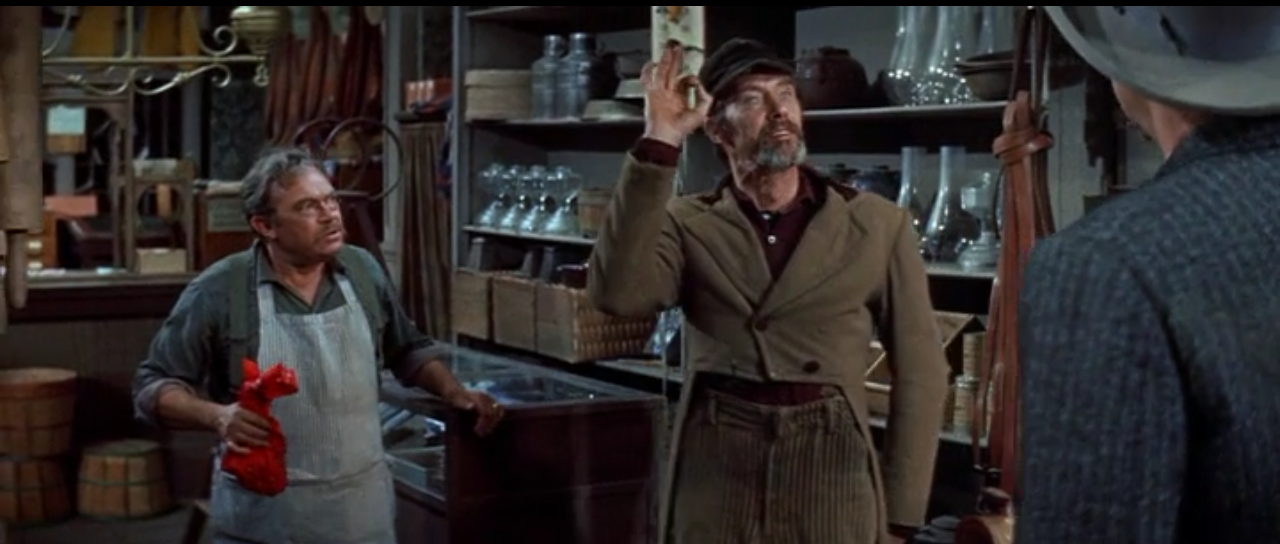
Harris and Wayne meet a variety of characters in the train, including a potential love interest for either man in Prudence Cooper (Nina Shipman), the grizzled guide Seaton (Henry Hull) and the eccentric Garrison (John Carradine), for all intents and purposes the legendary Johnny Appleseed. There's also the obnoxious Brizzard (Tex Terry), who likes to pick fights with Harris and favors a bullwhip. As Harris grows suspicious of Wayne and his sidekick, who can't help calling Wayne "Sir," the party encounters the grisly remains of the massacred family from the prologue and has to go on short water rations when a waterhole Seaton depends on finding turns out to have gone dry. Brizzard goes berserk when he sees Garrison watering his baby apple trees, assuming that the old crank is stealing water when he's actually sacrificing his own ration to keep the trees alive. Harris comes to Garrison's defense and brawls with Brizzard until a sudden rainstorm resolves the matter. The scene closes with an amusing, almost Brueghelian moment as the pioneers scramble to catch rainwater in any available basin while Harris and Brizzard, still brawling, roll obliviously through the fresh mud in and out of the frame, until Garrison finally breaks things up with a swat to Harris's rear.


For much of the film Henry Hull guides the brave pioneers through the dangers of the great outdoors (above)
and the perils of the 20th Century-Fox soundstage (below).

Saturday, March 25, 2017
DVR Diary: GUN FEVER (1958)

Sunday, March 19, 2017
Too Much TV: LARAMIE (1959-63)
When I was a kid the westerns you saw most in reruns were Bonanza and The Big Valley. Those, at least, are the ones I remember most vividly, if that's the right word for my memories of Bonanza. I never saw Laramie, which ran the same number of seasons as Big Valley, until it appeared on the Grit channel, and then on Encore Westerns, in 2015. Encore -- or Starz Encore Westerns as they call it now -- is the ideal place to view the show since the economy premium channel runs episodes uncut and without commercials. Created by John Champion, Laramie relates the adventures of rancher Slim Sherman (the perversely pseudonamed John Smith) and drifter-turned-ranch hand Jess Harper (Robert Fuller), who operate a stagecoach station on Sherman's ranch in Wyoming. In the first season they share their little home with Slim's younger brother Andy (Robert Crawford Jr.) and comedy-relief handyman Jonesy (Hoagy Carmichael). Jonesy was dumped after that season, while Andy made occasional appearances on holidays from boarding school. For the most part the Sherman Ranch was a bachelor pad that year, but even in the innocent days of 1961 there must have been some anxiety over the possibilities for two young men living together, for in the third season Slim and Jess are saddled not only with a new, adopted orphan kid (Dennis Holmes), but with lovable old lady Daisy Cooper (Spring Byington), who acts as housekeeper and "aunt" figure for the boy. I suspect that Daisy is the model for the Aunt Harriet character on the Batman show, who may have been introduced for similar reasons, down to being known as "Mrs. Cooper." A persistent presence in later years who never quite graduated to regular starring status was Sheriff Mort Corey (Stuart Randall), who often had cause to deputize Slim and/or Jess for various missions, when they weren't getting into trouble on their own.
Laramie was a black-and-white show (except for its pilot) for its first two seasons, and ran in color for the last two. Unlike many shows that made the conversion during the Sixties, Laramie was hardly diminished visually in color. Credit for that goes to two-time Oscar winning cinematographer Ray Rennahan, who shot the majority of episodes and strove not to make them look cheaply overlit, even when occasionally forced to shoot on obvious soundstages. The black-and-white episodes are probably superior visually, but the color Laramies look quite nice, especially when they're shot on location, however unconvincing Bronson Canyon may be as a Wyoming location.
While the show is about Slim Sherman and Jess Harper, it is not, despite whatever fears led to the third-season changes, about the relationship between Slim and Jess. TV producers had responded to the challenge of filming a season of hourlong episodes by giving shows multiple heroes -- see Bart Maverick joining brother Bret, or Ben Cartwright and his three grown sons -- each of whom could be given a quota of missions per season. Presumably Smith and Fuller would be filming Slim-centric and Jess-centric episodes with separate units simultaneously to complete the show's schedule of approximately 31 episodes per season. If Slim was the main character, Jess might appear in bookend scenes to see him off and welcome him back. In a minority of episodes the two stars would share the spotlight equally. In later seasons the old lady and the boy would mostly be relegated to bookend scenes, carrying few episodes themselves. Sheriff Corey may actually have had more screen time in the final season than either of the two supplementary regulars. Apart from the sheriff's constant presence, Laramie has little to no continuity as we understand it today. Episodes are always complete unto themselves, and the implicit reset button meant that there were never "game changing" episodes with permanent consequences for the main characters. By the standard of our time that made every episode "filler," but in effect that meant that no episode was filler. Because no episode was going to change the main characters significantly, the focus often was on the guest stars during this golden age of character acting. Certain actors could appear multiple times (e.g. Lloyd Nolan, Rod Cameron, L. Q. Jones, Lee Van Cleef) without viewers questioning why they looked exactly like characters they'd seen before. While any given episode might not seem significant in terms of its impact on the main characters, they at least provided the satisfaction of a thoroughly plotted story with a beginning, middle and end that's often missing from the random series episode today. Of course, expectations are different now and the long-form series with tight continuity between episodes has many virtues, but I still enjoy being able to see a truly complete story in approximately 50 minutes.
Laramie is admirably short on comedy episodes, more rough than rollicking. Even in the first season, Jonesy was acceptable as a comic-relief character because he was convincingly competent at his job. In later years efforts at comedy didn't go far beyond Daisy's attempts to make Slim and Jess do the more mundane ranch chores like painting the barn roof. While not the darkest or most hard-boiled western, Laramie will appeal to those who like their westerns straight, tough and violent. While John Smith was top-billed, the show really proved a showcase for Robert Fuller, whose work here was a revelation to me. I knew Fuller almost exclusively from Emergency, a 1970s Jack Webb series in which Fuller played an ER doctor with Webb's characteristically stolid realism. My few views of Fuller on Wagon Train, which he joined after Laramie closed down, didn't dissuade me from thinking of him as a block of wood. On Laramie, however, the 26 year old Fuller got to be the hothead to Smith's calmer, or more slow-burning Slim, and his emotional and physical intensity -- he did nearly all of his own stunts, as far as I can tell -- surprised me. As the outsider, Jess drives more episodes because he's more likely to know the guest character passing through. There are four basic situations for the outsider character: Jess can trust a stranger based on experience, and either be vindicated or disillusioned, or he can distrust the stranger because of a past offense, and either be vindicated or proven wrong. Fuller handles all possible situations like a champ, and while Smith initially seems like a big stiff in comparison, over time you realize that still waters run deep with him, making it more meaningful when circumstances force Slim to cross lines of propriety or legality, if not ethics. Their contrasting but complementary personalities, supplemented by Stuart Randall's stalwart sheriff, provide a stable frame on which the show's writers and its stable of veteran directors (especially Joe Kane and Lesley Selander) can hang any number of variations on basic western themes. A meat-and-potatoes western prepared with high craftsmanship, Laramie might be the best western series that people haven't really heard of.
Laramie was a black-and-white show (except for its pilot) for its first two seasons, and ran in color for the last two. Unlike many shows that made the conversion during the Sixties, Laramie was hardly diminished visually in color. Credit for that goes to two-time Oscar winning cinematographer Ray Rennahan, who shot the majority of episodes and strove not to make them look cheaply overlit, even when occasionally forced to shoot on obvious soundstages. The black-and-white episodes are probably superior visually, but the color Laramies look quite nice, especially when they're shot on location, however unconvincing Bronson Canyon may be as a Wyoming location.
While the show is about Slim Sherman and Jess Harper, it is not, despite whatever fears led to the third-season changes, about the relationship between Slim and Jess. TV producers had responded to the challenge of filming a season of hourlong episodes by giving shows multiple heroes -- see Bart Maverick joining brother Bret, or Ben Cartwright and his three grown sons -- each of whom could be given a quota of missions per season. Presumably Smith and Fuller would be filming Slim-centric and Jess-centric episodes with separate units simultaneously to complete the show's schedule of approximately 31 episodes per season. If Slim was the main character, Jess might appear in bookend scenes to see him off and welcome him back. In a minority of episodes the two stars would share the spotlight equally. In later seasons the old lady and the boy would mostly be relegated to bookend scenes, carrying few episodes themselves. Sheriff Corey may actually have had more screen time in the final season than either of the two supplementary regulars. Apart from the sheriff's constant presence, Laramie has little to no continuity as we understand it today. Episodes are always complete unto themselves, and the implicit reset button meant that there were never "game changing" episodes with permanent consequences for the main characters. By the standard of our time that made every episode "filler," but in effect that meant that no episode was filler. Because no episode was going to change the main characters significantly, the focus often was on the guest stars during this golden age of character acting. Certain actors could appear multiple times (e.g. Lloyd Nolan, Rod Cameron, L. Q. Jones, Lee Van Cleef) without viewers questioning why they looked exactly like characters they'd seen before. While any given episode might not seem significant in terms of its impact on the main characters, they at least provided the satisfaction of a thoroughly plotted story with a beginning, middle and end that's often missing from the random series episode today. Of course, expectations are different now and the long-form series with tight continuity between episodes has many virtues, but I still enjoy being able to see a truly complete story in approximately 50 minutes.
Laramie is admirably short on comedy episodes, more rough than rollicking. Even in the first season, Jonesy was acceptable as a comic-relief character because he was convincingly competent at his job. In later years efforts at comedy didn't go far beyond Daisy's attempts to make Slim and Jess do the more mundane ranch chores like painting the barn roof. While not the darkest or most hard-boiled western, Laramie will appeal to those who like their westerns straight, tough and violent. While John Smith was top-billed, the show really proved a showcase for Robert Fuller, whose work here was a revelation to me. I knew Fuller almost exclusively from Emergency, a 1970s Jack Webb series in which Fuller played an ER doctor with Webb's characteristically stolid realism. My few views of Fuller on Wagon Train, which he joined after Laramie closed down, didn't dissuade me from thinking of him as a block of wood. On Laramie, however, the 26 year old Fuller got to be the hothead to Smith's calmer, or more slow-burning Slim, and his emotional and physical intensity -- he did nearly all of his own stunts, as far as I can tell -- surprised me. As the outsider, Jess drives more episodes because he's more likely to know the guest character passing through. There are four basic situations for the outsider character: Jess can trust a stranger based on experience, and either be vindicated or disillusioned, or he can distrust the stranger because of a past offense, and either be vindicated or proven wrong. Fuller handles all possible situations like a champ, and while Smith initially seems like a big stiff in comparison, over time you realize that still waters run deep with him, making it more meaningful when circumstances force Slim to cross lines of propriety or legality, if not ethics. Their contrasting but complementary personalities, supplemented by Stuart Randall's stalwart sheriff, provide a stable frame on which the show's writers and its stable of veteran directors (especially Joe Kane and Lesley Selander) can hang any number of variations on basic western themes. A meat-and-potatoes western prepared with high craftsmanship, Laramie might be the best western series that people haven't really heard of.
Wednesday, March 8, 2017
THE TIMBER (2015)
Remember a few weeks ago when I wrote about the visual appeal of violence in the snow? Anthony O'Brien's western -- a northwestern really, set in the Klondike but filmed in Romania -- is another vivid example of the juxtaposition of "darkness" in a pristine natural setting.


The terrific cinematography is by Phil Parmet, and it's the best thing about The Timber. Unfortunately, it's practically the only good thing about the picture. O'Brien's story, co-written with Steve Allrich and Colin Ossiander, is a vacuous compendium of "dark" western cliches hung on the flimsy frame of a minimal story. Two brothers are hired -- ordered, virtually, -- to hunt down their murderous father for a bounty that will save brother Samuel's (Josh Peck) land from a predatory lender. Impatient to take possession, the banker and his minions threaten Samuel's pregnant wife, who has to withstand their siege virtually alone until a friendly sheriff rides to the rescue.


The brothers' quest is part Apocalypse Now, part Blood Meridian as they encounter a human menagerie of degenerate grotesques on the way to their father, who proves a big pretentious emptiness at the heart of this would-be darkness. Including a cannibal in the mix will only remind western fans with strong stomachs of how much better the same year's Bone Tomahawk was. To be fair, The Timber doesn't aim to be a horror western, but rather, I guess, an existential meditation on the darkness that supposedly links the old man and his other son, Wyatt (James Ransome), if not the entire gold-greedy human landscape. The actors try to articulate this through dialogue that either aspires to the retro-formality of westerns in the True Grit mode or echoes the surliness that's seeped into the genre since the 1980s. They're clearly not up to the task, but neither were the writers, really. And since the action really isn't that great -- though for all I know, the film's confused melees may be shot and cut that way on purpose -- you're left with some knockout visuals that just might justify 80 minutes of a western fan's time. Brevity is one of the few things the The Timber gets right.


Monday, February 20, 2017
DVR Diary: THE NEW LAND (Nybyggarna, 1972)

Troell may have been depending on his superstar leads, king and queen of Swedish thespians, to dominate the film, but the most interesting things happen to other people. To be specific, the most visually interesting things happen to other people, perhaps Troell felt he had to be more creative as a director when von Sydow and Ullman weren't on screen. The main case in point is the long flashback telling the truth of Robert and his buddy Arvid's (Pierre Lindstedt) misadventures en route to California. Scored with modernist percussion, the sequence is an increasingly delirious montage climaxing when the Swedes get lost in a desert chasing a mule. Arvid dies after drinking from a poisoned stream while Robert contracts yellow fever (or some variant on the blood-coughing Movie Disease) tending his dying Mexican guide. He strikes gold quite by accident by inheriting the guide's savings in gold coins, but foolishly exchanges them (I assume he thought they'd prove he didn't literally mine gold) for Southern Bank of Indiana notes that are worthless back in Minnesota, where he presents them to his brother and sister-and-law as triumphant gifts. While most of the two films are paced and shot so they seem like windows into the actual 19th century, Robert's story feels very much like a Seventies movie, and it's the closest Troell gets to making the Swedish equivalent of a spaghetti western. The other major sequence, the Sioux uprising, feels more like an American revisionist western of the period.That's not to say Troell sympathizes with the Sioux, though Karl-Oscar is told by another immigrant that, while he may not personally have stolen land from the Indians, he definitely purchased stolen land. Instead, the uprising is introduced with an atrocity sequence, the massacre of a Swedish family, that arguably tops anything similar in American films of the time with its gruesome exclamation point of an impaled human fetus. Then, skipping over the war against the renegades, Troell just about tops that, measured by pure horror rather than raw gruesomeness, with the mass hanging of a few dozen Sioux, one swing of an axe dropping the platform under all of them while the director holds the camera to let us watch them swing.
While the most spectacular sequences are only tangentially relevant to the Nielsen saga, Ullmann and von Sydow are powerful enough actors to make their family scenes just about as compelling as the more violent moments. If New Land has a unifying plot it's the Nielsen's struggle with a homesickness that Kristina never really overcomes, each horror or other setback merely renewing it. Her final scene gives the film a crowning irony. Kristina's astrakhan apple tree has at last blossomed, and Karl-Oscar offers her its first ripe fruit. Barely able to bite into it, she's enraptured by the smell of it. "I'm home!" she says, but the tragic truth is that, in her delirium, "home" still means back in Sweden. There's a further irony in the denouement: by the time of Karl-Oscar's old age, his children have fully made themselves at home in the new land, but in doing so they've ceased to be Swedes. An old neighbor has to write to the old country of Karl-Oscar's death because his children don't know the language. An American superpatriot might say that's just as it should be, but the loss that goes with the process is still tragic, while Troell, still observing from a Swedish perspective, leaves viewers questioning whether everything really was worth it. In a sense he isn't telling the full story because the Nielsen children get short shrift in the last half of the picture, but it may be the same way in Vilhelm Moberg's novels. In any event, Seventies cinema tended to question the purpose of almost every endeavor once taken for granted, and in that respect Troell's immigrant films are quintessential Seventies movies.
Saturday, January 7, 2017
DVR Diary: WAR DRUMS (1957)

The protagonist this time is Cochise's father-in-law, Mangas Coloradas (Lex Barker), and the main story of the picture is an interracial romantic triangle that isn't quite equilateral. Mangas and his white friend Luke Fargo (Ben Johnson) are friendly rivals for the Mexican spitfire Riva (Joan Taylor). Mangas has the advantage here because he saw her first, rescuing her from virtual slavery in a comanchero camp despite her best effort to kill him. His shield with its three layers of buffalo hide fends off her close-range rifle blast, and despite his traditionalist ways he's as impressed by Riva's fighting spirit as Fargo is by her looks. No amount of trade goods will persuade Mangas to give her up, but Fargo, this film's good white man, is a good sport about it.
Speaking of the Apaches' relative degree of civilization, they seem positively bourgeois in their conservative disdain for Riva, a liberated woman in more than one sense. Apache women warn her constantly that she'll have to do all the household work, including building a wikiup from scratch after gathering the raw materials, now that Mangas intends, again to the women's disdain, to make Riva his wife. But Riva has had enough drudgery in her life with the comancheros, and Mangas apparently agrees with her. After she gets into a fight with some tribal women over her indifference to domestic chores, the young chief decides she's better suited for a warrior's role. He teachers her to hunt and shoot and she proves a quick study, while Mangas fights two tribal rivals to the death to defend his right to marry the outsider. Not even a fine horse Fargo offers in his latest trade package will turn Mangas from his marital purpose. Again a good sport, Fargo turns the trade goods into wedding presents. Meanwhile, playing the usual white-man's role in such encounters, Riva teaches the nose-rubbing Mangas how to kiss.
Inevitably some no-account white trash find gold in a stream on Mangas' territory, terrorizing the residents of a nearby wikiup and shooting a little boy. They won't believe Mangas when he tells them there are richer gold deposits not far away and flog him for a liar, the worst humiliation an Apache can endure.Now Mangas makes war, donning the red shirt that earned him the "Coloradas" nickname to hide the scars on his back, and so does Riva. She shoots one of the offending whites in the back with an arrow, but it doesn't go deep enough to keep him from going crying to the Army. Fargo agrees to lead a party under a white flag to get Mangas' side of the story, but the Apaches anticipate a sneak attack and the Cavalry obliges. Fargo, unwilling to fight, gets wounded and is healed by Riva. This is the white man's best chance, but it's still no dice. He's fascinated by her blend of beauty and bloodlust, and she explains this by revealing her half-breed nature as the daughter of a Mexican and a Comanche. Fargo's response: "You're the most beautiful woman I've ever seen." Later, it's Mangas's turn to be wounded, but this time he needs modern medical skills to save his life so his tribe takes a white settlement hostage, the settlers' lives forfeit unless their doctor can extract a bullet from the war chief's chest. Despite the distraction of a woman in labor, the doctor does the job. Fargo arrives with fresh cavalry to find what still looks like a hostage situation, but Mangas explains that the doctor had fulfilled his end of the bargain, so he has no power over the settlers. On his own initiative Fargo arranges a safe-conduct for the Apaches, offering them the friendly advice to stay high in the inaccessible hills for a while.
In reality, the whites captured Mangas and reportedly tortured the old man into making the escape attack that customarily allowed you to kill an enemy, but the Fifties Apache cycle (which continued into the next decade with 1962's Geronimo) often tries to have things both ways, acknowledging the injustices done to Native Americans while allowing them happy endings of sorts. Cochise, who died undefeated, made the perfect hero for this cycle, while erasing the actual end of Mangas Coloradas makes him an easier fit for the formula. By 1957 the novelty of articulate, intelligent, sympathetic Apaches must have worn off a little, though it may still have been a novelty for some to see recent Tarzan Lex Barker give an articulate performance in any role. Neither he nor Johnson (whose career seemed to be in freefall after an early push) is very charismatic, but the real novelty that makes War Drums worth seeing today is Joan Taylor as an all-out woman warrior in an explicit repudiation of the traditional female role in a Fifties film. She makes a modest outdoor western just a little bit more than that.
Subscribe to:
Posts (Atom)