 I
It shouldn't have surprised me to find out that one of the four films in VideoAsia's Sonny Chiba collection isn't really a Sonny Chiba movie. VideoAsia isn't exactly the most scrupulous purveyor of obscure movies. But in this particular case I perked up quickly as I realized that Akihisa Okamoto's film was, in fact, a Bunta Sugawara movie, with Chiba in a cameo role. Sugawara became one of my favorite Japanese actors when I saw Kinji Fukasaku's five-part
Battles Without Honor and Humanity series (aka
Yakuza Papers, 1973-4). If the Toei Studio in the 1970s is Japan's answer to Warner Bros. in the 1930s, and if Chiba, as I've suggested before, is Toei's James Cagney, then Sugawara is more like Toei's Bogart -- a stoic survivor in the
Battles films or a tragic figure in Fukasaku's
Cops vs. Thugs (1975), in which his cop protagonist makes a doomed bid to become a yakuza kingmaker. I was instantly glad for the chance to see another Sugawara film. This time, however, he has more of a Cagney role -- a very specific one.

A stylized opening shows Sugawara off in retro duds as he blasts away with his titular weapon, making me think I was going to see a period piece set in the 1920s or 1930s. Instead, the story starts in the modern day in subdued, suspenseful fashion as three monster-masked figures in a car await a rendezvous with gangsters at a dock on a rainy night. It's an ambush: the monsters kill the gangsters and grab their suitcase, but one of them is wounded. As he whines in pain, the driver unmasks, revealing a middle-aged woman berating the victim, telling him to be a man and shut the fuck up. Bunta Sugawara is the third person in this trinity, and the old lady is his mother. Together, leaving their partner to writhe in the car, they stash their loot -- an estimated one billion yen worth of drugs -- in a hollowed out section of a sewer wall. When they return to the car, Sugawara kills the wounded man.
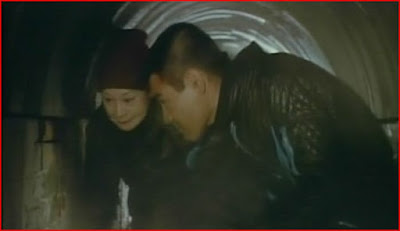
A gangster and his mother. As soon as Aiko Mimasu took her mask off I started asking myself, "They're not going to go
there, are they?" But when Sugawara and Mimasu celebrate their score by sharing a bath I was pretty sure they were going there. Later events bore out my suspicion in stunning fashion:
Machine Gun Dragon is a Japanese do-over of
White Heat, one of James Cagney's most legendary gangster films -- the one where he plays a borderline psycho with a heavy mother fixation.

James Cagney and Margaret Wycherly in White Heat. Below, their Japanese counterparts.


Nearly thirty years later, Okamoto and writer Hiro Matsuda elaborate on the main points of Raoul Walsh's classic. There's more tension in the mother-son relationship this time. She's possessively jealous of any female attention to her boy, and he still resents her driving off a former girlfriend years ago, before he did a stretch in jail, even though he picks up a new one early in the picture. All women are whores, mom says. You should know, Bunta ripostes angrily; you were one yourself. But she only did it for his sake, she says, to keep him from growing up into a shiftless yakuza like his dad. Just like that she guilt-trips him into submission.
Nice work, mom! Instead of a shiftless yakuza, your boy is a reckless misfit who robs from the yakuza. While other characters affect the same retro fashions Bunta likes (we're probably seeing a
Godfather influence) his preference for an anachronistic costume and a distinctive weapon (we're told that he's a prime suspect in the drugnabbing because not many Japanese use machine guns) suggests an arrested development, stunted by his suffocating mother. It's left him a big, crazy kid who spends his life role-playing with lethal consequences for others, as when he stages a St. Valentine's massacre of gangsters who tried to blackmail him.

This is all too much for the yakuza, who (perhaps having seen
Fernando di Leo's Manhunt) send a distress call to America and get a black-and-white team of hitman to hunt down Bunta and his ragtag gang. The yaks run down Bunta's biker pals with garbage trucks, while the Americans take to throwing them off tall buildings, but none of these losers know where the drugs are stashed. There's nothing to do but storm Bunta's hideout, but he sees them coming, sees he's outnumbered, and quickly thinks up a way out. He has his new girlfriend slash her own hand and call the cops. Bunta saves his neck by getting himself arrested for domestic battery right in front of his enemies.

Americans have no manners. Look at the mess they leave behind when they go out.

That's not going to stop the yakuza. They have a man in the department, and they have men in jail. While their goons work over Bunta, the corrupt detective brings in Bunta's Mom and gives her the third degree. She's a tough old bird, but you can only go without food, drink and sleep for so long. Since I've already told you this is a remake of
White Heat, you should know what's coming, but give Okamoto credit for a creative buildup.

In the original, Raoul Walsh sets us up by having Cagney pass a request for info on his mom across a row of cons in a prison dining hall. We see the query relayed one way, and the answer sent back the other way until the news hits Cagney, who takes a moment to absorb it before (as a full-of-it George C. Scott says from the grave on TCM) he becomes an animal and runs amok.
The do-over in
Machine Gun Dragon is less elaborate but arguably more devastating in the set-up. It's visiting hour for our protagonist, who rushes from cell to visiting chamber anticipating Mom. Instead, it's his girlfriend with some sort of package under her jacket. Bunta immediately realizes something's wrong. He's having a "what's in the box?" moment already before the girlfriend unveils the package: a box of Mom's ashes.


The sight sends Bunta reeling back the way he came, quoting Cagney explicitly in the way he neatly slugs guards on the jaw during his animalistic tantrum of bereavement. He gets to howl and cry and throw things as cons cheer him on and his girlfriend watches in horror. The scene has a topper unavailable for
White Heat when she lets loose a cry of agony when Bunta is finally carried away. This team of filmmakers gave themselves an awesome challenge here, and I think they acquitted themselves admirably.


Bunta is extremely vulnerable emotionally now, and it's the perfect moment for this film's counterpart to Edmond O'Brien to make another move to win Bunta's confidence. This guy had turned up already to save Bunta from a beating by yakuza goons (Bunta got his back by causing an "accident" that saws a goon's arm off and drowning another in a group bath). He's a police plant, presumably a good guy, hoping to track down the stolen drugs. Toward that end, he and Bunta are allowed to escape. Sure enough, after Bunta deals with the corrupt cop who interrogated his mom to death, he, his girlfriend and the plant recover the plunder.

Edmond O'Brien (right) and his Machine Gun Dragon analogue (below)


Now imagine if, three-quarters of the way through
White Heat, Humphrey Bogart suddenly pulls up outside Cagney's hideout and says "Hey Cody! That guy's a copper!" before drilling Edmond O'Brien. That's basically what happens here when the fixer who counterfeits passports for our trio recognizes the plant, karates the hell out of him and shoots him. Yes, Sonny Chiba has made his belated appearance with revenge on his mind, but Bunta basically says, "Step aside, Butch," and finishes the rat himself. Now the filmmakers have nicely cut themselves loose from
White Heat and are free to go their own way, whether it leads to a refinery or not.

The way leads north to a snowy coastal town where Bunta hopes to buy passage on a boat out of the country. He picks the town in part because he knows that's where he'll find his old girlfriend, the one Mom had driven off. That's a little rude of him, since his current girlfriend is along for the trip, but you can tell that Mom's death has liberated him a little. He's feeling nostalgic and eager to undo past mistakes, but that leaves him crassly indifferent to his current squeeze. When she falls in the snow, he doesn't help her up.


When he looks up his old flame in the inn where she tends bar, he leaves the other one outside until the old flame goes out to invite her in. You get the sense that it's too late for him either way, that he doesn't deserve either of them. But I guess there's a momma's-boy quality to him that inspires fanatic loyalty in women. After affecting to blow him off (she waves "bye" to him in English), the old flame ends up killing herself with an icepick rather than rat Bunta out to the closing yakuza and Americans.
We can tell, however, that Bunta isn't the hardcase he pretends to be. He took his mom's death too hard for that to be true. He faces one more test when his pursuers capture his new girlfriend. He's got his boat and his drugs, but they have a straight razor to the girl's throat. They propose an exchange: her for the drugs. In an appalling moment, he tells them they can have her and leave him alone. You can almost believe that he didn't expect them to do what they do.


There's no refinery for Bunta Sugawara to romp in, and no explosive finish, but the finale of
Machine Gun Dragon is in its way as apocalyptic as the end of
White Heat. Confronted with the horror his enemies have perpetrated, Bunta throws everything away but his machine gun. There's nothing left for him to do but kill, kill and kill in a fireworks festival of bloody squibs.

And with that accomplished, there nothing more to do than gather up his last beloved for what looks like a long walk off a short pier as Sugawara the actor (this being a certain period in Japanese cinema) croaks the film's end theme. There's a real note of despair in his singing, whether it expresses his character or his despair at having to sing, and it actually fits the mood of the moment.

I was floored by the audacity of Okamoto's Warners-Toei synthesis and the panache with which he pulled it off. If I keep seeing performances like this, Bunta Sugawara is going to end up as my favorite Japanese actor. It's a shame that his incredible work here goes out to the public in Sonny Chiba camoflauge, but now that you know the truth, VideoAsia's Chiba set may be the most economical way for people to discover Sugawara for the first time.
Machine Gun Dragon is an amazing genre film and a must-see for fans of global crime cinema.
 Videoasia's Sonny Chiba 4 Film Set is a peculiar little collection. One of the four films hardly counts as a Chiba film, since the great man only contributes a cameo, but that film proved to be a crazy diamond: Machine Gun Dragon, a Japanese re-working of White Heat with Bunta Suguwara in the Cagney role. The film that shares one side of the disc with Dragon is indeed a Sonny Chiba vehicle, but Videoasia neglected to note in its box copy that it is also a film by my second-favorite Japanese director, the relentless Kinji Fukasaku of Yakuza Papers and Battle Royale fame. You'd think that'd be a detail that would guarantee more sales, but Videoasia makes some peculiar calculations sometimes.


