Showing posts with label Vietnam veterans. Show all posts

Saturday, March 23, 2013

DVR Diary: PORT OF SHADOWS (Quai des brumes, 1938)

The French were in Vietnam long before us Americans, so it's only fair that France gives us cinema's first troubled Vietnam veteran. To be honest, I don't know for certain that Jean Gabin's character in Marcel Carne's crime drama is the first, but he's got us beat by more than a generation. Jean had some bad experiences with the colonial army in Tonkin and has been living in a kind of fog ever since. Back in France, he's deserted from the army but needs a change of clothes. He hitchhikes to Le Havre, nearly wrecking his ride by making it swerve to avoid a dog in the road. He's tender but tough, we'll learn. In the port city, he ends up in a waterfront tavern where he meets a depressed artist and a pretty young woman (Michele Morgan) and gets caught between some gangsters and an eccentric old man (Michel Simon) with an axe to grind about music. Quite conveniently, the artist commits suicide by going out into the water and bequeaths Jean his clothes and his identity papers, while the bartender wraps Jean's uniform around a rock and sinks them, hoping to hide the evidence of desertion. It doesn't quite work, and when the uniform pops up along with a body other than the artist's, investigators suspect a soldier in a gangland murder. Jean has no patience with the gangsters and spends a lot of time slapping around their leader, Lucien (Pierre Brasseur), whose bluster barely conceals some essential weakness. After a while, however, you'll wonder who the real bad guy is as we learn more about the ties between the Morgan and Simone characters. Jean falls for Morgan and Simon doesn't like it. But as the old man's menace dominates the story we'd all be wise not to forget Lucien's sulking, simmering rage.

Quai des Brunes often feels as if it was made by a French branch of Warner Bros. Gabin's take-no-crap toughness and redeeming romantic streak wouldn't be out of place on the actual Warner lot, while the short-lived plot detail of the suicidal artist may have been intentionally reminiscent of The Petrified Forest. Rather than imitating the Americans, however, Gabin had been setting a new standard for doomed antiheroes since his international breakthrough Pepe le Moko in 1936, and you could argue that his movies had some thematic influence on Warners' second major gangster cycle. The film as a whole is atmospherically gritty and romantically tragic in proto-noirish style. It has several strong set pieces, including an encounter between Jean and Lucien on bumper cars and a scene of Simon menacing Morgan set to some lovely music reminding us of Simon's pretentious tastes while the action belies his pretension. Simon and Brasseur make nicely contrasting villains, one burly and increasingly brutish, the other deceptively fussy and wussy. Overall, Port of Shadows can stand comparison with contemporary crime-film classics from the U.S. If you like them, you'll like this.

Thursday, September 9, 2010

Quickies: THE STUNT MAN (1980)

A fugitive dodges cops outside a convenience store, dashes through the woods and finds himself on a bridge. An old car -- really old -- races across. A helicopter hovers nearby. Though we haven't seen it, the car has gone into the water, and the man inside has drowned. He was a stunt double for the star of a movie filming there, and now the fugitive (Steve Railsback) will double for the stunt man so the director, Eli Cross (Peter O'Toole), can cover up the fatality and keep the sheriff (Alex Rocco) off his back.

Cameron, our fugitive, is immersed in a fantasy of moviemaking. He is put through his paces in insanely long takes and successions of stunts that look like no realistic notion I've had past childhood of how movies are filmed. If you seek out Richard Rush's film as an expose of the movie business or the director's art, turn back. The year is 1980 and Cross is shooting a World War I epic. Directors were doing some insane things around that time, but not that insane. The fantastical nature of the project (I don't recall even hearing the film's title) made me worry that it would all prove to be an "Owl Creek Bridge" scenario, especially since everything, including the American advertising art, urges us to treat Cross as a Satan figure. As the plot circles back to the beginning and Cross uses Cameron to restage the fatal car stunt, you're supposed to question whether the director really wants to see Cameron die. Cross seems to envy Cameron's war experiences, while Cameron, our archetypal Vietnam veteran, probably questions the reality of everything around him, not just the fake war on the film set. To set such a personality loose amid the purposeful unreality of filmmaking, especially while we don't know why he's a fugitive, is an ingenious high-concept scenario, but while it invites interpretation as some hell of Cameron's disordered mind, it can also be seen as a quest-like scenario designed to reintegrate the troubled outsider into society. Cross latches on to Cameron's statement that "If you want to see Thanksgiving, assume that the other guy's trying to kill you." He exploits Cameron's paranoia to a degree to prod him into furious action, but by the end he also seems to have tried to wean the stunt man off his fear and suspicion, or so he claims. Sometimes making a movie is just making a movie.

It doesn't quite hang together and it probably isn't meant to, but the exuberance of Rush's direction and O'Toole's performance sweep aside most questions or objections. Peter O'Toole is not quite my vision of a Seventies director gone overboard -- that might actually look more like Steve Railsback -- but to the extent that Eli Cross represents the archetype of the capriciously godlike movie director rather than Rush's own peers, O'Toole is right for the job. Railsback himself is always going to be Charles Manson for me, but Cameron is a role well-suited to his typecasting. He only goes wrong in the two scenes in which he expresses full-blown rage: his revelation of his crime and his final protest against being underpaid by Cross. Those moments don't seem consistent with the character we've seen until then, but were most likely expected of a Nam vet on film. While the ending left me scratching my head a little, I don't really hold it against the movie. The Stunt Man strikes me as a film I can watch again a year from now and find significances I missed the first time. If I can recommend it to myself for a rewatch, I guess I can recommend it to you.

FanOfMovies123 uploaded the trailer to YouTube:

Wednesday, March 10, 2010

DEATH FORCE (aka Fighting Mad, 1978)

Cirio H. Santiago's trash epiphany from 1978 is not to be confused, by using its re-release title, with Jonathan Demme's film from two years earlier. The Philippine film made little impression Stateside under its original label, but was put back in theaters in 1982 to exploit co-producer Leon Isaac Kennedy's success in Penitentiary and his wife and co-producer Jayne Kennedy's recent Playboy magazine layout. The print advertising for "Fighting Mad" inevitably fudged the details a little, giving the unwary reader the impression that Mr. Kennedy (originally billed only as "Leon Isaac") is the hero of the picture when he's actually one of the villains.

(Check out that double-bill to the left. Cirio H. Santiago and Sonny Chiba on the same program for one price! Too bad I was too young back then.)


The real hero is played by James Iglehart, who may be best known to American cult film fans for his appearances in Russ Meyer's Beyond the Valley of the Dolls and The Seven Minutes. He plays Doug Russell, a Vietnam vet wrapping up his tour of duty with a side project that involves smuggling contraband in coffins. It's not drugs, but gold, and it means a big score for Doug and his accomplices, Morelli and Magee (Leon Isaac). But Morelli, a veteran criminal for whom 'Nam was a vacation, figures that the payoff splits easier two ways than three. As he pitches it to Magee:


Morelli: That man's going back to a wife and kid. He ain't ready for what we're getting into. You could be going home to that lady. He could be just another war casualty.

Magee: You asking me to kill one of my own kind?

Morelli: Oh, don't give me that brother shit. The only brother's the man on the dollar bill -- and he ain't black.


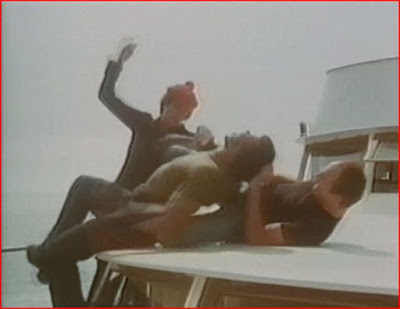
It's a pretty convincing argument. One moment Doug's sunning himself on the deck of their boat, and the next he gets stabbed, gets his throat cut, and gets dumped into the ocean. For Morelli and Magee it's on to LA, where they wage a two-man mad-dog war on the organized crime establishment, quickly muscling their way to the top while Magee tries to make his move on the allegedly widowed Mrs. Russell (J. Kennedy), a struggling nightclub singer. Hear her sing and you'll see what I mean by "struggling."


Meanwhile, Doug washes ashore barely alive on an island somewhere in the South Pacific. Now, what might you find in such a place at this time in history? That's right: Japanese soldiers who don't know that World War II is over. Their unit is down to one officer and one kvetching enlisted man. Rather than kill the enemy on sight they endeavor to nurse him back to health in the hope that he'll make a Man Friday for them. Both men happen to know English, though of course they can't have kept track on changes in the idiom.


Doug [reviving from delirium]: Those mother-humpers...

Officer: You said that in your sleep. What does that mean?

Doug: Nothing...some 'friends' of mine....

Enlisted Man: Hmmm, they do that to you? They ain't no friends. We your friends. We mother-humpers!

Discipline's broken down on Occupied Island, as the poor grunt Ichikawa back-talks to his superior all the time. He tells his commander that, had they stayed in Japan, he'd be a general by now, but the commander comes back by noting that by now he'd be Emperor. All the officer really has left is the personal discipline of the samurai, which he improbably imparts to the recovering Doug. As our hero regains his strength, the Japanese teaches him some martial arts and shows him how to chop coconuts with a sword. With this comes a moral lesson: "It's not for you to learn how to fight," the officer says, "but learn how to live."


"Where I came from, learning how to fight was learning how to live," Doug replies. So while the Japs have fatalistically reconciled themselves to spending the rest of their lives on the island, Doug lets himself get captured by the Philippine Navy. Before you know it he's back in LA, still carrying the samurai sword his mentor gave him, i.e. armed for payback. Now it's his turn to wage a one-man guerrilla war on Morelli and Magee, who prove much less effective now that they command scores of goons than they were on the offensive. While Morelli instigated the whole affair, Magee ends up the final antagonist, holed up in a heavily guarded Mexican compound with Doug's wife and son held hostage as our hero blazes a trail of severed heads toward the final showdown.


Santiago is a master chef of cinematic junk food. He keeps things going at a good clip throughout, constantly intercutting between the villains' conquest of LA, Magee's menacing courtship of the now-jobless Mrs. Russell, and Doug's samurai training. He makes sure that not too much time passes without some action or bloodshed, and he knows to save the best (or worst) for last. He knows that the one thing that can top an hour's worth of machine-gun mayhem is some serious head-cutting. The effects are awful, of course, but Santiago builds enough momentum to get you caught up in the spirit of the exercise. When you're ready to see heads roll, heads will roll. What more can you ask from exploitation cinema? In this case, I have to give the Filipino filmmakers credit for a perhaps-unusually sympathetic portrayal of Japanese soldiers, and for an idiosyncratically sentimental soundtrack featuring a love theme sung by J. Kennedy and a cute motif for our Japanese friends.

Mill Creek Entertainment presents the film as Fighting Mad (with an obviously spliced-in title card a la Death Proof) in its 50-film Martial Arts box set. As you can see, the presentation leaves a bit to be desired, and it's a bit of a stretch to call this a martial arts film (or at least to put it alongside kung fu and ninja movies), but somehow this seems like the way that Death Force was meant to be seen. I wouldn't mind seeing a properly-restored DVD, but I can safely recommend this item to fans of Seventies trash as is.

Friday, July 31, 2009

BLOOD SABBATH (1972)

All work and no play makes Samuel a dull boy, so I've taken a brief break from my current preoccupation with The Canon to look for something a bit more wild. It didn't take long to find that something. What I found was this trippy bit of hippie horror from a then-still-rare female director, and what kept me watching was an obvious directorial enthusiasm that transcended and nearly made a virtue of the film's budgetary limitations -- and a relentless tide of female nudity.

One detail that gives Blood Sabbath a bit of historical interest, for historians of trash pop culture, is the star turn by Tony Geary, later to be daytime television's most popular rapist. Here he's David, a young man with a guitar wandering the countryside. He's a classic American loner and isolato, so much an outsider that hippies pick on him. Does he want a beer, they ask him from their hippie van, only to spray the can in his face and flash boobs at him as they drive away.

Those damn hippies. A body can't sleep in the forest without them making noise with their wild parties and all that loud nudity. They won't even leave a man alone! Four naked women pounce upon the reposing David; his response is, basically: "What the hell? Ow! Leave me alone!" Now, many reviewers on IMDB have questioned why this young man should recoil so when presented with such a bounty, but I have to say that the critics are absolutely right. But we can't stop David from running away like it was Sadie Hawkins Day, tripping on a rock, and falling into a river. "Is he dead?" the hippie girls ask, but they lose interest before reaching a decision.

David (Tony Geary) fights his way free of a nubile wall of flesh in Blood Sabbath. Idiot.


David comes to on the riverbank and finds another woman, a clothed woman, bending over him. This he likes, whether because she's clothed or because there's just one of her. Indeed, he's smitten and wants her to keep him company. She'd like to, she says, but she can't stay, and into the water she goes. The next thing Dave knows, he's looking into the grizzled face of Lonzo, a local codger, who asks our hero where he's from. "I'm from Vietnam," David answers. So we know that he has issues. Indeed, these issues will manifest themselves a few times more later in the film. So he's a troubled Vietnam vet, but that's okay, because the clothed girl, Yyala, happens to be a water-nymph. So what we have shaping up here, in high-concept terms, is something like Jacob's Ladder meets Splash.


So she's a nymph. You could do worse. There are witches in the vicinity you see, and you know David wouldn't like them because those evil, attractive young women go about butt naked most of the time. But hanging with the nymph has its own complications.

Yyala: You are of the land, and I am of the sea. You have a soul, David, and I do not. I may not love anyone who has a soul.


David: I can't just give up my soul....Even if I wanted to get rid of my soul I wouldn't know how. But you must know a way!

Yyala: The danger is too great.

Dave's determination to be rid of his soul (you know, the better to love somebody) grows stronger with time, but advice is hard to come by. "Don't ask me about souls!" an irate Lonzo protests, "What do I know about souls?" "Well, who else can I ask?" David complains. Well, what makes him think Lonzo would know anything about the subject. Might it be that Lonzo annually collects a girl child from his village and leaves it up on the mountain for the witches to collect? And what has that to do with Dave's flashback to 'Nam, where he apparently killed a child?

As Blood Sabbath shows, one of the reasons the U.S. lost in Vietnam was because brave warriors like David often had to fight without any visible support. The war effort probably had hardly more budget than this movie did.


During a visit to the village festival, Dave plays a hunch and strikes up a conversation with the local Padre. "You know all about souls, don't you, and how to save them?" he inquires, "Would you know how to go about losing one?" The Padre (I capitalize it because this is all the name he gets in the movie) replies wisely, "Has the tequila gone to your head?" When David persists, the man of God has himself a little conniption fit, calling our hero a freak (well?) and driving him out of the cantina. Like he has a right to be righteous. It turns out that he has some sort of modus vivendi with Alotta, Queen of Witches. There's something about Dyanne Thorne, I guess, that makes a mere name inadequate. She needs a good epithet like "Queen of Witches" or "Harem Keeper of the Oil Sheiks." She has naked witches on call to entertain the Padre, but he's not in the mood tonight. "Are you resuming the BLOOD SACRIFICE!?" he challenges.


Alotta, Queen of Witches (Dyanne Thorne) knows how to treat guests, but one of the peculiarities of Blood Sabbath is the fact that no one, apparently, likes to be surrounded by horny, naked women.


You see, this sacrifice thing normally isn't as bad as it may have first sounded. As Lonzo finally explains it to David, he leaves the girl on the mountain, the witches pick her up, remove her soul, and raise her to be one of them. Where's the harm --but let's backtrack a moment. "Remove her soul?" Why, I think that's a little light bulb buzzing to life above our hero's head. Why couldn't he take the place of this year's little girl and get a free soul-ectomy. Then he and Yyala could be together forever and ever and ever and ever.

By normal standards, Dave, being a grown man and all, isn't exactly junior witch material. But Alotta (Q.O.W.) takes the offer anyway, though she doesn't care for the whole running-off-with-the-water-nymph idea. "Yyala is inconstant and short-loving," she warns, while I guess she or any of her subordinates would love him long time. Whatever. Dave will work out the contradictions later. For now, his mighty word is, "Yes, take my soul, damn you!"


It's time for a solemn ritual of the witches: the soul-ectomy. You can tell it's a serious occasion because the witches dress for the occasion in bikini bottoms. So clad, they warm things up with some sacred hoochie-koochie dancing before Alotta brings David to the altar. He is laid out, albeit with a discreet covering over the crotch, and the ladies love him up to the point where his double-exposure self (uncovered) up and leaves the room. From this point, David is "free," as he proves by romping around in the woods until the procession of witches, a bit more clad this time, catches up with him. Now we're really serious, for this is the BLOOD SACRIFICE that the Padre fretted about. It's the turn of one of the witches to be laid out on the altar, but there's no loving up for her (and the lack of witch-on-witch action is a grave omission from this film; the closest we get is another witch straddling the victim on the altar and screaming); only a dagger in the throat. Blood fills a ceremonial goblet for Dave to drink from. Feeling quite soulless now, he dashes off to Yyala. Soulless herself, she is nevertheless quite repulsed by the sight of Dave's bloodstained mouth, and just like any bourgeois square water-nymph she runs away in terror.


Once again our hero needs advice. He turns to Alotta this time, and her advice is that he should kill her enemy the Padre and bring the man's head to her. Then Yyala will be his! This request seems odd because earlier we had seen Alotta cursing the Padre and stabbing at a Padre voodoo doll. For all we knew that had accomplished something, but apparently not. He's in his bedroom staring into space as Dave arrives, and the next thing we know Alotta is the proud owner of a fresh head.

"I knew him, Lonzo, a fellow of...Actually, his jest was pretty damn finite."


Things get just a little complicated from this point. For starters, Dave is in a seriously deranged state in which he can't tell Yyala and Alotta apart. In addition, Lonzo finds out about the head and chastises Alotta about it, only to be told by her that Yyala killed the Padre. Alotta wouldn't lie, of course, so the wrathful Lonzo heads out to kill her. Fortunately, Dave intervenes, and Lonzo turns his pointed attentions his way. Fortunately for Dave, Yyala intervenes and stabs Lonzo in the back. For two soulless people our lovers are rather remorseful about this. Yyala in particular bawls over the deed, while David has another flashback.

At a certain point, there's nothing for a flashback-riddled vet to do but kill the villain. But he can't do it without Alotta getting off a final curse; "I call upon your own people to come and kill you!" At which point comes one final flashback in which Soldier Dave radios HQ to tell them that their planes are bombing "your own people." I foolishly had the idea that we were going to get some kind of Nam zombie climax, but by "your own people" the Queen of Witches meant that the instrument of her revenge would be that van full of hippies from the start of the picture. But will her revenge really be that bad for Dave?...


Brianne Murphy, the director of Blood Sabbath, helmed only one other film, spending most of her career as a cinematographer for television. The other film, To Die, To Sleep, was made 22 years later and sounds about as opposite to Blood Sabbath as you can get, but I guess a lot of people grew out of that period in their lives. Still, on the strength of this movie the fact that Murphy didn't work more in the Seventies is regrettable. She knew how to keep a cheap film looking busy with frantic activity and regular outbursts of mass female nudity. As the story gets nuttier, she rose to the occasion in portraying David's delirium. For this she had Tony Geary to thank for bringing the enthusiasm of youth to his role. Like many of the actors, he tends to shout his lines, but this is the sort of film that needs to be hysterical, so there was no point holding him back. Had he more craft at this point in his career, the film would probably have been less entertaining. The only performer who really drops the ball in this regard is Susan Damante, making her movie debut as Yyala. It didn't exactly shock me to learn that she went on to star in the Wilderness Family movies, since those sound better suited to her. For an exotic creature, she was much too mundane, though according to the film's odd logic that seemed to be what attracted David to her. I suppose your traditional woodland sprites or pixies really couldn't compete with hippies for pure exoticism in those days. It's ironic that we regard hippies themselves today as little more than simple woodland creatures. Actually, that makes the combination of hippies and nymphs and witches a better fit than it may have seemed at the time.

I can't really comment on the cinematography because I saw a crappy print, but where this film really punches above its weight is on the musical side. IMDB informs me that the "BAX" to whom the score is credited is none other than Les Baxter of AIP fame, and he nails the notes to match the stark yet wacky imagery throughout the film, from hippie ballads to psycho-syntho trip music. I'd almost say that the film is more worth a listen than a viewing, except that the lavish nudity, quasi-supernatural violence and over-the-top acting, at the very least, makes it very watchable for citizens of the wild world of cinema.

Blood Sabbath can be viewed online on membership sites like Movieflix or Veoh, and can probably be found pretty cheaply otherwise. The only clip I could find on YouTube is dubbed into Spanish, so my poor captures will have to suffice as hints of the naked weirdness on display in this charmingly twisted little film.

Monday, July 20, 2009

WISE BLOOD (1979)

Did Jose Mojica Marins ever read Flannery O'Connor's 1952 novel? I have to ask because I see just a hint of affinity between Ze do Caixao, the blasphemous undertaker we know as "Coffin Joe," and Hazel Motes, the blasphemous preacher of Wise Blood. Hazel has no interest in finding the perfect woman to bear the perfect child or anything like that, but there's something about his small-town heresy and his more modest will to transgression that reminded me of the Brazilian menace.

Did John Huston ever watch At Midnight I'll Take Your Soul? This I doubt; the influence doesn't go both ways, and maybe not even one. It's no more likely that screenwriters Michael and Benedict Fitzgerald saw Marins at work. If there's something in the movie that reminds me of Coffin Joe, it must be inherent in the novel. But one thing Huston & Co. do to enhance the strangeness of O'Connor's story is to set it, probably for budgetary reasons, in their present day, the late 1970s. I didn't realize this was the case at first. The opening has Motes just out of the army and hitchhiking to his old family home, only to find it abandoned, then shopping for a $19.95 suit in a small-town clothes store, then riding a train into "the city," Taulkingham. Once he got off the train, I began to notice people with Afros and others not in period gear. Then I realized the film wasn't in period. But Brad Dourif as Hazel Motes looks as if he strode straight out of 1952 and into 1979. He didn't, though, and that makes him (arguably) a Vietnam veteran, though the moviemakers' probably faithful conception of him doesn't really make much of that detail.


Hazel has money and a determination to do something he's never done before. I don't know if shacking up and sleeping with a fat whore counts as novelty for a veteran, but it's a start. It doesn't stop his oppressive dreams of the childhood days when he toured with his grandpa (the director), an itinerant preacher and punished himself for glimpses of naked carny ladies by walking with stones in his shoes. The only cure for that, it seems, is to become a preacher himself or, better yet, preach against preachers. He founds the Church of Truth Without Christ, the Truth being that Christ was a liar who may well have been crucified, but not for our sake. Here's some typical Motesian theology:


Where you come from is gone. Where you thought you was going to weren't never there. And where you are ain't no good unless you can get away from it. Your conscience is a trick. It don't exist. And if you think it does, then you had best get it out in the open, hunt it down, and kill it.


He's provoked into prophecy by the presence of a purportedly blind preacher (Harry Dean Stanton) who travels with his daughter, to whom Hazel is conflictedly attracted. His initial confrontation with Asa Hawks attracts the attention of Enoch Emory, an 18-year old imbecile exiled from the sticks by his dad for offenses unknown to the moviegoer. Enoch has a hard time coping with city life because "people aren't friendly," and neither is Hazel. Huston treats Enoch as a comedy relief character, and Alex North's score definitely does, but he may be the most disturbing character in a film full of misfits. He steals a shrunken mummy from a museum because Hazel preaches that people need a "new Christ." He spends hours in the zoo haranguing monkeys because he suspects that they think they're as good as he is. He becomes obsessed with Gonga, the Jungle Monarch, a guy in an ape suit working the town to promote a movie. Seeing how kids rush to shake the monkey's paw, he finally steals the suit and romps through town, though he is ultimately disappointed to find himself somewhat less popular than Gonga. He has the "wise blood" of the title, which he claims gives him the ability to know things without learning them.


Dan Shor as Enoch, mummy thief and ape impersonator who only wants to be friendly, in Wise Blood.


Meanwhile, Hazel's mission seems to be to dispel people's illusions about a just or benevolent universe. You wonder whether the war had anything to do with his attitude, but the film won't tell you. His obsession with the blind preacher's daughter has led him to move into the same boarding house they live in, after assuring the landlady that the Church of Truth Without Christ is definitely a Protestant denomination. The worm turns at this point and the daughter, Sabbath Lily, begins to pursue Hazel, hoping he'll become her meal ticket when her dad moves on.


Hazel's career plan is threatened, however, by Hoover Shoates (Ned Beatty), who likes what he sees he of Hazel's preaching and thinks he can improve on it to his own profit. When Hazel won't go along, stubborn in his conviction that you can't buy the truth, Hoover hires a rummy (William Hickey) to dress up like Hazel and stand in for him on a car roof while Hoover works the streets for money. The rummy gets a $7 suit and $4 for a night's work, but it's the last money he'll ever see.


The closest Hazel gets to anything like Coffin Joe territory in the movie is when he stalks the rummy, forces his car into a ditch, forces the rummy to strip out of his imitation preacher clothes, and then runs him over with his own decrepit car. But despite all his preaching against conscience, our hero begins to feel unclean, and begins to pay a price for his feelings....


Wise Blood is full of disquieting if not quite horrific incidents and characters, yet the music and the promotion treat the story as if it were primarily a comedy. Maybe that's how Flannery O'Connor meant it, too, but Alex North's score veers distractingly from the bittersweet nostalgia of his riffs on "The Tennesse Waltz" to pure goofball effects for Enoch's exploits. Ultimately, after the story finishes with Enoch, it settles into a grimmer mode, though a sardonic temperament might still find it pretty comical. Yet Huston does something interesting with this material. He takes the utterly grotesque, almost cartoonish main characters and embeds them in an utterly authentic location shoot in Macon, Georgia. I can imagine the story being filmed in a more Expressionistic style or with more lurid effects, but Huston's realistic style extends to long takes that let us watch tiny characters lope or run and cars roll or lurch through the landscape.


The payoff is a late scene in which a cop pulls Hazel over "because I don't like your face," and makes Hazel's hapless auto roll down a gradual incline for something like thirty seconds before it ends up in the drink. It's as if Huston were adopting a godlike perspective to mock Hazel's pretensions, but it also reinforces the reality of the milieu in which the often implausible hero makes his personal pilgrimage. Gerry Fisher does a great job with the outdoor cinematography, while Sally Fitzgerald did wonders making the locations or sets look convincingly grungy. This film looks great. I mean it looks nasty, but in a great way.

This is a rare starring role for Brad Dourif and he makes the most of it. Hazel Motes may have been a role he was born to play. Harry Dean Stanton and Amy Wright as the Hawks family do fine work, and Ned Beatty has another of those performances where he storms into a film relatively late in the game and practically takes over by force of will and charisma.

I think it's a great thing about the 1970s that it was a decade in which so many brilliant young directors made their mark, and yet here was John Huston, who'd been directing since The Maltese Falcon in 1941 and writing since the Thirties, keeping up with the times with some great films. I wouldn't quite rank this with his best films of the decade, which are Fat City and The Man Who Would Be King, but Wise Blood is a film no Seventies auteur would be ashamed of, and as the work of a man in his seventies it definitely deserves respect.

Egamimedia has uploaded the trailer for Wise Blood, which treats the film as a far more lighthearted comedy than it actually is. It is okay to laugh, though.

Sunday, March 22, 2009

THE BOXER (Un Uomo Dalla Pelle Dura, 1972)


Robert Blake and Ernest Borgnine's careers both seemed to be on the upswing in 1972, so what are they doing in this Italian crime movie filmed in Albuquerque? Only their accountants know for sure, I suppose, but it looks like the film didn't open in America until after Blake made it big as Baretta on TV. This movie (whose Italian title translates very roughly to "A Man of Tough Skin") was directed by Franco Prosperi on a break from his collaboration with Gualtieri Jacopetti of Mondo Cane and Goodbye Uncle Tom fame. The Mill Creek edition on the Suspense Classics set is a pan-&-scan copy that sounds like it was edited for television, since the sound drops out whenever Blake's character is about to swear.

Our star plays Teddy "Cherokee" Wilcox, a small-time club fighter who breaks violently with Whiskey, his manager, over an $800 purse. He heads to New Mexico, where he encounters a generic-looking hippie at a Texaco station. The hippie promises "the kingdom of heaven" if Teddy gives him a lift, but Cherokee has problems of his own and drives off. He ends up at a diner where the waiters ignore his request for a cheeseburger. In protest, he spills condiments, cigarette butts and coffee on the counter.


He tells the waiter, "I made a swimming pool for you," and is about to put the man's face in the pile when Mike Durrell recognizes Teddy. Mike is a successful sportswriter, an assistant editor at the local paper. "You got a good job," Teddy says, defining the film as a period piece.

Mike invites Teddy to hang out at his place, but our hero grows restless. "If I relax anymore I'm gonna go bananas," he protests. So Mike hooks him up with Nick (Gabriele Ferzetti, "Mr. Choo-Choo" from Once Upon A Time in the West), a fight trainer who promises to "make boxing what it used to be." And Teddy rises through the rankings until a voice on the telephone tells Nick that his fighter has to lose his next bout, or Nick will die.

Meanwhile, the mysterious hippie has turned up at the training camp, where a fellow named Ching invites him to bet on the upcoming fights. "I never bet," the hippie demurs. "It's pretty hard to win that way," Ching observes. "You're wrong," the flower child replies, "I always win."

At the fight, Teddy is having his way with Joe Louis Tucker, a top middleweight contender. I pity the TV audience for this bout, since they're stuck with an incompetent announcer who identifies Tucker as "Joe Louis" and tells viewers that we'll be soon "beginning into" the next round. The technicians just seem baffled by the fact that the fight's still going on, as if broadcast time had run out during the feature bout. Anyway, between rounds, Nick rubs some gunk into Teddy's eyes to blind him. Prosperi illustrates this by blurring his image just slightly. Somehow, Teddy survives the round, realizes what Nick's done, goes berserk, throws him out of his corner, cleans his eyes out, and finishes Tucker in the next round.


Later that night, Nick invites Teddy to his place to explain what happened, unaware that an archetypal Italian black-gloved killer is in the house, poised to attack with a special pugilistic variation on the generic motif. He strikes when Teddy arrives, leaving Teddy laying and Nick dead. Teddy comes to and flees the scene, but not before bumping into Nick's daughter (Catherine Spaak) on the stairs.


Borgnine is Captain Perkins, the cop who leads the investigation. No fool, he instantly suspects Teddy, but Mike gives his pal a fake alibi. This leads to a tense exchange in Perkins's office.

Perkins: His file here reads like a cheap novel....Look at this: almost killing a university professor.
Teddy: Just a minute! He happened to be raping my girl at the time.
Perkins: That's not what she said at the trial.
Mike: See if it says anything about him being decorated for Vietnam.
Perkins: We've got that, too. Here, this will interest you. He was decorated for killing thirteen men.
Teddy: Yeah, well, they paid me to do it! You taxpayers!
Perkins: Are you still convinced, Mike?
Mike: If you've got a Bible I'll swear to it.


Ernest Borgnine in his opulent office, from The Boxer

Teddy is a pretty early example of the 'Nam vet as a troubled protagonist, an ex-con before the war and nothing but a fighter afterward. Blake plays him as a psychologically wounded but essentially sensitive soul rather than a psycho. Curiously, the psycho of the story is the hippie, but the movie is ambivalent about what he represents. Hippies were scary in their own right to some moviegoers who couldn't tell the difference between the corner pothead and Charles Manson back when hippies weren't yet the embodiment of ineffectuality. But the script eventually decides that our villain is not an authentic hippie, but "that phony who dresses up as a hippie." Whatever he is, he's a strange character.


After Nick's daughter (whom I don't recall ever being named) refuses to identify Teddy in a police lineup, she finds the hippie hanging out in her home. He idly clips his nails while questioning her about a mysterious notebook. He knows about the notebook, he explains, because his finger tells him things when he sticks it in his ear. So what about Nick's death?


Spaak: Do you know who killed him?
Hippie: Maybe. One thing's for sure. They killed him dead, all right.
Spaak: But why?
Hippie: Poor thing. I'm sorry, but he was a very stupid man. And what is worse, he thought he was clever.
Spaak: Why did you come to see me?
Hippie: To decide.
Spaak: Decide what?
Hippie: You're an orphan, right? I want to decide if you're going to be a live or a dead orphan.

Pseudo psycho hippie or the genuine article? Who is this actor, anyway?


Teddy realizes that the girl could change her mind about identifying him at any moment, so he has to solve Nick's murder to avoid the rap. Problem is, the people he turns to for help -- his old manager, a film crew with fight footage -- tend to suffer death by black glove, which only further implicates Teddy in Perkins's eyes. Only Mike is lucky enough to survive a murder attempt by the bad guy -- but why was that by gunfire rather than gloves? And why did Nick's daughter spare Teddy? Could it be so she can kill him herself? Can Robert Blake's desperate emoting and appeals to empathy save him? Can he punch his way to the truth while major twists remain in the plot? If the hippie is only a phony, on the sole evidence of Teddy's intuition, then what is he, after all? I'm afraid you'll have to see all that for yourself, but here's just one hint of the outcome.


While Borgnine coasts through his role, getting one amusing moment when he complains that there aren't enough cons available to fill a line-up, Blake seems to give the film his all, which may be more than the script deserves. He and the hippie make The Boxer worth watching, and I imagine it'd be more so if it could be seen in the right aspect ratio. I should acknowledge that Catherine Spaak makes it pretty watchable, also. Movie fans may know her from Dario Argento's Cat O' Nine Tails, which just happens to share a side with The Boxer on a Suspense Classics disc, in case anyone wants a mini festival. Perhaps this parting shot will inspire you.


Saturday, February 7, 2009

Book Into Film: CUTTER AND BONE (1976) and CUTTER'S WAY (1981)


As a rule, it's not a good idea for me to read a novel before a movie is made from it. Movies usually can't help but suffer in comparison because they have to cut so much material out. Worse, screenwriters or producers often make arbitrary changes for no apparent good reason, or no reason that has to do with cinematic values. When that happens I can't help but wonder why -- and to try and understand the process better, I decided to read a novel that had been made into an acclaimed film, and then to watch the film.

A lot of my casual reading lately has been crime fiction, influenced by my growing appreciation for film noir and related work from the 1940s and 1950s. As a big fan of most things from the 1970s, I wanted to move forward in time, and chose Newton Thornburg's novel Cutter and Bone, which I knew had been adapted into Ivan Passer's film, which was renamed Cutter's Way after the studio blamed the title for the movie's initial flop. The novel is very much a phenomenon of the 70s, and the movie is as well, despite its date of appearance. It's my own view that for cinema, the 70s didn't really end until around 1983, but that's a topic for another time.


Cutter and Bone is about Richard Bone, a drop-out from white-collar work and middle-class family life, and his pal Alex Cutter, a once-wealthy Vietnam vet who lost a leg, an arm, an eye and his sobriety in the war. Cutter lives with Maureen (Mo) and their child, "Old Brown Pants" in domestic squalor which Bone shares occasionally. One rainy night, Bone's car breaks down and he has to walk off a drunk through town to Cutter's place. On the way he sees a man get out of a car and dump some large object into a trash can. He later learns that the object was a murdered woman's body, but he can't help the cops with the investigation because he couldn't make out the man's face. Later, when he sees a picture of food service magnate J.J. Wolfe in the newspaper, he has an intuition that Wolfe was the man with the body. He almost instantly retreats from the claim, but once Cutter heard it, he assumes that Bone was right the first time. Cutter becomes obsessed with doing something to Wolfe, but its never clear (even to Cutter himself) whether he means to blackmail the millionaire or trap him into a confession that would get him arrested. The victim's sister, Valerie, joins Cutter and a reluctant Bone in the scheming. Bone can't bring himself to do his part in the blackmail plan, so Cutter takes the initiative. When Mo and the baby die in a house fire soon afterward, Cutter becomes convinced that Wolfe was sending him a message and grows increasingly unhinged as Bone tries to keep him tethered to reality.


At that point, book and film diverge dramatically, but Passer and screenwriter Jeffrey Alan Fiskin had already made substantial changes in the story by then. They increase the stakes for Bone (Jeff Bridges) by having him treated initially as a suspect in the girl's death, which he never really is in the book. Thornburg has Bone ratted out to the cops by a radical wannabe who'd heard his story while staying at Cutter's place and left in a huff over some petty dispute while Bone slept with his girlfriend. Those two characters are gone in the movie, which is excusable for concision's sake. A more distressing omission is the absence of Cutter (John Heard) and Mo's child. In the book, Mo is a poor housekeeper and an erratic though loving mother, as well as a heavy drinker and drug-user. She drinks in the movie, but the absence of the baby works to soften her character so that she remains more sympathetic and appears less like an irresponsible loser. Likewise, the movie never really states that Bone supports himself as a gigolo, and has him living on his own on a houseboat rather than as Cutter's guest. Again, he's less of a lowlife than he is in the book. This makes Cutter stand out more as an anomaly than he does in the novel, so that you might think he's the irritant primarily responsible for making Mo and Bone miserable (or for driving them into each other's arms). Valerie is also whitewashed. In the novel she's a part-time prostitute, but not in the movie. In both, though, she skedaddles after the fire.


Fiskin also does one of those arbitrary changes, changing J. J. Wolfe into J. J. Cord for no intelligible reason. He also changes J.J. from a poultry magnate based in the Ozarks into an oilman based right in Cutter and Bone's hometown. He then takes another character, George Swanson, who has no relation to Wolfe in the novel, and makes him an employee of Cord for the movie. George retains his function from the novel as a wealthy friend who helps Cutter out a lot, and I think the tie to Cord can be justified as a way of keeping George in the story. Later in the movie, Cutter will assert that Cord had killed George's father, or had him killed, in the past, and paid for George's education and made him a protege in order to atone but also to keep George under his thumb. It's teased a little that George might betray Cutter and Bone to his boss, but nothing really comes out of it.

George's tie to Cord also facilitates the movie's major change in the plot. In the novel, Cutter and Bone finally head to Wolfe's home ground in the Ozarks, with a new girl in tow -- Monk, "the Virgin of Isla Vista," whom Bone met after a suicidal swim after the fire ended in a hallucinatory orgy with "the Clap Twins" in which Monk didn't participate. The absence of all this material from the movie, including Monk, is understandable. In Wolfe's home town, Cutter disrupts a parade by blabbing about the great man's alleged crimes. It remains maddening unclear to Bone exactly what Cutter intends to do, and so it is to Cutter, whose mind deteriorates rapidly until he loses it completely at an amusement park and is left pretty much a vegetable in a local VA hospital. That leaves Bone to face minions of J.J. Wolfe and to become increasingly certain that his hunch is right after all. He can't be absolutely certain about that, however, until the final scene, in which he's driven down by Wolfe and a flunky and gets a good look at the shotgun that will kill him.

In the movie no trip to the Ozarks is necessary, since J.J. Cord is practically a neighbor. Taken to lunch at a country club by George, Cutter goes after Cord during a polo party, threatening to "crucify" him. Later, Cutter steals George's invitation to a Cord party and sneaks onto the Cord estate with Bone playing his limo driver. Despite Cutter's claim that the gun he's carrying isn't loaded, Bone fears the worst, but when Cutter gets loose from him, it's Bone who's captured and roughed up by Cord's bodyguards and finally taken in for an audience with the magnate. Cutter somehow eludes his pursuers long enough to get hold of a horse in Cord's stable and go riding to Bone's rescue. He makes it to Cord's house, but the horse throws him through a window, apparently killing him. Bone is now convinced that Cord killed the girl, and tells the dying or dead Cutter that fact. He then turns on Cord, saying, "It was you!" "What if it were," Cord scoffs, putting on dark glasses. Bone aims the gun still in Cutter's hand at Cord and fires. Blackout. Credits roll.


Bone (Jeff Bridges) points out a parade highlight to Cutter (John Heard) in Ivan Passer's CUTTER'S WAY .


To Thornburg's dismay, the producers deemed it necessary to change the ending of his story because they felt that death by rednecks was too reminiscent of the ending of Easy Rider. In a recent interview, Thornburg scoffed at that reasoning. "I thought to myself, so many people have been killed over the years by shotguns, for heaven's sake," he said, "You can't copyright an ending because there's a shotgun." Taken in the context of the film, however, the new ending has a more plausible if not necessarily better explanation. The film underplays to the point of ignoring the fact established early in the novel that both Bone and Cutter have been contemplating suicide. Both characters in the novel are sporadically paralyzed by indecisiveness or an inability to stick with a commitment, demonstrated by both men's failure (carried over in the film) to deliver the blackmail letter. Something of this survives in Bone, but it's become more like the more typical fear of commitment than the inability to trust his own instincts or impulses that fatally characterizes the original Bone. The movie Cutter is no more self-destructive than any movie alkie or Viet vet. His main trait seems to be a need to be or see a real hero. That's why he goads Bone into action, then takes heroic action himself at the end, as if redeeming himself with the ride to the rescue. There's less ambiguity about his motives in the movie than in the book. It's unclear up to a very late point in the novel whether Cutter means to kill or still just blackmail Wolfe, while the movie Cutter consistently wants to "get" Cord, first for being the sort of rich jerk who'd presumably never put his ass on the line, then because he's absolutely convinced that Cord had Mo killed. Cutter's more single-minded than in the novel, where it's rarely certain and often disturbingly uncertain whether he's sincere or putting someone on as a private joke. For Thornburg, Cutter and Bone are two disintegrating personalities. For Fiskin and Passer, neither really is; the protagonists are dysfunctional in less profound ways.


On its own terms, Cutter's Way is worthwhile for John Heard's furious performance as Cutter. He's not as ambivalently sardonic as the character in the novel, but it makes cinematic sense for him to be a more explosive personality. Heard really shines in extreme scenes that aren't in the book, like his outburst at the polo match. Best of all is a scene at an amusement pier, where Bone dawdles at a shooting gallery while Cutter waits for him to make a crucial phone call to Cord's office. His patience at an end, Cutter produces a loaded pistol and blasts Bone's target, telling the barker to "give the man his goddamn doll." When the second call proves fruitless, Cutter goes berserk, grabbing the stuffed animal and flailing at the pier railings with it before tossing it into the ocean and emptying his gun into the poor thing. Heard also nails a scene from the book in which he rams a neighbor's car and lambastes the neighbor with filthy insults, only to reappear after swallowing some mouthwash to play the humble, deferential wounded veteran when the police arrive. Jeff Bridges has little choice but to be a straight man for Heard, but does so with his expected charm. He also excels in tormented romantic scenes with Lisa Eichhorn as Mo, and his performance has resonance beyond the film itself, as I'll explain shortly.


While Fiskin may not have liked the novel's ending, he did like the element of the parade, which he transports to Santa Barbara for an early scene during which Bone has his great intuition about Cord and Cutter gets to make some nasty cracks about Indians and other parade participants. He also makes at least one change that enhances the suspense element of the story. In the book, we follow Bone into Wolfe's office and see him chicken out, intimidated by a flow chart that shows Wolfe's power over numerous major corporations. Thornburg wants us to know that he's lying to Cutter and Valerie about delivering the blackmail letter. In the movie, we see Bone go in, then see him get back in the car to announce his mission accomplished. It's not until Cutter goes nuts with the doll on the pier that Bone tells him the truth, which should come as a proper surprise to viewers who hadn't read the book. I don't really approve of the movie's ending, but overall I think that Fiskin and Passer constructed a story that succeeds in its own right, but not as profoundly as the book.


Through most of the movie I was trying to think of what Jack Nitzsche's score reminded me of. The answer: Nitzsche's score for One Flew Over the Cuckoo's Nest, which uses similar instruments in a way that now strikes me as the generic soundtrack for dying hippy dreams, or dying 70s dreams -- whichever you prefer.


Cutter and Bone team up (somewhat passively on one side) to dispense some form
of justice in CUTTER'S WAY.
Screen capture from
Radiator Heaven.


Finally, here's more of an echo than an epilogue. A quick Google search confirms that I'm far from the first person to think of this, but what does it sound like when you have Jeff Bridges as the relatively laid-back sidekick of an often-angry and singleminded Vietnam veteran? So are there hints of The Big Lebowski in the novel? Not as many, I think. Bridge's Richard Bone is a more placid character than Thornburg's, who is clearly on more of a downward trajectory than the movie Bone. In book and film alike Alex Cutter is a long way from Walter Sobchak, but the business with the car foreshadows Walter's destruction of a car in the Coen Bros. film, and I could see Cutter believing that Lebowski was faking his disability ("This man walks!"). The one element in the book that might be a foreshadowing or a proof that the Coens read it is the fact that Mrs. Little, a woman for whom Bone goes to work as a "handyman" in the novel, and who doesn't appear in the film, is a sculptor -- an artist, as Maude Lebowski is in the later movie.


In closing, I recommend Cutter's Way as a good sample of very late 70s cinema, but I recommend Cutter and Bone even more strongly as a great 70s novel.