A randomly comprehensive survey of extraordinary movie experiences from the art house to the grindhouse, featuring the good, the bad, the ugly, but not the boring or the banal.
A horse-drawn wagon rolls hurriedly through a wilderness as a man settles down to a dubious picnic lunch: a chalky looking loaf of bread and two hard-boiled eggs. The man will eat the eggs, but saves the bread for another time. It's our old friend Sartana, dapper as ever but now looking more like George Hilton than Gianni Garko. He's gone back to the grubby three-day growth look of his earlier outings instead of the blond moustache Garko adopted later. Appearances aside, Sartana didn't come out here just to have a snack. He wants to kill a man; the driver of the wagon has a price on his head. But someone beats him to it. A gang of bandits pop out of trapdoors in the earth and blow away the driver and his escort. They gather up the riderless horses, but what of the wagon's contents? They don't seem to care. In fact, they throw a stick of dynamite at it and ride away.
Sartana's curiosity is piqued. Why didn't they loot the wagon? He wants to take a look for himself, but that means preventing the explosion. That should be a simple matter, for a gunhawk like him, of shooting away the fuse before the fire reaches the dynamite. But Sartana doesn't do things the easy way. Instead, he tosses his water canteen far into the air and shoots a hole through it. The water puts out the fiery fuse. It takes our hero a full credit crawl before he reaches the wagon. I don't know what he expected, but he finds sacks of sand in a safe.
If it all seems familiar to Sartana, he doesn't let it show, but it reminded me of one of his earlier films in which the villains faked stage robberies as part of an insurance fraud scheme. The rest of this film, directed by "official" Sartana hand Giuliano "Anthony Ascott" Carnimeo, traces the hero's effort to track down the gold that everyone else believes has been stolen. His detective work pits him against the bandit gang and an evil banker, along with various satellite villains. The main thing is that there be plenty of people for him to shoot.
Sartana is like The Shadow of the spaghetti west. His gimmick is that he sees all and knows all. The gag is that he's always at least one step ahead of the opposition. His gunplay tends toward the cartoonish, the gunfights ending up like sight gags. There's an almost classical slapstick quality to his showdowns this time out, since he almost always cheats. He always seems to have a gun hidden somewhere, whether in his boot, in a deceptively empty holster, or in that nasty loaf of bread. The bread becomes the main running gag of the film, provoking the funniest line in the English dub when a bandit, on to his tricks, orders Sartana: "On your feet, and keep your hands away from that loaf of bread!" When Sartana makes a big reveal of three loaves of bread on a table during his final showdown with the bandit leader, you can't doubt that Carnimeo and writer Tito Carpi have tongues in cheeks more than ever this time out. There's no realism to the gunfights, since Sartana's enemies uniformly violate the Tuco Rule and talk, talk, talk (one even tells his men to count to three!) when they should shoot, shoot, shoot. The gags wouldn't work otherwise. It still works, somehow; I was amused by the brazenness of it all.
This is why they called it Boot Hill.
When Sartana plays with his food, he plays for keeps.
The filmmakers throw a couple of wild cards into a mix: a ruthless saloon girl played by Erika Blanc, and a rival gunfighter named Sabbath. This man (some online reviewers point out that, in some countries, he'd be called Sabata) is in some ways Sartana's antithesis. He wears white while Sartana wears black, for instance. He's also an effete, poetry-reading, parasol-carrying Englishman -- or at least he sounds that way in the dub. He reveres his mother's memory and insists on etiquette toward ladies; he kneecaps a thug who was threatening to rough up the saloon girl in order to make him "curtsy" properly. In this showcase role, the American actor Charles Southwood nearly steals the picture from a charismatic George Hilton. I got the impression that this film may have been a tryout for a separate Sabbath series that never happened, though Carnimeo and Carpi later pitted Hilton and Southwood against each other again in a film in the Alleluja series.
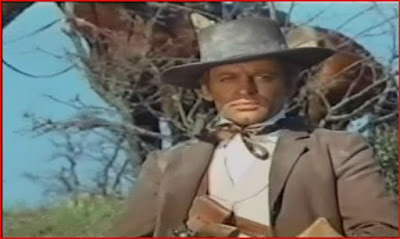
Erika Blanc (top) and Charles Southwood (below) complicate things for Sartana and keep us guessing which side each will end up on.
This last "official" Sartana film -- the last with either Carnimeo or Garko involved -- is a refreshing comedown from the ridiculous excess of Garko's last outing, in which Sartana turned a church organ into a machine gun. Perhaps with Garko out of the way Carnimeo could poke fun at the character and his conventions instead of simply escalating the outlandishness quotient. Hilton makes a good replacement, he's supported by a good cast, and he's backed by a nice score by Francesco (The Inglorious Bastards, Lone Wolf McQuade) de Masi. It's still the sort of gimmicky film that hardcore spaghetti fans aren't necessarily supposed to like, but I'll recommend it for being well-paced, action-packed, and pretty amusing in its silly way.
While the version included in VideoAsia's Spaghetti Western Bible Vol. 2 collection is full-frame, here's a widescreen Italian language trailer, uploaded to YouTube by MrSpaghettiWestern.
They say that imitation is a form of flattery, but I doubt whether Giuliano Carnimeo or Gianni Garko felt especially gratified by the proliferation of cheap movies using the name of Sartana, the character that Garko more or less created and Carnimeo developed into a spaghetti western institution. But such were Italian copyright laws, it seems, that there was nothing to be done about the exploitation of that good name. I guess you couldn't copyright a proper name in Italy; hence all the Djangos, Ringos, Trinities and so forth. Come to think of it, that may explain the weird elaborate titles attached to so many Italian genre films, horrors and giallos especially; they're less easy to copy.
But how quickly should we blame producer Enzo Boetani for the preposterous rip-off that Sartana nella valle degli avvolti proves to be? I don't know enough about the production or distribution history of the film. Looking at it, you could imagine that Boetani and writer-director Roberto Mauri had no intention of making a Sartana movie. Their idea seemed to be to put William Berger into a decent suit of clothes and try him out as a hero rather than a villain of the sort he portrayed in the first "true" Sartana film, If You Meet Sartana, Pray For Your Death. It's Boetani's first film as a producer and the first and only for the production company, Victor Produzione. In some countries, it wasn't released as a Sartana movie. In Germany, from whence the DVD used by VideoAsia for their Spaghetti Western Bible Vol. 2 set derives, the title is simply Der Gefuerchtete. In the U.S., it was both a Sartana and the more generic Ballad of Death Valley. But in France, Spain and Italy itself, it was clearly offered to the public as the latest adventure of Sartana.
What a crock! Berger bears no resemblance to either the early stubbly Sartana nor the later Garko model with the clean chin and blond moustache. He sports a more-or-less clean shaven face and a mop of blond hair, and his costume bears no great resemblance to the genuine Sartana wardrobe. But if you believed that Sartana was the only reasonably well-dressed gunfighter in the Old West, I suppose Berger might pass muster. You might even believe that Sartana is in some form of deep cover for the duration of the picture, since he is never -- in this English dub, at least, -- ever called Sartana by anyone at anytime.
Instead, everyone in Valley of Death is determined to call Berger by the name Lee Calloway, under which he has a $10,000 price on his head for bank robbery. We first meet him in a mirror, as a bounty killer walks into a tavern where he's playing cards. This Calloway promptly guns down his hunter ("He wanted gold but ended up with lead.") then visits an erstwhile partner who's been holding his money from a recent job. The partner has decided to keep the money and collect the bounty on Calloway. Instead, he dies. Fleeing, Calloway finds himself and his horse surrounded by a posse. Time for some very fancy gunplay or an all-out massacre, you suppose. What actually happens is hard to explain. Mauri shows Calloway firing low, as if, as I first suspected, at the posse's horses. Then there's an explosion of some kind at street level, breaking up one wall of horsemen so Calloway can ride out of town. There's nothing in the movie to set up that there was something he could blow up with a bullet. Maybe it's just a very powerful gun, though he never uses such heavy ordinance afterward.
So he gets out of town and the posse follows, but he's faster, except for two guys who ride up to him and explain that they are not part of the posse, but have a proposition for our hero. We next see Calloway breaking the three Gregg brothers out of jail. They stole a gold shipment, and Calloway's idea is that they should pay him half their plunder for freeing them. Their idea of gratitude is to immediately begin plotting to kill him. First they have to make a few stops, including a visit to a man who makes those music boxes with the little dancing girls on them, the sort they sell for a princely three dollars at the local saloon. The idea here seems to be that the tinkle of a music box (or a pocket watch) is an essential part of the spaghetti western soundscape. Anyway, the man seems to have ripped the brothers off, so they assume, so they kill him and decide to do away with Calloway, too. Any last notion you might have had that this Calloway is Sartana should be dashed by the ease with which the Greggs (Jason, the leader, Coughy, who coughs a lot, and Willy) beat and tie up our protagonist before leaving him to be blown up by a stick of dynamite. They forgot that the music-box guy had a daughter who comes home just in time to save Calloway and mourn her dad.
Calloway catches up with the Greggs and has it out inconclusively with them. He disarms them, but Jason and Coughy get away while Willy is killed in a melee. They have no weapons, but Calloway has lost his horse. They know he won't kill them until he finds the gold, so they decide to have some sport with him, leading him on a trek through the titular deadly valley and letting him sweat while they keep at a safe distanct to taunt him from.
"You silly Calloway person! Your father was Sartana and your mother was a herring! You make excellent target practice for our taunting, boy cow!"
Our hero barely makes it through the desert, and has only enough strength to fire his weapon to catch the attention of a passing stagecoach. As the Greggs watch, the coach's female passenger picks up the poor man, conveying him to her hacienda. The Greggs hang around outside rather pointlessly (Coughy recognizes this, but Jason wants to avenge Willy) while gets a good invigorating bath of soapy water, followed by just as invigorating a flesh bath courtesy of his hostess. In a profound case of second thoughts the morning after, she tells her ranch hands that this is Lee Calloway the wanted criminal and urges them to catch him. But mere lassos can't hold the mighty Calloway. He shoots down the ranch hands, silently judges the lady for a moment, and moves on.
He finally catches up with the Greggs, who finally got tired of waiting on him and went to claim their gold. The finale piles lameness upon lameness. Don't expect a big showdown between Calloway and Jason Gregg, because Mauri thinks it'd be more interesting if he suspensefully crosscut between the gun battle and a scorpion crawling around. He throws in a few shots of music box dancers, too, which Calloway has brought to the show for no good reason. The payoff: Jason is dispatched not by our ersatz Sartana, but by the scorpion. The sting kills him in about two minutes, which I'm given to understand is record time. Maybe someone should make movies about the scorpion. And then the U.S. Cavalry arrives. Do they want their gold back? Hell, no! Turns out there was an important strategic document mixed in with all the gold. That's all they wanted Calloway to fetch for them. The gold? He can keep it!
At best, Valley of Death is an idiot cousin to the genuine Sartana series. Berger tries to project some of the attitude, mostly with a persistent smirk, but the script undercuts the mystique by requiring Calloway to get his ass kicked by the bandits and endure near-death in the desert. Part of Sartana's appeal is based on his mostly-unflappable mastery of all situations. Comparing him to James Bond makes sense in that respect. Calloway, by comparison, is set up as a master criminal, only to be made a hapless victim for the middle part of the story before being outrageously rewarded at the end. It's as if the first reel or so was from a different movie. The actual story of the film is pretty flimsy, as you may have noticed. In its present form, it's only 78 minutes long, but manages to seem both choppy and padded.
Nevertheless, it is occasionally picturesque thanks to some decent outdoor cinematography by Sandro Marconi, who did similar work for If You Meet Sartana. Also, good film music wasn't hard to come by in Italy, no matter how cheap your movie was. Augusto Martelli gives this show a decent score and a theme song, "King for a Day," that is actually picturized, as the Indians say, within the film by the comely Betsy Bell, who must endure some foot fondling by Coughy for her trouble.
Given VideoAsia's reputation, I'm surprised they didn't take a completely unrelated film and call it a Sartana movie to fill out their set. But this item looks like it comes from the German set that provided source material for several other Sartanas in the VideoAsia collection. Like those, this one has German titles at the beginning, and while they run, the characters on screen speak in German. The film is letterboxed, but it doesn't look like the 2.35:1 claimed at IMDB. The picture quality is good, but it does look like some of the image is cropped on the sides, though not defacingly so. Overall, it's okay to look at, if not to watch. If there are William Berger fans out there, they ought to like it. Otherwise, it's for spaghetti-obsessives only. You might as well look at it if you get the Sartana set, but it wouldn't be worth getting in its own right, I'm sad to say.
In lieu of a trailer, here's SpoonMHD's upload of the Italian opening credits, including the first version of "King for a Day."
Gianni Garko may not be as well known a spaghetti western star as Clint Eastwood or even Franco Nero, but on the other hand, he was never made to sing in a Lerner and Loewe musical. What the man could definitely do is wear a suit of clothes, though Giuliano "Anthony Ascott" Carnimeo's film, his first in the Sartana series, raises questions about what else Garko was really capable of.
Is Sartana really nothing more than a suit of clothes? The opening credits actually invite you to ponder that point, which is relevant to the story at hand. The credit sequence is quite imaginative, or at least different for a spaghetti, starting with a mannequin and cut-by-cut building the Sartana costume on it. -- already presumably instantly recognizable even though Garko had only worn it once before at this point. We cut again to a living Sartana showing off some card tricks, but you notice quickly that we're only seeing the man from the neck down. You never do see Gianni Garko doing this stuff. But you might be distracted from that realization by the kick-ass theme music by the team of Vasco and Mancuso, the best music so far in the series. Take a look and a listen yourself, thanks to SpoonMHD.
From here we go to the town of Iron Hat, home of the North Western Bank, one of the region's soundest financial institutions.
Like Sartana, the NWB's bounty-killer security guards wear a recognizable uniform, which probably makes quite a deterrent as a rule. It's not likely to intimidate the man in the familiar hat and cloak, however, who arrives to make an everyday sort of financial transaction. Here's how banking worked in the Old West. Let's say you're a bounty killer. You've just gotten your man, but the local government isn't immediately able to pay out your reward. All you need to do is bring the corpse up to the teller window, dump it on the counter, and collect from the bank. The state or federal government will pay them back later. Only Sartana seems to have made a mistake. I'm pretty sure that bank rules require the wanted man to be dead before you bring him in for exchange, and this character proves to be very much alive. It turns out that the bank personnel have made a mistake, because that dude in black is not Sartana. That pales beside an even graver error: not all those liveried bank guards are actually employed by the bank. They join "Sartana" in riddling the place with bullets and taking $300,000. It's rare to see two small armies going at it inside a bank, but that's why God made spaghetti westerns.
We know that the perpetrator isn't Sartana because the director hasn't shown us Gianni Garko's face and the man's dubbed voice sounds mean. He's so mean, in fact, that he wipes out most of his cohorts shortly after the getaway. But the poor slobs in the movie don't know it isn't Sartana, so posters promptly put a $10,000 price on our hero's head. The invitation to cash in arouses the most eclectic collection of mighty men since Van Halen's "Pretty Woman" video. You've got some Indian dude. You've got genre badass Gordon Mitchell living in the lap of luxury, yet deciding this will give him something to do. You've got Klaus Kinski (back from the previous Sartana film) as a gambling addict who needs the reward money to pay off his debts. At one point, you have an entire town gunning for our innocent hero, as if they meant to share the reward.
Kinski: Will Work For...
Sartana is annoyed to discover that he could be impersonated so easily. He's also chagrined to learn that expert craftsman Homer Crown, who designed Sartana's signature spinning-top/bullet cylinder for his little four-barrel pistol, has been making knock-offs for practically anyone who asks. So there's nothing to be done but track down whoever impersonated him and whoever framed him. Once I saw the real man, I could confirm that the makeover I noted when I inadvertently watched the next film in the series, Have A Nice Funeral...Sartana Will Pay actually takes place in that film. There he has a clean-shaven chin and a full, blond mustache, while here he has the same stubble he wore in his first appearance as the heroic Sartana in If You Meet Sartana, Pray For Your Death. I'm not the final authority in such matters, but I like the stubble better, though I suppose the big 'stache was an inevitable development once the series reached the Seventies.
Our hero actually has help of a sort from a sidekick, Buddy Ben, played by Frank Wolff in slovenly mode. The script makes a mostly successful effort to keep us guessing whether this guy will backstab Sartana or not, but the character himself isn't that interesting. A disappointing thing about this film is that it sets up these big-time bounty killers to chase Sartana, only to throw less interesting characters at us who prove to be more important to the plot. Gordon Mitchell, for instance, doesn't show up after his introduction until the film has less than ten minutes to go, and even then his motivation for pursuing Sartana seems like a secondary matter. The Indian, played by Jose Torres, comes off better. He gets a cool scene in which he pins Sartana down in a miner's cabin and seems to have an answer for every escape attempt. Sartan tries to lasso his rifle from his horse's saddle and drag it to him, but the Indian shoots the rope. Sartana throws dynamite at him, but he shoots it out of the sky. It's fun to see Sartana sweat these things out sometimes.
Kinski has more yet to do, but his bounty killer emerges as a kind of comedy relief character. He's saddled with a theme motif that has reminded more viewers than me of "Santa Claus is Coming to Town." The running gag is that he's a better gunfighter than a gambler, but can't help himself. "I'm a pig" when it comes to gambling, he says at one point. This extends to a scene where he loses at cards to a fellow passenger on a stagecoach. In this case, he finds that the man's wife, seeming to snooze next to him, has actually been spying on him and signalling hubby with her foot. Amazingly, Kinski resolves this situation without shooting anyone, though he does get to wipe out a gang of bandits, whom he has loaded on top of the coach so he can cash them in in town.
When he finally catches up to Sartana, it's in a casino, so he's surrounded by temptation. Complicating things further is the revelation that Sartana is yet another of his creditors. This makes Kinski reluctant to kill him, after all, because it might look like he was welshing on a debt. This sets up a curious confrontation with a more curious resolution: a happy ending for Kinski. This is another instance where Angel of Death (also known as Sono Sartana, il vostro becchino, commonly translated as "I am Sartana, your gravedigger," among many alternate titles) is less brutal than it could or possibly should be.
Angel of Death is, in my opinion, the weakest of the series so far, though there's enough going on to keep it an entertaining film. Carnimeo doesn't seem to have a real grasp of what to do with Sartana yet. The character doesn't retain the quasi-supernatural vibe he had in If You Meet Sartana, and comes the closest here to being just a generic spaghetti hero. Part of the problem is that this film is focused on Sartana himself in a way the ones that come before and after aren't. In those, the writers came up with settings and situations for Sartana to intervene in as a dangerous x-factor. In Angel of Death, nothing more is at stake than Sartana's own name, however good that might be. That's plotting at a comic-book level, with no offense meant to modern comics. Fortunately, I can assure you (since I saw it last week) that Carnimeo got his act together by the next film.
Nor is Angel of Death without good moments. I've already mentioned Sartana's battle with the Indian bounty hunter. Now I'll add a nicely done action scene in which Sartana has to fight his way out of a hostile town. Carnimeo films a lot of this from inside the moving covered wagon as Sartana shoots down enemies, only to have more appear. The director also experiments with violent camerawork that he won't repeat in Have A Nice Funeral. When people get shot in this film, Carnimeo seems to slap the camera around so that it tips and lurches as Sartana's victims tumble and fall. He definitely deserves credit for trying things with the widescreen image in the honorable spaghetti tradition. If you like spaghetti westerns in general, you'll probably like this one.
As with Have A Nice Funeral, VideoAsia has used a German DVD copy of Angel of Death (the German title translates to something like "Sartana: Corpses Were Like His Daily Bread"). The letterboxing appears to be correct and the picture is sharper than Funeral was. So whatever the ethics of the Grindhouse Experience Sartana package, the aesthetics of it are quite satisfactory this time.
Between Have A Nice Funeral and the next "official" Sartana film starring Garko, imitation Sartanas began to appear, as if invited by the concept of Angel of Death. Before moving on to Carnimeo's Light the Fuse...Sartana is Coming, I'll take a look at some of the imitators stating next week.
Why are you laughing? It's my money. Only I can laugh! --Lee Tse Tung
Mea culpa. I grabbed the second side of the first disc of VideoAsia's Spaghetti Western Bible Vol. 2 set and played the movie on the top. It turns out that Buon funerale, amigos!...Paga Sartana is the fourth, not the third film in which Gianni Garko plays a character named Sartana, the third, not the second, in the "official" series about the invincible antihero of the old west, and the second, not the first film of the series directed by Giuliano "Anthony Ascott" Carnimeo. I'll have to backtrack and deal with Sartana, the Angel of Death sometime in the coming week.
By 1970, Sartana had evolved in appearance. In If You Meet Sartana, Pray For Your Death he had what looks like a five-day growth on his face, not unlike his villainous godfather in Blood at Sundown, though his hair is a little longer and he's much better dressed. I don't know if the changes began with Angel of Death, but by Have A Good Funeral his chin is clean shaven and his moustache is quite blond and more filled out than before. The costume is pretty much the same and he still carries his adorable little four-barrel pistol, but in Funeral he also favors a deck of cards that he can throw like weapons, as well as a watch-chain that can snatch guns out of people's hands.
The title of the fourth film is actually relevant to the story this time, since our hero tends to throw money around to cover the expenses of burying the men he kills. "I executed them so I had to bury them," he explains, "I have an old habit of doing that." His expenses start mounting when he wipes out a band of killers who have just massacred Joe Benson and his pals inside an isolated cabin. Those who are about to die object to Sartana's interloping presence. "Better pray for your mortal soul," one tells him. "I'll pray for yours," he replies, as if punching the coolness clock. The killers, we should note, found a nugget of gold on Benson's body.
What's Sartana doing around here? We'll have to figure that out for ourselves, and the man himself has some figuring to do. He skulks around the ruins of the burned cabin the next morning and finds a Chinese man in western dress snooping about. He follows this person to the town of Indian Creek, where he establishes himself in the local hotel to watch the reactions when his victims are brought to town. Mary, the woman who runs the place, asks if Sartana is hunting for gold like so many other characters in these parts. "Yeah," he admits, "but I don't have to dig it out of the ground." In other words, he's what the spaghettis call a "bounty killer," while modern usage prefers the more euphemistic "bounty hunter."
Sartana sees the Chinese man from the burned-out cabin pulling another man in a rickshaw. The passenger is Lee Tse Tung (George Wang), who runs the local gambling house. Lee is described by a rival, Hoffman the local banker, as "A Chinese gambler who's a bad copy of Buddha, meaning he's very round and fat." He never gets out of the rickshaw, and sits in it like it was his throne as he surveys the goings on in his casino. He and Hoffman are rival bidders for the late Benson's property, making them the most likely suspects in Benson's assassination. For the moment, Sartana explores the Lee angle, losing at cards and offering a $20,000 letter of credit in payment (while expecting change) to see what Lee will do with it. Our hero notes that twenty grand was what Benson was asking for his land. After Sartana leaves, Lee notices that the visitor actually had a winning hand and lost on purpose. He takes the letter to Hoffman, who tells him it's a forgery -- and that the land has been inherited by Benson's niece Abigail, who's about to arrive from Wichita.
Abigail checks in to the hotel, where Sartana quickly latches on to her, explaining that he killed the men who killed her uncle. "You took ... revenge, didn't you?" she asks. "Hardly," he corrects her, "They were only hired to murder Benson. Before you take revenge you've got to find out who paid them." This requires him to dodge bullets at times, to kill men at others, and sometimes to leave them alive to see where they run. As the corpses pile up, the sheriff starts pressuring Sartana to leave town, but he produces wanted posters to prove his right to kill another set of gunmen. This is a lot of trouble to go to, but Sartana claims that Benson was a "good friend" of his, and there could be big money at stake if there's gold on Benson's land, as everyone but Abagail suspects. She doesn't suspect because Hoffman has been telling her the land is worthless so she'll take a small sum for it. Sartana makes mischief by raising his asking price, driving both Hoffman and Lee upward as one or both of them takes heightened measures to eliminate our hero.
The series has clearly gone in a comic-book like direction by this point. The action scenes are set up more like sight gags, and Sartana has developed a power like Batman (or Droopy Dog, depending on your frame of reference) to be exactly where he needs to be. One example of this is when he somehow realizes that a man in a secret chamber behind a barroom mirror is going to try to shoot him. After Sartana drives him out of the bar, the gunman flees practically to the other end of town to take shelter in a church, only to find Sartana there reciting the 49th Psalm: "For he sees that wise men die, likewise the fool and the brutish person perish and leave their wealth to others." Other characters have gimmick weapons, too. Hoffman, for instance, dispatches an erstwhile associate with a hollowed-out ledger book that has a spring-activated gun inside. This even inspires a pun in the English dub that might not have been possible in the original Italian, when Hoffman reflects, "It was bound to happen sooner or later."
Antonio Vilar as Hoffman somehow reminds me of Hedley LaMarr -- not Hedy.
Some of these scenes are just ridiculous, and some are just pointless, as when the film makes a big deal of the arrival of four brothers come to take revenge on Sartana for a minor character's death, only to have our hero eliminate them in a couple of minutes.
Others have exactly the desired kick-ass effect, as when a funeral procession turns into a gallop-by shooting at a barber shop, provoking a chase scene in which gunmen burst out of their coffins and start blasting away at Sartana, who of course puts them back in their proper places.
In the end it comes down to Sartana and Lee Tse Tung, who has just paid out $100,000 to Abigail Benson for the land, only to learn the truth about Joe Benson from our hero. Old man Benson was a con man, it turns out, and the land is as worthless as Hoffman wanted people to believe. Sartana was in the neighborhood to collect a bounty on Benson (no killing required), and stuck around to drive up the price so he could then take a cut to cover what Benson owed to Sartana's nameless client. This news pisses Lee off to no end. So he bursts out of his rickshaw and starts whaling away at Sartana with kicks and chops. Sartana vs. Kung fu! And he didn't see it coming! Lee lands some shots and has our hero reeling. "Hey, I thought you were an invalid!" a distressed Sartana complains. "No," Lee answers, "it's only that I'm a lazy man."
And so, however this fight turns out (and you must learn for yourselves), Sartana and his foe are brothers under the skin. Our hero has defined himself during the picture as a lazy person, someone unwilling to make money by mundane methods. He's as much an underworld character as the people he manipulates and kills. While the series Sartana is defined as heroic or a "good guy" compared to his villainous Blood at Sundown precursor, he is no paragon of virtue by any means. The best that can be said for him is that he cons the cons, or that those he does to have it coming. That distinction only matters, of course, if you don't believe we all have it coming, and watching a Sartana film, you do have to wonder sometimes. We're even left with a suspicion at the end that Abigail Benson isn't as innocent or virtuous as she seems, though she gets off easy regardless with a hint of future romance with Sartana. But that's the spaghetti west for you. It's the western stripped of all pretension that people are building civilization, leaving a hard-boiled or cynical attitude many still like better than the overdone affirmation of earlier American films.
Have A Good Funeral is one of the Sartanas taken from German DVDs for the VideoAsia set. You can only tell they're German from the title card auf deutsch and an "ENDE" card that appears slightly abruptly at the end of this film. The letterboxing appears to be correct, and while the image itself could be sharper, it's clearly a vast improvement on the dupes used for the two earliest films. Carnimeo's direction is energetic and there are plenty of nice widescreen images, thanks in part to Stelvio Massi's cinematography. Bruno Nicolai provides a serviceable if generically jaunty spaghetti score. This film differs strongly in tone from both the more American style psychology of Blood at Sundown and the semi-spooky attitude of If You Meet Sartana, but it's still good stuff, so I expect Angel of Death to be just as good. We'll find out soon.
Light one up, Sartana -- you've earned it!
The DVD picture is definitely better than this trailer uploaded to YouTube by ItaloWestern, but this is the only trailer available in English.
So for a better idea of the picture quality, here's a German trailer uploaded by ShobaryWesterns.
Gianni Garko made five films between Blood at Sundown, in which he played the villainous Sartana Liston, and "Frank Kramer's" film, including one western in which he played "Django," so we can guess he was used to the Italian style of exploiting popular character names. Wikipedia says that Se incontri Sartana prega per la tua morte was inspired by the success of Blood at Sundown, but it still seems strange that the producers (and Garko, who reportedly had script control in his contract) should want to evoke a character who was pretty much the diametric opposite of their new hero. Sartana Liston is scruffy and often hysterical. The new Sartana is neater (though his hair is longer than his precursor's) and exudes the existential calm of the typical spaghetti western hero.
The series Sartana has been described as a heroic character, but the protagonist of Se incontriSartana seems as amoral as they come. I got no sense that he was a good guy, but the character may have a different sense of his purpose. His famous entrance line, uttered after he rises from playing dead to confront a gang that has just murdered a stagecoach driver and its elderly passengers, is "I am your pallbearer." For some reason that reminded me of the Blood at Sundown Sartana's utterance that "the right to punish is mine," but the new Sartana is never really as pretentious as that through the rest of the film. Like us, he's probably too busy trying to wrap his mind around the plot to maintain an attitude.
Se incontri is a nihilistic riot of backstabbing and backshooting. It opens modestly enough with Klaus Kinski taking pot shots at the stagecoach, but things get stranger with the next robbery, in which a plant inside the stage shoots down the mayor of Gold Spring, an innocent woman, and a priest, only to be shot down by another gang led by lead villain Lansky (William Berger) who could give Heath Ledger's Joker pointers on how to run a criminal gang. After his men take out the first robbers, he tells them to meet him at a rendezvous point where he wipes them out with a Gatling gun. He takes possession of a treasure that proves to be a box of rocks.
If I understood things correctly, some of the city fathers, namely Stewall (Sydney Chaplin) and candy-loving Holman, are conspiring with Mexican bandit chieftain El Tampico to commit insurance fraud with fake robberies (including real murders) in order to get the insurance money and keep the allegedly missing gold. It's in the conspirators' interest to have Lansky annihilate as many of the people involved as possible, though he's a risk himself as he begins to demand more money and sees the blackmail potential of the situation. Morgan is his right-hand man, handy with the throwing knife, but Sartana eliminates him in the "vestibule of the beyond," the dark workshop of Dusty, once an acclaimed sculptor and now a rummy coffin maker. Franco Pesce aims for a Walter Brennan effect but looks more like Pappy Yokum, for those who know their comic strips.
Sartana's role is to study the situation, figure out who's doing what to whom, and exploit the confusion. He messes with Lansky's head by playing a musical pocket watch left behind at the second stagecoach massacre. Poor Lansky suffers from mighty swings of mood. He feels the exhilaration of having lured some of his foes into a house full of dynamite so he could blow them up, only to lose it when the seemingly invisible Sartana opens what must be a really loud watch to spook our villain. But despite this psychological warfare, Sartana apparently likes Lansky because he's plainly decided to kill him last. Maybe that's because he figures the man with the Gatling gun is most likely to be the last man standing and the one who can lead Sartana to the gold.
Lansky celebrates killing five men with one shot. The irrational exuberance of William Berger in If You Meet Sartana, Pray For Your Death.
It's a good bet, because the other villains are busy backstabbing one another while trying to eliminate Lansky. Ultimately it's down to Lansky and Holman's wife, who's just done Holman in with intent to run off with the bad guy. This sets up an eerie finale in the "vestibule of the beyond" that teases a possible supernatural quality in Sartana ("I knew it!" Lansky says, "You're the d--") but finally offers a mundane (not to mention slightly derivative of Fistful of Dollars) explanation for our hero's miraculous survival.
If You Meet Sartana is an entertaining start to the official Sartana series. It's a more typical spaghetti than Blood at Sundown, which aspired to the psychological depth of Fifties U.S. westerns, but it's better than average thanks partly to the large cast of villains led by the frenetic Berger. I think he's actually on screen more than Garko is, and while he never qualifies as a sympathetic character he succeeds in keeping you interested in seeing what he's going to do next. Garko does without the scenery chewing that dominated Blood at Sundown. His performance is more a matter of style than anything else. He has the look and he has the manner, and he also has some neat toys, like his little four-barreled pistol that fires one shot at a time. I don't know what good that really does him, but it's so cute! He also has a top with the suits of the card deck on it that he likes to spin frequently -- and which proves to have an important alternate purpose.
The film is part of Videoasia's Spaghetti Western Bible Vol. 2: Sartana, the Complete Saga set. Like Blood at Sundown, the Videoasia copy is improperly letterboxed and probably copied from VHS, though it doesn't have tracking issues like Blood does. The next three films look considerably sharper, since they were apparently copied from German DVDs. I'll have a review of Have A Good Funeral My Friend, Sartana Will Pay sometime next week.
And here's the English language trailer, uploaded by Mart85
Johnny Liston has just done twelve years hard time for a crime he didn't commit, but freedom may prove harder still. He's hardly out of stir when he's ambushed by bushwhackers. He survives by playing possum and catching them unawares as they try to loot his body, pummeling them and confiscating their boots. Then he finds out that his brother has married his girlfriend. Things don't get better when he's reunited with his mother. She always liked the other brother better. You could tell she had different attitudes about the two. Our hero is just plain Johnny, but she named his brother Sartana.
You may have heard that name. "Sartana" may be second only to "Django" as an archetypal Spaghetti western protagonist, starring in films with those peculiarly elaborate Italian titles along the lines of It's the Big One, Sartana, I'm Coming to Join You or Sartana's Waiting; Why Aren't You Dead Already? I exaggerate, but only slightly. Anyway, Johnny's brother is not that guy. He just happens to be played by John (Gianni) Garko, who actually did play that guy. It seems that someone saw this film and decided that Sartana was such a cool name (it is, actually) that it had to be used again, and that Signor Garko fit the name as well as anybody. In fact, the name and the man were apparently so cool that the reborn Sartana would be a good guy, while the proto-Sartana of Blood at Sundown (the Italian title means "A thousand dollars on the black, and what that means in terms of the story is a mystery to me) is a raving crazy loon of a villain.
Anthony Steffen as Johnny
Gianni Garko as the original Sartana
Blood at Sundown is the gateway to VideoAsia's Spaghetti Western Bible Vol. 2, Sartana: The Complete Saga. This set collects ten films featuring either Gianni Garko or the character of Sartana, including several "official" films as well as rip-off films. There's a wider variance of quality in the editions than in previous VideoAsia or Grindhouse Experience collections, since a fair number of the titles actually look good. They're the ones that have been copied from German DVDs that fortunately included English language tracks. Blood at Sundown isn't one of those films. It's the more typical dupe off of VHS, complete with tracking issues, though it letterboxed somewhat.
"Albert Cardiff's" film didn't impress me at first. It opens with an overlong fistfight between Johnny (Anthony Steffen) and the bushwhackers, and the dubbing is pretty bad. But the film gets better as the story opens up to encompass three towns under the heel of "General" Sartana and Johnny's escalating effort to break up his brother's protection racket. It has a fairly sprawling cast of characters for a spaghetti western, including Johnny's hysterically mute ally Jerry, a collector of explosives, and the corrupt judge who sent Johnny to jail, as well as the lovely Erika Blanc as Joselita, sister of the man Johnny supposedly killed.
Erika Blanc (above) is one of the good, but Roberto Miali (aka Jerry Holt, below) as mute Jerry is good, bad and ugly all in one.
Looming in the background is Rhonda, the Liston matriarch, who indulges Sartana's madness because it makes her, a former servant, the most powerful woman in the community. Carla Calo has an awesome scene when she finally realizes that Sartana is going too far, yet demands that the women of the town fall on their knees to beg her help before she marches into the middle of a mass gunfight armed to stop her son. She can do it, too. She has no problem whipping her boy in the face when she thinks that Johnny has humiliated him.
The lengths a mother must go to. Carla Calo as Sartana's Mom.
Blood at Sundown has a number of strong female roles, and the filmmakers believe in equal opportunity mayhem. The women of the main town join in the final massive battle with Sartana's men. This is the sort of film where anybody can become a killer. Nor is the film sparing of the fair sex. Innocent women are gunned down in cold blood, and an old lady and a baby are trampled by a rearing and plunging horse at one point.
The women of Blood at Sundown can dish it out as well as take it.
Cardiff's (aka Alberto Cardone) initially stodgy direction becomes more forceful as he makes effective use of his town locations and the sinister Aztec temple ruin Sartana uses as his headquarters. He produces nicely done tracking shots of Sartana's gang rampaging through the towns while making nicely modulated use of the zoom lens in a scene when the Judge desperately seeks shelter from a suddenly wrathful Sartana. The English language dialogue isn't particularly well acted and is sometimes lazy (as when Sartana yells the name JOHNNY about ten times in a row), but there are cool lines like Sartana's motto, "The right to punish is mine," which sounds like something the later Sartana might say, or his threat, "When the sun sets, I promise there'll be very few to enjoy it."
Blood at Sundown doesn't fall into the conventional spaghetti categories of mano-a-mano duels or revolution south of the border. Even the climactic showdown between the brothers is interrupted by outside interference. The film isn't really about one or two super gunmen, but strives for a more ambitious scope, at least in the scale of violence, that gives the film a distinctive tone, as if one Italian film, at least, was trying to absorb the lessons of the American "adult" or "psychological" westerns of the 1950s. It's far from a perfect film, but I'd definitely recommend it to spaghetti fans and to western buffs in general.
 A horse-drawn wagon rolls hurriedly through a wilderness as a man settles down to a dubious picnic lunch: a chalky looking loaf of bread and two hard-boiled eggs. The man will eat the eggs, but saves the bread for another time. It's our old friend Sartana, dapper as ever but now looking more like George Hilton than Gianni Garko. He's gone back to the grubby three-day growth look of his earlier outings instead of the blond moustache Garko adopted later. Appearances aside, Sartana didn't come out here just to have a snack. He wants to kill a man; the driver of the wagon has a price on his head. But someone beats him to it. A gang of bandits pop out of trapdoors in the earth and blow away the driver and his escort. They gather up the riderless horses, but what of the wagon's contents? They don't seem to care. In fact, they throw a stick of dynamite at it and ride away.