A randomly comprehensive survey of extraordinary movie experiences from the art house to the grindhouse, featuring the good, the bad, the ugly, but not the boring or the banal.
Best known for crime and cannibal films, Umberto Lenzi got his start making swashbuckling period pieces. One early effort was Il trionfo di Robin Hood, which went over well enough in some places, especially in Germany, that this subsequent effort was marketed, however implausibly, as a sort of sequel. It's a showcase for Pierre Brice, the French actor who became a star in Germany for playing the heroic Winnetou in adaptations of Karl May's western stories. The setting is somewhere in Spain, and to judge by the costumes some centuries after Robin Hood's time. An evil nobleman, Don Luis, (Daniele Vargas) has a neighboring aristocrat murdered, blaming it on highwaymen who are actually his stooges, and assumes guardianship over the victim's territory and daughter Carmencita (Helene Chanel). The only thorns in the villain's side are Maurilio, a local rabble-rouser (Romano Ghili), and an apparently invincible horseman who robs the robbers and bullies the bullies. This fellow is as masked as you can get, the full-face getup leaving no features exposed while leaving you wonder how he can see through it, though he manages well enough.
The plague has come to the territory, and Maurilio convinces the common people that their only shelter is within Don Luis' walls. The don's men repel the peasant invasion as they would a siege, capturing peasant women in the process and subjecting them to humiliating decontamination process. They're to provide entertainment when Luis marries his new ward, Carmencita to his stepson, Don Diego, who is returning from his studies for the occasion. At long last, after more than half an hour, Pierre Brice enters the picture in full "Don Diego" mode as the effete fop is discomfited by a staged attack on his coach, from which Don Luis' men rescue him. Somehow, we suspect, Don Diego probably has been hanging around the area already. Euro audiences must have been familiar enough with the Zorro legend or more local precursors like the Scarlet Pimpernel to see where Brice's shtick was leading.
Carmencita proves a reluctant bride, and Don Diego is too refined to force himself upon her. On top of that, the masked rider appears occasionally to hint that maybe she ought to give Diego a chance. When not carrying on this ambiguous courtship, the invincible one starts taking out Don Luis' henchmen, including a Moorish henchman (Carlo Latimer), whose lust for white women is portrayed in a way that may make the film look racist today. On the other hand, Lenzi makes a point of including at least one token Moor in the oppressed village to show that not all that kind are bad guys. But while the rider (or "Robin Hood," if you please) carries out his vendetta, Don Luis captures Maurilio in a masked rider costume and happily puts the malcontent to the hot-tong torture.
Don Luis plans to celebrate Diego and Carmencita's nuptials with a masked ball, but someone spoils the mood by showing up in another invincible masked rider costume. Protesting this politically incorrect sartorial decision, Luis orders the offender to unmask, only to discover that -- shock! -- Don Diego is the genuine, authentic Invincible Masked Rider. Except he isn't! The Pierre Brice character now explains that the real Diego died of the plague, creating an opportunity for him to take his place and fool the stepdad who apparently hasn't seen the boy in quite a while. This is a weird twist, and I wonder if it's exclusive to the German edition. Is it because the filmmakers didn't want to portray (spoiler warning) parricide on screen, or because the Germans, in particular, couldn't have a local aristocrat be the masked rider if the rider is supposed to be "Robin Hood," a man from another country. It's probably an unsettling and unsatisfying twist for many a viewer, since it renders the Don Diego performance a complete imposture without cluing us in on the real personality behind the double mask. But some audiences may have been satisfied simply by seeing the evil aristocrat killed and the good guy riding off for his homeland with Carmencita. What pleasures this film offers are simple ones: action, violence, good guys and bad guys. Lenzi had yet to find his own style or the stories to express it, and to be fair, the way I saw this film in the German dub (with English subtitles) probably didn't do it any favors. Still, it's an interesting example of European pop cinema other than peplums just before spaghetti westerns and Eurospy stuff overwhelmed nearly everything.
For four years, and over four films, erstwhile Hollywood "Baby Doll" Carroll Baker was the muse of Italian director Umberto Lenzi. Knife of Ice was the last of their collaborations, and apparently an effort by the producers to get in, quite late, on the Edgar Allan Poe racket. The title is allegedly rooted in a Poe line describing fear as a "knife of ice," but if you google that phrase and the name Poe, all you get are references to the Lenzi film. Whatever. It looks like they took footage from Francesco Rosi's Moment of Truth to lend a touch of morbid spectacle to the opening credits as Baker's character, Martha, watches a bullfight. Lenzi spares Baker a trip to the dubbing studio this time by making her character a hysterical mute, traumatized since childhood by the death of her parents. I suppose it's because she's not deaf that she's never learned sign language, communicating instead mostly by pantomime, sometimes by writing notes, and on the telephone by rapping on the mouthpiece in a manner presumably intelligible to her intimates. She receives a gift in the form of a recording she made as a little girl, a morbid recitation about a trial and execution. In short order, people around her start dying.
Il coltello is more a whodunit than a giallo, as there are no setpiece kills. Rather, bodies are found after the fact and clues collected mostly pointing toward some local Satanic cult. When an irreverent hippie is caught skulking around he looks all too guilty, but as the killings continue he proves a red herring. There are more likely suspects, according to movie logic, in Martha's inner circle, from the family doctor to an uncle with eccentric scholarly interests. Martha herself seems to be losing it, constantly flashing back to eyes watching her and the friends and loved ones she's lost, as someone finally comes for her.
Who done it? Could it be Satan???
There's some nice suspenseful business toward the end as Martha, feeling threatened, tries to make noise to get the attention of a motorcyclist, only to have the sounds drowned out by his revving engine. As clutching hands close in on her, Martha finally screams, and for a moment I thought the film was going to prove a tremendous fakeout with people pretending to be murdered so the poor woman could get her voice back. It turns out, however -- take this as a spoiler warning -- that the restoration of Martha's speech is only a side effect, the real purpose of the final attack being to take the true murderer into custody. You see, Martha didn't like it that some people could speak while she couldn't and so, possibly unbeknownst to herself, she occasionally killed them, including a beloved niece. She could confess all this in writing, so the only benefit of getting her voice back is that now, apparently totally bonkers, Martha can recite the bit from her childhood recording. None of this explains why someone had to come at her like a strangler, but the idea there, of course, is to fake the audience out one more time. In the end, Knife of Ice is mainly an exercise in audience manipulation and misdirection. While handsomely directed, its gimmickry renders it little more than a trifle that will certainly disappoint anyone expecting stronger stuff from Lenzi.
The late Umberto Lenzi (he died in October 2017) may be best known today for his cannibal films of the 1970s. He started out making period adventure films, and by 1964 he was assigned an Italian pop-culture icon: Sandokan, the anti-imperialist Malaysian pirate hero of Emilio Salgari's novels published between 1883 and 1913. Contemporaneously with Italy's infamous failure to conquer Ethiopia and the establishment of colonial rule over Libya, Salgari's protagonist battled the ever-expanding British empire. The anti-colonial 1960s were a ripe time for a Sandokan revival with Steve "Hercules" Reeves in the title role. Sandokan the Great, as it was called in the U.S., was the first of a four-film series, the first two of which starred Reeves under Lenzi's direction. The series carried on with a new director and Ray Danton as Sandokan while Lenzi made two more exploitation pictures featuring a character called Sandok, offered as "The Maciste of the Jungle." In the premiere outing Reeves traipses about in a costume out of Hollywood's Arabian Knights fantasies and is overall less concerned with flexing his famous muscles than with something more like swashbuckling. He, his tea-obsessed sidekick Yanez from Portuguese-ruled Goa (Andrea Bosic) and Sandokan's mostly-loyal followers wage guerrilla warfare against the Brits, who answer less to the empire proper than to a character here called Lord Bromm who is really John Brooke, the historical White Rajah of Sarawak, the big bad of Salgari's books. Along the way Sandokan kidnaps a British official's daughter who gradually becomes radicalized (Genevieve Grad) and must worry about a traitor within his ranks. The traitor mystery is handled rather half-assedly and the action overall is rather unspectacular, and quite landlocked for the adventures of a reputed pirate, until we come to the climactic attack on a British fort, where Reeves gets to show some strength and the pace quickens as we near the end. The film's main assets are Lenzi's locations and Reeves's reliably heroic presence. Apart from the exotic locales and the appearance of a somewhat less civilized yet friendly tribe, nothing here really suggests what Lenzi will become as a director. Compared to his horror films Sandokan is kiddie stuff, and it probably was such on its own terms. TCM broadcast Sandokan recently while you can find its immediate sequel, as I did years ago, in some cheapo Mill Creek boxed sets. If you don't expect much from them they make for undemanding light entertainment with just a hint of progressive political consciousness to make it worth some people's while, but not so much to turn others off.
The way Umberto Lenzi tells it, Tomas Milian came back from a trip to the U.S. raving about a book he'd bought at an airport to read on the flight back to Italy. The book was David Morrell's First Blood, and Milian thought that the novel's antihero, the alienated Vietnam veteran John Rambo, would be a great part for him. Fat chance of Lenzi getting the rights, of course, but couldn't Milian play a character like Rambo in his next film for the director? Couldn't he even call the man Rambo? That he could do, and so Milian is just plain Rambo, with no first name that I can recall hearing, in Lenzi's Giustiziere sfida la citta' -- "The Executioner vs. the City" according to Bing Translation. Lenzi says that he wanted to call it Rambo vs. the City but got rebuffed by the distributor because "rambo" was a nonsense word in Italy and could never sell a movie. Lenzi tells the story with some hindsight, of course, but he also relates that Milian wanted to do the film to improve his image after having played his ultimate criminal grotesque in the director's Almost Human earlier in 1975. The star's desire to play a good guy doesn't sit well with his desire to evoke the irreconcilable Rambo of Morrell's novel, as opposed to the redeemable Rambo of subsequent Sylvester Stallone movies.
Who is that masked man?
How much of the "real" Rambo is in Milian's Rambo? Lenzi's protagonist is a loner and a drifter who apparently has been carrying on a personal war on crime that had taken him to Marseilles before he arrives in Milan in the movie. The look seems right, though Milian's overall scruffiness seems more to anticipate feral cops like Mick Belker on the Hill Street Blues TV show. He doesn't care to work with others, rebuffing his buddy's invitation to join him in a new private police force (a sign identifies it as "Mondiapol"), but will lend a hand when the chips are down. This Rambo doesn't like to "grow moss" in one place, but that makes him as much like the wandering heroes of Westerns (or peplums) as it makes him a Rambo redux. In Milan's career, his Rambo looks most like a dry run for his more lighthearted Nico Giraldi character in Cop in Blue Jeans and its sequels.
Test your might -- fight!
If Giustiziere is a lesser Lenzi cop movie compared to such genre highpoints as Almost Human and Violent Naples (the latter featuring another prime Milian grotesque) it may be because director and star were trying to do too much at once. On top of polishing Milian's image and allowing him to riff on Rambo, Lenzi and writer Vincenzo Mannino are playing the old Red Harvest game, following in the foosteps of Hammett, Kurosawa and Leone by having their protagonist play two crime families against each other. Rambo's pal in the private police force is trying to solve the kidnapping of a rich man's son, for whom the perps want 2,000,000,000 lira ransom. After his buddy gets killed -- a failed pursuit ends with his skull getting smashed on a rock -- Rambo's revenge (as the film would get retitled in some places) consists of goading a rival crime clan to muscle in on the kidnappers. This brings him into contact with Paterno, an aging boss whose path last crossed with Rambo's in Marseille. He'd love to destroy Rambo, but feels incapable himself -- it's a secret that he's going blind -- and fears that his impetuous son will only get killed trying. We should see an old lion making a last stand, but what we get is an alarmingly decrepit Joseph Cotten, far from the days of his Forties stardom in Hollywood. He wears a huge pair of glasses most of the time -- there's a plot reason but you can't help thinking it's all the better to read cue cards with -- and his voice is slow and tremulous as he speaks his lines. Some of his line readings are robotic, as if he doesn't understand what he's saying or what's going on in the picture. He may have been sick, or drunk, or both, but it's a demoralizing sight that makes it hard to enjoy the picture.
Cotten aside, Giustiziere lacks the force and flash of Lenzi's best work in the genre. While we might expect a Rambo type to become a furious avenger, especially after his girlfriend is beaten to death, Milian seems too committed to being a good guy to give his part the power it needs. Nor is Lenzi in top form; most of what's good here he's done better elsewhere. For what it's worth, the film doesn't come close to living up to its American title. The U.S. poster and DVD box art show a bald fellow applying a blowtorch to a chained couple. The film itself has the chained couple but no baldy with a blowtorch. In the actual scene, Rambo's idea of torture, after having cuffed them together across a bathroom pipe, is to take a leak in front of them and throw the cuff key in the unflushed toilet.
The shot above is more suggestive than the scene itself;
the scene below is more violent.
It may be bad form to express disappointment over this, but violence and cruelty are part of the genre and any given film looks tepid without it. Worse still, keeping track of the kidnapped kid grows tiresome quickly -- as Lenzi and Mannino must have realized themselves in giving Rambo an extra revenge incentive. The American edition is apparently an incomplete translation of the Italian original, but I suspect that the full film won't make a much better impression. You might want to try Syndicate Sadists as your first Lenzi cop picture before watching the stronger stuff, but if you want to watch just one to see what the genre's about, it should be something else.
Leonardo Tanzi is one of the interchangeable tough-cop characters that Maurizio Merli played for Umberto Lenzi and other directors during the heyday of the Italian police genre in the 1970s. In this follow-up to Lenzi's Rome Armed to the Teeth, however, Tanzi's no longer a cop. He's retired to become an editor of mystery novels for some publishing house. One of his old enemies, "the Chinaman" (Tomas Milian, back after playing a different character in Rome) doesn't make such fine distinctions. Fresh out of prison, he's determined to have revenge on Tanzi, who put him there. He leaves pre-printed death notices as his calling card. Tanzi finds one but manages to escape a deathtrap with only a shoulder wound. The cops knew that "China" would come for him, but they were detailed to a Communist demonstration and didn't have the manpower to protect their old pal. That's one of those bits of local color I appreciate in foreign films.
If you've seen a Maurizio Merli movie, you know that Tanzi isn't going to run off and hide in Switzerland like the cops advise him to. Instead, Il Cinico, L'Infame, Il Violento raises the ethical stakes of the Merli persona's tough-cop tactics by turning him into an outright vigilante, acting without any authorization whatsoever to take out the Chinaman and possibly China's new employer, the American Frank DiMaggio (John Saxon) in the bargain. Cop or civilian, Merli's position always seems to be the same: draconian measures are needed to destroy organized crime; criminals like China and DiMaggio are better off dead than in revolving-door prisons. In this film Tanzi gets to make a teeth-baring speech to that effect, which tells me that Lenzi and writer Ernesto Gastaldi knew that this was red meat for the target audience. Merli's fans must have wanted to hear someone say stuff like that, the sort of rhetoric you hear in some American crime films from the 1930s.
I don't know who's the cynic and who's the rat between John Saxon and Tomas Milian (above), but I'm pretty sure that Maurizio Merli's the fist.
On the other hand, Il Cinico lacks the intensity of other Lenzi-Merli collaborations. It may be just a quirk of the American dub I heard, but the script almost seems to send up the Merli persona a bit. In one scene, one of Tanzi's victims describes him to China as a bleached blond with a big moustache, and China, now suspecting that his arch-enemy isn't dead, summarizes the description as that of a "fag-looking cop." Other criminals call Tanzi a "faggot" later on. That may be how Gastaldi or the dubbers imagined criminals would speak to cops, or they may have recognized something about the way Merli looks. In any event, it doesn't surprise me that Merli shaved off the moustache eventually, though I feel he took most of his personality with it. This issue aside, The Cynic has more of a slapstick quality and a lot less of Lenzi's trademark brutality. Some of the fight scenes are clearly played for laughs, and there isn't really a good chase scene to match the motorcycle racing in Violent Naples.
The overall story doesn't grow as complex as it should have been. Tanzi's strategy is to drive a wedge between China and DiMaggio and drive them to destroy each other. This culminates in a robbery of DiMaggio by China's men, secretly facilitated by Tanzi to set up a final showdown between the two gangsters. But China knows that Tanzi is up to mischief and says at one point that his strategy will be to play Tanzi and DiMaggio off each other -- yet we never see this happen. DiMaggio, for all we know, doesn't know Tanzi from Adam, and this is typical of a role that gives the mighty John Saxon relatively little to do but gripe at China. Acting honors this time go to Tomas Milian, who goes against type, as far as Lenzi is concerned, and plays the Chinaman as a calm, cool customer who apparently earned his nickname for demonstrating an "oriental" patience and dispassion. Milian's one concession to the grotesque is the bandage China sports on his head through the whole picture, suggesting a wound that won't heal and thus symbolizing some inherent corruption in the character. Compared to his other work for Lenzi, which is more like Lon Chaney's for Tod Browning, this is an effectively subdued performance that actually makes China a more serious villain.
Maurizio Merli on the run.
While this isn't as good as the other Lenzi cop films I've seen, Il Cinico is still a fairly energetic and entertaining film. Lenzi displays his mastery of urban landscape yet again and most of the fight scenes are reasonably well done, apart from some overdone, out-of-sync sound effects. At the end, the English-language script finally hits the note of ambiguity it's been aiming for throughout when a detective tells Tanzi that he doesn't know whether to thank him or throw him in jail -- and when he tells Tanzi to "come on," we don't really know what he'll do. The Italian audience of the time may have assumed or insisted that Tanzi would go free, but from our cultural, historical and critical distance we can wonder what really would have been the right thing to do.
There's no English-language trailer available online, so here's an Italian one uploaded to YouTube by trailersdaculto.
Is it strange that I tend to prefer crime movies that take the criminal's point of view over those that sympathize with the cops? It seems strange to me sometimes. I don't exactly sympathize with criminals in the real world, nor do I aspire to be one. My preference is aesthetic rather than ethical, though I suppose there's a little bit of ethics to it. What bugs me about some cop movies is the attitude that criminals are just scum to be wiped out by any means necessary. Something in my mind rebels against that attitude. I don't consider myself soft on crime or an advocate of leniency. But something gets lost, I think, when writers and directors portray criminals as "just scum," or nothing but evil. Maybe I've seen too many films noirs. From them I get the attitude that nearly every criminal is a human tragedy. They can richly earn whatever bad fate they get in a movie, but if a film uses criminal characters just to show the bad fate it does seem a little like exploitation in the bad sense of the word.
With this setup, you might expect me to slam Umberto Lenzi's poliziotteschi film, one of a series featuring genre god Maurizio Merli as hard-charging Inspector Betti. Actually, I found it wildly entertaining.
Commissario Betti has bounced from one Italian city to another, his tactics apparently proving too tough for the higher-ups or the politicians. In Naples, he has a number of problems to solve. These include the kidnapping and rape of a woman whose husband refuses to cooperate with investigators even after she's recovered; a rash of bank robberies for which a leading suspect seems to have an airtight alibi; and a feud between two mobsters, the Commandante (Barry Sullivan) and upstart Francesco Capuano (John Saxon). For Betti, there's no problem that a grant of special powers to the police can't solve. Crime is getting ever more organized, so Betti thinks the police should also. His superiors never seem to agree with him, usually for political reasons. But Betti's tactics, sanctioned or not, seem to work, but by the time they do he's outworn his welcome in another city.
John Saxon is pursued by cops and crooks alike in Violent Naples.
Poliziotteschi is basically Italian for "tough cop," and the genre was supposedly inspired by American films like Dirty Harry and The French Connection. The concept obviously struck a nerve in Italy, which was beset not only with criminal violence but political terrorism throughout the Seventies, and where there was a historical constituency for a strong government that would deal ruthlessly with its enemies. There's an obvious temptation to view the genre as "right-wing" or even "fascist," but we should probably steer away from putting political labels on sensationalistic exploitation films. Betti's occasional hankering after more power is just crowd-pleasing window dressing for the real matter of Lenzi's cop movies: fast-paced, violent action.
American cult movie fans probably know Lenzi best as the director of gorefests like Cannibal Ferox and Eaten Alive!, but his poliziotteschi films are slowly winning more of a following. That's because they combine some of the gore he's better known for here with more thrilling action sequences. Napoli Violenta, for instance, has one of the most exciting race-against-time sequences I've ever seen. Those bank robberies I mentioned earlier are the work of a paroled gangster. He has to sign in at precinct headquarters at the same time every day as part of his parole. His racket is carefully plotted and timed across the map of Naples. Masked, he leads his gang into a bank and takes the money. He joins them in a getaway car and rides a few blocks. Then he hops onto the passenger seat of a waiting motorcycle. Each job is timed so the bike can deliver him at the police station just in time to sign in. Given the "impossibility" of getting from the bank to the station, his signing in gives him an alibi. As Lenzi films it, you can understand why. Filming from between the handlebars and almost at street level, with no faking whatsoever, the stunt biker goes on a nearly suicidal, nearly homicidal tear through Naples, barely missing pedestrians who may not be in on the stunt and squeezing past two tight lanes of traffic at many points. I shudder to imagine outtakes of these scenes.
Eventually, this guy gets too cocky about his alibi, leading Betti to suspect that he has a system. This leads to a chase scene made up entirely of editing as the crook rides hellbent from the latest bank to the station while Betti, who's been tricked into staking out the wrong location, races through the streets in his cop car to intercept the suspect outside the station. They end up colliding in a side street, but that just sets up a foot chase that leads to a hostage crisis on board a tram. As Betti, riding the roof, dodges bullets fired through the ceiling, the bandit threatens to kill passengers. This being a Lenzi film, the man is true to his word. As another train passes on the opposite track, he holds a woman's head outside a door and smashes it repeatedly against the windows of the other train before Betti finally confronts and kills him.
The brutality in Violent Naples points toward Lenzi's gore films. The violence both establishes the criminals as monsters and serves as fitting punishments for them. It's meant to justify Betti's ruthless tactics, though he never commits atrocities on the scale of what the criminals do to each other or to innocents. He usually beats them up or at worst shoots them. The most ethically questionable thing he does is to frame one character (who deserves to go to jail) for shooting another criminal whom Betti himself has killed.
Above, the perp did it to himself, honest. Below, another loser faces death by bowling ball in another obvious precursor to the finale of There Will Be Blood.
While the movie exists to gratify the audience's lust for violence, Violent Naples aims for pathos in a peculiarly bleak ending. Earlier in the film we were introduced to a spunky punk of a kid who likes to annoy drivers by playing the cripple and limping slowly across the street, only to razz them once he reaches the sidewalk. The kid's dad is an honest garage owner who won't pay protection money. The garage gets torched, the dad dies, but the kid barely escapes -- and ends up crippled for real. The film closes with Betti about to leave town after resigning. His driver stops at a light and he sees the kid, whom he'd sort of befriended earlier, limping all too painfully and slowly across the street. The sight changes his mind, and he turns back to reclaim his job, but the camera sticks with the boy limping along as the credits roll.
"I'm walking here!" But this kid will soon learn better than to mock the handicapped.
To an extent, Betti has felt guilty about putting his own men at grave risk, especially when it costs some of them their lives. He blames the establishment for forcing him to use risky tactics instead of declaring all-out war on crime, but his resignation is partly a way of blaming himself for his friends' deaths. Seeing the limping kid reminds Betti that the risks cops take don't count as much as the danger everyone must endure while crime flourishes. But that's about as much depth as you'll get out of Commissario Betti. Maurizio Merli's performance is a matter more of attitude than characterization, and you could argue that he acts as much with his mighty manly moustache as with anything else. But he has an indisputable charisma as an icon of righteous indignation that made him the defining star of the poliziotteschi genre. Unfortunately, he was typecast as a tough cop and couldn't transcend the short-lived genre. His movie career was pretty much finished before he died at age 49, and that adds another layer of pathos to his performance in this or any movie in the genre.
Anyone who appreciates authentic action should give Violent Naples a look just for the amazing motorcycle scenes, and fans of John Saxon should enjoy his relatively small role here. I liked the movie but I see its limitations. It's like reading a pulp novel in all its simplicity compared to the noirish novels by Jim Thompson, David Goodis, Peter Rabe, etc. Sometimes there's something fresh, bracing or exuberant to the pulps, especially when done in hard-boiled style. But there's a richness to the other writers even when they deal with lousy people that exposes the pulps for the caricatures that they often are. For the same reason I prefer the crime films of Fernando di Leo, which are nearly as violent as Lenzi's films but take up the challenge that Lenzi avoids of rendering criminals as nearly three-dimensional characters instead of cartoonish ogres. Napoli Violenta is a terrific film of its kind, and worth seeing for any genre student as a representative poliziotteschi, but there are certain kinds of Italian crime films that I like better.
The screen caps you're looking at come from the 5-film Mafia Kingpin collection, part of Allegro Corporation's new cheapo Pop Flix line. This two-disc set includes two more Lenzi-Merli movies (The Cynic, The Rat and The Fist and Rome Armed to the Teeth, both letterboxed) along with Di Leo's Mr. Scarface and Bruno Corbucci's Cop in Blue Jeans (both fullscreen). I found it in a Borders checkout line for $5.99, and since it was meant as an impulse purchase I was glad to oblige. These are English-only editions and presumably not definitive, but it's an inexpensive introduction to Italian crime and the Lenzis make it worth the price.
In lieu of a trailer, here are the opening credits with some nice music by Franco Micalizzi, uploaded to YouTube by poliziotteschi.
Still in a mood for crime films, I turn to Umberto Lenzi's poliziotteschi that is more about a criminal than the cops. I've noticed less sympathy for the underworld in Italian films than I've found in American, French or Japanese genres. That may be because the Italians long ago hardened themselves against romanticizing gangsters, but it may just be that my experience with Italian crime films is limited to the Seventies, when most movies reflected the police point of view. Whatever the reason, Giulio Sacchi is no tragic antihero. As defined by Lenzi and screenwriter Ernesto Gastaldi and portrayed by Tomas Milian, the villain of the piece is a despicable, irredeemable wretch, a coward and a bully whose mere existence stacks the deck in favor of the extreme action ultimately taken by lead cop Henry Silva.
Sacchi is a lookout and driver for Ugo Majone's robbery gang, but he has hair-trigger nerves. Unable to talk his way out of a confrontation with a cop outside the bank being robbed, Sacchi shoots him, forcing the gang to make an early exit. After an exciting escape that gives the film its requisite car chase, the gang kicks Sacchi's ass and Majone tells him he'll die if they see him again. They leave Giulio a whimpering, blubbering heap who can do no more than spit at them as they drive off.
With his girlfriend Iona, Sacchi tries to play the part of a badass criminal mastermind, but she tells him he gets a Napoleon complex when he's drunk. He takes this the wrong way, mistaking the Napoleon reference for some slur on his masculinity, or the size of it. "I'll make you see Napoleon, you bitch!" is his subtitled retort.
Poor Sacchi tends to overreact to cops. When one catches him trying to break into an outdoor cigarette machine (yes, children, such wonders once existed), he stabs the man to death. Thinking on his feet for once, he asserts a pre-emptive alibi when detective Walter Grandi (Silva) arrives at the scene. "Do you know where I can get cigarettes around here?" Sacchi asks the Commisario. But you can see the detective wondering why he asked.
Sacchi dreams big. Like some of the American country bandits of Dillinger's day, his idea of a big score is a kidnapping. Unlike them, Sacchi takes a no-witnesses approach to kidnapping; the best way to ensure a safe getaway, he believes, is to kill the hostage. His innovative legal theory is that killing the hostage is not murder. Since the hostage can identify you and put you in prison, killing her is justified self-defense.
Giulio has chosen a target: Mary Lou Porrino, an heiress who's an acquaintance of Iona's. He begs Iona to let him borrow her car, without specifying the purpose. Piling on the sweet talk, he says, "I can't promise you love, but I'll give you cock for your whole life." She relents, and Sacchi and two partners prepare for the snatch. They get guns from a smuggler, then kill him and his wife. For the kidnapping, Giulio needs some pharmaceutical courage, and urges it on his allies. One, Carmine "the tobacconist," wants to know what the pill is. "This was invented by people who went to university for us who didn't, so that we don't have to bother about it," Sacchi explains. The pill apparently is best taken with booze.
They try the snatch, killing Mary Lou's boyfriend in the process but letting her escape. They track her to the home of a bookkeeper, an ideal setting for a gratuitous round of torture. The drugged-up gang hangs the bookkeeper, his wife and a lady friend by their wrists from a ceiling fan, taking care to free the women's ample mammary endowment from their confinement as Sacchi plays some sort of roulette with his victims. This is after he insisted on "brotherly love," i.e. a blowjob, from the bookkeeper and his guests. Their reverie is interrupted by a sound from upstairs that draws fire from below. A teddy bear bounces down the stairs, signalling that Giulio has succeeded in bumping off a dangerous seven-year old girl. After that, shooting the adults is a little anticlimactic.
Now Sacchi is all cool and cunning, explaining to his pals that there's no hurry to demand ransom since "people in a hurry are scared." He takes his time about the process while dreaming of wealth and its privileges. "I'll have a champagne bidet every morning," he muses. Meanwhile, reflecting that Iona knows too much, he first admits everything to her, then sends her and her car off a cliff into a deep lake. But his plan begins to fall apart when, unexpectedly to him, the car is noticed and hauled out of the lake and the victim identified. Worse, Carmine is starting to go soft on Mary Lou. He's incapable of Giulio's pragmatic viewpoint. "When you stick a knife in a steak you don't worry about the poor cow, do you?" Giulio tells the captive, "But you've still got to live." She, to him, is steak, but not for eating.
Inspector Grandi doesn't want Mary Lou's dad to cooperate with the kidnappers, but he's overruled to the point that the investigation is suspended in order to prevent him from interfering with the ransom drop. That doesn't stop him from interfering, however, but by the time he makes his move the kidnappers have fallen out and Sacchi has killed both Mary Lou (for calling him "a pig full of drugs") and Carmine. Sacchi barely escapes the cops and goes for help to the same Majone who humiliated him earlier in the picture. He's figured out an angle, however: he can rat out Majone for the robbery, but he won't in return for Majone giving him an alibi. Grandi knows the alibi is fake, and after a previous encounter when Sacchi went to the cops looking for his "missing" girlfriend Grandi recognizes him as the guy who asked about cigarettes at the cop-killing scene. But there's nothing he can do about it according to the letter of the law. Grandi is one of those cops who gripe about the system all the time; he feels entitled to serve justice by any means necessary, and at the end, when it comes to a choice between the law and his own sense of justice, Grandi does the "just" thing with Sacchi and lets the law do theirs with him.
Almost Human (Babelfish translates the Italian title as "Milan hates: The police can't talk nonsense") is primarily a showcase for Tomas Milian. The sometime star of spaghetti westerns often played abject degenerates in cop movies, and this is his definitive performance in that mode. He slobbers, gibbers, leers, cackles and wears ghastly shirts. He's a villain out of a Steve Ditko comic: pure evil, if that isn't an oxymoron. You're supposed to applaud when Henry Silva finally deals with him, but while I applaud Silva as a rule, he came off too much like a malcontent to have my sympathy. These are films for a reactionary audience (in Italy, at least) and it wouldn't surprise me if someone has called Silva's cop a "fascist." I won't go that far, but I think he does want more of a "police state" than I would care for. Silva is cool and authoritative looking in the role, but he needed a greater share of screen time to make his showdown with Milian more meaningful.
Otherwise, Milano Odia is well made, a showcase for what Lenzi was capable of in what must have been his preferred genre. You really get a feel for Milan, and that appeals to the vicarious time-traveling tourist in me. The big car chase is very well done while the torture sequence at the bookkeeper's house is effectively squirmy in its mix of viciousness and titilation. The NoShame DVD spiffs the film up quite nicely to show off the scenery and cinematography. Good old Ennio Morricone's score uses some elements that recur in his crime movies, yet still succeeds at building mood and momentum. Overall, Almost Human would make a good introduction to the police genre for fans of Italian horror because of Lenzi's direction and the monstrous character at its center. Whether you find it fun or offensive, it's probably succeeded at its task.
jonnyredeyes has uploaded an English language R-rated trailer from the time when our film was introduced to the world as "The Executioner." Take a look if you dare.
For those just joining us, the Library of Classics consists of selections from the more unexpected or inexplicable holdings of the Albany Public Library, my main source for free movies. One that I've had my eye on for a while is Umberto Lenzi's Paura nel Buio, retitled in the U.S. and other markets to exploit the success of The Hitcher. Shriek Show released it on DVD as part of a Giallo Collection, but that label creates a false expectation that the film doesn't meet. On the other hand, you could come up with any expectation you want, and this film still wouldn't meet it.
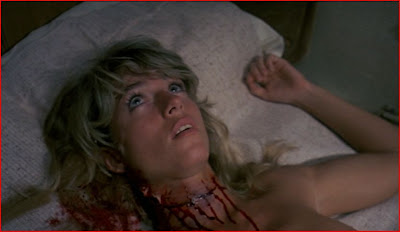
A young man driving a Winnebago camper picks up a young woman hitchhiking on the road. She's annoyed that so many trucks, vans, etc. have gone by and only one son of a bitch, as she puts it, bothered to stop for her. The young man promptly hits the brakes, making the girl knock her head on the dashboard. "So I'm a son of a bitch?" he asks, but she strives to calm the situation. Cut to a long shot of the camper at night. Cue a woman's screams. Cut to the young woman's naked, dead body. The young man leans over her with bloody scissors in his hands, but he doesn't seem to realize what he's done. He seems genuinely confused. The only thing to do in such a situation, he decides, is to start shooting polaroids of the body. Then he feeds it to the local alligators.
It hasn't taken long for Lenzi (here directing as "Humphrey Humbert") to not just defy but spit on our genre expectations. He spent much of the 1980s making brutal horror films in the cannibal and zombie genres. You'd think he'd want to build up the driver's menace, get us scared before killing the girl -- or you'd think he'd show the driver killing the girl in gory fashion, since that's what he tended to do this decade. Instead, he does neither. So we can assume one of two things. On one hand, maybe he thinks it's enough to establish the menace of the driver by showing that he has killed somebody and might kill others later. On the other, Lenzi may just not give a crap this time.
Without ruling option two entirely, I think we have to go with our first choice. Lenzi isn't making a giallo here, but a psychological thriller or a woman-in-peril movie. The woman to be imperiled makes her appearance as the Winnebago of Evil pulls into a Virginia Beach amusement ground. A crowd has gathered around a young lady performing a desultory sort of dance to some dreadful synthesizer track playing on her boyfriend's boombox. Carlo M. Cordio bravely takes credit for this Eighties concoction, though it can't do his reputation as a composer any good. You can imagine why a crowd has formed. Is the girl drunk? Is she high? Is she going to take her top off? The answer to question three is no, but I'm not quite sure about the rest.
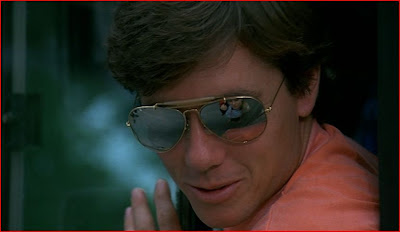
In a restaurant, the shades-sporting Winnebago driver bumps into Kevin, the girl's lunkish boyfriend, and is sullenly unresponsive when Kevin apologizes. He remains sullenly unresponsive behind his shades when two girls ask him if he wants to join them at the Madonna concert at the beach. Put off by his sullen unresponsiveness, one asks, "Who do you think you are, Mickey Rourke?" while the other concludes that he looks like a fag, anyway. Meanwhile, our driver observes that Kevin and his girlfriend are having a spat. She slaps him and storms out. Bingo.
(above) Josie Bissett storms out on Jason Saucier while Joe Balogh (see also below) looks on.
Before you can say, "Get the movie going, already!" the driver, one Mark Glazer, is offering the woman, Daniela Foster, a lift. He thinks Daniela's a nice name. It reminds him of a woman he knows, Danyetska. Daniela kind of looks like her, too, so he claims. He gets defensive when Daniela asks if Danyetska's a ballerina or spy. Don't make fun of her, he insists. She's about to quit this gig when she sees Kevin coming in his car in the rear view mirror. She crouches in the passenger seat so her pursuer won't notice her. With him safely past, she can try to be friends again with Mark. He wants to be friendly, after all. He offers her some Coke -- the fizzy soda in a thermos, that is, but not quite that innocuous. In fact, it isn't Coca-Cola at all. So always remember, children: when you're hitchhiking, never drink anything from Mr. Driver's thermos. The rest of Hitcher in the Dark will illustrate the importance of this point.
The situation is this: while we know that Mark will kill women on general principles, he has a special obsession over Daniela because of her purported resemblance to Danyetska -- his mother, who ran off with another man when poor Mark was young and fragile. During Daniela's captivity, he'll do a Vertigo on her, cutting and coloring her hair to make her better resemble his holy photograph of Mom. He also wants to screw her, but the confusing thing about this guy is, while he wants to screw her and wants to call her Danyetska, he doesn't actually seem to want to screw his mother. He doesn't call his victim "Mom," after all. But he blames the perversity of the situation for his failure to perform -- that and Daniela's innate whorishness. Still, he's determined to have her stay, and though he'd really like her to love him, he'll use the cuffs if he has to.
So the pattern is set for about 90 minutes of mental cat-and-mouse games as Mark tries to dominate Daniela and she tries to manipulate him into giving her chances to escape, all while Kevin tries to figure out what became of his girl. He eventually catches up with the Winnebago, only to be caught and tortured by Mark. In a scene Lenzi says was inspired by the Manson murders, Mark carves the word PIG into Kevin's hairy chest as if this will prove the man's unworthiness to "Danyetska." This comes the closest, I suppose, to being a gore highlight of a largely nonviolent film in the physical or effects sense of the word. Lenzi, who wrote the screenplay, is more interested in emotional violence here. He clearly had a portrait of modern evil in mind, though he complains in an interview that his producers forced him to change his desired "evil wins" finish to a revenge finale more typical of the Eighties.
I can credit Lenzi for trying, but he doesn't have the cast of actors to carry out his plan. The main name in the cast is Josie Bissett as Daniela. She went on to be a regular on Melrose Place, which may give you an idea of what to expect here. As for our villain, Lenzi says that actor Joe Balogh is better here than in the director's later Black Demons -- which may be reason to steer well clear of that film. Balogh is just too ordinary looking for his psycho role, and conveys no menace whatsoever. But maybe Lenzi wanted to depict the banality of evil. If so, Balogh was his man. Even if the acting had been better, I don't know if I'm really interested in a Lenzi film pitched, a few bloody moments aside, at the level of a Lifetime Original Movie. Hitcher in the Dark fails almost completely as an exploitation film. Whatever Lenzi's ambitions, he seems to have realized this himself. So he offers us extended footage of a wet T-shirt contest in mid-film as if it were a square-up reel. I've liked some Lenzi movies (Eaten Alive!,Rome Armed to the Teeth) and I know that some are bad, but I didn't expect any to be as lame as this one. The best I can say about it is that it was free -- for me, at least.
The trailer for Hitcher in the Dark is currently unavailable for embedding, but you can see it here. Truckertron has uploaded the introductory Virginia Beach scene, including Carlo Cordio's so-called music and Josie Bissett's so-called dancing as appreciated by a crowd of echt Eighties dorks.