
Showing posts with label werewolves. Show all posts
Showing posts with label werewolves. Show all posts
Wednesday, October 3, 2018
THE WEREWOLF AND THE YETI (La Maldicion de la Bestia, 1975)

Tuesday, February 16, 2016
DVR Diary: FRANKENSTEIN'S BLOODY TERROR (La Marca del Hombre Lobo, 1968)

Readers of this blog probably know how Enrique Lopez Egiuluz's film got its inaccurate American name. U.S. distributor Independent International was committed to deliver a Frankenstein picture to theaters, namely Al Adamson's legendary Dracula vs. Frankenstein, but the picture wasn't ready, apparently due to legal reasons. So I-I slapped a new title on the Spanish film -- the end credits offer yet another title, Hell's Creatures -- and added a prologue explaining how the Frankenstein family had been cursed with lycanthropy for its unholy experiments and renamed Wolfstein, thus explaining how the film's Imre Wolfstein is a werewolf. Ironically, a later Daninsky film, released in some places as Dracula vs. Frankenstein, was retitled Assignment Terror for the U.S.in deference to the Adamson film. More confusing still, the Hammer production Horror of Frankenstein was released in some U.S. markets as Frankenstein's Bloody Terror! Check out the Gadsden Times for January 31, 1972 on the Google News Archive if you don't believe me.
Naschy was the onscreen alter ego, adopted to win over this film's anticipated German audience, of screenwriter Jacinto Molina, heretofore little more than a bit player in movies and a big fan of the Universal horror cycle. Molina/Naschy's career project was to revitalize Universal tropes with a modern, adult Euro sensibility. Waldemar Daninsky is his take on Larry Talbot, albeit more dangerous as man and wolf. His opening scene, in which he appears at a costume party in a mephistophelean red outfit, is a warning that, however charming Daninsky may be, he's someone dangerous to know. And that's before Imre Wolfstein, recently resurrected by fools removing a stake from his heart, transmits his curse to the Polish Count. While Naschy does the Talbot torment thing well, screenwriter Molina spares himself the "they won't believe me" misery Lon Chaney's Larry often endured. Daninsky has won friends who see plainly what has happened to him and are eager to help him beat the curse. Their research turns up a potential expert on curing lycanthropy whose work was thirty years in the past. The expert's son arrives by train with his female assistant and one large wooden crate. He is, in fact, the expert himself (Julian Ugarte), a vampire who revives Imre yet again, imprisons Waldemar, and plans to make Waldemar's friends his undead thralls.
Ugarte's vampire is the weirdest thing in the picture. You know he's bad news before the reveal, as the camera approaches him warily at the lonely train station. Once he's revealed, he proves a strangely frolicsome creature, seducing an intended female victim with a running dance. Here Molina takes no cues from Universal but gives us a vampire whose spirit of amoral play reminded me of Molina's contemporary, Jean Rollin. Treating the vampire that way makes sense on Molina's own terms, however, because it maximizes the contrast between the elegant, almost ethereal vampire and the brute force of the werewolf, played by Naschy as a drooling cannonball of animal fury, especially compared to the greying Imre. The transformed Daninsky swipes at his prey compulsively, swinging his arms like he was throwing haymakers, when he isn't hurling himself at human or undead targets. Even before the makeup goes on, when Waldemar is chained, the former weightlifter Naschy thrashes about so, while an incredible chanting theme for the transformation plays, that you fear for the props. Naschy has always reminded me of John Belushi a little, and if any of you remember Belushi's Weekend Update editorials when work himself into an apoplexy and throw himself to the floor, that's Naschy just getting started. You can see how he became a horror star here; Naschy as performer and Molina as writer infuse the old tropes with an unprecedented level of energy, while the widescreen cinematography and terrific locations and sets give Daninsky the biggest possible showcase. Frankenstein's Bloody Terror isn't free of the curse of dubbed Euro-horror: bland supporting characters are rendered still more bland by dull dubbing, and either this cut or further cuts imposed by Comet eliminated nearly all of a final fight between Daninsky and Imre. Most of the time, fortunately, the slow bits are redeemed by the pictorial spectacle, even in what looked like an unmastered print. Under even worse broadcast conditions long ago, Frankenstein's Bloody Terror inspired people to seek out more of Naschy's work. It has been a while since I'd seen any Naschy movies, but now I want to get back into the habit.
Sunday, December 19, 2010
Wendigo Meets THE TWILIGHT SAGA: ECLIPSE (2010)
 To review: my friend Wendigo is invalid enough that he can't sit in a movie seat comfortably, and so has just seen the third filmed episode of the Twilight series this weekend. And while he yields to no one in his love for the vampire movie tradition, he defends the work of Stephanie Meyer against all comers, rejecting entirely the idea that her portrayal of vampires is somehow wrong or inherently bad. To date, he has liked Catherine Hardwicke's film of Twilight pretty much unreservedly, while finding Chris Weitz's New Moon a considerable slip in quality while still a tolerable movie.
The third film has David Slade of 30 Days of Night for a director and a new vampire villainess, Bryce Dallas Howard taking over the role of Victoria, the arch-enemy of the benevolent Cullen clan. The rest of the cast remains the same, while the famous triangle of Bella Swan, Edward Cullen and Jacob Black grows more sharp-edged. The young men and their respective clans, Edward's vampires and Jacob's shapeshifters, must quiet their rivalry to defend Bella from attack by an army of newborn bloodsuckers raised by the vengeful Victoria. Newborns, we learn, are actually more powerful (by virtue of retained human blood) than more experienced vampires, and must be handled with extreme care if you're to kill them. Hovering over the entire scene are the imperious Volturii, who offer Victoria no aid but would be happy to see her exterminate the annoying Cullens before they renege on their promise to turn the promising Bella, as Miss Swan herself desires but Edward would rather not do.


Wendigo reminds me of the common reading in which Edward embodies an old (though not to him) ideal of chastity. In past comments he's compared Twilight to fairy tales in which marriage is the gateway to happily ever after, while Anita Blake comes out of a different kind of romantic tradition in which sex itself is the consummation. Edward's embodiment of traditional values is what makes him difficult for monster-movie fans to comprehend or perhaps even like. He's a vampire, but not a monster. Wendigo has read the Anita Blake books and assures me that her boy-toys are monsters through and through, though some are reasonably noble. The idea of a monster doesn't preclude the idea of a noble monster; many such creatures are beloved by horror fans. But monsters by definition have an aura of danger, threat, even tragedy that simply doesn't exist for Edward Cullen, for all he talks about how dangerous his love might be. Monsters can struggle for self-control and win our sympathies by failing in their struggle and regretting their failure. By that standard, Edward isn't just something other than a monster, but someone too good to be "true" for many horror fans.

In the Twilight saga evil is a matter of choice rather than identity. In Eclipse, the noble Cullens (above) face off against the feral newborns (below).


Twilight's werewolves can also choose their enemies. In Eclipse, they warily side with the Cullens (above) against the newborns (below) for Bella's sake.

While reading the novels, Wendigo leaned toward "Team Jacob" because even he got tired of Edward's self-pity in print. But after reading Breaking Dawn he switched to "Team Edward" for reasons he can't divulge without spoiling the films yet to come. He still likes Jacob better as a character, but felt that, in the end, Edward was the "right" one for Bella. Wendigo still likes to insist, however, that he belongs to "Team Bella," since Twilight is her story, and he'll stand by the character's ultimate preference.
So much for setting the stage. I agree with Wendigo that Eclipse is a big improvement on New Moon. The direction and the acting is more relaxed; all three lead actors are more casual and personable than last time, and Pattinson is the best he's been in the series so far. Slade makes more of the spectacular locations and the story seems better paced. Where New Moon seemed impersonal, perhaps because it was rushed into production, Eclipse, though just as rushed, has more style and personality. Slade has advanced as a director from 30 Days of Night, but he has more material to work with and plays more to his original material's strengths here than he did when adapting the graphic novel. One flashback scene (the film has three) is imported from another novel, and some of the mechanics of supernatural combat are altered (in the novels, you can only dismember a vampire with your teeth), but the movie is reasonably faithful to the book.
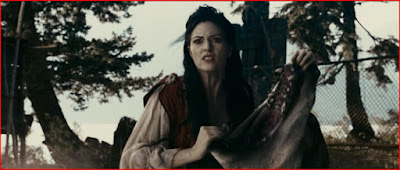


Flashback-a-rama: From the top, the "Cold Woman" battles ancient Indians; Rosalie Cullen remembers a fatal wedding; Civil-War Jasper is beguiled by a vampiress.
Bree Tanner, who became the heroine of her own novella last year, is a somewhat more prominent figure in the film than in the book, but that's no cause for complaint. Victoria's new boy-toy Riley, her puppet-leader of the newborn army, is built up more here than in the novel, but that's only to the story's benefit. The battle scenes with Cullens, werewolves and newborns are violent without being gory, thus keeping the movie safely PG-13, since under Meyer's rules vampires break rather than bleed.


There's one book and two films to go as Summit Entertainment goes the cynical Harry Potter route to maximize revenue from its tentpole series. Breaking Dawn Part I comes out next November, followed by the conclusion a year later, with Bill Condon directing both installments. Wendigo wonders whether the final novel can be split in a way that doesn't leave the first film empty or the second film nothing but a big fight scene. He also doubts whether Summit will sacrifice the all-important PG-13 to do justice to the novel's more explicit sexuality, violence and childbirth. To date, the film series, in Wendigo's opinion, has been more good than bad, stumbling in the second round like the Potter series did but back on solid ground by the third episode. He'll have to be more patient than most folks waiting for the final films, but for now he's still looking forward to them.
Tuesday, November 30, 2010
DR. JEKYLL AND THE WEREWOLF (1972)
 Jacinto Molina died one year ago this week but on film he lives on as Paul Naschy, the last of the old-school horror men, an interpreter of the classic monsters who translated the naive fantasies of Universal Studios into the idiom of Seventies exploitation without losing the original sense of wonder. To mark the anniversary of his passing I'm contributing to a memorial celebration blogathon coordinated by the Vicar of VHS and the Duke of DVD of Mad Mad Mad Mad Movies fame, but I fear that my tribute isn't all it could be. That's because I chose to watch Leon Klimovsky's Dr. Jekyll y el Hombre Lobo in a version provided by Mill Creek Entertainment as part of its new Pure Terror collection. In its original form, the film is 96 minutes long. Mill Creek's version is barely 72 minutes; more than a quarter of its running time is gone, including the opening credits. The remainder is an awkwardly disproportionate film that feels like two separate projects grafted together and leaves you wondering for the longest time when Dr. Jekyll might show up.
We seem to be moving far from Jekyll territory immediately as Imre, an Anglo-Hungarian gentleman, and his new bride Justine take their honeymoon in the old country so Imre can commune with his dead ancestors. A well-off tourist, Imre is an instant target for the local riffraff, and he will go exploring in odd places despite warnings of a monster in a nearby castle. Why worry about monsters, though, when the countryside has plenty of mundane carjackers and rapists to offer? In short order Imre is stabbed to death and Justine is prepped for gang rape. All the while, however, a monster has been watching, but now Waldemar Daninsky has seen enough.

Waldemar Daninsky (Paul Naschy, below) works himself up to the proper state of outrage before intervening to break up a gang rape.


Ding, dong, the witch's head.
With his friends dead and a widow wanting to go home to England, there's nothing to keep Waldemar in Transylvania anymore. Indeed, Justine just happens to have a friend who might be able to help the poor Pole with that curse thing. The friend is Dr. Henry Jekyll, grandson of the famous fictional physician and inheritor of his research into the isolation and concentration of evil in human form. He's been busy refining granddad's formula, and he has an idea that could help Daninsky. It goes like this: Jekyll will inject Waldemar with granddad's formula just before the next full moon. Daninsky's transformation into Mr. Hyde will counteract the effect of the curse, Hyde's concentrated evil will being stronger than the werewolf's. Once the crisis is past, Jekyll will hit Hyde with the newly improved antidote, restoring a civil Daninsky and curing the curse. Despite a setback when Waldemar is trapped in an elevator at the rise of a full moon, slaughters a nurse, and rages into the night, everyone resolves to carry on with the experiment.

"Why do things happen?" Waldemar waxes philosophic just before tearing a nurse's throat out with his teeth. Below, the werewolf steps out.


Above, "Waldemar's Hyde!" The scientists mean to say that Waldemar is now Mr. Hyde, but he does show plenty of hide in this shot. Below, I saw Waldemar Daninsky in the streets of London, but the hair he wore was funny, through no fault of his own.


Sandra "hydes" a dagger in Jekyll's back. Get it?
And here we come up against the limitations of the Mill Creek edition of the movie. In that, the reign of terror of Hyde Redux consists of 1) pushing a drunk into the Thames, 2)impaling Sandra on a torture device in a fit of temper and 3)flirting with girls in a bargain-basement discotheque in the dregs of Swinging London. It's a short reign; the Hyde formula is in limited supply, and in time an embarrassed Waldemar finds himself among the go-go dancers just as the full moon cues a nifty stroboscopic transformation scene. That sets up the inevitable showdown as the werewolf targets Justine, who may have learned to love Waldemar enough to kill him....

Above, a Polish werewolf in London. Below, a continuity error: this shot of Shirley Corrigan as Justine comes from much earlier in the picture, but I thought it looked best here.

I'm reluctant to judge Klimovsky's film on such limited evidence, but I do feel that it retains the odd charm of Naschy's work. My only real complaint is the absence of a worthy antagonist for the werewolf to fight, it being impossible, after all, for Hyde and the Werewolf to fight. A good dream sequence could have taken care of that, however. Anyway, count me among those already won over by Paul Naschy's curious charisma and his commitment to the monster movie tradition. Even in its vivisected form, Dr. Jekyll and the Werewolf didn't damage my regard for the man and his work.
There's more where this came from all over the Internet this week. Look for this sign for a wide variety of Naschiana from fans and critics throughout the blogosphere.

Friday, July 9, 2010
THE WOLFMAN (2010)
 It's one thing to make a film about a werewolf. It's another thing if you claim to base it on a screenplay by Curt Siodmak and open the film with the famous verse, "Even a man who is pure in heart and says his prayers by night..." Even if you mess with the spacing, presumably to pre-empt the instant rip-off artists out there, I presume that you're making a film about Larry Talbot. You can dandify him a little, make him an actor instead of an engineer and insist that everyone call him "Laurence," but I have a right to expect that this is basically the same person Lon Chaney Jr. played in the 1940s. At the very least, Talbot should re-enact his distinctive character arc, or else why bother using the name? But what's distinctive about his story? The big deal about Larry Talbot was that he knew something was terribly wrong with him, that he had, in fact, become a monster, but could not make people understand that fact. They wouldn't listen, you see, because they could hardly even imagine a "wolf man," much less that a gypsy curse could make you one. This was 1941, after all. There's no place for superstition in our streamlined modern world. But maybe you don't want to set your remake back in the Forties. That's fine. A remake true to the spirit of the original could easily be set in the present day. In fact, it probably should be.
Well, guess what? Writers Andrew Kevin Walker and David Self and director Joe Johnston set their Universal-approved remake in 1891, and they planted poor Talbot in possibly the most superstitious community in the entire United Kingdom, one more credulous, quite probably, than any actual place of the period. These villagers pretty much assume that Talbot will be a werewolf before he even grows a hair out of line. He has no problem convincing them of his trouble. His challenge is to keep from getting lynched. But our masterminds do bow in the direction of the original film's prevalent incredulity by relegating a captive Talbot to the custody of London scientists who appear to have ignored all reports from the field on Laurence's exploits. They refuse to believe he can become a monster, but they torture him anyway to dissuade him of his delusion. It's as if, between the scientists' stupidity and their viciousness, the filmmakers want us to root for the Wolfman to massacre them. That gets us about as far as Forties Universal as we can get, and it's really just about as far from Victorian England.
But let's go back to our old friend Larry. The main reason he can't get people to believe that he's a Wolf Man is that no one sees him as one until it's too late for them to report what they've seen. In part, that's the Wolf Man's fault. From what we can tell, Larry would get itchy, take off his shoes, and then the Wolf Man would go out, find some lone person in a dark, isolated location, rip the person's throat out by grabbing their shoulders and shaking them vigorously, and then go home. Afterward, Larry could claim to have killed someone, and folks would scoff. They might concede that Larry's a little loony, but they won't do anything to stop him from what they don't think he's doing. That's the horror and tragedy of his situation: he can't stop himself and he can't get anyone else to stop him.
In the remake, the Wolfman prefers to attack in crowded areas and doesn't seem to tire easily of disemboweling, amputating, decapitating and so forth. Since he is still not the most efficient killing machine, he invariably leaves dozens of witnesses who can attest to the existence, at the least, of a murderous lunatic, and more likely, depending on the location, of the devil himself in action. So again, Talbot has to be transported far away before he can find people who wouldn't believe him. All of this seems to miss the point of the original Talbot story, and if you want to argue that that point isn't relevant, then why do you want to have a character called L. Talbot in your movie?
The remake misses just about every point possible. It tries to make points of its own -- and misses those, too. It wants to be about fathers and sons in a more antagonistic way than the original, and it also wants to indulge in silly homages to King Kong when the Wolfman runs amok in London. Nowhere in the two hours of the director's cut can the naive sincerity of George Waggner's original film be found. Lon Chaney Jr. may have had his limits as an actor, but you couldn't accuse him of phoning in his performance as Larry Talbot. You can't do that with Benicio Del Toro, either; it'd be more accurate to say he tweets it in. There's definitely a character limit to his work. The man is playing a 19th century actor; you'd think he might project a little? Instead, he seems to be taking lessons in alienation from Sir Anthony Hopkins, who manages to make no human contact with anyone else in the picture. Maybe that's just the character he plays, you might suggest, but I've seen him do this before. He's doing "Anthony Hopkins" the way Samuel L. Jackson does "Samuel L. Jackson" so often. Enough gruff bluff and he's earned his money, and somehow people keep paying him to keep doing it. There are other actors in the film, but there's no point in reproaching them. They're just as much victims as we the viewers are, I suspect.
How badly did the remake fail? I watched it with my friend Wendigo, who is as much a werewolf fan as he is a vampire fan. The Wolf Man, Larry Talbot is his favorite movie monster. There came a point in this film, after Hopkins had clarified some plot points, made a Shakespearean allusion and winked at Del Toro, when he almost asked me to turn the film off. When you consider what he's sat through for our weekly vampire screenings, that's pretty damning.
The experience left me wondering whether the essence of Larry Talbot could be recreated today. You could argue that Larry's increasingly desperate effort to learn how to die made him an appropriate antihero for male audiences during World War II, but I might save that argument for another time. For now, I'll leave you to ponder whether such a struggle could have the same impact, consciously or subconsciously, acknowledged or not, that I presume it had back then. Maybe the remakers had to take a different approach. I just wish they'd taken a different different one.
Sunday, March 28, 2010
Wendigo Meets NEW MOON (2009)
 Catherine Hardwicke's Twilight was one of the last films my friend Wendigo saw in a theater, due to his advancing invalidism, and one of the first films reviewed (based on his report) on this blog. He had to wait until this week to see Chris Weitz's sequel when the DVD arrived in his mailbox, and to an extent he's been spoiling for a fight with all the Twi-haters out there. He yields to no one in his vampire fandom, and his isn't bound by any notion of what a vampire should be, since there is no such thing as a vampire. It's essentially a fantastical creature, and from his reading and viewing Wendigo finds that vampires fit as well in fantasy or romance stories as they do in horror films. Horror fans don't have to like non-horror uses of vampires, but they have no business arguing as if such uses are inherently wrong. Folklore from the Middle Ages forward, he claims, is full of vampire lovers who are not simply bloodthirsty bogeymen, so today's trend is really nothing recent or decadent. Call either film bad if you must, or all of Stephanie Meyer's books, but be sure you mean that they're badly written or directed or acted, not simply that they're stories you're not interested in.

The scariest men in movies today? Robert Pattinson and Taylor Lautner certainly seem to give lots of folks the willies for some reason or other.


Future bandmates Kristen Stewart and Dakota Fanning, among others, in New Moon. You simply can't go wrong with sticking a bunch of mismatched people in an elevator. Below, vampire Tony Bla--I mean Michael Sheen asks, "What are you looking at?"

***

While the big-budget vampire show was a bit of a letdown, Wendigo would like to send you home with a low-budget recommendation. He recently saw Mark James and Phil O'Shea's Vampire Diary in an edited-for-TV broadcast on the Chiller channel. It's a British pseudo-documentary about the accidental discovery of a real vampire that is pound-for-pound (or dollar-for-dollar) much more effective than New Moon. An unedited version includes a lot of hot lesbian action, which makes it something I'll watch some day, but Diary isn't just prurient. Wendigo saw some real imagination both in the writing and the direction that New Moon was too often sorely lacking.
Take a look at a trailer for Vampire Diary, uploaded by monarch movies:
And as a change of pace, here's the Eclipse trailer, uploaded by clevverTV
Tuesday, March 2, 2010
Wendigo Meets DRACULA THE DIRTY OLD MAN (1969)
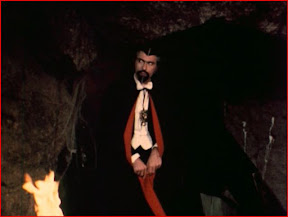 Either way, it was going to be an ordeal. The next movie on my friend Wendigo's to-do pile for our vampire series was Vampirella. I was steeling myself for the task when he reminded me that it was my turn to provide a film, the Larry Talbot movies having come from his collection. That meant it was finally time for him to discover William Edwards's attempt at softcore horror-comedy.
What did he see? "Honestly, not a whole lot," he reports, "Basically, we have your standard plot of European vampire moving to America, establishing himself in a run-down location, picking some schmoo to be his local lackey and sending this poor retard to maim, kill, and retrieve food for him."
"Food," in this case, is women. "They are food for Dracula and for his lackey, who is transformed from hapless reporter to novice jackalman simply by the vampire's will. Dracula may as well say 'poof!' and make it so. But like Andreas from The Return of the Vampire, Irving Jackalman eventually resists the vampire's will. In this case it's because he wants a woman to rape, and Dracula won't let him. So they slap one another around, Dracula bashes in Irving's head with a rock (that already has Irving's blood painted on!), then just happens to stagger backwards out of his cave into the sunlight. Noticing his peril, he staggers back inside, and into his coffin. But it's too late. His hand becomes a skeleton, and then his whole coffin disappears, as do the female victims he's left hanging naked on scaffolds, and the scaffolds -- for a while. The vampire's demise cures Irving of jackalmanhood, and he celebrates by screwing his girlfriend in the cave, just after she's finally thrown her clothes back on after running through the cave for long minutes, never noticing the cave entrance within twenty feet of where she'd started. That may sound silly, but the scenes of the woman running through the cave clad only in her shoes is actually one the few highlights of the film."

Werewolf (well, jackalman) and vampire on a collision course of terror!
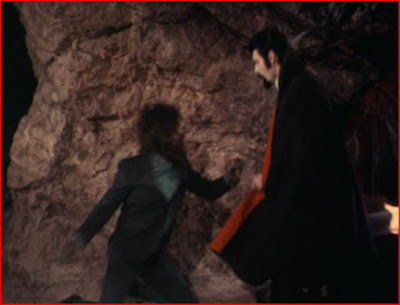


Victims: Stricken by the jackalman's claws (above) and the vampire's bite (below!)

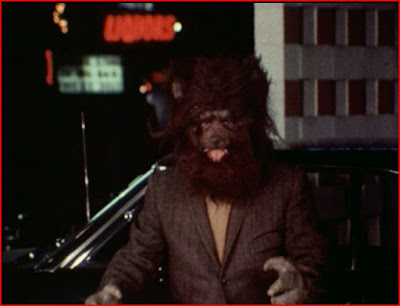
"Irving Jackalman strikes again -- heh heh!"
Make no mistake: this film is inept at every level. The cave set barely qualifies as a set, the bat effects (on a stick!) are indisputably the worst ever, and (our admiration for some of the actresses aside) it fails almost completely as softcore porn. As a failed comedy it's in the danger zone of eligibility for Worst Movie of All Time, but I think it has just enough distinguishing eccentricity to save it from infamy. Just bear in mind that this is a comedy you'll be laughing at rather than with.
* * *

Dracula the Dirty Old Man headlines a Something Weird DVD from the good old days of their Image Entertainment deal, packed with extras. Along with the trailers and promo art galleries, there's a second feature (Guess What Happened to Count Dracula, to be covered later), the aforementioned debacle Dracula and the Dirty Old Witch and another good-sized short, Sex and the Single Vampire. This one is worthy of note because it compels me to report that a young John C. Holmes as the disgruntled-then-(slightly) aroused vampire, is probably the best actor on the entire disc. Judge the contents accordingly.
Or simply judge from this clip uploaded to Dailymotion by scootaway:
Thursday, February 18, 2010
Talbot vs. Dracula, Part II
 When Larry Talbot responded to a woman's distress call in Dr. Edelmann's house, he had no idea until after the fact that he was about to have a close encounter with Count Dracula. It's unclear from the evidence of House of Dracula whether Larry even knew that "Baron Latos" was a fellow patient of the great scientist. Yet the next time we see Talbot, he is a sworn enemy of the Count and all his evil works (whether Dracula knows this or not), tracking him across the Atlantic to thwart his latest scheme. Asked why he must battle Dracula almost on his own, and definitely without police aid, Larry tells a new friend that going to the cops would require him to explain "why I know what I know." But what's to explain? Why can't Larry simply say that he was being treated at the late Dr. Edelmann's clinic in Visaria when he encountered the vampire? Leave aside whether American cops would believe the vampire part; unless Talbot has a compulsion to tell the whole truth he shouldn't have to say that he was a werewolf, or believed himself to be, at the time....that is, unless Larry was talking about something else that explains why he knows what he knows about Dracula.
There's an obvious temptation to try to draw a line of continuity from House of Dracula to Bud Abbott [and] Lou Costello Meet Frankenstein (1948), to give the film its full title, but is it necessary to try? My friend Wendigo says he used to wonder how Larry's cure from the previous film failed. For amusement purposes only, he speculates now that Dr. Edelmann's surgery simply lacked lasting effect. The pressure on Larry's brain may have reasserted itself, or his curse may have. While there is no compelling reason to identify Charles Barton's comedy as a sequel to Erle C. Kenton's monster rally, Wendigo, like many people, can't help thinking of it as one. When Larry talks of what he knows, then, he could just be referring to the events of House (which Dr. Edelmann would have to have filled him in on in the doctor's declining moments of sanity) or he could be dropping a hint of a to-date untold story that may link Talbot's pursuit of Dracula to the resurgence of his curse.


Lou Costello stoically faces Bela Lugosi's silent command (above) and Glenn Strange's silent scream (below).


Dr. Mornay (Lenore Aubert) spies while Joan Raymond (Jane Randolph) scans The Secrets of Life and Death at a costume party. Below, Mornay likes to dress up as an evil crypto-fascist nurse for professional occasions.

For many monster fans, the highlight of A&CMF is Bela Lugosi's return to the role that made his name, whose name he made. Wendigo thinks it's always great to see him back, especially since he looks in much better shape than he did in the (still good) Return of the Vampire. Compared to that film of five years earlier, it looks like at least five years have fallen away from him. But have the years changed his approach to Dracula? One change that occurred to me was that the character now has to deal with the legend of Dracula (by concealing his identity) in a way that Tod Browning's Dracula didn't. For his part, Wendigo sees some subtle differences in the two performances. There's a hint of doomed melancholy to the 1931 Bela, and a sense that Dracula is an unnatural force of nature. In 1948 Dracula is more evil, more of a schemer, more inclined to revel in villainy. But there are more differences between Lugosi and his imitators (Latos, Alucard) than between the '48 and '31 models. For starters, those so-called Draculas are hapless creatures with few survival instincts. More signifcant is Dracula's dominance of a briefly-defiant Mornay compared to Alucard's virtual victimization by the femme fatale of Son of Dracula. Bela makes it plain: "I am accustomed to obedience from women," and he gets it. Another difference: the pseudo (or crypto?) Draculas from the Forties get by with mesmerism, a learned skill almost, while Lugosi's Dracula dominates people by overwhelming force of pure will. He can command from a distance in ways his emulators can't dream of. However you may feel about the way the monsters are used here, Bela's Dracula is the real deal.

It wouldn't surprise us if fans don't feel the same way about Lon Chaney Jr.'s Wolf Man. As Larry, Lon is impeccable, as impressive and heroic as he's ever been despite his bouts of despair and guilt. But the Wolf Man is still under the constraints necessary for the film to treat Larry as a good guy. That means he has to be an ineffectual monster in two scenes in which he proves incapable of even pouncing on Wilbur, instead tripping and tangling himself in every possible impediment. It's fair to ask what's worse: the fact that the Wolf Man can't escape from a locked hotel room or the fact that Lou Costello bops him on the nose, mistaking him for a masked Abbott, and survives? It's also fair to remind ourselves that the film is meant as a comedy, and that, as Wendigo reminds, me, Chaney was a very good sport about taking his monster's pratfalls. None of this compromises Larry Talbot's role as a hero, if not the hero of the movie. Wendigo adds: if he can't consider The Munsters a travesty of the Universal monsters, he can't complain about this film.Lou mugs like mad, and brilliantly, in the "young blood and brains" scene, but he has to to keep Bela from stealing the scene just by wearing that smoking jacket.

In any event, the Wolf Man redeems himself a bit by taking down Dracula after a rather absurd battle that sees the desperate vampire throw everything he can lay hands on at the persistent lycanthrope. Bela even resorts to hitting him with a chair, rasslin'-style. You can ask whether the Wolf Man attacks Dracula because he knows the vampire is the enemy, or just because Dracula is there? On the other hand, the vampire's enmity toward the werewolf seems to be a matter of panicky disgust, as if Dracula had seen a large rat. In any event, Larry gets the job done even if it means a dip in the rocky drink. Do they both die? Well, Dracula is clearly out of action because the plunge breaks his power over Joan Raymond, but on the evidence of Talbot's suicide attempt in HofD it's definitely debatable whether the drop would kill the Wolf Man. It may be best for us to wish Larry Talbot godspeed on his long, long journey home -- or back to Europe, or wherever."Grrrrrr!" Even Bud makes fun of the Wolf Man, but his playacting gets him in trouble later in the picture.


"Back...back... He thinks I'm Dracula."
Abbott & Costello are Wendigo's favorite comedy team, and he has many fond memories of Sunday morning double-features on WPIX. I didn't like them as much as he did back then, but every time I see A&CMF I get an urge to see more of their films. Some time ago I put this film on my list of ten favorite comedies, and I'd say that Lou Costello gives one of my favorite comedy performances ever in it. With Bud and Lou in top form and the return of the monsters, I'm inspired to ask: does any other Hollywood studio have a film in its library that is as definitive an expression of its creative identity as this film is for Universal? Abbott and Costello Meet Frankenstein is Universal's monument.
And here's the Realart trailer, uploaded to YouTube by horrormovieshows
Subscribe to:
Posts (Atom)