Showing posts with label women in prison. Show all posts

Friday, January 10, 2014

Pre-Code Parade: PAID (1930)

Joan Crawford is a pioneer woman-in-prison in Sam Wood's Pre-Code adaptation of a 1912 chestnut, the Bayard Veiller play Within the Law. As Mary Turner, Crawford is sent up for shoplifting on the job at a department store. Mary says it's a frame-up but who'll believe her, especially after she uses her sentencing hearing as a platform to rant against her employer for his cheap, heartless ways. There's a nice bit of early cross-talk as Mary, her boss and his lawyer all try to make themselves heard in the courtroom. Crawford gets a very early prison shower scene noteworthy, alas, for its whiff of racism. Unlikely as it seems, there's only one black woman in prison with Mary, and maybe for that reason Mary reacts like that woman is carrying plague when they end up side by side, naked, in the shower. The wall of the stall covers the naughty bits, but the sight of bare black and white legs in such proximity no doubt titillated or scandalized many in the original audience. Happily, the black prisoner gets the last word, gently mocking Mary's revulsion. "Don't worry honey," she says, "It all goes down the drain!"

Paid doesn't linger in prison, since its real subject is Mary Turner's pursuit of revenge against her oppressors. With no opportunities for an honest living on the horizon after her release, she falls in with a gang run by Joe Garson (Robert "Carl Denham" Armstrong). Mary and other women seduce, entrap and extort wealthy men with threats of breach-of-promise suits. Mary hits the law books and is able to tell the cops off when Garson's schemes are within the letter of the law. Meanwhile, she pursues her own agenda, seducing the son of her former employer. The object this time, however, is to humiliate the old man by actually becoming his daughter-in-law. But you know how it is. The kid is handsome and doesn't care that he was only a pawn in her plot, and she has real feelings for him. Meanwhile, the cops come up with a preposterous plan to trap the Garson gang. Their plant tries to convince Garson, who has extensive burglary experience, that the Mona Lisa is being kept in a local mansion. Garson himself is skeptical at first; he knows about the 1913 theft of the famous painting, but the plant assures him that a fake was returned to the Louvre, while the real Leonardo came to America. It doesn't take much to convince Garson after all, but the break-in ends in predictable disaster, with Mary's husband blundering into the middle of it while the plant gets killed.

The film's final act is a melodramatically psychological cat-and-mouse game pitting the cops against the members of the Garson gang. Mary refuses to rat out Garson, while her husband, not wanting Mary to take the rap for the killing, claims responsibility himself. Mary backs him, believing that he can dodge the chair by claiming self-defense. Mary's wise to the cops' tricks, alerting her husband to a bug in the room where the detectives expect them to incriminate themselves. Finally, Garson himself is brought in and made to believe that his cohorts have already confessed. Ultimately, however, Garson succumbs to the Pathos of Renunciation. He's had feelings for Mary, too, and he realizes that the only way to spare her another term in jail, or to give her a chance at a fresh start with a husband who loves her, is to take the rap himself, even if it means the chair. He puts on a brave, blithely hard-boiled face, but neither he nor the detectives are fooling Mary by assuring her that he won't burn. Fortunately, she has hubby's handsome shoulder to cry on. All of this shows the source story's age by the time Paid winds up; it may have seemed as hokey in 1930 as it does now. The film earns just about all its Pre-Code points in the prison scene, but Crawford's intensity keeps things watchable throughout. Her smart, tough-minded antiheroine is a more compelling criminal than Armstrong's old softy, and deserved a slightly better showcase.

Monday, April 29, 2013

Pre-Code Parade: HOLD YOUR MAN (1933)

Metro-Goldwyn-Mayer may not have made the grittiest Pre-Code pictures, but theirs are some of the earthiest. In Clark Gable and Jean Harlow they had two of the most unapologetically sexy performers of the period. There's a carnality to them that sometimes makes the Warner Bros. crew of gangsters and gold diggers look merely cartoonish by comparison. After Victor Fleming's Red Dust Metro knew they had a combination that clicked. Sam Wood reunited them, with Harlow billed on top, for Hold Your Man, a grifters' love story. Gable's a clean-shaven con man fleeing the cops; he seeks refuge in Harlow's apartment, walking in on her bath as he searches the place. She screams but adapts quickly, like sympathizing with like. When the cops arrive and she answers the door Gable has settled into her tub and lathered his face so they won't recognize him. He only had time to take his shirt off and his pants are soaked. She has men's pants to spare and a photo of Stuart Erwin on her bureau. For those unfamiliar with Erwin, just read "schlub" or "loser." Harlow's out to drain him of everything she can get; we see her with him on a dinner date dumping her handbag in the ladies' room and whining that she must have lost it on the street -- with her rent money inside. Erwin hands the same amount over just as a washroom attendant returns the handbag. Erwin's a forgiving soul and a good guy at heart -- too good for her, Harlow will eventually decide. He's simply no competition for Gable. Harlow and Gable are soon working a con together, she enticing men to the apartment, he bursting in, in the role of her brother, to shake the mark down. Except that Gable starts jumping the gun and getting too rough with the marks. He can't stand to see them laying hands or lips on Harlow for even a moment. After punching the last mark through a doorway, he storms out with Harlow to get a marriage license. They leave the man laying and he stays laying.


In fact, Gable has killed the man, the mark having bashed his brains against a corner wall. By the time our lovebirds come back home there's a crowd outside and cops crawling through it. Once they figure out what's up they flee and are separated. Harlow is caught, tried and sentenced to a reformatory without ratting out Gable. There are all kinds of interesting people at a reformatory. It's a politically and ethnically diverse environment. There's a house socialist expounding on the class struggle to anyone who'll listen; Harlow makes the mistake of asking what the difference is between socialism and communism and comes to regret it. Theresa Harris (Barbara Stanwyck's maid and sidekick in Baby Face) plays Lilly Mae, a preachers' daughter gone bad whose race is no barrier to mingling freely with the white cons. There's also Gypsy, Gable's ex-girlfriend and Harlow's enemy. They've tangled before and they tangle now. Gypsy's a slapper and Harlow's a puncher; that's how you tell the real women of Pre-Code Hollywood. Harlow may be able to wipe the floor with all of them, but somehow she isn't happy. She misses her man at the worst possible time; as the picture takes its time saying outright, but makes clear early enough, she's carrying Gable's child. Erwin shows up for a visit, learns of the trouble, and offers to do the stand-up thing, but Harlow drives him away, only to break down and cry. Gypsy finally gets to gloat when her time is up first. She threatens to take Gable back and when she learns of Harlow's plight she gives her the horselaugh. But something happens offscreen to get a happy ending started. Somehow Gypsy returns as a visitor to facilitate a meeting between Gable, still a fugitive, and Harlow. It so happens that Lilly Mae's father is coming to visit that same day, and it also so happens that Gable still has that marriage license. It's all very tearjerking at the close, if not also transgressive in true Pre-Code style for the lovers to be united in the sacred bonds of wedlock by a black man. Too weepy in the end, perhaps, with Gable and Harlow promising to reform, but I guess that's the price you pay for the good stuff in the first hour. It's a fun film overall, a star vehicle carried along by the lead couple's charisma and some nice touches from the director. It has more honest erotic energy than most contemporary films and certainly helped cinch Gable's claim to the Hollywood He-Man throne. He wouldn't be second-billed for much longer, and he had Harlow, among others, to thank for that.

Sunday, April 21, 2013

DVR Diary: HOUSE OF WOMEN (1962)

They should have called it House of Women and Children. Nothing quite kills the buzz of a women-in-prison picture like a bunch of toddling brats, but the maternal bond is a big deal in this latter-day social-problem picture from Warner Bros., credited to Walter Doniger but mostly shot by writer Crane Wilbur. It worried me at first to see stock footage from (I believe) the pre-Code prison picture Ladies They Talk About over the opening credits, but Doniger and Wilbur were able to assemble a respectable number of she-cons for a B picture, just not as many as were available to a studio director thirty years earlier. The story here is that Erica (Shirley Knight) is doing five years as an accomplice to robbery -- we later learn that she was essentially innocent -- but arrived in the clink without the authorities knowing she was pregnant with her dead husband's baby. When the compassionate, alcoholic prison doctor (Jason Evers) discovers this, Erica expresses her hope that she'll lose the baby. Little does she known that a women's prison is practically a government-run nursery. She'll get to keep her little girl until the child turns three, and she'll be up for parole shortly after that birthday. If she plays her cards right, she should be able to keep her baby once she becomes a free woman. One factor complicates things: the male warden (an unusually mustachioed Andrew Duggan) is a misogynist who dislikes the idea of babies in prison, yet falls for Erica when she works as a maid at his home as a trustee. The warden's bitter because, back when he ran a men's prison, his wife ran off with a parolee. Not trusting Erica to be faithful, or even to think of him, once she's free, he works to deny her parole, not long after her daughter has been taken away while Erica was planning a big birthday party for her with all the convict mommies and their kiddies. Add to that somebody else's unsupervised brat taking a dive off a roof and we're gonna have ourselves a riot....

The women are all quite demure if not chic in their prison dresses, their semi-sensible shoes and their thoroughly styled and sprayed Sixties hair -- except for the token pants-wearing "butch" whose idea of harassing a straight con is defacing her photo of Troy Donahue. Action takes second place to melodrama here, which is probably for the best given the big action scenes we get. The most memorable of these is the riot that breaks up that aborted birthday party. While Erica faints to retain her innocence, her convict pals turn on the guards, throwing chairs, presents and the birthday cake at them. Whoever directed this scene breaks it down to a bunch of sight gags, whether they intended them to be funny or not, intercut with shots of crying or inert children. For this kind of picture an earnest speech is part of the camp value and we get one on the disadvantages of the parole system from one of Erica's friends (Barbara Nichols), an ex-stripper who refuses parole because it hardly qualifies as freedom when she can't associate with her friends and "can't die without asking permission." Overall there's too much playing for pathos and too many damn kids laying around for House of Women to rise to guilty pleasure level. This has to be one of the last WIP pictures before changing production standards allowed more honest sleaze, and it proves that the change was probably overdue when it came.

Tuesday, June 5, 2012

DVR Diary: LADIES THEY TALK ABOUT (1933)


Ladies: proper prison etiquette dictates that you not slap Barbara Stanwyck in the course of your petty disputes, because she will punch you in the face. That's one of the lessons learned in this Warner Bros. collaboration between directors Herbert Bretherton and William Keighley. If Ever in My Heart offered the Pre-Code public a new, goody-good Stanwyck, Ladies They Talk About is the good old bad Stanwyck, the same one that made the now-legendary Baby Face later in 1933. Here she's Nan Taylor, an unrepentant gun moll who puts on an act to give her gang an in at a bank. The gang (led by Lyle Talbot) gets the loot and gets away, but Nan has to stay behind to finish her innocent act. Unfortunately, one of the investigating officers recognizes her as a hardened crook and takes her in. Her looks make her a newspaper cover girl and attract the attention of moral crusader David Slade (Preston S. Foster), who calls for a crackdown on crime from his revival pulpit and on the radio. Turns out he and she are old school chums, she a renegade parson's daughter. He thinks she can reform and appeals for her to be released into his custody, but she makes the mistake of admitting to him what she wouldn't admit to the cops. He promptly rats her out and dooms her to a term in prison. 

Nan's place of confinement sometimes seems more like a girl's dormitory than a women's prison. The convicts are allowed to decorate their rooms as they please -- as long as they don't make an opening to the outside. Nan's fellow cons are an eclectic bunch, from a cigar-smoking butch lesbian who impresses her cellmate with her constant exercise to an aristocratic murderess who thinks of the others, especially a black prisoner named Mustard, as her servants. Playing Mustard, Madame Sul-Te-Wan has a great scene in which she chews out this biddy with a ferocity unusual for a black actress even in this period -- only for the effect to be ruined when a guard frightens Mustard with her pet cockatoo. Nan's main antagonist among the prisoners is Susie (Dorothy Burgess), who has an obsessive crush on David Slade and listens to him on the radio every night. Nan makes trouble for herself by shutting the radio off without permission, since she can't stand the sound of Slade's voice. It's Susie who learns the lesson cited above first hand; Nan floors her with one punch, and afterwards can intimidate her simply by making a fist. Stanwyck is never so close to being a female Cagney and the hard-boiled equal of Warners' gangster stars as she is here.

Slade still pines for Nan and writes her letters that she tears up contemptuously until she finds a way to use him. Learning that Talbot is in jail himself, she works up a plan for a joint breakout, part of which involves using Slade as an unwitting courier of a paper outline for an all-important prison key. Unwittingly enough, Slade mails the letter, but Nan doesn't know that her outside collaborator has himself been arrested. The letter is forwarded to prison and opened by the authorities, exposing the plot. Talbot and a partner are killed making a break, while Nan is doomed to finish her full sentence seething with fresh hatred for Slade, whom she assumes opened the letter and ratted her out himself. Finally free, she plans a mortal revenge, setting up a suspenseful climax that the directors botch. Nan goes to Slade's revival hall with a gun and heads to the anxious bench with the other penitents. It seems as if she intends to shoot him as he blesses her, and the film builds tension nicely as Slade works his way toward her while Susie, freed earlier and now working for Slade, watches with alarm and the chorus sings "Almost Persuaded." The climax should come here, one way or the other -- but the tension starts to dissipate as Slade recognizes Nan and invites her into a private room. It seems like this is what she wanted, because she has a more theatrical revenge in mind, though one not designed for play before a live audience. Her plan is more theatrical because it's more corny. She shows Slade a photograph of herself with Talbot and the other dead con, neither of whom the reformer knows. But she wants him to know that they're the reason why he's going to die. Suspicious Susie eavesdrops through a keyhole but does and says nothing until Nan has levelled her weapon and fired. Then she runs for help while Nan, her violent passion spent, immediately repents of wounding Slade in the arm. He immediately forgives her, and by the time Susie returns with some cops Slade is proposing to our antiheroine. Since bloodless wounds are the rule even in Pre-Code, no one notices that Slade has been shot, and Susie the eyewitness is disposed of with some trickery that convinces the cops that she couldn't have seen anything. The situation begs for a sequel in which psycho Susie seeks revenge on Nan, but Warners wasn't into sequels unless you count Gold Diggers of 1935, of 1937, etc. But even though Keighley and Bretherton waste opportunities on an anticlimax their closing stumble doesn't debase the entertainment value of their picture very much. If Baby Face is Stanwyck in apex-sexual-predator form, Ladies They Talk About is Barbara at her hard-boiled swaggering best. Don't expect much realism here; this picture is closer to classical, authentic pulp fiction come to cinematic life. If that idea appeals to you, so will the movie.

Warners knew that a brawling Stanwyck was a highlight, so they threw her punch into the trailer, provided as usual by TCM.com.

Friday, February 10, 2012

THE ARENA (1974)

It's a stroke of exploitation genius. The women-in-prison movie was a big money-making genre in the sleazy Seventies, but how do you keep it fresh? You can change the locale from Central America to the Philippines or beyond, but after a while the camp in the jungle motif looks the same no matter where you shoot it. Why not take the idea back in time? And what more natural destination for the Roger Corman wayback machine than mythically decadent and exploitative Rome? It was a perfect opportunity for Corman to do something new with Pam Grier and Margaret Markov, the stars of his Philippine production Black Mama, White Mama. I didn't care much for that film when I finally saw it but the original audiences ate it up, so Corman wanted to reunite the glamazonian actresses in a similar tale of sporadic adversarity and uneasy alliance. He sent them to Italy with novice director Steve Carver to work for local producer Mark Damon, a long established expatriate American actor. The Arena had a happy ending after it wrapped when Markov and Damon married; they remain a couple today. As for the film itself, it fulfills the potential Black Mama, White Mama really only hinted at for Grier and Markov as a formidable female action team.


In the first century B.C., with memories of Spartacus's uprising still fresh, Romans are scouring the world for plunder and slaves. In "the Brittany," a raiding party attacks worshippers leaving some sort of druidic ceremony, slaughtering most of the natives but taking Boadicea (Markov) alive. In Nubia, Roman raiders interrupt the celebratory dance of leopard-skinned Mamawi (Grier) with a rain of arrows, seizing the woman after killing the men. You'd think they'd take more slaves to make the raids worthwhile, but maybe they just enjoy killing, or maybe they're trying to solve the Riddle of Steel. In any event, our hapless heroines end up practically shackled together in Brundusium, in the house of the lanista Timarchus (Daniele Vargas), his consort Cornelia (Rosalba Neri), his effete servant Priscium and a school of gladiators. The women are meant to be kitchen workers, servants of refreshments during the games, entertainment for Timarchus's cronies and comfort for the gladiators. But after the prideful Mamawi attacks a citizen-turned slave (Marie Louise) who'd insulted her race, and Boadicea intervenes to keep the Nubian from killing the woman, Timarchus gets a brainstorm. He'll liven up his games by matching his slave women against each other in the arena.
There's some training involved, but soon enough the women are fighting before crowds who aren't sure what to make of it all. Boadicea is matched against the film's comedy-relief gladiatrix, Dierdre of the Erse (Lucretia Love), a stereotypical carrot-topped dipso who quickly proves incompetent in the arena. But the audience is so amused by her pratfalls that they convince Timarchus to spare the clown. The next bout pits Mamawi against Livia, the onetime Roman citizen, who appeals to the crowd to be spared such shame. She wins them over, compelling Timarchus to replace her with Lucinia (Mary Count), the girlfriend of top gladiator Septimus (Pietro Ceccarelli). We'd seen him earlier breaking up the fight between Mamawi and Boadicea, so we're expecting one or both of them to get back at him later in the picture. For now, we see him watch in horror as Mamawi gets the upper hand over Lucinia and Timarchus orders the Nubian to kill her foe. She can't do it until Timarchus's archers make it clear that she has no choice if she wants to live. No Woody Strode style self-sacrificing heroics -- for the moment.
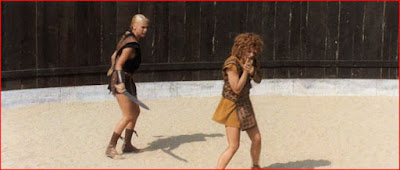
Lucretia Love (above right) was actually top-billed in Italian advertising for this picture. Maybe they gave her credit for genre experience for starring in Alfonso Bresica's Battle of the Amazons a year earlier.
Two thumbs down.
Finish her!
Inevitably, Mamawi and Boadicea are matched against each other. Like their male counterparts, they're invited to seek comfort with a bedmate the night before -- in what proves, shockingly, the film's only nod toward lesbianism, they're told they can choose a male or a female. Boadicea chooses the desolate Septimus, not to screw with him, except maybe with his head. But it doesn't take much convincing to get him to seek vengeance on Timarchus. Unfortunately, he's ratted out, captured, and sentenced to crucifixion -- but a sympathetic soldier allows him an honorable suicide. Now the question becomes whether Boadicea and Mamawi will kill each other or make a stand. This shouldn't be too hard to figure out....

Because the lesbian content is minimized to almost nothing, you might miss that Arena is basically a women-in-prison film, complete with an antique equivalent of a shower scene. The absence of lesbianism makes sense when you remember that same-sex desire was usually vilified in these movies, accentuating the unnatural power women wardens seemed to have in prison settings. In The Arena there's no illusion of female power; while Cornelia comes closest to a wicked-warden figure it's always clear that Timarchus is the master. In a way, that makes the gladiatrix uprising (oops, I spoiled it) even more of a titillating nightmare of female empowerment than the jailbreaks and riots are in the conventional WIP movie. This time it's unambiguously a war of women against men -- though the male gladiators join in as well. The WIP movie has a subtext of fascinated fear of the sexually liberated women, pandering to a male notion that these women need to be kept down and controlled before jolting them with the arousing terror of a female breakout. The Arena arguably makes this point more plainly by emphasizing the training mandated by men that turns the women into unstoppable killing machines. Movies have sent us mixed messages about the outcome of a gladiator-vs-soldier showdown, Spartacus of course favoring the gladiators while Anthony Mann's Fall of the Roman Empire noted their indiscipline and likely cowardice under battle conditions. The Arena is all the way with gladiatrices. Once the rebellion breaks out, Mamawi and Boadicea make mincemeat of the soldiery, and even the ridiculous Dierdre manages to kill a few. Think of it as sublimated sexual blowback. Men may want sexual superwomen but the revolution won't necessarily stop there.

Look into your hearts! I can't die here, like some gladiator!

Steve Carver is best known to me as the director of that cheese epic and guilty pleasure of the Eighties, Lone Wolf McQuade, and The Arena shows that he hit the ground running. Aided by cinematographer Aristide (Joe D'Amato) Massaccesi, Carver gives the action a dynamic budget-epic vibe. The arena scenes may be underpopulated but otherwise the production values are perfectly adequate and even superior during the climactic escape and chase through the catacombs. A few cheesy moments are worth noting, however, like the way a man slashed across the throat clutches his head and the way a gladiator can manage to rape Dierdre while keeping his black trunks on. A little of that is probably inevitable, but it's not typical of the film. Francesco de Masi, who did a stupendous score for Lone Wolf McQuade, punches things up nicely here in his first work for Carver. Most importantly for the success of the picture, Grier and Markov are on their game, the latter for the first and only time in a marriage-shortened career. Doing their own fighting and stunts, the two rangy females are still occasionally gawky but mostly as convincingly forceful as they need to be and often more than that. To an extent, it's just a matter of Carver being a better action director than Black Mama, White Mama's Eddie Romero. But he also makes judicious use of huge, spaghetti-western scale close-ups that showcase the actresses emotions, Grier's especially, as well as their physical prowess. Let's not mistake The Arena for anything profound -- the previous paragraph notwithstanding -- but let's give credit where it's due some serious high-functioning kick-ass schlock like they hardly make anymore.

Listen to the hard sell on this trailer, uploaded by Keshizzz.

Sunday, May 22, 2011

BLACK MAMA, WHITE MAMA (1973)

How could you go wrong with a women-in-prison film with Pam Grier in the Philippines -- especially when you've got violent revolutionary action, plenty of naked shower action and lesbian innuendo, Vic Diaz and Sid Haig as gangsters, and the all-important gimmick of Grier and blonde fellow-amazon Margaret Markov chained together on the lam in a distaff variation on The Defiant Ones? Here's how.

Problem number one is that, if you're going to do Defiant Ones in drag, you've got to do some race-baiting. But by making the white prisoner Karen a left-wing revolutionary director Eddie Romero and a story team that included the young Jonathan Demme pretty much throw away any opportunity to stir up intense conflict between the chained women. The script tries to make class an issue for one scene as black prisoner Lee mocks Karen's revolutionary commitment as the playacting of a spoiled rich girl, but this movie never unleashes the all-out hate or the bonding personal revelations the Defiant Ones gimmick needs to work. The most we get once the defiant duo break loose is that Karen wants to go one way to reunite with her revolutionary comrades (and boyfriend Ernesto) who ambushed their prison van in mid-transfer in the first place, while Lee wants to go where the $40,000 she stole from sleazy pimp Vic (Diaz) is stashed. It's okay that they end up going Lee's way, since you're probably anticipating that the money is going to end up with the cash-starved revolutionaries thanks to some political awakening on Lee's part. But a lot of stuff that you might expect to see happen here -- just because in many cases it's the obvious play for an exploitation film -- doesn't.


Romero's movie smacks of having been put together ad hoc of parts that don't quite fit together, right down to the trailer whose narrator clearly thinks that he's promoting a movie called "Women in Chains." Black Mama spends its first reels setting up the sapphic hell of a prison to which Lee and Karen are condemned. The warden (Laurie Burton) and head matron (Lynn Borden) are clearly lovers, but the warden's lust is too voracious for one woman. She has a peephole to observer her charges showering while she masturbates. She offers the more attractive prisoners privileges in return for sexual favors. Lee turns her down ("I just don't like to be forced.") while Karen accepts (off-screen) out of revolutionary necessity. That creates resentment in Lee (if not jealousy; the two newbies seemed to be checking each other out as they arrived) because when Karen gets taken off a work detail it means more work for Lee. And that leads to their first battle, a feeble food fight that unfortunately sets the tone for their struggles throughout the picture.


Romero has no clue how to make these two big girls seem powerful. He has Pam Grier at his disposal and makes her look weak. Neither of the women -- who would soon be cast together as gladiators, for crying out loud -- seems capable her of much more than impotent slapping and scratching. Romero seems not to have gotten the news that he was in the 1970s, the era of the superwoman, and his cluelessness cripples Black Mama, White Mama. He should have Grier and Markov running amok through the island, fighting each other and all comers, but once they are set loose by Ernesto's bungled rescue attempt (during which our heroines kill the warden and the rebels kill the matron) Romero seems to go out of his way to find distractions from the stars' story.


It's okay to introduce Vic and his gangsters, since it's his money Lee is after and Diaz's scenes hit just the right note of sleaze. Diaz, the international face of Filipino exploitation, actually rules it quite nicely as he calmly supervises the electrode torture of a prostitute while receiving a pedicure from a topless floozy. To clarify what I mean by sleaze: if a woman takes off her top in a scene, it's erotic; if she starts the scene topless, it's sleaze. Anyway, we expect to see Vic's men on a collision course with Ernesto's rebels, but in mid-film Romero introduces more characters, not to complicate things, but to pad out the movie. We get some Filipino cops who are out to get Vic's money if not Vic himself -- but to keep a low profile they subcontract the pursuit of the escaped women to Ruben (Sid Haig), an American criminal and all-around cowboy-for-hire who ends up being, along with the cops, the comedy relief of the picture.


The funniest thing about Haig here, however, are his costumes. Still, you might be interested in what might happen when Ruben catches up with the girls -- but remember what I wrote above about what you expect to happen. Ruben and the cops largely exist in their own closed-off universe within the main film. They mostly interact with each other, as when Ruben catches the cops tailing him and forces them to drop trou so he can (for some reason) inspect their penises. The only character from the main story whom Ruben encounters is Ernesto, and the rebels kill him and his men in a fight over bloodhounds before Ruben comes anywhere close to Lee and Karen. Haig's presence comes across as a big waste of our time.


Overall, Black Mama, White Mama is a case of too many cooks and not enough confidence in the stars or the main story of the film. Too often, Lee and Karen's adventures are played for laughs, as when they mug a couple of nuns and somehow (while still shackled together) manage to don their habits for a reel or so. Eddie Romero has made some interesting horror films, but he seems like the wrong man for the job this time, when a Jack Hill or (to use local talent) a Cirio H. Santiago would have gone for the jugular every time. This is a film I've wanted to see for a long time, and now that the Albany Public Library has acquired it in a stash of blaxploitation pictures it proves to be a big disappointment. Some of my regular readers may feel that a film like this was hopeless from the start, but I want to make clear that what disappoints me most about Black Mama, White Mama is that it fails as an exploitation film. It should have been more violent and more sleazy as well as more feminist and more coherent. Just about everyone involved has done better, and I feel a need now to find the proof of that.


And here's the trailer for Women in Ch-- I mean Black Mama, White Mama, uploaded to YouTube by oldiestrailers.


Saturday, June 5, 2010

FEMALE PRISONER 701: SCORPION (1972)

First-time director Shunya Ito has something to say about Japan in this Toei Studio manga adaptation, and it isn't nice. The movie opens with the raising of the peacetime red sun-on-white field flag over a prison, and that symbol is later equated with the blood shed in a woman's deflowering. The specific woman is Nami Matsushima, Matsu for short -- prisoner 701. She loved a narcotics cop. He used her as bait to entrap drug dealers. The dealers found her out and gang-raped her. The cop caught them red-handed. He then cut a deal with them; that's what he planned to do all along. Matsu was just the bait to give him some leverage over them. They don't mind the scam as long as "co-prosperity" results. Even Matsu gets some money, but it's poor compensation for her betrayal. She's in prison because she tried to kill the cop in broad daylight. She knows too much, but never told it to the authorities. That leaves the gangsters wondering, but no one orders a hit on her in prison. Maybe that's because this particular prison is a living death, if not a living hell, where Matsu is tormented by the trustees and harassed by the guards while she perpetually plots to escape.


Behold the widescreen awesomeness of Meiko Kaji as Female Prisoner 701, the metaphorical Betsy Ross of Japan.

Toei in the 1970s was the home (more or less) of Kinji Fukasaku, Bunta Sugawara and Sonny Chiba, the studio of gritty yakuza films and gory martial arts that I often equate with Warner Bros. in the 1930s. For me, this Toei outing is a flagrant change of pace. Grit and gore it's got, but Shunya Ito takes the proceedings to another level of feverish expressionism. He does stuff with color, lighting and set design that may suit this story's cartoonish origins but send the film reeling merrily out of the realm of realism. A location sequence of prisoners digging a massive crater into the earth is transformed by a gunshot into a setbound showcase of riotous red-painted sky. Matsu's backstory flashback features an erotic unwrapping arguably inspired by Singin' in the Rain, the flag/blood business I mentioned, a gang-rape filmed from below through a transparent floor, and rotating sets like something else out of a Hollywood musical. Matsu's trustee enemy Masaki, enraged by having a glass door pane slammed in her face, is transformed by lighting into something like a demon of rage until -- oops, she misses her target and puts the warden's eye out with a shard of glass. He's too annoyed to suffer and strangles her instead.


Ito's experiments in style are eclipsed in many viewers' minds by the human special effect that is Meiko Kaji. She's part of the Seventies pantheon of valkyries -- joining Pam Grier, Claudia Jennings, Angela Mao, Christa Lindberg, etc., who still set the cinematic standard of violent female empowerment. Kaji could wield a sword (in the Lady Snowblood films), a gun or whatever came to hand for killing or torturing purposes. In this one, she's hogtied in solitary and a trustee is torturing her by ladling hot miso soup on her body. How can she fight back. By catching an edge of a towel in her teeth and pulling it out from under the trustee so she spills the entire pot of boiling broth on herself, that's how. Matsu's resourceful that way, and once she's finally free the men who tormented her don't stand a chance. As her "Vengeance Song" plays she picks them off one by one, with only her once-beloved corrupt cop putting up much of a fight. As Matsu (aka Scorpion) Kaji's best known for her taciturnity. Apart from her narration of the flashback, she probably has less than a dozen lines of dialogue in the whole picture, and one of those is "You talk too much."


Meanwhile, this is the sort of women-in-prison film your parents warned you about. Every possible excuse for nudity is exploited, including a credits-sequence inspection that requires naked prisoners to climb ladders and cross bridges while male guards watch from below, presumably to watch for vaginally-concealed contraband but with obvious ulterior motives. Lesbianism is inevitable, with Matsu being the top of the tops. One hopefully intentional comic sequence has another prisoner attempt to seduce her. Our heroine quickly takes charge and proves herself no cool-hand Luka. The would-be seducer is soon groveling at her feet begging for more -- and she's later revealed to be an undercover cop who insists desperately on getting another chance to share a cell with 701.

I can fault some things about FP701 -- particularly the uniformly inept action whenever someone has to slap or punch anyone else, with most performers missing by a mile despite the sound effects, -- but it has an undeniable momentum, the kind that keeps you wondering what Ito's going to do next. It's ultimately just a nasty cartoon with a misanthropic streak, but it's perpetrated with grisly panache by all hands. It's worth watching as an exercise in pop-cinema decadence that few would dare imitate today.

This version of the English-subtitled trailer was uploaded to YouTube by asianwack.


* * *
Here's a bonus. Following the custom of the time in Japanese cinema, Meiko Kaji sang the title song, "Urami Bushi," translated as "Vengeance Song" or "Grudge Blues." The original version plays over the end credits of the Kill Bill films. In this clip from sometime shortly after that film's release, Kaji performed the song in public for the first time in 20 years. It was uploaded by kukutxmuchu.

Saturday, April 24, 2010

WOMEN'S PRISON (1955)

If you're Sony Pictures Entertainment and you're going to release two movie collections titled Bad Girls of Film Noir, there's a one-in-eight chance that one of your offerings will be a women-in-prison film. Imagine your good fortune when you happen to have a film called Women's Prison in your extensive B-movie library. Lewis Seiler directed it, Crane Wilbur and Jack DeWitt wrote it, but the main attractions are the bad girls. Jan Sterling, Audrey Totter and Cleo Moore are among the lead convicts, and their warden is Ida Lupino. How could you go wrong?

Easy. For starters, make your women convicts the least hard-boiled, least menacing bunch of cons you can imagine. The inmate population are really a merry sorority once you get to know them, and once you get over your own terror at the prospect of exile from home and hubby. We actually get off to a strong start as we follow Helene Jensen (Phyllis Thaxter) into the can. She's no criminal, but she happened to kill a kid while speeding. She can't take the confinement and isolation, and spends her first night on a non-stop crying jag until the guards have to put her in a straitjacket and dump her in a padded cell.

But Helene gradually drifts to the periphery of the picture, which proves to be an ensemble piece showcasing a number of harmless types. Cleo Moore, for instance, is a southern-accented bimbo determined to improve her diction. Vivian Marshall does impersonations: a passable Bette Davis on her own, but when she mimics prison personnel (including Lupino) the relevant actresses dub in their own voices. Jan Sterling is such a good egg that rather than have a guard discover Audrey Totter in a tryst with her smuggled-in husband from the adjoining men's prison, she burns her own hand with an iron. There aren't any rivalries or factions in this prison, unless you count the four black women who share their own cell. The film's just a little bit stereotypical about these four. They sing in close harmony and one of them is shown (with the cinematic equivalent of a straight face) singing "Swing Low, Sweet Chariot" while scrubbing the floor. But they get along with the white girls easily enough, though it may have been different had there been five of them.

"I'd know those legs anywhere!" Juanita Moore welcome Jan Sterling back to stir. Below, the hand won't look as good as those legs after this stunt.

There's hardly a hardened criminal in the bunch, unless you count Sterling's repeat-offender check forger. Women's Prison is more interested in portraying its imprisoned women as victims, not of society, but of their vicious warden, Amelia Van Zandt. This character, and the casting of the generation's lone female auteur in the part, may be the most offensive thing about this picture. Van Zandt is a control freak indifferent to the suffering she causes and dedicated to breaking the will of her charges. "I know these women, all of them," she says, "and only a strong mind can control them." When Helene Jensen freaks out on that first night, Van Zandt has her straitjacketed mainly because the garment can be strapped on so tight that the new fish won't be able to scream.

The inevitable sensitive (male) doctor -- played by Lupino's husband, Howard Duff -- offers this insulting amateur psychoanalysis of the warden:

Dr. Crane: May I tell you what's wrong with you?...You dislike most of the women here because, deep down, you're jealous of them.

Van Zandt: That's absurd.

Crane: You're feminine, attractive. You must have had opportunities to marry. Maybe you even cared for somebody once in your cold way.

VZ: How dare you!?

Crane: But possibly he turned to someone who could give him what he really wanted: warmth, understanding, love. There's hardly a woman inside these walls who doesn't know what love is.

VZ: Yes, and that's why most of them are here.

Crane: Exactly. Even the broken wrecks have known some kind of love, and that's why you hate them.

The film goes on to confirm this laymen's analysis when Van Zandt is cornered inside the padded cell by a vengeful male con during a riot. Threatening him with reprisals against his wife, not knowing that she's already dead, the warden cracks and raves "I hate them all! I hate them all!" before Dr. Crane calls for the straitjacket. Maybe I'm being politically correct, but there's something ugly about this. There've been evil and sadistic male wardens in prison films, and some of that evil sadism may well be blamed on sexual or social dysfunction, but the way Women's Prison goes about it you're invited to assume that something's wrong with Van Zandt just for being a warden instead of somebody's wife. Having to perform this role seems like a penance for Lupino, an almost unconscious punishment of her by Hollywood for being uppity enough to become a producer and director. However, if you resist reading too much into the role, you can probably get some campy pleasure out Lupino's chic villainy, whether she's slapping the daylights out of a pregnant con or virtually climbing the walls of that padded cell.

Above, Lupino lays the smack down on Audrey Totter. Below, disguised escapees (l-r) Jan Sterling, Cleo Moore and Vivian Marshall threaten revenge.


Columbia pitched Women's Prison as a racier film than it really is, and the film presents itself as a kind of social problem picture denouncing the persistence of co-ed prisons -- the sexes are segregated but are all in the same compound. Today, Sony pitches it as a film noir, but despite its dark and shadowy moments it falls short of the genre standard. For a film set in prison there's little sense of criminality or guilt in it. The women prisoners are somehow too good to be true, and that's a no-no for noir. But since Sony is also sort of selling the Bad Girls collections as camp (why else advertise Cleo Moore's limitation as an actress?) Women's Prison would seem to belong. It's definitely a document of its time, and its certainty that it will shock audiences is one of its more charming features now.