Showing posts with label sports. Show all posts

Wednesday, December 18, 2013

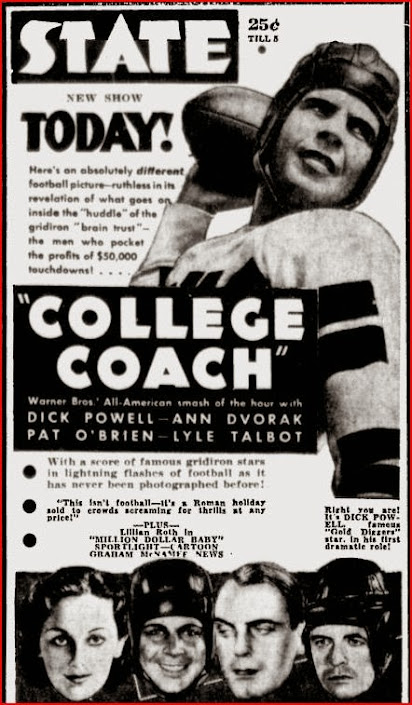
Pre-Code Parade: THE COLLEGE COACH (1933)

Pat O'Brien may be best remembered today for his title role in the 1940 biopic Knute Rockne, All-American, if only because of his proximity to Ronald Reagan in the film that gave the future President his "Gipper" nickname. In that picture, playing the legendary Notre Dame leader, O'Brien was the ideal of a college sports coach. The contrast with Pre-Code O'Brien could not be more stark, for in the title role of William Wellman's athletic satire the actor is for all intents and purposes the anti-Rockne. Sure, there are points of resemblance: like Rockne, who died two years before College Coach was made, Wellman's Coach Gore is a celebrity and a constant winner. But Gore lacks Rockne's loyalty to a single school; he sells his services to the highest bidder. The high bidder is Calvert University, despite a grave budget deficit. The trustees' desperate belief, then as now, is that the revenue from a successful football program will finance worthy academic projects. Gore couldn't give two farts about academics, promptly hiring patently unqualified ringers out of football mills designed to give them the high grades they need to get into college. To give you a visual idea, one of these paragons of amateurism is Nat Pendleton with a moronic Slavic accent; an unhappy subtext of College Coach is that any football player with an ethnic name is academically suspect. The real stars of the team are Buck Weaver (Lyle Talbot), a sleazy showboater, and Philip Sargent Jr. (Dick Powell), the son of the college president (Arthur Byron). Powell is the real star of the picture, in fact, and since he had become a star in 1933 by virtue of his performances in 42nd Street and Gold Diggers of 1933, Phil gets to play the piano and sing a song to himself for no reason relevant to the story. Phil's a good boy and a good student, or at least he wants to be -- we see him hard at work in the chem lab under Donald Meek's tutelage, but Buck doesn't give a damn. The two are incompatible teammates; Buck defies the coach himself if he can see an opening to score on his own, and Gore makes them roommates in the hope that, following a locker-room dustup, Phil will knock Buck down a few pegs. Buck's idea of cultured conversation is to show off a pin-up poster and ask Phil, "How'd ya like to put your finger in her coffee?"

Little does Gore know, at first, that Buck is making moves on his wife (Ann Dvorak). Mrs. Gore feels neglected by Gore's genuine dedication to winning and his sometimes contemptuous rounds of publicity arranged by a largely self-appointed agent (Hugh Herbert), while Buck would probably jump anything with decent curves. When Gore finally gets wise, he throws Buck off the team. Meanwhile, Phil quits in disgust with both the program and himself after he deliberately flunks the chem exam, knowing that practice and publicity gave him not time to study properly, only to find that he had passed (albeit with a D) despite turning in an empty exam booklet. Furthermore, Sargent Sr. is inclined to get rid of Gore after an opposing player is mortally injured during a game. Somehow, after everything, we're still supposed to root for Calvert to win the big game, and to celebrate when both Phil, possessed by school spirit, and Buck, manipulated by Mrs. Gore, rejoin the team. But the genius of the picture is that Calvert wins and Buck becomes the hero despite learning nothing during the picture. As before, he breaks up a play designed as a pass to Phil and runs for the winning touchdown himself. His comeuppance comes when he realizes that Mrs. Gore, having reconciled with hubby, had played him so he'd play. Preparing to declare his love for her to reporters, he sees the truth through a door and credits his success to dear old mother instead. By then, the Gores are ready to move on. The school just beaten has offered the coach $10,000 more than Calvert paid him. He hesitates, thinking of his wife, but she grabs the phone and accepts the offer for him.

College Coach isn't exactly a hard-hitting expose of the corruption of academia by athletics. The picture is more amused than outraged by its subject and its high-spirited cynicism is Pre-Code to a tee. Powell may get the top billing but if anyone steals the picture from him it isn't O'Brien, who in the title role is equally susceptible to theft, but Lyle Talbot in one of his best Pre-Code showcases, in a role he clearly enjoyed playing. Talbot often comes out second-best, at best, in these movies, but here he achieves a kind of seedy charisma, swaggering through the picture with a perpetual five o'clock shadow, unrepentant and nearly imperturbable despite some hard knocks along the way. Modern viewers may be distracted by John Wayne's very brief appearance as a student, near the end of his underwhelming run at Warner Bros., but Talbot should make more of an impression than he ever would until he played Lex Luthor (and quite well, too) in the Atom Man vs. Superman serial. William Wellman was also near the end of his far more memorable run at Warners, and while this isn't one of his more memorable films visually he gets the job done with typical crisp efficiency and gives O'Brien and Talbot their chances to shine. College Coach isn't on the level of The Public Enemy or Wild Boys of the Road, but it may be more relevant today, in some respects, than those or other Wellman masterworks at Warner Bros.  People (and not just movie buffs) would get this film today if they gave it a try.

And here's our usual Warner Bros. trailer, courtesy of TCM.com

Saturday, May 26, 2012

DVR Diary: THE SPORT PARADE (1932)

Can you imagine a time when pro football was considered nearly as disreputable as professional wrestling? Look no further than the fall of 1932 and Dudley Murphy's film for RKO, a Pre-Code bromance between college football stars Joel McCrea and William Gargan in which McCrea's decision to go pro is the wrong turn in his life. Back then if you played for pay it proved your low character, with high-profile exceptions like iconic "Galloping Ghost" Red Grange, whose experiences in the pro game may have inspired this collaboration between four screenwriters and Robert Benchley, who apparently wrote his own lines for his comedy-relief bits as a drunk or simply confused radio broadcaster.  McCrea washes out in the pros, despite the superiority implicit in his remark to Walter Catlett, a high-pressure promoter, that his eleven is "good for a pro team." He's also had his fill of the corruptions of pro sports, from Catlett's urging that he put some showmanship into his play to the inevitable invitation to throw a game. McCrea's time at Dartmouth left him unprepared for a real career, and by the time he quits football the businessmen who wanted to give the sports celebrity a job have forgotten him. Fortunately, Gargan still longs for the old partnership and hires McCrea as a columnist for the sports section he now edits. Of course a dame comes between them, the sports department staff artist (Marian Marsh), Gargan's girl turned McCrea's. But McCrea feels guilty about two-timing his pal and quits the girl and the job. There's nothing left for him but to take up Catlett's offer, formerly spurned, of a wrestling career. It probably tells you something about pro football in 1932 that a team owner is also a wrestling promoter; this film has the XFL beat by something like seventy years.

Something must have happened to put pro wrestling in the public eye, because some cities had Sport Parade and John Ford's Flesh, the legendary Wallace Beery wrestling picture, playing at the same time. Both films share a shocked horror at the thought that wrestling bouts are fixed and a hero who rebels out of pride against having to do the job in the big match. Here the assumption is that pro wrestling is fixed because people are dumb enough to bet on it. As far as Gargan is concerned McCrea has humiliated Dartmouth by becoming a wrestler with a collegiate gimmick, and a group of alumni confront McCrea and warn him not to wear the sacred D on his ring robe. But Gargan's attitude is based on his assumption that McCrea will do the job; when it becomes clear that McCrea's fighting to win all is forgiven, and when he sees Marsh's faith in McCrea he realizes that she's rightfully McCrea's girl. McCrea officially gives up 15 pounds to his antagonist but in the flesh it looks like more. He clearly yields to a stuntman for the more elaborate work but clearly takes some bumps himself. And here's something you probably didn't know, courtesy of the Spokane Spokesman-Review.

Chaney was under contract to RKO at this time and had appeared with McCrea in Bird of Paradise earlier in 1932. Whether this entitles him to "uncredited technical advisor" billing, let history judge.

Dudley Murphy is best known for the avant-garde silent short Ballet Mecanique and the Paul Robeson showcase The Emperor Jones. If that partial filmography promises an eccentric feature, Murphy fulfills the promise. He proves fond of gimmicky transitions, most notably a bit where the camera dollies in to a picture of Catlett on a barroom wall, and the picture comes to life to start the next scene. Murphy really gets ambitious in the big wrestling scene, filmed either in a big arena or a convincing studio facsimile. He shoots from all angles, moves the camera freely, and really shows off with a topsy-turvy POV shot as McCrea tumbles across the mat to escape from a submission hold. He also stops the show briefly for a trip to a Cotton Club-type joint with a "savage" dance number seen from a drunkard's multiple-perspectives, almost a cross between Busby Berkeley and Marcel Duchamp. Murphy's showiness is in sync with RKO's Pre-Code tendency to cartoonishness, as is Benchley's irrelevant patter, but he also keeps the film moving at a brisker pace than many Radio Pictures from the period. It almost has the snap of a Warner Bros. picture. Among Pre-Codes in general, it seems unusual for emphasizing beefcake over cheesecake, from a football-team shower scene with naked buttocks in the background to McCrea grappling in some tight and tidy whiteys. You get your racism when a black man's head is rubbed for luck. You get your homophobia when two flaming fairies leave the wrestling arena in disgust at the antics of the brutes. And you get lots and lots of drinking, including from McCrea, a year before Repeal. It has its moments, and on the other hand it's probably less than the sum of its parts, but good or bad Sport Parade looks like an indispensable part of the Pre-Code filmography.

Saturday, March 17, 2012

Pre-Code Parade: FLESH (1932)

In the Coen Brothers' Barton Fink, a pretentious playwright is lured to Hollywood and tasked with making a "Wallace Beery wrestling picture." If you believe the Coens -- and that's a big if sometimes -- they didn't know at the time they wrote their picture that there was such a thing as a Wallace Beery wrestling picture. Yet to someone at M-G-M in 1932, it may have seemed natural to follow up Beery's big success in a boxing picture -- he won an Oscar for The Champ -- with a film about wrestling. But the natural-seeming follow-up doesn't follow The Champ's formula -- Jackie Cooper is conspicuously absent, as is any hint of father-son pathos. Instead, Flesh is much more of a true Pre-Code movie, at least on paper -- and can you beat that title? Actually, in retrospect, Metro should have thought twice about it. No matter how beloved Beery had become, I can only imagine that advertising a film called Flesh on the understanding that most of the title substance on display would belong to Beery might have sent even his most devoted fans in headlong flight from the nearest theater showing the picture.

That title isn't the only thing not quite right about the project. This is an M-G-M picture directed by John Ford during a period when Fox let him work for other studios -- Air Mail for Universal, Arrowsmith for Samuel Goldwyn, etc. It is, in fact a "John Ford Production," but Ford refused to take credit for directing. That is, he repudiated a picture that still bears his name. But I can't blame him. Flesh is one of those rare occasions -- the silent Four Sons is another -- when he indulges a certain Germania-mania. His is a vaudeville Germany where the natives sometimes speak their local lingo and sometimes speak English -- to each other. Ford never figured out a neat Judgment at Nuremberg type trick to transition us from German to English. They just start out auf Deutsch, vacillate a while, then stick to comic-strip dialect. In this milieu flourishes the great Polokai (Beery), king of the beer-hall wrestlers like Hitler was king of the beer-hall orators. But Polokai is more than a wrestler -- he's a wrestling waiter. He'll bring the beer barrel to your table to fill your mug. But he is mighty without being a brute -- he's shy, unworldly and simple -- Ford seems to suggest that the last is a national trait. In short, he's a sap. Or as one of the ads says of Beery, "The Champ becomes the Chump!"


Polokai proves easily manipulated by a pregnant expatriate American ex-con (Karen Moley) who's been ditched by her boyfriend/baby-daddy and needs money to get back home. When the boyfriend (Ricardo Cortez) finally appears, he pretends to be the woman's brother because he sees an angle to exploit Polokai, who has become the German wrestling champion, and sees a better chance for himself if Polokai keeps his romantic hopes up. Polokai's own plan has been to follow his emigrating employers to America, where they intend to open a biergarten in spite of Prohibtion. Now the Cortez character (a smooth-talking sleazebag, as usual) figures to promote Polokai in the big-time world of American professional wrestling. He explains the title by declaring his intention to make millions pushing "a hunk of flesh." Ford and his writers (reportedly including William Faulkner -- do the Coens really want us to believe they never heard of this?) don't have the surest grip on what wrestling was about at this point. They seem to understand that wrestling was what wrestlers call a work, but they seem to see this as the moral equivalent of fixed fights in boxing. That is, when Cortez suggests that it's sometimes the smart thing to lose instead of win, he seems to mean that Polokai should take a dive at some moment of his choosing, as a corrupt boxer might. Of course, German wrestling is totally real -- a shoot, as they say, so Polokai's honor is offended by the suggestion that he lose on purpose. His career is stalled a little by rigged decisions after time-limit matches, but he finally gets a title shot. As his career approaches its peak, his life falls apart as he discovers the truth about the sleazy Cortez and the repentant Morley and kills Cortez with his bare hands for hitting Morley. He proceeds to the arena and wins two of three falls before turning himself over to the police. There remains a tearjerker moment during visiting hours when Morley finally admits her love, for all the good it'll do Polokai in stir.


There's little Fordian about this picture, though the director does manage to hustle Ward Bond on screen for a minute or so as a wrestler. The ethnic aspect enables Ford's worst impulses, and the comedy in general is stupid. Typical is the German championship bout, where Polokai seems to be losing until he hears that the Morley character has given birth, at which point, after having chatted inanely with his corner men while suffering in a leglock, he promptly squashes his foe so he can get to the hospital. The one time I laughed out loud was when Polokai was learning English out of a phrase book, reading aloud, "That is a warm donut. Step on it." A glimmer of redeeming absurdity in a leaden melodrama. This is the part where I usually say that some film in the Pre-Code Parade is of interest as a historical document, at the very least, but Flesh is less than even that. It's probably one of the most forgettable items in both Ford and Beery's filmographies, and as such it does teach a historical lesson or two. First, not every great director flourished under Pre-Code conditions; 1929-34 was not a peak period for John Ford. Second, and corollary: Pre-Code didn't prevent anyone from making crap -- here's proof.

Monday, March 5, 2012

THE MOMENT OF TRUTH (Il momento della verita, 1965)

Italian cinema's pursuit of reality has always been ambiguous. The country invented the neorealist movement, but how realistic can fiction film be? Things got still more questionable with the advent of Mondo movies, ostensible documentaries widely assumed to include scripted or otherwise "fake" footage. All art tells us something about the world -- at the furthest remove, it tells us what someone thinks about the world, or what someone assumes that others believe. Francesco Rosi's bullfighting drama gets you to thinking about such things. It's more than a film about bullfighting -- Budd Boetticher's Arruza is arguably the last word on the subject as a subject unto itself. Rosi uses the career of a bullfighter to say something about poverty in Spain and the exploitation of the poor everywhere. But he wanted his movie to have unprecedented spectacular authenticity. Instead of casting a male idol or rising star of the moment,  -- an Alain Delon or Franco Nero -- he hired a real star bullfighter, Miguel Mateo, aka Miguelin, to play a fictional bullfighter dubbed Miguelin. The idea was that he could film Miguelin close up and close in, actually in action in the ring, instead of using stunt doubles and process shots. I assume much of the footage is taken from live bullfights -- if so, then Miguelin is putting his life on the line as you watch. Like Buster Keaton or Jackie Chan, "no faking" is the rule and the selling point of the movie -- except for the actual moment of truth.


The fictional Miguel Romero leaves his rural village and his family's poor farm to make a living in the big city. In Rosi's unromantic vision, Romero is only ever in the bullfighting game for the money, and as soon as he strikes it rich he's thinking about quitting. After all, why take chances? Because there's money in it for someone else: an agent who programs Romero for a punishing schedule of fights in big cities and small towns. It becomes clear that the matadors are ultimately as dispensable as the bulls they kill. Exploitation rather than moral corruption is the root of Romero's ruin. As in many a melodrama, he's seduced by an amoral female -- here a jet-setter played by the late Linda Christian -- but for Rosi that's just an episode, not a betrayal of anything.  "The bull is sacred," someone says, and the film is bracketed with religious rites. But the overall, overwhelming impression is one of human sacrifice. The "moment of truth" for the film, toward which everything seems to build up, isn't the death of a bull but the death of a matador. Spoiler coming up....


So of course the entire rationale for the picture (from an exploitation standpoint) falls apart at the very end because Rosi is not about to get the real Miguelin killed, but he wants Miguel Romero to die. The result is as fake as you would expect, and while you don't want Rosi to trod the alleged path of some Mondo makers and stage real death for his camera, it still seems strange that this should be the literal moment of truth. Whether the film can survive that moment depends on whether you think Rosi has told enough truth by then.


Of course, you can enjoy Il momento as sheer spectacle -- not just for its actuality footage of bullfights but for the vibrant widescreen cinematography by a three-man team. The movie may be too beautiful sometimes -- the scenes in Romero's village are more thoroughly composed than the bullring scenes and the color creates a probably unwanted idyllic impression. The bullfighting is what it is, and Rosi films it unflinchingly. Some will understandably find it as repellent as any Mondo violence toward animals -- and Mondo Cane had already covered the topic. Some will find it thrilling, and that goes for the running-of-the-bulls footage, too, as human bodies go flying in that unwilled way that special effects still can't recreate. In the end, Rosi is in the same predicament as any Mondo-monger or exploitation expert. I don't doubt that he finds it all quite barbaric and cruel to man and bull alike. But he can't criticize it without showing all the things that have made bullfighting attractive for centuries. It still attracts spectators and participants. I read in the paper this morning about a matador who made a comeback this weekend mere months after getting an eye gored out by a bull. If you read such a story and wonder why, and actually want an answer, The Moment of Truth may have one for you.

Sunday, February 21, 2010

FIREBALL (2009)

Are you a sports fan? Do you get tired of team sports where they don't let defenders defend? Where the defense gets penalized for brushing the hem of the offensive players' garments? Well, the film industry of Thailand has a new sport just for you. It's "fireball," -- yes, that's what they literally call it -- and it adds to the existing thrills of basketball the extra excitement of that ancient custom of running the gantlet. The rules are simple: the first team to score wins. But won't it be over quickly? Isn't this basketball, after all? No, it's fireball, and that means if you want to score a basket you've got five guys in front of you to beat down before they beat you down. There's no shot clock, and given the people trying to punch, kick and elbow you as you try to line up a jumper it could well take a while to sink one. But the rules take that into account: if no one scores, then the team with the last man standing wins.

According to Thanakorn Pongsuwan's movie, fireball's been around since 1974 -- the league still has the original game ball -- but this is the first time it's been depicted on film. The release of Fireball may reflect a liberalization of the sport, since the film's expose of corrupt practices in management might not have made it past censorship during the period when most people didn't realize that the game existed. It turns out that league teams are run by gangsters who can make more money by making and taking bets than they'd earn in championship prize money. For that reason many games are fixed, and the players get in on the act sometimes for various reasons. One guy has his twin brother's medical care to worry about. Another's trying to pay his girlfriend's debts to avoid her relapsing into prostitution. Still another, half black, has a baby on the way to take care of. Things are tough all over in the world of fireball. Off court, a good deal of the action takes place in a sprawling dilapidated apartment complex, and given the dirty goings on the Fireball movie sometimes comes across like a cross between Gomorrah and Gymkata.

The film ultimately falls on the Gymkata side of that equation. For the country that aims to set the modern standard in martial arts movies, Fireball is pretty bad. The main problem is the director's frantic, edit-happy manner of shooting the film. The virtue of superior Thai fight films is our clear view of unwired action, but Thanakorn films Fireball like a music video. It's all too obvious that he has to fake most of the basketball action -- not that there's much of it. You'd expect shooting baskets to be filmed the way a decent Thai action director shoots fight scenes. Instead, Thanakorn will show a player heaving the basket, then cut to the ball sailing toward the basket. Then he'll cut to a reaction shot from someone. Then it's back to the ball coming in for a landing. Then another reaction shot, and then the ball finally goes through the net. At many points you can easily lose track of the action. In the middle of one game the guy with the ball eludes some pipe-wielding defenders, and as they ask where he went he seems literally to have disappeared from the game and the movie for a few minutes. Thanakorn reduces his game too often to just plain chaos.

Overall it's hard to follow the action because the sport as Thanakorn has imagined it really doesn't make sense. The rules change from game to game. The first contest we see opens with a jump ball, with the two teams on opposite sides of a midcourt line. But the next game opens with the two sides charging one another Braveheart style from opposite ends of the court as the ball is shot into play. Finally, for the championship game, the court (the cargo hold of a freighter) is littered with piles of pallets for the players to jump up and down from to attack each other. Throughout, the first-score-wins rule makes you wonder what the spectators expect to see. You'd think a marginally competent basketball team could pass the ball downcourt and sink the winning pill in a matter of seconds, perhaps before anyone hits them. But you get the impression that the fans, apart from having betting interests in the outcome, come out to see the teams beat the pee out of one another. The players certainly spend more time doing that than trying to score, and when foreign objects are thrown into the cage it's obviously not to help anyone shoot baskets.

For a moment I thought Fireball was going to finish with a real flourish, with its chain-link basket becoming an improvised flying guillotine, but the film is not that imaginative.

In practice, the basketball side of fireball looks pretty superfluous. Perhaps it was imagined entirely in the hope of attracting an American audience. But it went straight to DVD in this country last month, so so much for that idea. Fireball is really a hopeless proposition. Its Thai fighting is second rate, and the only way the basketball angle would have meant anything to American audiences is if there'd been an American character in the movie. That leaves indiscriminate violence as the only potential attraction for anyone other than those on the alert for bad movies. I rented this from the Albany Public Library fully expecting a bad "new sport" movie, though holding out hope for something better. I suppose I wasn't really disappointed, since I expected it to stink, but unless you're into utterly mindless violence that doesn't even stink in a memorably entertaining way you can abandon hope before renting Fireball.

The film does have it's admirers, and if you want a second opinion here's a review from someone who's seen more Thai films than I have. And here's an English-subtitled trailer, uploaded to YouTube by richyjac: