Teruo Ishii might be called the Tod Browning of Japanese cinema. He shared with his American precursor an interest in crime and an instinct for the grotesque. These converge in Blind Woman's Curse, an early starring role for 70s death-goddess Meiko Kaji that I got to see at the Proctor's GE Theater thanks to the It Came From Schenectady cult film society. If some of the film's virtually supernatural elements seem incongruous in a yakuza film, bear in mind that its setting is implicitly a fantasy film, one in which a yakuza boss can be described as pure in heart. That boss is our star, playing Akemi Tachibana, who inherited the mantle and the unquestioned loyalty of her henchmen from her father. She's a fighting boss, as demonstrated in a formal showdown with another gang during the opening credits, and almost unconsciously charismatic, as demonstrated when, serving time for her role in the fight, she converts some skeptical fellow convicts in a women's prison into future soldiers. Her clan controls a public market but is regularly challenged by her clownish rivals, the Aozora clan. These challenges aren't to be taken too seriously, since the primary attribute of the Aozora boss (Ryohei Uchida) is the long-unwashed loincloth that adorns his prominently displayed buttocks. But when a retaliatory raid on his gang goes terribly wrong, Akemi comes under increasing pressure to escalate the feud.
As we quickly learn, events are being manipulated by a third gang, led by the ambitious Dobashi (Toru Abe) and abetted by a traitor in Akemi's midst. The provocations grow more extreme as Akemi's followers are stripped of the dragon tattoos that adorn their backs and a dubious feline is seen licking at the flayed remnants. There are, in fact, still more players in the game. One is a soft-spoken swordswoman (Hoki Tokuda -- at the time Mrs. Henry Miller!) who happens to be blind. She happens to have been blinded by Akemi in that opening-credits fight, during which her brother was killed. She actually looks really good for someone who apparently had her eyes slashed, and of course, this being Japan, her handicap confers a compensatory advantage in fighting skill. A cat licking her wounds immediately after the injury probably helped as well. Anyway, you get the idea; she's out for vengeance against Akemi. Meiko Kaji is the object of vengeance for once, that is, but this was still early in her career before she was set in her ways.
What the story is with the blind woman's sidekick, who can say? Ushimatsu is hunchbacked performance artist, played by Tatsumi Hijikata, credited as a creator of the modern dance form of butoh. We're treated to one of his strange performances, enhanced (if that's the word) by Ishii's (and Osamu Inoue's) frantic editing. We're also treated (if that's the word) to his hobby, which is maintaining a carny house of horrors featuring fake (???) severed heads, limbs, etc. Ushimatsu appears to go above and beyond whatever mandate the blind swordswoman or Dobashi gave him, and his exploits are pretty much the essence of this picture. At one point, after the more conventional thugs have bumped off Akemi's wise old uncle, the rare yakuza who has gone straight, the hunchback shows up to lick and fondle the corpse. Later, the apparently living corpse shows up to spook some people, but when the head promptly rolls off we see that Ushimatsu is just having fun with his new meat puppet. As far as movie hunchbacks go, this guy makes Paul Naschy in Hunchback of the Morgue look like Quasi from the Disney cartoon.
Things can't go on like this forever -- can they? -- so finally Akemi's had all she can stand, til she can't stands no more. Once the traitor in her midst is exposed, she leads the climactic assault on Dobashi's headquarters, except that it's only a warmup for the inevitable showdown between our jingi-licious heroine and the blind swordswoman. Again, in Japan you always bet on the handicapped person in these encounters, even if it's Meiko Kaji on the other side. Only this time, you wouldn't collect, because nobody wins. After the damned cat tries to interfere and gets gutted for its trouble, it looks like Akemi is down for the count. She's waiting for the coup de grace, but it never comes, for the blind swordswoman can tell -- she usually can smell such things -- that our yakuza boss lady is genuinely repentant about killing her brother and the other stuff. She accepts this as an apology, takes her dying cat and goes home. But let's face it: anything after what we've already seen in this picture is going to be an anticlimax, and maybe that's for the best. Otherwise people are bound to leave the theater in a disoriented state dangerous to themselves and others. As it is, the downbeat-yet-upbeat finish gives viewers time to reflect on the fact that, for all its excesses and confusions Blind Woman's Curse is goofy fun, as long as you're in the right -- or fright -- frame of mind.
A randomly comprehensive survey of extraordinary movie experiences from the art house to the grindhouse, featuring the good, the bad, the ugly, but not the boring or the banal.
Showing posts with label Meiko Kaji. Show all posts
Thursday, April 25, 2019
Sunday, January 26, 2014
LADY SNOWBLOOD (1973)
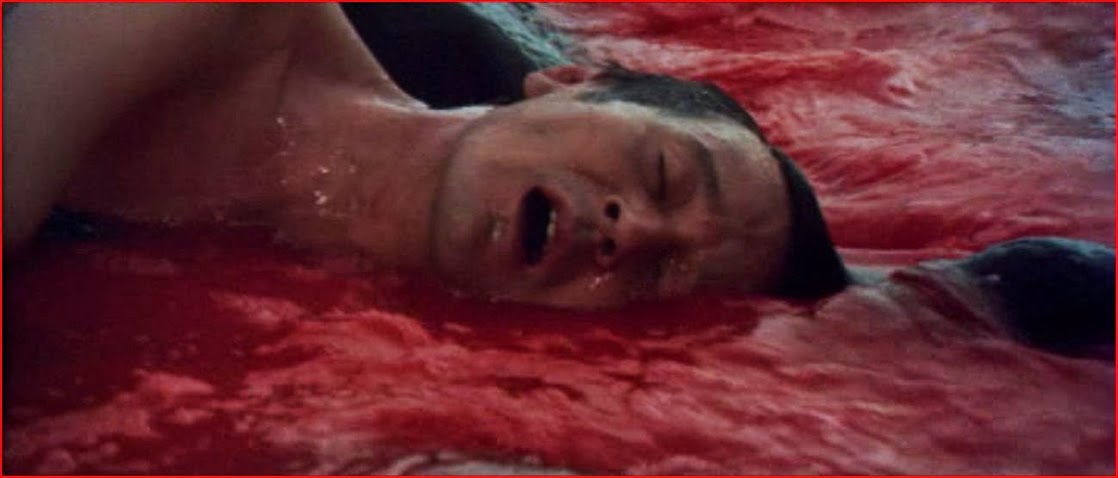
Toshiya Fujita's film is obviously a landmark in the mental landscape of Quentin Tarantino. It's not only a gory revenge story, but it also has the quirky chaptering that would become a Tarantino tic. In the context of Japanese cinema and pop culture, it's part of the legacy of Kazuo Koike, the manga writer best known for his Lone Wolf and Cub (aka Shogun Assassin) series. America's nearest counterpart to Koike probably would be Frank Miller, an admirer who contributed covers to the first series of American translations of the Lone Wolf books. Like Miller, Koike brought a new level of "realistic violence and death" (as it used to be described by comic book sellers) to his medium, though Koike did so as a writer only. Ironically, given the new level of gore his stories inspired in movies, Koike's manga were published in black and white. Others factors certainly influenced filmmakers like Fujita, whose unflagging enthusiasm for arterial spray can make Lady Snowblood sometimes look like a Herschel Gordon Lewis samurai film. Fujita didn't invent the effect; Kurosawa had done it (in black and white) in Sanjuro back in 1962. But Fujita's persistent attentiveness to all the ways blood can flow seems exploitative if not pornographic. Fortunately, there are levels of style and self-awareness that redeem the picture. Koike contributed to the screenplay, and there may be a note of self-congratulation in the sequence when Meiji-era readers rush to buy copies of Lady Snowblood, the muckraking account of the heroine written by the film's Koike surrogate, a Japanese Ned Buntline who turns the protagonist into a folk heroine, as images from the original manga appear on screen. More characteristic of Koike, perhaps, is the doomy tone, the way the heroine is identified as a creature of the "netherworld," accursed from birth with a burden of vengeance. But that portentousness actually fits well with the increasing stylization of the story, the way a curtain comes down to end Chapter Three after the heroine slices a hanged woman in half, or the way Fujita teases the start of Chapter Four by having the author actually drafting the chapter head with ink on paper before something distracts him. Perhaps these are ways of acknowledging the manga-ness of the material, of establishing that the source is at a further remove from reality than the usual sources of samurai movies. The increasing stylization puts the blood in a different light, suggesting that it's more than spectacle for slack-jawed gorehounds. Not that that would compromise the experience for the gorehounds, but Lady Snowblood was and still can be enjoyed on multiple levels depending on the what the viewer is looking for.
The mighty Meiko Kaki plays Yuki, "Lady Snowblood," first scene assassinating a yakuza boss on an appropriately snowy night. An origin story follows establishing her beef with four scumbags -- three men and a woman -- who ran a racket promising exemptions from military service in return for payments with which they absconded. These no-goods pounce on the new schoolteacher who's arrived in town, identifying him as a wicked government "man in white" and murdering him and his son. They rape his wife, who ends up a prostitute in prison desperately trying to get pregnant so a child can avenge her family against the remaining three malefactors after killing one herself. Yuki is her prison-born spawn, born as her mother dies, raised by a soon-released fellow con and trained in combat by a rather mean priest.
Believing one of the three dead at sea, Yuki goes after the survivors, one a broken-down gambler with a devoted daughter, the female fourth in parts unknown under a new identity. Yuki agrees to have her story published with the idea that pubilcity will draw the woman out rather than forcing her deeper into hiding, and that proves a good guess. More surprising is how that woman ends up hanged before Yuki can finish her. Turns out that the one thought lost at sea wasn't lost at all -- and he's the writer's father. You'd think he wouldn't show his hand and risk Yuki's wrath, but common sense would only stop this film in its tracks, and we really wouldn't want that to happen.
I assume that most people wouldn't. To be frank, I still don't care for the increased gore in Seventies swordplay movies; no matter how we might rationalize it as stylization, it still comes across as crass compared to the more elegant violence of the previous generation. Still, style is substance in Lady Snowblood, and Fujita and cinematographer Masaki Tamura bring enough genuine style to the picture to keep it worth looking at -- although Meiko Kaji pretty much does that just by showing up. She's arguably the greatest action actress cinema has yet produced, and that itself is probably a triumph of style over substance. Whether she's a sword-wielding avenger or Female Convict Scorpion in modern dress, Kaji has a presence that dominates the screen -- as well as a lovely singing voice for the theme songs all Japanese actors, apparently, were obliged to perform in this period. However we describe Lady Snowblood generically or stylistically, it's first and foremost a Meiko Kaji movie, and as such is certainly worth seeing. Maybe we should think of all those ejaculations of blood as the homage due to her.
Tuesday, June 12, 2012
WANDERING GINZA BUTTERFLY (1971)
During the trailer for Kazuhiko Yamaguchi's film, Meiko Kaji addresses herself directly to Toei Studio fans, greeting them for the first time and asking for their approval as stars sometimes did in these previews. It's hard to remind oneself that Kaji got her start elsewhere; you'd think that had she never existed, Toei would have to invent her. The studio that specialized in tough yet stylish crime movies during the 1970s seems like the natural home for Japan's greatest female crime-action star of the decade, yet Wandering Ginza Butterfly was her Toei debut. I often describe Toei as Japan's equivalent of Warner Bros. in the 1930s in the production of fast-moving, zeitgeist-grasping crime pictures, and this is a Toei production that often feels like an actual Warner Bros. movie in its mix of violence and sentimentality.
Past and Present
Ironically, while the woman with the most cause to hate her doesn't, Nami's fellow hostesses turn their noses up at her when they learn that she's an ex-con. It seems like they won't let Nami play any hostess games, but when the local bad guy tries to muscle in on her employer, it's up to Nami to defend the place. Her weapon of choice is a pool cue in a game of three-cushion billiards against the bad guy's resident hustler, a drug addict who luridly loses his composure in mid-match, but recovers to force Nami to make a big comeback in order to win and save the brothel. A poster of Paul Newman as Fast Eddie Felson presides over the contest, but Yamaguchi is no Robert Rossen. Instead, apart from the opponent's withdrawal episode, the director films this showdown like Billiards for Morons, with voiceovers from Kaji recording such subtle insights as "I need one more point to win." At the risk of spoiling things, I'll inform you that our heroine does win, but it's not much of a spoiler since the bad guy decides that he's going to take over the brothel anyway, so there.
We've got trouble, right here in Ginza City, with a capital T that rhymes with B,
and that stands for Butterfly!
The local good-guy yakuza steps in at this point, trumping the bad guy by announcing his marriage to the madam and his protection of her business. But the bad guy yakuza still won't play fair and has the good-guy yakuza killed in the street. All right, then; that's all Nami can stands, and she can't stands no more. It's time for a different kind of game, the kind you play with swords with a kimono for a uniform and your own song for entrance music. Kaji takes a stroll through the rain like Cagney in The Public Enemy as her song plays on the soundtrack. Only in Public Enemy William Wellman left Cagney's wrath to the imagination, with some help from shots and groans of agony. At Toei we follow the avenger inside -- and it turns out that Ryuji's there already to introduce her to her victims. They practically part the curtain for the moment we've all been waiting for....
She's singing in the rain, but her lips don't move.
Nami's sword does all the talking.
But despite the last-reel effort to live up to Toei standards, Ginza Butterfly is relatively lighthearted affair, despite a mildly downbeat finish, while the sequel, in which Sonny Chiba co-stars, is more blatantly comic from the evidence of the trailer on the Synapse DVD. Maybe "lightheated" doesn't make my point as well as "corny" would. The movie isn't without a bare minimum of Seventies sleaze, but it isn't hardcore Toei by any stretch of the imagination. As a Kaji vehicle it doesn't compare to the Scorpion or Lady Snowblood movies, but the actress is quite likable in a role pitched on a more human or humane level than her most iconic parts, and on this first outing the humor isn't obnoxiously over the top. It's mild for a Toei picture, but unless you must have a bloodbath every ten minutes, not just the last ten, its overall amiable attitude may just win you over.
Here's that trailer I mentioned; dijedil uploaded it to YouTube.
Wednesday, June 23, 2010
YAKUZA GRAVEYARD (1976)
This late film in Kinji Fukasaku's cycle of yakuza films for Toei is regarded as a companion piece to the 1975 film Graveyard of Honor, which also stars Tetsuya Watari. I haven't seen that film yet, but Yakuza Graveyard stands out from the Fukasakus I've seen for a more romantic (or Romantic) sensibility befitting its doggedly doomed hero. Unlike Graveyard of Honor, this one's written by frequent Fukasaku collaborator Kazuo Kasahara, the scripter for the Yakuza Papers/Battles Without Honor or Humanity series and the police tragedy Cops Vs. Thugs. Watari, the star, is less known in America than the female lead, the formidable Meiko Kaji of Scorpion and Lady Snowblood fame. This isn't the sort of film where she can set things right by grabbing a sword or gun. Given a more fragile character to play, Kaji still invests it with authority -- her character, the wife of a jailed yakuza boss, is said to control the gang's purse strings -- and she does get to at least carry a gun at one point. But Fukasaku is as far away here from fantasies of invincible vengeance as he could probably get.Watari plays Detective Kuroiwa, a cop who isn't above planting evidence on people, though the thug we see so treated probably deserved it. He starts out undercover in a pachinko parlor, contested territory for the established local gang and a larger, richer organization that's starting to muscle in. The local cops have an arrangement with the local gang, but the higher-ups seem to feel how the wind's blowing and urge the local yaks to come to terms -- except for Kuroiwa, who dares them to settle things the traditional, violent way. He has a conflicted relationship with the gang, feuding violently with an underboss while falling for Kaji's quasi-regent. In Keiko he recognizes another damaged soul. He hasn't shaken off the effects of killing a man in the line of duty years ago. He's shacked up with the victim's girl and has been scraping together money in order to buy her her own business, a bar; the girl alternates between open contempt for him and suicidal demands on his attention. He seems happiest alone in his desolate high-rise apartment listening to loud music. Keiko is half Korean and her imprisoned husband, her onetime pimp, despises her for it. "Why aren't you dead already?" he demands when Kuroiwa takes her for a visit to his prison. Afterward, Keiko wants to throw herself into the ocean. A drunken Kuroiwa stops her and then goes From Here to Eternity on her on the moonlit beach.
Meanwhile, Kuroiwa bonds with his erstwhile enemy the underboss, going from a brawl with him at a yakuza ceremony to a night on the town with two American hookers. When the gangster points a gun at his face in the morning, Kuroiwa's indifference cements their new friendship, which results in a sworn brotherhood that threatens our hero's position in the force. With Kuroiwa's encouragement, he goes to war with the rival gang, but by now the cops are openly on the other group's side. They convince a gang subordinate to capitulate once Kuroiwa's friend is out of the way, and when that happens everyone, including Keiko, assumes that Kuroiwa is a rat. Can our hero turn the tide in his favor? Don't bet on it....
I'm still a long way from seeing even a majority of Fukasaku's work, so I don't know how exceptional Yakuza Graveyard is stylistically, but there did seem to be more moments designed for pure pictorial effect than in his other films. There's a breathtaking long shot of a drab, geometric apartment complex that zooms in slowly to catch the insect-like Kuroiwa walking a path alone. When he takes Keiko to his apartment, he opens a window and lets in the wind. It blows a wintry note through the curtains and his open shirt as if he were a gothic antihero living in a tower. The scene with Keiko on the beach is another unusually romantic moment, though its the romanticism of desperation and pure need on display here.
Welcome to Kuroiwa's world
At the same time there are more typical Fukasaku effects all over the place. The fight scenes are done in his incomparable hand-held camera style, the violence of the camera's spasmodic movement accentuating the brawling, beating and shooting in each shot. Stills or screen captures can't really do justice to these scenes, which have the realistic effect of obscuring the action rather than choreographing them for maximum clarity. This particular film gets a little psychedelic, too, in illustrating the effects of truth serum on an already disoriented Kuroiwa.
Graveyard of Honor inevitably lacks the sweep of the five-film Battles series, and it doesn't pack the full punch of Cops vs. Thugs, but it has enough distinctive virtues, including the urgent performances of Watari and Kaji, to earn its own recommendation. The filmography of Kinji Fukasaku is an ongoing revelation of bitter little treasures, from the antiwar invective of Under the Flag of the Rising Sun to the cynical samurai epic Yagyu Clan Conspiracy to the apocalyptic misanthropy of Battle Royale. Not everything is a masterpiece, but Fukasaku hasn't disappointed me yet.
The Japanese-language unsubtitled trailer is three minutes of mayhem and Meiko Kaji on smack, uploaded to YouTube by asianwack.
Saturday, June 5, 2010
FEMALE PRISONER 701: SCORPION (1972)
First-time director Shunya Ito has something to say about Japan in this Toei Studio manga adaptation, and it isn't nice. The movie opens with the raising of the peacetime red sun-on-white field flag over a prison, and that symbol is later equated with the blood shed in a woman's deflowering. The specific woman is Nami Matsushima, Matsu for short -- prisoner 701. She loved a narcotics cop. He used her as bait to entrap drug dealers. The dealers found her out and gang-raped her. The cop caught them red-handed. He then cut a deal with them; that's what he planned to do all along. Matsu was just the bait to give him some leverage over them. They don't mind the scam as long as "co-prosperity" results. Even Matsu gets some money, but it's poor compensation for her betrayal. She's in prison because she tried to kill the cop in broad daylight. She knows too much, but never told it to the authorities. That leaves the gangsters wondering, but no one orders a hit on her in prison. Maybe that's because this particular prison is a living death, if not a living hell, where Matsu is tormented by the trustees and harassed by the guards while she perpetually plots to escape.Toei in the 1970s was the home (more or less) of Kinji Fukasaku, Bunta Sugawara and Sonny Chiba, the studio of gritty yakuza films and gory martial arts that I often equate with Warner Bros. in the 1930s. For me, this Toei outing is a flagrant change of pace. Grit and gore it's got, but Shunya Ito takes the proceedings to another level of feverish expressionism. He does stuff with color, lighting and set design that may suit this story's cartoonish origins but send the film reeling merrily out of the realm of realism. A location sequence of prisoners digging a massive crater into the earth is transformed by a gunshot into a setbound showcase of riotous red-painted sky. Matsu's backstory flashback features an erotic unwrapping arguably inspired by Singin' in the Rain, the flag/blood business I mentioned, a gang-rape filmed from below through a transparent floor, and rotating sets like something else out of a Hollywood musical. Matsu's trustee enemy Masaki, enraged by having a glass door pane slammed in her face, is transformed by lighting into something like a demon of rage until -- oops, she misses her target and puts the warden's eye out with a shard of glass. He's too annoyed to suffer and strangles her instead.Behold the widescreen awesomeness of Meiko Kaji as Female Prisoner 701, the metaphorical Betsy Ross of Japan.
Ito's experiments in style are eclipsed in many viewers' minds by the human special effect that is Meiko Kaji. She's part of the Seventies pantheon of valkyries -- joining Pam Grier, Claudia Jennings, Angela Mao, Christa Lindberg, etc., who still set the cinematic standard of violent female empowerment. Kaji could wield a sword (in the Lady Snowblood films), a gun or whatever came to hand for killing or torturing purposes. In this one, she's hogtied in solitary and a trustee is torturing her by ladling hot miso soup on her body. How can she fight back. By catching an edge of a towel in her teeth and pulling it out from under the trustee so she spills the entire pot of boiling broth on herself, that's how. Matsu's resourceful that way, and once she's finally free the men who tormented her don't stand a chance. As her "Vengeance Song" plays she picks them off one by one, with only her once-beloved corrupt cop putting up much of a fight. As Matsu (aka Scorpion) Kaji's best known for her taciturnity. Apart from her narration of the flashback, she probably has less than a dozen lines of dialogue in the whole picture, and one of those is "You talk too much."
Meanwhile, this is the sort of women-in-prison film your parents warned you about. Every possible excuse for nudity is exploited, including a credits-sequence inspection that requires naked prisoners to climb ladders and cross bridges while male guards watch from below, presumably to watch for vaginally-concealed contraband but with obvious ulterior motives. Lesbianism is inevitable, with Matsu being the top of the tops. One hopefully intentional comic sequence has another prisoner attempt to seduce her. Our heroine quickly takes charge and proves herself no cool-hand Luka. The would-be seducer is soon groveling at her feet begging for more -- and she's later revealed to be an undercover cop who insists desperately on getting another chance to share a cell with 701.
I can fault some things about FP701 -- particularly the uniformly inept action whenever someone has to slap or punch anyone else, with most performers missing by a mile despite the sound effects, -- but it has an undeniable momentum, the kind that keeps you wondering what Ito's going to do next. It's ultimately just a nasty cartoon with a misanthropic streak, but it's perpetrated with grisly panache by all hands. It's worth watching as an exercise in pop-cinema decadence that few would dare imitate today.
This version of the English-subtitled trailer was uploaded to YouTube by asianwack.
* * *
Here's a bonus. Following the custom of the time in Japanese cinema, Meiko Kaji sang the title song, "Urami Bushi," translated as "Vengeance Song" or "Grudge Blues." The original version plays over the end credits of the Kill Bill films. In this clip from sometime shortly after that film's release, Kaji performed the song in public for the first time in 20 years. It was uploaded by kukutxmuchu.
Subscribe to:
Posts (Atom)