Showing posts with label silents. Show all posts

Wednesday, March 7, 2018

DVR Diary: WINGS (1927)

On the day of the latest Academy Awards ceremony I rewatched the first ever Best Picture, William Wellman's World War I flying epic. Wings was one of two "best pictures" that year, officially recognized as the "outstanding production" of 1927-8 while F. W. Murnau's Sunrise received the first and only award for "unique and artistic" effort. Film buffs today regard the Murnau as the superior film and I'd most likely agree with them, but the distance between the two pictures really isn't as great as some may think. Both films are spectacles showing silent film at its peak of technical virtuosity, and both have plenty of corny moments. If Sunrise showed what a proven expressionist master could do with a Hollywood budget, Wings is arguably more of a revelation because Wellman really hadn't done anything distinguished before. Finally matched with the right subject, the young director went at it with every trick in the book and achieved unprecedented and arguably unmatched effects. While it flaunts supremely mobile late-silent camerawork and attacks the air war from almost every possible angle, Wings is above all the ultimate statement of silent cinema's primitive authenticity. Richard Arlen and Charles "Buddy" Rogers literally take to the air for the film's dogfights, and even jaded modern audiences are likely to be captivated if not awestruck by the unmistakable reality of it.

Arlen and Rogers are the leads in the film's tragic bromance of frenemies. They're from the same town, where David Armstrong (Arlen) is a privileged rich boy and Jack Powell (Rogers) is a car enthusiast. Both pine for rich girl Sylvia Lewis (Harold Lloyd leading lady Jobyna Ralston), but Jack does so almost as a matter of one-upmanship with David, and in spite of the obsessive attention paid him by his neighbor Mary, his neglect of her all the more inexplicable by the fact that Mary is played by top-billed "It" girl and legendary sex symbol Clara Bow. Maybe Mary comes on too strong, as Bow often does in her films. She does score a point with Jack by naming his homemade race car "the Shooting Star" and creating a logo he'll also use on his fighter plane.

The audience will be all for Bow because Mary also enlists, joining the motor corps as an ambulance driver. There's a scene nearly midway through the film that may remind today's moviegoers of Wonder Woman's exploits in a French village, down to the climactic destruction of a church steeple. Of course, all Mary can do is cower under her truck as that steeple crashes down point first almost on top of her, provoking what probably was some salty language from our star, though my lip-reading isn't good enough to verify it. As an aside, there's at least one "Son of a bitch!" during a dogfight scene that absolutely no one will miss. In any event, Mary's really big adventure takes place in Paris (some actual second-unit shooting was done there), where she's tasked with dragging a sozzled Jack from a bar because his leave's been cancelled. This is part of the scene that includes a famous tracking shot including two lesbians at a table, for what that's worth to you. On one hand, this is one of the film's dumbest scenes, sinking to the level of idiot comedy as Jack becomes obsessed with champagne bubbles and begins hallucinating them everywhere in special-effect form. On the other, the whole bubble business has a brilliant payoff when Mary, having changed from her chic uniform into a sequined cocktail gown to get Jack's attention, shimmies a blizzard of bubbles at him that finally wins him away from a predatory French woman. Of course, he's so stinking drunk that he never recognizes her through the whole experience, finally passing out in a hotel room just before some MPs show up to arrest Mary in mid-change back into her uniform. Her war ends with the grim irony of dismissal for immoral conduct, and when Jack reads about her "resignation" in a hometown paper, still none the wiser about Paris, he remarks that Mary didn't seem like the quitting type.

It's remarkable that Wings made Buddy Rogers a star when Jack is such an obnoxious character. Not only does he treat Mary like dirt, only to win her at the very end of the picture, and not only does he delude himself about Sylvia when she really loves David (as Ralston did Arlen), but on top of everything else he kills David. Not intentionally, mind you, or not in the "I want to kill David" sense, but because, believing David dead behind enemy lines, he goes on a berserker rage during the big American push, breaking from his formation to go on a solo rampage against any German plane he can find. So of course David has survived, and of course he steals a German plane in a desperate effort to get back to his own lines, and of course Jack isn't going to realize that it's his buddy in a German plane flying toward the American lines. This is all a big tragedy, of course, but Wellman takes it beyond tragedy to outright horror, milking David's hopeless helplessness for all it's worth as he knows exactly who's after him from the shooting star logo on the pursuing plane. This isn't a moment of valorous resignation but a sustained fit of despairing terror, and Arlen makes the most of it. Sure, the boys reconcile before David finally expires, after he's shot down and crashes into a house, but while Wellman strives to restore a sentimental tone -- the symbolic cut to a plane's propellers slowing to a halt outside a military ceremony is a nice touch echoed in the epilogue by Sylvia's mournful stillness in the swing she and  David used to swing on -- that play for pathos can't erase the memory of one of the most terrifying moments in all silent film, all the more terrifying, of course, for knowing that Arlen is up in the clouds, theoretically as helplessly vulnerable as the character he plays.

It's quite an achievement by both Wellman and Arlen that that scene of one man in peril is so memorable after some massively detailed scenes of land and air battle, nearly as definitive as the trench warfare scenes from All Quiet on the Western Front. Wings is more of a patchwork than that film, with wider variance in tone than Sunrise, to return to the original 1927 comparison, in an effort to please every part of the audience. Somehow it's a film that elevated everyone involved, including Gary Cooper in his famous few minutes as a doomed trainee pilot. Wellman knew star power when he saw it, and while Cooper doesn't have quite the godlike emergence here that James Cagney gets in Wellman's Other Men's Women, you can tell from the way the director dissolves to a closer shot of Cooper as he prepares to leave his tent for the last time that the young actor would make an indelible impression. But hell, this film even elevated El Brendel. Brendel really became a big deal in talkies, when his Swedish accent was judged inherently hilarious, if nothing else about him was. What on earth did he have to offer in silent film? Apparently Wellman found his face funny, having used him in an earlier picture, and in the meantime silence freed the presumptive comedian from the confines of his own shtick, so that here he can play a German-American, Herman Schwimpf, who has to fend off disdain for his enemy ethnicity by displaying an American flag tattoo on his bicep. Apart from that, he gets beat up during an aggressive demonstration of hand-to-hand combat and is forgotten about for most of the rest of the picture until he turns up firing an anti-aircraft gun before the climactic battle. He was there for someone's benefit, I guess, though I'd wonder about anyone who found him the highlight of the film. He's what you get when you try to have something for everyone in a movie, and that just goes to prove that Wings is more -- far more -- than the sum of its parts. Parts of this film are probably still the best air-war movie ever made.

Tuesday, August 22, 2017

DVR Diary: WHERE EAST IS EAST (1929)

This was the end of the line for Lon Chaney Sr. and director Tod Browning after a legendary run of films during the 1920s. Browning went on to make his sound-film debut later in 1929 with The Thirteenth Chair, which featured Bela Lugosi in a teaser of things to come. For Chaney, you could say Where East is East is the beginning of the end. Metro-Goldwyn-Mayer kept its "Man of a Thousand Faces" silent for another year, making him one of the very last major stars to make his speaking debut, perhaps because they were unsure of how to present Chaney as a talking star, and perhaps because the health problems that killed him in 1930 were already apparent. In any event, East is a typical Chaney-Browning production, though creepier in its insinuations than in explicit content. It seemed creepy to me, at least, because I inferred a quasi-incestuous subtext in the close relationship between the white hunter Tiger Haynes (Chaney) and his daughter Toyo (Lupe Velez). Toyo is a grown woman, which makes the father-daughter horseplay at points seem just a bit excessive -- but maybe I'm just reading stuff into a Browning film (Waldemar Young adapted an original story by the director and pulp writer Harry Sinclar Drago) because you're supposed to. Even if you suppress such speculation, there's something creepy about the way Toyo's mother and Tiger's ex, the half-caste Madame de Sylva (Estelle Taylor), becomes Toyo's romantic rival for the affections of Bobby Bailey (Lloyd Hughes), who's come to Laos to buy tigers for his father's circus from Haynes. And because this is a Tod Browning film, Tiger keeps what I take to be an orangutan, though it might be a runt of a gorilla, in his house -- an orangutan with a grudge against de Sylva. That sounds familiar. The Chaney character is going to unleash the ape to kill his wife but something will happen, he'll change his mind and get himself killed, right? Not quite. It looks like Tiger Haynes is done for after locking himself in the room with the ape to keep it from getting loose and attacking the young lovers, but not before the avenging orangutan did what he had to do to the half-caste vamp.


Considering some of the unfilmed ideas Browning had -- he told a doozy to Herman Mankiewicz about Chaney as a violinist/mad scientist grafting women's heads onto gorillas' bodies -- this is fairly mild stuff, though it makes you confident that the Browning-Chaney team could have taken their act into the Pre-Code era with little trouble. There's really no reason for East, a May 1929 release, not to be a talkie except that the studio and/or director and/or star weren't ready just yet. Chaney's scarface makeup wouldn't have gotten in the way of dialogue and he wouldn't have had to attempt a foreign accent for his role. Yet I suppose the Chaney-Browning world worked according to a kind of dream logic, at the slightly unnatural speed of silent action, that would not translate, despite wishful thinking about Chaney as Dracula, to the gravity of sound. They belong to another universe the way the silent clowns did, and as a male star at M-G-M circa 1929, Chaney probably was doomed anyway.

Tuesday, July 25, 2017

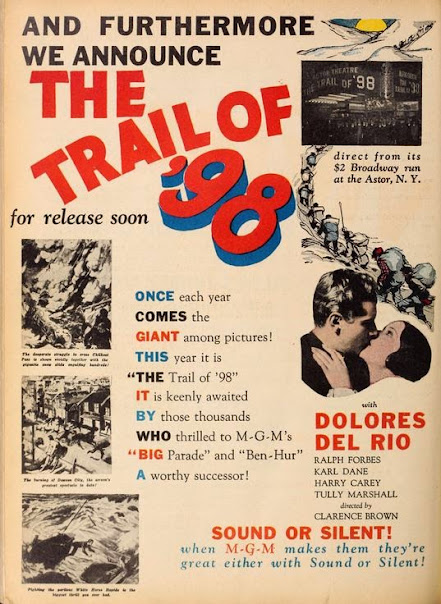
DVR Diary: THE BIG PARADE (1925)

Ever since Wonder Woman stormed through No Man's Land earlier this year I've wanted to take a fresh look at World War I movies, including those I'd seen before. It had been a while since I looked at King Vidor's 1925 blockbuster, the first major film about the war made after the armistice, with no need for propaganda. It made a superstar of leading man John Gilbert, real stars of romantic lead Renee Adoree and comic relief Karl Dane, and a bankable name of Vidor himself. I didn't remember it being as hard a slog back then. More than half the film is over before we get a battle, and most of that first half is seemingly interminable service comedy stuff with Gilbert, Dane and Tom O'Brien in France. That probably reflects the sensibility of Lawrence Stallings, whose novel Plumes formed the basis of the screenplay. Roughly speaking, Hollywood gave us two kinds of World War I movie between the world wars, not counting the German-point-of-view picture All Quiet on the Western Front. John Monk Saunders, the writer of Wings and many subsequent war pictures, brought a sort of "Lost Generation" post-traumatic sensibility to his work that makes his pictures more accessible today. To be cynical about it, his 1940 suicide probably gives Saunders additional street cred in our time, though if you want to play that game take note that by little more than a decade after Big Parade was completed Gilbert, Adoree and Dane were all dead. Stallings brings a different sensibility to war literature. His major contributions were Plumes and the play he wrote with Maxwell Anderson, What Price Glory, adapted into another blockbuster movie that inspired a spinoff comedy series about its bromantic heroes, Flagg and Quirt. Judging from Big Parade (assuming it to be a faithful adaptation of Plumes) and What Price Glory, it looks like Stallings saw the war as an occasion for the loosening of inhibitions as well as a perhaps pointless slaughter. Hence the girl-chasing in Big Parade as well as the notoriously salty "dialogue," available only to lip-readers, of the What Price Glory film. Saunders covers some of that territory as well, especially in Wings, but his stories always remain more grim than Stallings'. That's not to say that Big Parade doesn't get grim. In fact, it probably came across to its original audiences as very grim, since after building up Gilbert's buddies through that long first half of the picture Vidor promptly destroys them in his one big battle scene.

To back up a bit, Gilbert plays Jim Apperson, wastrel son of a successful businessman who enlists at the spur of the moment when the U.S. declares war on Germany without really thinking about it much. His dad thinks he's become a man at last -- an older brother stays home to help run the business -- but Jim doesn't want to make a big deal of it because he realizes, on his first second thought, that his mother will be horrified. Nevertheless, he leaves home and girlfriend behind to ensure basic training and the many indignities of military life (especially stable cleaning) alongside construction worker Slim (Dane) and bartender Bull (O'Brien). In France, they all have the hots for Melisande (Adoree), but Jim's an easy winner in that contest over his grotesque pals. Finally their unit is called to the front (the intertitles get hysterical about it: "Front! FRONT!" etc.) and Melisande can't stand to see Jim go. In a melodramatic high spot, she clings to the rear fender of the truck taking the men away until she can't hang on anymore, and then lies there abjectly after everyone else has left.

There isn't really any trench warfare in Big Parade unless you count the dark night Jim and his buddies spend in a shell crater. Instead, the Americans advance on the enemy through a forest in a scene famously choreographed by Vidor to establish a rhythm of footsteps, gunshots and falling bodies. In its deliberateness this scene is far from the machine-gun pacing of Lewis Milestone's All Quiet  battles or the relentless tracking shots of Stanley Kubrick's Paths of Glory, but it's a great way to build up tension as the Americans approach their baptism of fire. At a more intimate level, the night scene with the three soldiers in the crater must have been terrifying to the original audience as the men lose each other in darkness and light can mean death. The intertitles go over the top again in their own way -- blame them on movie writer Harry Behn rather than Stallings -- as Jim loses his buddies. "GOD DAMN THEIR SOULS!" he thunders at the Germans as he realizes that they've killed Slim. He gets a bit more explicit than that later, and while I recall seeing a version in which "bastards" is spelled out on screen, the version I saw on TCM (presumably more authentic) bleeps it down to "B---!" In any event, Jim barely survives, taken away in a singular burst of color by a Red Cross truck and sent home minus a leg. He learns that his girl has Dear Johned him with his brother and promptly heads back to France -- whether to stay with Melisande or bring her home to America is unclear. My gut feeling is that he stays, and I suppose there's a message there about the war experience for many Americans. You probably need a sense of Big Parade's place in film history to fully appreciate it now, or at least forgive the patches that have grown dull over time, but it's still essential viewing if you're interested in how Hollywood presented the war supposed to end all war.

Saturday, March 11, 2017

THE MYSTERY OF THE LEAPING FISH (1916)

I don't know enough early films to say whether The Mystery of the Leaping Fish is the first American drug comedy film, so let's make a more modest claim: John Emerson's two-reeler, conceived by that beloved humorist of the cinema, Tod Browning, is the Birth of a Nation of drug comedies. I suppose we could be more modest still and call it the Inherent Vice of 100 years ago. It's almost certainly the weirdest performance ever given by Douglas Fairbanks Sr., who plays the "scientific detective" Coke Ennyday. While the name is a loose play on Arthur B. Reeve's then-popular scientific detective Craig Kennedy, the character's awesome drug habit is taken from Sherlock Holmes, and expanded upon immensely. The great detective sits at his desk, injecting himself with something every couple of minutes to restore his spirits -- he chuckles after each injection -- while a huge jar labeled COCAINE is within easy reach. A closet holds the detective's many disguises, clearly labeled as such, while a clock divides Ennyday's routine into four phases: drinks, eats, sleep and dope. This film was made two years after the federal government first cracked down on the distribution of cocaine and other narcotics, so Leaping Fish flies in the face of a national anti-drug hysteria in the admirably irreverent fashion of that era's films. A police chief, I.M. Keen, rings Ennyday's doorbell, and the slightly paranoid scientific detective pulls out his "scientific periscope," a proto-TV apparatus to verify the man's identity. After his servant, dressed like a giant bellboy, opens three layers of doors, Ennyday hears the lawman's appeal. There's a man in Short Beach rolling in wealth despite lacking apparent means of support. Certainly something requires investigation there!

In Short Beach we are introduced to the mysterious leaping fish, which are inflatable floating devices for coastal frolicking. We are also introduced to the film's heroine, Inane the Fish Blower (Bessie Love). That's what they call the girl who inflates the inflatables with an air pump. The lurking Coke Ennyday discovers her in distress, having fallen off a pier into shallow water. Skipping into action with the celerity of a Keystone Kop, Coke flings himself off the pier and plants himself head-first in the mud. Inane has to rescue him from this predicament, but he'll return the favor later. The man Ennyday was assigned to trail, earlier shown literally rolling in money in his bed, is, in fact, a drug smuggler; he sends two Japanese minions out to sea with Leaping Fish, and they return with contraband. Poor Inane knows nothing about this, but is threatened just the same by the amorous attentions of Fishy Joe. Another member of the criminal ring is the Chinese launderer Sum Hop. For you youngsters, that was more drug humor. Despite his perpetual daze some instinct drives Coke Ennyday to discover a cache of opium, which he commences to eat like cake batter out of the bowl. In the double climax Coke must battle the yellow perils and their white master, while Inane must defend her virtue against Fishy Joe. She defends it with all the vim and violence you'd expect of Douglas Fairbanks himself, wiping the floor with Joe, while Ennyday, quivering as if he'd OD'd on Acme Earthquake Pills, uses his trusty hypodermics to inject his foes into various states of stupefaction. One virtually floats through the ceiling, while another throws himself out a window. Finally comes the showdown with the mastermind, which conveniently goes down in darkness, with Coke conveniently victorious when the lights go on again. Once more Coke Ennyday has conquered crime, and this time he gets the girl, too -- only that's not the end of the story. Before we really got started with the story we were shown a quick shot of Fairbanks out of makeup, laughing at something he'd just read. The film closes with the real Fairbanks trying to sell the very story we've just seen to the scenario department at the Triangle Studio. The department head tells him to stick to acting, and Fairbanks exits with a pout. He actually did a lot of his own writing under the Elton Thomas pseudonym, but here he gives one of the great good-sport performances ever in what some have seen as a send up of his own already-formed frantic screen persona. It's an all-out fearless physical performance that shows the young star unafraid to look like a complete idiot, flaunting the fakeness of Ennyday's moustache, rocking his ridiculous outfits, and pretty much pogo-ing through most of the story as if he, the actor, really were on something. He helps mightily to make The Mystery of the Leaping Fish one of the damnedest things you'll ever seen. And you can see it right here, as uploaded to YouTube by one Ivan Smirnov. Check it out, man...

Monday, October 17, 2016

DVR Diary: SPEEDWAY (1929)

William Haines is a recognizable ancestor of the boy-men who continue to infest Hollywood, and as such he was one of the biggest stars of the late silent era. Sound and scandal snuffed out his career soon afterward, and the former alone might have done it -- Haines was gay and refused to go through with a studio-arranged marriage to cover it -- because, on the evidence of the talkies of his I've seen, his shtick came on too strong in sound. He is possibly at his most obnoxious in Harry Beaumont's racing melodrama, but his obnoxious qualities -- he seems to have been arrested in development at adolescence -- were packaged to be tolerable to movie audiences. The archetypal Haines story portrays him as arrogant and selfish, albeit with an innate harmless charisma that makes women warm to him, but while today's boy-men stop right there, Haines usually suffers some comeuppance that leads him to redeem if not necessarily mature himself. In Speedway he's part of the pit crew for Ernest Torrence's long-suffering Indy-car driver, a sort of savant with engines and ambitious to race himself yet neither very ambitious nor disciplined. In Indianapolis he spends most of his time hitting on Anita Page, who turns out to be an aviatrix and inflicts a comic comeuppance on our hero by taking him on a wild, ultimately destructive plane ride. Haines makes a spectacle of himself attempting to seduce her at a diner, and later stages a fake auto accident to get her attention. I guess the girls in these pictures are supposed to be bowled over by his good looks once they realize that he means no harm, but I don't know if I buy it.

Meanwhile, Haines grows estranged from father-figure Torrence, who hopes to finally win the 500 in his final race. Our hero is seduced himself by John Miljan's dirty driver, Torrence's longtime rival, who promises that Haines can drive his car in the big race but only wants the naive young man to soup up his engine. The melodrama really kicks in when Torrence's doctor tells him his heart won't last 500 miles. With Haines now allied with his enemy, Torrence has to hand the wheel to his other pit man, Karl Dane. Miljan reclaims his car just before the race, and when Dane can't hack it as a driver, Torrence pulls a switcheroo and lets Haines drive for him. Most of the film was shot on location and while this is no Ben-Hur with motors there are a few money shots of Haines and Miljan driving on the actual race track. Haines overcomes a four-lap deficit, and just as he's poised to pull away he fakes an eye injury in an act of filial piety, the idea being to let Torrence finish the race and take the long-coveted checkered flag. This he does, only to pass out in the winner's circle, but the film isn't so melodramatic that it will kill the man off. Speedway was Haines' last silent film -- he had already spoken on screen -- and it's enlivened by racing sound effects in place of music during the climax. It is not the picture to explain Haines' appeal to modern viewers, but I don't know if any of his films can explain it now. As a very late silent, premiering in the fall of 1929, it was destined to the memory hole, but unlike some other Haines vehicles from this period, at least Speedway survives to play sometimes on Turner Classic Movies. It's arguably even more obsolete than many late silents when you consider that within five years of its release William Haines was finished as an actor and Ernest Torrence and Karl Dane were dead.

Wednesday, January 20, 2016

DVR Diary: TWO ARABIAN KNIGHTS (1927)


"One flash of that pan and she'll yell for Allah!"
"I've had more broads yell for me than you and this Allah guy put together." 
Q. What World War I movie starring Louis Wolheim won director Lewis Milestone his first Oscar? It wasn't All Quiet on the Western Front. It was this film, long thought lost, that won Milestone the first and only Academy Award for Comedy Direction. It may dismay viewers today that none of the era's slapstick masters, or their directorial collaborators, took this prize -- and that may indeed have been a factor in the category's quick abolition -- but Two Arabian Knights proves to be a fairly funny film. That's mainly because Wolheim and William (Hopalong Cassidy) Boyd have a blast playing unrepentant Ugly Americans -- and Wolheim is literally ugly! -- running amok in wartime Europe and the Middle East. Cynicism about "the war to end all wars" had quickly taken hold around the world, but while All Quiet finds Milestone in despairing mode over the slaughter, Two Arabian Knights rejects all pity or piety. Irreverence reigns right from the start as Boyd and Wolheim, as private and sergeant respectively, face death in a crater in the middle of No Man's Land. If they're going to die, Boyd decides, then by God, he's going to pay the sergeant back for all the time he pushed me around! Before long, German soldiers ring the rim of the crater, like spectators at a pit fight, as our heroes try to beat each other's brains out. Thus begins a picaresque tail that next delivers our warriors to a POW camp. Also imprisoned here are Arab soldiers who fought for the Allies, presumably from one of France's imperial possessions. Apparently these Arabs fought in their traditional white robes, which make great camouflage when you're going to escape into a snowy wilderness -- except it's our imaginative Americans who do the escaping, after first clobbering two fellow prisoners. They barely make it under some electrified wire -- it's actually a clever piece of direction that we can clearly see the tiny twig propping up the wire tottering as the boys squirm across -- before they blunder into another group of Arab prisoners and German guards. Great job!

The German policy apparently was to put Arab prisoners in the hands of their Turkish allies. Thus our heroes end up on a train to Constantinople, where they manage to dodge their captors and stow away aboard a civilian ship (with a Russian crew) bound for the Ottomans' Arab territories. Boris Karloff is the purser on this vessel but doesn't get much to do. Of more interest to the boys is a genuine Arab princess (Mary Astor) returning home from her studies in the imperial capital. She's sort of traditionally dressed -- it's Hollywood's (or producer Howard Hughes's) idea of such dress -- but she has a modern education. Repeatedly, Boyd and Wolheim underestimate Arab learning, making cracks about their plans for the girl -- these include the exchange quoted above -- until they realize that, despite her early dumb show, Mirza knows English all along. The gag is repeated to greater effect when the soldiers have an audience with Mirza's father and his vizier. Wolheim makes an idiot of himself in a parody of the pantomime that was a staple of silent comedy, only to have the vizier ask, again in perfect English, "And exactly what is your business here today?" The Arab characters are still largely stereotypes, but so are the Americans, and in a world of universal caricature there's no reason for anyone to take offense. Eventually the boys will take Mirza away with them, of her own will, to a life in America in a time when no one thought twice about Muslims in the country. But if it is a sort of fantasy of liberating Americanism, it's also a learning experience for our American heroes -- or at least Wolheim learns the meaning of the word eunuch. There's an interesting lesson here in how intertitles could illustrate relative intelligence. Boyd knows what a eunuch is and identifies one to Wolheim, the title card spelling the word correctly. Wolheim is innocent of such things and asks what a "yunick" is. In this film's quaintly ribald way, Boyd whispers the answer to Wolheim -- no intertitle this time -- and Wolheim's face acquires an expression of queasy horror. As they pass the eunuch on their way out of town, on their way to freedom, the film closes with a reprise of Wolheim's sick gaze, as if he's lucky to leave the story intact. It's an odd way to end the show but overall Two Arabian Knights is a welcome reminder that silent cinema didn't depend entirely on pratfalls and special effects to be funny.

Friday, November 27, 2015

THE DAUGHTER OF DAWN (1920)

Like the buffalo and the Native Americans, The Daughter of Dawn was nearly lost. An independent production of the Texas Film Company, this all-Indian cast film had few known showings before disappearing for decades. Now you can stream it on Netflix, and now that the film is much closer in time to the epoch it portrays than it is to our own it probably looks more like an authentic historical document, simply by virtue of age and wear, than it may have to whoever saw it 95 years ago. Back then, the film's cornier aspects may have stood out more. While they still stand out now, they matter less than the idea that here is a movie of Indians hunting buffalo in which the actors probably had living knowledge of how it was done. Daughter of Dawn puts us one degree of separation from the legendary Old West; two of its main actors were children of the famous Comanche chief Quanah Parker. Its historical value is indisputably, almost immeasurably greater than its aesthetic value.


Norbert Myles and Richard Banks's scenario is self-consciously archetypal in a generic way. He's less interested in a narrative grounded in the authentic details and rhythm of Native life than in "the eternal triangle" that could appear anywhere, at any time. This time it's a triangle of a woman and two men. The woman is our title character (Esther Labarre), named for the time of her birth but in fact the daughter of a Kiowa chief. She has two suitors. One, Black Wolf (Jack Sankadota), is rich in goods. The other, White Eagle (White Parker) is a hunk compared to the pot-bellied Black Wolf. White Eagle is also a good citizen; he locates a buffalo herd and leads the Kiowas on a successful hunt that highlights the picture. The chief knows that Black Wolf can offer more for his daughter but he also respects her opinion and her emotions. Knowing her preference for White Eagle, the chief decides to let a trial of courage decide her future.


Black Wolf and White Eagle are to jump off a cliff. It's more steep than high but it promises a rough landing. Whoever survives will win the Daughter of Dawn. I'd hate to think any actual tribe settled such disputes that way, but no one claimed that this is an anthropological text. Anyway, both men survive, but Black Wolf survives by cowering on a ledge while White Eagle nobly takes his lumps all the way down. He'll be fine, while Black Wolf is shamed out of the tribe. On the rebound, he finally accepts the loyalty of Red Wing (Wanada Parker), who's been pining inexplicably for this lout through the whole picture and now volunteers to share his exile.


Rather than take his punishment like a man, Black Wolf turns traitor, betraying the Kiowas to this film's bad guys, the Comanches. He shows them the way to the Kiowa village, promising them horses and women, so long as he gets Daughter of Dawn. To cut to the chase, a recovered White Eagle leads the rescue mission, setting up a final showdown with Black Wolf. This climactic fight is reasonably well staged for 1920, Myles gradually moving closer, cut by cut, from long shot to close-up. But he follows it with a corny, clunky anticlimax as Red Wing knifes herself out of implausible grief for this dead Bluto of the Kiowas and an intertitle comments: "Constancy, thy name is Red Wing."


As a Native critic might have said, "Ugh." But while the story is the stuff of pulp fiction, with apologies to pulp fiction, Daughter of Dawn is fascinating even more as a piece of cinematic history than as a relic of Native folkways. For silent film buffs there's inherent drama to every rediscovery, and Daughter deserves its place on the National Film Registry (Class of 2013) regardless of its dramatic limitations. With so many major-studio Hollywood pictures from the silent era still missing or unlikely to be found, it's a wonder that an outlier project like this one can be seen so easily today, and that shouldn't be taken for granted.

Tuesday, November 24, 2015

WHEN AN ALIEN ROBOT CRASH LANDS IN TROY, NY (2015)

The poster above is an accurate representation of the protagonist of Bobby Kendall's silent film. On film, the alien robot is a charmingly preposterous creation. He's really no more than a cardboard frame built on top of a remote-control toy truck, with a control panel painted or drawn on his torso and a permanent expression of open-mouthed anxiety drawn onto his red-eyed face. His arms look useless, and when he uses them to touch or manipulate things, Kendall resorts to POV shots in which the arms are clearly being held in the director's hands. It's not to be taken seriously, after all, and the robot's abject simplicity makes him almost a 21st century version of the tramps and pasty-faced clowns of a century ago. He's a sign of Kendall's intentions, which are not, as far as I can tell, to make science fiction, but to get back to the essence of moviemaking. Silent films are about images and movement, and boy, does this film move.

In slightly less than an hour, Kendall follows his little robot from his crash site through the Collar City known as the Home of Uncle Sam, the place of my birth and my daily work. In the first section, "Terror," the robot struggles to find an exit from a post-industrial wasteland. In the second, "Wonder," he makes it into the city proper, exploring downtown Troy during one Saturday's outdoor farmer's market. In "Exploration" he tries to make contact with the planet's indigenous life, primarily an indifferent cat, and takes a treacherous trip through some parkland. In the final section, "Love/Freedom," he discovers the possibility of companionship and appears to find fulfillment as a child's toy.

The robot is Kendall's only special effect, but his dogged mobility brings this micro-budgeted film to life. Much of the film consists of long tracking shots following the robot as he scoots down roads of varying smoothness. These are impressive compositions, and they only get more so when the robot reaches populated areas. The Farmers' Market sequence is a modest tour de force as Kendall follows the robot through a crowded Monument Square and environs, leaving you wondering how the little guy doesn't get stepped on, or how no one ever sued Kendall for tripping over the thing. It takes you back a little to the early days of silent comedy when Mack Sennett's troupe would set up shop at public events and make comedy wherever they might find it. There aren't really any gags in Alien Robot, but it's still a sincere throwback to that century-old spirit. That comes through in the final sequence, when the robot, after watching two people enjoy a railyard picnic, befriends a little girl playing alone in her yard. There's something sentimental if not corny to this courtship, as the girl guides the robot with her little stick and finally does a happy dance as he circles elegantly around her. The closing high-five is a more modern touch, of course.

If the robot is in some ways a 21st century silent clown, in another way he's a humble embodiment of cinema itself. Seeing Troy from ankle-level and on the move from the robot's perspective must be like seeing things through a movie camera for the first time; the artifice automatically changing what we see as well as how we see it. Kendall has a few more tricks up his sleeve than tracking shots; like a good silent director he's also adept at montage, which he uses to establish the first terrifying, then wondrous strangeness of the cityscape. But when he's following the robot through the city he arrives at something like pure cinema. And on top of that, like many a silent film Alien Robot has an original score, which I was lucky to hear performed live by the band Lastdayshining, including Kendall. The score elevates the film, underscoring its often ecstatic sense of discovery and wonder. The combined effect is more artistry than amateurism -- which is more than I can say for that poster -- reminding us of what can still be done with limited resources and an understanding that cinema itself is a special effect. I don't want to exaggerate the film's virtues, but it definitely deserves a lot of appreciation, just as Bobby Kendall deserves encouragement in his future ventures.

Sunday, November 22, 2015

On the Big Screen: THE GOLDEN BED (1925)

Cecil B. De Mille is identified with a certain kind of movie spectacle exemplified by his second version of The Ten Commandments (1925), now the oldest movie regularly shown on network television. Back when he made the first version, in 1923, he had a different reputation. In both phases of his long career he was widely perceived as a vulgarian, but while late De Mille, the director remembered today, is identified with historical or Biblical spectacle, and with reverence disguising sex, violence or overall sleaziness, early De Mille -- it's really middle De Mille, following a period where he was perceived as a pioneer cinematic artist -- goes straight to the sleaziness, but with style. In the early to mid 1920s a De Mille picture meant scandalous behavior among the opulent classes. Increasingly he covered his preoccupations with a veneer of archetypal ambition. His big gimmick was to interrupt his modern sex stories with interludes set in olden times to illustrate his themes more vividly. The 1923 Ten Commandments was different only insofar as the Moses material went into a long prologue, after which came a modern story in which the penalties for violating the commandments were illustrated with a winking earnestness. The Golden Bed comes at the end of this phase of De Mille's career -- it marked the end of his first stay at Paramount Pictures before he became an independent studio head -- and is perfunctory in its gimmickry. An intertitle equates the film's belle fatale with the legendary Lorelei and De Mille dutifully demonstrates by showing us a possibly-nude maiden urging a shipwrecked sailor to climb up out of a storm-tossed sea and onto her rock. The shot lasts less than a minute and then it's on with the show. There are plenty of characteristic De Mille moments yet to come, but Golden Bed strikes an overall tone that seems atypical of the great showman, and it's unclear whether audiences or reviewers -- one contemporary called it De Mille's worst film -- knew what to make of it. Since its release it's been largely forgotten and unseen. The organizers of the De Mille festival at the Madison Theater in Albany called their showing a world premiere of a George Eastman House restoration of the picture, and chief organizer Michael V. Butler put a distinctive stamp on it by compiling, with a collaborator, a new score that proved surprisingly effective given its dependence on Soviet composers, above all Khachaturian and in particular his Spartacus ballet music. But if it worked for Caligula it was certainly going to work for De Mille. It was still a strange juxtaposition since Golden Bed itself is very much a product of its own time and place, De Mille and his regular writer Jeanie MacPherson tapping into American literary influences above and beyond the Wallace Irwin source novel. Call it De Mille's Magnificent Ambersons and you may get the idea.

The Golden Bed is about the fall of an American family and how they nearly take a rising family with them. In Atlanta live the increasingly shabby yet ever genteel Peakes and the aspiring hardscrabble Holtzes. Papa Peake (Henry B. Walthall of Birth of a Nation fame) was bred to spend money but not to earn it, a title tells us. He's staked his family's future on his beautiful, spoiled, blonde daughter Flora Lee (Lillian Rich), while neglecting still-pretty but definitely second-best Margaret (Vera Reynolds). Flora has been bred to land a rich husband; early proof of her talent is the way young Admah Holtz, a candymaker's son (who grows up into Rod La Rocque) will give Flora free peppermints while making Margaret pay. As Papa patiently explains to a jealous Margaret, when Flora lands the right husband there'll be candy for everybody. Everything works out just in time; Flora lands a European aristocrat and Papa hosts the wedding the same day that the bank repossesses his furniture. As it is, Margaret still has to go out into the world and get a job. She goes to work for Admah, who has inherited the store and the name of "Candy" Holtz. Margaret hits the ground running with ideas for Admah to spruce up his slovenly shop, e.g., take the used flypaper off the candy shelves. Admah appreciates her entrepreneurial sense but is almost cruelly oblivious to the way Margaret plainly pines for him. He jokingly orders her to leave by the employees' back entrance after hiring her, not realizing how humiliating the moment is for her, though she pluckily jokes about noblesse oblige. Worse, he'd gone to Flora's wedding and hovered at the margins like a neglected puppy, except that Flora didn't neglect him. She saved him a flower from her bouquet and threw it to him while her new hubby wasn't looking. He still has a chance.

Now that Margaret has civilized the place and Admah isn't pulling taffy in the shop window anymore, the Candy Holtz business picks up. With Margaret as his conscience Admah rejects schemes to adulterate his produce by using sugar substitutes. As they condemn Atlanta to Type 2 diabetes, Flora is abruptly widowed during an Alpine vacation when her hubby and a rival with whom she'd started an affair fight their way off a cliff. I guess you can call that a De Mille touch, down to a primitive version of the Saboteur effect as the two men take the plunge. Now that Flora's free again, not to mention left out of hubby's will "for some reason," Margaret doesn't have a chance with Admah. Flora becomes Flora Holtz virtually by fait accompli and Margaret practically vanishes from the picture for an hour. Candy Holtz has achieved his dream, but he's also cut his own throat. Like father, like daughter; Flora lives to spend and is determined to rule Atlanta society, even if Admah can't really afford it. When she loses her bid to be hostess of the Peachtree Ball, she browbeats Admah into hosting a rival ball, playing on his class insecurity by blaming his working-class background for her defeat. Admah has been warned by his banker, whose wife won the right to host the ball, that he'll get no more credit if he continues his extravagance, but he blows practically all of his latest $40,000 loan on staging an insane candy-themed ball. This is the true De Millean showstopper, a nutty (and chocolatey!) masterpiece of demented set design (topic for future discussion; De Mille's true heir in our time is Tim Burton) garnished with hostesses in costumes made of candy -- that is to say, edible costumes. C.B. doesn't mean that in a purely theoretical sense, either. Censors reportedly went nuts over scenes of men nibbling near sensitive areas on those outfits. So which ball would you go to? Most of Atlanta society agreed with you, but Admah and Flora's moment of triumph is about to turn to ashes like many Cinderella stories. You see, after all that party planning Admah is running on fumes and Flora's dressmaker won't let her have her party gown until she pays her back bills. In a Dreiserian moment of decision (read Sister Carrie, or read about it if you're in a hurry), Admah takes the day's sales receipts out of a safe to pay the dressmaker, and that, children, is what we call embezzlement. Oh, and Flora is practically cheating under his nose with social butterfly Bunny (a young Warner Baxter). With Flora walking out on him and the police closing in, Admah may think the world has turned against him but this is really a moment of self-destruction, perfectly illustrated by De Mille in what should be this film's signature shot. In a self-parody of Samson and Delilah a quarter-century in advance, an enraged, self-pitying Admah brings a full-sized candy gazebo crashing down behind him by pushing the pillars apart. Next on his schedule: five years in prison.

It would be too brutal if the film ended here, so we get a final act in which Flora is punished and Admah is reformed through labor, while Margaret reopens the original Candy Holtz store and proves herself a successful businesswoman in her own right. This sets up a sad, almost chilling emotional climax that anticipates not only Orson Welles's Maginificent Ambersons but the mad pathos of southern gothic literature. In short, Bunny kicks Flora to the curb at the first opportunity, and with her youth gone and her looks going its only downhill for her. On the day Admah is released from prison a threadbare, moribund Flora makes her way to the old Peake mansion, which is now a boarding house. She has a poignant reunion with her old pet monkey, now working for an organ grinder -- I could write a whole post on the monkey as her totem animal going back to a childhood doll, the way its mischief at the Candy Holtz store embodies Flora's destructive rivalry with Margaret, and whether the monkey's name, Louella, is a dig at Parsons the gossip columnist -- before the new mistress of the house reluctantly lets her tour the place. How far Flora has fallen is hard to say; she may be homeless, but there's no hint of prostitution, and I might have found her comeuppance excessive except that I know that Hollywood actresses actually did fall that far if not further. Anyway, Flora's old Golden Bed is still in its old place -- I should explain that Admah had bought the house for her, and presumably refurnished it, as a wedding present -- but its crowning swan's head is broken and tied to the bed, upside-down, with wire. Meanwhile, as I mentioned, Admah is getting out of prison, and Margaret has put together a nice dinner to welcome him back. But he -- can't -- let -- go! Some morbid instinct draws him, too, to the boarding house, where he finds you-know-who in the Golden Bed. She recognizes him, but seems to have forgotten, in her decrepitude, that she and the "Candy Man" had been married. You'd like to think that her calling out for Bunny in her last moments would be the ultimate deal-breaker, but I think she actually has to die before Admah will finally quit her. Of course, Margaret has no clue about this nearby deathwatch and sadly falls asleep at an untouched dinner table. But the film does us the kindness of closing on a things-could-yet-be-worse note. After all, neither Admah nor Margaret commits suicide. Instead, he finally shows up about twelve hours late, and "your sister died in my arms" proves a satisfactory excuse. The Golden Bed actually closes on a note of bittersweet perseverance as the two survivors watch a construction crew reporting for work across the street and realize that the only thing to do is start over.

I feel justified in giving a detailed synopsis because most of you are never going to see this film. I hope the synopsis conveys that you're missing out on something because Golden Bed packs a wallop that's probably unexpected in a Cecil B. De Mille movie. It's as anti-romantic a movie as C.B. ever made while retaining considerable emotional power. In fact, it's an all-out attack on a certain romanticism, in movies and the wider culture, that Walthall, D. W. Griffith's Little Colonel, may have purposefully symbolized. Golden Bed is a vindication of bourgeois virtues, as forgotten by Admah but learned under pressure by Margaret, against an aristocratic romanticism of leisure and conspicuous consumption that Flora Peake was shaped to embody and Admah Holtz could not help idolizing. Knowing that Flora was consciously shaped by her father into the creature she becomes justifies the pathos of her wretched end if we realize that by spoiling her, her father victimized her while guaranteeing the victimization of others. Amid the often outlandish set design there's surprising seriousness of purpose, or else an on-the-nose satiric impulse. But whatever message you take from it, artistically Golden Bed demonstrates how good a visual storyteller De Mille was in the silent era. We'll have a chance shortly to discuss his struggles in early talkies, but when he didn't have to worry about staging dialogue the director was, on this evidence, quite good at getting emotions on screen and finding the right images to keep the story moving and its meaning plain. His three lead actors deserve a lot of the credit. Earlier this year Rod La Rocque impressed me as the heroic idiot in The Log of the Jasper B., and now I'm more impressed by his range. Neither Lillian Rich nor Vera Reynolds had much of a career, so maybe C.B. does deserve more credit with them, but Reynolds especially is very good and seems to have deserved better than she got. So does this film; I consider myself lucky to have seen it.

Friday, November 20, 2015

My vow of silents

Usually I don't preview my viewing or reviewing plans here but I found that pun too good (?) to waste. Be informed, therefore, that up through the Thanksgiving holiday, circumstances permitting, I'll be taking a look here at a diverse range of silent movies viewed in various places. From Netflix comes The Daughter of Dawn, a recently rediscovered 1920 film shot with a Native American cast. From Troy, New York comes a new silent sci-fi featurette, When An Alien Robot Crash-Lands in Troy, NY, which I'll be seeing tonight with live musical accompaniment. Tomorrow takes me to the Madison Theater in Albany, where a Cecil B. De Mille festival climaxes with the "world premiere" showing of a George Eastman House restoration, with a new musical score, of the great showman's long-obscure 1925 film The Golden Bed. In addition to all these, I DVR-ed some early Douglas Fairbanks Sr. pictures off Turner Classic Movies last night and may have something to say about those in time. Stay tuned as the reviews come in....

Tuesday, October 13, 2015

DVR Diary: WHY BE GOOD? (1929)

Colleen Moore was one of the biggest stars of 1920s Hollywood and the person who pretty much defined the look of the archetypal flapper -- you can take F. Scott Fitzgerald's word for it -- but show people with a non-specialized knowledge of film history a picture of her and they'll probably mistake her for Louise Brooks. Apart from their shared hairstyle, there was no comparing the two in 1929, but Brooks's films for G. W. Pabst have endured in the cinematic canon in a way nothing of Moore's has, and even Brooks's memoir gets more literary respect than Moore's. Life enhances art retrospectively to an extent, and Brooks led a more dramatic life than Moore, whose career didn't really survive the coming of sound but who died rich from wise investments. It's most likely also true that Pabst's Pandora's Box is better than anything Moore made. But does Moore deserve to be as completely eclipsed as she has been?

Last year Moore was given a chance to stick her foot in history's door when a restoration of William A. Seiter's Why Be Good? did the film-society circuit. The title was certainly inviting, suggesting that Moore marched mutely to the beat of the Pre-Code Parade -- mutely because Moore, in a rare move, had retreated to silents (albeit with Vitaphone music tracks) after making her talking, singing debut the year before. I haven't seen her first musicals -- in fact, they're lost films -- so I can't say whether she had good reason to retreat. But I can see how sound may have weighed her down; on the silent screen she has the perky exuberance of the era's clowns. I can also see that Moore was getting a little old, at 30, for her typecast flapper role; Flaming Youth had made her a superstar six years earlier. She tries to make up for that with manic energy. Moore helped popularize the Charleston and Why Be Good? makes much of her dancing, but to the modern eye it looks like she's having a manic conniption fit. She could be trying too hard at this point, but once she's off the dance floor she's much more palatable.

Moore also lives up to our expectations for flappers by asserting her character's rights against both her father and her boyfriend Winthrop (Neil Hamilton). When Dad questions the aptly-named Pert Kelly's nightlife, she reminds him that the year is 1929, not 1899, and that she's earning nearly as much for the household as a department-store salesgirl as Dad does, so she's entitled to make some decisions for herself. She has a more substantial complaint against the boyfriend. He's the new personnel director at her store, and the owner's son, whom she happened to meet cute at a jazzed-up boiler room turned speakeasy before their professional relations are established. He has to reprimand her the following morning for coming in late -- his waiting room is full of leggy employees who plan on coming in late more often if it means a trip to the handsome man's office -- but Pert has him to rights when she blames him for bringing her home late. On the other hand, he made it in on time, didn't he? Anyway, when Winthrop's dad notices his interest in Pert he decides she should be fired, even though her supervisor says she's one of their best salesgirls. Naturally Pert blames Winthrop, but he promises to get her job back and plies her with gifts. The mating dance begins in earnest, each careful to check the other's intentions. The climax comes when Pert confronts him over male double standards after a succession of mixed signals. Her message remains all too relevant today: men expect women to come on strong, loosen up, etc., but the next thing you know they condemn you for doing just what you think they want. Fortunately, her tirade convinces Winthrop that she's a good girl after all and a happy ending is assured.

In short, Why Be Good? is a romantic comedy and the genre doesn't age well. In fact, it dates quickly. Compared to the mechanical brilliance of slapstick comedy, romantic comedy seems trifling, and you have to pay attention to the intertitles. As a star vehicle, however, it's good testimony to Colleen Moore's star power. She's pretty and charismatic and has a physical grace peculiar to the silent era when she isn't going berserk on the dance floor. Moore will never be the icon for the modern age that Louise Brooks became, but Why Be Good? should resonate in our time as a snapshot of a young woman struggling with the odds stacked against her to live on her own terms. Not many films survive to testify to Moore's stardom -- only one reel of Flaming Youth is known to exist -- but this one at least gives us a clue to what all the fuss was about. It's a reminder that Colleen Moore was an icon of her time, at least, and a part of Hollywood history who deserves to be remembered.

Wednesday, July 8, 2015

DVR Diary: THE TOLL OF THE SEA (1922-85)

Chester M. Franklin's film was neither the first color feature nor Anna Mae Wong's film debut, but its place in history depends on its early use of both Technicolor and Wong. It's not just a technological milestone but a document on race relations spotlighting a pioneer Asian-American actress. Wong was only 17 when Toll of the Sea came out, making male lead Kenneth Harlan a transgressor by modern standards as well as one, for different reasons, by the standards of his time. The story, by future Oscar winner Frances Marion, is kin to stuff like D. W. Griffith's Broken Blossoms in its presentation of a sympathetic Oriental as an object of pathos. It's more obviously kin to Madame Butterfly in its portrayal of an American who loves and leaves an Asian woman. The redundantly named Lotus Flower (Wong) gets Harlan virtually dumped in her lap when he washes ashore without explanation in her coastal village. He's handsome, she's pretty, and in 1922 Hollywood lets nature take its course. Inevitably the white man's idyll must end and he must take up responsibilities, including marriage, back home. He must leave Lotus Flower, and their son (who takes after the father) behind with a blithe promise of his eventual return. Lotus Flower's faith in that promise, and her hope that he'll take her to America with him eventually, makes her something of a laughingstock in her village, where one woman boasts sardonically that she's been forgotten by four American husbands already. LF doesn't help her situation by writing fake letters to herself to read to her boy, in which "hubby" boasts of his success and promises anew to return. Who's laughing now, however, when Harlan does return? Unfortunately, he's brought his wife along with the thought of making a clean breast of everything to both the women he's loved. Naturally, LF is crushed, but selflessly she seeks to avoid further embarrassment for Harlan by denying that the little white kid who clings to her is her (and thus his) son. He's the kid of the neighborhood missionaries, she says -- but Mrs. Harlan (Beatrice Bentley) isn't buying that. Fortunately, she's a good sport, and the film, to its credit, emphasizes that both women are good women whose natural empathy allows the American to understand the truth without rancor. The right thing to do seems to be for LF to turn the boy over to the Harlans, her noble lie now being that she was only ever his nurse. That done, we come up against the title of the film. The white man had been the sea's gift to Lotus Flower, and now she must pay the sea's toll with her life. In the new footage shot in 1985 (with 1922 tech) to replace a missing final reel, we have tasteful shots of the ocean waves and a title card explaining what LF is going to do. I don't know whether the original ending was as tasteful, and in any event this resolution can't help but be distasteful by modern standards.

In its own time I suppose the film was progressive in its solicitation of sympathy for a Chinese girl, though it is also inescapably condescending toward her naivete, which extends to her antiquated notion of American fashion. But insofar as Toll of the Sea is a tearjerker and a textbook example of silent-era pathos, it exposes the complacency behind pathos. Whether it's the hopeless dream of a Chinese girl or the hopeless dream of a tramp, the point of pathos seems to be: you don't have a chance; you never can; you never will. Pathos stands quietly weeping at the insurmountable social barrier separating otherwise deserving heroes and heroines from their due. There may have been something realistic about it, but it's the sort of realism that often takes too much for granted. It's one thing to pity Lotus Flower, as 1922 audiences certainly did, and another, most likely, to think she deserved better and should have demanded it. It's the difference between watching this and thinking it's sad and watching it and thinking it's wrong. That Marion and Franklin didn't necessarily intend the latter response doesn't make Toll a bad film --especially given Wong's precocious star quality and the spectacle of its blazingly restored (or enhanced) Technicolor -- but it does mean they could have made a better one, morally if not aesthetically. But if you concede that they could do no better back then, I suppose that only adds to the pathos of the thing.

Tuesday, June 2, 2015

Hardboiled Ozu: DRAGNET GIRL (1933)

For half the 1930s Yasujiro Ozu was reluctant to switch from silent film to talkies. It's hard to see why, since sound made Ozu. It made him into the director idolized globally for his preference for humane conversation over purely visual spectacle. His reluctance to switch -- Japan had been making talkies since 1931 -- is especially strange given how often characters in his films talk about the importance of talking. Even in Dragnet Girl, a self-indulgent spectacle by his later standard, the film's good girl chastises her aspiring-hoodlum brother for not spending more time talking to her. "When was the last time we had a nice chat?" she laments. Maybe this film finds its director at a point of uncertainty where he's questioning his own practices. That'd make sense in a film that is, to say the least, ambivalent about the influence of western popular culture, of which movies are obviously a part, on Japanese civilization.


Here is a Japanese picture in which the criminals appear not to be yakuza but American-style gangsters whose favorite martial art isn't karate but boxing. These are "crooks," as American silents would call gangsters whose primary activity seems to be robbery, and the type of men (and women) who carry guns while the police carry swords. Americans themselves were worried about such people, and often saw them as foreign implants, meaning by that Irish or Italian. Above all, Ozu sees them as western. The signage at the Toa Boxing Club and at the pool hall where the hoods hang out is all conspicuously in English. Since in many ways the director is already the Ozu many love and others loathe, he's fascinated by the decor and bric-a-brac. Nipper the RCA dog dominates scenes set in a record store almost to the point of product placement. Often Ozu gives us close-ups of objects. More unexpectedly, if you're used to later Ozu, he gives us smooth tracking shots of the front rank of a jazz band playing in a dance hall, or secretaries pounding on typewriters, or even a row of hats on hooks, just as one is falling off. Some of this may not be style as much as showing-off in imitation of F. W. Murnau and all the Hollywood filmmakers influenced by him in the late 1920s. But there's also style that would stick with Ozu all his career. It's not just the montages of objects but also the way he stages shots, not just in early versions of his typical T-grid -- characters moving toward or away from the camera with a perpendicular plane of action in the background -- but also the layers of windows and objects and words on posters that make some shots reminiscent of Picasso's or Braque's collages. Dragnet Girl may be a self-conscious genre piece but it's also still a work of art in many ways.

 
Pick on a helpless plastic dog, will you? Where I live in Albany NY we have a Nipper it'd take Godzilla to punch that way.

Ozu's gangster film more closely resembles the silent Hollywood gangster films of a few years earlier than contemporary talking crime films. By Pre-Code standards the story might well seem sappy. To be brief, it tells how that good girl's effort to save her brother from a life of crime ends up saving two seeming hardened criminals as well. The girl is Kazuko (Sumiko Mizikubo), the clerk at the record store. Her brother is Hiroshi (Koji Mitsui), who idolizes Joji (Joji Oka) as both a boxer and a gangster. Joji's moll is Tokiko (Kinuyo Tanaka), who works one of those typewriters when her boss isn't trying to hit on her. Just as Joji agrees to accept Hiroshi into his little gang, Kazuko appeals to Joji to send Hiroshi away and let him (or order him to) go straight. To his own apparent surprise, Joji agrees, punctuating his decision with a sock to Hiroshi's jaw. For a while Joji seems interested in Kazuko, hanging out at her store and sampling the records. Word of this gets to Tokiko, who borrows Joji's gun for a confrontation with the good girl. Ozu pointedly emphasizes their different dress -- Kazuko's traditional footwear and Tokiko's overall sleek chic -- as they walk to a point where Tokiko turns and points the gun at Kazuko. To her own surprise, and probably even more to the audience's surprise, even Tokiko is moved by Kazuko's courage and goodness. Rather than eliminate a potential rival, she now hopes to emulate her, vowing to go straight and take Joji with her.

 
"I'm very extravagant." Japanese cinematic legend Kinuyo Tanaka in Dragnet Girl

Tokiko is one confused dame. She finally convinces Joji that they should quit the big city, but not until they do one more robbery, mainly so they can give something to the struggling Kazuko and Hiroshi. Her criminal spirit seems to surge once more when she gleefully pulls a gun on her obnoxious boss, but no sooner have she and Joji made their exit that she starts thinking that they ought to turn themselves in. That way they can have a real fresh start after they pay their debts to society. Hollywood had this same idea a lot of the time and it's hokey wherever it plays out. To his credit, Ozu plays it out to an extreme. Joji's having none of this idea at first, and their arguing nearly gets them caught when the cops raid their apartment. After an escape via the window ledge, Joji would rather split up than surrender with her. Tokiko's answer to this is to shoot him in the leg. After that, he may as well give up, and in symbolism Hollywood would love the cops cuff our antiheroes together, even if they'll be spending the next few months? -- years? -- apart.


Like many an American film of the period, Dragnet Girl is dumb fun enlivened by a sense of style. It sort of reinforces your respect for what Ozu would become when you see that he could do all the tricks he later denied himself back when he felt like it. Beyond style, there's a playfulness here that we'd get less of later. There's some self-consciousness of this being a silent film, and a clever "who needs sound?" argument in a scene where tensions build up to a fight between Joji and three men. Just as the action's about to start, Ozu cuts away to different groups of people lounging around the club. Suddenly they start; they're responding to something and we know exactly what it is. By the time they get to where the action is the action's over and Joji casually dusts himself off. At first I thought it might be an Ozu thing that he doesn't show the fight, but he does give us a little bit of a later pool-hall tussle, though he makes a point of putting a crowd in our way before it's done. For a film that implicitly decries corrupting western influences Dragnet Girl is rather derivative of Hollywood product, but to be fair Ozu never directly denounces the west. That'd be too much of a downer for a film meant above all to entertain. In time Ozu would march to his own beat, but here he's practically in the Pre-Code Parade, and we're glad to have him with us.

Tuesday, April 21, 2015

On the Big Screen: OUR DANCING DAUGHTERS (1928)

Harry Beaumont's flaming-youth film was billed as Metro-Goldwyn-Mayer's first sound film -- the studio's first with a pre-recorded soundtrack. Filmed at a time when silent film, at the brink of extinction, had reached a peak of expressive artistry, Our Dancing Daughters is a silent that feels like it should have been a talkie. Consider its signature moment, Joan Crawford's wild dance scene at a sort of wild party. The scene did for Crawford what the dance scenes in Saturday Night Fever did for John Travolta; the film as a whole made her a superstar and a sex symbol. But by the standards of sound cinema something isn't right about it. The dance music wasn't recorded live; the scene was filmed silent and scored in a studio afterward. Crawford moves at silent-film speed, filmed by Beaumont with little sense of style or choreography. She looks frantic, almost more spastic than sensual, and for all I know this was the desired effect and the way the flapper's era saw her: crazed energy bursting to express itself in wild motion. But from here Crawford calms down quite a bit, to the point where this, her star-making movie, is nearly stolen from her by the film's real bad girl, Anita Page.

The attempted theft may seem more obvious now; modern audiences may be more attentive and responsive to her character's fearsome dysfunction. Bred to be a gold digger by a mother so mercenary that she's an outright kleptomaniac, Page steals Crawford's millionaire boyfriend (as an Alabama football star with a fortune, John Mack Brown plays a wealthier version of himself) but isn't happy and is probably incapable of happiness. I thought Page had shown me something with her one-punch KO of Buster Keaton in Sidewalks of New York that had been hidden in her now best-known picture, The Broadway Melody, but Our Dancing Daughters shows her in full rage mode. Her jealous drunken tirade against Crawford and Brown is a sustained bit of suspense set against open windows and steep staircases; you expect her to fall or throw herself to her doom at any moment as she releases all the pent-up bile that may have kept her alive all along. The sequence climaxes with her mocking (and self-mocking) chiding, from the top of that perilous staircase, of three scrubwomen cleaning the floor at the foot of the stairs for failing to raise pretty daughters to keep them from having to work. If Page had been able to speak during the scene, she may well have stolen the film completely from Crawford. Her mad scene is still the highlight of the silent film.

Crawford still earned her fame with a performance that plays for pathos the way Twenties audiences liked, and Dorothy Sebastian, who completes an actress troika that went on to make two thematic sequels, is fine in the least showy role of a newlywed struggling to live up to her love for and responsibility to a husband (Nils Asther) who proves a bit of a stick in the mud. Beaumont's direction is mostly overshadowed by the film's art-deco production design, but he achieves at least one coup de cinema, opening the first party scene by parting a frame-filling screen of balloons to reveal the dance floor as seen from the ceiling. Until recently that shot opened Turner Classic Movies' "Silent Sunday Night" intro montage, and it set the tone quite nicely.  Our Dancing Daughters was indisputably a success on its own terms in its own time, but it may have gone over even bigger as a talking picture. It would have been better objectively had it not been burdened, as many late silents and part-talkies were, with an insipid love theme. The turgid ballad, "I Love You Now As I Loved You Then" is the antithesis of the jazz rhythm that possesses Crawford on the dance floor; it has no business on the soundtrack of a flapper film, but juxtapositions of that sort were all too common in the late Twenties. They shouldn't surprise us in as obviously transitional a film as this one.

Sunday, April 12, 2015

On the Big Screen: THE CRUISE OF THE JASPER B (1926)

In the mid-1920s Cecil B DeMille became a sort of movie mogul as the mastermind behind the Producers Distribution Corporation, which later merged with the more established Pathe company. DeMille's biggest hit as an independent was his own Jesus picture The King of Kings but his company released pictures from many hands, in all genres. DeMille as a comedy producer sounds like an unlikely proposition but The Cruise of the Jasper B. allowed him to tap, at whatever remove from the actual creators, into his inner Mack Sennett. Director James W. Horne filmed an adaptation by three writers (including future director Tay Garnett) of a novel by humorist Don Marquis. Best known now for his whimsical "archy & mehitabel" pieces, allegedly written by a cockroach jumping on his typewriter keyboard, Marquis wrote Jasper B in 1916 as a kind of mock epic, and Horne's film is even more mockingly epic. It mocks the conventions of melodrama and adventure by taking them way, way over the top, into the realm of the absurd.

Swaggering in his pirate shorts, star Rod LaRocque (who'd go on to play perhaps the most smart-assed version ever of The Shadow in the movie International Crime) looks like a parody of Douglas Fairbanks in The Black Pirate, which came out nine months before Jasper B. A prologue establishes the storied history of the Cleggett dynasty as the original Jeremaiah Cleggett wins a wife by rescuing her from scurvy ravishers. Since then, the heir to the line comes of age and into his fortune when he takes the old pirate vessel Jasper B onto the open sea to be married on it. By the eighth generation, however, the Cleggett line has grown decadent and bankrupt. The present Jerry Cleggett, whose exact likeness to his distant ancestor raises suspicions of inbreeding, will sleep through the auctioning off of his estate if not for the dedication of his manservant Wiggins (Jack Ackroyd). The beleaguered man must dress in front of prospective buyers, including plenty of women. He insists that they turn their backs, but the ladies whip out their trusty mirrors in the meantime, supposedly to adjust their lipstick. Rarely since the 1920s has the Hollywood male been so subject to the female gaze, but LaRocque is a good sport and unashamed. His performance requires comic timing worthy of the great clowns, especially early on as his bath goods and wardrobe are being snatched from him every time he turns his back. It's starting out as the worst day of Jerry's life, but his salvaging of his ancestor's original pirate costume augurs a change in fortunes.

And just across the way, the ink hasn't dried yet on a revised last will that bestows a fortune on the dying man's niece Agatha Fairhaven (Mildred "First Mrs. Charlie Chaplin" Harris) while virtually disinheriting the hateful Reginald Maltravers (Snitz Edwards). A maid taunts Reginald by waving the new will at him until the wind blows it out of her hand, after the runty villain jumps for it in vain, the will blows through a bathroom window to plaster itself, ink side down, on the bathing Agatha's naked back. Now it's not enough for Reginald to rip the paper text to shreds. To win his fortune, he must scrub the fatal backwards lines off Agatha's body. And so the chase begins, the villain pursuing with a loofah, until Agatha seeks shelter with Jerry Cleggett. It's love virtually at first sight under fire, and the dramatic title cards give an idea of the sensibility at play here:

Agatha: "Don't let him wash my back!"
Jerry: "NEVER!"

Jerry subdues the despicable Reginald and orders Wiggins to "soak" him. The loyal manservant misunderstands this as a command to "croak" the offender, but fortunately lacks the killer instinct. Instead, Maltravers plays dead in hope of escape and gets stuffed into a coffin-like crate which the men then dump out a window. But like Dracula aboard the Demeter the un-dead villain rides the roof of the Cleggett car, somehow unconfiscated, to where the old Jasper B is moored so Jerry can come into his own before the boat is turned into a floating chop house. They barely make it to the boat as Wiggins abandons the driver's seat to investigate the roof and the brake slips. A crash landing luckily leaves everyone unscathed, and Wiggins rejoices that they're at least rid of the accursed box until the thing slides down the hill to cut his legs out from under him.

Meanwhile, gangsters are robbing a mail truck to steal a priceless tapestry stored a in a crate that farcically resembles Reginald Maltravers' quasi-coffin. You can see where this is headed, but you probably don't know how far it's going. You can probably guess that Maltravers will end up leading the gangsters in a raid on the Jasper B. But while this storm gathers the wheels of government keep turning. The driver of the mail truck appeals to the local constable for assistance. "It's a federal matter," that official answers before taking him to the police. "It's a federal matter," the police agree before taking it up with the militia. "It's a federal matter!" an officer affirms before consulting the Navy. An admiral reviews the information up to this point and is about to deliver an opinion when everyone in the frame draws close to hear exactly what they, and by now you, expect. This gradual escalation features some of the best use of title cards I've ever seen in a silent film, and this extra beat of anticipation as everyone cocks their ears is a stroke of genius. And when the admiral (or his card) screams silently "IT'S A FEDERAL MATTER!" it's the cue for the film, already screwy, to go howling mad.

For as a federal matter the theft of the tapestry brings the full military power of the United States to bear against the Jasper B. In a sequence that may have inspired scenes from Duck Soup, infantry, air and naval power and even those newfangled tanks are mobilized against the pirate ship and its crew of three. A montage of stock footage and special effects portrays an apocalyptic assault on the plucky boat. Shelled by naval guns and land artillery, carpet bombed from the air, the ship somehow remains intact as Jerry battles Maltravers and the gangsters, though the villain himself is blown out of his clothes by one lucky shot even as our hero chastises him. Now that's a climax!

I wasn't surprised to learn that James W. Horne's subsequent career was split between slapstick and serials. Immediately after Jasper B. Buster Keaton recruited him to do the directing chores for College. He later directed Laurel & Hardy in Way Out West and some other films before ending his career in the Columbia serial department. You can see the knack for thrills and the comedy timing in Jasper B., which for all I know (which is little) of the man's work is his masterpiece. It definitely proves again that silent comedy had more going for it than the canonical clowns, yet it was a film I hadn't heard of before it was announced as part of this weekend's Jazz Age film program at the Madison Theater. The definitive work of genre criticism, Walter Kerr's The Silent Clowns, had nothing to say about it. That just goes to show how deep the talent pool was in those days, and how much possibly this good remains to be discovered once we look past the big names of comedy.

Saturday, January 10, 2015

100 Years Ago At the Movies: JANUARY 10, 1915

From the Troy N.Y. Northern Budget: Advance publicity for Charles Chaplin's debut as an Essanay Studios star and director of comic "panto-plays."

Tuesday, December 9, 2014

DVR Diary: YANKEE DOODLE IN BERLIN (1919)

Because I haven't seen enough war propaganda films from other countries, I have the impression that ridicule is a peculiarly Anglo-American mode of propaganda. Perhaps because the Americans for so long couldn't take any foreign power seriously as an existential threat, it seemed more natural for us to make fun of our enemies. Mack Sennett's production seems like a perfect example of ridicule as propaganda -- except that Sennett, self-styled King of Comedy, was too chicken actually to make the film during the war.

Here's how Sennett explains himself in the March 29, 1919 issue of Moving Picture World magazine.


Sennett wasn't as courageous as his erstwhile protege Charlie Chaplin, who released his war comedy Shoulder Arms while the fighting was still under way, though by October 1918 the war was almost over. Sennett's reticence echoes the feeling at the time that Chaplin was taking a big chance by making any aspect of the war a source of comedy, not to mention the feeling more prevalent in our time that comedy "trivializes" war and its atrocities. By the time the next world war rolled around Chaplin again seemed to take a risk by trivializing Hitler in The Great Dictator, but he only set the tone for the mockery of Hitler and other Nazi leaders that continued throughout the war, from Bugs Bunny's battle with Hermann Goering in Herr Meets Hare to Moe Howard's inspired casting as Hitler in Three Stooges shorts. If anything, those burlesques take their inspiration more from Yankee Doodle in Berlin than from Chaplin's films.

With their big moustaches and bombastic manner, the Kaiser and his generals were as obvious a Sennettesque subject as Hitler was Chaplinesque. The comics playing the Prussians, led by Ford Sterling as the Kaiser himself, easily steal the film from top-billed Bothwell Browne, a popular female impersonator on stage whose only movie appearance this is. Browne plays an American flying ace assigned to go behind enemy lines and wreak havoc. Naturally his most effective tactic is to dress as a woman and arouse the rival lusts of the imperial family and the high command. Browne doesn't really make much of an impression because he's supposed to be good at what he does. Comedy might normally derive from how obviously fake a female impersonator is. But if we're supposed to believe that Browne's disguises are effective, our focus shifts to the dupes we know are being fooled. The focus shifts further away from Browne once the top Germans become rivals for the strange woman's affections, and especially when the Kaiserin learns (from her jealous son, the gangly, rat-faced, chain-smoking Crown Prince Frederick [Mal St. Clair]) that Wilhelm is making eyes at the newcomer. Her beatdowns of her imperial husband are among the slapstick highlights of the film. She hits him with everything in her domestic arsenal, spreading collateral damage all over the face. Sennett's director F. Richard Jones sets things up nicely. Knowing he's caught and there's a storm brewing, the Kaiser orders everyone else off their lawn, for delicacy's sake, and then declares mildly to the missus, "Now we're alone." At which point the Empress utterly destroys him; it's the sort of scene that gets funnier as Jones piles on the violence beyond all reasonable expectation. Seeing the Kaiser beat down this way may have been funnier and more cathartic for the 1919 audience than when the Americans attack and drive him from power. The final scenes are pure cartoon: the Kaiser, Crown Prince and General Hindenburg (Bert Roach) run on the Sennett cyclorama, chased by a gravity-defying, horizontally traveling bomb labeled "U.S.A," while Browne's hero makes his escape by latching himself to an aeroplane.

The war might have been over when Yankee Doodle hit theaters starting in March 1919, but wartime hate endured in the film's equation of Germans with monkeys ("both from the same family"). Stereotypes predating the war abound: the Kaiserin is shown draining a huge stein of beer, while the Kaiser's big serving dish conceals a single frankfurter, because Germans love those things. There's lip service to propaganda about war aims -- the Kaiser's fall marks "the end of autocracy" -- but it's possible people had already stopped taking that seriously. There's dishonest propaganda when an Irish POW, in a virtually self-contained subplot, taunts his captors by reminding them of how the Irish beat the hell out of the Germans at the Battle of the Somme. Instead of answering, "Uh, no," the indignant Germans threaten to execute the Irishman unless he becomes a German citizen -- he takes the oath with his fingers crossed before vandalizing a painting of the Kaiser. On a more insensitive note, when the Kaiser critically scrutinizes a rather sad-looking Prussian Guard, he's informed by their commander that these same men bravely stormed and captured a Belgian convent earlier in the conflict. Sennett might not have been able to get away with some of this material a few months earlier, and in any event his caution paid off when the film, often supported by live appearances by Browne and a troupe of Bathing Beauties, became a smash hit. It gave American audiences an opportunity to express their relief, after both the strains of war and the pressures of real hardcore propaganda had passed, with raucous laughter at the threat that now seemed so ridiculous. Yankee Doodle in Berlin isn't a very good film in retrospect, but it's one of those cases where you definitely had to be there at the time

Tuesday, July 15, 2014

DVR Diary: THE TRAIL OF '98 (1928)

How bass-ackwards can Hollywood get? Metro-Goldwyn-Mayer spends a fortune and gets a to-this-day uncertain number of stuntmen killed to make an epic drama of the Klondike gold rush three years after Charlie Chaplin released his burlesque of the Yukon epic. But to be fair, the subject was bigger than either Chaplin or M-G-M; the Klondike was the stuff of pulp fiction practically from the time gold was found there, little more than 30 years before Trail of '98 was made. There were still plenty of stories to tell, and Chaplin could be topped in terms of sheer spectacle. He did some location shooting -- not in the Klondike itself -- but didn't use much of the footage: his style required a more controlled environment. Clarence Brown had second units all over the place, and the payoff is scenes of actors suffering quite convincingly in pretty rugged settings. This was a huge production; Metro promoted it as its next triumph after The Big Parade and Ben-Hur. But it aspires more to do for the North what The Covered Wagon did for the West. Unfortunately, the film only comes to life in its second half, despite many impressive early scenes on location and an almost too convincing "snowslide" scene. Once it comes to life, however, it just about literally catches fire.

The picture gathers a cast of characters from across the country as word spreads via the newspapers of the gold strike. The most important ones are our hero, Larry (Ralph Forbes); the heroine, Berna (Dolores Del Rio), who's travelling with her blind grandfather; Salvation Jim (Tully Marshall), a Bible-spouting Old West-style prospecter; and Lars Petersen (Karl Dane), the stereotypical big Swede. Talking pictures weren't necessary for dialect humor; Lars says "Yumping Yimminy!" several times over on title cards. These and a few others survive the winnowing-out process on the trek through the wastes of Alaska -- a teenaged boy and Berna's old man are among the casualties -- to set up shop in Dawson. There the successful gold-striker Locasto (Harry Carey) lords over all he surveys; he returns from prospecting and orders a half-dozen plates of beans, just so he can leave them while he enjoys a steak. One key to Locasto's success, we learn, is claim jumping; our heroes are among his latest victims.

The first half, the trek to Dawson, has the most awesome and harrowing location shots and special effects, but there's a monotony to the long march that's only relieved when the movie actually grows a plot. Larry and Berna have hooked up but are ready to quit and head back to the U.S. when word of a fresh strike sparks a "stampede" of miners. Larry convinces a reluctant Berna to let him stay on to try his luck once more. Left alone, her resources running out, Berna is befriended by a woman (Doris Lloyd) who says she knows how it feels to be left behind to starve. She invites Berna to move in with her, and Berna's sudden enthusiasm for the idea may raise eyebrows. Her clinging gratitude is excessive, as if her feelings for her new friend involve something besides food. But just as Berna stretches out rapturously on her new bed, her arms spread as if to welcome whoever walks through the door, who should stroll in but Locasto? The woman has lured Berna here for him to rape, and Brown films the scene as if Harry Carey were Dracula; his back covers the fainting Berna and the screen goes dark.

Larry, Lars, Jim and a fourth partner have found gold after all. Lars and Jim rush to Dawson to register their claim, only to find out that Locasto has already claimed the land, thanks to some fancy bookkeeping. Lars goes berserk, hauling a clerk through the teller's window before destroying the entire office with his bare hands. With their resources running low at the camp, Larry's remaining partner decides to abandon him, taking their food with him but accidentally leaving behind the matches essential to his survival. He dies fantasizing of his triumphant return to his family with a suitcase full of money and gifts, while Larry retrieves the canned food on his own trip to Dawson. He arrives with a poke of gold dust to find Berna employed as one of Locasto's dance-hall girls. He shows her the gold and she slaps it away, screaming at Larry as the saloon patrons and employees all hit the floor to gather up the dust. It takes awhile for Larry to realize how Berna has reached such a state, and it bears mentioning here that Locasto had kicked Larry's ask quite convincingly earlier in the story. Naturally Larry wants a rematch now, but Brown makes us wait as Locasto arrogantly takes his time getting some valuable furniture, including an oil lamp, out of the way of the imminent mayhem. Harry Carey makes a great badass villain, by the way. Locasto gets in the first punch, but Larry's adventures have toughened him and now he gives as good as he takes. They move on to chair shots, and while these are typical flimsy movie chairs the fighters bleed from the blows as later barroom brawlers rarely would. Finally Larry gains the upper hand until Locasto pulls a pistol and opens fire. He shoots thrice and hits Larry at least once before our hero grabs that oil lamp and lobs it at the gunman, turning Locasto into a human torch. Our villain staggers through a corridor, tumbles off a balcony onto the dance floor and still manages to crawl a little as the crowd flees in terror while the whole building catches fire. Berna manages to drag Larry to safety as a whole block of buildings goes up in flames. They and Jim and Lars survive to earn another fortune at a more reasonable pace, vindicating the virtue of steady work.

In short, Trail of '98's epic aspirations are redeemed by the second half's robust pulp trash. It only comes to life when the protagonists have a compelling human antagonist instead of the impersonal elements. By the last half hour it's a snowball rolling downhill, and you get the impression that Brown and Metro could have made a perfectly fine action movie had they simply started in Dawson, without killing people for real. In sum, the epic pretensions of the first half weigh the film down, so that it's not as great a Yukon saga as Anthony Mann's The Far Country. Still, if you have the perseverance of the film's characters and make it all the way to Dawson, there's two-fisted fun to be had with this picture, if you're into that sort of thing.