A randomly comprehensive survey of extraordinary movie experiences from the art house to the grindhouse, featuring the good, the bad, the ugly, but not the boring or the banal.
Showing posts with label Edward G. Robinson. Show all posts
Showing posts with label Edward G. Robinson. Show all posts
Mervyn LeRoy's third collaboration with Edward G. Robinson, following Little Caesar and Five Star Final, may remind movie buffs of Fritz Lang. Robinson, in an early departure from his tough-guy type, plays the sort of weakling who gets victimized by predatory women that the actor played for Lang a decade later in Woman in the Window and Scarlet Street. He also gets to make a climactic plea for his life similar to Peter Lorre's big scene in Lang's M. You might believe that LeRoy and/or Robinson had seen M, but they'd have to have gone abroad to do so, since the Lang film didn't open in the U.S. until 1933. Not impossible, but not necessary, either; Two Seconds is based on a stage play and the big speech would be a natural on the boards. Still, you will get a similar vibe because Robinson goes awesomely nuts during the tirade, filmed mostly (if not entirely) in a single take to showcase Edward G as a new master thespian.
The title derives from the notion that a man condemned to the electric chair has two seconds of consciousness before the juice does its work, during which he'll relive his whole life, as dying men are wont to do. There's some confusion about point-of-view throughout, however, since we see scenes in which Robinson, playing John Allen, isn't present or is more or less unconscious. We shouldn't see these things if John is reliving his experiences, but the two-second device may be introduced simply to segue into a cinematically objective account of John's misfortunes. John's a riveter working on a skyscraper construction project. He shares an apartment with the aptly named Bud (Preston Foster, recreating the part he created on Broadway). John's the more responsible flatmate, talking Bud out of throwing away his gambling winnings on a sure thing pitched by the neighborhood bookie (Guy Kibbee). Bud's engaged but has a roving eye, while John's a shy, lonely man. They talk themselves out of a double date with two struggling gold-diggers ("Looks like we don't eat tonight!") and John ends up on his own in a dance club, where he falls for Shirley Day (Vivienne Osborne), a sympathetic-seeming dime-a-dance girl. A masher paws Shirley until the picture lapses into Fist-a-Vision as John kayoes the bum. He gets Shirley fired in the process, however, and feels sorry for her. He also begins to believe he's found a soulmate who shares his intellectual and cultural aspirations, and makes a date with her to attend a lecture at the library. Bud warns him that Shirley's just another grasping female, but while John boasts of his resistance to female snares he clearly doesn't share his pal's suspicions.
Robinson has built this character up so effectively that it's a genuine shock, if not a blatant plot contrivance, to find that Shirley has gotten him plastered at a niteclub. John's weakness is that he can't hold his liquor, and Shirley finally drags the incoherent lush to a justice of the peace, whom she bribes with ten bucks to declare them married even though John has no idea what's going on. She drives a hostile Bud out of his apartment and sets up shop as Mrs. Allen, eventually explaining that "there's lots a Mrs. can get away with that a Miss can't." Predictably, the new wife drains John's savings, but hubby remains defensive in the face of Bud's denunciations. Bud pushes him too far when he suggests that Shirley is still earning money on the side the same way she used to while she worked at the dance hall. When John rises to threaten him, Bud backs off the edge of a girder and plunges to his death.
The tragedy shatters John, who quits his job. He feebly protests that he doesn't want to live off his wife but Shirley no longer cares what he thinks. The marriage is an arrangement of convenience now, though to her only as John wastes away. But a deus ex machina appears in the form of Kibbee's bookie, who reports that the money John had scraped together on an exotic wager has paid off to the tune of $388 -- that's thousands by today's standards. This good fortune drives John over the edge. He claims that Bud told him how to bet and frantically calculates how much of the money he actually needs to pay off his debts. He has several kinds of debts to pay off. He wants to pay back with his own money everyone whose bills have been paid with Shirley's dubious earnings. He then wants to pay Shirley back with lead for ruining his life.
Robinson is just about the only reason to watch Two Seconds, though Osborne gives an exceptional performance as more a monster femme fatale than the era's typical hard-boiled but good-natured gold digger. The payoff for the Robinson watcher, of course, is that closing speech, a convincing testament of madness in which John, who has offered no defense during his murder trial, pleads to be spared because he's actually redeemed himself through murder. The time to have killed him, he argues urgently, was when he was nothing but a "rat" living off his wife's vices. John simply can't understand why the state wants to kill him now that he's a man again. It's a great speech, delivered with gusto, and I don't really understand why it isn't recognized as one of Robinson's career highlights. I'll recommend this film to Robinson and Pre-Code fans for the speech alone.
His mightiest role? Probably not, but let Warner Bros. make the case in the original trailer for Two Seconds, courtesy of TCM.com.
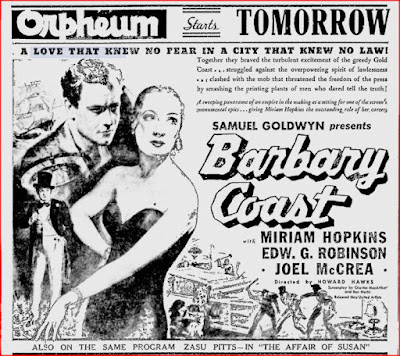
Freely adapted by the legendary team of Ben Hecht and Charles MacArthur from one of Herbert Asbury's chronicles of urban lowlife -- the same author was the source for Martin Scorsese's Gangs of New York -- Howard Hawks's film for Samuel Goldwyn focuses on a fortune-hunting female (Miriam Hopkins) who arrives in 19th century San Francisco to learn that her betrothed to be has been killed by the local vice lord (Edward G. Robinson). With no other prospects in sight she attaches herself to Robinson and becomes a corrupt croupier at his casino. Robinson controls the town; the sheriff and judge are his pawns and advocates of law and order, led by Harry Carey, seem powerless to thwart him. They turn to a newly-arrived newspaperman but Robinson and apprentice thug Brian Donlevy intimidate the ink-stained wretch into effective silence, sparing his life only because Hopkins, who'd arrived with him, begs that he be spared, and Robinson feels he should do nice things for her every so often. But Robinson isn't getting everything out of the relationship with Hopkins that he'd hoped for, and he resents it passionately. If Hopkins is the center of the picture you can see the outline of an old Lon Chaney Sr. vehicle just below the surface. Robinson is playing a version of his standard gangster here, but the extra element he contributes is his character's apparently genuine longing for love. You feel it in his angry exchanges with Hopkins, when he demands the love she'd promised. Robinson brings a passion to these scenes above and beyond the usual cruel lust of the melodrama villain. But it's up to him to invest the scenes with emotion, since Howard Hawks isn't making a Chaneyesque movie. I don't mean that Hawks neglects the actor or leaves him to his own devices; he certainly deserves some of the credit for the intensity Robinson brings to his performance. But Hawks isn't really interested in the pathos an actual Chaney vehicle was designed to generate. Neither he nor Robinson plays for pity, nor do they dare suggest that the character's longings redeem him. Yet the film closes on a note of renunciation worthy of Chaney.
Hopkins finds true love with a handsome young prospector with a poetic temperament (Joel McCrea) whom Robinson has vowed to destroy. Again, Hopkins begs Robinson to spare a man, this time promising never to see McCrea again and to give Robinson the love he craves if only he'll let McCrea live. Robinson agrees and allows Hopkins to see McCrea off on a boat. Watching her make her farewell, Robinson recognizes true love and apparently realizes that he can't have it, at least from Hopkins. That leaves few other options for him, since Carey has finally incited the citizenry into vigilante action and his men are at work destroying Robinson's operations and lynching his men. Perhaps Robinson realizes that his time is running out and he simply has nothing left to offer Hopkins. Maybe he realizes that he can't have love because he can't love. So he does the next best thing, and probably the best thing he's capable of. He orders Hopkins to stay on the boat with McCrea and disembarks himself to face Carey's lynchers alone. To an extent the way he meets his end ennobles him, since he shows no fear, urging Carey to get on with whatever he intends. The matter-of-fact way in which the director films this, the avoidance of pathos, may be the most Hawksian thing about the picture. Otherwise it's a slick production that evokes the mythic grunge and glamor of Gold Rush San Francisco, primarily powered by Robinson despite Hopkins's top billing. If it's remembered now, it's most likely as a Robinson movie than as a Hopkins or Hawks show. Hopkins is fine in her role, as is McCrea and Walter Brennan in one of his first high-profile character turns. But Robinson gives the film what character it has as the embodiment of the city's storybook decadence, and he's what makes it worth watching today.
Pre-Code cinema is beloved by many for an almost quaint though sometimes still vital transgressiveness, but here's a Pre-Code picture that's probably more transgressive now than it was when it was released. The reason is obvious: William Wellman's movie, yet another from his torrent of work for Warner Bros., features Edward G. Robinson as a Chinese man -- and not just a man, but a "hatchet man," the designated executioner for a Chinatown tong. Apart from bit players and extras, all the speaking parts are played by white actors in "yellowface" or slant-eyed makeup, including ingenue Loretta Young. If The Hatchet Man is not quite as transgressive as, say, the Amos 'n Andy vehicle Check and Double Check, it's only because Wellman and his team aren't consciously out to mock another race. In fact, they, like the playwrights whose work The Honorable Mr. Wong they adapted, probably thought they were honoring the humanity of the Chinese people, and by the standards of their own time they probably were. Even if we can't take that pretense seriously, there's an interesting mix of ethnic stereotypes and melodramatic conventions, as well as an attempt to transcend both in a matrix of self-conscious modernity before a violent finish.
Robinson is a strange presence in a role and plot more suited to the late Lon Chaney Sr. Perhaps because someone perceived an "Asiatic" cast to Robinson's Romanian-Jewish features, he plays his part with only minimal makeup, compared to the rest of the cast. From certain angles, or under certain lighting, he seems not to be wearing "oriental" makeup at all. Nor does he attempt a Chinese accent, but neither do any of the other actors. What we get instead is the sometimes stilted dialogue that signified "foreign" in American pop culture, though this movie swings back and forth from the stilted "honorable" manner -- you could play a drinking game based on the use of that word -- to casual "Number One Son" type dialogue for the younger generation. Had the film been made a decade earlier, it probably would have been a Chaney vehicle. But with Robinson, Wellman and Warners involved it becomes more than anything Chaney or his usual collaborators might have made of it. But the story still reads like a Chaney film. It opens with a prologue set "fifteen years ago" with Wong Low Get (Robinson) reluctantly obeying orders to eliminate an old friend, who just happened to have written Wong into his will. Obviously it's not a comfortable situation for anyone, but the victim sees no reason to rewrite his will, which stipulates that Wong is to raise the victim's daughter as his own, and then marry her. The little girl is in the next room playing with a doll as Wong discreetly closes the door leading into her room before sadly doing his duty. We see his shadow pitch his trusty hatchet at the victim's head, and Wellman cuts to the girl's doll, which has just lost its head.
Over the next fifteen years Chinatown has modernized, and a text crawl informs us that tong wars have become a thing of the past. Wong Low Get has modernized and wears modern American clothes in his office. Implicitly repudiating the old ways that led him to kill his friend, Wong is all for modernity, defending his secretary's right to show off her sexy calves -- it's an improvement on footbinding -- and his daughter's right to get a modern education. Wellman cuts abruptly from Wong's high-minded hymn to self-improvement to the daughter, Toya (Young) partying at a dance hall with her unsavory Americanized boyfriend Henry (Leslie Fenton) until she slaps him for getting too fresh. Whatever her plans for the future, Wong intends to carry out his obligation to marry her, but first has to nip a new tong war in the bud. While he goes to negotiate a settlement in his old haunt of Sacramento, the local tong assigns Harry to bodyguard Toya. In Sacramento, Wong finds that a lone-wolf American gangster has been egging on the rival tong. The round-eye says the war will go on until he gets what's coming to him. A newspaper report of his death makes clear that he did get his. Upon returning, Wong discovers Toya and Harry engaged in heavy petting. He's faster with his hatchet than Harry is with his gun and practically chops the younger man's hand off disarming him. Toya refuses to see Harry die, reminding Wong that he swore never to deny her happiness and affirming her love for Harry. This brings on the big moment of melodramatic renunciation as Wong lets both young people go. A Chaney film may have ended here, but the worst is yet to come.
By sparing Harry and surrendering Toya to him, Wong has lost face in a big way. His tong cronies now see him as a coward and shun him. Worse yet, they boycott him, ordering everyone in the tong not to do business with him. They taunt him by delivering a coffin and reminding him that it should hold either Harry's corpse or the remains of Wong's honor. The coffin proves only another thing Wong can auction off after he loses his business. He resigns himself to lowly farm labor until a letter in English arrives from China. To the surprise of probably no one in the audience, Harry proves an asshole and a loser. Caught trying to sell opium, he gets deported, and since Toya never got a birth certificate, she's stuck back in China with him, in a state of "living death." Now she realizes that she loved Wong all along, but as far as Wong is concerned it's never too late to get good new. Now all he has to do is scrape together his savings, get his hatchet out of hock, work his way across the Pacific as a coal stoker, and find Toya somewhere in China. After a lot of walking -- we see him getting his shoes repaired, apparently not for the first time -- he finds his girl, whom the opium-addled, nightmare-haunted Harry has sold to an innkeeper. This discovery sets up an ending that the original audiences reportedly found shocking for its violence yet satisfying in its consequences.
Like Wellman's The Public Enemy, The Hatchet Man is suggestively rather than explicitly violent much of the time. It's most shocking in its presentation of the consequences of violence, echoing Public Enemy in showing us a dead man trussed up and left upright and topping it by having the victim topple backwards off a pier into the ocean. It's that moment that provokes the long-peaceful Wong to take up the hatchet again, and the whole sequence of discovering the body of an employee and fishing him out of the water is the most powerful scene of the picture. At other moments Wellman, admittedly a man in a hurry in those days, misses the mark. He stages an elaborate opening sequence on an impressive Chinatown set as the neighborhood battens down the hatches for a tong war, but he dissipates the impact of his tracking shots by repeatedly cutting back to the image of a war banner every time a gong sounds. There's nothing wrong with crosscutting, but when your alternate shot is nothing but a static image, there's hardly a point to the practice. Overall, the film has nice sets and overall production design, but too many of the players are unconvincing as Chinese people despite heavy makeup (Young's being nearly the heaviest and Fenton's simply the worst) while Robinson makes so little effort to be Chinese, apart from a few "honorables" and the occasional proverb that suspending disbelief is nearly impossible. Robinson remains so compelling a presence, however, that you can just about accept Hatchet Man as just another Robinson picture, which is hardly a bad thing.
You might argue that Robinson's resistance to the expected chinoiserie is in keeping with the picture's implicitly critical stance toward both Chinese stereotypes and old-timey melodrama and pathos. The two phenomena go together: it takes stereotypical character types, not excluding white ones, for the old melodramatic conventions to work, for people to behave in the self-denying, "honorable" ways melodrama demands. Modernity doesn't have to settle for conventions. Toya doesn't have to bind her feet. Wong doesn't have to settle for whatever solace follows from supposedly having done the right thing. Pre-Code audiences -- that is to say, Depression audiences -- weren't as impressed with the pathos of renunciation as they might have been in the otherwise Roaring Twenties. They responded to survival ethics and applauded characters who played to win, from gold diggers to hatchet men. If they could see Robinson's hatchet man as a hero, despite his less-than-superficial otherness, then maybe Hatchet Man was a progressive picture after all. You just wish a little that Warners could have found work for some more Chinese actors during hard times. If they couldn't do without Robinson, then at least he could have buried a hatchet in Keye Luke's bean to save Anna May Wong's honor. But lapses in sensitivity and taste are part of Pre-Code's strange charm, and while they may not redeem this picture for most modern observers, Hatchet Man's somewhat self-conscious struggle with its own stereotyped nature makes it another item of interest for those fascinated by the era, warts and all.
Warner Bros. was great about preserving their trailers, and here's one for The Hatchet Man, courtesy of TCM.
As long as TCM keeps dishing 'em out, I'll keep lapping them up. Last Monday was Edward G. Robinson's 118th birthday, and the Turner channel served up a daytime marathon of mostly lesser-known items from the filmography, ranging from his breakthrough year of 1930 through the late-noir period. For this occasion, let's look at four pre-Code pieces, two with Robinson in archetypal gangster mode, two in something closer to the Edna Ferber style, tracing the rise and fall of titans of enterprise.
Less than two months before the January 1931 release of Little Caesar, Robinson was the gangster heavy in Eddie Cline's THE WIDOW FROM CHICAGO. He's second-billed under lead actress Alice White in this peculiar comic revenge story from the co-director of many of Buster Keaton's classic silent short subjects. The set-up isn't exactly comic: White's cop brother is gunned down in a drive-by courtesy of Dominic (Robinson), nightclub owner and bootlegger supreme. The cops can't build a case against Dominic, so White takes steps on her own. Her brother had just conveniently told her about the daring escape from a moving train off a bridge made by supercrook Swifty Dorgan, who has been unseen ever since. Taking Dorgan's swastika-covered grip with her, which poor brother had kept as a trophy, White poses as Dorgan's widow, hoping that sympathy and her own good looks will earn her a job at Dominic's club and enable her to get dirt on the gangster. The plan works until Dorgan (Neil "Commissioner Gordon" Hamilton) makes good on his reputation by turning up alive. He can expose White's imposture, but since Dominic will only accept the wife's word as proof of Dorgan's identity the master crook goes along while planning a big hotel robbery for Dominic. White's vengeance scheme threatens to go off the rails when she shoots a cop in the back to protect Dorgan, but there may be a method to her madness.
Robinson doesn't exactly steal the film from White, but did steal top billing in some markets.
White is impossible to take seriously as an avenger, even when the film insists, and Cline maintains a comic, almost hysterically hard-boiled tone throughout -- practically every other line is an insult of some sort. Robinson is effortlessly domineering but relatively unthreatening; the overall comic tone allows him to be taken alive so he can make more wisecracks on his way up the river. The highlight is a gun battle between Dominic and the cops after they've raided his club and he's dimmed the lights. As the patrons panic the cops bring in searchlights, but when you know the lay of the place like Dominic, a cop turning on a light only makes himself a target. Even this nicely staged and shot action scene is interrupted by shots of Frank McHugh (in what must be one of his first turns as a comedy-relief lackey) seeking shelter and stoically slinking away from the spotlight. Widow is odd and awkward, as a star vehicle for a failed and forgotten star often is, but it retains historical interest as an early-draft version, albeit one of the latest, for the Warner Bros. gangster genre.
Once Robinson was established as a star, Warners guessed that the rise-and-fall gangster formula was translatable into other genres. In a period when big businessmen were still thought of as "robber barons," turning Robinson into a morally-conflicted entrepreneur seemed like a good idea. The first fruit of this transformation was Alfred E. Green's SILVER DOLLAR, released in December 1932. In this "based on true events" saga, Robinson is Yates Martin, a Colorado pioneer who accepts shares in a silver mine as payment for groceries from his store. He's practically forgotten about it when the miners return from making a strike and making Martin rich. Though it takes him a while to figure out the difference between silver and gold, he soon builds on his investment to become a silver tycoon, a philanthropist and a political force in the young state. He's naively ambitious in an almost lovably stupid way -- when asked to run for lieutenant governor he tells his wife he's just been made governor -- but begins to feel that the wife (Aline MacMahon) is a drag on his aspirations, especially after he's fallen for another woman (Bebe Daniels). The film won't be complete, however, unless the Robinson character falls and falls hard. Just as he's striving to corner the silver market the government establishes a gold standard, drastically reducing the value of silver and bankrupting Yates Martin in one stroke. While future films of this sort might be described as rise, fall and rise, this film and the next one end with the fall, without redemption or reconciliation. They play on the pathos of Robinson as a broken man, Silver Dollar ending on a Wagnerian note as he collapses in delirium on the stage of the grand opera house he built in Denver, with the reconciliation left to his two wives at the funeral. The film has decent production values reflecting the studio's desire to put the star over as a great and versatile actor. He's likable enough to make you regret Yates Martin's fall, but his performance and the film as a whole pale in comparison to Robinson's next effort in this line.
Green took the Silver Dollar formula to further extremes in I LOVED A WOMAN, released in September 1933. The title acquires bitter irony as the story progresses. Despite the poster art to your left, this is another period piece, reaching back to the early 1890s. Robinson plays John Mansfield Hayden, the young heir to a meatpacking fortune called home from his grand tour of Europe when his father dies. Young Hayden is something of an aesthete and contemptuous toward the business practices of his father's rivals. He's more concerned with becoming a philanthropist and indulging the charitable whims of his wife (Genevieve Tobin), the daughter of one of his new rivals. They appear to share a contempt for the corner-cutting that inflicts "condemned" meat on consumers, but Mrs. Hayden seems crestfallen as hubby's principled practices put his business further behind the pack. His own complacency is slapped silly when he falls hard for glamorously ambitious opera singer Laura McDonald (Kay Francis), who sees how inhibited he is and urges him (in a speech that could have been uttered in Baby Face) to become utterly ruthless in pursuit of his dreams. Hayden abandons all his scruples, scrambling to sell any meat he can sweep into a can to the troops bound for Cuba in 1898, earning a face-to-face rebuke from Teddy Roosevelt. To impress Laura, he becomes king of meatpackers while Mrs. Hayden seethes with hate. Hiring a detective to catch him in flagrante with Laura, she discovers before he does that Laura has been cheating on him all along with a younger man. The artiste's idea of love had never included fidelity, it seems, and she feels that Hayden still owes her, since he'd needed her to motivate himself to succeed in business. In his fury, he vows to become bigger than ever to prove that he never needed her -- and proves his point by becoming a war profiteer on a megalomaniacal scale, purchasing land and cattle around the world to feed the armies of World War I. The only problem is that the war eventually ends, and the sudden cancellation of so many orders leaves him short when the bills come do. He ends up a senile exile -- a strange prophecy from Robinson and Warner Bros. of Al Capone's end -- failing to recognize Laura when she visits him in Greece, where the film began. He doesn't even get the dignity that comes with death, as the film fades out on him lapsing into troubled sleep. As in Silver Dollar, the refusal of any real redemption makes I Loved a real downer, and the sweeping character arc Robinson describes from idealist to pathetic criminal makes this film a somewhat soul-crushing experience. I Loved passes a judgment more bleak than we'd get in the crime-does-not-pay era of Code enforcement, when Hollywood would rather reward virtue than punish hubris. The pre-Code era's greater willingness to countenance tragedy is probably another point in its favor.
Curiously, while Robinson played businessmen in tragic mode, his gangster character turned comic in Roy Del Ruth's THE LITTLE GIANT, released in between Silver Dollar and I Loved A Woman. This is one of Warner's pro-FDR propaganda films of 1933, though the political stuff is dealt with quickly at the onset. The movie opens with a news montage illustrating two recent revolutionary events, Roosevelt's election and the repeal of Prohibition. Following the news closely is John Francis "Bugs" Ahearn (Robinson), who reads the writing on the wall and quits organized crime. Arguably, Little Giant is the first "end of an era" gangster film, though the effect isn't elegiac but comically optimistic as Robinson embodies the nation turning a corner toward a new deal. His abandonment of crime symbolizes the nation's commitment to follow FDR on the path to renewal while leaving open the question of injustice. This becomes clear as Ahearn heads to California to retire in luxury amongs the horsy set, only to learn that some criminals are still operating in broad daylight. These are the criminals of high finance, represented by the predatory Cass family, who ironically see Ahearn as an easy mark. The really ironic thing is that they're right; the reformed gangster is so eager to make an impression on the rich that he guilelessly walks into a trap, stamping him even more as One Of Us. Pretty Polly (Helen Vinson) is the lure to catch Bugs's money, which the Casses hope he'll invest into their shady investment bank, which has been issuing bad bonds for some time. Bugs is so hot to go legit that he blindly buys into the scheme, against the advice of his friendly realtor (Mary Astor), whose family fortune was wiped out by the Casses, reducing her to renting out her mansion, without admitting her desperate ownership, to Ahearn. Finally realizing what a sucker he'd been, Bugs fights back the Chicago way, within limits, in an amusing reversal of the vigilantism usually directed at gangsters in 1933 movies. Probably the most "pre-Code" of all these films, Little Giant is a testimony to how beloved Robinson had become among moviegoers as agangster. He never has to answer for whatever misdeeds he perpetrated as a bootlegger, and never seems in danger of prosecution once Time magazine exposes his presence in California, except for holding the bad Cass bonds. In this film, the New Deal and Repeal are a kind of amnesty for the movie gangster, freeing him to take the fight to the economic royalists and ripoff artists who arguably made many more people's lives miserable. Robinson has a ball with his fish-out-of-water role and the charismatic challenge of playing a tough guy and a sap in one person. He forms a weird little pre-Code triangle with Astor and Russell Hopton, who plays Bugs's loyal sidekick Al. There's something virtually homoerotic about Al's devotion to Bugs ("Where papa goes, mama goes too" he says of himself) and a sense of damaged goods about the overall character that makes him more sympathetic than creepy. He gets the Pre-Code Line of the Film when Bugs invites him to admire an abstract painting he's just acquired. When's the last time you saw something like that? Ahearn asks. "Just before I quit cocaine," Al answers. The film goes a little too far into physical comedy, closing anticlimactically with Bugs's Chicago buddy wreaking havoc on a polo field, but it charms you into forgiving this indulgence. While Silver Dollar and I Loved A Woman demonstrate Warner Bros' feeling that Robinson was destined for better things, Little Giant suggests more persuasively that pre-Code audiences already loved Eddie just as he was.
To close, a trailer double bill. First, Warner Bros. uses every promotional device at its disposal, from rave reviews from contract players to the mailed fist of persuasion, to put over I Loved A Woman. BadMoJos uploaded this frantic preview to YouTube.
And here's a Little Giant trailer straight from TCM.
Adding strength to strength, the Albany Public Library is starting to add Warner Archive titles to its already-formidable DVD collection. Given widespread complaints about pricing and quibbling over picture quality, this looks like a great idea that other libraries should emulate. It gave me the chance to sample my first Archive disc, an Archie Mayo film for Warner Bros. (actually under its alt-brand First National) starring Edward G. Robinson that I'd never heard of before.
The Man With Two Faces, promoted with ballyhoo touting Robinson as a Lon Chaney-like character creator, was adapted from a play, The Dark Tower, by Algonquin Round Table stalwarts George S. Kaufman and Alexander Woollcott. The original title survives in its original role, as a play within the play. The play's in tryouts, and will mark the comeback of famed actress Jessica Wells (Mary Astor), the sister of equally famed thespian Damon Wells (Robinson). Jessica had dropped out of the theater after a disastrous marriage to a creep named Stanley Vance who has been declared dead after a long disappearance. Damon, a likable fellow despite drinking and treating his actress girlfriend Daphne (Mae Clarke, used to it no doubt), has come out of semi-retirement to help promote the play, while producer Ben Weston (Ricardo Cortez) hopes that success will cement his romance with Jessica. Everything seems to be shaping up nicely (except maybe for Daphne) when Vance (Louis Calhern) abruptly reappears, having disappeared only to prison under an alias. He wants in on the anticipated hit of The Dark Tower and reasserts his control over Jessica as leverage over Weston.
The character of Vance as interpreted by Calhern is the most interesting part of the story. As for the actor, here Calhern is like a prophecy of Vincent Price; he has the younger man's height and many of the physical and vocal mannerisms Price would acquire. I don't know if Price ever cited Calhern as an influence, but perhaps he should have. As for the character, Stanley Vance emerges as another manifestation of the popular Svengali archetype of the period, alongside Bela Lugosi's Dracula and, of course, John Barrymore's Svengali. At least that's how I read the character -- only, the nature of his mesmeric power, and its origins, are damned unclear. We never see him do anything to Jessica except give her orders. We never get a close-up of his mesmeric gaze, and Calhern, for all his eccentricities, has none of the burning intensity that Lugosi and Barrymore brought to their roles. Yet he clearly has a power like theirs, because in his presence Jessica becomes like a thrall, a Trilby, a zombie -- though, unlike Svengali, Vance's power dampens rather than enhances her talents. Where does this power come from? The film's refusal to explain leads one to infer that it's sexual at root. Yet I've read online a Time Magazine review of The Dark Tower from 1933 in which Stanley Vance is described as a "homosexual masochist." You could have fooled me from the evidence on screen in The Man With Two Faces, but that tidbit forces us in another direction, to conclude that Vance's power over Jessica is a matter of pure domination, of brainwashing before the word was coined. Time says that Vance broke Jessica's spirit, and my friend Wendigo (who watched this with me) said it could be just that simple; Vance broke her simply by taking over her life and giving her orders all the time. But an explanation that simple doesn't take into account what happens later.
In the play, Kaufman and Woollcott teased the audience by introducing a new character, Jules Chautard, who claims to be a fan of Jessica Wells and wants to buy shares in The Dark Tower. As Time explains, the Broadway producers went so far as to credit the role of Chautard to an entirely fictional actor, to save for later the surprise when Chautard, having killed Vance, removes his makeup. Warner Bros. was absolutely uninterested in such a tease. In every way from changing the title of The Dark Tower to The Man With Two Faces to announcing Robinson in "his two greatest roles" the studio wanted everyone to understand beforehand that the actor was going to show off his skills in a double role. The Man With Two Faces is less a mystery than a star turn for Robinson, of which he makes the most, though without going over the top in Master Thespian fashion. In fact, everyone in this ensemble cast is quite good, blessed presumably with plenty of grand dialogue from the original play. In any event, in the film the real suspense isn't about Chautard's real identity but about whether Damon Wells will get away with the crime, especially given that the more anyone learns about Stanley Vance, including police investigators, the more they appreciate his demise.
About that. Before Chautard kills him (first with poison, then by stabbing), Vance sends Jessica away from the hotel in a cab. When Vance succumbs to the poison, Chautard drags him into a closet, presumably to peform the coup de grace. Mayo cuts to Jessica in the cab. We see a sudden change of expression on her face, a relaxation and awakening at once. We know from this that Vance has been killed, but why do we know that? On the model of Svengali and Trilby, I suppose, people (writers, at least) in the Thirties presumed that a mesmerist maintained control over his victim by some sort of psychic bond that death would obviously sever. Of course, many viewers would be reminded less readily of Svengali and Trilby and more of Dracula and Mina and her very similar reawakening after Van Helsing destroys the vampire. Did Stanley Vance have a supernatural power over Jessica? Could he fairly be called a "psychic vampire?" Mesmerism in the collective imagination of the time probably straddled a flimsy borderline separating superstition from pseudoscience. At the same time, Hollywood was still only fitfully assimilating the "reality" of the supernatural into movies in these years. Vance's vague power seems out of place in this sort of story, but phenomena like that hadn't yet been segregated into a "genre" category. Whether Hollywood actually enhanced this aspect of the story will stay unclear until I decide to track down The Dark Tower and read it. But it's a wild enough element to arguably make The Man With Two Faces eligible for inclusion in the genre canon of Thirties cinema, and worthy of recommendation here. Those Archive discs aren't the cheapest, though, so ask your local library to keep up with the times.
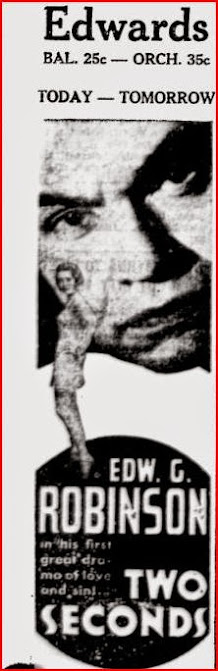 Mervyn LeRoy's third collaboration with Edward G. Robinson, following Little Caesar and Five Star Final, may remind movie buffs of Fritz Lang. Robinson, in an early departure from his tough-guy type, plays the sort of weakling who gets victimized by predatory women that the actor played for Lang a decade later in Woman in the Window and Scarlet Street. He also gets to make a climactic plea for his life similar to Peter Lorre's big scene in Lang's M. You might believe that LeRoy and/or Robinson had seen M, but they'd have to have gone abroad to do so, since the Lang film didn't open in the U.S. until 1933. Not impossible, but not necessary, either; Two Seconds is based on a stage play and the big speech would be a natural on the boards. Still, you will get a similar vibe because Robinson goes awesomely nuts during the tirade, filmed mostly (if not entirely) in a single take to showcase Edward G as a new master thespian.