Tuesday, March 17, 2009

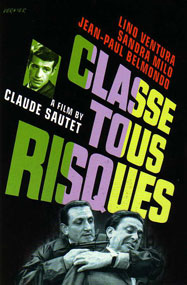
CLASSE TOUS RISQUES ("The Big Risk," 1960)


Do the French call their own crime movies films noirs, or do they reserve that label for American films? I know that they refer to their own hard-boiled crime fiction as romans durs (dur=hard or tough), so a film like this one could be a film dur. "Hard-boiled" or "tough minded" pretty well describes the attitude of Claude Sautet's movie. But it's a different kind of hardness or toughness than the American style. Rather than wisecracking irreverence in the face of disaster there's a matter-of-fact fatalism to this movie, and to most of the French crime films I've seen -- an attitude that says, "This is how it is. No use complaining." But there's also a tragic sense to this movie that reminds me of American noirs. It's based on a novel by Jose Giovanni, a onetime denizen of Death Row who also did the source novel for Jean-Pierre Melville's Le Deuxieme Souffle. If anyone's translated these books into English, I want to read them.

This film (the title translates more correctly to something like "Consider the risk") opens in Milan, where Abel Davos is arriving at the train station with a child in his arms. He and his friend Raymond meet Abel's wife and his other son. They send Therese with the kids on board the train and head back up to street level, where a narrator introduces them to us as career criminals, Davos being a fugitive. They have eyes on two security guards transferring money, and make their move in broad daylight.


They evade the Milanese cops by ducking into a subway station as the idiots run past, then popping out and hopping into their getaway car. They divide their 500,000 lira haul and split up at a gas station, Raymond taking a motorcycle and Abel keeping the car. This launches a fast-paced getaway scene as they go separate ways at a roadblock, clobbering cops and carjacking folks along the way until they reunite. "We're the greatest!" Abel says before they inconspicuously catch a bus to next rendezvous.

Now they have to hire a boat to get from Italy to France. With Therese and the boys below deck, Abel and Raymond throw the captain overboard (along with some life preservers) before planning their clandestine landing at Meston. They arrive at night, but blunder right into a customs patrol. Therese and Raymond are killed, as are the guards. Abel and his boys are on their own.


Investigators cover the scene the next morning. The boat captain has been fished out of the sea and gives them a good description of Abel and his kids, who are now on a bus bound for Nice. In the city, he explains to the boys that they have to walk at least ten yards behind him in the streets from now on, since a man and two boys together will attract suspicion. Now he places a call to Paris and waits for his pal Henri Vinton (alias "Riton") to arrange a way to smuggle him up to the capital.

This is where the real story kicks in. Riton and his cronies all consider themselves friends of Abel Davos, to whom they owe various moral or monetary debts. But they all find it too risky to themselves to go down to Nice and fetch their friend. Instead, they seek out someone with nothing to lose to drive a dummy ambulance south, while Abel stews and his boys grow anxious. He's thrown out of one safehouse because it's getting too hot in Nice, but Abel has nowhere to go but Paris, and no way to get there on his own. Finally, the Paris gang finds their man.


Eric Stark is a lone wolf operator who boasts, "Nobody's ever made the decisions for me." For money, he agrees to take the ambulance to Nice, where he manages to find Abel with little trouble. Stark is a spontaneous character. He stops the ambulance along the edge of the woods when he sees a man harassing a woman. He pummels the man and invites the girl, Liliane, along for the ride, telling her that the "patient" in the back is on the lam without telling her why. She's a good sport and an aspiring actress, playing a nurse tending to Abel when cops inspect the ambulance at a checkpoint, while the boys are hidden in convenient trick compartments.


The ambulance makes it to Paris with little trouble, and Abel's friends are happy to see him, but the feeling isn't mutual. He doesn't care for their excuses for the delays. He stuck his neck out for them in the past. Couldn't they do the same. After a rare display of temper, he stalks off in disgust, Stark still trailing behind. Initially uncertain about his driver, Abel is warming toward the one person who was willing to take a risk for him. Stark likes Abel, too, offering him a spare room in his apartment building. Unfortunately, Abel has to turn his boys over to a retired sea captain who was a friend of his father.


As the investigators slowly follow the trail north, it looks like Liliane is being interrogated, too. But it's only a rehearsal for a play as Stark drops by to renew their acquaintance. They look like a promising couple, a vindication of both character's spontaneity. Meanwhile, Abel is going a little stir crazy in the apartment. Stark gets him some fake papers so he can walk the streets, but Abel declines his offer of a criminal partnership. The tragic irony of the film is that while a surrogate family of Stark and Liliane seems to be growing around Abel's truncated family, and while he burns bridges to those who weren't willing to risk anything for him, Abel is sadly reluctant to build closer ties to his new friends because he doesn't want to risk losing them the way he did Therese and Raymond earlier. As his world constricts from the sweeping scope of the exhilarating early sequences to his self-entrapment in a succession of small rooms, Abel Davos is figuratively dwindling away until he says, "Abel is gone. There's nothing left." Finally, as the nets close in on Stark no matter what Abel does, and after a halfhearted stab at vengeance on his former cronies, Abel literally disappears into a crowd (in a scene that reminded me, of all things, of the end of Sam Raimi's Darkman), leaving the narrator to wrap up the story.

* * *


There was a time some years ago when I would see the same trailer every time I went to the Spectrum Theater, Albany's outstanding art-house multiplex. It was for a film called Un Coeur en Hiver, which I decided from the evidence must be one of the most boring films ever made. Back then I had no idea who Claude Sautet was, but this was one of his later films, after he had abandoned the crime genre for romantic dramas. Now, having seen Classe Tous Risques, I'd like to see that other movie. If it has any of the vitality and emotional weight of Sautet's debut, I'll offer a quiet apology for my sneering youthful self. The Criterion DVD is a beauty, with lots of crisp location shooting and the kind of urban detail I really enjoy.


But while credit is due the director, and to Jean-Paul Belmondo, who signed up to play Stark just before Godard's Breathless made him an international star, the reason I wanted to see this film was Lino Ventura.


Ventura was a blunt object of a man, Franco-Italian, a former boxer and wrestler who became a star in the 1950s playing, among other parts, a recurring role as "The Gorilla." He's a badass without being "badass," a modest monster who seems perfectly at home in the milieu of French crime films. He was capable of more, from playing a French Resistance leader in Melville's Army of Shadows to a two-fisted Chicago priest who battles Fred Williamson in Three Tough Guys. He had charisma without glamour, power without overstatement, emotion without emoting. Le Deuxieme Souffle may be his two-gun apotheosis, but Classe Tous Risques is the best work of his that I've seen to date. I've liked him in everything I've seen so far, and there's much more out there -- how much on DVD I don't know. I recommend him to any crime film fan or European films in general.
Here's the French trailer, with English subtitles and a sample of the light yet tense score by Georges Delerue.


Sunday, March 15, 2009

Ron Silver (1946-2009)


A character actor who hit his career peak in the late 1980s and early 1990s, Ron Silver was probably already past his prime when he became better known as a politicized actor on the Right following the 2001 terrorist attacks on New York and Washington. However that may have impacted his career, he should be best remembered for the run of films that put him close to stand-alone stardom, including a leading man performance in Enemies: A Love Story. Given my genre tastes, it's probably no surprise that I like best after Enemies his psycho villain role in Kathryn Bigelow's Blue Steel. Short of his 63rd birthday, Silver died too young, as just about everyone does.

DOCTOR X (1932) and THE RETURN OF DOCTOR X (1939)

The mainstream tradition in American horror movies during the classic studio era was Universal Gothic, built on the then-revolutionary idea that monsters like Dracula or the Wolf Man were "real," as far as the story was concerned, instead of hoaxes perpetrated by mere mortals. Throughout the "golden age" there was another tradition, more irreverent, often hard boiled. In this tradition, the main characters are often wisecracking reporters rather than monsters or their intended victims. This tradition extends from films of the "old dark house" genre, where reporters provided comedy relief alongside scaredy-cat servants and inept cops, through the Poverty Row horrors of the 1940s, where reporters gave writers and directors a way to hold already-campy material at a knowing arm's length.

Michael Curtiz's Doctor X is one of the definitive films from this tradition. Its trailer proclaims the movie's combination of terror and comedy as something new in cinema, but anyone who's surveyed the "old dark house" pictures of the early 1930s knows that that claim is crap. Comedy, horror, and "two-strip" Technicolor -- that's a different story. Curtiz did this one and Mystery of the Wax Museum in the soon-to-be obsolete process. It was Warner Bros.' way of using up the film stock it bought when they expected Technicolor operettas to dominate the market three years earlier.

The film definitely has the Warner Bros. sensibility, embodied by Lee Tracy as the archetypal reporter in search of a lead on the "Moon Killer" case. His nose for news leads him to eavesdrop on the investigation of Dr. Xavier (Lionel Atwill) and his staff of eccentric scientists, most of whom should be dismissed as suspects because of various physical handicaps. Atwill himself, dubbed by one writer "the mental Lon Chaney" for his ability to be horrific without makeup, would be a suspect as soon as he appeared on screen, and his readiness to cooperate with detectives probably made him more suspect. Nevertheless, he seems honestly determined to crack the case, and just as convinced that one of his colleagues is guilty. In the meantime, Tracy meets cute (or as cute as Warner Bros. gets) with Xavier's daughter -- Fay Wray in an early scream-queen workout.


Xavier has a hare-brained notion that the killer will reveal himself by getting measurably excited by a re-enactment of his crimes staged at the doctor's home. The first experiment gets one of the scientists killed without really giving the killer away. And for a while Doctor X doesn't seem to be going anywhere. There's too much comedy with Tracy in typical ODH situations, and there's a scaredy-cat servant in the mix as well. But the last 15 minutes of the movie are amazing.


Once you rule out Xavier as a suspect, if you have by this point, then one of the other scientists has to have overcome his handicap in order to kill and partially cannibalize people. The truth finally comes out in a riveting sequence featuring one of the maddest scientists of the era turning himself into a monster with "synthetic flesh." He utters the phrase like an incantation as he does a Jack Pierce on himself, the unreal colors of the old process making the scene all the more delirious.


This builds up to a ludicrously effective climax, as Xavier has arranged for himself and his fellow scientists to be handcuffed and helpless during the next reenactment, which features his own daughter as the victim of an all-too-real killer who's all-too-ready to improvise.


Curtiz hammers it together with rapid-fire editing and a hard-hitting fight between the reporter and the killer that has a fiery climax. This last fifth of the film makes Doctor X well worth seeing as an alternative to the Universal tradition. Long live the synthetic flesh, one wants to say, yet memories for movie makers and movie goers alike were short....


* * *


The Return of Doctor X is a sequel to Doctor X the way the movie The Return of the Vampire is a sequel to nothing in particular. It's about as relevant to the original as the typical "Django" film was to the Sergio Corbucci spaghetti western. Vincent Sherman's 62 minute B movie seems to have been Warner Bros.'s way of cashing in on the 1938 horror revival that led to Universal making Son of Frankenstein. The studio went for what it presumed was a bankable name from the past -- though I don't know if they actually re-released the older film prior to this production. To be fair, the title is literally true. The film features a man known as "Dr. X" who returns, in this case from the dead in an echo of Curtiz's Karloff vehicle The Walking Dead (1936). There's also a thematic link between the films, the focus this time being synthetic blood as the means to reanimating corpses as opposed to synthetic flesh as a way of eliminating physical handicaps. As well, the two movies have the generic element of a reporter as lead character in common.

This time the reporter is angling to interview a famous actress, only to find her dead in her apartment -- except that when the cops arrive, after he's phoned in his scoop, the corpse has vanished, and the actress turns up very much alive. "Very much" may be an exaggeration, since the reporter notices a pallor not much improved from when he found her bloodlessly white and dead. Fired by his grumpy editor, the "Wichita Frankenstein" (as he is once called) investigates the mystery independently to redeem his reputation, with the help of a doctor friend. The murder of a professional blood donor raises the doctor's suspicions further, and the appearance of Dr. Quesne (pronounced Kane), an assistant to master hematologist Dr. Flegg, raises them off the charts.


The Return is most famous as the demeaning horror film that was reportedly forced upon a still-struggling Humphrey Bogart, who was still at this time most often playing the heel opposite James Cagney or Edward G. Robinson. If he seems to give a bloodless performance, this was only what the script required. While he does look creepy, this isn't much different from his typical work of the period. Dr. Quesne, aka Dr. X, is just as likely to solve his problems with a gun as by more monstrous means. Nevertheless, he takes over the film toward the end. Having first seemed like a merely odd flunky to more likely villain Dr. Flegg, the scientist's repentance leaves Quesne as the main menace. You can almost see the moment when the writers changed their minds. Once our heroes discover an important part of Quesne's secret, they confront Flegg as the responsible party. He offers to take them into his confidence after asking whether they'd told anyone else about their discoveries. That sounds like he's going to set them up for something, but it doesn't happen, and he throws Quesne, who didn't ask to be reborn, after all, under the bus instead. From there the film lurches to a close with a car chase, a damsel in distress, a shootout at an abandoned farmhouse, and the reporter getting his job back.

Doctor X is more colorful than The Return in more ways than one. The Curtiz film benefits from being a "pre-Code" movie. The benefits include one scene in which Tracy's reporter goes into an obvious brothel to make a phone call and flirt with some of the staff. The scare moments are also far more intense, and the climax more violent, than they are in the Sherman movie, though that may just be because Curtiz was a far superior director. Doctor X is always going to be a nearly-unique cultural artifact, while The Return is never going to be more than a stray sentence in Bogart's career. You can check both out, with commentaries (by nonagenarian director Sherman on The Return) and trailers, on a Warner Home Video double-feature DVD. It's probably worth your time for Doctor X alone.

Friday, March 13, 2009

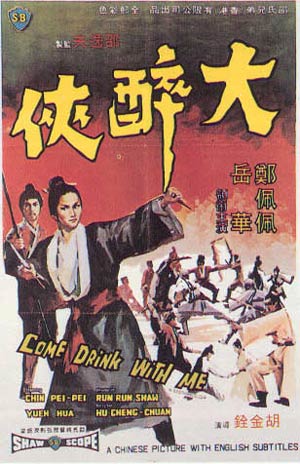
COME DRINK WITH ME (Da zui xia, 1966)

From most accounts, King Hu was the John Ford of martial arts movies, and this is his Stagecoach: the movie that supposedly gave the genre artistic legitimacy. As Bey Logan explains in a documentary segment, King Hu is reputedly the first director to apply art direction, particularly a strong sense of landscape, along with a musically-influenced sense of dramatic choreography, to subject matter that was previously just planted in front of the camera. On the strength of the beautiful looking Dragon Dynasty DVD I borrowed from the Albany Public Library, I can believe the hype. I had also seen a later King Hu film, A Touch of Zen, years ago. That film was nearly twice as long as Come Drink With Me, and while I liked it, the earlier film benefits from concision. It also benefits from the extraordinary presence of Ching Pei-Pei as a pioneer ass-kicking heroine.

As I've noted before, the Chinese have been very progressive in their presentation of fighting women in films. Compare Come Drink With Me with some contemporary attempts at making female Western heroes -- films like Cat Ballou, Hannie Caulder, or even Viva Maria! -- and the Chinese cinema leaves the Westerns, not to mention the West, in the dust.


Ching is the Golden Swallow, the sister of Mr. Zhang, an official who is kidnapped by a bandit band while commanding a caravan of prisoners. The bandits, led by a pancake-makeup favoring joker nicknamed "Sleek Face," want their top gang leader freed from death row, or they'll kill Mr. Zhang. Golden Swallow comes to town to negotiate the exchange, but isn't about to take crap from the gang -- some of whom seem to take her for a young man. She's perfectly capable of kicking limitless ass on her own, but she has some unwanted help from a drunken stranger who keeps butting in at the inn, where his main occupation seems to be leading a chorus of beggar children. He's called Drunk Cat, and when you see drunkards in kung fu or wuxia movies, you know you better keep an eye on him.

Through his songs and other clues, Drunk Cat informs Golden Swallow that the bandits are using a Buddhist temple as their headquarters. She visits the temple and gets into another big brawl with the bandits. She cuts a bloody swath through the lesser goons, but Sleek Face seems like an even match until Golden Swallow stumbles and falls. Then Drunk Cat throws a fruit peel at Sleek Face's feet and the villain falls on his butt. Golden Swallow escapes by running up an obviously canvas "wall," but not before Sleek nails her with a toxic dart.


GS makes good her escape, but passes out in the woods. She wakes up at Drunk Cat's house by a waterfall. Initially scandalized by his presumption, she has little choice but to submit when he says, "Come here, let me draw the toxic pus out of you." It's not his normal vintage, but he drains her with gusto. When some of the bandits show up, he shows his true colors by killing them all with his super kung fu. He then resumes the drunk act and takes the bodies to the temple, humbly telling the bandits that Golden Swallow killed them all, and that she sneers at their poison darts.

Once Golden Swallow gets healthy you'd suppose that she and Drunk Cat against the bandits would be unfair. Fortunately for the bad guys, Master Liao Kang arrives at the temple to tell Sleek Face and company that those corpses were the handiwork of his "younger brother" from the "Kong Fu League," known to him as "Fan Big Drunk" and the thief of the League's prestigious Green Wand, a late arriving Macguffin if there ever was one. The Master can crack a coffin open with one blow from his bare hand. Should we be worried?


Drunk Cat is. Back home, he practices his skills, including some sort of spirit force that looks like it could do serious violence to the ozone layer. He shows off his power by having Golden Swallow throw heavy rocks at him while he catches and holds them aloft with one fingertip. He's not proud, however; he's worried that the Master, who killed their old master (to no one's surprise), will whup him when the big showdown comes.

But this is Golden Swallow's story and she has a prisoner exchange to attend to. For the occasion, she brings along what looks like her own private army of women warriors. At moments the movie looks like The Clones of Ching Pei-Pei with really good special effects as the Chinese amazons tear through the bandits when the deal goes sour -- thanks to Drunk Cat sabotaging the exchange in the government's favor.


GS herself wipes out most of the bosses, but Master Liao intervenes before she can finish Sleek Face. How badass is the Master? We've just seen Golden Swallow annihilate numerous men, and she can't even hurt this guy. It's a good thing Drunk Cat shows up for some super aerosol combat. And he shouldn't have questioned himself, since he administers an excellent beating on his "elder brother." Then the fool spares him, guaranteeing that there'll be at least one more fight in this movie....


The one disappointing aspect of Come Drink With Me is that for the last ten minutes or so it ceases to be Golden Swallow's story. Once it's apparent that she's no match for the Master she's reduced to bystander status and Drunk Cat/Fan Big Drunk takes over the picture. It seems like there should have been something for her to do to reclaim the movie, but it simply comes to an end with her departing with her army and Drunk Cat remaining with his kids. Any teasing of a romance between the heroes is just that. Golden Swallow doesn't really have anything like a "character arc" to hold the film together. She just kicks butt until she can't, and her real job is to look good doing it. Ching Pei-Pei's ballet training really serves her well, and King Hu's gracefully tracking camera is as much her dance partner as any of her antagonists. She is less vivacious than intense, as if she had something to avenge rather than her brother to rescue. That's probably meant to contrast with Hua Yueh's broad playing as the drunken hero (whose alcohol comes in handy during a climactic fight). His charismatic performance, including a musical number, made me imagine Gene Kelly taking the experiment of his casting in MGM's Three Musketeers a step further, making a fully musical swashbuckler and taking American cinema on a road not taken.


Come Drink With Me has been the subject of several homages, from Ang Lee's casting of Ching Pei-Pei as the villain of Crouching Tiger, Hidden Dragon to a vengeful female's utterance of the title as a line in the Jackie Chan-Jet Li crapfest The Forbidden Kingdom. Once you see it you can understand the desire to tip one's hat when you have the chance. It doesn't need the CGI overkill of today's Chinese epics to be one of the genre's most artistically striking films. I recommend it unreservedly to martial arts fans and fans of female action cinema. I only wish the subtitling were a little better. It seems to trip over idiom sometimes, while making inexplicable choices of translation, as when Sleek Face chews out a henchman by calling him a "nebbish." Details like that may make a subtitled film more attractive to some people, but Come Drink With Me can be taken straight. Here's a recap.


Thursday, March 12, 2009

KILLPOINT (1984)

Back in 1995 I crossed the continent to visit Riverside, California, to serve as best man at a friend's wedding. I took in such sights as there were, most notably the theater where Gone With The Wind had its first preview showing. It seemed an ordinary, past-its-prime town, but I had little inkling of its secret history. For according to Frank Harris's movie, about a decade earlier Riverside was the murder capital of the United States.

The trouble began when a man in soldier's fatigues robbed a military arsenal of its guns and ammo. The perpetrator was "Nighthawk," the right-hand man of local crimelord Joe Marx (Cameron Mitchell). Nighthawk then carried out a daring attack on rival arms dealer Leo DeJulio in a crowded Chinese restaurant, instructing his men, "There should be no witnesses, and everyone has to die. Have fun." His orders were carried out; 15 people died in the eatery.


The ATF soon learned from Snake the snitch that Marx and Nighthawk were behind the robbery and the massacre. Agent Bryant (Richard Roundtree) was assigned to supervise the Riverside investigation. Capt. Skidmore of the Riverside PD, noting the stakes involved ("We think we've got a real problem with this thing.") assigned Lt. James Long (Leo Fong) as Bryant's liaison, despite reservations from ATF higher-ups. Wasn't Long the officer whose wife was raped and killed recently? Is he all right? "No, he's not all right. Would you be?" Skidmore told the Bureau, "But I'll tell you one thing. He's going to get the job done."

Nighthawk was soon handing out guns as if they were free samples. Gangbangers were soon shooting up grocery stores, bumping off another 15 people in one robbery.


The film portrays Joe Marx watching news reports linking the two massacres and shooting his TV set. Marx had a love-hate relationship with his pet poodle, adoring the animal despite the fact that it "poos and pisses all over the living room." He fussed over the dog while arranging with his procuress, Anita, to have a new girl visit him.


Candy is shown telling Marx, "This really isn't me....I'm really a singer." To which Marx responds, "Girly, when you know Joe Marx long enough, when this old son of a bitch tells you to sing, you better sing before I get physical with you. Sing! Anything!" The filmmakers believe that Candy's voice failed her due to nerves, and that when she refused to strip on Marx's order, he murdered her and had her body dumped in a river.

Lt. Long took over the murder investigation when the police learned that a burn mark on Candy's left breast matched the m.o. in an unsolved New Jersey homicide in which Joe Marx was a suspect. The autopsy clearly depressed Long, who is shown in a montage working out furiously, recalling his own dead wife, and staring into space.


Having discovered Anita's address in Candy's home, Long interviewed her to no avail until he explained that Candy had been murdered. Anita then apparently went to Marx's home to denounce him as the gunrunner tried to feed his dog a cigarette. The song Cameron Mitchell sings is probably dramatic license.


Sparky is a friend of mine.
She will do it any time,
For a nickel or a dime.
Twenty cents for overtime.


The film contends that Anita's first guess was mistaken, and that Nighthawk killed Candy. It shows Anita wounding Nighthawk before he killed her, after which Marx complains, "Now you're bleeding all over my carpet!" Sparky is the dog, by the way.

As the investigation intensified, Long and Bryant pumped informants for new leads on the gunrunners. One likely prospect was gunned down in a tavern men's room before Long could meet with him. Nighthawk subsequently shot the gunman. Meanwhile, the gun trade continued, Nighthawk delivering arms to the Sanchez gang (with his lady chauffeur on hand for "insurance"), who subsequently massacred members of the rival Ramirez gang.


The first major break in the case came after Long kung-fued the snot out of the Sanchez crew and arrested their leader. After breaking up a gas station robbery by a black gang, the Riverside police played the gang leaders against each other, locking them in a bare cell to kung-fu one another until one is willing to rat out the arms dealers -- as long as the other is blamed.


Using the fresh lead, Long arranged to meet Marx and Nighthawk, pretending to be an Asian gangster interested in rocket launchers. James Long's origins are unknown, but to account for Leo Fong's incongruous Southern accent, Long claims to come from Arkansas, where the China-born Fong was raised from the age of five. Long didn't realize when meeting with Nighthawk that the gunrunner had just killed Agent Bryant. It's an oddity of the film that Bryant dies without his liaison, Long, ever really taking notice of the fact. But there were more than enough ATF guys to go around in Riverside, even if Marx and Nighthawk wanted to start their own religion.

Marx suspected that Long might be a cop. He tested his theory by having four of his men beat Long up. He was satisfied of Long's good faith because "If you'd been a cop you'd have back-up all over the place." Paranoia, however, wasn't Marx's main problem. A breaking point came in his partnership with Nighthawk when Marx went berserk in a diner where the waitress kept a crying baby.


This apparently convinced Nighthawk that Marx was no longer a viable partner. He also had reason to think that Marx no longer trusted him, since the boss was wont to wander about talking to himself, saying such things as "From now on it's me alone, nuts or otherwise, against the whole world." Soon afterward, while picking Marx up in his limo, Nighthawk cut his mentor's throat. That left Nighthawk to consummate the big arms deal with Long, while the ATF surrounded the rendezvous point in an abandoned factory complex....


If Joe Marx didn't exist, Frank Harris and Cameron Mitchell would have to invent him. Mitchell gives one of his patented eccentric performances, fussing over the dog as much as he plots evil. But such is the quality of the man that Marx comes across as convincingly nutty, capable of completely unpredictable behavior. There's weird psychosexual tension between Marx and Nighthawk, whom Anita accuses of being gay. In turn, Nighthawk insults Marx while the boss wallows in a hot tub: "Look at you, wearing scarves, flowers in your hair, talking to a dog. Business going downhill and you're still turning into a raving faggot." Mitchell and Stack Pierce as Nighthawk make an effective team of misfits. Their interplay is the most entertaining thing about Killpoint apart from the sheer volume of gunplay that erupts every few minutes. This is a film that kills for the love of killing. Why does a criminal gang need to kill 15 random people in a grocery store? Because they're evil and the violence looks cool is my best guess.

Mitchell may steal the film, and Richard Roundtree may recede into the background for no good reason, but this is Leo Fong's show. The overaged (56 when this was filmed), mop-headed master of redneck style kung fu is a spectacle even if he couldn't act his way out a door. He spends a lot of time receiving very detailed orders from Capt. Skidmore, because taking the initiative might require him to open his mouth, and Director-Screenwriter Harris apparently wanted to delay the awful moment when Fong's accent revealed itself for as long as possible. Now, an Asian man has just as much right to a Southern accent as anyone else, but in Leo Fong's case it's just the icing on the cake that makes him an avatar of '80s bad taste. Only in that decade would anyone have thought of making him a star.


Harris is capable of creating dynamic moments, especially the grocery store attack, and he keeps things busy during the drawn-out climactic siege, crosscutting the ATF blasting thugs with Leo Fong going hand to hand with various foes until his showdown with Nighthawk. But there are also lots of flat moments of telephone conversations, pointless helicopter shots and instructions from the authentically dull Capt. Skidmore to pad out the picture. Throw in some convincing sleaze, some country music and a lot of bloody shirts and the end result is approximately 90 minutes of mindless action candy, Crown International Pictures style. You can find this one nicely letterboxed on BCI's Maximum Action set, which includes another Harris-Fong-Mitchell exploit, Low Blow. But if you want to see lots of people get shot, Killpoint should probably be your first stop in that collection.

Tuesday, March 10, 2009

Proctor's Theater: 30 Years on Death Row

Reality is finally sinking in for the owners of the old Proctor's Theater building in the heart of downtown Troy, New York -- my old home town. The local paper reports that the city government wants a $15 million grant to redevelop the property, preserving the theater facade but demolishing the interior and replacing it with office and retail space.

I saw a building like that in nearby Schenectady, where the shell of the State Theater stood for years after the actual theater space gave way to a parking lot. It's a cruel illusion of civic vitality, but preserving the vintage facade of the Troy structure is probably the best that can be done, now. Proctor's has been dark since 1977, and experts say that the interior is unsalvagable.

As the name indicates, Proctor's was built as part of a vaudeville circuit back in 1914. It later became part of the RKO theater chain. After the government ordered the studios to give up their theaters, it was part of the local Fabian chain, and passed through other hands before the end. I don't recall whether it was the first theater I visited, but it was either that one or the long-gone Oxford up in Lansingburgh. Those were the only movie houses left in Troy when I was a kid, not counting the Cinema Art, which had evolved from the American Theater to an art house to a porno house. Most of what I saw at the Oxford or Proctor's was kiddie matinees, usually Disney cartoons plus second live-action features that I couldn't stand. I also remember seeing The Man Called Flintstone and Snoopy Come Home on the big screen.

The closest I ever came to a "grindhouse" experience was the Saturday night a babysitter took me out to Proctor's for an AIP double feature of At The Earth's Core and The Conqueror Worm (aka The Witchfinder General). I recall the attacks of pterodactyl-like creatures in the first film, but I slept through most of the other film. From that one I recall only a slow-motion gunshot and a recitation of the Poe poem that AIP superimposed on the British film.

If TV was the mortal blow for many theaters, the arrival of cable TV with HBO was probably the coup de grace for places like Proctor's. Once people could see R-rated content at home there was even less incentive to go downtown to the theater's dubious comforts. Once the place shut down, its location in a dense downtown limited the prospects for revival. It was built at a time when most people were expected to get there by streetcar, in an area that's never been very accommodating for cars. Schenectady has a Proctor's of 1928 vintage that's now the Capital District's prime site for touring Broadway blockbusters; it has a vast parking space in the back. Albany has the Palace, an RKO theater from 1931 that hosts concerts, "Chitlin Circuit" plays and classic films. Troy is a theatrical ghost town. Even the multiplex built into the city's ill-conceived downtown shopping atrium disappeared long ago, while the Cinema Art was finally raided and shut down just a few years ago.

It seems sometimes as if public life has been in retreat for the last 30 years or so, as if a concerted effort had been undertaken to privatize as much of each person's life as possible. Theaters like Proctor's went, the drive-ins went, and even the first generation multiplexes are disappearing. I don't think there was a conspiracy, though I'd make one up for symbolic purposes if I ever write my script or novel about the 1970s. It's most likely just the mindless "creative destruction" of the Market at work. I look at desolate landscapes like downtown Troy and I feel like a crime has taken place, even though I know better. But even if there was no crime, there was death just the same.

Monday, March 9, 2009

TAXI BLUES (1990)

From the land of Socialist Realism comes something closer to Neorealism. Maybe we should call it Bohemian Realism, since Pavel Lungin's film aspires to warts-and-all honesty about low life during the last days of the Soviet Union. The Koch Lorber DVD invites comparisons with Taxi Driver. I was skeptical, but borrowed it from the library anyway.


It's a holiday of some sort in Moscow. Ivan Shlykov drives his hack through the streets as the masses have their backs turned, their eyes on fireworks over the river. His fares are a noisy, drunken bunch looking for a party. Their ringlieader is Lyosha, a jazz saxophonist who ends up the last passenger in the cab. He tells Ivan to take him to "the Captain," and to wait outside in case Cap's not at home. Ivan ends up staying all night, as Lyosha's fare grows and grows.


The last days of the Soviet brand, from TAXI BLUES.


Ivan goes home and works out. He seems fanatical if not desperate about his routine. He shares a shabby apartment with Deti ("Pops"), an old crank who treats Ivan to anti-Semitic harangues. Since Lyosha had invited him to watch a show at the Blue Note jazz club, Ivan heads there to collect his money. He finds Lyosha, who declares himself broke and dares Ivan to beat him up. Ivan confiscates his sax instead. He tries to pawn it at several places, but no one offers enough to cover Lyosha's debt. He tries to track Lyosha down again, but finds that the guy's been fired from his gig and thrown out of his girlfriend's apartment. He finally discovers Lyosha busking with a guitar and gives him back his sax. Lyosha then has the gall to ask for a loan.


Instead, Ivan brings him to his own apartment and forces him to strip so he can appraise the pawn value of his clothes. Lyosha insists that everything he wears is western and should be worth more, and asks for a drink. Ivan finally demands an apology and, getting one, declares them even. Now Lyosha will stay overnight, despite Pops's protests. In the morning he looks for more booze while the radio reports the latest production goals surpassed by heroic laborers. He settles for Pops's cologne, watered down a little. He soaks in a bathtub and loses himself in a reverie of jazz. Inspired, he plays his sax in the nude while the tub water overflows. The leak damages three floors of the building and sets Ivan back another 400 rubles. By the time he finds out, Lyosha has skipped out.

Ivan finds Lyosha dealing with some rough customers, one of whom beans Ivan with a bottle. Ivan breaks the bottle and drives them off, then drags Lyosha to jail, where the jazzman shares a holding cell with two angry prostitutes. Ivan wants to file a complaint and is told to write that Lyosha assaulted him. As the cabbie drives away from the jail, some punks accost his car. He chases them down and beats some of them up. When one of the punks calls him a fascist, he demands an apology. After this outburst, he has a change of heart, returns to the jail, and rescinds his complaint against Lyosha.


Now he seizes Lyosha's passport and resolves to make the poor slob work off his debt as a baggage handler and car washer. Lyosha finds time during his busy day to raid his ex-girlfriends pad for aspirin. When she tries to kick him out, he throws her into the bathroom and bars the door, yelling, "Slut, you wrecked my life!" After he washes down the pills with water from a plant vase, he calms down and goes into another jazz trance. Later, he opens the bathroom door and joins his girl in the tub.

Lyosha pleads to Ivan that he can repay him more quickly as a musician, but Ivan wants to see him slave for the money. He exhorts Lyosha to wash the floor mats with more enthusiasm. "Put your soul into it!" he says, "Use love! Love the mat!" He farms Lyosha out to other cabbies to make more money, but worries that he's gone too far when the jazzman passes out in the bathroom back home. Lyosha recounts a dream of crawling through narrowing corridors until his skin peeled off. Ivan recommends stomach exercises to get Lyosha out of his funk. When Lyosha doesn't take up the suggestion, Ivan slaps him around until he angrily grabs a knife. "Now you're talking!" Ivan says approvingly, "Now you'll be a man."

Ivan has a girlfriend, Cristina, who works in a meat market and can bring him black-market food. To Pops's disgust, they dine on their plunder and Ivan tells Lyosha to play them some music. Lyosha had one of his reveries and fits of playing earlier, leading Pops to call him a degenerate, but now he protests that he lacks inspiration. Ivan tells him to earn his keep, and Lyosha gets into his work as Cristina gets into the music. Ivan dances like a frantic idiot in emulation of his girlfriend while Lyosha tells her that "Women call it the sexophone." Ivan gets agitated when Cristina embraces the musician. He goes to the bathroom to wash up, then storms back into the kitchen to grab the sax, throw it to the floor and kick it across the room. Lyosha goes nuts in turn and starts tearing up Ivan's posters. Ivan tries to strangle Lyosha until Cristina crowns him with a cardboard box, and he passes out.


Lyosha runs amok into the night, stripping his clothes off on a train and fleeing from motorcycle cops, proclaiming himself a Buddhist, a saint and a genius. Back at the apartment, Ivan seems to rape Cristina, though the sex seems to become more consensual later. Their coupling is interrupted by the telephone: Ivan has to bail Lyosha out of the drunk tank. This time he tells Lyosha to get out of his life for good while the jazzman implores him to "at least stick me in the madhouse." Lyosha plants himself in front of a slowly oncoming train until Ivan pleads with him to come home. The train has come to a stop behind them.

Now Ivan and Lyosha are selling bootleg vodka. A potential customer recognizes Lyosha and urges him to come to the recording studio. Hal Singer, an American saxophonist (and a real person playing himself), pays a visit and asks who's playing that sax he hears. It's Lyosha, cleaned up enough to make an impression on a chance for a lifetime. The two men jam together, and Lyosha brings Fisher to Ivan's place. Ignoring Pops's repeated toasts to "disarmament and eternal peace," the musicians commune drunkenly. Fisher says Lyosha is "my brat" -- the Russian for brother. When Ivan shows up, Fisher's handler sees him as "the only normal person here" and urges him to end the party. Ivan throws Lyosha out, while the jazzman vows to tour the world with Fisher.


Sometime later, Ivan is driving the same road he traveled at the start of the movie. He passes a jumbotron screen and can't believe his eyes. It's Lyosha! True to his word, he's made it to New York and scored a triumph. Soon he returns to Moscow a conquering hero. Ivan dresses up in his best clothes to pick him up, but Lyosha is crowded by reporters, handlers and groupies and doesn't see him.

Now it's Ivan's birthday. He drinks sullenly with Cristina's friends at the market but goes nuts while she plays the guitar. He smashes the instrument and roars out an old patriotic song, protesting that she doesn't love him at all. Then he grabs an axe, goes into the meat locker, and takes it out on the carcasses.

Ivan pulls himself together to attend one of Lyosha's shows. Now he gets it, and is moved to tears by Lyosha's virtuosity. This time he catches the jazzman's attention and gets a promise of a visit. He expects the visit that night and sets out an impressive spread, but hours pass before Pops finally offers him some homemade soup. Ivan, a man after my own mind sometimes, loses himself in a kung fu movie until he's surprised by Lyosha and a gang of revelers. He remembered! He's brought all kinds of gifts from America: clothes, cigarettes and more. Pops grabs some cologne to compensate for what Lyosha drank earlier, and seems to be enjoying himself. But there's one special gift just for Ivan. One of Lyosha's cronies puts it together with much expenditure of breath until the finished product is revealed.


Ivan is devastated as it sinks in that Lyosha and company have shown up as much to laugh at him as to shower him with gifts. The camera slowly closes in on him as it sinks in deeper and the kung fu noises throb in the background. Can you guess what happens next? You're probably wrong, but...

Taxi Blues is on to something about the way people on the lower rungs of society are repelled from and drawn to one another at the same time in the forced intimacy necessity often imposes. You may despise someone, and despise the fact that you need him or her, but needing them for whatever reason encourages bonding of different kinds. Ivan clearly has a love-hate relationship with Lyosha, and people are bound to draw conclusions about Ivan from his obsessive workouts. There is room to speculate about his sexuality, but the dominant feeling here is Ivan's longing to be part of something larger than his own tawdry milieu. He envies Lyosha's talent, as his singing outburst at the birthday party makes clear, and he craves the vicarious experience of his friend's (?) storybook success as if it belongs to him in fulfillment of Lyosha's debt. Anyone who's ever lived with roommates will empathize with at least parts of this film.

Taking the larger view, Taxi Blues is an impressive document of the glasnost era, when the Soviets started calling things as they saw them. The film had partial French financing, but clearly owed its existence to Gorbachev's liberalism. His predecessors would most likely not have allowed such a portrait of their country on the downward slide. Nor had Gorby anything to worry about, since Lungin didn't make a political or dissident film, except by implication. "Down with the Party" isn't the film's message. "Down with humanity" probably comes closer to the real theme. Even though Lungin tacks on a "Whatever Became Of" title card that suggests that Ivan straightened himself out eventually, the film itself offers little hope of redemption for its lowlife protagonists. Stardom doesn't make Lyosha less of a jerk; instead it enables his ultimate act of unthinking cruelty. This pessimism is nothing new to world cinema, but for the USSR it was unusual if not entirely new. Whether it could only emerge near the end of that nation's sad history, like a harbinger of it, is a question for another time.