Sunday, May 24, 2009

Library of Classics: RAIN OF FIRE (Holocaust 2000, 1977)

It didn't take long for me to recognize what Lionsgate was peddling in their recent DVD of a Kirk Douglas film the title of which I had never heard of before. All I had to see was Simon Ward's name and I realized they were repackaging Alberto De Martino's Omen-ripoff Holocaust 2000, perhaps to be rid of the obsolete dating, perhaps also to hide a bad reputation for the movie. I'd never seen the film before, so when the Albany Public Library made it one of their more improbable recent acquisitions, I decided to give it a shot, and I'm glad I did.

Because of his current standing as a living legend of the screen, it may be hard to recognize that Kirk Douglas's career was on the skids in the 1970s. When you compare his output from the great decade with his peers (Lancaster, Mitchum, Holden, Peck) it's not that impressive. Even Peck was skidding a bit, but Kirk had to notice what The Omen did for Greg. But to get similar results, at the time, Douglas had to go to Europe (where he'd done The Master Touch a few years earlier) for this Anglo-Italo production was set up for the director of Blazing Magnum. I've watched that recently without reviewing it here, but its two great highlights -- the stunt-happy car chase scene and Stuart Whitman's bruising brawl with a gang of transvestites -- further encouraged me to try Holo--I mean Rain of Fire.

It's not such an Omen ripoff after all. Look: Douglas's character Robert Caine is a businessman, not a diplomat, and the Antichrist is practically grown up, not a toddler. Oh, all right, people have a funny way of dying when they could mess up the infernal plan, but wouldn't the Devil do that anyway even if there had never been an Omen? Anyway, the plan is different, too, though the makers of Holocaust 2000 didn't know going in what the long range plan was for the Omen franchise -- and they didn't know their film would be renamed Rain of Fire, either. But Omenologists will recall that Damien's plan is to pretty much make everyone miserable so that they'd renounce God, while Angel Caine (Simon Ward) simply wants to kill everyone in a nuclear holo--(sigh) --rain of fire.
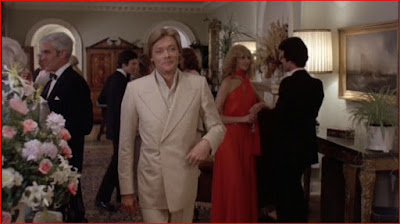

I'm an atheist, but I'd still have this guy
pegged as an Antichrist just on appearances. Simon Ward in the film formerly
known as
Holocaust 2000.

How does Robert Caine happen to raise an Antichrist? I cannot tell you, but it seems to have something to do with little Angel strangling a twin to death in Mommy's womb. Also, carrying the genes of an avatar of Kirk will give you a certain degree of cussedness even before other powers intervene. But it all does seem to be part of a plan, as our hero begins to discover strange numerological coincidences linking his big Middle Eastern nuclear power project with some of the symbolism of the Apocalypse. Some people don't like this idea simply because of the pollution it might cause. Protesters dog Caine's every step, chanting: What do our children want to be when they grow up? Alive! Them he won't believe, but all those coincidences get him having very strange dreams.

I don't think Kirk Douglas would know how to merely go slumming in exploitation cinema. He earned stardom in a series of apoplectic performances (Champion, Detective Story, Ace in the Hole) in which his characters drove themselves into early graves by force of pure will, it seemed, and at moments here he taps into that early fury. He throws himself into the show with Bela-like commitment, putting himself through more than Lugosi ever had to endure in a picture. Two scenes stand out: a feverish dream sequence that requires him to run naked through a desert and martyr himself (sort of) in a crowd of demonstrators; and a furious insane asylum visit that comes off less like Douglas's dream project of One Flew Over the Cuckoo's Nest and more like Shock Corridor, albeit with more color and violence.


Above, the dream; below, the nightmare.


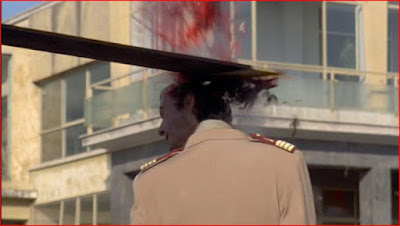
Since I left out the bit where Douglas smashes an assailant's skull with that plank, I may as well show you the other gore highlight. A change in government in the Middle East has jeopardized Caine's power-plant project, so it's up to Satan to do something about it, helicopter style.

I don't mean to suggest that it was all hard knocks for poor Kirk in Europe. After all, he gets to go shoulders-&-sheets with the charming Agostina Belli, so charming a female that the innocent fawns of the forest are drawn to her.


Everybody loves Agostina Belli in (with apologies to Lionsgate) Holocaust 2000.


She becomes the object of some anxiety when Kirk confuses his prophecies and begins to believe that the child she's carrying by him will be the Antichrist rather than his grown boy. His suspicions are furthered in a manipulative scene in which Belli's character claims she's too tired to visit a church, leading Kirk to think she can't enter such a sanctuary. These suspicions lead our hero to force her into having an abortion -- with the endorsement of a Roman Catholic priest! I'll leave that particular plot point in suspense, as the whole film rather leaves you hanging. As if they, too, were planning a sequel, the filmmakers leave most of the major characters alive, though the balance of power has shifted a bit. What might Holocaust 2001 (or Rain of Fire 2, if you insist) have been like? The world will never know.
Whatever you choose to call the picture (your choices also include The Chosen and Hex Massacre), it wasn't your everyday Italo exploitation project. Getting Douglas and Anthony Quayle, among others, was just part of a budget that included some nice art direction and location work. Morricone did the music, by the way. Especially now on a widescreen DVD, this is a treat to look at, even if the plot doesn't endure much thought. For instance, the devil's style is to kill those who might interfere with his scheme. But at a certain point, the main obstacle becomes Robert Caine, yet at that point the best the evil one can do is to get him very temporarily confined to the nervous hospital. Why aren't buildings falling on him, for Satan's sake? On the other hand, there is no way you want Kirk Douglas taken off the screen prematurely on this occasion. He more than earns respect from genre buffs and exploitation fans with his all-out work here, though he may not necessarily have respected himself for a while afterward. It's his shamelessness on screen that makes the movie worthwhile.
* * *
Now dig this: an alternate ending to the movie that has been copied from a Greek tape and posted to YouTube. I'm guessing this was for countries that wanted a less ambivalent ending or where censorship boards required evil to lose. You can also find the whole film in installments, as well as clips of the helicopter death scene and Kirk's dream, if you look for them.


Friday, May 22, 2009

BLOOD AT SUNDOWN (1,000 Dollari Sul Neri, 1967)

Johnny Liston has just done twelve years hard time for a crime he didn't commit, but freedom may prove harder still. He's hardly out of stir when he's ambushed by bushwhackers. He survives by playing possum and catching them unawares as they try to loot his body, pummeling them and confiscating their boots. Then he finds out that his brother has married his girlfriend. Things don't get better when he's reunited with his mother. She always liked the other brother better. You could tell she had different attitudes about the two. Our hero is just plain Johnny, but she named his brother Sartana.

You may have heard that name. "Sartana" may be second only to "Django" as an archetypal Spaghetti western protagonist, starring in films with those peculiarly elaborate Italian titles along the lines of It's the Big One, Sartana, I'm Coming to Join You or Sartana's Waiting; Why Aren't You Dead Already? I exaggerate, but only slightly. Anyway, Johnny's brother is not that guy. He just happens to be played by John (Gianni) Garko, who actually did play that guy. It seems that someone saw this film and decided that Sartana was such a cool name (it is, actually) that it had to be used again, and that Signor Garko fit the name as well as anybody. In fact, the name and the man were apparently so cool that the reborn Sartana would be a good guy, while the proto-Sartana of Blood at Sundown (the Italian title means "A thousand dollars on the black, and what that means in terms of the story is a mystery to me) is a raving crazy loon of a villain.

Anthony Steffen as Johnny


Gianni Garko as the original Sartana

Blood at Sundown is the gateway to VideoAsia's Spaghetti Western Bible Vol. 2, Sartana: The Complete Saga. This set collects ten films featuring either Gianni Garko or the character of Sartana, including several "official" films as well as rip-off films. There's a wider variance of quality in the editions than in previous VideoAsia or Grindhouse Experience collections, since a fair number of the titles actually look good. They're the ones that have been copied from German DVDs that fortunately included English language tracks. Blood at Sundown isn't one of those films. It's the more typical dupe off of VHS, complete with tracking issues, though it letterboxed somewhat.

"Albert Cardiff's" film didn't impress me at first. It opens with an overlong fistfight between Johnny (Anthony Steffen) and the bushwhackers, and the dubbing is pretty bad. But the film gets better as the story opens up to encompass three towns under the heel of "General" Sartana and Johnny's escalating effort to break up his brother's protection racket. It has a fairly sprawling cast of characters for a spaghetti western, including Johnny's hysterically mute ally Jerry, a collector of explosives, and the corrupt judge who sent Johnny to jail, as well as the lovely Erika Blanc as Joselita, sister of the man Johnny supposedly killed.

Erika Blanc (above) is one of the good, but Roberto Miali (aka Jerry Holt, below) as mute Jerry is good, bad and ugly all in one.


Looming in the background is Rhonda, the Liston matriarch, who indulges Sartana's madness because it makes her, a former servant, the most powerful woman in the community. Carla Calo has an awesome scene when she finally realizes that Sartana is going too far, yet demands that the women of the town fall on their knees to beg her help before she marches into the middle of a mass gunfight armed to stop her son. She can do it, too. She has no problem whipping her boy in the face when she thinks that Johnny has humiliated him.

The lengths a mother must go to. Carla Calo as Sartana's Mom.


Blood at Sundown has a number of strong female roles, and the filmmakers believe in equal opportunity mayhem. The women of the main town join in the final massive battle with Sartana's men. This is the sort of film where anybody can become a killer. Nor is the film sparing of the fair sex. Innocent women are gunned down in cold blood, and an old lady and a baby are trampled by a rearing and plunging horse at one point.

The women of Blood at Sundown can dish it out as well as take it.


Cardiff's (aka Alberto Cardone) initially stodgy direction becomes more forceful as he makes effective use of his town locations and the sinister Aztec temple ruin Sartana uses as his headquarters. He produces nicely done tracking shots of Sartana's gang rampaging through the towns while making nicely modulated use of the zoom lens in a scene when the Judge desperately seeks shelter from a suddenly wrathful Sartana. The English language dialogue isn't particularly well acted and is sometimes lazy (as when Sartana yells the name JOHNNY about ten times in a row), but there are cool lines like Sartana's motto, "The right to punish is mine," which sounds like something the later Sartana might say, or his threat, "When the sun sets, I promise there'll be very few to enjoy it."


Blood at Sundown doesn't fall into the conventional spaghetti categories of mano-a-mano duels or revolution south of the border. Even the climactic showdown between the brothers is interrupted by outside interference. The film isn't really about one or two super gunmen, but strives for a more ambitious scope, at least in the scale of violence, that gives the film a distinctive tone, as if one Italian film, at least, was trying to absorb the lessons of the American "adult" or "psychological" westerns of the 1950s. It's far from a perfect film, but I'd definitely recommend it to spaghetti fans and to western buffs in general.

Thursday, May 21, 2009

MAN HUNT (1941)

Fritz Lang is one of my favorite directors, and the best of the silent era in my opinion. From M through The 1000 Eyes of Dr. Mabuse he cut quite a swath through the sound era as well. Fox has recently released this thriller based the Geoffrey Household novel Rogue Male (later remade under its own name with Peter O'Toole starring) and the Albany Public Library has just acquired it. The book came back into print last year, but I haven't read it. I suspect the studio took liberties with the source material to make propaganda points at a time when Pearl Harbor was yet to come but preparedness was in the air and the taboo against portraying Nazism had been broken.

After an unusual title card describing the origin of the story, Lang immerses us in nature somewhere in Europe "just before the war." We later learn that the exact date is July 25, 1939. Walter Pidgeon appears with a hunting rifle and adjusts his gunsight. Looking through it, we see his target: Adolf Hitler chatting with someone on a balcony.


Click. Pidgeon's gun is empty. He makes a silly, unseen salute to der Fuehrer, but then gets an odd notion. He puts a bullet in the rifle and aims again, only to be discovered by a German soldier who tackles him and takes him prisoner. Pidgeon is in for rough treatment, interrupted by the godlike George Sanders as a white-clad, monocled German officer with the oddly Anglophone name of Quive-Smith. Discovering Pidgeon's movie identity of Captain Alan Thorndyke, Sanders recognizes him as a famous big game hunter. He has a hard time buying Thorndyke's claim that he had no intention of killing Hitler, but had done all this just to prove to himself that he could. It was a "sporting stalk," the only kind Thorndyke does now that he's renounced taking lives of any kind. This explanation exasperates Sanders.


"This softness in your nature with regard to the ultimate purpose of firearms betrays the weakness, the decadence, not only of yourself but of your entire race," the officer sneers, "Yes, you are symbolic of the English race." Thorndyke will seem to symbolize more than that by the time we're done. For now, Sanders wants him to symbolize English perfidy. He insists that Thorndyke sign a confession admitting that he came to kill Hitler with the encouragement of the British government. Beatings are unpersuasive for Thorndyke because "I don't like force!" So Sanders has him thrown off a rocky ledge, intending to declare him a suicide while forging his confession.


But Thorndyke was lucky, getting caught in a tree (and not impaled), then managing to cut himself loose. He manages to evade Sanders's hunting dogs and somehow finds a boat to take him into a harbor, where he takes refuge on a Danish freighter where master Roddy McDowall is the enthusiastic cabin boy. "My word! You seem to be knocked about a bit," the youth tells his new bedraggled friend.


The none-the-wiser captain lets the Germans search his ship while Thorndyke moves from one hiding place to another. Meanwhile, the Krauts arrange passage on the freighter for an English traveler --one Alan Thorndyke. The real man had lost his passport, you see, and Sanders has given it to John Carradine, described by little Roddy as "a walking corpse," who has little to do here but look sinister, but looks pretty good doing so.

The cat-and-mouse game moves to London, where the film goes off the rails. The trouble starts when Thorndyke seeks refuge in an apartment from Carradine and allied pursuers. The apartment has an occupant: Jerry Stokes, a Cockney gal played by Joan Bennett. She and Lang are destined for better things in The Woman in the Window and Scarlet Street, but here, at least to me, her Eliza Doolittle accent and mannerisms are atrocious. "Ere! Oo yer callin nimes?" is a typical remark. Much of this thriller's sense of urgency falls away once Bennett and Pidgeon meet cute. Time is wasted on an allegedly humorous digression when Thorndyke takes Jerry with him to see some aristo friends. Her pluck and spunk are meant to contrast with the others' snobbish airs, and that's supposed to impress Thorndyke, but it just struck me as dueling obnoxiousness.


There is time during the romantic subplot for a tense encounter between Pidgeon and Carradine in the London underground, but Bennett really can't be ushered offscreen soon enough. Unfortunately, you can predict pretty easily what (or who) she'll find when she returns home. To Lang's credit, however, what happens after isn't quite so predictable, and is fairly shocking as a result -- for something we don't actually see. It sets up one more showdown between Pidgeon and Sanders in the English countryside as war breaks out in Poland. There are no sporting stalks now as out trapped hero becomes a proto-MacGyver to save himself and do what must be done to the enemy....


Man Hunt suffers from an imbalance of powers. Sanders and Carradine as villains are sure things, even if JC is underutilized. But Walter Pidgeon never really convinces me that he's the sort of super hunter that Sanders describes. In part that's the fault of Lang and screenwriter Dudley Nichols, who don't really deliver the amount of chase action that seems necessary to sell Pidgeon's skills. Worse, when he has to articulate the movie's propaganda points, he simply sounds shrill. Only at the end does Thorndyke do what he should have been doing all through the picture -- but I suppose I was expecting more of an action movie than the thriller Lang made. Where Lang doesn't go wrong is with Arthur C. Miller's brilliant black-and-white cinematography, which does wonders both with locations and shadowy interiors. The setting is right for some major suspense, but it never really comes off.


Released at a time when Hollywood no longer had to play neutral, Man Hunt ends up as an anti-pacifist film. Thorndyke could have saved the world much grief had his refined conscience not restrained him from plugging Germany's "strutting little Caesar" the first time around. Quive-Smith is determined throughout the picture to have Thorndyke admit that he meant to kill Hitler. By the time he elicits that admission and proves after going to grim extremes that our hero is indeed a killer at heart, Thorndyke has been transformed into a weapon against Hitler, Quive-Smith and all they stand for. He is last seen parachuting clandestinely into Germany with another hunting rifle as a narrator implies that, by virtue of this alone, Hitler's days are numbered. The message to American audiences was obvious enough: Hitler needs killing, and somebody's got to do it. This emphasis make Man Hunt more a document of its specific moment in history than a major work in Fritz Lang's filmography. It has it's moment despite that, and if you can stand Joan Bennett's Cockney stylings better than I can, you may enjoy the film more.

Did you ever see one of those old trailers where all the title overlays have been lost? Here's one for Man Hunt, that includes some modest samples of Joan Bennetts Crockney accent. Enjoy.


EMPIRE OF PASSION (Ai no Borei, 1978)

The second Franco-Japanese production by controversial director Nagisa Oshima threatens for most of its running time to become cinema's most ambitious EC comic, but Oshima ends up having a somewhat different agenda. This is the follow-up to his international success with In the Realm of the Senses (Ai no corrida), which landed him in court back home on obscenity charges. Criterion has just released both films, but the Albany Public Library has the later film first, so that's what I'm reviewing.

The setting is a Japanese village in 1895, during the Meiji era. Gisaburo is the local rickshaw driver for hire. Seki, his wife, is middle aged but doesn't look it. Friends call her "little Seki," and she's still attractive enough to earn the attention of Toyoji, a drifter 26 years her junior who lives with Renzo the village idiot and still wears his old military jacket, which makes him quite the modern figure in this traditional environment. He has an itch that Seki must scratch. Wandering into her house while Gisaburo's on the road, he sees her sleeping with her toddler son at her breast. "Hey, little boy, don't hog it all," Toyoji says, "Let your big brother have a sip." Seki's awake after all and rebuffs him after he cops a feel. He drags her into another room and, how shall I say, orally rapes her. She's turned on, except for her boy wailing in the other room. She tries to shut that sound out and concentrate on Toyoji's more intimate oration, and the affair is on.


Things quickly go too far. Toyoji grows jealous of the hapless Gisaburo, and after enticing Seki into letting him shave her privates, he decides that the rickshaw driver has to die. The idea is to get him drunk and then strangle him, but Gisaburo has a Rasputin-like capacity to absorb alcohol. After three trips to the local liquor dealer for refills, he's finally in a killable condition. The lovers then drag the corpse through the snow and dump it into an abandoned well. Seki tells the village that Gisaburo has gone to Tokyo to look for work, while Toyoji collects leaves under the suspicious eye of a local aristocrat to dump into the well.


By the time three years have passed, people are starting to dream about Gisaburo in a weird way. That's pretty much his cue to start appearing as a ghost. That makes Oshima's movie a kwaidan (or kaidan), which is something different from the ghostiness associated with modern "J-horror," and something even more different from American ghost stories. Over here, the mere thought that there might be ghosts inspires dread, and many horror films create suspense by leaving the existence of ghosts in question. In a kwaidan, by comparison, ghosts are pretty much taken for granted. They're just part of the spiritual landscape in traditional communities like Seki's village. Gisaburo's ghost has no vengeful agenda. He hangs around the house and asks for food, or he pulls his ghostly rickshaw along familiar roads, offering Seki a lift on one eerie occasion. He still loves his wife. At one point Seki sets her house on fire and appears determined to die. Toyoji, trapped outside, flees the scene in despair, only to see the ghost himself. He prepares to defend himself with a rock until he realizes that Gisaburo is imploring him to save Seki. At one point, Seki asks the ghost if he realizes that she helped kill him. He gives no clear answer.


So we have a sort of unnatural menage a trois, further complicated when Seki's eldest daughter comes to visit. Toyoji thinks it unwise for him to visit when Seki's entertaining, but she takes his reticence as a sign that his affection is waning. This gets worse when all the ghost sightings draw an obnoxious, clumsy policeman into the village. Again, Toyoji thinks seeing Seki with this guy hanging around would look suspicious, and his absence only heightens Seki's anxieties. But these two can't resist each other. They share something like true love.


At different moments, each resolves to take the full rap for Gisaburo's death, urging the other to plead innocence. And when they talk of the tortures they'll endure to protect each other, that turns them on even more. When Seki imagines the corpse rotting in the well, that turns them on. Their passion gets more masochistic. He puts his hand over her mouth during sex to still her ravings about the corpse, and she bites deeply into it, bringing him to climax -- all while the policeman is eavesdropping under the floorboards. They finally decide to haul the corpse out of the well, thinking that might appease Gisaburo's spirit. They nearly get trapped inside themselves, and seem to see the ghost dumping leaves on them. They escape, but Seki suffers hysterical blindness, which doesn't stop them from one more bout of muck-covered love before the police close in. In an ironic consummation of their passion, they're tortured together, suspended from tree branches and beaten with rattan canes in a brutal denouement that only proves the depth of their loyalty to each other....

There seem to be three empires coexisting in the film: the titular empire of passion, the empire of nature and spirits, and the political empire of Meiji Japan. The twist in the tale is that the state, rather than the ghost, is the instrument of retribution against the killers. Oshima may be suggesting that the natural order, of which the ghost is a part, may be more tolerant of the lovers' violent passion, or at least more capable of reconciliation, than the state can be. The state also seems to be more cruel even than the murderous lovers, and hypocritical to boot. "This is an age of civilization and enlightenment," the policeman says, "If I torture a man I'll lose my job." But torture he does, with gusto, at the end. I might be able to whittle the empires down to two if you'll buy an argument that the empire of passion is part of the empire of nature, that Seki and Toyoji's affair is a kind of natural phenomenon, while the state's violence is the unnatural force and the source of whatever ultimate horror this ghost story offers.

This is the first Oshima film I've seen and it's a beautiful piece of work, full of vibrant landscapes, authentically grungy interiors, and uncanny visions. Oddly, there seemed to be a sharper visual contrast between the gritty environment of the peasants and the immaculate, geometric domain of the doomed young master and his mother than between the peasants' everyday existence and the ghostly interventions. Kudos to Yoshio Miyajima's cinematography and to the folks at Criterion for confecting another luscious bit of DVD eye candy.


Toru Takemitsu composed a nicely evocative score, while the cast, led by Kazuko Yoshiyuki as Seki and Tatsuya Fuji as Toyoji, is uniformly fine -- possibly excepting whoever had the thankless job of playing the village idiot who communicates only by yelling.

In the end, Ai no borei is neither a horror movie nor a sex movie in any strict generic sense, though it definitely comes closer to the latter. It's not nearly as explicit as Realm of the Senses is said to be, though it's still a very sensual experience. It's definitely an adult movie, but I mean that in the "work of art" sense of the term.

Here's an oddly static trailer for the American release of the film.


And here's a French trailer (with Greek subtitles) that gives you a better idea.

Monday, May 18, 2009

In Brief: FAST COMPANY (1979)


You'll please forgive a lack of screen captures for this one. The Albany Public Library DVD behaved a little hinky on my living-room player, so I didn't want to put it in my computer's drive. As you see from the trailer, it's a car racing film with a stalwart-looking 1970s B-movie cast. It's better known now as an early film from David Cronenberg, and it's definitely the most cartoonish film he made until A History of Violence. It's also a film sure to touch the heartstrings of auteurs and their fans everywhere for its opposition of the pursuit of excellence to the corporate obsession with the bottom line.

Fast Company is the story of Lonnie "Lucky Man" Johnston (William Smith), something like a living legend among fuel-car drag racers. He drives for the FastCo fuel company team, and answers to corporate scumbag Phil Adamson (John Saxon). Adamson flies around in his own helicopter and likes the perspective it gives him. "They crawl, we fly," he tells Candy Allison, the new Miss Fastco (Judy Foster) as they hover above the Fastco caravan, "but sometimes the hired help don't like to be reminded." The race team exists only to promote the Fastco brand. Whether they win or not doesn't really matter to Phil. In fact, "Winning is too expensive." He's content if the cars are just competitive, but Lonnie and teammate Billy the Kid don't agree.

When Lonnie's car explodes (he luckily survives unhurt), Phil wants to cut a replacement dragster out of the budget and make Lonnie race the funny car, bumping Billy out of his spot behind the wheel. Facing both men's discontent, Phil schemes to replace them with Gary "the Blacksmith" Black, an ambitious driver who resents Lonnie's fame and apparent complacency. Gary is often obnoxious, but his mechanic, "Meatball," is downright vicious. Phil manipulates these people to the point where he has them plotting sabotage, if not murder, when Lonnie, Billy, Candy and their mechanics all quit (or are fired) and form an independent race team. The climax comes at a nighttime meet where Lonnie's luck may mean Billy's death unless Gary acts on his suddenly conscientious suspicions of the people around him....

It may be the late Seventies, and it may be Cronenberg behind the camera, but apart from some topless scenes (Billy pours a can of Fastco on a hitchhiker's boobs; she says, "My boyfriend will kill me, he hates Fastco!") this tale could have been told pretty much the same way in the Thirties or earlier. This is pulp cinema, with none of the ambiguity you'd expect from Seventies cinema. Lonnie and his pals are the good guys, and Phil is vile and evil. The heroes win and the villains get a hot dose of what they deserve.

You would have gone to Fast Company to see the racing or the stars. William Smith again proves that he's more a character actor than a leading man. He has a certain innate charisma, but I don't think he ever figured out how to project it apart from playing crazy brutes (see my review of Piranha, Piranha, for instance). He's pleasant enough here, but notice that Cronenberg has the Billy character carry most of the romantic load. That leaves third-billed Claudia Jennings with little to do in her final film role. She plays Lonnie's loyal wife, and that about sums it up. It's a disappointing coda from one of the pioneer action heroines of the decade, whom I know more by reputation than from seeing her major works. The mighty John Saxon is obliged to give a one-note performance as Phil and succeeds in making him thoroughly hateful. He can project his charisma, however, and he dominates everyone else whenever he's on the screen, except when Smith punches him down a flight of stairs for calling Lonnie's truckborne living quarters a "goddamn whorehouse" and "an insane asylum."

The Saturday matinee storyline is an odd fit on Cronenberg's atmospheric portrayal of the racetrack milieu and the details of fuel car racing. The more documentary moments have the vibe I was hoping for from the film as a whole. I don't mind a movie having a silly story and solving all its problems with fiery violence, but Fast Company is ultimately a little too mundane. I may be jaded for faulting a film that ends with a man on fire and a chopper crashing into a truck, but there was something perfunctory about the finale. Cronenberg did not take the story to "eleven" the way an exploitation film needs to, but with the story he was given he had no choice but to try, since the melodrama had surrendered any claim to realism. For that matter, going over the top may have been too expensive for the producers, just as winning was for Phil. Having said this, if you like redneck cinema in general, albeit set in Canada and just across the border, this show should push enough of your buttons to get by.

Sunday, May 17, 2009

PICKPOCKET (1959)


Bruce Li one day, Robert Bresson the next: that's the wild world of cinema for you. Bresson may seem to many cineastes like the furthest person from genre cinema, but at a certain point style and genre converge to the point that Bresson was his own genre by virtue of having his own idiosyncratic style and a distinctive point of view that he applied to all his subjects. This is the fourth of his films that I've seen. I saw Lancelot du Lac in college and found Bresson's style off-putting and pretentious. Years later I got Au hasard Balthazar, the one about the donkey, out of the library and was more favorably impressed with the conceptual rigor of his approach. I've also seen his farewell film, L'Argent, which I enjoyed as a grim piece of work that came complete with a car chase and an axe murder. In the extras for that DVD Bresson expounded his ideas of "cinematic writing" in a way that suggested that he was, in his own fashion, an action director. They also showed a playful attitude I warmed to, as when he told a 1983 interviewer that the film then playing in theaters that best exemplified his cinematic principles was Octopussy.

In any event, Pickpocket is a French crime film and therefore of inherent interest to me. Bresson warns the audience immediately that his film isn't made in the style of a policier, but he can't change the fact that it's a French film about crime. His disclaimer is still a fair one, since he's not really concerned with the milieu of crime as much as with the mental or spiritual condition of a particular criminal. Unfortunately, Bresson's concern on this occasion isn't especially original, since it'll soon be apparent to well-read people that this film is a variation on the theme from Dostoevsky's Crime and Punishment. Fortunately, Dostoevsky's story is a good one and adaptable to other settings.

Michel is an aspiring pickpocket who does crimes in part to provide money for his sick mother. As was typical of him, Bresson cast the part with a first-time actor, Martin La Salle, who subsequently moved to Mexico and became a full-time actor with films like Dr. Tarr's Torture Dungeon and Alucarda on his resume. Michel is a small-time Raskolnikov who argues in a cafe that society's geniuses ought to be able to steal and break other laws to provide for themselves and thus benefit society in the long run. He's not a good pickpocket initially, but is a fairly lucky one, escaping one arrest for lack of evidence. He's determined to become better at the trade and ultimately falls in with a very professional team that wreaks havoc in train stations.


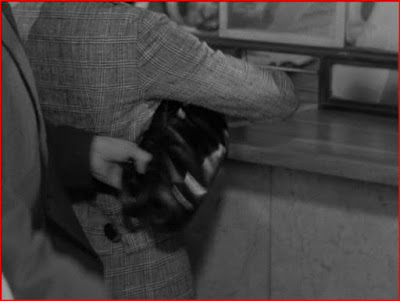
Pickpocketing is an ideal subject for Bresson's unconventional style, which tends to steer away from the human face and toward portraying bodies and objects in motion. What bugged me about Lancelot was his habit of focusing on the knights' feet when they were walking, for instance. Here, however, it's the sensible thing to focus on hands reaching into coat pockets and pocketbooks or passing swag to other sets of hands. The scenes of the gang at work in the train station are brilliantly shot and choreographed. The film is also well edited to build the momentum of the gang's crime spree and the tension of Michel's various risky solo jobs.


Dostoevsky kicks in again as Michel falls for Jeanne (Marika Green, aunt of Eva), a downstairs neighbor of his mother, and guilts over not being with his dying mom enough in her last days and failing to live up to his promises to her. He finds that it wasn't enough to salve his conscience to give her money, and he also finds that when his own conscience falls short, the idea of what people he cares for think of him is nearly an adequate substitute. From Crime and Punishment Bresson also appropriates the idea of a patient policeman engaged in subtle psychological warfare with his prey. As I suggested, it's initially annoying to discover that Bresson copies the Russian so closely, but he's talented enough, as are, for his purposes, his cast of inexperienced actors, that the story asserts its own individuality while following the Dostoevsky pattern.


Bresson is often hyped for his spirituality, which is clearly present in films like Balthazar and Diary of a Country Priest. Watch the Criterion DVD that I got out of the Albany Public Library (a recent acquisition) and you'll hear Paul Schrader get a little nutty on the subject. He's taken a stopwatch to Pickpocket, it seems, in order to explain that Bresson cuts between shots with unorthodox timing in order to jar viewers into a state of unease that will presumably make them receptive to the incoming spiritual message. That's overstating things a bit. Pickpocket flows more smoothly than Schrader's intro might suggest (and why call it an introduction and then warn viewers of spoilers so they don't watch it until after they've seen the film, anyway?), and on this occasion the spirituality is basically Dostoevsky's, not Bresson's. The main thing is that it's a simple, accessible story intelligently cinematized in a way that non-specialist audiences should appreciate as much as connoisseurs. I still have a lot of Bresson to see (the Library has Diary as well as A Man Escaped), but I feel confident in recommending Pickpocket to people who want to try him out for the first time.


Here's the French trailer. The narrator is mostly speculating about the motives and mindset of the title character. Judge for yourself.