Wednesday, March 24, 2010

Wendigo Meets VAMPIRELLA (1996)

The most money that my friend Wendigo has ever spent on a DVD is the $59.95 he dropped on the film adaptation of the famous Warren comic magazine, produced by Roger Corman and directed by Jim Wynorski for an original broadcast on Showtime. That's a markdown from the $79.95 list price he used to see in stores. When he found it available at a discount last year, he swallowed his pride and put the money down. He didn't get the cable channel back in the day and had never seen the film before. He had high hopes for it.

Wendigo has met Vampirella many times before, of course, in many forms, -- most of them really hot. Created by famous monster man Forrest J. Ackerman, she inspired many great cover artists of the day and remains a magnet for good-girl artists in our own time. Those artists set a standard that was probably impossible for any mortal female to match, though Caroline Munro, proposed for the role back in the 1970s when Hammer was contemplating the project, would have come damn close.


"Vampi," as her friends know her, is a native of the planet Drakulon, where water has the same components and consistency as human blood. Drakulon is a dying planet when an Earth expedition lands there, and Vampirella, attempting to fight off the invaders, discovers that they have "water" flowing through their veins. Taking the humans' ship and going to Earth, she finds herself reluctant to kill people, becoming a model instead. Eventually a nice doctor invents a blood-substitute she can drink, and she becomes a hero and defender of humanity against various dark forces. None of this is in the film.

Instead, Wynorski and writer Gary Gerani (sole prior screen credit: Pumpkinhead) present us with the eminently civilized world of Drakulon, where Ella (Talisa Soto) is the white-clad scholarly stepdaughter of one of the planetary elders (Angus Scrimm). Drakulon has a sort of shopping-mall quality to it, but its people are high-minded, mostly, and very conscious of their dark past:


Elder: Dear daughter, that's they way we vampires used to behave in ages long past. Our ancestors would drain each other's blood instead of drinking it from Drakulon's organic rivers and streams.

Ella: How barbaric!


But there are barbarians still in their midst. Their leader is Vlad, a self-styled man of action who enjoys being a predator. He's played by Roger Daltrey, and if you wonder why The Who still tours and plays shows like the Super Bowl, I like to think its a conscientious, charitable decision on Pete Townshend's part to prevent his mate from embarrassing himself like this ever again.

Once upon a time, Roger Daltrey hoped to die before he got old. He seems to have found a middle ground.

Vlad's flunkies break into the courtroom and slaughter the elders before hijacking a spaceship and heading for that promising planet, ours. Ella embarks after them on a mission of revenge, but her spaceship conks out in an ion storm and our heroine has to put herself in suspended animation on Mars, losing 30,000 years of precious time while Vlad & Co. hit earth and give birth to the race of vampires. It's not until the space shuttle (!) co-piloted by John Landis (!!) reaches Mars that Ella can reboot her revenge scheme. So instead of the original origin, imagine if General Zod had hopped out of those spinning rings, done a Limey on Jor-El, and high-tailed it for Terra, leaving a technically-inept Kal-El to give chase.

"Dang! I shouldn't have lent those spare parts to Eros and Tana. And I shouldn't have lent my interocitor to Lattis and Krobar."

"Can you use a computer, Missus Vampire Lady Person? It's got Windows 3.1!"

Ella exits the shuttle as a bat, only to end up in an alley in time to prevent the mugging of earnest young nerd Forry Ackerman, who gives her a new name ("Ella?...Vampire?...") and gratefully provides her first clue toward tracking down Vlad's crew. Somewhere along the long trail she learned to kickbox, a skill that serves her well later. Her path is destined to cross with that of Operation Purge, a vampire-hunting operation of global sweep based beneath a nondescript gift shop. In a touch that's actually ahead of its time, we see Purge capturing vampires and torturing them in order to learn the whereabouts of Vlad, the master vampire. Threatening to inject holy water into their veins is very effective. Had they not resorted to these extreme measures, they might never have learned Vlad's alias. Until then, they had no clue whatsoever as to what identity their longtime enemy was working under.

Jamie Blood never really caught on in the age of grunge, but he still had his fans.

To be fair, Jaimie Blood doesn't keep that high of a profile. His lounge rock act attracts a few dozen people, including that incorrigible camera hog, the real Forrest J. Ackerman. Daltrey's vocal performance here would be sad if he weren't completely committed to grimacing up a store and working his ridiculous costumes, which are far from the most ridiculous costumes on display here. Daltrey is a terrible actor, but also the only one with the right sense of what to do in these impoverished circumstances, which is to camp up a storm while Soto and the rest of the cast plod woodenly through their paces.

There's a plot that has to do with a "Judgment Night" that Vlad is orchestrating, and a subplot dealing with Operation Purge's initial distrust of Vampirella, but it all tends to blur in the memory. It couldn't be much of a plot, anyway, when Vampi smashing one machine in the middle of a western ghost town can cause all your satellites of doom to disintegrate in orbit. Little about this movie makes much of an impression. This is a film about which Wendigo has little good to say. "What did it get right?" I asked him. "It ended," he said.

Part of the problem was the low budget, of course, which forced Wynorski to use stock footage from older Corman productions for outer space scenes. Wendigo says there's no way they were going to be able to do a more faithful origin story for Vampi with the budget they had here, but they might have gotten away with doing a typical Vampirella story on earth if they didn't bother with an origin. Wynorski has pulled off near-miracles of silliness in his impoverished past (e.g. the hilarious Deathstalker 2), but his economy-sized inspiration fails him here.


A better Vampirella could still have elevated this film, but Talisa Soto ends up a poor choice for the role. She's handicaped from the start by the poor costume she wears. Maybe nothing possible in the 1990s could have lived up to those magazine covers, but Soto's outfit reminds Wendigo too much of vinyl garbage bags rather than anything more arousing. You can see better looking Vampirellas in almost any comic book convention, and that was probably true even at the time of the movie.

Wendigo thinks that Soto acquits herself adequately in the fight scenes (she'd just done Mortal Kombat, after all) but she can't act, or at least can't put life in Gerani's glum lines, and her athleticism has its limits. In one scene she has to chase Daltrey on foot (why either transforms from bat form for this purpose is unclear), and she makes the old man look spry as she trudges after him in her modest boots. Wendigo tells me he's tempted to say I could have made a better Vampi, but I insist on assuring readers otherwise. He's also less forgiving of Daltrey than I am, and I can't blame him. He's even less forgiving of the film's poor excuses for special effects, including the worst bat transformations of modern times and the poorest imitation of a hologram we may ever see.

"Ve are Nihilists. Ve believe in nothing."
The worst failing of the Vampirella movie may be its misrepresentation of the character's personality. The comic-book Vampi may have her poignant moments, but she often displays a more vibrant personality, and the drawn character has an indisputable charisma that Talisa Soto misses almost completely. Given the popularity of vampires now and the ease with which the character could fit into the milieu of "urban fantasy," Wendigo thinks there's an opportunity for someone to make a more genuine Vampirella movie, or at least the first good one.
Here's the trailer, uploaded to YouTube by batmandingo007:


As a bonus, here's a clip from Vampi's little known career as a professional wrestler, uploaded by gohwave.

Monday, March 22, 2010

NIGHT EDITOR (1946)

Sony Pictures Home Entertainment's Bad Girls of Film Noir Vol. 2 collection goes back further in time than its companion volume to revive Henry Levin's 66-minute feature, the only film of the four collected here to be listed in Silver and Ward's noir encyclopedia. Night Editor is a kind of failed pilot for what Columbia Pictures intended as another series of B-movies based on a radio program. The Night Editor himself would be the narrator, recollecting stories to keep the graveyard shift at his great metropolitan newspaper entertained and possibly imparting moral lessons to younger members of the staff in the process.


Charles D. Brown is the Night Editor!

Night Editor is a very cheap and foolhardy movie. The cheapness really comes through in the opening that introduces us to the Night Editor and his cronies at the Daily Star. This sequence is filmed in one master shot. When the script calls for Levin to cut to a close-up, you can tell from the film grain that he's simply zooming into a section of the master. DVDs are unforgiving of such stuff, and I shudder to think of what Blu-Ray would do to the poor film. The foolhardiness comes from the decision to make the main story a period piece set during the days of Prohibition. Some things it gets right (cars, telephones), but every character you see looks straight out of 1946. That's most true of our femme fatale, the slightly crazy Jill Merrill (Janis Carter), who's having a slumming affair with schlubby cop Tony Cochrane (William Gargan). Jill looks like no flapper I ever saw, and the production's ignorance or disinterest in period costume leaves you wondering why they'd even think of doing a period piece until you realize that there's got to be a present-day payoff somewhere.


That Janis Carter is another Louise Brooks, a veritable personification of the flaming youth of the Roaring Twenties -- I don't think.

Tony is cheating on his wife and feeling guilty about it, but he can't give up the vamp. "Do you want blood?" he asks Jill at one point. "Yes!" she insists. She really does seem bloodthirsty, too, though not that literally. When their lovers' lane tryst is interrupted by another car carrying a girl and her murderer, Jill has a sudden crazed urge to see the body. The noir encyclopedia makes a big deal of this, seeing sexual arousal in her reaction to the murder, but the story itself eventually reveals an even baser motive behind her curiosity. For Tony, the problem is that he can't function as a cop despite witnessing a murder. As Jill warns him, reporting the crime or even pursuing the criminal would be a confession of his affair that he can't bear to make. If anything, he ends up obstructing the investigation -- and a more clever film might have exploited this by having his cop colleagues begin to suspect him of the crime. But the writers think themselves clever enough for suggesting that Tony's compromised investigation is exactly what someone intended.

"Stop! Or I'll ... ... Alright, then; don't stop!"

Gargan made a good hardboiled radio detective, but in this film his hangdog guiltstrickenness suggests Lon Chaney Jr. on a slow day. It's a one-note performance that doesn't earn our hero much compassion. In fact, I felt annoyed when what looked like his comeuppance turned out to be a setup for a happy epilogue. As Jill, Janis Carter is a monster, a pure predator apart from some late-revealed psychological issues. "I don't know why I do things sometimes" she says before stabbing someone with an icepick and repenting immediately. She's attractive in that icy way, though, and helps keep this thing watchable. The Night Editor gimmick obviously wore out its welcome instantly, perhaps because the producers went too far in tying the story of Tony Cochrane to the lives of some of the newsroom characters. There's simply too much of the news crew in the film, and the idea that someone in the office'd learn something from each little Night Editor anecdote probably had audiences begging for less.

Still, there's no point in denying that Night Editor is a film noir, it's "never mind" epilogue notwithstanding. It's dark, it has a femme fatale, and it boasts a guilt-stricken compromised hero. It's just not a good noir. Bad Girls Vol. 1 taught us, however, that some films didn't have to be noir to be good, so I hold out hope for the remaining three films, which form a Cleo Moore film festival, along with a half-hour "All-Star Theater" episode included as an extra on disc one. She's highlighted in Hugo Haas's One Girl's Confession and Lewis Seiler's Women's Prison and Over-Exposed. We'll learn more about these efforts in the near future.

No trailer for this one, but one joelcairo just yesterday uploaded the whole movie to YouTube in seven installments for those who remain curious.

Sunday, March 21, 2010

On the Big Screen: THE GHOST WRITER (2010)

When a woman hands a man the confidential manuscript of a memoir and tells him he has a limited time to read it, I don't need to see the white pages turn into a snowy landscape to know that the spirit of Orson Welles is in the room. Roman Polanski's new film is Wellesian in theme if not in style or structure. If it hints at Citizen Kane at some points, it points to Mr. Arkadin in others. One can only imagine what Welles might make of the situation Polanski has adapted from Robert Harris's novel, in collaboration with the author. The title character is an unnamed writer (Ewan McGregor) hired to polish the memoir of a former British prime minister (Pierce Brosnan) after the politician's original collaborator dies. The previous ghost writer got separated from his car and the ferry that bore it under circumstances that grow increasingly suspicious, while the pressure on the present ghost to finish the book grows more urgent as his subject faces an International Criminal Court indictment for war crimes. Adam Lang (meant as a stand-in for Tony Blair, though Brosnan attempts no imitation) is accused of placing four alleged terrorists into the hands of CIA torturers. Is there a connection between his legal jeopardy and the death of his previous ghost writer? Does the project put the present writer in jeopardy? It wouldn't be much of a thriller otherwise.

McGregor's character is a kind of doppelganger for Lang and may be set up to die for Lang's sins if he isn't careful. As he comes to question the official version of his predecessor's demise, he stumbles across some supplemental research the first writer had undertaken on Lang's rise to power. As he traces the first ghost's fatal steps, the new ghost puts himself in danger of ending up in the same place, setting up some nicely handled set pieces of pursuit and escape. Meanwhile, he finds himself in a potentially dangerous relationship with Lang's wife (Olivia Williams), who's jealous of hubby's closeness with his chief assistant (Kim Cattrall). All of this is handled very well by the sure-handed director. The film betrays nothing of the constrained circumstances of its final assembly, Polanski having edited it in jail while extradition to America for an extended stay seemed likely. The acting is good all around, possibly excepting Brosnan. He doesn't strike me as the sort of wonky politician I expected Blair or a fictional counterpart to be, but in his defense the movie politician is supposed to be less than meets the eye; that's part of the plot. Polanski gets the most from limited use of such American character actors as Timothy Hutton, Jim Belushi and the mighty Eli Wallach. Someday, at the end of the world, Wallach and Ernest Borgnine will face each other as the last men standing, and while Wallach looks a little frail here I wouldn't count him out.

The Ghost Writer is an effective, entertaining film that I readily recommend, but it left me wondering whether the conspiracy thriller genre is going obsolete. Thrillers of this kind work by withholding and gradually revealing information in a process that doesn't seem realistic in the current information age. Without spoiling anything, let me note that The Ghost Writer saves a major piece of circumstantial evidence for its final revelation. That revelation is meant to have you suddenly think differently about a major character. In retrospect, however, you sense that the writers had manipulated you into an artificial presumption of innocence. Given the internet research our hero undertakes to discover the sinister ties linking other characters, it seems unlikely, given that final revelation of a detail that seems to have been public knowledge, that the ghost would not have stumbled onto something online that at least suggested the association that so floors him later. When you consider that one tidbit he learns from a single website is accepted by an important person as decisive proof of a monstrous, decades-long conspiracy to manipulate British politics, his failure to find anything to warn him of a more dangerous truth seems even more unlikely. Movies are simply falling behind the ability of the conspiratorial imagination to draw inferences. As a result, it was in its final minutes when The Ghost Writer suddenly seemed most old fashioned -- and its extra revelation of a hokey secret code didn't help. But overall, Polanski's film is old-fashioned in good ways, and many people may not feel the same way about the ending as I did. Maybe I'm just too conspiracy-minded -- but that's just what they'd like you to believe....

Saturday, March 20, 2010

MAN IN THE WILDERNESS (1971) and LAST CANNIBAL WORLD (1976)

At first I was just going to review Ruggero Deodato's first essay into cannibal cinema, which I saw for the first time earlier this month under its exploitative nom de video Jungle Holocaust. I had a backlog of other films to write up, however, and in the meantime I read venom5's survey of Italian cannibal and related horrors at his Cool Ass Cinema blog. In it, he noted that the pioneer film of the cannibal genre, Umberto Lenzi's Man From Deep River (as yet unseen by me) was a retelling of A Man Called Horse, the movie that made Richard Harris an unlikely Western star. That point provoked me to ponder the differences between the American wilderness genre and its Italian counterpart -- counterpoint may be the better word. It occurred to me while thinking about it that Indians never factored much in spaghetti westerns. I've never seen one in which they play the noble-savage role (with increasing emphasis on noble) that became common in American films. You see Mexicans more than Indians in Italian westerns, at least in my experience. The absence of Indians is understandable, I suppose, since American moviemakers are playing out issues from their nation's recent past that have no parallel that I can think of for the Italian moviegoer. Yet Italians seemed to have a distinct idea about aboriginal cultures, or at least their exploitation producers did, and it's profoundly different from the prevailing American idealization of Natives. Arguably it extends to profoundly different ideas of nature itself and the possibility of achieving harmony with it.

So I decided on a comparative approach, matching the Deodato with an American counterpart. I happened to have one at home: Richard C. Sarafian's Man in the Wilderness, starring none other than Richard Harris. It actually isn't the ideal film for comparison, since its Indians are rather peripheral to its story, but there are a few moments with surprisingly exact counterparts in Last Cannibal World, leading me to wonder whether Deodato was commenting on or parodying Sarafian.

Man in the Wilderness is at the least a case of truth in advertising. It consists mostly of Richard Harris in the wilderness. He's Zach Bass, a member of a peculiar trapping expedition circa 1820. The trappers are hauling a big boat through our title wilderness, intending to ride it down the Mississippi. It's a powerful eerie image to open the film with, and its progress gives us a visual jolt whenever we see it, but it promises a stranger, more interesting film than Sarafian actually made.

John Huston and his ship-on-wheels often seem to be part of a different, more surreal or sinister film than Man in the Wilderness, but that's where they're stuck.

The trouble begins when Zach is mauled by a bear in a nicely staged scene with some nasty wound effects. By the time his comrades have shot the bear down, Zach is at least half dead. It tells you about the influence Italian films have had on me when I assumed, when one of the trappers says, "At least he left us some meat for the rest of the journey," that the trapper meant Zach, not the bear. I realized my error quickly. The chief of the trappers, Captain Henry (John Huston) is concerned mainly with giving Zach a Christian burial before they move on. Since Zach is still alive, he details two men to stay with him until he dies, then bury him. He gives them two days; if Zach's still alive then, they should kill him, bury him, and rejoin the main group. Harris is uncommunicative but conscious enough to hear this.

Two days later, it looks as if Zach is actually getting better thanks to the minimal patching up he received. Orders are orders, however, -- except when Indians are close. The two trappers, one unwilling to kill Zach in the first place, chicken out and skedaddle, abandoning the still gravely hurt man in the middle of nowhere. From here the film consists of Zach's slow recovery, from dragging himself to a watering hole to regaining the use of his legs, from scavenging in rivalry with wolves to trapping and hunting on his own. For variety's sake we're treated to flashbacks that reveal Zach as a sullen, undemonstrative fellow. We see him as a child getting rapped repeatedly on the knuckles for refusing to answer the question, "Who made the world?" One of this film's problems is that we can't tell from this scene whether little Zach is a precocious agnostic or clinically dense. In later life we see him about to abandon his pregnant wife, but not without telling the child in her womb that he wishes them both the best despite his belief that it's foolish to be born in such a world as ours. Later yet, we see him return to find the wife dead from childbirth and his son a toddler tended by Zach's mother-in-law. Our hero was content to leave things that way, reluctant even to greet the boy. We're rooting for a real winner here, but rooting for him to do what?

The trappers continue on their way but take a detour while the Indians dither over whether to attack them. Captain Henry grows obsessed with Zach, believing like many of his men that their colleague is still alive and most likely powerfully pissed off at all of them. Having a ship in his picture with John Huston as its captain is Sarafian's way of begging for comparisons with Moby Dick, but screenwriter Jack DeWitt gives Huston little to work with. The old man has a striking costume and a proven presence on film, but he isn't sufficiently villainous or crazy to get us anticipating a showdown between him and Harris. That's a good thing, I suppose, since that showdown is an incredible anticlimax that leaves you wondering what the point was of it all.

Sarafian's wilderness isn't a benign place. It tests people, but like many wilderness films it seems to argue that the hero's ordeal has a positive or purifying effect. The location work is the film's strongest suit apart from the imagery of the ship on land. Harris's performance is almost entirely physical. He has little more than a dozen lines of dialogue in the whole picture, it seems, but he does invest his role with nonverbal expressiveness. Apart from Huston, the trappers (including James "Scotty" Doohan) are a nondescript bunch. The Indians notice Harris's existence occasionally, but usually leave him alone because he wears some sort of Indian sign. Henry Wilcoxson is their chief, which rather limits their ability to represent natural authenticity. He has a big scene with Harris in which he talks entirely in untranslated native language. There are no initiation scenes of the kind that made Man Called Horse notorious. There is, however, a moment in which Indians teach Zach Bass about humanity, and this is where I found an evil echo in Last Cannibal World.

On his road to recovery, on the trail of the trappers, Zach comes across an Indian woman by a riverbank. She's there to give birth to a baby. Our hero watches raptly, and the sight inspires the flashback to his first and only sight of his son. His eyes appear to ache with sympathy for the mother as he suddenly and clearly misses his own child. This feeling grows stronger as he sees the father lovingly claim the new baby and take the mother home.This sets up what the writer wants to be the payoff of the final confrontation between Harris and Huston, and while you can see what his point was, it's still an anticlimax, and a fatal one for this sort of film. Still, we have to note this one moment when the taciturn, solitary white man learns the value of family from "savages."

In Last Cannibal World, Robert Harper (Massimo Foschi) is on the run from his cannibal captors somewhere in the Philippines when he pauses to espy a similar sight. While the Indian mother in Wilderness is fully clothed, the Cannibal mother is as naked as most of the rest of the cast. With louder birth pains she brings her baby into the world. Like the Wilderness mother she bites through the umbilical cord. She then throws the baby into a river, presumably to be eaten by an alligator.


Apart from scenes of violence against animals (which Deodato denies shooting in a video intro to the Shriek Show DVD), this business with the baby is the most appalling part of a pretty appalling film. Deodato's primitives have no family values that we can notice, and maybe no values whatsoever. Their collective feasts of human flesh or fresh-killed alligators are free-for-alls that see fellow tribesmen fighting each other for the best bits. They seem to be envisioned as sub-human; one civilized character claims that the tribespeople don't even have a language. This is meant to be more alarming to the audience because, while the American wilderness films are set in the past, the Italian cannibal films take place in the present.

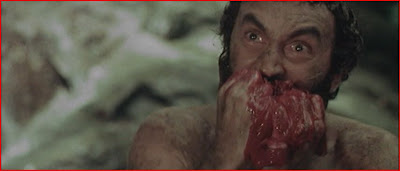
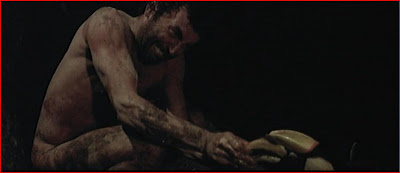
Harper's sojourn among the cannibals is in no way purifying. Quite the opposite; he ends up raping the native woman (Me Me Ly) who helps him escape a captivity intended to fatten him up into alligator bait. When one of his civilized colleagues reunites with him, he thinks that Harper is going insane. In the thematic climax of the film, Harper faces down his last pursuers by ripping the heart from one he's just killed and tucking into it as a form of intimidation. I was reminded of this a little when in Wilderness Harris chomps on a hunk of raw meat he'd just cut from a still-quivering buffalo after beating wolves away from the body. That moment is meant to make you a little queasy, but the Deodato scene is far more horrific and powerful because Harper has turned cannibal not from necessity, but out of pure viciousness. It represents his victory over the cannibals but also his final descent into savagery, his eventual return to civilization and his reported marriage and retirement to Mexico notwithstanding.


Last Cannibal World hearkens back to Man Called Horse in its ritual humiliation of Harper, who is stripped naked, has his penis fondled by curious or contemptuous natives, and is pissed upon by children. In the wilderness films you can construe this treatment as a kind of breaking down of the defective "civilized" personality before the hero can be built up as a better, more natural man. In Deodato's film there's no room for idealistic fantasy; Harper's story is an ordeal of degradation from beginning to end, which he survives only by becoming more savage than his oppressors.

Massimo Foschi is made to fly like an eagle (or an airplane) by the literal cavemen of the Last Cannibal World. Below, an eagle resents the comparison.


Critics have been speculating for nearly forty years about the roots of the Italian fascination with cannibals. If the cannibal films are a response to the American wilderness films they can be seen to some extent as a grim satire on American noble-savagery. I don't know if the notions about noble savages popularly identified with Jean-Jacques Rousseau had much influence in Italy, but I do know that Italians were little exposed to aboriginal peoples compared to other European powers that had more extensive colonial empires. Maybe they had no colonial guilt to drive them to idealize the primitive, and maybe they had a stronger sense of original sin than other nations that immunized them against noble-savage idealism. I have to defer to the experts on this one.

I've long been a defender of Deodato's magnum opus, Cannibal Holocaust (1980), and having now seen Ultimo Mondo Cannibale I can definitely say that the later film is an advance on the earlier one. Holocaust is often taken as a satire on "Mondo" moviemakers, but in the context of Deodato's career it could also be an act of self-criticism, or willful self-parody. While holding no illusions about its cannibals, Holocaust takes their side, to an extent, against its predatory filmmakers. That's progressive compared to Last Cannibal World, but just about anything would be. More so than Holocaust, the earlier film is one whose power must be acknowledged in spite of, or perhaps because of the profound feelings of loathing it may provoke. It taps into an atavistic fear that most people had hoped to forget, or might prefer to experience in the sublimated or (strange to say) euphemistic form of the flesh-eating zombie film. Did the cannibal films fill a perceived void left by some supposed denial at the heart of the wilderness films? It depends on how you see the wilderness films, and how you see the wilderness.

In Brief: SHUTTER ISLAND (2010)

It's been nearly two weeks since I saw the new Martin Scorsese film but I've had a hard time working up a review. In part that's because it's hard to describe without potentially spoiling the story, though by now I think everyone knows that at some point in the movie you're supposed to question the reality of what you're seeing, or at least the perspective through which you see it. It's based on a novel by Dennis Lehane, a cleverly conceived period piece that plays on our perception of period paranoia. It raises possibilities that keep you guessing all the way through, even after the film seems to settle on one particular version of events. Scorsese made a good choice directing this, since the psychological subjectivity in play is the best platform yet to ply his post-Casino trade. The public rejection of that film seems to have made it impossible for the director to make more films in his once-characteristic style, since Casino was condemned for being a do-over of Goodfellas. It was like telling John Ford he shouldn't make any more cavalry films, but Scorsese took the verdict to heart and resolved, after a Buddhist bildungsroman and some ambulance chasing, to become the new Michael Powell instead. The results of that transformation have been quite mixed. I like the visuals of Gangs of New York and the flamboyant performances despite its travesty of history. The Aviator had a few striking moments but overall left me asking "so?" The Departed is mostly effective but a cartoon compared to his classic films. Now at least Scorsese can let rip with lurid Fifties-ish gothic expressionism and cut loose from literal realism. At least I hope we're not meant to take anything we see literally. If reality is as one character describes it, in detail, towards the end, then it's one of the most ridiculous stories I've ever seen. But we don't have to take that person's word for it, however much the film hints or insists that we should. The nature of the tale lets us and Scorsese have it both ways. So there are beautiful, uncanny moments as well as a banal bit when Leo DiCaprio spreads his arms, gapes heavenward and yells, "NOOOOOO!!!!" in the middle of a Leave Her to Heaven homage. There are wonderful turns by Ben Kingsley and Max von Sydow, while Mark Ruffalo is largely wasted as DiCaprio's straight man. There are times when you think this is the American Cabinet of Dr. Caligari and times when you can imagine it as an informal sequel to Inglourious Basterds. So is it a kind of counter-history, an account of a crazy man, or of a crazy director? My answer: sure... Give it a shot sometime.

Wednesday, March 17, 2010

THE TAKING OF POWER BY LOUIS XIV (1966)

I'm a historian by vocation. In practice my work has ranged from writing a thesis on antislavery politics in Massachusetts to teaching a film history course in a community college once upon a time. In the end I didn't feel myself cut out for academia, so I find outlets for my continuing interest in history elsewhere. To cut to the chase, I was just the sort of mark the Criterion Collection had in mind when they started releasing the the late-career docudramas directed by master neorealist Roberto Rossellini. La Prise de Pouvoir par Louis XIV was the affordable lure, and if you're hooked you'll go for the Eclipse collection of three more history films. Me? I bought the Eclipse set during a Barnes & Noble 50% off sale even before I got around to watching Louis XIV. I might have found myself feeling a little foolish if I didn't like the earlier film.

As it happened, I found it fascinating. French history isn't one of my specialties, so it was a rewarding challenge to be immersed in the 17th century without benefit of narration. The situation establishes itself soon enough. The prime minister, Cardinal Mazarin (like Rossellini an Italian in service to France), is dying. The leading nobles and courtiers are maneuvering for position, literally in the sense of proximity to the dying man and politically in order to exploit an expected power vacuum. As doctors ponder whether to keep bleeding the poor cardinal, no one really takes the King of France seriously. Louis XIV is considered a callow young man more interested in courting mistresses than in court politics. As Mazarin is considered the power behind the throne now, so Superintendent Fouquet expects to take over once the cardinal dies. While most of the nobles are out for personal gain, Mazarin and his right-hand man Colbert serve the national interest. They encourage Louis to assert himself and bring the nobles to heel, but the king is cautious. Mazarin wants to bequeath him his massive personal fortune to help make the monarchy independently wealthy, but Louis refuses, thinking it will arouse suspicions. He has his own ideas, however.

Just another day in the life of a king. Somehow he doesn't seem happy.

Once Mazarin finally dies, Louis starts making his move. He keeps the nobles off balance by moving from province to province, never holding council meetings in the same place. He lays down the law by having the corrupt Fouquet arrested. Now the master plan kicks in. He wants to undermine the economic independence of the nobles in their regional power bases. He does it by exploiting their desire for the prestige that derives from proximity to the king. He's seen it all his life, and now he takes it to the extreme. He becomes a fashionista revolutionary, setting a budget-busting standard of personal style and dress that anyone who wants to be anyone has to emulate. He makes it mandatory that they stay near him at his new palace at Versailles, breaking their local ties and making them more dependent on him for everything. He makes himself the lender of first resort to help them meet the mounting expenses of courtly living. Meanwhile, his living large kickstarts the French economy, making the bourgeoisie as well as the nobility more dependent on him. His goal is to make the king the source of all the country's wealth, the one who gives life to all things like the sun does in nature.

While most scenes are filmed straight ahead, Rossellini adopts the olympian perspective of the king watching from a window for the crucial arrest of Fouquet, shown here discovering his doom.

There's an artful artlessness in Rossellini's telling of this story. Every shot is very carefully composed and the cinematography is gorgeous, but the director does little to dramatize his scenes in the manner we expect from period pictures. He throws in occasional bits of exposition to explain things like why Louis doesn't go into Mazarin's room after the cardinal dies, and he has the main characters state their motives rather baldly. But like Jack Webb he strives to minimize the theatricality of the drama. His Louis is a non-actor who usually reads his lines off cue cards, giving his utterances an unaffected quality that passes for naturalism. Characters don't emote in this film, allowing you to suspend disbelief and imagine yourself back in time among real people.

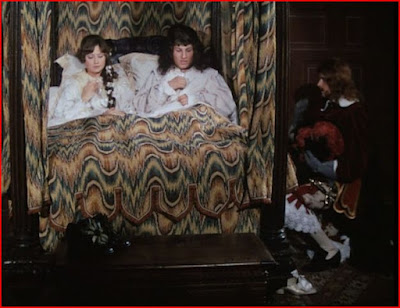
Despite the illusion, Louis XIV is a carefully crafted story. Rossellini establishes a visual parallel early, linking Mazarin's deathbed scenes with Louis's marriage-bed scenes and contrasting the dying minister and the rising monarch. The film's big outdoor scene, a deer hunt during which Louis takes his mistress into the woods for a quickie, is a metaphor for the main storyline. By continuing to play the self-indulgent wastrel after Mazarin's death, Louis is throwing Fouquet and other power players off his scent just as a deer tries to throw hunting dogs off its scent by swimming across a stream.

Le roi pimpedelique

Rossellini's most important directorial decisions are matters of pace. He films in long takes and lets scenes breathe. The deliberate pace helps perpetuate the illusion of living in the past, and it fits the ceremonial pace of court life. It lets you see how important physical proximity to power is to the nobles, whether they attend the king when he wakes up in the morning or compete to be the first to view Mazarin's corpse. He's setting up a big payoff, and it comes in a scene that plays out to almost oppressive length -- on purpose. Louis's triumph is represented in a stunning scene in which the nobles are obliged to stand about watching the king eat a meal of more than a dozen courses -- without a fork, mind you. He knows how to use one, we're told, but he doesn't like to and he doesn't like others showing off. Course after course is conveyed from the kitchen in elaborate processions and put into the hands of courtiers for whom it's a mighty honor to serve the monarch this way. Most viewers have probably been rooting for Louis up to this point, but now you have to question whether he's taken things too far. The "Sun King" becomes a despot here, and the scene is sure to have a dystopian quality for American viewers, particularly those of a certain ideological bent who probably imagine such scenes playing out in the White House today. Anyway, here's some of the scene, as uploaded to YouTube by hvolsvellir

To be honest, the film's stately pace and dry feeling aren't going to work for everyone. It'll help if you're interested in history, though I can't vouch for the accuracy of Rossellini's account or the fairness of his emphasis. But if you love film for the sake of pure imagery I can tell you that, at the least, this film's a visual feast. Made for TV it may have been but it's gorgeous to look at, and the costumes take it to another level altogether. Louis XIV is a mesmerizing trip in a cinematic time machine that makes me look forward to future travels with the director.

Tuesday, March 16, 2010

Wendigo Meets CIRQUE DU FREAK: THE VAMPIRE'S ASSISTANT (2009)

My friend Wendigo is pretty widely read in vampire fiction, but he was barely aware of Darren Shan's 12-book series of young-adult novels before he heard of Paul Weitz's movie adaption. He's only just forging into the young-adult realm (Twilight being the gateway), but Shan's books hadn't really caught his attention, most likely because they don't fit the Twilight archetype. Based on what we've now seen, the "Saga of Darren Shan" seems intended for a slightly younger and more male audience than Stephanie Meyer's books. So all Wendigo knew about The Vampire's Assistant was what he saw in the commercials. They made the film look like a vampire comedy, a subgenre that has produced little good, and that it had freaks in it. I traumatized my poor friend once with a Halloween showing of Tod Browning's Freaks (a double feature with The Texas Chain Saw Massacre!) so he was uneager to see more freaks on film.

On that point he needn't have worried. The freaks of Cirque du Freak are more like Marvel Comics mutants than "Nature's Mistakes." Most of them have abilities that border on super powers, one woman being able to dismember herself and instantly regrow her limbs, another being able to devour all substances, digest them in his two stomachs, and spit out finished custom goods. Selma Hayek plays a fortune teller who can grow a full beard instantaneously when entranced by dangerous visions of the future.

The nearest thing to an old-school freak is the impresario, Mr. Tall (Ken Watanabe), who has height and a sort of lopsided Metalunan forehead. The next nearest thing is "the wolfman," an endearingly mangy beast who partners in the dismemberment act and, if anything, looks more like a Baboon Man to me. He's played by a guy in a suit. I adored him at first sight.

As far as I was concerned, the guy in the suit nearly stole the movie.

But enough about freaks, except to note that one of them is Larten Crepsley (John C. Reilly), who performs with his trained spider Madame Octa and seems romantically linked with Hayek's oft-bearded lady. Steve, an alienated delinquent and vampire buff, recognizes Crepsley as a famous vampire he's read about in some modern illustrated edition of The Book of the Vampires. He's so alienated that he wants Crepsley to bite and turn him, but his "bad blood" disqualifies him. Instead, Crepsley turns Steve's friend Darren Shan (the author's name is a pseudonym) as a condition of saving Steve's life when Madame Octa bites him. For Darren (Chris Massoglia) this is a too-sudden escape from stifling family life and meaningless overachievement, as he must appear to die in order to take up his role as Crepsley's half-vampire assistant. Through him we meet more of the freaks, including a lovably dumb snake-boy who fancies himself a rock star and a comely monkey girl (it's all in the tail) who may be Darren's first romance if he isn't swept away in the swirling conflict between the vampires (Crepsley's kind) and the renegade vampaneze.

Larten Crepsley (John C. Reilly, above) and his partner, Madame Octa (below)

In Wendigo's eyes there's nothing uniquely original about the attributes of Darren Shan's vampires, though they make an interesting combination of familiar details. The most visually distinct thing about them is their super-hard fingernails, which they use for climbing and for slashing attacks. Larten Crepsley is a more interesting individual vampire. He's neither a beautiful creature nor a bat-faced monster. He ages (slowly) and bears scars that haven't healed. Personified by John C. Reilly, one of today's great character actors, he often looks like a clown in the right light, but is also sad, sometimes cynical, and definitely not the standard master vampire. Wendigo hasn't seen much of Reilly's work but is impressed by this performance. While Cirque du Freak is yet another modern movie theoretically focused on the quasi-Renfield vampire-wannabe character, the film's success really depends on Reilly, and he succeeds in making Crepsley a representative of a plausible fantasy world. He's as noble a vampire as we've seen these days, having invented techniques of non-lethal blood drinking that inspired most of his kind to swear off killing (it's more like mugging instead), but in fantasy terms he's more of a reluctant mentor figure, someone trying to remain aloof from the looming conflict hinted at throughout the film.

Religion won't shield Darren Shan from his destiny (above), but he wouldn't have a chance at hot monkey-love otherwise.

This movie, which apparently combines the first two books of Shan's "saga," has an unavoidable rite-of-passage quality. For the most part, the film doesn't come on too strong about it after some dodgy early scenes portraying Darren's parents as cartoons of bourgeois conformity. You can forget about the metaphors as you get into the slightly-Burtonesque fantasy or enjoy the slightly Raimi-esque goofy action. But the symbolism comes roaring back towards the climax, when Darren must finally overcome his reluctance to drink live blood in order to gain the strength to defeat his old friend Steve, who was finally turned by the vampaneze and is now a bad guy. It's his new friend the monkey girl who offers her blood (from the shoulder), and the symbolism of the moment is obvious yet not overstated. The target audience of early teenage boys might miss the meaning altogether, but Wendigo couldn't help but see this as the moment when Darren finally becomes a man. It makes for an interesting contrast with Twilight, which is all about delaying the big moment as long as possible, but that may be all about the different audiences for each series of books.

While Mr. Tall is tall, Mr. Tiny (Michael Cerveris) is false advertising by comparison. What's his game? I guess you'll have to read the books, since the film leaves the answer to a sequel that will probably never be made.

The Vampire's Assistant is a textbook case of low expectations easily exceeded. We'd heard nothing but bad about it going in, but in Wendigo's opinion it's one of the more satisfying horror comedies of recent times, benefiting from a distinct quirkiness, and occasionally an endearing goofiness, that unfortunately satisfied none of the major target audiences for modern vampire movies. Weitz's movie fell between two stools, losing the female audience through its lack of romantic passion, and the male audience through its lack of cool or extreme violence. Reviewers probably resented having to learn yet another mythos, even though it isn't that hard this time. And from the bonus materials it looks like the film deviated from the novel in ways that may have left its most reliable target audience alienated. But Wendigo hasn't read the books yet, and judging the film on its own merits he found it quite entertaining and original. His philosophy of vampire cinema is "vive la difference!" and he thinks more people might enjoy this one if they set aside preconceived notions of what a vampire movie ought to be or should have in it. There's no gore, no killer chicks in leather, no heavy-breathing beauties, but lots of good films over time have done quite well without any of those things. This film is easily one of the most underrated films of last year. Though no classic, it's an enjoyable oddity for viewers with open minds.

This version of the trailer was uploaded to YouTube by darkmater101.