Tuesday, June 15, 2010

Wendigo Meets THE FORSAKEN (2001)

Before showing me J.S. Cardone's movie, my friend Wendigo warned me: "If you haven't seen Near Dark, you might find a few things here that look original or interesting, but if you have, it'll all look pretty familiar." I have seen Near Dark, and so has he, and he'd seen The Forsaken during its theatrical run. After looking at it again, Wendigo stands by his criticism. Cardone's film is basically a chase through the desert with (mostly) white trash thrill-kill vampires, with a hero's survival against a vampire curse at stake. As far as he's concerned, this is Near Dark Lite, cast entirely with pretty people in post-Scream fashion as opposed to a formidable presence like Lance Henriksen as the master vampire.

So why does Wendigo own a copy to show me? There are a few things about it he likes, it turns out. The B-movie vampires aren't overboard with superpowers, but are still a mortal challenge for our hapless heroes. It isn't a cartoonish battle of super hunters vs. uber-vampires; its ambitions don't exceed its budget. Also, Wendigo has an affection for white-trash vampires, for starters, and exploding vampires -- and they blow up real good here, not counting the one that gets her head blown off with a shotgun. As a bonus, the ingenue is frequently nude in good old R-film fashion. Finally, and perhaps most importantly, it cost just enough online that he was eligible for free shipping on his total order.

Good guys (above) and bad guys (below) in The Forsaken.

The Forsaken follows Sean, an aspiring editor for a Troma-type movie studio, on a cross-country errand in a borrowed Mercedes. Told not to pick up hitchhikers, he breaks the rule when he loses his wallet and apparent slacker Nick offers to pay for gas. As they pass through territory with lots of missing-person posters, they help out a foursome -- two guys, two girls -- who could use some jumper cables. Nick acts suspicious around them and they notice it, but each group goes its own way, the guys to encounter a strung-out girl in a diner, the quartet to crash a private beer party, beg for brews and kill everyone in sight. They are our vampire team: Kit, the master (Jonathan Schaech), two female "feeders" and their mortal "daydriver." We will know them, in no particular order, as "the poser," "the retard" and "the Penthouse Pet from Hell." The other female doesn't stick around long enough to earn a nickname. She blows up real good when the good guys drag her out of a car trunk one morning.

Look into your heart, Kit. Where were you when your girlfriend was left out in the sun too long?

Nick seems to know what's wrong with Megan, the strung-out girl. She's been bitten by the vampire and has empathic seizures whenever he kills thanks to some sort of psychic link. Luckily, Nick has some medicine for this sort of trouble, and he uses the stuff himself. There seems to be an entire underground pharmaceutical industry dedicated to staving off the curse of the vampire, but the effects are temporary and increasingly ineffectual. That's bad news for Sean, since the girl bit him while freaking out in a bathtub. Through the medical grapevine, Nick has learned of a surer cure. In classic Bram Stoker fashion, if he can whack the master vampire whom he suspects bit both him and Megan, their curse and Sean's will clear right up. The thing to do is leave bait for the vampire, and the way to do that is deny the girl the medicine so she maintains her link to the master.

Screenwriter Cardone seems to have thought that he needed to justify his project by positing a new mythology of vampirism. Along with his pills, Nick has acquired the knowledge that vampirism began at the Siege of Antioch during "the Great Crusade," when eight French knights made a pact with the Devil in order to avoid death at the hands of the Turks. Forsaking their cause and each other, they become... The Forsaken! Their subsequent aversion to daylight is an extension of their guilty reluctance to be seen, and as for drinking blood,... as the man on the old TV show used to say, "Deals with the Devil are bad." The funny thing about this claptrap is that I suspect that no one told Jonathan Schaech about it. His performance betrays no awareness of a medieval or crusading past. You'd think that was brought up because it might be relevant to the character's actions or motivations (sort of like how Dracula in Wes Craven's Dracula 2000 is really Judas Iscariot and -- actually, never mind.), and you would think wrong. Schaech is barely convincing as the master of a moron and a crazy woman. We wouldn't want to burden the man with a backstory, would we?

With a reasonable amount of nudity and frequent bursts of ultra-violence, The Forsaken might actually pass for a passable Eighties drive-in movie.

So what is The Forsaken's actual contribution to vampire cinema? Wendigo says, "There isn't any, apart from some new jargon." Not even its pharmacological approach to warding off the curse strikes him as unique; Blade and the sequel to John Carpenter's Vampires had the same idea. Cardone may have been aiming at an A picture (Sean drives through Monument Valley to set the tone) with a cast mostly made up of TV graduates, but the end product is pure B-movie. Not that that's entirely a bad thing, because it's an okay B-movie, with some decent action scenes, attractive nudity and amusing explosions. Wendigo can't really recommend it to anyone, but he says not to knock it if you find it on TV. You could do a lot worse with ninety minutes of your life.

This version of the trailer was uploaded to YouTube by HorrorMvieTrailers:

Monday, June 14, 2010

In Brief:LEGION (2010)

It's one part The Prophecy, one part Night of the Living Dead, one part Terminator (or its sequel) and one part The Petrified Forest. A dead end diner in the desert called Paradise Falls is ground zero for the End Times, only things aren't playing according to Scripture. God's in one of those moods again and has decided to wipe out mankind. But forget about that "fire next time" crap. The divine plan this time is to have his loyal angels possess the weak-willed, turn them into sharp-toothed, ceiling-crawling critters, and set them to attack the strong before they presumably wipe one another out. But before all else the hordes must hasten to that desert diner, where a cigarette-smoking pregnant waitress must decide whether or not to keep the baby. They would rather she didn't, but the Archangel Michael (Paul Bettany) arrives with a pro-life message. He's defied God and torn his wings off in order to save mankind, the stipulation being that the big guy will back off if this baby gets born. Fortunately, Michael looted an LA gun shop before dropping in, because there's a few hundred folks outside who need to die.

It's not quite the standard collection of types -- I missed the little old Jewish man -- but some things are still done the old way. The two black characters die early, and both pretty pointlessly, for instance. I suppose the creators think they're being badass by giving everyone a potential character arc, only to cut some short until we're down to a final two. Problem is, this is the sort of film where you assume that most of the cast will die, and that makes it hard to invest any emotion in any of the characters. A really daring film of this type would be the one where everyone sticks together and a majority actually survive. This film, despite its pretensions to sacrilege, isn't that daring.

Scott Stewart's film does have a few interesting moments. I dug the angel combat, when a swing of a wing can deflect a bullet or rip a belly open. There were a few presumably intentionally funny moments, like when beery diner owner Dennis Quaid challenges Bettany at gunpoint to "show your goddamn teeth!" But it's basically a collection of influences, a movie made of parts of other movies that doesn't quite live. It's not even inspired enough to be truly bad. You may even find it passable company for 90 minutes or so if you're in the mood for a shoot-'em-up with some fantasy thrown in. But you'll probably find it less memorable than its various source materials.

Sunday, June 13, 2010

BANDIDOS (1967)

Massimo Dallamano was Sergio Leone's cinematographer for A Fistful of Dollars and For A Few Dollars More. This film, whose alternative Italian title Crepa Tu...E Vivo Io is translated as "You die, but I live," was Dallamano's first and only western as a director. Following the early custom for Italian westerns, his name is Americanized into "Max Dillman" in the opening credits. He quickly moved on to giallos and other genres before dying in a 1976 car accident. After Bandidos, he had nothing more to prove in the western genre.

Dallamano's screenwriters started with perhaps the most monstrous villain in all spaghetti westerns. Billy Kane (Venantino Venantini) is a train robber who doesn't believe in leaving witnesses. Let that sink in for a moment. If you can't imagine it, Dallamano illustrated the point with a gruesomely epic tracking shot of the carnage Kane's gang and his Mexican collaborators leave behind. Playing over the massacre footage is Egisto Macchi's grim theme song, which identifies specific victims along the way: immigrants, an ambitious showgirl, young lovers who died together. I've seen nothing like it in a spaghetti western before.

Billy Kane (Venantino Venantini, above left) and his handiwork in Bandidos.

Kane spares one man: a middle aged gunfighter named Richard Martin (Enrico Maria Salerno), despite Martin's killing of several of his gang. He's content to end Martin's gunfighting career by shooting through both his hands after proving his superiority by outdrawing the older man and shooting his holster off his belt.

We next see Martin as a threadbare impresario, the mentor of fast-draw artist Ricky Shot. The team works a tough circuit; gunmen murder Ricky on stage in mid-performance. Martin tries to drink away his frustration later, only to be provoked into a barroom brawl. A stranger intervenes to bail him out, but we've seen him before. He'd been thrown off that train just before the bandits hit it, and one of the gang had used a knife from his confiscated saddle to gut a conductor. For that reason, we learn later, Phillip Raymond (Terry Jenkins) is a wanted man. Understandably, he's content to take on a new identity as the new Ricky Shot. Martin trains him in fast draw and trick shooting, revealing that he hopes to make Ricky his instrument of revenge against Billy Kane.

Enrico Maria Salerno (above) promotes the latest in a long line of Ricky Shots, Terry Jenkins (below).

Kane has few friends. Vigonza, his Mexican partner, wants to sell him out, and so do the men in his own gang. One of them, Al Kramer, tracks down Martin and wants him to act as an intermediary between him and Vigonza in a plot to kill Kane for a bounty. Kane is one step ahead of the plot, however, and mortally wounds Kramer in a saloon. In the typical spaghetti, when you're shot, you're dead. Here, after Kane departs, the slow-dying Kramer takes over the saloon, buys drinks for everyone, and takes inspiration from a painting of the Death of Sardanapalus. Just as that potentate refused to die alone, so Al decides to kill a few showgirls for company. Ricky Shot finishes him off before any girls die, but not before Al tells him of the plan to betray Kane.

If Ricky kills Kane, or sets him up for others to kill, everyone's happy. There's one problem, though: what's it to him if Kane dies? The way he sees it, Kane can clear his name by confirming that he wasn't part of the train-robbing gang, and that makes him more valuable alive than dead to Phillip Raymond. So Ricky cuts a deal: he lets Kane in on the plot in return for Kane giving up one of the gang to exonerate Raymond. Together they destroy Vigonza's gang, then Kane lives up to his end of the bargain. He's a monster but he's also capable of honor in his fashion. That's no consolation to Richard Martin, whose instrument of vengeance has abandoned him. Once Kane's man clears his name, Raymond's heading back home. That forces Martin to painfully train himself in the use of a shotgun so he can claim his own revenge. He fails, and it's a shocker to see who we took to be the main character eliminated well in advance of the ending.

Phillip Raymond learns of Martin's death. He also learns the origin of Martin and Kane's feud: Kane was the original Ricky Shot, the student who surpassed and betrayed the master. He abandons his own mission of exoneration to avenge Martin, perhaps feeling that he'd failed his mentor or ill repaid his training, but also perhaps feeling that the spirit of Ricky Shot, the idea of the master gunfighter whose mere existence provokes violent challenges, needs to be exorcised once and for all. If so, it'd be ironic if Ricky Shot ended up the only identity left for him...

Contrasting samples of the Dallamano-inspired cinematography of Emilio Foriscot.

There's more going on here than in the typical spaghetti western, more complex motives and ambiguous personalities, and there's definitely more going on visually. Even in a far-from-perfect copy in VideoAsia's Thug City Chronicles collection (it's the odd film out in an anthology of modern urban adventures) it's a pictorial treat. Emilio Foriscot's cinematography is worthy of his director, while art director Jaime Perez Cubano makes the most of locations and sets. Dallamano really shows off with both dramatic widescreen compositions and tracking shots, including such extravagances as a shot following a whisky bottle down the length of a bar and a tracking shot of spurred boots walking across a street. In one especially inventive shot, Billy Kane shoots an enemy firing on him from a building across the street, and Dallamano zooms in on the man falling out the window as reflected in the window next to Kane. The train massacre aftermath is simply one of the most stunning images I've seen in a western. Bandidos has become one of my favorite spaghetti westerns and fits nicely in a top ten along with such well-known worthies as the four key Leone films, Sergio Corbucci's The Great Silence and Damiano Damiani's Quien Sabe? Because it doesn't feature any of the key stars of the genre, we're unlikely to see an official, definitive DVD of this film in the U.S. In that absence, Thug City Chronicles is worth getting, not just for Bandidos but also for some major Italian crime films from the Seventies. Any western fan should give Dallamano's singular effort a look sometime.

The English-language trailer uploaded to YouTube by LindbergSWDB doesn't really do the film justice, but take a look at it anyway.

Friday, June 11, 2010

THE PRINCE OF THIEVES (1948)


Maud: This is Robin Hood, milady.

Christabel: Robin Hood???

Friar: He's quite harmless.


Anticipating a surge of interest in anything pertaining to Robin Hood due to Ridley Scott's new film, Sony Pictures Entertainment has released a number of Sherwoodian features from the Columbia Pictures library. Rather than combine them into an "Icons" collection, Sony released each as an individual and inevitably overpriced DVD. The Albany Public Library took a chance and acquired one of them, so I took a chance and watched it.

Columbia apparently had a success with the 1946 film The Bandit of Sherwood Forest and decided to exploit it by advertising a film full of "rare, lusty Robin Hood secrets." Along with that salacious promise came literary prestige. The Prince of Thieves is based (how faithfully? I dunno.) on one of two novels Alexandre Dumas wrote about the English hero, and the French author gets name-above-the-title billing here. This project was entrusted to arch-exploiter Sam Katzman, who made serials like the first Batman film for Columbia while producing Bela Lugosi's legendary B-horrors for Monogram. For Katzman a Robin Hood film was upmarket, and he marked the occasion by having director Howard Bretherton work in color -- Cinecolor. An economical, inferior alternative to Technicolor, Cinecolor was ideally unsuited for a Robin Hood movie because it was incapable of producing the color green. Our bandit thus romps through a blue-grey forest, his firehouse-red boots treading upon blue-grey grass. Red Cinecolor can do, though not subtly. Will Scarlett has never lived up to his name so intensely, for instance. The Merry Men can attack at night, one supposes, by the radioactive glow of Will's vest or the feather in Robin's cap. Blues are equally vivid, unnaturally so. Sherwood Forest and environs seem to be watered by a river of mouthwash. Watching this film on a high-definition TV was something close to a psychedelic experience, though the imagery might inspire seizures in other viewers.

For safety purposes, this is but a mild sample of the eye-blasting
Cinecolor imagery of
The Prince of Thieves.

For the role of Robin Hood, Katzman recruited Jon Hall, late of Universal's Arabian Nights absurdities. From the moment he asks visitors, "Where ya goin?" you begin to think fondly even of Kevin Costner, though Hall is at least a more or less merry man. He probably counted as an action star or a swashbuckler in his time, but there's little proof of any prowess in that line here. In one fight scene a very obvious double does the swordplay for him, and at the end he finishes off his main antagonist offscreen.

Jon Hall's stuntman can't even be bothered to wear a matching moustache -- not that it would have helped much -- in this not-so-crucial fight scene.

Like all men of medieval England, our hero is a master of that dangerous science: underarm swordfighting. Those trained in this careful discipline can catch an enemy's thrust between bicep and armpit and wrench the weapon out of his hands. Error is fatal, however. Just as many men in this picture appear to catch swords in the exact same fashion, or even spears, yet end up dead. My theory is that some of these blades are poisoned. My proof: in one shot, Robin runs his sword across the apparently unharmed belly of an enemy, not through it, but the man falls lifeless to earth. How did Robin do it? It's one of those "Robin Hood secrets" that the film never gets around to explaining.

Michael Duane tensely explains one of the fine points of English underarm swordfighting.

The big "secret" here, if you must take the ballyhoo seriously, is an alternate account of how Robin met Marian. According to Dumas, Katzman and his writers, Marian's the sister of Alan Claire and travels with him through Sherwood toward a rendezvous with Alan's beloved Lady Christabel. Robin saves them from a renegade archer and decides to help the Claires, loyalists toward the still-absent King Richard, rescue Christabel from an arranged marriage to a Norman nobleman. This involves a raid on the magical castle where Christabel lives. I call it magical because it appears to be encased by a Cinecolor-blue wall at night; you can see the seams of the panels on a good-sized screen. But no sooner is Christabel freed with the help of Maud the maid than Marian is taken as the intended bride of another Norman bastard. You can't say you don't get your 72 minutes worth of action in this film, but apart from the underarm technique it all tends to blur together. The antagonists probably wouldn't be much of a threat to the Three Stooges, and you could hardly have a happier ending than this one's triple-wedding ceremony. Robin Hood completists will want to see it, but for the rest of you I can only echo the conspicuously nameless Friar's comment I quoted above. For all its candy-colored clumsiness, The Prince of Thieves is really quite harmless, and it's dumb enough to be fun for the right crowd.

Thursday, June 10, 2010

FLAMMEN & CITRONEN (2008)

If murder is just killing without a license, as Arthur Wilson says, that begs the question of the authority to license killing. In Ole Christian Madsen's film, the protagonists -- red-haired "Flame" (Thure Lindhardt) and sweaty "Citron" (Mads Mikkelsen) get their license from the Danish underground resistance to the Nazi occupation, and their boss, Aksel Winther gets his from London. With the pretense of a license come rules: the team can kill Danish collaborators, but not the German occupiers themselves. But one day Winther changes the rules and orders our heroes to kill three Germans, including a woman. Here Flammen draws the line; his personal code won't let him kill women. Citronen is willing but less expert; he wounds the woman in the arm but can't follow through. Flammen has to go in and finish her, but he has to turn her head away so he doesn't have to look at her face.


If it's open season on Germans, Flammen and Citronen would like to whack Hoffmann, the local Gestapo commander, but Winther places him off-limits. Meanwhile, one of the three condemned Germans persuades Flammen to spare him by declaring himself a member of the German resistance to Hitler. Winther calls Flammen a dupe and sends him back to do the job right. What is the truth? Does it matter? Is there a logic or a strategy to Winther's inconsistency, or are the targets chosen on an arbitrary basis? Or are they chosen with an ulterior motive? As they discover greater cause to question Winther's orders, Flammen and Citronen approach the moment when they'll authorize themselves to kill Hoffman or whomever their own sense of the national interest dictates. They begin to see themselves above the law in other ways. Citronen has a hard time supporting his wife and daughter as a resistance assassin. Eventually he decides to rob a collaborating grocer (though he refuses to take money from the register) so he can put food on the table and give his daughter presents. When he delivers the goods, his wife confesses to an affair. That's the sort of film this is. It develops an almost oppressive momentum; if anything bad can happen to our heroes, or if something can further tilt their moral balance, it will. Flammen falls in love with a woman who acts as a courier for Winther. Will she be a spy for the Germans? You'll at least be strongly invited to think so.

This movie, based on actual resistance fighters, grows in the shadow of one film in particular: Jean-Pierre Melville's Army of Shadows (1969), a film condemned in its time for telling a resistance story in the manner of a gangster film but rediscovered to universal acclaim in the new millennium. Melville's film is a grim, suspenseful affair in his characteristic manner. Madsen can't match Melville as a thriller, but he can try to top the grimness and place more emphasis on the ethical dilemmas confronting irregular killers in wartime. This he does quite effectively, if he does also go on too long, nearly to the point of overkill.

What Madsen does most effectively is question the entire purpose or relevance of his heroes' exploits. He duly notes the postwar honors conferred upon the real men, but the film itself leaves you wondering what Flammen and Citronen actually accomplished. The director expresses this most forcefully when he portrays the Copenhagen uprising of late June 1944. For once it looks like actual warfare on screen, even if it's only street fighting, but the thing you really notice is how Flammen strolls through the action without lifting a finger to help his fellow Danes. He's under orders to do nothing until he gets further orders from London via Winther. This is what World War II is supposed to be: people fighting Germans. But it's the sort of showdown Winther has been at pains to avoid. If Winther and Flammen and Citronen seem to be fighting their own private war at times, I'm sure that impression was intentional. In our age of terrorism, privatized warfare and the idealized ruthlessness of special ops, this side of the "good war" seems more relevant than ever. Leaving aside temporary relevance, Flammen & Citronen is worth seeing for anyone interested in the ongoing cinematic exploration of the enigma of killing.

The English-subtitlted trailer from IFC Films was uploaded to YouTube by rando14.

Tuesday, June 8, 2010

THE MECHANIC (1972)

This review is a tale of two movies in one. I don't know how much money Michael Winner's film made in its initial release, but after Death Wish came out and Hollywood realized that Charles Bronson was "the most popular star in the world," someone decided that there was still money to be made from The Mechanic. That someone lacked confidence in the original title, perhaps assuming that people had mistaken it for a car-racing movie the first time around. So the film was reborn under the vaguely chopsocky-ish sobriquet of Killer of Killers, and the DVD includes a trailer under that title. So the film had two lives, enigmatic than exploitative, and those adjectives could well describe the two halves of the actual film.

Charles Bronson sees himself through a glass -- a shop window -- darkly in The Mechanic.

The Mechanic first appeared at a time when Bronson was still bigger in Europe than at home, and in some way it seems tailored for a European audience. It's moody, ominous, and patient about getting to the big action scenes. It has that distinctive Seventies feel, that teasing sense that you might get to look at a moral abyss. But it's "the mechanic," the killer of killers, who does the looking for us, and we can feel Bronson flinch. Violence won't make him bat an eye, but in the film's most disquieting scene his would-be protege (Jan-Michael Vincent), the estranged son of a gangster (Keenan Wynn) whom Bronson has just killed, takes him first to a party full of idiot kids whose idea of fun is making crank phone calls, then to his girlfriend's pad. The girlfriend has threatened to kill herself, and Vincent has come to see if she'll follow through on her threat. As Bronson watches with uncomfortable impassiveness, she threatens and Vincent dares until she slits one wrist, then the other. Vincent is unmoved. "If you don't care whether you live or die, why should I?" he asks. She asks Bronson how long she has. He answers as objectively as he can, based on her weight. Time dissolves away. She starts to feel cold and shaky. Will Vincent let her die? He won't, but he won't help her, either. But if she wants to live after all, he offers her car keys so she can drive herself to the ER. She staggers out, and the two men leave a little later.

Jan-Michael Vincent goes blithely from his father's funeral to his girlfriend's suicide attempt, with a troubled but taciturn Bronson in tow.

Bronson's character, Arthur Bishop, is an observer by nature. We'd earlier seen him watching an argument between Vincent and Wynn with the same superficial impassivity. However he felt about the spectacle at the girlfriend's house, he felt no visible impulse to rescue her. A certain objectivity may be part of his job as a hitman, but his indifference is a cracking facade. Soon he'll have to be taken to a hospital after suffering a panic attack in an aquarium, apparently brought on by sensory overload. He seems to be breaking under the pressure of being an outlaw who lives by a special set of rules in a world that seems to be abandoning rules altogether. He's also nursing old hurts. You can feel his humiliation when Wynn laughingly recalls an incident when little Arthur nearly drowned, and you sense a vindictive streak when Wilson has to kill Wynn and does so in a way that forces the old man to run for his life to the brink of a heart attack. You're prepared to think of Wilson as a monster until he gets to know Steve McKenna, Vincent's character, better. Steve is a nihilist or a sociopath, contemptuous of his peers and his dead father, interested only in learning about the world of crime and murder from which his dad excluded him. After ample warnings, Wilson takes him under his wing as an apprentice, teaching him that even outlaws have rules. Well, they may have in his day, but Wilson's defensive cynicism is no match for Steve's absolute amorality. Murder, Wilson teaches, is just killing without a license, and everyone kills. He's thinking of the license that governments grant themselves and their soldiers, but Steve understands that Wilson also depends on a license, the one issued by the Mob. That makes him no real outlaw by Steve's lights. Once the student surpasses the master, Steve looks forward to killing only whom he pleases, when he pleases.

Arthur Wilson tries to see himself as a disciplined warrior whose honor resides in his observance of the rules of his trade. It's his own license to kill, one which Steve McKenna doesn't need.

All of this makes The Mechanic one of the grimmest American action films of the Seventies, and the mood takes you by surprise when you're only expecting a violent formula film. Eventually, however, Winner's movie lived up to my original expectations a little too much. For its last half-hour or so much of its sinister tension dissipates as the director focuses on well-staged but routine chase scenes. The mood's nearly broken entirely by a long motorcycle chase that looks for every excuse to stage a sight gag.


The screenplay by Lewis John Carlino (Crazy Joe, Resurrection, etc.) introduces the inevitable big twist a little too early and a little too implausibly. It seems unlikely after a nearly botched hit on his first outing that the Mob would hire a still-green understudy to take out the master, and the film would have been better off letting us assume that Steve will turn on Wilson and teasing the turn instead of making it obvious. But none of this makes the final act dull, nor does it mar the mood of the great earlier scenes. The first half of The Mechanic deserves a better fulfillment, but the film as a whole deserves a look from any fan of Seventies cinema.

Here's the "Killer of Killers" trailer, deceptively presenting Bronson's character as a vigilante, as uploaded to YouTube by ChopperTCB.

Monday, June 7, 2010

Wendigo Meets ATOM AGE VAMPIRE (1960-3)

It wasn't much of a meeting this time. For starters, Mill Creek Entertainment included this in its new Undead:The Vampire Collection box set in the same spirit with which an American distributor named it "Atom Age Vampire." It isn't exactly an accurate title, but how much more so is the original -- "Seddok, the Heir of Satan?" Worse, the Mill Creek copy is gravely mutilated. According to IMDB, Seddok in its original Italian form ran for 105 minutes. The American theatrical version, the original "Atom Age Vampire," ran for 86 minutes. You can see this version for free online from a number of sources, and you'd think that'd be good enough for Mill Creek. But no: they had to pick up what we presume to be a TV copy (which also seems to be partially letterboxed) that is all of 69 minutes long. A quick comparison of editions shows that the Mill Creek copy leaves out extra Atom Age Vampire attacks and nightclub dance numbers. But here's the worst part: My friend Wendigo and I looked at this appalling truncated edition -- and thought it was padded.

Once-lovely Jeanette is disfigured for life, unless the Atom Age Vampire can save her -- by killing people.

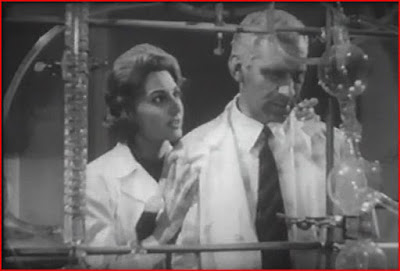
Wendigo is happy to say without reservation that Seddok is not a vampire movie. There's no way around the fact that it's a mad-scientist movie of a very old sort. It's the hoary legend of the scientist with a sickly wife or child whose treatment depends on extracting some substance from living persons (e.g. spinal fluid, glands) in a way that kills them. In America it goes back at least as far as Boris Karloff in The Ape, and it was Bela Lugosi's stock in trade at Monogram. Wendigo has seen a version of the motif as recently as an episode of Supernatural. In many cases the scientist disguises himself as a monster in order to cover his trail. In Seddok, the mad Professor Levin (Alberto Lupo) takes this idea to atom-age extremes by mutating himself into a lumpy, hoodie-wearing stalker by injecting himself with Derma-25, a failed predecessor to Derma-28, the miracle compound (derived from glands) with which he hopes to cure disfigured nightclub dancer and car-accident victim Jeanette (Susanne Loret). So he's a monster, though naming him heir to Satan is still a stretch. But he hardly counts as a vampire if he's extracting a vital fluid for someone else's benefit. In fact, the whole "atom age vampire" gimmick is imposed on the picture in the English dub when an inspector speculates that a disgruntled Japanese radiation victim may be doing the killings -- "like a vampire of the atomic age," no less -- despite the prevailing theory that an escaped gorilla's doing it. This professor is a sharp character. He tells Levin at one point that he knows him "intimately," having read his writings and watched his TV interviews. But when the doctor offhandedly mentions his research, our top cop asks, "Which research, exactly?"

Dr. Levin ignores the love of his dedicated assistant (above), only to find himself reduced to picking up random streetwalkers while hopelessly pretending to be a hip youngster in his fashionable threads (below).

While Wendigo recognizes the obvious U.S. Poverty Row influences on Seddok (there's even those beloved mainstays, the mute servant and the nosy reporter), I saw that it was also a cheap knockoff on what was arguably the most influential European horror film of its time, Georges Franju's Eyes Without a Face -- another tale of a doctor mad to cure a girl's disfigurement. And for all I know, the invocation of Satan in the title is a nearly-instant ripoff of the other most influential Euro horror of the era, Mario Bava's The Mask of Satan -- better known in the U.S. as Black Sunday. Director Anton Giulio Majano and his writers try to stake out their own sci-fi territory with Marvel Comics level buncombe about the mutagenic power of radiation. Their brilliant notion is that, since radiation disfigures people, it could be used to redisfigure or undisfigure already deformed people like our poor Jeanette. In the world of Seddok this works, since radiation is an antidote to Derma-25, as is the sadly limited and temporarily efficacious Derma-28. But I'm not clear on the limitations of Derma-28. Dr. Levin's attractive female assistant Monique shoots herself up with 25 in order to goad him into testing 28 on her arm. It works, and as far as we know it works permanently on Monique, but when he uses it on Jeanette's face the cure quickly wears off, requiring him to exhaust his supply of synthesized 28 and resort to lethal gland extraction. We're assuming that Monique's arm never turns nasty again, and that she'd never turn into a monster, but since Levin kills her for her glands (and for being clingy, needy and jealous) it's probably a moot point.

After a mutating Derma-25 treatment, be sure to clean yourself off with some good, steamy radiation. Be sure to open the container and release the radiation into the atmosphere when you're done.


We may seem to be describing some mad science and weird goings on, but you have to have a deep love of low-budget, brutally-edited, badly-dubbed, black-and-white, pre-sexploitation Euro horror to endure even the shortest edition of Atom Age Vampire. Even in its original form, Wendigo suspects that the project was uninspired on any level. Its completely derivative nature could be forgiven if the filmmakers or performers showed any panache, but neither the original creators nor the English dub scripters and actors show any imagination. It looks more like a cheap TV show of the time than a film -- and that's probably how most Americans first saw it. It didn't surprise us to learn that Majano mostly worked in TV afterward. It fails on even the simplest level: as the beautiful, doctor-maddening dancer Jeanette, Susanne Loret isn't even more attractive than Franca Parisi as Monique the jealous assistant. Wendigo could not take his mind off the star's beak-like nose, and he could not stand her dubbed whining and griping.

Wendigo might think differently if he ever encounters the unedited Seddok, but Atom Age Vampire didn't even work as camp for him. He likes a good bad movie as much as anyone, but such a film has to be trying to do something, while this film only seemed to be trying to make a buck.

The trailer for Atom Age Vampire is far more entertaining in classic exploitation fashion. This copy was uploaded to YouTube by CrowTRobot1313: