Monday, July 19, 2010

Wendigo Meets CONDEMNED TO LIVE (1935)

Frank N. Strayer's poverty-row chiller for Invincible Pictures is arguably the second American film to feature a "real" vampire, after Todd Browning's Dracula (1931), but that depends on how we define a real vampire. My friend Wendigo points out that the film's antihero, Professor Kristan (Ralph Morgan) is not a supernatural vampire; his curse comes from the bite of a vampire bat suffered by his mother while exploring in Africa. Looking at it in biological or psychological terms, it's a trickier call. The taint the professor inherits from his mom doesn't kick in until he's past forty, brought on, a friend suggests, by exhaustion from overwork. Once it kicks in, he becomes an unconscious serial killer, his Jekyll-like (or werewolf-like, without the hair, fangs, etc.) transformation triggered by complete darkness. But why does he kill? Why would he? Why would the friend, his foster father, believe that Kristan's mother being bitten would make her son a monster? How do you make that leap? Did the mother start biting folks before she died? Beats us. The utter idiocy of the film's explanation for Kristan's strange behavior forces Wendigo to speculate about more plausible motives for the man's killing spree.

Mama Kristan struggles dramatically with a prop bat in the prologue to Condemned to Live.

The "good" Professor Kristan is the idol of his little town (the town itself is played by the familiar village set from Universal Studios). He's betrothed to Marguerite, a dim but lovely young woman by arrangement with the girl's father, though the girl herself, meaning no harm, is clearly crushing on David, the village dandy and heroic skeptic. Wendigo believes that the Professor subconsciously recognizes that the girl, despite her virtuous determination to marry him, really loves David. His transformations and attacks targeting young women, Wendigo argues, are really Kristan's subconscious lashing out at substitutes for Marguerite. He doesn't turn victims into vampire brides, but his attacks are very Dracula-like, the "fiend" looming over sleeping women in their beds as Strayer's camera dollies in for a close up on Kristan's distorted features and contorted, claw-like hand before he descends to ravish and claim his victim. Kristan doesn't seem to need blood to survive (throwing his vampire status into question), but he's clearly driven by some need that he doesn't recognize himself in his conscious state. Wendigo sees it as the need to control or own victims that we now attribute to modern serial killers, which would make Condemned to Live prescient if we aren't just reading modern assumptions into an old film. But since the fiend of the film behaves more like a serial killer than a vampire, you have to wonder.

Professor Kristan (Ralph Morgan, flanked by Mischa Auer as Zan the hunchback) shows the public one face, but saves another for private chambers after dark.


Condemned to Live comes from a moment when Hollywood still seemed confused about what a vampire was. You can see this confusion in the way our otherwise-stereotypical villagers behave. Confronted with a series of murders in which the victims had their throats bitten, these folks don't for a moment speculate that the culprit is a vampire in the Dracula sense; an undead dude who kills for blood. Instead, the local consensus is that the women have been killed by a vampire bat -- one big enough to carry the women off to a cave. It's David, the skeptic, who rejects the fantastical notion of a giant bat and suggests a human fiend as the culprit. Even then, no one believes in a human vampire or any sort of evil spirit. Is it unlikely that this town somewhere in 19th century Europe would have no notion of a folkloric vampire? Wendigo says it depends on where the village is. The film itself claims to take place in "another land" (as opposed to the African cave of the prologue), so it's hard to say how likely it'd be for them to believe in vampires. Also, folklore is quite flexible about what a vampire was or did, though folk ideas usually focused on a malevolent corpse that either rises to stalk the living or projects its spirit to torment them in some way. If Condemned to Live takes place in eastern Europe, someone would probably suspect a vampire. If it's somewhere further west, that'd be less likely. Regardless of the location, because this is a movie, the villagers' failure to cry vampire is a surprise. On the other hand, they're ready to kill David for "blasphemy" for questioning Kristan's integrity near the end of the film. Their real superstition is their unquestioning reverence for a man who comes to realize that he doesn't deserve it.

The big suspense moment in Condemned to Live comes when Marguerite gradually blows out all the candles in her living room to soothe Kristan's tired eyes, not realizing (despite his warnings) that darkness triggers his fiendish transformation. I can imagine 1935 audiences yelling out how stupid she was, but I also like to think people were more polite back then.

As a movie, this is nearly a one-man show for Ralph Morgan, who's handed a big challenge in having to play someone sometimes saintly (and later deeply repentant), and sometimes a mute fiend. Wendigo feels that Morgan managed to pull it off without getting insufferable in good-guy mode. He does the fiend bit without makeup, simply scowling and scrunching his hand, but it's still effective. Morgan's definitely the best actor in this group, which includes Mischa Auer as a mediocre hunchback and a helpless Maxine Doyle in the hopeless role of Marguerite. All the actors grapple with often-leaden dialogue, flattering least of all to poor Maxine Doyle. The film looks good, from what we could tell from the grungy Mill Creek DVD. It was always a good investment to rent those Universal sets, which give this film some much-needed class. Overall, Wendigo found it to be a decent little B-movie, acknowledging the limitations of mid-Thirties poverty-row filmmaking. It's also an intriguing milestone in the evolution of American vampire cinema.

Sunday, July 18, 2010

On the Big Screen: INCEPTION (2010)

Here's a James Bond film for the age of "millennial unreality," a quality only enhanced for Christopher Nolan's new picture by its appearance in the same year as Martin Scorsese's Shutter Island, another film featuring a fraught, partially repressed relationship between a character played by Leonardo DiCaprio and his wife and kids. Inception has it both ways, sending its characters around the real world and to still more exotic locales in their dreamscapes. It can't quite have it both ways, however, when Nolan must choose between making a dream film and a thriller. This is one movie that can't be accused of resorting to "dream logic." Its dreams are quite undreamlike in many ways because they must conform to the requirements of the thriller genre. Thrillers operate by strict rules that add up to a logic of their own: time limits, specific physical problems to solve, and so forth. For Inception to work, we have to accept that dreams work the way Christopher Nolan says they do, and you could argue that the artificial dreams imposed on "extraction" targets by DiCaprio's crew could well work exactly that way. As a thriller, the film works fairly well, though the crosscutting between several simultaneous dream states grows absurd eventually. The constant cutting back to a van's protracted plunge into a river is begging to be parodied, and it left me wondering why Nolan never felt it necessary to include in the crosscutting an occasional check on the actual people dozing away on their trans-Pacific flight. The crosscutting is dazzling at first but once the pattern was set the mind tends to wander a little.

There are plenty of powerful, massive images in Inception, as you'd expect. Nolan's visual imagination is weighed down less by his generic commitment to the thriller than by two cliched character conceptions. One is our old nemesis, the Audience Identification Character who is introduced into a fantastic environment so that everything can be explained to her, and us. In Inception this is the insufferable, meaningfully-named Ariadne (Ellen Page), and this is the sort of film in which no one's ever going to call her Ari. She's our AIC for expository purposes only, because otherwise she's a genius (which is why she's recruited in the first place) and also insufferably wise. She manages to suss out all the secrets DiCaprio's Cobb is keeping, and ends up lecturing him constantly on the right choices he needs to make. The other cliche is Cobb himself with all his guilty secrets. He starts out separated from his children and exiled from America, and we're given strictly rationed bits of explanation for these facts, and for why his wife (Marion Cotillard) constantly intrudes on his invented or shared dreams to sabotage his work. Cobb's personal issues overshadow the dream-espionage plot to the point that the latter becomes a Macguffin, a problem exacerbated by Nolan's teasing revelation of the rules of extraction and inception. A situation we'd been shown was no problem before (what happens when you die in a dream) suddenly becomes a big one when another element is added, but we don't know that when the element is added, only when the problem arises. You can have suspense either way, but the option Nolan chooses feels cheaper somehow.

For some viewers, the inception-plot will matter less than the question of what was "real" and what was dream. Some people will leave wondering whether the ending is real or dream. That'll be the fun of it for them, but I found myself not really caring. I don't say this to knock Inception; while a bit overlong it still worked as a thriller for the most part. But as far as I'm concerned Nolan's new film is not an advance on The Prestige or The Dark Knight. It felt cliched in ways those films weren't, and the Batman film in particular had a real tragic power missing amidst the new film's sturm und drang. Inception is a fun film with many amazing visuals that are almost worth the admission price in their own right, but Nolan is a talented enough director to have done better already.

Friday, July 16, 2010

Is this the age of "Post-Camp Cult Film?"

"What does it say about contemporary American culture that the Rocky Horror Picture Show of our time is not a winning exercise in leering camp and butt-shaking grooviness but an earnest melodrama distinguished by what it is unable to provide? Why are so many people responding to a megalomaniacal feat of formal incompetence?"

Tom Bissell claims to have seen Tommy Wiseau's The Room twenty times by the time he wrote "Cinema Crudite: The mysterious appeal of the post-camp cult film" for the new issue of Harper's. The Room is the only example of this new phenomenon that Bissell describes, and his article consists mostly of a film synopsis interwoven with an account of a midnight showing, complete with plastic spoons supplied by the management for throwing at the screen, followed by a torturous interview with the inscrutable Wiseau. Bissell doesn't attempt to define the label he's invented, but you might infer from the excerpt above that "post-camp" means a departure from the self-evidently absurd subject matter that defined "camp" for about fifty years. What makes The Room an object of cultic fascination, Bissell believes, is Wiseau's dysfunctional realism, his unintentionally absurd interpretation of mundane subject matter.

"He tried to make a conventional film and wound up with something so inexplicable and casually surreal that no practicing surrealist could ever convincingly ape its form," Bissell writes, "It is the movie that an alien who has never seen a movie might make after having had movies thoroughly explained to him....What makes [Wiseau] interesting is the degree to which his art becomes a fun-house-mirror version, an inadvertent expose, of a traditional film."

Like many a bad film that's become a cult item, The Room inspires something more than contempt or revulsion in those viewers who become converts and proselytizers. I still haven't seen the thing, so I have to take Bissell's word on what leaves him, at least, "strangely exhilarated."
In an entertainment culture in which everything from quiet domestic dramas to battling robot fantasias is target-audienced with laserlike precision, The Room is as bereft of familiar taxonomy as a bat from Mars. In an entertainment culture in which bad and good movies alike have learned how to wink knowingly at their audiences, The Room is rivetingly unaware of itself or its effect. In an entertainment culture in which 'independent filmmaking' is more a calculated stance than an accurate accounting of means, The Room is a film of glorious, horrifying independence.

As his subsequent attention to Tommy Wiseau shows, what Bissell's trying to say here is that The Room is an incorrigibly idiosyncratic individual vision that Wiseau will not or cannot conform to cinematic narrative conventions. Bissell ponders rhetorically whether people watch the film for "the satisfaction of seeing the auteur myth cruelly exploded, of watching an artist reach for the stars and wind up with his hand around a urinal cake." The truth is more likely that people have made a cult of The Room because there they see the auteur theory confirmed.

It's possible that "post-camp cult film" is not so new if, as I suspect, it's really a mirror image of art-house auteurist cultism. Camp itself was defined by the absurdity of its subject matter or by a certain accidental performance style. The camp quality of a film wasn't necessarily identified as a director's unique contribution in the old days. Some of the early camp discoveries like Reefer Madness or the 1943 Batman serial weren't regarded as auteurist works. A change arguably began with the discovery of Ed Wood, though the change was masked by Wood's proclivity for subject matter similar to the stuff of conventional camp. The Wood cult, however, insisted that the compelling consistent badness of Wood's films was a matter of authorial style, of Wood's peculiar way of seeing and describing things. Since then, cult hunters have been on the lookout for cult directors as much as cult films; some may assume you can't have the latter without the former.

While Tommy Wiseau makes important on-screen contributions to the eccentricity of The Room, Bissell is most fascinated by Wiseau's fanatic struggle at great expense (compared to the impoverishment that so often defines cult film) to realize his unorthodox vision. Wiseau is not just a man with funny hair and a strange accent, but an auteur. Bissell suggests that the almost-invisible drama of Wiseau's authorship is part of his film's appeal.
We are all of us deeply alarmed by the Wiseauian part of ourselves, the parts that are selfish and controlling, that crave attention at any cost, that imagine ourselves as superlatively gifted ... To watch The Room is to see that part of ourselves turned mesmerizingly loose.


Reading Bissell's article strangely reminded me of something I read in one of the tribute pieces the New York newspapers ran this week following George Steinbrenner's death. Mike Lupica described the excitement of going to Yankee Stadium when Steinbrenner was at the peak of his rampaging controlling mania. The Stadium was the one place in sports, Lupica wrote, where you could feel like you were watching the owner own the team even if the man himself was nowhere to be seen by mere fans. You could argue that, as the owner, and one who changed managers and players with manic frequency, Steinbrenner was the auteur of the Yankees for nearly forty years. That made every Yankee game a double drama, a contest in its own right and a chapter in the Steinbrenner saga. The cartoonist Bill Gallo even transformed Steinbrenner into a uniformed German martinet, "General von Steingrabber," in a distinct echo of the old archetype of the tyrannical movie director. Movie cultists may respond to auteurist films, good or bad, in something like the way Yankee fans followed the fortunes of Steinbrenner, condemning his meddling or identifying with his power fantasies. Just as his drama came to the forefront when the Yankees did badly, so films that fail as conventional seamless narratives, in exposing the nuts and bolts of cinema that are usually hidden neatly away, heighten our awareness of an authorial presence that's all the more insistent and fascinating, for many people, for its inelegance of expression.

The auteur, in most cases, is the gorilla who's not in the room. The thought of him may be too terrible to contemplate, but as Carl Denham says, you can't look away. That compulsion to see what the gorilla's left in his wake is part of the stuff that cults are made of.

Thursday, July 15, 2010

TERRIBLY HAPPY (Frygtelig Lykkelig, 2008)

Henrik Ruben Genz's film took home most of the major Danish film awards for its year of release, and was Denmark's official entry for the Academy Awards. The box cover for the Oscilloscope Laboratories DVD touts the film as a neo-noir with something of the spirit of David Lynch and the Coen Brothers in it. It's really neither as out there as a Lynch film nor as stylish as a Coens film, but you can see how Ganz may have been influenced by them in adapting Erling Jepsen's novel.

Robert (Jakob Cedergren) is a cop who's been reassigned to a small backwater town for reasons only gradually revealed. Your typical big-city Dane looks down on places like this, apparently, where the people have their own peculiar salutation -- "Mojn," which can stand for hello or goodbye. It's one of those burgs where everybody knows everybody and they prefer to take care of things themselves instead of calling in the cops from the nearest city. They'd rather have Robert slap a little shoplifter around than have him file a report, and their preferred last resort is to put things in the town bog. There's a legend about this place that we hear as the film starts. A cow sunk in the bog once, then came back mutated. The townsfolk blamed it for mad cow disease and the infertility of local women. They killed it, put it back in the bog, and the problems went away. If they're talking about mad cow disease, that's a recent legend, and just the sort you know you have to bear in mind as the picture progresses.

Above, the bog. Below, the town.

It doesn't take long for Robert, after he flushes his meds down the toilet, to get embroiled in the local drama. Ingeliede (Lene Maria Christensen), the wife of Jorgen the town bully (Kim Bodna), keeps throwing herself at Robert, asking for protection from her husband one moment after he beats her, the next going home peacefully with him. Ingeliede is playing with fire, since Robert was exiled to this place in part because he pulled a gun on his own wife and threatened to kill her. He resists temptation for a while, but he gives in in her bedroom, with Jorgen dozing drunkenly in the hallway after another beating. When he hears Jorgen stir, Ingeliede screams and Robert panics. Before long there's a body to deal with, but the town "quack" tries to paper things over by calling the death an accident. The rest of the people in town don't buy it, but they blame the wrong person, whom Robert has to save from being forced into the bog, despite the person's own warning that "you're making a mistake." Robert probably should have listened....

Jakob Cedergren as Robert, the troubled "marshall" of a troubled town.

Maybe I was in the wrong mood when I watched Terribly Happy. I can't really fault the filmmaking or the acting, and the location work really sells the sparse, squishy desolation of that squalid town, but I also couldn't help feeling that this was an utterly generic film without any distinctive local character. The fact that Robert's job title is translated as "marshall," along with Jorgen's preference for cowboy hats and another character's John Deere cap only enhanced my feeling that this may as well have been an American movie, and that's not what I'm looking for when I see a foreign film on the library shelf. All the mumbo-jumbo about the bog and the quirky bits like the little girl pushing her cart late at night and the cat that says "Mojn" left me feeling that Ganz's movie really took place in "movie land" rather than Denmark or America. That may just mean that the writing, the direction and the acting weren't strong enough to make this feel like a new experience the way any number of equally derivative but more compelling movies manage to feel. Someone else who watches this may think differently, however, so I neither recommend it nor condemn it. I can't say I was terribly happy with it, but it wasn't terrible, either.

Tuesday, July 13, 2010

Wendigo Meets COUNT YORGA, VAMPIRE (1970)

Count Yorga is the first modern vampire I can remember watching on TV as a kid, the first one who didn't come across as a complete throwback to some gothic fantasy Europe. Something has always impressed me about Robert Quarry's smooth voice and manner and the way his vampires integrated themselves with relative ease among then-modern people, whether the bourgeois dolts of Bob Kelljan's film (which calls itself The Loves of Count Iorga...Vampire onscreen) or the hippies of The Deathmaster. Though Yorga is supposed to be Bulgarian, he came across to me as the nearest thing to an American vampire that I'd seen to date. Seeing the film now, Yorga impresses me even more as a swinging vampire of his era, a Hefneresque fiend in a fiery red smoking jacket -- though when shot from the right angle and in the right light, he now makes me think a little of Jude Law gone to seed.


Those eyes. Those hands. Robert Quarry is Count Yorga, Vampire.

My friend Wendigo first saw Yorga on TV, too -- we're both too young to have seen him in the theaters. He liked Yorga in part for his resemblances to Christopher Lee -- he was a vampire in color, with fangs, -- and like me, he dug seeing a vampire in a modern setting. What really intrigued him was Yorga's little harem of vampire brides. Wendigo hadn't seen a zombie movie yet, but Yorga's brides were the nearest things to zombies he'd seen -- not for any putrescent cannibalism but for the stiff robotic mindlessness with which they moved and attacked. As for Yorga, Wendigo recalls that he was the first vampire he'd seen that he knew wasn't Dracula.

Today, Wendigo recognizes Yorga (and Quarry with him) as a groundbreaking movie vampire. Yorga updates the Dracula concept of the master vampire into modern times, unlike the lone vagrant vampire he'd seen in The Night Stalker around the same time. Nearly forty years on, Wendigo is most impressed by Yorga's utter coldness (a counterpoint to the cool I perceive in him), the way he casually sacrifices one of his brides to save himself by throwing her on the point of a vampire-hunter's sharpened bit of broken furniture -- or is that a broom handle?


As for the film Count Yorga, Vampire, Wendigo always saw an element of black humor alongside its viciousness, an attitude more typical of slasher films that view its mundane characters as so much fodder for the villain. There's a bigger body count here than in many earlier vampire films (though the brides and Yorga's cretinous rapist lackey Brudah must share credit for some kills). The heroes come across as basically or ultimately ineffectual, despite the usual scenes of learning vampire lore. They seem uncomfortable with the requirements of vampire hunting ("This is the atomic age and we have to use sticks!" one complains). As late as 1970, a group of people could still be sweepingly ignorant of vampire lore in a way that seems implausible in our genre-saturated modern day. Their cluelessness may be best illustrated in one of the movie's most unintentionally infamous scenes, when they confont Yorga at his mansion and try to talk him into betraying himself. That is, they want to keep him up all night chatting inanely about the supernatural on the premise that his desire to go to bed proves that he's a vampire. By this logic, any of us who might hustle these people out the door around 4:30 a.m. should expect to be staked the next day. You'd think that these people might try something like Van Helsing's mirror trick to force Yorga's hand, but from a movie perspective, I suppose, that wouldn't be original, no matter how practical it'd be.

Nowadays Wendigo notices Kelljan's limited budget and skills more than he did in the past. We know the story of how Loves of Count Iorga was originally conceived as a porno film, and you can still see how some scenes come to the brink of sex but stop for the sake of a rating. When Yorga's brides wake up and stiffly embrace each other while the master watches intently, you can deduce that some Hot Lesbian Action was once forthcoming, but given how Kelljan directs the brides, you don't regret the omission. One detail that reminded Wendigo strongly of porn was actually the way Kelljan filmed dialogue scenes in long shots, shot so far from the actors that we can't see their mouths move, with the actual dialogue in voiceover because the director didn't or couldn't film live sound. That was a typical narrative shortcut in porn back when porn had narratives.

Edward Walsh as Brudah, more in the Andreas tradition (see Return of the Vampire) than the Renfield line, only without Andreas's conscience.

Speaking of shortcuts, Yorga skips much of the usual establishing business of vampire films. We see a coffin arrive on a Bulgarian freighter, and we see Brudah throw it on a pickup and drive down the highway, but the next thing you know there's this guy conducting a seance with a bunch of whomevers (including some people we don't see after this scene), seeking the spirit of a woman who recently died (and he knows how). Only eventually do we learn that this is Count Yorga, but Quarry instantly commands the screen in a way that leaves the man's identity beyond doubt. This is a pretty simple story, so shortcuts make sense.

"Vampires? You mean, like?..." Vampire hunting in Count Yorga is a bit of a charade.

A more common sin of all cheap cinema committed here is the artless use of day-for-night shots. A van is stuck on Yorga's property overnight. From inside the van, we can see light blazing through the shaded windows; but it's pitch black outside, but a blazing light illuminates the side of the van. Despite these deficiencies, there are some good scare or shock moments, especially when the vampires attack with an in-your-face ferocity not often scene before, and particularly when Yorga, whom we thought in full flight moments earlier, comes out of nowhere to tackle our remaining hero as he steps into a hallway. On top of that, since this was the Seventies, we have a decade-standard unhappy ending for just about everyone involved, people and vampires alike.

Count Yorga, Vampire didn't make it onto Wendigo's top-ten vampire-film list from last year, but he'd definitely place it in a top 20 or top 25. He actually likes The Return of Count Yorga better, but he'll have more opportunity to explain that in a week or so. Both are seminal Seventies horror films that make the most of limited means to create a memorable experience we find ourselves frequently willing to relive.

This copy of the trailer was served up to YouTube by TrailerFood.

Sunday, July 11, 2010

EMERGENCY SQUAD (Squadra Volante, 1974)

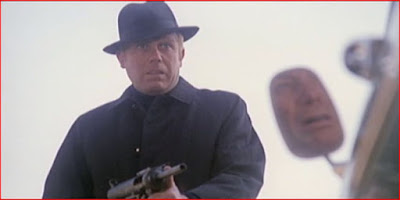
Stelvio Massi's film must have set the template for star Tomas Milian's later series of "Squadra" films starting with The Cop in Blue Jeans in which he plays a tough, sardonic slob of a lawman. This one has more of a sting to it, a more ambiguous conclusion than many of Italy's more manichean cop films. It's a showdown between Milian's widower Inspector Ravelli and Gastone Moschin's robbery gang leader, "the Marsigliese." Ravelli's investigation of a bloody robbery, perpetrated by the gang disguised as a movie crew, becomes personal when he learns that one of the victims was most likely killed by the same gun that killed his wife, an innocent bystander mowed down during the Marsigliese's escape from an earlier heist.


As Ravelli, Tomas Milian has an easy time envisioning an event he never witnessed; his wife's death by accidental drive-by.

As Ravelli gradually closes in, the gang starts to fall apart, and Marsigliese intends to keep all the loot for himself and split with his Marilyn Monroe-obsessed girlfriend Rita (Stefania Casini burdened with a dubbed dumb-blond voice). Ravelli nearly nabs them in a helicopter-vs-car chase, but Marsigliese outwits them inside a tunnel, abandoning his vehicle (and one of the gang) and carjacking another going the other way. That sets up a Desperate Hours style hostage situation while the cops await a fresh lead, before Marsigliese lights out on his own. But before he can run off with Rita he has to deal with another rival criminal, and by the time they're done with that, Ravelli and a small army of cops have them tracked on the dock.


This is where Squadra Volante takes its own peculiar stand. Seeing himself hopelessly outnumbered, Marsigliese throws down his weapon and surrenders. Then Ravelli appears with damning evidence against him, only to announce, "I'm not a cop anymore." At this point, I wondered how Massi and his three co-writers wanted their audience to feel. Ravelli wants revenge; is he entitled? Marsigliese has been a betraying scumbag for most of the picture, but he's shown resourcefulness rescuing Rita, and she's shown bravery and loyalty to her man. Ravelli proposes to kill Marsigliese in cold blood in front of a loved one. If he'd had a chance to take his man down in battle, in the kind of climax more typical of Italian cop films, there'd be no ambiguity about the justice of his revenge. Confronting an unarmed man is a different story -- to me, at least. To spoil the ending, Ravelli opens fire, every shot intercut with flashbacks of his wife's death. To him, presumably, this equalizes things. But as we leave Rita weeping over the Marsigliese's corpse, should we feel that Ravelli did the right thing? Did Italian audiences think so? How about cop-film fans elsewhere? All I know is that The Cop in Blue Jeans, a do-over of the Ravelli character template, makes things much simpler for viewers.

Emergency Squad is a dynamic, efficient story dominated by its two male leads. The revenge angle makes Milian a more interesting cop than he'd play later, and Moschin brings some of the same power he brought to Milano Calibro 9 to a less sympathetic role. As always, the music of an Italian genre film is of interest. The culprit this time is Stelvio Cipriani, and he contributes a jauntily melancholic main theme, adding rock elements to it as the story builds momentum. It gives the movie an incongruously romantic, sentimental quality. That happens often with Italian films, but it works particularly well here because it creates the sense that Ravelli approaches revenge as if it's the consummation of a longterm passion.

You'd be unhappy, too, if Gastone Moschin pulled your car over.

The screencaps come off an English-only copy that's part of Pop Flix's Big Guns Collection. For a cheapo public-domain (?) edition it looks pretty good. The Italian trailer comes from YouTube, uploaded by trailersdaculto, and features toplessness, sacrilege and hippies.

Friday, July 9, 2010

THE WOLFMAN (2010)

It's one thing to make a film about a werewolf. It's another thing if you claim to base it on a screenplay by Curt Siodmak and open the film with the famous verse, "Even a man who is pure in heart and says his prayers by night..." Even if you mess with the spacing, presumably to pre-empt the instant rip-off artists out there, I presume that you're making a film about Larry Talbot. You can dandify him a little, make him an actor instead of an engineer and insist that everyone call him "Laurence," but I have a right to expect that this is basically the same person Lon Chaney Jr. played in the 1940s. At the very least, Talbot should re-enact his distinctive character arc, or else why bother using the name? But what's distinctive about his story? The big deal about Larry Talbot was that he knew something was terribly wrong with him, that he had, in fact, become a monster, but could not make people understand that fact. They wouldn't listen, you see, because they could hardly even imagine a "wolf man," much less that a gypsy curse could make you one. This was 1941, after all. There's no place for superstition in our streamlined modern world. But maybe you don't want to set your remake back in the Forties. That's fine. A remake true to the spirit of the original could easily be set in the present day. In fact, it probably should be.

Well, guess what? Writers Andrew Kevin Walker and David Self and director Joe Johnston set their Universal-approved remake in 1891, and they planted poor Talbot in possibly the most superstitious community in the entire United Kingdom, one more credulous, quite probably, than any actual place of the period. These villagers pretty much assume that Talbot will be a werewolf before he even grows a hair out of line. He has no problem convincing them of his trouble. His challenge is to keep from getting lynched. But our masterminds do bow in the direction of the original film's prevalent incredulity by relegating a captive Talbot to the custody of London scientists who appear to have ignored all reports from the field on Laurence's exploits. They refuse to believe he can become a monster, but they torture him anyway to dissuade him of his delusion. It's as if, between the scientists' stupidity and their viciousness, the filmmakers want us to root for the Wolfman to massacre them. That gets us about as far as Forties Universal as we can get, and it's really just about as far from Victorian England.

But let's go back to our old friend Larry. The main reason he can't get people to believe that he's a Wolf Man is that no one sees him as one until it's too late for them to report what they've seen. In part, that's the Wolf Man's fault. From what we can tell, Larry would get itchy, take off his shoes, and then the Wolf Man would go out, find some lone person in a dark, isolated location, rip the person's throat out by grabbing their shoulders and shaking them vigorously, and then go home. Afterward, Larry could claim to have killed someone, and folks would scoff. They might concede that Larry's a little loony, but they won't do anything to stop him from what they don't think he's doing. That's the horror and tragedy of his situation: he can't stop himself and he can't get anyone else to stop him.

In the remake, the Wolfman prefers to attack in crowded areas and doesn't seem to tire easily of disemboweling, amputating, decapitating and so forth. Since he is still not the most efficient killing machine, he invariably leaves dozens of witnesses who can attest to the existence, at the least, of a murderous lunatic, and more likely, depending on the location, of the devil himself in action. So again, Talbot has to be transported far away before he can find people who wouldn't believe him. All of this seems to miss the point of the original Talbot story, and if you want to argue that that point isn't relevant, then why do you want to have a character called L. Talbot in your movie?

The remake misses just about every point possible. It tries to make points of its own -- and misses those, too. It wants to be about fathers and sons in a more antagonistic way than the original, and it also wants to indulge in silly homages to King Kong when the Wolfman runs amok in London. Nowhere in the two hours of the director's cut can the naive sincerity of George Waggner's original film be found. Lon Chaney Jr. may have had his limits as an actor, but you couldn't accuse him of phoning in his performance as Larry Talbot. You can't do that with Benicio Del Toro, either; it'd be more accurate to say he tweets it in. There's definitely a character limit to his work. The man is playing a 19th century actor; you'd think he might project a little? Instead, he seems to be taking lessons in alienation from Sir Anthony Hopkins, who manages to make no human contact with anyone else in the picture. Maybe that's just the character he plays, you might suggest, but I've seen him do this before. He's doing "Anthony Hopkins" the way Samuel L. Jackson does "Samuel L. Jackson" so often. Enough gruff bluff and he's earned his money, and somehow people keep paying him to keep doing it. There are other actors in the film, but there's no point in reproaching them. They're just as much victims as we the viewers are, I suspect.

How badly did the remake fail? I watched it with my friend Wendigo, who is as much a werewolf fan as he is a vampire fan. The Wolf Man, Larry Talbot is his favorite movie monster. There came a point in this film, after Hopkins had clarified some plot points, made a Shakespearean allusion and winked at Del Toro, when he almost asked me to turn the film off. When you consider what he's sat through for our weekly vampire screenings, that's pretty damning.

The experience left me wondering whether the essence of Larry Talbot could be recreated today. You could argue that Larry's increasingly desperate effort to learn how to die made him an appropriate antihero for male audiences during World War II, but I might save that argument for another time. For now, I'll leave you to ponder whether such a struggle could have the same impact, consciously or subconsciously, acknowledged or not, that I presume it had back then. Maybe the remakers had to take a different approach. I just wish they'd taken a different different one.