Tuesday, December 31, 2013

A Cockeyed Nightmare of Fun: NOW PLAYING, Dec. 31, 1933

This year saved some of its biggest, or at least best-remembered films for last. To give you an idea of the big picture, here's the movie page of the Milwaukee Sentinel from Dec. 29:


Let's take a closer look at some of these.


Duck Soup is most likely the most beloved today of these films, and maybe the runner-up to King Kong in the posterity popularity contest. In legend Leo McCarey's picture was a flop and left the Marxes without a studio home until Irving Thalberg saved them at the cost of their edge. While it's not the biggest attraction for New Year's audiences in Milwaukee, at least if you measure by column inches, it's clearly a big one.


If the Christmas attractions were mainly single-star vehicles, for New Years Milwaukee's theaters went for the opposite approach, as exemplified by George Cukor's all-star comedy for M-G-M. Moderns might wonder at Marie Dressler's top billing but the old lady probably was the most popular star of those cast here. One might notice a slowing of Lee Tracy's momentum from earlier in the year, when we saw him top-billed in several comedies, since he only makes the second tier of stars here. His misadventures while filming Viva Villa! in Mexico marked a turning point that soon reduced the gabby actor to B stardom at best and character roles in later life.


RKO was still looking for an answer to Warner Bros.' new style of musical pictures, and this was their latest experiment. The emphasis is on spectacle on a nearly cartoonish scale, the money shot being the "bevy of singing, dancing beauties atop an armada of airplanes!" But the studio had some not-so-secret weapons with more staying power. Note how the ad tries to sell the Carioca as a new dance craze, without really identifying it with the couple who introduce it in the picture. There was some flexibility about the billing, as you can tell by comparing the ad above with the ad on the left. Dolores Del Rio is consistently the top banana, but the order rotates underneath. Fred Astaire, whose first major film showcase this is, bounces between second billing and fifth, in one instance ahead of his dance partner, the already-established film star (and veteran of the Warners spectacles) Ginger Rogers, in another beneath her. In retrospect, the way RKO learned to use Rogers, compared to how Warners did, is as significant as how they used Astaire. Rogers's best-known moment in a Warners musical is her rendition of "We're In the Money" in Gold Diggers of 1933, but her singing is inevitably overshadowed by the Busby Berkeley spectacle surrounding her. By emphasizing her virtuosity as a dancer as well as a singer, RKO made her, with Astaire, the spectacle itself. By focusing on virtuosity rather than the spectacle of sheer numbers, the studio found the answer to Berkely and Warners after several false starts. RKO's earlier comic musicals are so cartoonish at points that they border on the inhuman; they do little to endear themselves to posterity, unless you're a connoisseur of Pre-Code strangeness like me. With Astaire and Rogers, RKO would usher in the classical period of the Hollywood musical.

Here's a single-star vehicle opening at the Strand. In fact, they sell it like the star's biography.


It's a pretty funny picture in its grandly amoral way. I ought to give it a fresh look and write it up for the Pre-Code Parade sometime.

Finally, such a survey as ours would not be complete without the novelty of finding a film that no one remembers.
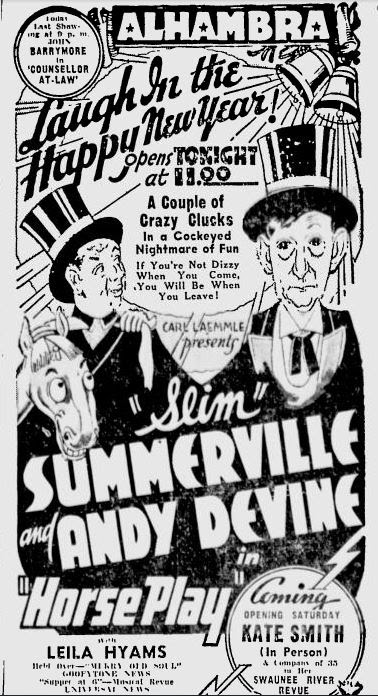

1933 was a pretty good year for Slim Summerville. He was part of a popular team with ZaSu Pitts and Horse Play may have been an attempt to launch a second franchise with Summerville and (god help us) Andy Devine. Whatever this is, it's clearly in competition with Duck Soup; you wouldn't advertise a movie as "a cockeyed nightmare of fun" otherwise. And admit it: if you heard about a cockeyed nightmare of fun happening somewhere, wouldn't you be interested? Strange to say, Slim himself doesn't look too interested in the ad. Maybe he knows something we don't, since for the time being Horse Play must remain a mystery to us. The past should always be a little mysterious, I suppose; it keeps us interested and leads to us learning things. I hope that people learned something or were at least entertained slightly by this series over the past year. I may pick another year and another city as a project for 2014, but I haven't decided yet. I'll make a resolution to make my mind up, and in the meantime I wish you all a Happy New Year -- or to be more modest, a Happy New Year's Day.

Sunday, December 29, 2013

On the Big Screen: AMERICAN HUSTLE (2013)

For some people, this will be the film where Lois Lane and Katniss Everdeen are fighting over Batman, who's trying to save Hawkeye from the machinations of ... of ... the guy from Silver Linings Playbook. It sure helps a director when his stock company have more famous gigs elsewhere, even if it's to David O. Russell himself that Christian Bale and Jennifer Lawrence owe their Oscars. So how else do I describe Russell's new film? Oh, it's That 70s Movie! But how much of a Seventies movie is it when the lead couple's theme song is Duke Ellington's Jeep's Blues as performed Live at Newport in 1956, and the origin of Bale's protagonist is literally Chaplinesque? Jackie Coogan was doing that same thing, breaking windows to stir up trade for Chaplin's glazier business, back in 1921. In many ways, just about all of them good, American Hustle is more a movie movie than a Seventies period piece. I could just as well describe it as an epic Scorsesean farce, a film that may have out-Scorsesed Scorsese himself this Oscar season, with a touch of Capracorn thrown in. It's the funniest film I've seen this year, though I admit that I don't go out of my way to see comedies and I haven't seen the new Coen Bros. picture yet. The audience that braved a cold driving rain for the Sunday afternoon show at the local arthouse laughed throughout and applauded at the end. But there's something more than farce or even satire going on here that may make the picture good for more than a laugh.

While Amy Adams tarts herself up into a Seventies goddess of jiggle and plunging necklines, Bale becomes a sympathetic grotesque, first seen elaborately assembling his hairpiece and combover combo, who somehow sustains a conman's charisma, captivating not only Adams, a fellow grifter, but Lawrence, whom Adams make seem almost frumpy, as the Bale character's estranged yet still-covetous wife. Bale's character, Irving Rosenfeld, rose from those Chaplinesque beginnings to run a chain of laundromats, sell forged paintings, and swindle desperate people with bad credit, promising them $50,000 for $5,000 but never delivering and blaming the victim every time. He's a prosperous sleazebag in love, but the whole point of the childhood flashback is to illustrate that Irving has had to hustle to survive, in a milieu where just about everyone is conning everyone else. By comparison, FBI agent Richie DiMaso (Cooper) hustles out of ambition. He's not exactly well off, still living with a nagging mother,  but if Irving is only a player, Richie is a predator. If Irving and Sydney Prosser (Adams) are just out to fleece people for five grand apiece, Richie is out to destroy people's careers, if not their lives, to advance his own career. Having caught Iriving and Sydney (aka Lady Edith) in a sting, Richie treats them as rungs on his ladder, hoping to use them to entrap bigger fish.

American Hustle is based on the real-life Abscam case and manages to make the FBI, or at least Richie, the villain of the piece. Richie develops a scheme that will invite politicians to take bribes to facilitate the naturalization of a fake Arabian sheik, which will in turn facilitate the development of casinos in Atlantic City, New Jersey. For Richie, the politicians, ranging from local figures to U.S. Senators, are no more than targets. But as he assigns Irving to cultivate the mayor of Camden, Carmine Polito (Renner), Irving sees the good that Polito has tried to do on the street level and understands the compromises the mayor has had to make and may have to keep making. Irving decides that Polito shouldn't have to go down just to be another scalp on Richie's lance. He also happens to resent the moves Richie has made on Sydney, while Sydney resents Irving's failure to cut loose completely from Rosalyn, a loose cannon who gets to play the wife again during nights on the town with the Politos and eventually knows too much for anyone's good. Since we're talking casinos, why not throw the Mob into the mix, represented by another member of the Russell stock company, Robert de Niro. Why not throw in some more stuff? The key here isn't so much to make sure the audience keeps track of all the complications, though Russell and co-writer Eric Warren Singer do a good job of that, but to make them appreciate how dangerously complicated things have become and how easily any of the freaks we're following can bring the whole house of cards crashing down.

If there's a point to the Seventies setting, apart from it being the period of Abscam, it's not to mock the decade's music or fashions but to romanticize it as a period when things still seemed possible as long as people were willing to take chances and even get a little shady. Strange to say, here is a movie that is defensive toward politicians. Irving's uncomfortable about Richie's scheme from the first, thinking it wrong to discredit more politicians so soon after Watergate. That may be less an authentic character note than a protest from the screenwriters about a discrediting of politics itself that has only gotten worse since the time of their story. American Hustle can't bother itself to be outraged at politicians taking bribes because, in a curious echo of the ethics of last year's Lincoln, the film seems to see getting one's hands dirty as a sometimes-necessary price of doing the right thing for the most people. And while Richie is no counterpart in thoughts or attitudes to today's right-wingers, there may be something about the essential selfishness of his motives that would make him a substitute for such figures for today's audience.

I'm suggesting a more subtle reading of the picture than will be necessary for most people. You could laugh throughout American Hustle without necessarily having a deeper thought about the implications of the story. If Bradley Cooper plays the villain of the piece, his is one of the great comic villain performances of recent times. There's no moustache twirling but a lot of desperation, horniness and frustration, not just in his pursuit of Sydney but in his rivalry with a skeptical killjoy superior (Louis C.K.) that escalates to violence (it's a rare false note that we actually see the violence after Russell has gotten a laugh out of revealing its aftermath) and triumphant mockery before the fall. While Bale cuts a heroically ludicrous figure throughout, he's practically a straight man for his co-stars, and having to deal with the schemes and threats of Richie and the chaos Rosalyn carries with her keeps him sympathetic in our eyes. If anything, Lawrence gives too chaotic a performance, though that's the fault of writers who needed Rosalyn to do little but create mischief, whether by menacingly kissing Sydney in the ladies' room or by half-wittingly ratting out Richie as an "I.R.S." man to her new Mafia boyfriend. As a performer, though, Lawrence is hilarious and this film will certainly do nothing to slow her meteoric rise. Adams's acting may be overshadowed by the eye candy she provides throughout but she can hold her own with all her high-powered co-stars. Russell's direction often feels at once like a homage to and parody of Scorsese. He has the narration and the use of pop music nailed, but his distinctive touch may be seen when the tension created by scoring a scene where Irving's life is threatened by mobsters to the Live and Let Die theme is leavened by cutting to Rosalyn, who's actually listening and singing along with the record, doing a goofy dance while dusting her furniture. At other moments, as when Richie and Sydney appear as period fashion icons outside a hotel through the smoke of an exploded spotlight to Goodbye Yellow Brick Road, the imagery and effect is as uncanny as anything Scorsese has done. In many ways, American Hustle feels like an instant classic because Russell has made it in a recognizably classic style. It might not be the best film of 2013, but it's a strong contender for the most entertaining.

Let's close with an encore of Jeep's Blues from the album they listened to in the movie, and as uploaded to YouTube by Jazzman2696.


Tuesday, December 24, 2013

Now Playing: CHRISTMAS 1933

For their holiday attractions Milwaukee's movie houses depend on star power. In particular, the Palace depends on overwhelming star power. Check out this cast list:


Unfortunately, this Alice is notorious for putting all its stars under heavy makeup inspired by the original illustrations that left the performers unrecognizable except for their voices. Cary Grant may as well not be there as the Mock Turtle, for instance, though his weepy turn is one of the film's most memorable voice performances. Gary Cooper comes nearest to playing a human being and plays against type by falling off his horse a lot. Overall, one part inspired, one part stupendously misconceived. You can say that about a lot of films.

The other theaters worked on the assumption that one star was enough.


If any of these clippings has sparked a happy memory, consider that my Christmas gift (and 1933's) to you.

Sunday, December 22, 2013

DVR Diary: MASSACRE MAFIA STYLE (1974)

Consider the source: Duke Mitchell was a Sinatra wannabe marketed as a Dean Martin clone and paired with a Jerry Lewis clone, Sammy Petrillo, at the height of the original pair's popularity as a team. Early on, Mitchell staked a claim to cult-movie history by co-starring with Petrillo in Bela Lugosi Meets a Brooklyn Gorilla, one of the most sublimely self-explanatory titles ever. After Jerry Lewis litigated Petrillo into oblivion, Mitchell stuck to live performance, declaring himself "King of Palm Beach." By the 1970s, the man born Dominic Micelli was a Johnny Fontane who wanted to be Sonny Corleone. He had caught something of the zeitgeist of the time, both prideful and defensive about his Sicilian heritage. Massacre Mafia Style seems intended as an answer to The Godfather, a film criticized by Mitchell's character, who bears the actor's real family name. Mimi Micelli feels that the character of Don Vito Corleone is based on his own father, "the Padrone," who's been insulted by Brando's clownish portrayal of the don in retirement. Mimi rails against the stereotype of the Sicilian as a gangster, complaining that none of the other ethnic types with whom Sicilians interact in the underworld are so stigmatized. At the same time, he condemns himself and his peers for giving enough reality to the stereotype to disgrace their innocent, long-suffering mothers. This self-criticism comes in the middle of a mad-dog spree during which Mimi tries to muscle his way into control of the numbers and prostitution rackets in Los Angeles, escalating his tactics from kidnapping to indiscriminate slaughter. Part of his campaign is the murder on live television of the spokesman for a Sicilian anti-defamation league modeled on Joe Colombo's quixotic real-life movement in New York and Colombo's near-assassination at a public rally. As a filmmaker, Micelli/Mitchell protests the stereotyping of Sicilians as gangsters by making as nearly stereotypical a Sicilian gangster film as possible. His is a conflicted message, though less generous observers might call it incoherent.

But the funny thing about Massacre Mafia Style is how much the neophyte Mitchell's work resembles that of not just Coppola but Scorsese. The resemblance to the latter, whose most recent film was Mean Streets while Mitchell shot his picture, is stronger yet almost certainly coincidental. Mitchell opens his film in what we'd now recognize as Scorsesean fashion, with a shock sequence that actually takes place in the middle of the story, scored to ironically chosen pop music, from which he flashes back to the beginning of Mimi's American adventure as narrated by the protagonist. The opening is a brazen if not bravura sequence in which Mimi and his partner Jolly (Vic Caesar) walk into a high-rise office to kill a businessman. They set him up to be electrocuted by the flush of a urinal, then decide that they leave no witnesses in the entire office suite. The film earns its true title -- it was also known as Like Father Like Son and, most popularly on videotape, The Executioner -- right here. Whatever budgetary limitations Mitchell labored under, he was never short of squibs and blood packs. This film is almost absurdly bloody, but Mitchell stages other creative kills, from the crucifixion of a pimp (scored to the Hallelujah Chorus and staged near the Hollywood Bowl) to the impalement of an enemy through the back of the head with a meathook that comes out through his eye ("He's hanging around in there," Mimi quips bondishly). Mitchell was clearly trying to have it both ways, as if the exploitation-level violence would cover the tirades against Sicilian stereotypes, or vice versa -- or else he never really figured out what he was trying to do or say. But Mitchell clearly has something to say, and that's something that distinguishes the truly great bad movies. I'm not ready after one viewing to say this is one of that group, but Massacre definitely touches a lot of the bases.

Mitchell's own unintimidating personage -- balding on top but hair all he way down his neck, enhanced later in the story (thus already present in the opening) by a moustache that made him resemble late-stage Rock Hudson slightly -- maintains a constant of absurdity through the whole picture, especially when Mimi scores with babes who go nude for him. Memorable moments abound; another is a rival's attempt to intimidate Mimi and Jolly with a karate-expert bodyguard who chops through a coffee table, only to be riddled immediately with bullets by the unimpressed pair. The script is baldly racist, at least in the words it puts into Mimi's mouth, and in a manner not necessarily alien to the style of Mitchell's Italo-American peers, and Mitchell dependably carries the bigotry to an absurd extreme by having Mimi rant about the proliferation of blaxploitation films with "Super" characters. Some of this is genuinely ugly, like the crucifixion of the black pimp with the commentary, "He said Jesus was black; maybe he can get a resurrection," and Mitchell isn't good enough a writer to make clear whether this represents his own deplorable attitude or an attitude he deplores in Mimi. One way or the other, it's still a kind of truth-telling that makes Massacre a perhaps-unconscious self-revelation and enhances its cult-film credentials.

Films like this are often mocked for their low-budgets, though in this case Mitchell often manages to maximize his production value with decent location work, but the true cult-film fan is more impressed by the ability of marginal figures like Mitchell to get feature films made at all. On that level, Massacre Mafia Style is a kind of epic achievement, and its rise-and-fall narrative (including Mimi's attempt to go straight by becoming a shot-on-yacht porn producer) has an appropriate sub-Scorsesean sweep. For every Scorsese or Coppola there may have been a million Mitchells monkeying around on typewriters trying to do the same thing. You'd have to figure some of them would come close to something, and seeing how close Mitchell came in many ways was a fascinating experience.

Friday, December 20, 2013

DVR Diary: 7TH CAVALRY (1956)

Joseph  H. Lewis is remembered for his films noirs, the best known of those being 1950's Gun Crazy and 1955's The Big Combo. As that wave ebbed, Lewis wrapped up his theatrical career with four westerns before becoming a TV director. The best known of these may be the last, 1958's Terror in a Texas Town, an eccentricity highlighted by Sterling Hayden bringing a harpoon to a gunfight. Surprisingly little attention goes to the two Lewis directed for Randolph Scott, considering how Scott's reputation has grown thanks to the rediscovery of his films directed by Budd Boetticher. The films Scott made with Andre de Toth, before the Lewis pictures, seem to have fared better with posterity. Yet Lewis would seem like a perfect match for Scott, given the director's ability to get the most out of a B budget. In fact, 7th Cavalry is on a larger scale than most of Scott's work in the Fifties. This is partly because Lewis filmed at the same location fort used in Anthony Mann's Last Frontier and often made just as impressive use of it. This film has sweep if nothing else; shot by Ray Rennahan, it looks great. The problems begin with the story it tells.

Scott plays Capt. Tom Benson of the 7th Cavalry, returning to the fort with his bride-to-be only to find it largely abandoned. He'd been ordered by Gen. Custer, a romantic at heart, to go fetch the lovely lady (Barbara "Della Street" Hale) rather than ride with him to the Little Big Horn. Benson soon learns what he missed, and learns that people hold his luck against him. Many believe that he must have had an inkling of Custer's doom, since everyone now finds the general's foolhardiness obvious, and requested leave out of cowardice. Among those with their suspicions is the officer chairing the court of inquiry into the Little Big Horn debacle, Benson's prospective father-in-law. Benson himself defends his honor and Custer's; he won't accept the likes of Benteen and Reno questioning his hero's tactics, and he'll have no one question his own courage.

To vindicate himself, Benson volunteers for a detail to retrieve the bodies of Custer and the other fallen officers from the battle site. This is asking for trouble, since Sitting Bull's forces now believe that the dead Americans have infused the site with "medicine" that will inspire them to further victories as long as their bodies remain where they fell. Benson complicates his own mission further by recruiting a band of convicts and malcontents who seem ready (the one played by badass specialist Leo Gordon in particular) to frag him at any moment.

A soldier undertaking a perilous mission to refute charges of cowardice can't help reminding me of a better film, Robert Rossen's They Came to Cordura from 1959. The contrasts are drawn more starkly in that picture, in which Gary Cooper must escort a group of Medal of Honor candidates back from Mexico during the expedition against Pancho Villa -- the heroes all proving themselves rather rotten people while Cooper virtually martyrs himself in search of redemption. In 7th Cavalry the Scott character's courage is never really questioned by the audience, and he never really faces the sort of ordeal that would prove his courage beyond doubt to his detractors. In short, he doesn't suffer, apart from taking some lumps in a fistfight with the beefy Gordon. Worse for the theme, Benson owes the accomplishment of his mission not to his own extraordinary bravery but to a deus ex machina contrivance. The late Harry Carey Jr. arrives at the fort and announces himself as an eyewitness to Custer's order to Benson. He can vindicate Benson on the spot, but rather than do something practical like give a deposition to the court of inquiry, he rides out to find Benson. Along the way, an Indian kills him but fails to capture Carey's horse. This beast happens to be Custer's second-favorite steed, which makes its way to the Little Big Horn, where Benson's little crew is surrounded by Sioux warriors. Sitting Bull thinks it'd be wrong to shed more blood at the battle site, but has nothing against starving the bluecoats by trapping them there. Leo Gordon tries to break through the cordon, passes through and gets an arrow in his back. It looks bad for our hero until the horse arrives. Somehow the Sioux recognize this as Custer's horse, and take it to be the ghost of the horse he rode in on. They interpret its appearance as a confirmation that the bluecoats should take the body of "Long Hair" home after all, so they leave.

Lewis supposedly had qualms about the historical accuracy of the story; whether he expressed them to Scott, who was co-producer of the film with his usual partner Harry Joe Brown, is unclear, as is whether this has anything to do with Lewis never working with Scott again. The actor may simply have preferred Boetticher after doing Seven Men From Now with him for John Wayne's production company that same year. It's worth noting that Scott and Boetticher avoided subjects on the scale of 7th Cavalry, and did nothing nearly as silly. Lewis's film remains visually impressive but the screenplay's already-outmoded (?) reverence toward Custer and its patronizing attitude toward Native superstition leave it with the old-fashioned formula westerns that Randolph Scott belatedly and triumphantly outgrew.

Wednesday, December 18, 2013

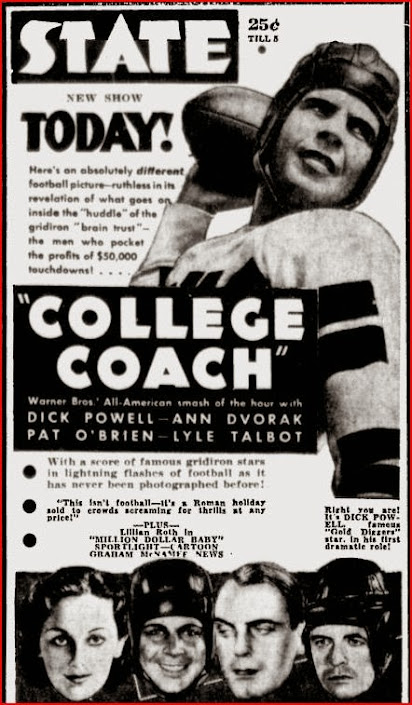
Pre-Code Parade: THE COLLEGE COACH (1933)

Pat O'Brien may be best remembered today for his title role in the 1940 biopic Knute Rockne, All-American, if only because of his proximity to Ronald Reagan in the film that gave the future President his "Gipper" nickname. In that picture, playing the legendary Notre Dame leader, O'Brien was the ideal of a college sports coach. The contrast with Pre-Code O'Brien could not be more stark, for in the title role of William Wellman's athletic satire the actor is for all intents and purposes the anti-Rockne. Sure, there are points of resemblance: like Rockne, who died two years before College Coach was made, Wellman's Coach Gore is a celebrity and a constant winner. But Gore lacks Rockne's loyalty to a single school; he sells his services to the highest bidder. The high bidder is Calvert University, despite a grave budget deficit. The trustees' desperate belief, then as now, is that the revenue from a successful football program will finance worthy academic projects. Gore couldn't give two farts about academics, promptly hiring patently unqualified ringers out of football mills designed to give them the high grades they need to get into college. To give you a visual idea, one of these paragons of amateurism is Nat Pendleton with a moronic Slavic accent; an unhappy subtext of College Coach is that any football player with an ethnic name is academically suspect. The real stars of the team are Buck Weaver (Lyle Talbot), a sleazy showboater, and Philip Sargent Jr. (Dick Powell), the son of the college president (Arthur Byron). Powell is the real star of the picture, in fact, and since he had become a star in 1933 by virtue of his performances in 42nd Street and Gold Diggers of 1933, Phil gets to play the piano and sing a song to himself for no reason relevant to the story. Phil's a good boy and a good student, or at least he wants to be -- we see him hard at work in the chem lab under Donald Meek's tutelage, but Buck doesn't give a damn. The two are incompatible teammates; Buck defies the coach himself if he can see an opening to score on his own, and Gore makes them roommates in the hope that, following a locker-room dustup, Phil will knock Buck down a few pegs. Buck's idea of cultured conversation is to show off a pin-up poster and ask Phil, "How'd ya like to put your finger in her coffee?"

Little does Gore know, at first, that Buck is making moves on his wife (Ann Dvorak). Mrs. Gore feels neglected by Gore's genuine dedication to winning and his sometimes contemptuous rounds of publicity arranged by a largely self-appointed agent (Hugh Herbert), while Buck would probably jump anything with decent curves. When Gore finally gets wise, he throws Buck off the team. Meanwhile, Phil quits in disgust with both the program and himself after he deliberately flunks the chem exam, knowing that practice and publicity gave him not time to study properly, only to find that he had passed (albeit with a D) despite turning in an empty exam booklet. Furthermore, Sargent Sr. is inclined to get rid of Gore after an opposing player is mortally injured during a game. Somehow, after everything, we're still supposed to root for Calvert to win the big game, and to celebrate when both Phil, possessed by school spirit, and Buck, manipulated by Mrs. Gore, rejoin the team. But the genius of the picture is that Calvert wins and Buck becomes the hero despite learning nothing during the picture. As before, he breaks up a play designed as a pass to Phil and runs for the winning touchdown himself. His comeuppance comes when he realizes that Mrs. Gore, having reconciled with hubby, had played him so he'd play. Preparing to declare his love for her to reporters, he sees the truth through a door and credits his success to dear old mother instead. By then, the Gores are ready to move on. The school just beaten has offered the coach $10,000 more than Calvert paid him. He hesitates, thinking of his wife, but she grabs the phone and accepts the offer for him.

College Coach isn't exactly a hard-hitting expose of the corruption of academia by athletics. The picture is more amused than outraged by its subject and its high-spirited cynicism is Pre-Code to a tee. Powell may get the top billing but if anyone steals the picture from him it isn't O'Brien, who in the title role is equally susceptible to theft, but Lyle Talbot in one of his best Pre-Code showcases, in a role he clearly enjoyed playing. Talbot often comes out second-best, at best, in these movies, but here he achieves a kind of seedy charisma, swaggering through the picture with a perpetual five o'clock shadow, unrepentant and nearly imperturbable despite some hard knocks along the way. Modern viewers may be distracted by John Wayne's very brief appearance as a student, near the end of his underwhelming run at Warner Bros., but Talbot should make more of an impression than he ever would until he played Lex Luthor (and quite well, too) in the Atom Man vs. Superman serial. William Wellman was also near the end of his far more memorable run at Warners, and while this isn't one of his more memorable films visually he gets the job done with typical crisp efficiency and gives O'Brien and Talbot their chances to shine. College Coach isn't on the level of The Public Enemy or Wild Boys of the Road, but it may be more relevant today, in some respects, than those or other Wellman masterworks at Warner Bros.  People (and not just movie buffs) would get this film today if they gave it a try.

And here's our usual Warner Bros. trailer, courtesy of TCM.com

Monday, December 16, 2013

Johnnie To's DRUG WAR (2012)

After exploring the realms of high and low finance in Life Without Principle, Hong Kong crime-film specialist Johnnie To returned to familiar territory last year (he has since made another film), but on the relatively unfamiliar territory of mainland China. Once upon a time it would have been hard to imagine a film from the People's Republic acknowledging the existence of drug dealers within its borders, yet here we are. And I found it interesting that To made his hero, Captain Zhang of the narcotics squad (Sun Honglei) the image of an American cowboy in the opening scene. The symbolism is highly and fluidly suggestive; is To saying something about his character, or about China, or about movies?


After going undercover Zhang breaks up a meth-smuggling operation, capturing a bus full of human mules stuffed full of drugs. Also taken in after crashing his car in the middle of town is Timmy Choi (Louis Koo), who proves to be (or claims to be) an important middleman in the drug trade and the boss of the Deaf Brothers -- literally a hearing-impaired gang who communicate through sign language and grunting, presumably the better to avoid surveillance. To avoid China's death penalty, Choi cooperates with Zhang, introducing the cop into his circle of crime. Zhang passes for a moneyman nicknamed Haha for his crazed laughter. After intercepting the real Haha and taking him out of circulation, Zhang, with Choi as chaperon, meets with representatives of mastermind "Uncle Billy." As a show of good faith, "Haha" has to snort two lines of coke; his hosts won't take no for an answer. Zhang mans up and keeps up his somewhat ridiculous act, but the drug men are barely out the door when our hero collapses in an overdosed fit. As the other cops threaten Choi, as if he's to blame for their boss's predicament, he yells out advice to save Zhang's life and prove anew his own good will.


There's something about the cold way Choi initially regards Zhang's distress that makes you wonder about his ultimate motives. Louis Koo's poker-faced performance dominates the picture despite Sun Honglei's broad role-playing, and Choi's facial bandages keep your attention focused on the actor throughout. Whatever Choi's motives have been along the way, when the shit hits the fan in the film's climactic rolling gunfight he means to be the last man standing. To's skill at developing slow-burning suspense pays off with a furious marathon battle that may remind crime fans of the epic street combat in Michael Mann's Heat. Choi comes tantalizingly close to his goal as cops and criminals inexorably eliminate each other, with no little help from Choi himself. It may be a concession to China's more authoritarian values, however, that the movie ultimately takes on a "Crime Does Not Pay" quality emphasizing China's inexorable justice.


At the climactic moment, however, movie buffs may be again reminded of America and American film, as Choi is beaten in a manner straight out of Erich von Stroheim's legendary silent film Greed. I haven't seen enough Johnnie To movies to know whether this sort of thing is typical of him or if Drug War's hints of Hollywood are some reflection on the People's Republic or what the mainland wants in a crime movie. Ultimately there's little reason to look for anything subversive here, since Drug War, if not as sociologically ambitious as Life Without Principle, is a potent pulp cinema directed with suspenseful style. Its main ambition is to entertain and by communist or capitalist standards it largely succeeds.