Tuesday, January 28, 2014

Pre-Code Parade: A SOLDIER'S PLAYTHING (1930)

For the great silent clowns, the coming of sound was a grave challenge. Everyone's careers seemed to depend on whether they could talk properly, but sound also threatened to change the nature of film comedy. Charlie Chaplin had enough power and popularity to keep on making silents for another decade. Laurel and Hardy passed the test with flying colors, their voices only enhancing their comedy. Harold Lloyd switched to sound quickest, only to learn over the course of the 1930s that his persona had grown obsolete. Buster Keaton lacked the creative control to define his own course, and when he spoke his throaty gravel seemed to weigh him down. All of them, at some point, must have perceived sound as a threat. To Harry Langdon, I suspect, it represented a second chance. After ascending to popularity nearly equal to Chaplin's and Lloyd's, and greater than Keaton's, Langdon crashed and burned before Hollywood really cared whether he could talk. By 1929 he was reduced to making two-reelers for Hal Roach on the same lot as the ascendant Laurel and Hardy. But in 1930 he got another chance at features -- two chances, in fact. Universal starred him alongside fellow silent veteran Slim Summerville in the gangster comedy See America Thirst. Warner Bros., the studio that had swallowed Langdon's former employers at First National, cast him alongside Ben Lyon in Michael Curtiz's service comedy A Soldier's Plaything. Technically Langdon was billed second, and for some markets the main attraction was that popular novelist Vina Delmar wrote the story. Today, no one remembers either Delmar or Lyon, but even in 1930 audiences must have felt that Langdon dominated the film, that it was his movie above all. He's such a strange figure that he can't help monopolizing our attention. Whether that makes him funny is another story.

The army was full of misfits, and many of them were unconsciously the means of bolstering up the spirits of the companies. Many of them were pathetic, too, because comedy characters and pathetic characters are often only a hair's breadth apart.
- Harry Langdon, 1930.


Unfortunately for Langdon, A Soldier's Plaything doesn't really address his interesting thesis about the morale-building effects of misfit clown-soldiers. That said, Langdon, as "Tim," certainly is a misfit clown-soldier, and a pathetic one at that. Tim starts out running a Coney Island shooting gallery when the U.S. enters the Great War. Inspired to an enlist by a patriotic speech across the boardwalk, he's detained by a customer determined to shoot every duck in the row, almost before Harry can move them into position. Finally, Tim goes to a local bookie parlor to bid a strangely sentimental farewell to his pal Georgie the gambler (Lyon).  Georgie doesn't buy that patriotism bunk but wishes Tim well just the same. When he gets into a fight over a card game and seems to kill his antagonist by knocking him over a railing -- the drop is several floors and the dummy takes it hard -- Georgie decides that the best way to escape the electric chair is to join Tim in the army and risk getting shot, blown up, bayoneted, etc.

Fortunately, the film isn't really about war -- it really isn't about anything. It boils down to a sequence of episodes, each introduced with a lengthy title card, that keep the film going until the inevitable discovery that Georgie's victim didn't die, making it safe for him (and Tim) to return home after the war. A Soldier's Plaything is mostly a postwar story, as Tim and Georgie take part in the occupation of the German city of Coblenz. Fraternization with frauleins is their primary objective. Their secondary objective is avoiding punishment details which inevitably involve shoveling horseshit. So traumatized is Tim -- shellshocked, even -- by his experience with horses, not excluding the time he literally becomes a horse's ass when he and Georgie put on a two-part costume to escape a compromising situation -- that once he's back home he can't even stand the sight of a merry-go-round. "Oh no no no" he says in his peculiar way as he flees Coney Island at the close.

Langdon opens the picture in his familiar costume but trades it in for a uniform in short order. Tim's still very much the Harry Langdon fans would have recognized, and he's a type not exactly unfamiliar now: an infantilized adult who has the desires of a full-grown man but seems to have none of means to realize those desires. Tim's as determined to get girls as Georgie is and as determined to prove himself a ladies' man. The joke, I guess, is the childish way he goes about it. Unable to speak French or German, he responds to foreign languages with a stream of babble, as if he thinks his interlocutors might just randomly understand some of it. He seems capable of playing music, but the song he chooses to seduce a girl with goes something like this: "If You'll Wee-Wee Me [Oui-Oui, get it?] Then I'll Wee-Wee You." It actually seems like the perfect Harry Langdon theme song; it nails something vaguely or unwittingly unsettling about his persona. It's all quite archaic and yet there's something contemporary about the embarrassment of it all. Langdon has a voice that might remind you slightly of Lou Costello and uses it in a similarly childish way throughout, though not as loudly as Costello would use his. You get a lot of "uh-ohs" and "no-no-nos," but at some moments Tim comes across as nearly a human being, or someone who wants to be a human being before his inadequacies betray him. Tim walks that hair's breadth Langdon mentions in a publicity interview for the picture, and often trips over it. He may not have had creative control over Soldier's Plaything, but it definitely ends up like a Harry Langdon star vehicle.

The comedy's not all verbal, of course. Langdon is a master of small gestures as well as pratfalls, and one of his best bits comes when the movie finally gets around to the service comedy's inevitable drill scene, when Tim almost mockingly illustrates the drill sergeant's comments with hand gestures. As a slapstick director, Michael Curtiz is often ambitious, but his results are hit-and-miss. A scene when Tim disrupts a military amateur show in rehearsal is marred by choppy editing, but a long take in which Tim has to sneak out of a barracks quietly, yet manages to bump into nearly every possible noisemaking object, is admirably done. The main problem with the film is Curtiz's inability to develop any narrative momentum, though post-production editiong may have been a factor against him. It has its moments and proves Langdon's promise as a sound comedian, but personal issues and plain bad luck soon forced him into bankruptcy and back into two-reelers after a year of idleness. When Langdon filed for bankruptcy, he blamed his misfortune on the coming of sound. That's unfair to this film, bad as it is in many ways, since Langdon's misfortunes started before movies talked. A Soldier's Plaything must go down as a failed experiment, but at least the people involved deserve credit for trying.

Sunday, January 26, 2014

LADY SNOWBLOOD (1973)

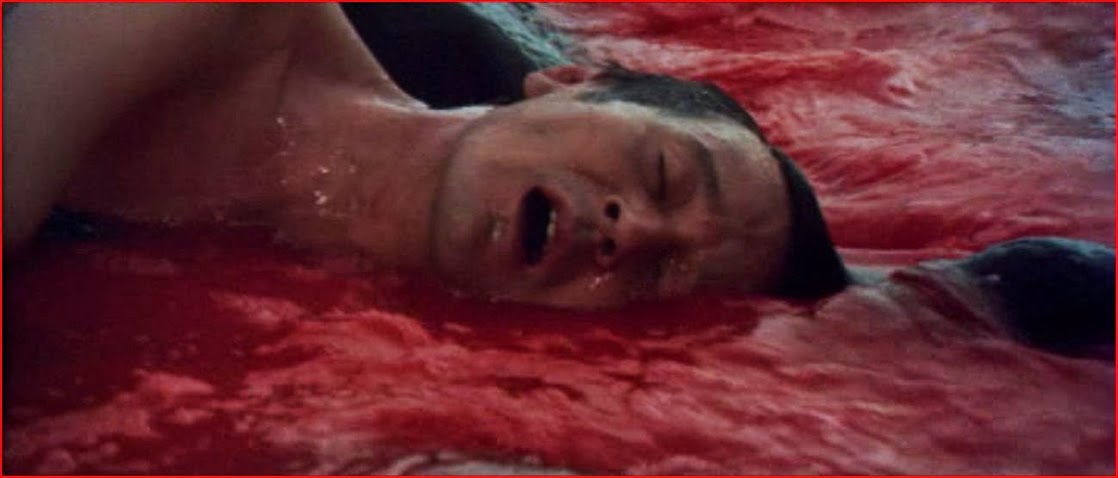
Toshiya Fujita's film is obviously a landmark in the mental landscape of Quentin Tarantino. It's not only a gory revenge story, but it also has the quirky chaptering that would become a Tarantino tic. In the context of Japanese cinema and pop culture, it's part of the legacy of Kazuo Koike, the manga writer best known for his Lone Wolf and Cub (aka Shogun Assassin) series. America's nearest counterpart to Koike probably would be Frank Miller, an admirer who contributed covers to the first series of American translations of the Lone Wolf books. Like Miller, Koike brought a new level of "realistic violence and death" (as it used to be described by comic book sellers) to his medium, though Koike did so as a writer only. Ironically, given the new level of gore his stories inspired in movies, Koike's manga were published in black and white. Others factors certainly influenced filmmakers like Fujita, whose unflagging enthusiasm for arterial spray can make Lady Snowblood sometimes look like a Herschel Gordon Lewis samurai film. Fujita didn't invent the effect; Kurosawa had done it (in black and white) in Sanjuro back in 1962. But Fujita's persistent attentiveness to all the ways blood can flow seems exploitative if not pornographic.


Fortunately, there are levels of style and self-awareness that redeem the picture. Koike contributed to the screenplay, and there may be a note of self-congratulation in the sequence when Meiji-era readers rush to buy copies of Lady Snowblood, the muckraking account of the heroine written by the film's Koike surrogate, a Japanese Ned Buntline who turns the protagonist into a folk heroine, as images from the original manga appear on screen. More characteristic of Koike, perhaps, is the doomy tone, the way the heroine is identified as a creature of the "netherworld," accursed from birth with a burden of vengeance. But that portentousness actually fits well with the increasing stylization of the story, the way a curtain comes down to end Chapter Three after the heroine slices a hanged woman in half, or the way Fujita teases the start of Chapter Four by having the author actually drafting the chapter head with ink on paper before something distracts him. Perhaps these are ways of acknowledging the manga-ness of the material, of establishing that the source is at a further remove from reality than the usual sources of samurai movies. The increasing stylization puts the blood in a different light, suggesting that it's more than spectacle for slack-jawed gorehounds. Not that that would compromise the experience for the gorehounds, but Lady Snowblood was and still can be enjoyed on multiple levels depending on the what the viewer is looking for.


The mighty Meiko Kaki plays Yuki, "Lady Snowblood," first scene assassinating a yakuza boss on an appropriately snowy night. An origin story follows establishing her beef with four scumbags -- three men and a woman -- who ran a racket promising exemptions from military service in return for payments with which they absconded. These no-goods pounce on the new schoolteacher who's arrived in town, identifying him as a wicked government "man in white" and murdering him and his son. They rape his wife, who ends up a prostitute in prison desperately trying to get pregnant so a child can avenge her family against the remaining three malefactors after killing one herself. Yuki is her prison-born spawn, born as her mother dies, raised by a soon-released fellow con and trained in combat by a rather mean priest.


Believing one of the three dead at sea, Yuki goes after the survivors, one a broken-down gambler with a devoted daughter, the female fourth in parts unknown under a new identity. Yuki agrees to have her story published with the idea that pubilcity will draw the woman out rather than forcing her deeper into hiding, and that proves a good guess. More surprising is how that woman ends up hanged before Yuki can finish her. Turns out that the one thought lost at sea wasn't lost at all -- and he's the writer's father. You'd think he wouldn't show his hand and risk Yuki's wrath, but common sense would only stop this film in its tracks, and we really wouldn't want that to happen.


I assume that most people wouldn't. To be frank, I still don't care for the increased gore in Seventies swordplay movies; no matter how we might rationalize it as stylization, it still comes across as crass compared to the more elegant violence of the previous generation. Still, style is substance in Lady Snowblood, and Fujita and cinematographer Masaki Tamura bring enough genuine style to the picture to keep it worth looking at -- although Meiko Kaji pretty much does that just by showing up. She's arguably the greatest action actress cinema has yet produced, and that itself is probably a triumph of style over substance. Whether she's a sword-wielding avenger or Female Convict Scorpion in modern dress, Kaji has a presence that dominates the screen -- as well as a lovely singing voice for the theme songs all Japanese actors, apparently, were obliged to perform in this period. However we describe Lady Snowblood generically or stylistically, it's first and foremost a Meiko Kaji movie, and as such is certainly worth seeing. Maybe we should think of all those ejaculations of blood as the homage due to her.

Saturday, January 25, 2014

Riz Ortolani (1926-2014)

Perhaps you recognize this familiar theme:


Nicolas Windig Refn's Drive reintroduced the music of Riz Ortolani to American audiences. Ortolani, who died this week, was one of that mighty generation of Italian film composers of whom Ennio Morricone is the best known. Ortolani actually made his name in America before Morricone did, earning an Academy Award nomination for Best Song for "More," the theme from Mondo Cane, the breakthrough film of his major collaborators, Gualtiero Jacopetti and Franco Prosperi. This clip from the film provides a sample of its many instrumental variations on the theme.


"Oh My Love," the song from the Drive soundtrack, comes from Jacopetti & Prosperi's most infamous picture, Goodbye Uncle Tom. Those who think themselves hardened by sitting through Twelve Years a Slave may yet flinch at this time-bending exploitation essay on slavery and its consquences. Ortolani's greatest film score is typical of his mondo work, providing a romantic, sentimental counterpoint to horror on screen. Here's "Oh My Love" in its original context.


As with "More," Ortolani came up with variations on the theme that go far from the rapturous idealism of the Katyna Ranieri vocal. A second theme gets quite a workout, starting here:


And climaxing here with new notes of funky menace as the directors imagine modern blacks (circa 1971) reliving Nat Turner's rebellion:


Perhaps the greatest example of Ortolani's characteristic effect is his opening music for Ruggiero Deodato's Cannibal Holocaust. Like Goodbye Uncle Tom, Cannibal Holocaust has a reputation as one of cinema's most horrifying experiences, and like Uncle Tom, it includes some of Ortolani's most beautiful music.


Ortolani wasn't Morricone's equal in quantity or quality, but he was one of the top men of that cohort that made almost every Italian film of a certain era sound incredible. At his very best, he was quite nearly equal to anyone's very best, and his are some of the most memorable moments in movie music.

Wednesday, January 22, 2014

Pre-Code Parade: WHAT! NO BEER? (1933)

This is career death: Buster Keaton's final film for Metro-Goldwyn-Mayer, the studio that destroyed him. The legend is that the studio people thought they understood comedy better than the greatest physical comic of the silent era. The truth was that Keaton's big-budget spectaculars for United Artists, The General and Steamboat Bill Jr. -- had not been especially popular with their original audiences, so Metro may have felt it necessary to steer Keaton in another direction, just as they would do, more successfully to an extent, with the Marx Bros. a few years later. Keaton made two silents for M-G-M that are conceded to retain some of his old spark. But Keaton in talkies proved hopeless. His voice made it easy for Metro to reinvent the Buster persona as an utter moron, though he did at least once revive his naive millionaire character for them. Worse, it was thought necessary that he say funny things, though thanks to the scripts he rarely did. Keaton wasn't reluctant to talk, but his own ideas for sound comedy were thwarted consistently. His inclinations ran from the parodic to the absurd. His idea to save his career was to film an all-star parody of Grand Hotel -- he'd wanted in on Grand Hotel itself but Lionel Barrymore got the part he wanted -- but of course the studio nixed the idea. In frustration with both his career and his marriage, he drank. In What! No Beer? he is often obviously sozzled on screen. That film might drive anyone to drink, whether you had to perform in it or watch it.

Edward Sedgwick directed; he made all but one of Keaton's Metro pictures, and by now was as void of inspiration as his star. Throughout the picture there are moments that have the potential for humor that might have been realized by a healthier Keaton and his old collaborators. There's potential, believe it or not, in the idea that Elmer Butts, a taxidermist, keeps money stuffed in his various specimens. In better days, Keaton might have run with the idea of storing much more in the stuffed animals, or using them as furniture, utensils, etc. But here Sedgwick seems to have no idea of how to frame the action so it works as gags. You see the same sort of failure repeatedly. Buster is handcuffed to Jimmy Durante -- in the story as well as in his career at that point -- and is flung about as Durante gesticulates wildly protesting their innocence to a judge. At his best Keaton would have choreographed this business with care and ensured that his director would have shot it to get the most laughs out of his pratfalls. In the finished product Sedgwick cluelessly shoots Buster crashing about aimlessly, as if his main concern -- and there's probably no "if" to it -- had been to record Durante's malaprops and mugging. Even Durante can't do anything with one of the film's big set pieces; his and Buster's first attempt to brew beer at their new brewery. Durante is working from an old family recipe that's pathetically small in scale given their resources, and the gag is that he, Buster and their three helpers (including stuttering Roscoe Ates) still louse up the job. Sedgwick has a large brewery set to work with, and no idea, probably having no input in its construction, of how to work with it. The sort of workplace comedy that the Three Stooges could do in their sleep seems beyond anyone's ability here. There's lots of spraying people with water, with hose gags that must have seemed old to the Lumiere brothers in 1896, but nothing that rises to the level of a true sight gag. What! No Beer? is one of the most ineptly directed comedies you'll ever see, and as such it exposes mercilessly how badly Keaton had deteriorated in his five years at Metro.

The idea is that Elmer Butts wants to make a million dollars to impress a girl (Phyllis Barry) he met outside an anti-Prohibition rally, not realizing that she's a gangster's moll. In this inspired-by-imminent-events fantasy, Prohibition is doomed by a national referendum, after some clumsy pratfalls in collapsible voting booths, and the Durante character assumes that beer will be legal the very next day. He convinces Elmer that he can make his million by investing his $10,000 nest egg in a brewery, but when they finally brew a batch large enough to sell they're raided by the cops. They're spared jail time only because they've actually failed to brew proper beer, but once Ates gives them a formula for then-legal "near beer" they become pawns in a power struggle between two gangsters for the last days of the bootleg market. In a badly written and performed scene one of the gangsters (Edward Brophy) invades Elmer's office, only to be impressed by Elmer's newly-learned sales talk (Buster conveniently reads his lines from the book) into thinking that "the frozen-faced guy" is a business mastermind. This alliance makes Elmer the enemy of the rival gangster (John Miljan) whose moll is the very girl Buster pines for. She exploits this to get information (and $10,000) from Elmer in the Pre-Code era's lamest seduction sequence, but she later inexplicably falls for him for real. The alleged slapstick highlight of the film is Elmer's thwarting of a hit on him by accidentally unloading his beer barrels from his truck so that they roll downhill and wipe out his assailants. It's a feeble imitation of the boulder gags from Seven Chances with none of the payoffs. The real climax comes when Mijan takes over the brewery and forces Durante & Co to make real beer. Elmer escapes by having himself sealed in a barrel and rolled off the premises. He then gathers a mob by driving through town promising free beer at the brewery. A horde descends on the place, and in the confusion Elmer takes out Miljan with a drop kick to the ankles that is, sad to say, the high point of acrobatics in this Buster Keaton picture. In the end, our heroes open a legal beer garden (misspelled "Butt's") and in a rush for his autograph another mob strips Elmer to his underwear, while Durante promises the audience that beer is coming soon to a town near them. He can't help adding a "hotcha-cha" to that, and I can't help wanting to break a bottle (or a barrel) over his head.

To be fair, Durante seems almost desperately conscious of a need to fill the void created by Keaton's implosion, even if his efforts seem to further suffocate his colleague. He's trying to save the picture, but Jimmy Durante can only do the opposite with his maddeningly repetitive shtick and his dismal malaprops. Some people actually dig that type of humor, and I can only feel sorry for them. Again, had the film had a more competent director and a more engaged star a better balance may have been struck between the co-stars' styles. A scene at Durante's barber shop is another missed opportunity. He raves about the referendum while lathering Elmer's face and while impulsively gesticulating cranks the lever that raises and lowers the barber chair, as all the while a stoic, silent -- almost Keatonesque -- black man struggles to shine Elmer's shoes. You can see the pieces of a promising gag sequence laying about, but Sedgwick is barely capable of putting one block on top of another and the result is more disorganized flailing about. In Sedgwick's defense, there are signs of heavy editing in the 65 minute picture. Shots are cut abruptly, probably in at least some cases to cover some lapse of Keaton's. In one case, near the end of the seduction scene, Sedgwick sets up a pratfall gag, but we never see Keaton take the fall. Had it gotten so bad that Buster couldn't manage such a simple task? Watching this film, you can believe it. It's one of the most demoralizing hours of cinema you could subject yourself to, and though you may know that Keaton would bounce back eventually, if not to full creative flower than at least in the esteem of movie lovers, you may find that hard to believe after seeing What! No Beer? This is a film that lives down to its bad reputation and may even exceed it. For some, my saying this may be a dare to watch the movie, but it lacks the spectacle and pathos of a more ambitious train wreck as well as anything like the incoherent inspiration that makes some bad films highly entertaining. What! No Beer? is so bad that it's terrible; for fans of Keaton it's downright horrifying.

Monday, January 20, 2014

DVR Diary: TUMBLING TUMBLEWEEDS (1935)

 
The last time I reviewed a Bollywood movie I speculated that the nearest American counterpart to the Indian movie format was the singing-cowboy genre that flourished for not quite 20 years, from the mid-1930s through the early 1950s. The two types of movie aren't really the same, but the singing-cowboy westerns remind us of a time when "melodrama" meant a combination of drama and music, when the drama paused for a "specialty" of song and dance. The singing-cowboy film is melodrama par excellence, particularly when it's made by Republic Pictures. Republic specialized in singing cowboys, stunts and special effects. Many of their serials are still revered today by genre fans, but the singing-cowboy films tend to get dismissed as a creative dead end. If we think of them, we think of them as bowdlerized westerns, usually set in a dude-ranch sort of west of the modern day, complete with telephones, automobiles, etc. -- and in which the hero always shoots the bad guy's gun out of his hand. But if we think of them as musicals first, they represent another evolutionary step away from Busby-Berkeleyan spectacle and the musical as a syncopated live-action cartoon, contemporary with the rise of Fred Astaire at RKO, with an emphasis on virtuoso performance rather than mass formations. At Republic, you got the musical innovation -- their films are important in the evolution of country-western music as well -- along with as much mayhem as their legendary stunt men could throw in.

Joseph Kane's Tumbling Tumbleweeds was the first feature-length starring vehicle for Gene Autry, who'd made his starring debut earlier in 1935 in the one-of-a-kind singing-cowboy/sci-fi mashup serial The Phantom Empire for one of Republic's precursors. Autry was already a radio and recording star by the time he hit Hollywood, a fact often acknowledged in the films in which he almost invariably played "Gene Autry." With him came sidekick Smiley Burnette, who in this film is "Smiley" rather than his usual alias, "Frog Millhouse." Burnette was the Curly Howard of singing-cowboy sidekicks, younger and heavier than the bewhiskered codgers who more often attended the heroes. A frequent songwriting partner of Autry, Burnette had a bizarre gimmick, earning his movie-character nickname by taking his voice down to an Popeye-like throaty rasp for humorous effect, in contrast to his more high-pitched yet mellow drawl. Speaking of bewhiskered codgers, journeyman character actor George Hayes had not yet transformed himself into "Gabby" when he took the role of a clean-chinned yet mustachioed snake-oil salesman in Tumbleweeds. His turn here is a reminder that the New York native could act and wasn't merely something Republic found in the desert.

Although we learn during the film that this version of Gene Autry has made a name as a recording artist, we find him traveling with Hayes's medicine show as it visits his old family home. The story Autry may have had a poor agent, or he may have sought the opportunity to return to the land we saw him exiled from in the film's first act. He had refused to take his father's side in the typical range war, but intervenes to save his life at the climax of a furious action sequence in which film buffs may choose to see the hand of supervising editor Joseph H. Lewis. Since Papa Autry was unconscious during the rescue, and no one else witnessed it, he still thinks of Gene as a coward and repudiates his son before the young man can account for himself. Returning, Gene and his band take shelter in a shack still occupied by a wounded fugitive our hero recognizes as a boyhood friend. After helping him evade a posse, Gene learns that his friend is accused of killing Old Man Autry, and that changes things, at least until his friend's wife sets him straight about who really done it....

In later life Autry bought up the rights to his old pictures, and his heirs have had them preserved and restored for regular play on the Encore Western cable channel. So the first surprise about Tumbling Tumbleweeds for those with dim memories of lousy public-domain prints of singing-cowboy pictures on old-time TV, is how good this picture looks. It's a twofold surprise, since apart from the crisp picture Kane's direction is often impressive, not only in the action scenes but in the framing of many more sedate scenes. He has a knack for getting a camera into tight spots and making each scene as lively as possible. A performance of Hayes's medicine show, without Autry, is a highlight, thanks to Burnette and Eugene Jackson as "Eightball," at once a performer in the show and flunky to Hayes. Jackson does a frantic tap dance during a Burnette number, then tops himself (while Kane cuts to a tighter shot) by doing a James Brown bit avant le lettre, tiring of his pace and collapsing until dosed with Hayes's remedy, which brings him back to full power or more. Ernest Miller is the credited cinematographer and Lester Orlebeck the credited editor; both deserve credit for packing this little picture with considerable energy. Autry himself was never much of an actor but he is what he needs to be here. The players bring the enthusiasm of a new project to their first of many, many more pictures, and even if you don't care for the music you can appreciate the impression Tumbleweeds must have made. It's the sort of landmark movie film buffs may have to learn to appreciate, instead of appreciating it outright, since it set a standard few of us comprehend anymore. A reappraisal of singing-cowboy films is probably necessary before we can judge them on their own terms, rather than as compromised westerns or regional musicals. We shouldn't expect to find masterpieces anywhere in such a survey, but the films themselves might find some more respect than they get today.

Saturday, January 18, 2014

On the Big Screen: COOL HAND LUKE (1967)

That's right: the big screen for Paul Newman's iconic performance in Stuart Rosenberg's film of Donn Pearce's novel. The occasion was the grand re-opening weekend for the Madison Theater in Albany NY. Located near the College of St. Rose campus, the Madison is a neighborhood movie house dating back to 1929. It was a single-screen theater as late as the early 1990s before the original space was split into two screens. Four more smaller theaters were added later. Under new management, the two primary screens now serve as Albany's first full-time repertory movie house, while the remainder are converted into a live performance space. The revamped Madison emphasizes classic Hollywood, broadly defined, programming films according to a different theme each week. Prices for films and concessions alike are reasonable ($5 for the movie) and I intend to be as much of a regular there as the films justify. Anyone who really loves movies in the Albany area should support a theater that shows old films the way they were meant to be seen -- bigger than life.

For whatever reason the new management at the Madison opened with a four-film Paul Newman festival, also showing Butch Cassidy and the Sundance Kid, The Sting and Slap Shot this opening week. Perhaps predictably, I chose the oldest film of the four. Cool Hand Luke is celebrated as a celebration of rebellion, but a closer examination reveals greater ambivalence about the hero's rebellion. In his southern prison, Luke is a reluctant Christ figure in a world without God, or at least a Christ figure who doesn't believe in God. Rosenberg acknowledges the absurdity of the concept, posing Newman in his most Christ-like attitude just after Luke has eaten 50 hard-boiled eggs in an hour on a bet. Later, the idolization of Luke by his erstwhile enemy Dragline (George Kennedy in his Oscar-winning role) adds a tragicomic note to the allegory. Luke seems capable of miracles, not just in his capacity for eggs but in his inspiration of the work gang to finish a road job in record time, earning them precious extra hours of leisure. Late, he has a Gethsemane moment in an empty church, asking a God whose existence he doubts whether He has any plan or purpose for Luke, finally interpreting an unpromising omen as a cue to give up his life. Luke himself is as uncomfortable with his eventual role as hero of the work camp as he is with any role life tries to force on him. Rebel he may be, and rebel he may against real oppressors, but Luke's rebellion is no more principled or conscientious than Marlon Brando's in The Wild One. Brando's biker, asked what he rebelled against, answered, "Whaddaya got?" Luke might well answer, as in a moment of fatigue, "I dunno, boss." The movie never tries to explain his rebelliousness apart from noting a broken home -- abandoned by his father, raised by an aunt. He has no theory of rebellion beyond, "just because it's the law don't make it right." For this film's purposes, that's enough.

Luke doesn't rebel for a living. He may well have settled into a stint as idol of the cons had the bosses not insulted and provoked him, sending him to "the Box" on no more pretext than a fear (having seen White Heat?) that his mother's death might drive him to attempt escape. Their own actions provoke the response they feared as Luke makes three breaks for freedom. After the second, his acolytes appear to desert him after he seems to break under physical and mental torture from the bulls, but Dragline's faith is restored when a seemingly tamed Luke seizes a truck and drives off. Dragline needs to believe that Luke had faked being broken, that even as he was clinging to a guard's foot he was planning the third escape. He seems undissuaded when Luke assures him that he was broken and had not planned the truckjacking in advance -- "I never planned anything in my life," Luke insists. Kennedy takes Dragline in an odd direction in these last scenes, turning him from the bully of the early scenes into a Lenny to Luke's George -- a Lenny for whom, in a way, George will sacrifice himself. Yet if Dragline has become as a child in Luke's presence, even as Luke tries to blow him off once and for all, there's a hint at the end that Luke has actually enlightened Dragline in some way. Before Luke, Dragline himself had seemed content to be the king of the cons, but Luke taught him to recognize his chains. That Dragline ends the film shackled actually seems like a sign of progress, proof that he's now travelling Luke's path, for whatever good it will do him. Because Luke himself remains an enigma, Dragline's relationship with him becomes the real story of the film -- which is, I suppose, how Kennedy earned that Oscar.

Stuart Rosenberg wasn't really a great director. He too often calls attention to his and cinematographer Conrad Hall's gimmickry, particularly the mirrorshades of "the man without eyes," and makes some odd pictorial choices like a huge closeup of a singer's mouth during a hymn. But he tells the story smoothly, though Lalo Schifrin's score threatens at times to overwhelm the images, and lets his vast ensemble of character actors do their things. Seeing the picture on a big screen made it more atmospheric, more sensual in a grubby, sweaty sense. It reminds you how a star on the big screen commands not just the screen but the whole theater. Seeing it whole for the first time in a long time also reminded me of how much Cool Hand Luke has influenced the Coen brothers, from their recreation of the mirrorshade man in O Brother Where Art Thou to the echo of Clifton James's orientation speech in The Hudsucker Proxy. It's odd because the Coens have never done anything in spirit like Luke, but it gives you an idea of the impression Rosenberg makes visually, despite what I said above. The film may have a mixed message, but there's definitely no failure to communicate here.

Thursday, January 16, 2014

Redford was Robbed

The Academy Award nominations for the 2013 movie season have been announced and from my perspective the big story is the almost-total exclusion of J. C. Chandor's All is Lost, which ended up nominated only for its sound editing. From what I've seen Chandor's is just about the best American film of the past year, with only Twelve Years a Slave rivaling it. Which is number one and which number two depends on my mood. Most stunning is the exclusion of All is Lost's star Robert Redford from the Best Actor race, but I suppose I should not have been surprised. Redford has won some awards since Lost made its debut at Cannes, but even there he lost to Bruce Dern, who remains in the Oscar race for his work in Alexander Payne's Nebraska. Since Cannes it may have seemed that Dern and Redford would make this year's competition a Lifetime Achievement contest, but Dern isn't necessarily the favorite in a strong field from which another erstwhile front-runner, Tom Hanks in Captain Phillips, has been bumped in favor of latecomers Christian Bale (for American Hustle) and Leonardo DiCaprio (for The Wolf of Wall Street), while Chiwetel Ejiofor (12 Years a Slave) and Matthew McConaughey (Dallas Buyers Club) got the nominations everyone expected. I haven't seen Nebraska yet but I can assume safely that Dern gives a more "showy" performance than Redford by any imaginable standard, simply because Redford's work in All is Lost was masterfully minimalistic, primarily physical rather than verbal. Redford no doubt suffered more in competition because his role required no physical transformation or accent, and he did not play a real person. He had no big speeches to give, unless you count the note we hear him compose at the very start of the film, and the most emoting he did was to yell "F-F-Fuck!!!" when his character ran out of fresh water. It all goes to show that a theatrical standard for acting still prevails that underrates the committed and convincing yet understandably quiet physicality the elderly yet vigorous Redford brought to Chandor's film. It will be said, and has been said already, that Redford and the film as a whole fail to "connect" with audiences, but the real problem is that audiences don't watch certain films with sufficient attention to appreciate the work on the screen. The wisdom of Alfonso Cuaron's choice to have Sandra Bullock's astronaut talk to herself constantly throughout Gravity appears to be reconfirmed, since Bullock won a nomination and is probably the closest rival to Cate Blanchett (Blue Jasmine) for the actual prize. But Chandor's decision (obviously seconded by Redford) to keep "Our Man" almost entirely silent throughout All is Lost is one reason why theirs is a slightly superior film to Cuaron and Bullock's, though few acknowledge the difference.

For what it's worth -- and there's little reason, really, to take the Oscars seriously as a measure of cinematic worth -- I would have left Bale and DiCaprio's good performances off the short list in favor of Redford and Oscar Isaac for Inside Llewyn Davis. I have to withhold judgment on Dern and McConaughey until I see their work, but for now I'm rooting for Chiwetel Ejiofor, though there's no nominee whose victory would disgust me. If anything, I may grow more disgruntled over the nominations after I see Joaquin Phoenix in Her this weekend. He gave the best male performance of the previous year in The Master, but the Academy judges actors by overall attitude rather than individual performances, and too many members simply don't like Phoenix. Of the actual nominees, I suppose Bale is the least worthy. While I enjoyed his work in American Hustle I get the sense that he's riding everyone else's coattails and basking in the obvious love Hollywood apparently has for David O. Russell, in collaboration with whom Bale has already won an Oscar. I suspect that Russell will win one of the big prizes, either Best Director or Best Picture, either of which will infuriate those who see Hustle as a mere entertainment compared to the harrowing history lesson of 12 Years or the innovative spectacle of Gravity. But a comparison of the films rather than the actors is a topic for another time. For now, just remember that Robert Redford was robbed.